1741: Will, Ward’s Negro

(Thanks for today’s guest post to Daniel Horsmanden, the former judge whose account of hunting down a slave conspiracy in New York in 1741 has been so crucial to our running series on the affair. This entry is Horsmanden’s record (in full) for the events of July 4, 1741.)

The Jail being now throng’d with Negroes committed as Confederates in the Conspiracy, many whereof had made Confessions of their Guilt, in Hopes of Pardon in Consequence of the Proclamation, and others who were pardoned and turned Evidence; it was feared, considering the Season of the Year, that such Numbers closely confin’d might be apt to breed an Infection; therefore the Judges thought it was proper to examine the List of them, and to to mark out such as should be thought proper to recommend to his Honour the Lieutenant Governor, to be pardoned, upon Condition of Transportation to be therein limited by a short Time, and to distinguish which of them who had been made Use of as Witnesses, might be necessary to reserve for some Time; and for this Purpose they associated to them Mr. Nicholls and Mr. Lodge, by whose Assistance the following List was accordingly settled, which the Judges reported to his Honour, and submitted to his Consideration.

A List of Negroes recommended this Day by the Judges to his Honour the Lieutenant Governor, for Transportation.

Quamino, Pemberton’s.
Toby, Widow Breasted’s.
Willor Bill, Ten Eyck’s.
Warwick, Hunt’s.
Tom, Soumain’s.
Deptford, Cruger’s.
Will, Lush’s.
York, Peck’s.
Scipio, Van Borsom’s.
Guy, Horsefield’s.
Cato, Benson’s.
Tony, Widow Brazier’s
Scipio, Bound’s.
Caesar, Kortrecht’s.
Jack, Abrahamse’s.
Dundee. Todd’s.
Starling, Lawrence’s.
York, Crooke’s.
Bridgwater, Van Horn’s.
London, French’s.
Mars, Becker’s.
Primus, DeBrosse’s.
Jacob, Rutger’s.
Mink, Groesbeck’s.
Titus, Phaenix’s.
Lewis, Schuyler’s.
Jonneau, Vaarck’s.
Scotland, Marston’s.
Worcester, Varian’s.
Jamaica, Ellison’s.
Patrick, English’s.
Scipio, Abrahamse’s.
Fortune, Clarkson’s.
Caesar, Pintard’s.
Fortune, Wilkins’s.
Tom, Moore’s.
Pompey, Lefferts’s.
London, Marschalk’s.
Wan, Low’s.
Will, Vaarck’s.
Fortune, Latham’s.
Sarah, Burk’s.

This Day Will, Ward’s Negro, was executed according to Sentence, and made the following Confession at the Stake.

  1. He said, That William Kane, a Soldier belonging to the Fort, knew of the Plot; and he heard the said Kane say, he did not care if the Fort was burnt down: That since the Plot was discovered he told Kane he would make a Discovery; on which Kane gave him three Pounds in Bills, and told him, not to discover; Part of which Money his young Mistress found in his Chest.
  2. That his Mistress lost a Silver Spoon, which he, Will, stole and carried to Kane’s Wife, who gave it her Husband in his Presence, and he sold it to Peter Van Dyke, a Silver-Smith, and gave him [Will] eight Shillings of the Money.
  3. That Kane and Kelly asked Quack to burn the Fort, and said if that was done, they (the Soldiers) would have their Liberty; and Kelly said, you must do it with some wet Cotten, and that will make no Smoke.
  4. That he has talked of the Plot with Kane and Kelly often, and has been at Kane’s House, and has heard that other Soldiers were concerned, but does not know them. That he has seen Quack (Walter’s) there, Ryndert’s Tom, Governour’s Jack, Cuyler’s Pedro; and John (Vanzant’s) went round, who received some Money in his Hat, collected at a Meeting at Kelly’s, which Money was to be paid to Hughson.
  5. That Quack, Goelet’s, and Will, Tiebout’s, drew him in; and called on their Names to the last.
  6. That Pedro (De Peyster’s) is innocent for what he knows.
  7. That Moore’s Cato advised him and Pedro, to bring in many Negroes, telling Pedro, that he would be certainly burnt or hanged if he did not confess; but that if he brought in a good many, it would save his Life; for he had found it so himself; and must say, he was to set his Master’s House on fire, which would make the Judges believe him.
  8. That Pintard’s Caesar said much the same; and Comfort’s Jack advised Cato; but that Jack was a true Evidence.

The Pile being kindled, this Wretch set his Back to the Stake, and raising up one of his Legs, laid it upon the Fire, and lifting up his Hands and Eyes, cried aloud, and several Times repeated the Names, Quack Goelet & Will Tiebout, who he had said brought him into this Plot.

This Evening William Kane, Soldier, Quack, Goelet’s, and Will, Tiebout’s, Negroes, were apprehended and committed.

After we had several of the Fires mentioned in the Introduction to this JOURNAL, Quack, Goelet’s, was had up and examined before the Magistrates, for some suspicious Words overheard to be uttered by him, to another Negro, which seemed to import strong Hints as if he had been privy to the Occasion of them; but nothing could be made of it, and was therefore discharged. But this was long before we had the least Intimation of a Conspiracy.

On this day..

1741: Prince, Tony, Cato, Harry and York

On this date in 1741, according to Daniel Horsmanden’s relentless chronicle of his pursuit of the great New York slave conspiracy “Duane’s Prince, Latham’s Tony, Shurmur’s Cato, Kip’s Harry, and Marshalk’s York, negroes, were executed at the gallows, according to sentence; and the body of York was afterwards hung in chains, upon the same gibbet with John Hughson.”

Seventeen days have here elapsed since the most recent executions, but despite the lull in corpses New York’s high court has not rested its guard.

Those seventeen days consume 43 pages of Horsmanden’s journal. Roughly half of that space consists of confessions or “confessions”: it was by now obvious that this was the path to safety, and the colonial governor confirmed same by publishing on June 19th an amnesty “offer[ing] and promis[ing] His Majesty’s most gracious Pardon to any every Person and Persons, whether White People, free Negroes, Slaves, or others, who had been or were concerned in the said Conspiracy, who should on or before the first Day of July then next, voluntarily, freely and fully discover, and Confession make, of his, her or their Confederates, Accomplices, or others concerned in the said Conspiracy”

And so Horsmanden’s document grows heavy with lifesaving auto-denunciations. For late June and the first days of July alone we read

Confession of Mink, Negro of John Groesbeck, Before the Grand Jury.

The Confession of Tom, Ben. Moore’s Negro, Before the Grand Jury.

Confession of Wan, Indian Man of Mr. Lowe, Before the Grand Jury.

Confession of York, Negro of Marschalk’s.

Confession of London, Negro of Marschalk’s.

Confession of Pompey, Negro.(Mr. Peter De Lancey’s.) Before One of the Judges.

Confession of Caesar (Alderman Pintard’s) Negro, Before One of the Judges.

Confession of Cato, Col. MOORE’s Negro, Before One of the Judges.

Confessions of several Negroes, Before one of the Judges.

Confession of Starling, Mr. S. Lawrence’s Negro, Before one of the Judges.

The Confession of Quack, WALTER’s Negro. By an unknown Hand.

Confession of Dundee (TODD’s) Negro. Taken by a Private Hand.

Confession of London, (Mr. French’s) Negro, Taken before his Master by a private Hand.

Confession of Jack, (J. Tiebout’s) Negro, Before Alderman BANCKER.

Confession of London, a Spanish Indian (Wynkoop’s) Before one of the Judges.

Confession of Brash, Mr. PETER JAY’s Negro, Taken before one of the Judges.

Confession of Tom, (SOUMAIN’s) By a private Hand.
Examination & Confession of Jack, Mr. Murray’s Negro, Before one of the Judges.

Examination and Confession of Adam, Negro of JOSEPH MURRAY Esq;. Taken before one of the Judges.

Confession of Harry, KIP’s Negro, under Conviction. Before one of the Judges.

Confession of Cato, Mr. Shurmur’s Negro, under Conviction. Before one of the Judges.

Confessions taken this Day by Mr. Nicholls and Mr. Lodge, of the Fifteen following Negroes.

Confessions of the four following Negroes taken by Mr. George Joseph Moore.

Confession of Emanuel, a Spanish Negro, belonging to Thomas Wendover. Taken by a private Hand.

Confession of Cajoe, alias Africa, (GOMEZ’s) By a private Hand.

Confession of Tom, Mr. R. LIVINGSTON’s Negro: Before one of the Judges.

Confession of Pedro (DE PEYSTER’s Negro.) By John Schultz.

Confession of Jeffery (Capt. Brown’s) and Mars (Benson’s) Negroes: Before the Grand Jury.

Confession of Scotland, Mr. MARSTON’s Negro, Before one of the Judges.

Confession of Braveboy (Mrs. KIERSTEDE’s) Before one of the Judges.

Confession of Windsor (Samuel Myers Cohen’s Negro) Taken by John Schultz.

The Confessions of the seven Negroes following, taken by Mr. Nicholls and Mr. Lodge.

Minutes of Othello’s Examination & Confession, Taken before one of the Judges the 29th & 30th June.

Confession of Sam, Negro of Col. FREDERICK CORTLANDT, Before one of the Judges.

The eight following Negro Confessions were taken this Day by Mr. Nicholls and Mr. Lodge.

As each in turn named his names, the city hall’s cellar gaol grew overcrowded with plotters, some hundred or more in total as June ended. “Between the 19th and this day,” Horsmanden remarked in his June 27th entry, “there were upwards of Thirty Slaves more added to [the dungeon], insomuch that the Jail began to be so thronged, ’twas difficult to find Room for them.”

[W]e were apprehensive, that the Criminals would be daily multiplying on our Hands; nor could we see any Likelihood of a Stop to Impeachments; for it seemed very probable that most of the Negroes in Town were corrupted.

The Season began to grow warm, as usual; and … ’twas feared such Numbers of them closely confined together, might breed an Infection.

The spiraling investigation was not only a risk to public health: slaves were valuable property, too valuable to put to the torch without excellent cause. In New York Burning, Jill Lepore estimates that New York had perhaps 450 or so adult black men at this point, and about 200 of them were at some point implicated in the sedition. Horsmanden wasn’t kidding when he fretted “most of the Negroes in Town.”

Facing a potential bloodbath of truly horrifying expense, New York at this point began to pull back — it’s cold comfort to those still doomed like today’s quintet, but today’s mass hanging puts the affair onto the downslope.

On July 1 the colony’s chief justice, James De Lancey, returned from a mission mediating a Massachusetts-Rhode Island boundary dispute that had kept him away from New York for several months.

During De Lancey’s absence the entire progress of the arson scare and its subsequent investigations had unfolded. It had been spearheaded by a junior justice,* our correspondent Daniel Horsmanden.

Horsmanden compiled his The New York Conspiracy, or the History of the Negro Plot in 1742, and was keen to vindicate himself in an event that had obviously become controversial to his contemporaries — so Horsmanden’s account tends to efface the personal role of Horsmanden himself in preference to the institutional authority of the court as a whole.

Nevertheless, to a very great extent the judicial proceedings that turned New York upside-down in 1741 were Horsmanden’s own baby. He’s the chief investigator and interrogator; the confessions above taken “before one of the judges” were taken before Horsmanden. Others he won indirectly (“JOHN SCHULTZ made Oath, That whereas by the Judge’s Orders he took a Confession in Writing from the Mouth of Pedro …”) or secured for open court as a consequence of his private interrogations. A few times he even refers in the third person to actions of the “City Recorder”, which was a municipal office that Horsmanden himself also held.

Not incidentally, Horsmanden was also a man on the make: an arriviste English gentleman induced to try his fortune in the New World after meeting ruin in the South Sea Bubble. De Lancey, by contrast, was fruit of New York’s wealthiest family and an experienced hand in colonial politics. He’s too smooth to have given us a paper trail, but the space between the lines suggests that De Lancey may have returned to bring Horsmanden’s ship into the shore.

On July 2, the chief justice sat in court for the first time in this affair, ordering “Will, WARD’s Negro” to burn without wasting time on a trial. Indeed, although our series is not yet at its end, the negro plot trials are virtually finished once De Lancey returns; his court thereafter opens its daily proceedings only to adjourn, or to collect the pro forma guilty pleas and submissions to mercy of fresh batches of slaves — few of whom are now suffered to submit new confessions that would inevitably denounce new victims. The De Lancey court’s chief business becomes throttling down, emptying its docket, and arranging its inconvenient and unsanitary legion of basement prisoners for release or penal transportation.

But there were still loose ends to tie off, and the credibility of the court could scarcely admit abrupt reversals of what had already transpired.

Despite the amnesty, York (Marschalk’s),** Harry (Kip’s) and Cato (Shurmur’s) all happened to be convicted on the 19th. Discovering hours too late that the governor had extended his reprieve offer that very day, they immediately tried to clamber into safe harbor by admitting what they had already been condemned for — “THAT what was said against him at the Trial Yesterday, was true” — “That all that the Witnesses testified against him in Court on his Trial was true” — “THAT all the Witnesses who spoke against him at his Trial, spoke the Truth.” But that wasn’t good enough to save them, since their confessions post-conviction were not free and voluntary discoveries.

Tony and Prince, who shared their gallows but with whom this author would better share a foxhole, were proud and steely enough to venture a trial on June 26th in the midst of the amnesty window. It was a potential mass trial save that 12 other co-defendants opted out of simply by submitting confessions. Our two holdouts faced a cavalcade of slave accusations supplemented by the white arch-accuser Mary Burton and “asked the Witnesses no material Questions; upon their Defence, they only denied what had been testified against them.” New York executed these courageous men, of course.

According to Peter Zenger’s Weekly Journal (July 6, 1741), none of those executed on June 3 “acknowledg’d any Guilt; but by their Prevarications their Guilt appear’d too plain than to be deny’d” — a fine barometer of the prevailing climate — and one (unspecified) slave survived his execution and “after he had hang [sic] the common Time, or rather longer, when he was cut down, shew’d Symptoms of Life, on which he was tied up again.”

* Horsmanden was actually 12 years older than De Lancey, but outranked by De Lancey in stature and precedence.

** Another of Marschalk’s slaves named London was convicted along with York, Harry, and Cato — and subsequently confessed under exactly the same circumstances as his three hanged mates. It is unclear from Horsmanden’s record why London was spared but York was not merely hanged but gibbeted; one wonders whether the double financial hit to Mr. Marschalk might not have been the consideration — and if so, whether the master had to make an off-the-record Sophie’s choice between his men. Whatever the case, London was among a large number of slaves recommended on July 4 for transportation which had the effect of ridding New York of their seditious presence while also allowing their owners to recoup their sale value.

On this day..

1916: Trooper Alexander Butler

One hundred years ago today at Bussy-les-Daours on the Somme, Canadian Trooper Alexander Butler was shot for the unprovoked murder of another soldier during World War I.

Butler was a veteran soldier with six-plus years in the 7th Hussars. For obscure reasons possibly tracing to multiple head injuries he had sustained in falls from horse during World War I, Butler on June 8 approached a fellow Hussar named Mickleburgh and suddenly poured five rifle rounds into his chest.

Butler was one of only two Canadian soldiers executed for murder during the Great War. (Twenty-two others were shot for desertion, and one for cowardice.) Those two soldiers were excluded from the 2006 posthumous pardon of Commonwealth servicemen who were “shot at dawn” during the war.

On this day..

1555: John Bradford, in the grace of God

The Protestant martyr John Bradford, burned for his faith on this date in 1555, is the popularly reputed source of the idiom “There but for the grace of God go I” — a sentiment admirably fashioned for reckoning the scaffold.

Those who know their own hearts, will be ready to acknowledge, that the seeds of the worst and most aggravated wickedness which have been practised by other men, lie hid therein, (Matt. xv. 19,) and are only restrained from bursting forth by God’s grace. The pious Martyr Bradford, when he saw a poor criminal led to execution, exclaimed, “there, but for the grace of God, goes John Bradford”. He knew that the same evil principles were in his own heart which had brought the criminal to that shameful end. (Source)

It was certainly apt for Bradford himself, who got religion as a student in the 1540s, left off law studies for theology, and was ordained an Anglican deacon by Bishop Nicholas Ridley just in time for the wheel of fortune to spin back to Catholicism.

Clapped in prison within the first weeks of Queen Mary‘s attempted Catholic restoration, Bradford for a time shared lodgings in the Tower with both Ridley and Thomas Cranmer.

Alas, be he ever so pious, our holy martyr’s temporal legacy — his authorship of the aphorism attributed him — remains impossible to substantiate. The remark is not known to have appeared in print until well over two centuries after Bradford’s cold ashes melted into the Smithfield market, and it was thereafter attributed in the 19th century to a variety of other figures as well as to Bradford. (The rivals on no better authority than Bradford could claim, it must be said.) Sir Arthur Conan Doyle’s Sherlock Holmes, for instance, puts the remark in the mouth of 17th century divine Richard Baxter. (“I never hear of such a case as this that I do not think of Baxter’s words, and say, ‘There, but for the grace of God, goes Sherlock Holmes.'” in “The Boscombe Valley Mystery”)

But the mysterious provenance is only fitting, since that grace expired soon enough for John Bradford — as it does for all other flesh besides.

On this day..

1948: Meir Tobiansky, by summary judgment

On this date in 1948, an alleged spy was extrajudicially executed by the Israeli Defense Forces.

This execution occurred during a short truce punctuating Israel’s War of Independence, but prior to the ceasefire the nascent IDF had become suspicious at Jordan’s gift for accurately targeting critical infrastructure in Jerusalem.

Suspicions came to settle on Meir Tobianski a Lithuania-born former British officer who had become a captain in the Jewish militia Haganah: as an employee of the Jerusalem Electric Corporation, he would have made a great informant for enemy artillerymen.

On June 30, 1948, Tobianski was kidnapped and driven to a depopulated Arab village (present-day Harel, Israel), where four intelligence officers demanded to know if Tobianski had given any information to his British colleagues at the utility (he had), and then declared him condemned as a spy. (Efficiently, they had already prepared the firing squad ahead of time.)

The chief of these four, Isser Be’eri, was later charged with manslaughter for the affair, receiving a symbolic one-day sentence. His subordinates, who were never charged, had long careers in Israeli intelligence; one of them, Binyamin Gibli would go on to help cook up a subsequent espionage debacle, the Lavon Affair.

Tobianski has been officially rehabilitated by Israel. Despite the irregularity of the proceeding against him, he’s sometimes described as the first of only two executions in Israeli history, alongside the much more procedurally defensible hanging of Adolf Eichmann.

On this day..

1726: Joseph Quasson

Hanged on this date in 1726, Joseph Quasson enjoys a minor distinction in the annals of the gallows press: according to friend of the blog Anthony Vaver, Samuel Moody’s account of Quasson’s long* jailhouse sojourn was the first published in the colonies as a standalone conversion narrative, without cover of an attached ministerial sermon.

And here it is:

* Quasson fatally shot a fellow enlistee serving during Father Rale’s War. There was no question about his guilt, but when the murder took place the next sitting of the court was nine months away so the man just got to cool his heels.

On this day..

1680: The wife of Abdullah Celebi, and her Jewish lover

At noon on Friday, 28 June 1680, people crowded into Istanbul’s Hippodrome, the city’s main public space, to stone to death a Muslim woman identified as ‘the wife of Abdullah Celebi’ for adultery with an infidel, and to witness the beheading of the Jew who was alleged to be her lover, a neighbourhood shopkeeper. Neighbours who had raided her home when they knew that the Jew was inside claimed to have found the couple having intercourse, which was doubly illicit: not only was she married, but sexual relations between Christian or Jewish men and Muslim women were forbidden by law. The accused denied any wrongdoing, but a mob dragged the two before the chief justice of the empire’s European provinces (known as Rumelia), Beyazizade Ahmet (d. 1686), who had previously been the main judge at Istanbul’s Islamic law (shariah) court.

Beyazizade accepted the testimony of the witnesses. Denying the accused a trial, he condemned the pair to death. Grand Vizier Kara Mustafa Pasha (d. 1683) reported his decision to Sultan Mehmet IV (r. 1648–87, d. 1693), who confirmed the sentence. The sultan attended the double execution in person and offered the man conversion to Islam, permitting him to die swiftly and with dignity by decapitation. Mehmet IV was the only sultan to order an adulteress to be executed by stoning during 465 years of Ottoman rule in Istanbul.

Indeed, public stoning of adulterers was such a rare event in medieval and early modern Islamic history that it is difficult to find any other examples of Islamic rulers punishing transgressors of sexual norms in this way.

This remarkable double execution comes to us by way of three Muslim chroniclers via “Death in the Hippodrome: Sexual Politics and Legal Culture in the Reign of Mehmet IV” by Marc Baer* — whom we have excerpted above. Regrettably, it’s entombed behind a paywall.

Our Ottoman interlocutors universally hold the stoning and beheading as a gross moral failure on the part of both judge and sultan. To begin with, all three chroniclers consider the accusation against the couple legally groundless: evidently the two were not really caught in flagrante delicto and both denied the liaison; this led Sari Mehmet Pasha** to sharply criticize the judge for even admitting neighbors’ suspicions as evidence — rather than punishing the accusers themselves for slander.

According to shariah it is incumbent to accept such testimony only when this situation is witnessed with one’s own eyes, meaning that the witnesses actually see the man insert his penis in and out of the woman ‘like inserting the reed pen in and out of the kohl pot’. But this is one of those impossible conditions set forth to ensure that such charges and their punishment are not frivolously made. Moreover, what is also needed is the woman’s own confession, or admission of guilt. Yet in this case she insistently denied the charge. The Jew likewise continuously claimed he had no knowledge of the affair.

Indeed, another astonished chronicler, Mehmet Rashid, believed that the law required such exacting pornographic specificity of a witness that no adulterers had ever been executed in the history Islam without their own confession. All describe the eyewitness standard as a shield, not a cudgel.

Moreover, even a demonstrable crime of the flesh — and even one committed by a Jew or Christian with a married Muslim woman — ought not result in capital punishment according to religious scholars of the period marshaled by Baer. (At least, not of the man: theoretically the woman could be stoned to death although in practice this never occurred either.)

What was bizarre and blameworthy to contemporaries was that an esteemed judge issued a verdict of literally historic harshness on such dubious grounds — and that the sultan seemed eager not to restrain, but to enforce it. Their narratives† cast Mehmet in a very dark light. “Let me see [the executions] in person,” he says in Silahdar Findiklili Mehmet Agha’s account — then makes a point to cross the Hellespont that morning from the Asian to the European side of the city the better to establish himself in a mansion commanding a view of the ceremonies.

At that time they brought the woman and the Jew to the place of execution. Being told, “Become a Muslim, you will be redeemed, you will go to Paradise,” the Jew was honored by the glory of Islam and then decapitated at the base of a bronze dragon

Wailing and lamenting, [the woman] cried, “They have slandered me. I am innocent and have committed no sin. For the sake of the princes, do not kill me, release me!” But they did not let her go.

Since the incident is unique even in Mehmet’s own long reign one draws larger conclusions at one’s own risk: hard cases make bad law. But it might be possible to perceive here a misjudgment by a man who, having grown to manhood out of the shadow of the dangerous harem that had lately dominated Ottoman politics felt keen to assert himself as a champion of realm and faith alike. (And his sex into the bargain.)

Baer presents Mehmet as an unusually eager proselytizer, always ready with a conversion blandishment whether for infidels captured in the empire’s European wars or for chance encounters with Jewish and Christian commoners. (He also forced a noted rabbi, Shabbatai Tzevi, to convert after the latter started getting some traction as a possible Messiah, and eventually began pressuring Istanbul’s numerous court Jews — physicians, advisors, and miscellaneous elite intelligentsia — to become Muslims as well.) And a Muslim movement had in recent years clamped down on carnivalesque diversions like taverns and public singing thought to trend toward impiety.

Three years later, Mehmet would (over)extend the Porte’s sway to the gates of Vienna. But Mehmet’s defeat there helped to collapse his own power back home, and he was deposed in 1687.

Our correspondents, writing in the wake of that reversal, unmistakably view affairs like this date’s executions as evidence of moral depravity that was punished by its authors’ subsequent misfortunes. Writing of the once-powerful judge, who chanced to die around the same time Mehmet fell, Defterdar concludes that “Beyazizade fearlessly persevered in the matter without scruple” until “the hearts of young and old turned away from him in disgust” and he fell “from the summit of his dignity.”

* Past and Present, Feb. 2011

** The imperial treasurer, himself executed in 1717.

† It does bear remarking that all three chroniclers wrote after Mehmet IV’s own fall.

On this day..

1844: Joseph Smith, founder of Mormonism, lynched

Joseph Smith, the strange founder of America’s most successful home-grown religion, was lynched on this date in 1844 at the jail in Carthage, Illinois.

Mormonism today boasts some 15 million adherents but it all started in the 1820s when Smith, then an energetic young mystic in the revival hotbed of western New York, claimed to have been guided by an angel to plates engraved in a made-up language that only he could translate and only that one time because the plates disappeared back to angelic custody after Smith’s perusal. It will not be news to this site’s LDS readers that few outside the faith place this origin story on the near side of the laugh test, but then, it is the nature of religions to appear ridiculous to outsiders: Christ crucified is unto the Greeks foolishness.

Smith’s heretical story of America as the ancient zone of a literal “New Jerusalem” founded by Israelites with a theretofore unknown gift for transoceanic navigation was certainly a stumbling-block for Protestant American neighbors, who harried from state to state — a practically Biblical sojourn through the desert — the fast-growing community. It came to pass* that the young man’s implausible scripture struck a resonant chord for the young nation.

“It was a really powerful religion,” says John Dolan in an episode of the War Nerd podcast.** “It said, our people have always been here, America is the promised land, you’re at home here. And that meant so much to 19th century Americans.”

The strange new sect’s capacity for punching above its weight in the missionary game also unleashed violently hostile reactions, marrying to its settler theology a compelling lived experience of persecution. The march of the movement across the continent has an astonishing, can’t-make-this-up character — “full of stir and adventure” in Mark Twain’s words, so again a perfect fit for America.

A few books about Joseph Smith

Smith took his fledgling faith from its New York birthplace to Kirtland, Ohio — where he was fortunate to survive a tarring and feathering in 1832 — and then onward to Missouri where a dirty vigilante war led the governor to issue a notorious “extermination order”: “the Mormons must be treated as enemies, and must be exterminated or driven from the state if necessary for the public peace.” Scrabbling for a homeland and pursued by a Missouri treason charge (!) Smith ducked over the western border to Illinois and set up a Mormon town called Nauvoo.

The faith was barely a decade old and still struggling to find an equilibrium. While Smith fought the last battle by creating a gigantic militia to protect his flock from the sorts of military attacks it had faced in Missouri — which state still sought Smith’s head in the 1840s — he attained his martyrdom as the fallout of prosaic internal politics. Seeking to suppress schismatic Mormons, Smith in June 1844 ordered the destruction of their critical newspaper, the Nauvoo Expositor.†

By now having worn out his welcome with yet another state, the unpopular Smith became the subject of an Illinois arrest warrant as a result of this lawless attack on his rivals. Expecting better treatment than Missouri would have offered him and angling to keep Mormons in an amicable relationship with neighbors, Smith this time chose to turn himself in to face trial for inciting a riot, along with his brother Hyrum Smith and two other Mormon leaders, Willard Richards and John Taylor.‡

But in this case, the law did not take its course.

On the afternoon of June 27, 1844, a mob of 200 armed men stormed the jail in Carthage where the Mormons were held, meeting only token resistance. (Indeed, many of the force assigned to guard the Mormons joined the attackers instead.) They gunned down Hyrum Smith on the spot and drove Joseph Smith — firing back all the while — to a window where a fusillade knocked him out of the second story. His body was shot up and mutilated; one of the numerous accounts of those moments even has it that the corpse was propped up for a summary firing squad “execution.”

Whatever else one could say of Joseph Smith, he forged a community that survived its founder’s death, and is thriving still nearly two centuries on. With Smith’s passing, leadership of the Mormons fell to Brigham Young, who brought the Mormons out of Illinois for their destiny in Utah.

* Smith — or the angel Moroni, if you like — amusingly abuses the portentous clause “it came to pass” in the Book of Mormon, repeating it in about one-fifth of the tome’s verses.

** Also recommended: Dolan’s article on Joseph Smith as an outstanding product of an era of “text-finding” — his spuriously “ancient” book offering pious Americans their greatest desideratum, a national link to God’s Biblical chosen people much like James MacPherson‘s forged Ossian epic thrilled the patriotic fancies of Scots discomfitingly swallowed up into Great Britain.

† The Expositor published only one single issue: the June 7, 1844 edition that caused its immediate suppression and eventually Smith’s death.

‡ Both Richards and Taylor survived the mob attack on Carthage Jail. Taylor in 1880 succeeded Brigham Young as president of the church.

On this day..

925: Feast Day of St. Pelagius

June 26 is the feast date and reputed martyrdom date of the legendary Cordoban Christian martyr Saint Pelagius.*

Truly a martyr for our times of interconfessional strife, Pelagius (English Wikipedia entry | Spanish) is supposed to have been a Christian boy given as a hostage to the Moorish emir Abd-ar-Rahman III, one of the longest-reigning rulers of al-Andalus and a man whom historians now tend to view as a pragmatic and tolerant ruler.

That is certainly not the character in the Pelagius story: that caliph is a tyrannical lout who develops a pederastic infatuation with his young charge (13 years old when martyred) and lusts to conquer him both corporeally and spiritually.

Pelagius spurned all advances and refused inducements to apostatize until the frustrated Moor finally ordered him tortured and dismembered. The year was 925 or so.

He’s the subject of the Latin poem Passio Sancti Pelagii by the German poet Hrotsvitha of Gandersheim (here it is, in Latin). Although she claimed to have obtained the account from an eyewitness to Pelagius’s martyrdom the story’s historicity is very much doubted today. Nevertheless, it has had obvious national-propaganda utility in the land venerating “St. James the Moor-slayer” and has conferred the Spanish version of his name (Pelayo) on a number locations in Spain and the former Spanish empire. Topically for our dark site, Pelagius is also the patron saint of torture victims.

* This saint has no connection to the ancient heresy of Pelagianism or the 4th-5th century British monk for whom it was named.

On this day..

1942: Evzen Rosicky, athlete

On this date in 1942, Czech athlete and resistance figure Evzen Rosicky was shot with his father at Prague’s Kobyliske shooting grounds.

His country’s former champion in the 800 meters and 400 meter hurdles, Rosicky had the honor of representing Czechoslovakia at the 1936 Olympics … Hitler’s Berlin showcase.

Three years later, it was the Czechs unwillingly playing host to the Germans. By then, Rosicky was a journalist of left-wing proclivities (he was a card-carrying Communist) and he naturally segued right into anti-occupation resistance.

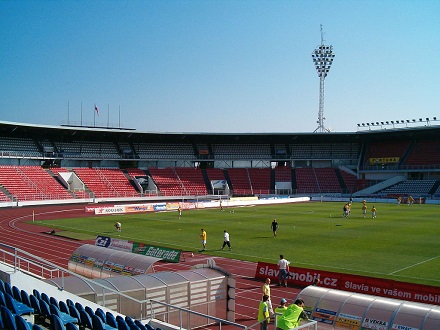
Arrested and shot along with his father, Jaroslav, Evzen Rosicky is the namesake of Prague’s Stadion Evzena Rosickeho.


(cc) image of Stadion Evzena Rosickeho by Honza Záruba.

On this day..