1938: Han Fuqu, Koumintang general

On this date in 1938, Chinese warlord Han Fuqu (or Fuju, or Fu-chu) was executed by the Koumintang for cravenly surrendering Shandong Province to the Japanese without a fight.

Han cut his teeth during China’s Warlord Era, and though he made a timely adherence to Chiang Kai-shek‘s central government that gave him rule over Shandong, he was never exactly in love with the KMT. He ran his fief like a dictator and got rich.

When Japan and China went to war in 1937, it wasn’t a gung-ho nationalist heart throbbing beneath his decorated breast.

Commanded by this still-alien central government to defend Shandong and its capital Jinan at all costs, the former warlord instead bargained secretly with the Japanese for a way to keep his prerogatives.

Why, after all, should he throw away his own position against an overwhelming foe merely for the better advantage of the distant Chiang Kai-shek?

When Han couldn’t pull off a deal and the Japanese set about simply taking his province by force, Han withdrew without firing a shot — forcing other KMT units in Shandong to likewise fall back. To top it off, Han himself then ditched the army he’d taken a-retreatin’.

Chiang, no dummy, could see an example waiting to be made. A couple weeks after arresting Han, Chiang’s trusted aide Hu Zongnan shot him in the back of the head in what is now Wuhan for flouting superior orders.

On this day..

2009: A day in the death penalty around the world

Capiital punishment may be an ancient historical phenomenon, but it’s hardly ancient history.

The executions that several of the 21st century world’s more aggressive death penalty users coincidentally carried out a year ago today testify together to the enduring place (and variegated guises) of the headsman in modernity.

China

Three prisoners were reported killed in Jinan in China on Jan. 15, 2009.

Two were men who had been serving prison terms for separate crimes when they incurred a death sentence for a violent (though seemingly non-lethal) escape attempt.

Liu Junjie, 35, and Wang Bing, 31, broke out of the prison in Zibo City on December 8, 2007 as a truck was moving out of the prison gate, according to a statement from the Shandong Provincial High People’s Court.

They hit a prison worker and two policemen with iron bars and choppers as they forced their way out. They were later caught as they fled along a road.

Former cabbie Bo Lijun shared that fate for a series of thefts, rapes, and murders.

According to the court, Bo raped and suffocated a female barber on Oct. 23, 2002 in Dongying.

Bo attempted to rape a female passenger in a wooded area near Dongying on July 29, 2006. Although he abandoned the rape attempt, he clubbed her to death for fear she would inform the police, and he buried the body at the site.


Saudi Arabia

One Mushabeb Al-Ahmari was beheaded in the province of Asir for “killing a compatriot with a machine gun” (who he killed and why was not reported).

Al-Ahmari was a minor when he was sentenced. The statement said his execution was delayed until he came of age.


United States

62-year-old James Callahan suffered lethal injection in Alabama Jan. 15, 2009, after 26 years on death row for raping and murdering a Jacksonville State University student in 1982. Callahan

requested a last meal of two corn dogs, french fries and a Coke … spent the day visiting with family and spiritual supporters … receive[d] communion at 4:30 p.m.

Callahan’s will bequeaths to his son $36.42 from his prison account, a black and white Radio Shack TV, two watches, a Walkman, some headphones, a leather belt, two pairs of boots, one pair of Nike tennis shoes, food items and legal papers.


Updated: Somalia

(This incident was not brought to our attention until after the post was already up, but in the peripatetic spirit of the entry, we thought it suitable to append.)

Somali politician Abdirahman Ahmed (also known as Waldiire) was shot by an Islamist militia in the port of Kismayo on Jan. 15, 2009.

Perhaps the first pol executed by Islamists, Ahmed was once the spokesman for a faction in the Somali civil war. He was put to death for collaborating with the Ethiopians who invaded Somalia at U.S. behest. As the Ethiopians were Christian, this behavior qualified as “apostasy” to the militants’ sharia court.

In January 2009, Ethiopia was in the process of withdrawing its military presence in its war-torn neighbor.

On this day..

2009: Akmal Shaikh, mentally ill drug mule

This morning, China confirmed (to London’s fury) the dawn execution of British national Akmal Shaikh.

As tweeted @executedtoday, Shaikh has been at the eye of a media firestorm the past week, though without himself being aware of his impending (and publicly announced) execution until family members who had raced to China to plead for mercy met with him within the past day.

“He was obviously very upset on hearing from us of the sentence,” said the clan’s post-meeting (under)statement.

The 53-year-old Shaikh had been homeless in Poland and apparently duped into schlepping some cargo to China as part of a wild goose chase to become a pop star and bring world peace.

In any case like this (and certainly on any blog like this), the mystery parcel invariably contains drugs, doesn’t it? In this instance, our courier was busted at Ürümqi airport with 4 kg of heroin, some 80 times China’s death-sentencing threshold. He swore he knew nothing about it.

If “carry suspicious package for shady central Asian contact to usher in Age of Aquarius” sounds a bit daft … well, mental illness was the basis of Shaikh’s family’s appeal for his life. Shaikh seems to have been severely bipolar and to “may also have … delusional psychosis.”

“Insufficient,” said China; it never gave him a formal psychological evaluation.

So this morning, Akmal Shaikh became the first European executed in China in some 50-plus years … and the lone casualty of a lonely quest to somehow save the world.

Update: China flexes its muscle in the diplomatic row: “We hope that the British side can view this matter rationally and not create new obstacles in bilateral relations.”

On this day..

1911: Ah Q

On this date in 1911, the fictional title character of Lu Xun’s The True Story of Ah Q was shot in “Weichuang village,” China.

Ah Q wins another victory. Image from the Marxist Internet Archive.

A modern masterpiece that remains standard reading in China, The True Story of Ah Q was also one of the first literary pieces in the vernacular. Published in 1921 and set in the events of the Xinhai Revolution ten years prior, the novella/short story acidly satirizes China through the biography of the absurdly hapless Ah Q.

Lu Xun (or Lu Hsun) presents the reader a peasant whose real name is literally unknown — an everyman, and no man at all — and proceeds to characterize this discomfiting allegory: a weakling, a bully, a chauvinist, a fool, whose pluck is all folly born of a bottomless capacity for convincing himself that each new failure and humiliation of his abject life is a victory. (In 1933, the American journalist Edgar Snow asked Lu Xun if there were still manh Ah Qs in China. “It’s worse now,” Lu Xun replied. “Now it’s Ah Qs who are running the country.”)

The second and third chapters detail many such “victories.” Through them, the Chinese tongue gained the phrase “the spirit of Ah Q” to indicate determined self-deception.

This story is well worth reading, which can be done for free here.

Though specific calendar dates are scarcely at all alluded to in the narrative itself, the timing of the “climactic” execution — it is an empty death tragic only in its dearth of tragedy, for a revolution that from the author’s standpoint of hindsight was still struggling with the country’s colonial legacy of weakness and backwardness — can be deduced from the text.

Its action takes place in the confused days immediately following the town’s going over to the revolution, which swept through the Chinese provinces in late October and early November of 1911.*

The robbery that precipitates Ah Q’s execution takes place on a night with “no moon”; according to the year’s lunar chart, there was a new moon on the night of Nov. 20. (The December new moon is much too late to make sense.) In the story, it is “four days later” that Ah Q is arrested at night, then drug out for interrogation the next morning (the 25th); returned to his cell and recalled the morning after (the 26th) to sign a confession;** and after one more night in custody,&dagger hauled to an execution he does not even realize is taking place until the last moment.

Suddenly it occurred to him — “Can I be going to have my head cut off?” Panic seized him and everything turned dark before his eyes, while there was a humming in his ears as if he had fainted. But he did not really faint. Although he felt frightened some of the time, the rest of the time he was quite calm. It seemed to him that in this world probably it was the fate of everybody at some time to have his head cut off.

He still recognized the road and felt rather surprised: why were they not going to the execution ground? He did not know that he was being paraded round the streets as a public example. But if he had known, it would have been the same; he would only have thought that in this world probably it was the fate of everybody at some time to be made a public example of.

Ah Q suddenly became ashamed of his lack of spirit, because he had not sung any lines from an opera. His thoughts revolved like a whirlwind: The Young Widow at Her Husband’s Grave was not heroic enough. The words of “I regret to have killed” in The Battle of Dragon and Tiger were too poor. I’ll thrash you with a steel mace was still the best. But when he wanted to raise his hands, he remembered that they were bound together; so he did not sing I’ll thrash you either.

“In twenty years I shall be another …”‡ In his agitation Ah Q uttered half a saying which he had picked up himself but never used before. The crowd’s roar “Good!!!” sounded like the growl of a wolf.

At that instant his thoughts revolved again like a whirlwind. Four years before, at the foot of the mountain, he had met a hungry wolf which had followed him at a set distance, wanting to eat him. He had nearly died of fright, but luckily he happened to have an axe in his hand, which gave him the courage to get back to Weichuang. He had never forgotten that wolf’s eyes, fierce yet cowardly, gleaming like two will-o’-the-wisps, as if boring into him from a distance. Now he saw eyes more terrible even than the wolf’s: dull yet penetrating eyes that, having devoured his words, still seemed eager to devour something beyond his flesh and blood. And these eyes kept following him at a set distance.

These eyes seemed to have merged into one, biting into his soul.

“Help, help!”

But Ah Q never uttered these words. All had turned black before his eyes, there was a buzzing in his ears, and he felt as if his whole body were being scattered like so much light dust.

As for any discussion of the event, no question was raised in Weichuang. Naturally all agreed that Ah Q had been a bad man, the proof being that he had been shot; for if he had not been bad, how could he have been shot? But the consensus of opinion in town was unfavourable. Most people were dissatisfied, because a shooting was not such a fine spectacle as a decapitation; and what a ridiculous culprit he had been too, to pass through so many streets without singing a single line from an opera. They had followed him for nothing.

* According to this footnote, it can be more specifically dated to the fall of Shaoxing, which would have been early November.

** Ah Q has no idea he is signing a confession; an illiterate, he makes his mark with a circle — fixated only on making it a perfect circle, at which endeavor he naturally fails “victoriously.”

† During Ah Q’s last night on earth, the scene cuts to two local officials arguing about the prisoner’s fate, where the man’s life is forfeit in some other mean contest of the municipal pecking order — “Punish one to awe one hundred! See now, I have been a member of the revolutionary party for less than twenty days, but there have been a dozen cases of robbery, none of them solved yet; and think how badly that reflects on me. Now this one has been solved, you come and argue like a pedant. It won’t do!”

‡ According to this footnote, “‘In twenty years I shall be another stout young fellow’ was a phrase often used by criminals before execution, to show their scorn of death.”

On this day..

1864: Hong Tianguifu, in the Taiping Rebellion

On this date in 1864, the sins of the father were visited upon the son when the Qing Dynasty dealt a coup de grace in what is perhaps history’s bloodiest civil war, executing the luckless teenager to whom leadership of the Taiping Rebellion had fallen.

Strangely little-known, the Taiping Rebellion shook the weakened Chinese state through the middle of the 19th century, nearly to its very foundations.

From 1851 until the 1864 death of its queer leader figure, prophetic Christian convert Hong Xiuquan, it maintained its own state in southern China, the Taiping Heavenly Kingdom.

China’s defeat in the First Opium War in the 1840’s set the stage for Hong Xiuquan’s movement, and not only geopolitically: western powers had pried open the Orient to proselytizers as well as poppies, and though Christianity would find a rough go of it in China, it did win over Hong.

Fired by his supposed divine vision, Hong’s Heavenly Kingdom conquered the Yangtze Valley and much of the south, with an outlook radically progressive as against the hidebound Qing: egalitarian land distribution and gender equity (the Kingdom’s administrative acumen is less generously accounted). Naturally, the “real” Christian missionaries abhorred it, which sincere theology happily comported with the policy of their national statesmen who abhorred the Taiping’s encumbrance upon the opium trade.

This illustrated podcast does creditable coverage of the Qing’s twilight century; from about 14:17, it covers Hong Xiuquan and the Taiping Rebellion specifically.

The rebellion waxed while the Qing lost a second Opium War to the west, but a Taiping bid to capture Shanghai fell short in 1860. By this time, westerners had the Qing by the short-and-curlies and were not eager to see the client dynasty they had so painstakingly browbeaten supplanted by a bunch of millenarian Levellers without the common courtesy to promulgate smack; accordingly, China’s recent Opium War antagonists now helped China field the forces necessary to suppress the rebellion.

Charles George Gordon, a British evangelical Christian himself destined for eventual beheading, even led the pacification force swaggeringly branded the “Ever Victorious Army“.

We’ve reached the end here and only just met our day’s principal, the son and heir who at 15 was handed the helm of the collapsing state by his visionary father. (Hong Xiuquan conveniently proceeded to kick the bucket just before the Qing finished off the rebellion.)

Officially the second (and obviously the last) ruler of the Heavenly Kingdom, Hong Tianguifu had no juice with his military or administration, and no time to enjoy the more prosaic perquisites of regal authority, but was available as the object of official vengeance. (Thanks, dad.)


Less exalted Taiping Rebellion prisoners, from here (click through the pages for a detailed history of the rebellion).

The Taiping Rebellion features in the 2007 Chinese flick Tau ming chong (The Warlods), which represents a Qing-Taiping battle in the fine cinematic bloodbath below. Some 20 to 30 million people are thought to have perished in this civil war, which was also one of the last significant conflicts fought primarily with blades rather than bullets.

On this day..

1898: The Six Gentlemen of the Hundred Days’ Reform

This afternoon in 1898, six liberals got the chop for their hopeless attempt to give a tottering empire the reforms it desperately needed.

The Hundred Days’ Reform — actually 103 days, from June 11 to September 21 — marked the attempt by China’s Guangxu Emperor to implement a far-reaching modernization programme backed by forward-thinking officials with a mind to correct China’s supine position vis-a-vis the West, and even vis-a-vis its neighbors.

“Reform has never come about in any country without the flow of blood. No one in China in modern times has sacrificed himself for the cause of reform, and because of this China is still a poor and backward country. Therefore, I request that the sacrifices begin with myself.” –Tan Sitong

The Wuxu Constitutional Reform still stands as the great attempt made by Chinese progressives who tried to follow the example of the modern powers in order to save China from extinction. Represented by Kang Youwei and Liang Qichao, the bourgeois reformists were imbued with the spirit of national salvation; they carefully set about designing a blueprint for a constitutional monarchy based on the example of Western countries. They advocated the establishment of parliament and a national conference, and wanted to see honest and fair-minded people with the courage to criticize authority installed in a position of power. National policies should be discussed by the monarch and the people. They also wanted a constitution to stipulate the rights and obligations of the monarch, officials, and the people. The constitution was to be the highest code for all people in the country. They also wanted to establish a system featuring a tripartite balance of forces: parliament was to legislate, the magistracy to deal with issues of justice, the government with administration. All of these would be under the monarch.

The constitutional reform was to take place with radical intellectuals submitting their memoranda to Emperor Guang Xu, who alone had the power to promulgate them. The feudal diehards being in a position of strength and the national bourgeoisie being weak, however, the new politics survived no more than 100 days or so. When the forces of reaction inevitably clamped down on the movement, the six reformists who had inspired the movement for constitutional reform met their deaths like heroes.

Although sincere in its aspirations, the reform movement was bound to fail, as it depended on a reform “from top to bottom”, which ultimately had to be enacted by the emperor. The Hundred Days’ Constitutional Reform, however, remains a landmark event in the modern history of China, its failure notwithstanding. The Chinese bourgeoisie in fact succeeded in spreading democratic and constitutionalist ideas widely, and this had a significant effect on future generations. The political and legal theory of the Western bourgeoisie could now take root in the soil of China.*

The emperor’s Machiavellian conservative aunt, the Empress Dowager Cixi, who had been the power behind the Chinese throne since 1861, made the sure reform didn’t see two hundred days with a “coup” that didn’t formally overthrow the Emperor — just made him irrelevant.

Troublemakers further down the food chain didn’t get off so easily.

Kang Youwei, the reform movement’s chief exponent, escaped to Japan. Six others suffered the wrath of the Dowager Empress: Kang Guangren (Kang Youwei’s brother), Lin Xu, Yang Shenxiu, Yang Rui and Liu Guangdi … along with the young reformer Tan Sitong, who notably refused imprecations to flee arrest.

The sword’s blade across my neck,
I look toward heaven — laughing.
-Etched on a prison wall, allegedly by Tan Sitong


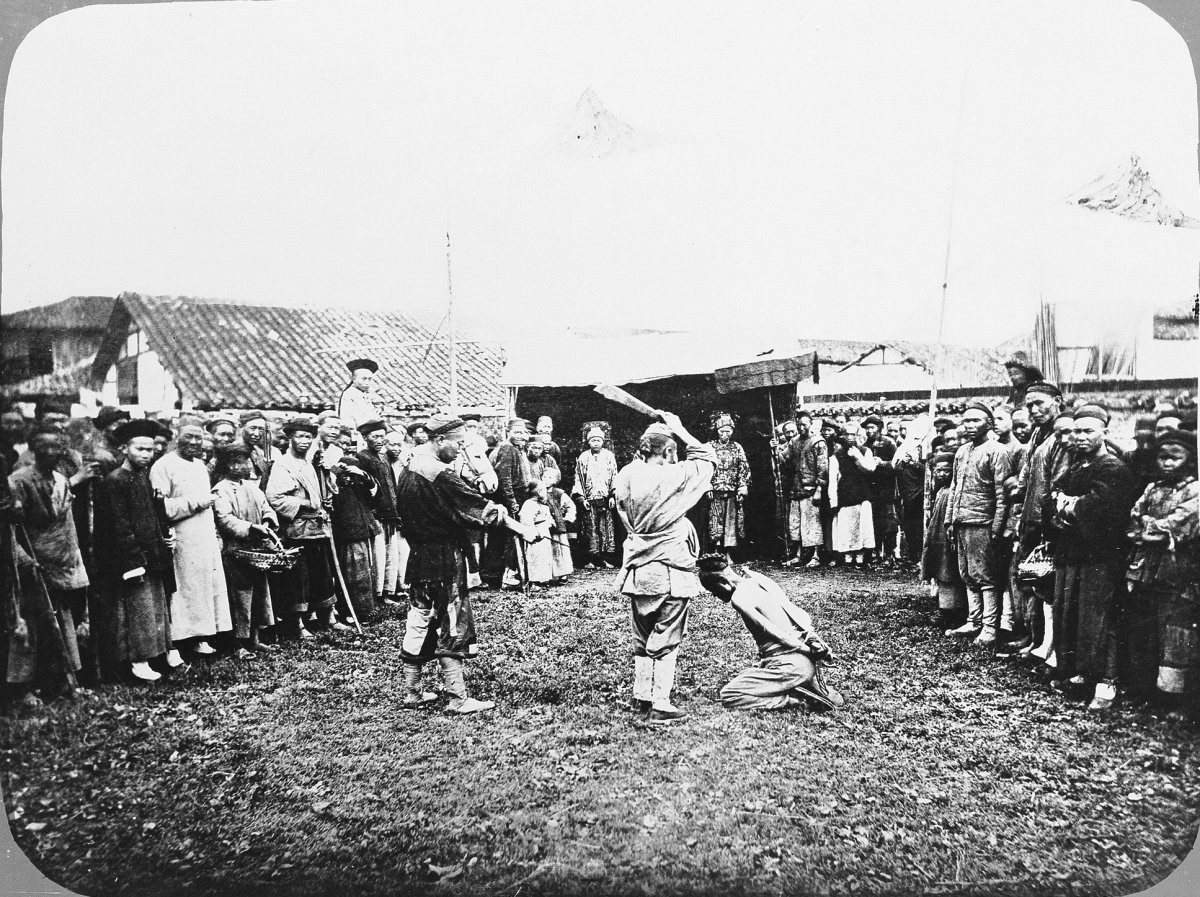
Photo of an unspecified 1867 Qing beheading in Canton.

* “The Chinese Legal Tradition and the European View of the Rule of Law” by Wu Shu-Chen in The Rule of Law History, Theory and Criticism, Part VI.

On this day..

2007: Duan Yihe, mistress-murderer

On this date in 2007, former senior Chinese lawmaker Duan Yihe was executed in Jinan along with the policeman nephew who had helped him spectacularly assassinate Duan’s mistress just two months before.

Taking up with a teenager 30 years his junior must have been an appealing perk of the job when Duan Yihe was a rising official in the early 1990’s.
Fast forward 14 years, and he’s in for several cars, a couple of apartments, and tired of the now 31-year-old Liu Haiping, who’s blackmailing him for more. Much less appealing.

Solution?

Why, detonate a remote-controlled explosive in her car.

“The blast was so powerful that her Honda sedan was ripped apart, her lower body was destroyed and her torso landed 30 metres away,” reported The Times.

The case helped crystallize growing official concern with the corrupting potential of senior officials’ ubiquitous mistresses. The day before the car-bombing, the Chinese Supreme Court issued a ruling extending anti-graft laws to mistresses.

The method of execution (either gunshot or — more likely — lethal injection) was not publicized.

On this day..

1946: Grigory Semenov, anti-Bolshevik

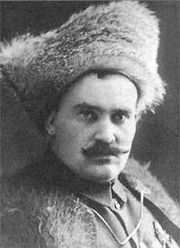
At 11 p.m. this date in 1946, White general turned Japanese collaborator Grigory Semenov (or Semyonov) was hanged for a generation’s worth of anti-Soviet depredations in the Far East.

The tsarist officer Semenov joined the Russian Civil War as a notoriously vicious White commander with the grandiosely retro title of Ataman of the Baikal Cossacks.

According to G. Patrick March, Semenov’s “penchant for killing, torturing, and looting” extended to executing a captured socialist by tossing the man into his locomotive’s fuel chamber.

Although also a rival in the suicidally fractious White political jostle, Semenov was the designated successor of Aleksandr Kolchak when the latter was shot in 1920, but by that time there wasn’t much left to succeed.

Knocking around the interwar era in gloryless exile, Semenov was an easy recruit for the Japanese war machine, which was in the market by the late 1930’s for locals with command experience and a grudge against Moscow and put him on retainer in Manchuria. Like the Soviet-Japanese front in general after Khalkin Gol, nothing much came of that enterprise; the Ataman’s last great hurrah was but a footnote for Japan, and his death would be a footnote in the annals of postwar victors’ justice.

Having picked a loser two wars in a row, Semenov was captured during the short-lived Soviet invasion of Manchuria at the tail end of the war and packed off for the inevitable. Five co-defendants, including Semenov’s son Mikhail, suffered death as well — although they were simply shot, while Semenov was ignominiously hanged. (According to White Terror: Cossack Warlords of the Trans-Siberian, the hanging was either botched or engineered to be an ugly strangulation job.)

On this day..

1857: Adolf Schlagintweit, intrepid explorer

Sometimes it’s better to let your curiosity rest for a little while, especially when a violent despot takes charge of the region you want to do geological studies on. That was the takeaway lesson for Adolf Schlagintweit (English Wikipedia page | German) when Wali Khan discharged the German explorer’s head in 1857 in the Kashgar region of present-day China.

Schlagintweit and his brothers, Hermann and Robert, were in pursuit of knowledge, following up Hermann and Adolf’s drab and long-titled work Untersuchungen über die physikalische Geographie der Alpen, in ihren Beziehungen zu den phänomenon der Gletscher, zur Geologie, Meteorologie, und Pflanzengeographie (Studies of the Physical Geography of the Alps, in Relation to the Phenomena of Glaciers, Weather, and Phytogeography) and equally odorless (but far more accessibly titled) successor Neue Untersuchungen über die physikalische Geographie und Geologie der Alpen (New Studies of the Physical Geography and Geology of the Alps), authored by all three.

The Schlagintweits were successfully largely because of their ability to draw: their writing left much to be desired, and their scientific skills were frequently a target of ridicule after the voyage that saw the end of Adolf.

The East India Company funded that venture, which was intended to take magnetic field measurements, beginning in 1854. The trek was spurred on by the then-85-year-old Alexander von Humboldt, who had extensively traversed Latin America and attempted the first scientific description of its geology and wildlife; von Humboldt, a noted scientist throughout Europe, convinced the East India Company to pony up large amounts of money for what he expected to be a significant geological study, one that he long sought but could not undertake himself. This relationship is explored in-depth by Gabriel Finkelstein in his well-written History of Science article “‘Conquerors of the Künlün? The Schlagintweit Mission to High Asia, 1854–57”.

The brothers made their way to central India and from there journeyed north into the Himalayas. They did not travel together, but separated and re-united occasionally to go over samples, pictures, and notes.

After their last meeting in the fall of 1856, Adolf’s itinerary brought him through the mountains of Tibet and into present-day China, near the borders with Kyrgystan and Pakistan. It was in this Kashgar region that the geologist found himself embroiled in what would be the last in a series of revolts by the East Turkestan Khojas, a group claiming nobility in Eastern Kazakhstan from the time of Genghis Khan.*

Adolf’s end is largely shrouded in mystery, but some contemporaneous accounts given to the British government provide a minimal sketch. Schlagintweit’s ostensible goal was to reach the city of Kashgar; despite much of his party deserting, and in spite of a warning from fleeing refugees that the notably cruel Wali Khan had initiated a rebellion, Schlagintweit pressed on.

He was met at the city’s border and brought before the Khan, who, having little use for European interlopers wandering his territory, accused the scientist of being a spy and had Adolf summarily beheaded.

Adolf’s notebook was later purchased by a passing Persian from the tobacco shop, where its pages were being used to wrap tobacco leaves. The purchaser tracked down a skull he believed to be Schlagintweit’s and brought the chartaceous and skeletal evidence to India.

The book published from the travels of the Schlagintweits is available here. It has been widely panned as dull.

* Four years after Wali Khan was deposed once again by the Chinese, Uighurs successfully battled for the region’s brief independence. Tensions in the region, needless to say, have not settled.

On this day..

2008: Tseng Fu-wen, drug dealer

June 26 is U.N. Anti-Drug Day, and if this year follows the recent trend, China will be marking the run-up with the salutary execution of consumers and/or vendors of chemical compounds disapproved by the state. (Update: Yes indeed it did.)

On June 24, 2008, for instance, Tseng Fu-wen, “a Taiwanese citizen who was convicted of producing or selling methamphetamine, heroin and other drugs,” was put to death in the eastern province of Fujian.

Two accomplices drew a prison sentence and a suspended death sentence (typically commuted to a prison sentence after two years).

Prosecutors said the Taiwanese trio started making drugs in October 2006.

Police arrested them one month later in Xiamen after they bought 50 kilograms of ephedrine to make methamphetamine, commonly known as “ice.”

The police also recovered 63.8 kilograms of ice, plus “varying quantities of other drugs such as heroin, and equipment and raw material in a workshop,” the agency said.

The method of execution does not appear to have been reported by the state media; China uses both lethal injection and gunshot, but I have not been able to document which method prevails in Fujian.

On this day..