1820: William Holmes, Edward Rosewaine, and Thomas Warrington, pirates

On this date in 1820, William Holmes, Edward Rosewain, and Thomas Warrington aka Warren Fawcett all hanged in Boston as pirates.

A Scotsman, an Englishman, and a Connecticut Yankee (respectively), the three numbered crewed a privateer bearing the flag of newly independent Argentina. Having captured a merchantman heavy with valuable cargo, they’d been put aboard it with a few others, to sail the prize home.

On July 4, 1818, following a drunken quarrel between one of their number and the mate of this skeleton crew, they stole below and agreed upon a mutiny whereupon that very evening they crept upon the sleeping mate and “Holmes and Warrington seized him by the heels and pitched him over the rail of the vessel.” Roused by the mate’s shrieking, the captain raced up to the deck where he too was overpowered and forced over the edge where he clung for dear life to a rope, until the trio cut it. (According to the testimony of one of the surviving crew, Salem Gazette, July 12, 1819)

The hijackers then trimmed sail for Baltimore which even those pre-Wire days was renowned as a haven for freebooters. Unfortunately they weren’t the best mariners, and overshot the Chesapeake all the way to Scituate, Massachusetts, where they clumsily ditched their ride and were rounded up in due course. A U.S. Circuit Court condemned them for “piratical and felonious homicide upon the high seas,” and the Supreme Court upheld the judgment. (A pdf of proceedings is here)

Heinousness aside, we are by this point in history well abroad in the period of fretful chin-wagging over the deleterious spectacle of public execution, and as church bells tolled the condemned out of jail on the morning of June 15 in 1820 right-thinking observers again wondered whether the whole scene wasn’t counterproductive to its purported objectives.

The Christian Watchman of June 17, 1820 — having observed with “regret” that “no satisfactory evidence of the genuine repentance of the sufferers has come to our knowledge” — approvingly reprinted another paper’s editorializing against the public execution:

The frequent recurrence of these scenes compels us to ask, whether the manner in which, in obedience to custom, they are now conducted, be such as promotes the great ends of this dreadful judicial infliction.

It scarcely need be said, that every thing which has a tendency to mislead the public feeling on these occasions, — to turn the reflections of the beholders from the enormity of the crime to the severity of the punishment — defeats the great objects, which the law has in view.

It is not from any want of humanity and tenderness toward the unhappy persons themselves, that we make this remark; but because we think the scene of a public execution, as it takes place among us, runs too far into a dramatic spectacle, and has the effect, first of exciting and occupying the curiosity, and then of making an untimely pity for those, whose dark and murderous passions have brought down upon them the righteous inflictions of the law.

The unreflecting spectator, who sees the Reverend priest in the party-coloured vestments of his church, pouring into the ears of the convicts those precious promises of Christianity, which it is scarce the right of the most tried faith and patience to claim, who sees them standing on the fatal scaffold in the arms of a Confessor, and receiving with the fatal doom of bloody crime in this world, the promises of eternal blessedness in the other; we say that the unreflecting spectator, who beholds this, if he do not conclude that the whole is a solemn mockery — will either be thrown wholly into confusion to his notion of judicial infliction, or he will be inclined to pity and sympathise with the sufferers. And either of these effects will defeat the order of justice.

The ceremony of execution should, in our opinion, be as short and simple as possible. The Warrant of Execution, in an abridged form, should be read; a short and solemn prayer, without purple surplices or embracings, or kissings, be made, and the last horrid moment hastened, as far as public decency admits.

On this day..

Feast Day of Rufinus and Valerius

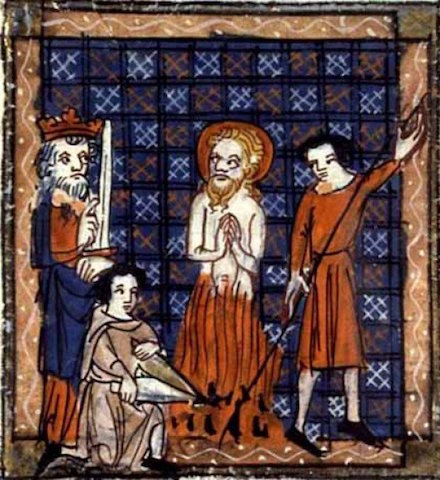
Rufinus and Valerius, Roman tax collectors who converted to Christianity and were martyred at Soissons during the Diocletian persecution in 287, are honored by the Roman martyrology on this date.

They’re saints of a lesser firmament, although Rufinus has a spot of archaeological distinction as the intercessor honored on the Darenth Bowl, a beautiful fifth-century glass artifact that somehow survived to us intact. (Note, however, that there are 11 saints Rufinus.)

They figure indirectly in one of the martyrology’s recurrent themes, the Saul-like conversion of Roman persecutors to the Christian faith: Rufinus and Valerius were held to have been martyred by the Roman prefect Rictius Varus,* who presents as a recurrent tormenter of Christians and in the martyrology arrives to dispatch our taxmen straightaway after doing the same to future Shakespeare monologue superstars Crispin and Crispinian.

In fact, Rictius Varus figures in no fewer than nine late third century martyrologies, compassing 20+ champions of the faith … the last of whom was the great Saint Lucy who is said to have induced Varus to embrace the same persecution and suffer martyrdom right along with her.

* Sometimes rendered Rictiovarus or Rixiovarus. He is no relation to the Varus from the Battle of Teutoburg Forest: that (in)famous man‘s cognomen was not Varus, but Quinctilius.

On this day..

Feast Day of St. Cetteus

June 13 is the feast of St. Cetteus, patron of the Adriatic port city of Pescara.

This saint’s legends smudges the line between just-so story and real historical events, illustrating the Church martyrology’s great strength as a ready-made memorial of Christians’ trials down the years. In this case the suffering was less a religious persecution per se than the shame of being trod over by conquerors who installed themselves almost without opposition in the hollowed husk of Roman greatness and did as they pleased.

The Lombard incursion beginning in 568 in some ways signals the permanent sundering of east from west in the Roman world, for the Germanic invaders — a mixture of pagans and Arian heretics, no less — in time ousted Byzantium from the latter’s Italian holdings and meanwhile underscored the Roman Empire’s near-impotence in its ancestral homelands. “From Italy the emperors were incessantly tormented by tales of misery and demands of succor, which extorted the humiliating confession of their own weakness,” writes Gibbon. “The expiring dignity of Rome was only marked by the freedom and energy of her complaints: ‘If you are incapable,’ she said, ‘of delivering us from the sword of the Lombards, save us at least from the calamity of famine.'”

For the near term, it was a violent and unstable period; Lombard rulers assassinated and warred with one another as their hegemony devolved into a patchwork of feuding duchies, helping set the scene for the fractured medieval peninsula.

The perils of internal strife manifest in our martyr’s story; despite his eventual association with Pescara, his bishopric was inland at Amiternum and it was there, the story goes, that he was ordered drowned in 597 by a tyrannous Lombard warlord who mistakenly thought him a crony of his rival.

Tossed into the drink, the bish floated downstream to Pescara where a fisherman, recognizing the corpse’s ecclesiastical raiments without knowing exactly who wore them, buried him under the whimsical name “Peregrino”.

On this day..

Feast Day of Saint Eskil

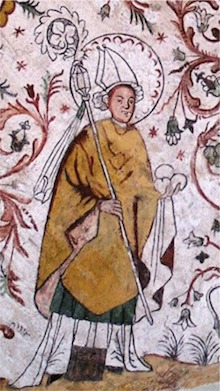
June 12 is the feast date* of Saint Eskil, a martyr to the slow Christianization of Scandinavia.

Ol’ “God-kettle” was one of several missionaries known to have been dispatched in the 11th and 12th century from England to Sweden, a traffic in religious conversion across the North Sea crossroads to invert the centuries-past course of Vikingers who put so many British sanctuaries to the sack.

The Northmen realms were ripe to join Christendom but sagas touching the time describe an uneven transitional period where the new and old faiths jostled for primacy.

“Ingi was king for a long time, well-liked and a good Christian; he put down [pagan] sacrificing in Sweden and ordered all the people of the land to become Christian,” runs The Saga of King Heidrek the Wise** (available in pdf translation here), about King Inge the Elder.

But the Swedes had too strong a belief in the heathen gods and held to their ancient ways … the Swedes thought that King Ingi had infringed their rights under the ancient law of the land, when he found fault with many things that Steinkel his [Christian] father had let be; and at a certain assembly which the Swedes held with King Ingi they gave him the choice of two things, either to observe the ancient laws or else to give up his throne. Then King Ingi spoke, and said that he would not leave the true faith; whereat the Swedes cried out, and pelted him with stones, and drove him from the law-assembly.

Svein, the king’s kinsman, remained behind at that assembly, and he offered to make sacrifice for the Swedes if they would grant him the kingdom; all agreed to Svein’s offer, and he was accepted as king over all the Swedish realm. Then a horse was led forth to the assembly, hewn in pieces, and divided up for eating, and the sacrificial tree was reddened with its blood. Thereafter all the Swedes cast off the Christian faith, and sacrifices were instituted, and they drove King Ingi away; he departed into western Gautland. For three years Svein the Sacrificer was king over the Swedes.

King Ingi went with his own bodyguard and some followers, though it was only a small force … into Sweden; he rode by day and night and came upon Svein unawares in the early morning. They seized the house over their heads and set it on fire, and burnt all the company who were inside … Svein came out and was cut down. And so Ingi took the kingship of the Swedes anew, and restored the Christian faith; he ruled the realm till the day of his death.

The “Svein” referred to here is a gentleman whom the historians recall as Blot-Sweyn — “Sweyn the Sacrificer” — and this Norse answer to Julian the Apostate apparently enjoyed his interregnum authority in about the 1080s thanks to Inge’s disrespect of the old rites still honored at the ancient Temple at Uppsala.

The timeline of high statecraft is extremely sketchy, and Saint Eskil’s relationship to events doubly so. Commonly recalled as a victim of the Blot-Sweyn period, Eskil is first marked in the 1120s annals of another Anglo-Saxon monk abroad in Scandinavia, Aelnoth from Canterbury — “Eschillus of sacred memory” who succumbed evangelizing to the “barbarorum feritate.” That’s the whole of it, with nothing like a year or a regnal era to hang one’s hat upon. In the 13th century, with Christianity truly triumphant, a hagiography of Eskil greatly embroidered the martyrdom story and tied it to the land’s most notorious rearguard ruling unbeliever, featuring a cast of heathens so nonplussed at the monk’s interruption of their feast that, notwithstanding his show of divine miracles, Blood-Sweyn has him sentenced to immediate stoning.

The town of Eskilstuna bears his name (it used to just be “Tuna”).

* Though it’s been bumped to June 12 everywhere else, the feast is still marked on its original June 11 date in the diocese Strängnäs, where the saint was supposed to have attained his martyr’s crown. (Strängnäs Cathedral is supposed to mark the very spot of his fatal confrontation with the Aesir followers.)

** This saga’s narrative stretches from an outright legendary prehistory to the Middle Ages. The Ingi-Svein affair is its last episode, but its first locates a more Wagnerian milieu: “Sigrlami was the name of a king who ruled over Gardariki; his daughter was Eyfura, most beautiful of all women. This king had obtained from dwarves the sword called Tyrfing, the keenest of all blades; every time it was drawn a light shone from it like a ray of the sun. It could never be held unsheathed without being the death of a man, and it had always to be sheathed with blood still warm upon it. There was no living thing, neither man nor beast, that could live to see another day if it were wounded by Tyrfing, whether the wound were big or little …”

On this day..

Feast Day of St. Barnabas

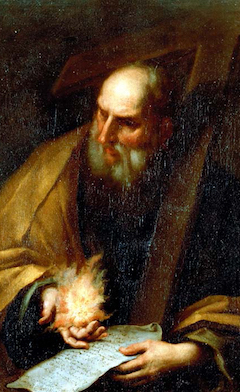
June 11 is the feast date of St. Barnabas, St. Paul‘s New Testament wingman.

A Cypriot Jew named Joseph, “Barnabas” (“Son of Encouragement”) was so christened in the fourth chapter of the New Testament’s Acts of the Apostles because upon his conversion he sold his land for a donative to the Galileans.

After that, Barnabas reappears throughout Acts as one of the most important of the early Christian missionaries, usually joining St. Paul — whom Barnabas himself introduced to the Christians after Paul got religion — as emissary to the non-Jews, for which purpose the Holy Spirit itself demanded him by name. (Acts 13:2: “Set apart for me Barnabas and Saul for the work to which I have called them.”)

They’re frequently paired thereafter in the narrative although it’s invariably Saint Paul’s honeyed tongue that does the confounding before the companions flee this city or that ahead of a furious mob.* Evidently the Holy Spirit’s labor policies could have used some updating: Barnabas also features in a whinge by Paul in 1 Corinthians 9 against the excess sacrifices the Jesus sect is exacting from its most successful envoys, who get no wages and no sex and (so it seems) have to hustle side jobs to keep up their proselytizing.

Don’t we have the right to food and drink? Don’t we have the right to take a believing wife along with us, as do the other apostles and the Lord’s brothers and Cephas [St. Peter]? Or is it only I and Barnabas who lack the right to not work for a living?

Who serves as a soldier at his own expense? Who plants a vineyard and does not eat its grapes? Who tends a flock and does not drink the milk? … whoever plows and threshes should be able to do so in the hope of sharing in the harvest. If we have sown spiritual seed among you, is it too much if we reap a material harvest from you? If others have this right of support from you, shouldn’t we have it all the more?

But we did not use this right. On the contrary, we put up with anything rather than hinder the gospel of Christ.

Barnabas eventually parted ways with Paul, proceeding to Cyprus with the mysterious John Mark (possibly Mark the evangelist, author of the Gospel, or possibly a different guy) where hagiography holds that Jews angered by his preaching fell on Barnabas and stoned him to death, perhaps around the year 61.

Although obviously a consequential figure in early Christianity, Barnabas’s many Biblical appearances do not capture his voice. The apocrypha preserves at least two tracts** further animating this important character: the Epistle of Barnabas dating to the late first century or early second century; and, the Acts of Barnabas, a 5th century creation which purports to arise from the hand of John Mark and describes a martyrdom by fire, not stone:

And Barjesus, having arrived after two days, after not a few Jews had been instructed, was enraged, and brought together all the multitude of the Jews; and they having laid hold of Barnabas, wished to hand him over to Hypatius, the governor of Salamis. And having bound him to take him away to the governor, and a pious Jebusite, a kinsman of Nero, having count to Cyprus, the Jews, learning this, took Barnabas by night, and bound him with a rope by the neck; and having dragged him to the hippodrome from the synagogue, and having gone out of the city, standing round him, they burned him with fire, so that even his bones became dust. And straightway that night, having taken his dust, they cast it into a cloth; and having se cured it with lead. they intended to throw it into the sea. But I, finding an opportunity in the night, and being able along with Timon and Rhodon to carry it, we came to a certain place, and having found a cave, put it down there, where the nation of the Jebusites formerly dwelt. And having found a secret place in it, we put it away, with the documents which he had received from Matthew. And it was the fourth hour of the night of the second of the week.

Because June 11 formerly fell on/near Midsummer, ere the Gregorian reforms skipped the calendar 10-11 days forward, St. Barnabas’s Day has a festive agrarian history commemorated by the proverb, “Barnaby bright, Barnaby bright, the longest day and the shortest night.” The saint is also the patron of Cyprus, and may be invoked to protect against hailstorms or in service of peacemaking. Numerous schools, churches, and monasteries around the world bear his name.

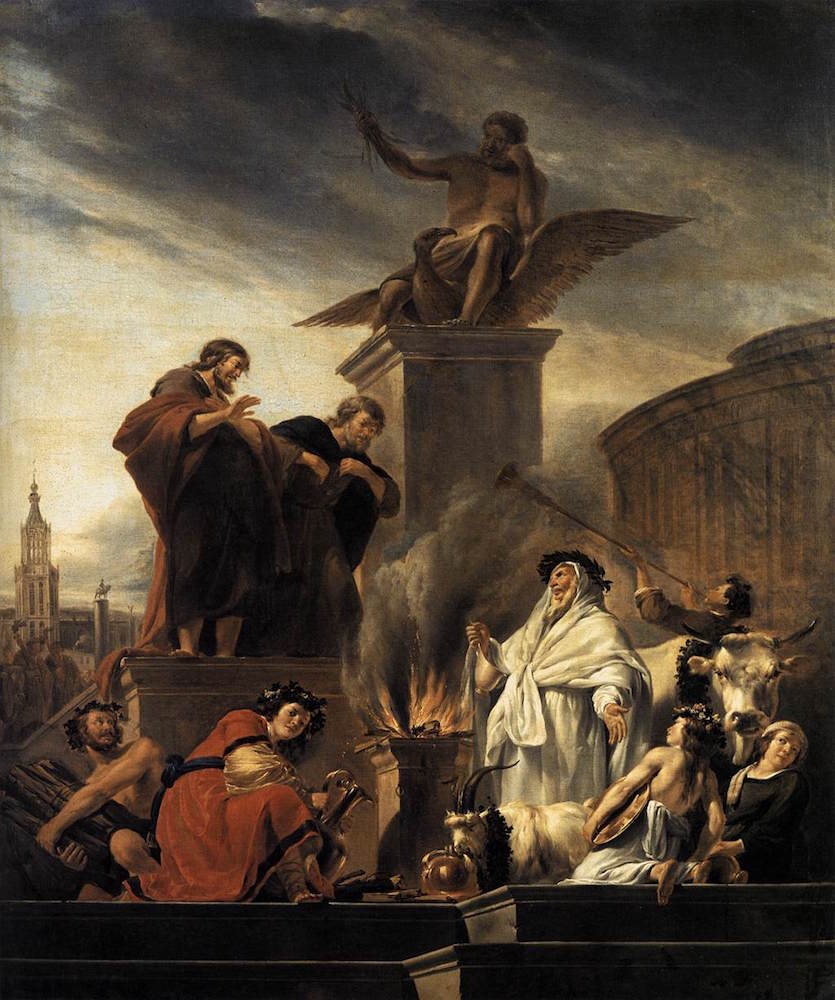
* There’s a comic touch to their preaching travails, too: in one exciting episode (Acts 14), Paul (of course) heals a cripple while the dynamic duo preaches in Lystra, leading excited witnesses to take them for Hermes and Zeus and start sacrificing to them.


No tips, please: Paul and Barnabas refusing the sacrifices of Lystrans in this detail (click for the full image) of a 1650 painting by Nicolaes Berchem.

** Beyond the Epistle and the Acts, there is also a very much later Gospel of Barnabas.

On this day..

1863: Not Nathaniel Pruitt, reprieved deserter

On this date 150 years ago, according to Larry Daniel’s Soldiering in the Army of Tennessee, a middle-aged man was all set to be shot for deserting the Army of Tennessee, and the much-resented command of Gen. Braxton Bragg.

In a well-documented incident, a soldier received a reprieve as a result of a dramatic incident. Forty-seven-year-old Nathaniel Pruitt of the Nineteenth Tennessee was found guilty of desertion and on June 10, 1863, was taken to a field beside his regimental camp, his coffin placed beside an open grave. A minister cut a lock of hair to give to Pruitt’s wife. The firing squad was positioned and ordered to take aim, but just then an officer came galloping up with a special order to suspend the sentence. The prisoner began crying. “I was truly glad [of the reprieve], but must say some of the boys were disappointed,” a Mississippi diarist noted. Incredibly, the very next day, Pruitt again deserted and was never heard from again.

One takes the author’s point here about Pruitt’s risk-seeking second flight, but even so it might not really be all that “incredible” that one would desert the company of armed men who had recently shown open disappointment about being prevented from shooting one dead.

On this day..

1863: Lawrence Williams and Walter Peters, bold CSA spies

From the July 4, 1863 issue of Harper’s, as digitized by sonsofthesouth.net.

THE EXECUTION OF WILLIAMS AND PETERS.

We are indebted to Mr. James K. Magie, of the 78th Illinois Regiment, for the sketch of the execution of the two rebel spies, WILLIAMS and PETERS, who were hanged by General Rosecrans on 9th inst. The following account of the affair is from a letter written by the surgeon of the 85th Indiana:

HEADQUARTERS POST, FRANKLIN, TENNESSEE

Last evening about sundown two strangers rode into camp and called at Colonel Baird’s head-quarters, who presented unusual appearances. They had on citizens’ overcoats, Federal regulation pants and caps. The caps were covered with white flannel havelocks. They wore sidearms, and showed high intelligence. One claimed to be a colonel in the United States Army, and called himself Colonel Austin; the other called himself Major Dunlap, and both representing themselves as Inspector-Generals of the United States Army. They represented that they were now out on an expedition in this department, inspecting the outposts and defenses, and that day before yesterday they had been overhauled by the enemy and lost their coats and purses. They exhibited official papers from General Rosecrans, and also from the War Department at Washington, confirming their rank and business. These were all right to Colonel Bayard, and at first satisfied him of their honesty. They asked the Colonel to loan them $50, as they had no coats and no money to buy them. Colonel Baird loaned them the money, and took Colonel Austin’s note for it. Just at dark they started, saying they were going to Nashville, and took that way. Just so soon as their horses’ heads were turned the thought of their being spies struck Colonel Baird, he says, like a thunder-bolt, and he ordered Colonel Watkins, of the 6th Kentucky cavalry, who was standing by, to arrest them immediately. But they were going at lightning speed. Colonel Watkins had no time to call a guard, and only with his orderly he set out on the chase. He ordered the orderly to unsling his carbine, and if, when he (the Colonel) halted them they showed any suspicious motions, to fire on them without waiting for ano rder. They were overtaken about one-third of a mile from here. Colonel Watkins told them that Colonel Baird wanted to make some further inquiries of them, and asked them to return. This they politely consented to do, after some remonstrance on account of the lateness of the hour and the distance they had to travel, and Colonel Watkins led them to his tent, where he placed a strong guard over them. It was not until one of them attempted to pass the guard at the door that they even suspected they were prisoners. Colonel Watkins immediately brought them to Colonel Baird under strong guard. They at once manifested great uneasiness, and pretended great indignation at being thus treated. Colonel Baird frankly told them that he had his suspicions of their true character, and that they should, if loyal, object to no necessary caution. They were very hard to satisfy, and were in a great hurry to get off. Colonel Baird told them that they were under arrest, and he should hold them prisoners until he was fully satisfied that they were what they puported to be. He immediately telegraphed to General Rosecrans, and received the answer that he knew nothing of any such men, that there were no such men in his employ, or had his pass.

Long before this dispatch was received, however, every one who had an opportunity of hearing their conversation was well satisfied that they were spies. Smart as they were, they gave frequent and distinct evidence of duplicity. After this dispatch came to hand, which it did about 12 o’clock (midnight), a search of their persons was ordered. To this the Major consented without opposition, but the Colonel protested against it, and even put his hand to his arms. But resistance was useless, and both submitted. When the Major’s sword was drawn from the scabbard there were found etched upon it these words, “Lt. W.G. Peter, C.S.A.” At this discovery Colonel Baird remarked, “Gentlemen, you have played this damned well.” “Yes,” said Lieutenant Peter, “and it came near being a perfect success.” They then confessed the whole matter, and upon further search various papers showing their guilt were discovered upon their persons. Lieutenant Peter was found to have on a rebel cap, secreted by the white flannel havelock.

Colonel Baird immediately telegraphed the facts to General Rosecrans and asked what he should do, and in a short time received an order “to try them by a drum-head court-martial, and if found guilty hang them immediately.” The court was convened, and before daylight the case was decided, and the prisoners informed that they must prepare for immediate death by hanging.

At daylight men were detailed to make a scaffold. The prisoners were visited by the Chaplain of the 78th Illinois, who, upon their request, administered the sacrament to them. They also wrote some letters to their friends, and deposited their jewelry, silver cups, and other valuables for transmission to their friends.

The gallows was constructed by a wild cherry-tree not far from the depot, and in a very public place. Two ropes hung dangling from the beam, reaching within eight feet of the ground. A little after nine o’clock A.M. the whole garrison was marshaled around the place of execution in solemn sadness. Two poplar coffins were lying a few feet away. Twenty minutes past nine the guards conducted the prisoners to the scaffold — they walked firm and steady, as if unmindful of the fearful precipice which they were approaching. The guards did them the honor to march with arms reversed.

Arrived at the place of execution they stepped upon the platform of the cart and took their respective places. The Provost Marshal, Captain Alexander, then tied a linen handkerchief over the face of each and adjusted the ropes. They then asked the privilege of bidding last farewell, which being granted, they tenderly embraced each other. This over, the cart moved from under them, and they hung in the air.

What a fearful penalty! They swung off at 9:30 — in two minutes the Lieutenant ceased to struggle. The Colonel caught hold of the rope with both hands and raised himself up at 3 minutes, and ceased to struggle at 5 minutes. At 6 minutes Dr. Forester, Surgeon 6th Kentucky Cavalry, and Dr. Moss, 78th Illinois Infantry, and myself, who had been detailed to examine the bodies, approached them, and found the pulse of both full and strong. At 7 minutes the Colonel shrugged his shoulders. The pulse of each continued to beat 17 minutes, and at 20 minutes all signs of life had ceased. The bodies were cut down at 30 minutes and encoffined in full dress. The Colonel was buried with a gold locket and chain on his neck. The locket contained the portrait and a braid of hair of his intended wife — her portrait was also in his vest pocket — these were buried with him. Both men were buried in the same grave — companions in life, misfortune, and crime, companions in infamy, and now companions in the grave.

I should have stated in another place that the prisoners did not want their punishment delayed; but, well knowing the consequences of their acts, even before their trial, asked to have the sentence, be it by hanging or shooting, quickly decided and executed. But they deprecated the idea of death by hanging, and asked for a communication of the sentence to shooting.

The elder and leader of these unfortunate men was Lawrence Williams, of Georgetown, D.C. He was as fine-looking a man as I have ever seen, about six feet high, and perhaps 30 years old. He was [a] son of Captain Williams, who was killed at the battle of Monterey. He was one of the most intellectual and accomplished men I have ever known. I have never known any one who excelled him as a talker. He was a member of the regular army, with the rank of captain of cavalry, when the rebellion broke out, and at that time was aid-de-camp and private secretary to General Winfield Scott. From this confidence and respect shown him by so distinguished a man may be judged his education and accomplishments. He was a first cousin of General Lee, commanding the Confederate army on the Rappahannock. Soon after the war began he was frank enough to inform General Scott that all his sympathies were with the South, as his friends and interests were there, and that he could not fight against them. As he was privy to all of General Scott’s plans for the campaign, it was not thought proper to turn him loose, hence he was sent to Governor’s Island, where he remained three months. After the first Bull Run battle he was allowed to go South, where he joined the Confederate army, and his subsequent history I have not been able to learn much about. He was a while on General Bragg‘s staff as Chief of Artillery, but at the time of his death was his Inspector-General. When he joined the Confederate army he altered his name, and now signs it thus: “Lawrence W. Orton, Col. City P.A.C.S.A.” — (Provisional Army Confederate States of America). Sometimes he writes his name “Orton,” and sometimes “Anton,” according to the object which he had in view. This we learn from the papers found on him. These facts in relation to the personal history of Colonel Orton I have gathered from the Colonel himself and from Colonel Watkins, who knows him well, they having belonged to the same regiment of the regular army — 2d U.S. Cavalry. Colonel Watkins, however, did not recognize Colonel Orton until after he had made himself known, and now mourns his apostasy and tragic fate.

The other victim of this delusive and reckless daring was Walter G. Peter, a lieutenant in the rebel army, and Colonel Orton’s adjutant. He was a tall, handsome young man, of about twenty-five years, that gave many signs of education and refinement.

Of his history I have been able to gather nothing. He played but a second part. Colonel Orton was the leader, and did all the talking and managing. Such is a succinct account of one of the most daring enterprises that men ever engaged in. Such were the characters and the men who played the awful tragedy.

History will hardly furnish its parallel in the character and standing of the parties, tne boldness and daring of the enterprise, and the swiftness with which discovery and punishment were visited upon them. They came into our camp and went all through it, minutely inspecting our position, works, and forces, with a portion of their traitorous insignia upon them; and the boldness of their conduct made their flimsy subterfuges almost successful.

On this day..

1658: John Hewett and Henry Slingsby, royalists

On this date in 1658, two royalist conspirators were beheaded at Tower Hill for plotting against Oliver Cromwell‘s Protectorate.

At this very late date, conflicts within the Lord Protector’s state raised the hopes of the exiled royal claimant Charles Stuart for a successful invasion. (Little did the imminent King Charles II suspect that Cromwell himself would die suddenly three months hence, collapsing the revolutionary government.) Plots and counterplots, spying and betrayal, were the order of the day; it was the bad luck of our men to set theirs in motion just a shade too early, but perhaps it was Charles Stuart’s good luck that Team Cromwell smashed it before it could ripen into a premature commitment of forces.

For the particulars, we turn to parliamentarian cavalryman and politician Edmund Ludlow, a regicide who had thirty-odd years cooling his spurs in continental exile during which to scribble his memoir of the grand experiment.

Another plot much more dangerous was about the same time carried on by the Royalists, and discovered to him by his spies. The persons concerned in it he used with more severity, because he accounted them to be of a more formidable party, and therefore referred them to be tried by those persons whom his last Assembly had nominated to be a High Court of Justice.

The prisoners were Dr. Hewet [John Hewett, onetime chaplain to King Charles I and an open royalist], Sir Henry Slingsby [a Yorkshire politician and Royalist veteran of the civil wars], and Mr. Mordaunt [eventually made a viscount by Charles II in recognition of his efforts on behalf of restoration], with some others of the meaner sort. The general charge against them was for endeavouring to levy war against the Government on the behalf of Charles Stuart.

The particular charge against Dr. Hewet was for dispersing commissions from the son of the late King, and perswading divers to raise forces by virtue of the same. That against Sir Henry Slingsby was for attempting to debauch some of the garison of Hull to the service of Charles Stuart, and delivering a commission from him to them. The prisoners of less note were charged with a design of firing the city in several places, at the time appointed for their party to be in arms.

Dr. Hewet being brought before the Court, moved that he might be tried by a jury, and demurred to the jurisdiction of the Court. But the Court over-ruled his demurrer, and told him, that unless he would plead to his charge, they would cause his refusal to be entred, and proceed against him as if the fact were confessed. This being twice said to him, he was required the third time to plead: to which he answered, that if the Judges would declare it to be according to law for him to plead, he would obey: but he was told that the gentlemen then present were his Judges, and that if he would not plead they would register his contempt the third time, and upon his refusal did so.

Mr. Mordaunt admonished by his example, pleaded not guilty; and after a full hearing of the witnesses on both sides, the Court acquitted him by one voice. Then Sir Henry Slingsby was called to the bar, and the witnesses on each side being heard, he was pronounced guilty, tho in the opinion of many men he had very hard measure. For it appeared that he was a prisoner at the time when he was charged to have practised against the Government; that he was a declared enemy, and therefore by the laws of war free to make any such attempt; besides it was alledged that the persons, whom he was accused to have endeavoured to corrupt, had trapan’d him by their promises to serve the king in delivering Hull, if he would give them a commission to act for him, which commission was an old one that had long lain by him. But all this being not thought sufficient to excuse him, he was adjudged to die.

The rest of the prisoners were also condemned, and sentence of death being pronounced, Sir Henry Slingsby and Dr. Hewet had the favour of being [June 8] 1658 beheaded; and the others, being men of a lesser figure, were hanged.

Cromwel’s daughter and favourite Mrs. Cleypole [Elizabeth Claypole, who was reputed to intercede frequently with her father on behalf of royalists], laboured earnestly with her father to save the life of Dr. Hewet, but without success: which denial so afflicted her, that it was reported to have been one cause of her death, which happened soon after with the concurrence Aug. 6. of an ulcer in her womb.

We have also an account of the dying behavior of both Slingsby and — much more detailed — Hewitt, each of whom slated the injustice of their sentence as having greatly exaggerated their “treasonable” designs.

On this day..

1935: May Hitchens Carey and Howard Carey, mother and son

(Thanks to Meaghan Good of the Charley Project for the guest post. -ed.)

On this date in 1935 in Georgetown, Delaware, a mother and son were hanged for the murder of Robert Hitchens, May Carey’s brother and Howard’s uncle.

The execution of May, 52, attracted some attention as it was the first time in living memory that a woman had faced capital punishment in Delaware. The last time a woman was executed there had been in the 1860s.

On November 7, 1927, May enlisted the help of her two oldest sons, Howard, then 20, and James, 16, to murder their uncle Robert. May had taken out a $2,000 insurance policy on his life and promised to buy her boys a car if they helped her. After Robert got home from work, the three of them jumped him, beat him with a club and sledgehammer, and then finished him off with a gunshot to the head. They poured alcohol over his body and down his throat and rummaged through his belongings in an attempt to make the murder look like a robbery.

The police fell for the robbery gambit and thought Robert had been slain by bootleggers. For a long time it appeared the trio had gotten away with it.

But murder will out. The homicide went unsolved until December 1934, when May’s youngest son, Lawrence, was arrested on an unrelated charge of burglary. He told the police everything he knew about his uncle’s murder, which was enough to put his mother and brothers behind bars.

Lawrence testified against his family at the ensuing trial. (Not that his cooperation in the murder case helped with his own legal difficulties; he got seven years for the burglary.) May tried to shoulder all the blame — “I drove my children to do it. It was all my fault. They killed him but they would not have done it, if I hadn’t made them do it.”

May, James and Howard were all convicted but the jury recommended mercy for the two young men. In the end, James was sentenced to life in prison but Howard, who had sired a family of three children, got a death sentence, as did his mother.

During the time period between the trial and the time the sentence was carried out, both Howard and May turned to religion for solace and read their Bibles “cover to cover.” Their last meal was cake and ice cream.

Authorities erected the gallows behind a high fence to conceal it from prying eyes. They even stretched a piece of canvas overhead to prevent aerial photography. A single rope was used for both hangings, and May was first in line. She wore a new black dress with white ribbon around the throat. Her son was dressed in a formal suit and tie. Mary died at 5:30 a.m. and Howard followed her at 6:08.

As for James, he outlived his mother and brother by only nine years, dying in prison of natural causes at the age of 34.

On this day..

1730: Sally Bassett, Bermuda slave

(Thanks to Meaghan Good of the Charley Project for the guest post. -ed.)

Perhaps on this day in 1730,* an elderly mulatto slave named Sarah or Sally Bassett was burned at the stake for attempted murder in the British Caribbean colony of Bermuda.

Sally was the property of Thomas Forster, as was her granddaughter, Beck. (Thomas Forster was the grandson of Josias Forster, who was governor of Bermuda from 1642 to 1643.) The Forster family lived in Sandys Parish.

Being so old, Sally wasn’t worth much: her value was appraised at one pound, four shillings and sixpence, or about $160 in modern U.S. currency. She also had the reputation of a troublemaker: in 1713, for example, she was whipped the length of Southampton Parish after being accused of threats, property damage and killing livestock.

On December 18, 1729, Sally allegedly gave two bags of poison, said to be “white toade”** and “manchineel root”, to her granddaughter, Beck, and told her to poison Thomas, his wife Sarah, and Nancey, another slave in the Forster household.

Beck slipped a dose into the master and mistress’s food, “where if her Mistress did but smell on’t twould poison her.” She put the rest of the poison in the kitchen door, where Nancey found it and “by only looking at it ye said. Nancey was poyson’d.” (Quotes are as cited in Slaves and Slaveholders in Bermuda, 1616-1782.)

Sally was not arrested and charged with the crime until June 2, nearly six months later. The victims were all still “sick and Lye in a very Languishing and dangerous Condition,” but Sarah Forster was at least well enough to drag herself out of her sickbed and testify against her slaves.

Beck was acquitted but Sally, “not having the fear of God before her Eyes, Butt being moved and seduced by ye Instigation of the Devil,” was convicted of petit treason for her attempt on her master and mistress’s lives.

Although she maintained her innocence, she was sentenced to death.

Barefoot, wearing only pants and a loose blouse, on the way to the place of execution Sally is said to have looked at the crowds rushing to see the show and quipped, “No use you hurrying folks, there’ll be no fun ’til I get there!” When she looked at the logs waiting to fuel the fire she supposedly said, “Ain’t they darlin’?”

She was burned alive on an unusually hot day, in public, either on an island off Southampton Parish or at Crow Lane at the east end of Hamilton Harbor. After her death a purple Bermudiana, Bermuda’s official flower, is reputed to have grown in the ashes. Days later, Bermuda enacted new laws to tighten control of the “many heinous and grievous Crimes as of that Secret and barbarous way of Murdering by Poison and other Murders … many times Committed by negroes and other Slaves and many times malitiously attempted by them.”

Sally’s death has passed on into legend and is considered part of Bermuda’s cultural heritage. Even today, nearly three hundred years later, a very hot day in Bermuda is sometimes called a Sally Basset day. In 2009, a ten-foot statue of Sally was dedicated at the Cabinet Office grounds in Hamilton, the first time in Bermuda that a slave was so memorialized.

* There are some shouts for June 21, 1730. If there is an authoritative primary document establishing the execution date with certainty, we have not been able to unearth it.

** The involvement of white toad, as historian Justin Pope observes, points — alarmingly for 18th century white Bermudians; intriguingly for posterity — to transatlantic black (in multiple senses) economies.

There were no indigenous white toads in Bermuda. However, as noted by the Bermudian historian Clarence Maxwell, poisonous toads were used in ceremonies among Akan speaking peoples in the tropical forests of West Africa and carried into the voudou traditions of San Domingue.

… If there really was a white toad used in the Bermuda poisoning conspiracy, then it was almost certainly brought to the colony by a slave mariner who believed he was arming a spiritual practitioner against her enemies. It was not something that Sarah Bassett could have asked for lightly. The person who purchased the item would have easily been able to discover, or at least suspect, its usage. Whoever carried it had to be trusted. The toad would have had to been captured or cultivated in the tropical forests of West Africa or northern South America, purchased in the slave markets of towns like Paramaraibo, on the Surinam River of Dutch Guyana, or in the markets of Elmina, on the southern coast of West Africa. We can only surmise the origins of the poisonous toad, yet its very presence on the island of Bermuda suggests a trade in poisons, betweens slave societies and through the hands of black mariners.

On this day..