1987: Edward Earl Johnson, “I guess nobody is going to call”

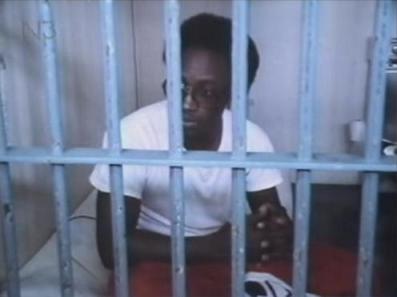
On this date in 1987, murmuring “I guess nobody is going to call,”* Edward Earl Johnson was gassed for capital murder in Mississippi’s Parchman Farm prison.
Don Cabana, the prison warden who oversaw Johnson’s gassing, eventually resigned over his misgivings about carrying out executions and wrote this book about it.

Johnson was convicted of raping a white woman and killing the policeman who answered her distress call. These are no-nos for a young person of color in the South.

Johnson fought his execution for eight years on death row, insisting on his innocence even on his last walk to the gas chamber.

And the case against him looks pretty thin — supported, as these things so often are, mostly by a highly suspect confession Johnson miraculously coughed up when he was out on a drive with John Law. (This led the victim, who knew Johnson and had excluded him as the attacker, to decide he did it after all.)

Needless to say, Johnson’s state-appointed public defender was unable to make the most of these gaping lacunae in the state’s case.

Years later, the prison warden Don Cabana — who was on this date overseeing his very first execution, and was deeply shaken by it — recalled his charge’s fearful situation in testimony to the Minnesota legislature:

He insisted to the very end, somewhat oddly, that he did not commit the crime … my experience with condemned prisoners was always that once strapped to the chair, they came around somehow with something, if only something simple as “Tell the victim’s family I’m sorry,” “Tell my mother I’m sorry,” something that indicated something bad had happened, I was there and I was part of it.

But not so with this young man. When I performed my ritualistic function of asking if he had a final public statement, this young man looked me in the eye with tears streaming down his cheeks, and he said: “Warden, you’re about to become a murderer. I did not kill that policeman, and dear God, I can’t make anyone believe me.”

This is a musty old case by now, but with the growing awareness of false confessions as a contributing factor in wrongful convictions, it may soon come in for a long-overdue re-examination.

Johnson, unfortunately, does not have any prospect of an a-ha forensic science win. However, as with Cameron Todd Willingham‘s case, there’s simply no balance of evidence that should point a fair-minded present-day observer to a conviction beyond reasonable doubt, and a good deal that points to an affirmative conclusion of innocence.

As the (admittedly partisan) Wrongful Conviction: International Perspectives on Miscarriages of Justice sums up,

[t]he murder weapon was never connected to Johnson; indeed, no physical evidence linked Johnson to the crime. The case against Johnson is weakened by his claim of inadequate counsel, his immediate recantation of his confession, and his claim that his confession was produced under threat of death. Also, after Johnson’s execution, a young woman came forward claiming to have been with Johnson on the night of the murder, and claiming also that she had come forward during the investigation but was rebuffed by police.

Edward Earl Johnson is the subject of the riveting BBC documentary Fourteen Days in May.

* Quoted in the New York Times, May 21, 1987.

On this day..

2005: Richard Cartwright, uncensored

On this date in 2005, Richard Cartwright was executed in Texas for robbing and murdering a gay man in Corpus Christi.

Cartwright attained some recognition (if not exactly a plausible purchase on clemency) as the writer of Uncensored from Texas Death Row, a sort of death row blog.

(As befits a blogger in the early 2000s, Cartwright also had a MySpace page, which remains active. “Chi-town” grew up in Chicago. He played youth hockey there, for this club. This is the sort of thing one learns about bloggers.)

Cartwright was admittedly involved in the robbery-murder, though he insisted he wasn’t the one who did the murdering.

Whatever one makes of that, his fairly prolific “Uncensored” series over the last six months of his life furnish a sometimes bracingly personal chronicle of a man among the lowest of the dead … and drawing nearer and nearer to a fate he realizes he cannot avert.

People are looking at me differently, like they are trying to instill into memory or something. They don’t mean to, but they do, and it is spooky. Like I am already dead.

On this day..

1990: Dalton Prejean, cop-killing child

Just after midnight this date in 1990, Dalton Prejean was electrocuted in Louisiana for murdering state trooper Donald Cleveland.

A 17-year-old (at the time of the crime) black youth who tested just this side of mentally disabled, Prejean shot Cleveland during a traffic stop. (He was, at the time, just seven months out of a reform school stint he had served for murdering a taxi driver at the tender age of 14.)

It was a three-day trial with an all-white jury, and not much question as to Prejean’s culpability.

But as he neared the execution of that sentence, his youth and his limited candlepower loomed ever larger. They would generate worldwide attention with some heated rhetoric like this one from Amnesty International’s southern regional director:

“I doubt that in documented recent world history there is an execution” with “such a pile of reasons not to do it.”

The Louisiana board of pardons agreed — it recommended commutation — but Gov. Buddy Roemer did not.

Dalton Prejean’s was the first execution of a juvenile offender in the United States since the Supreme Court upheld the constitutionality of that practice in the 1989 decision Stanford v. Kentucky. That decision was reversed in 2005, and minors are no longer eligible for death-sentencing in the U.S.

On this day..

1995: Girvies Davis, framed?

On this date in 1995, Illinois executed Girvies Davis for murdering 89-year-old Charles Biebel in Belleville, Ill.

A small-time African-American hood reared in an alcoholic home, Davis was not linked to the murder by any physical evidence, or even any eyewitnesses. There was only one piece of evidence against him: his signed confession.

Unfortunately, the source lacked all credibility.

Davis copped to some 20 crimes under police interrogation. Officially, he did this when he voluntarily wrote out a list of evildoings and spontaneously passed it to a guard, which would be hard to believe even if the guy weren’t nearly illiterate. (Even the official story later became that Davis must have dictated the confession to someone else, like a cellmate.)

According to Davis’s later account, he signed statements the police had prepared for him … at gunpoint. The police logs say that he was taken out for a drive that night (“for evidence”), and conveniently confessed in the small hours of the morning.

Even though our man’s involvement in most of these “admitted” crimes (anything outstanding in the area that was still unsolved, it seems) was disproven, he couldn’t get traction in the courts once his conviction by an all-white jury was secured. Paradoxically, because there was no other evidence in the case to discredit, that “a-ha!” exoneration moment became all but impossible to secure despite the other holes in the case.

More action was had in the court of public opinion, where the usual suspects enlisted any number of pro-death penalty prosecutors and Republicans with serious misgivings about the case.

Time magazine lodged a naive early entrant in the “wait, wrongful confessions happen?” genre. The New York Times also covered the Davis clemency campaign:*

“The public sees the Bundys and the Gacys executed and they cheer,” said Gary V. Johnson, a former Kane County, Ill., prosecutor, who sought the death penalty in the past but opposes the execution of Mr. Davis. “The public doesn’t see the Girvies Davises.”

What savvy pols like Illinois Gov. Jim Edgar could see was that in the 1990s, all the political upside was in denying clemencies. So that’s what he did.

Years later, Davis’s last appellate attorney still believes “that the State of Illinois executed Girvies Davis for a crime I am sure he didn’t commit.”

Northwestern University journalism professor David Protess was also convinced of Girvies Davis’s innocence, and led a team of students researching the case back before he was famous for doing exactly that sort of thing. His work did not yield success on this occasion, but to judge by his account (pdf) of a last conversation he and his students had hours before Davis was put to death, it helped lead to the school’s later headline-grabbing wrongful conviction exposes.

Protess put [Davis] on the speakerphone, and the group gathered around. “Try not to mourn for me,” Davis said. “Move on with your lives. Just try to help people like me who get caught up in the system.” …

Davis had a final request: He wanted Protess and the students to promise that this wouldn’t be their last crusade in a capital case.

The room fell silent. “Of all the guys you know on the Row, who do you think most deserves help?” Protess asked.

Buck Williams,” Davis answered without hesitation. “I’m certain he’s innocent.”

Protess … vowed that he and his next group of students would leave no stone unturned for Williams.

Protess was as good as his word.

In less than a year, Williams along with Verneal Jimerson, Willie Rainge and Kenneth Adams were free men after a generation in prison.** These men, known as the “Ford Heights Four”, would win the largest civil rights lawsuit payment in U.S. history for their wrongful imprisonment.

* Davis may also have been the first death-row prisoner in the U.S. with his own Internet site and online clemency petition, although these interesting artifcats have long since vanished into the digital oubliette. Gov. Edgar reportedly received 1,200 emails asking him to spare his prisoner’s life … testament even then to elected officials’ disregard for online advocacy.

** Williams and Jimerson were on death row; Rainge and Adams were serving life sentences.

On this day..

1879: Three botches in three states

America’s weird love-affair with Frankenstein execution technology has been an occasional theme on this blog, but the fact is that the old-school execution methods these ghastly machines replaced were unpleasantly hit-and-miss.

On this date in 1879, three different U.S. states produced botched executions, each blurbed this New York Times article. (pdf)


One is attracted most readily to the firing-squad execution of murderer Wallace Wilkerson in Utah.

Wilkerson appealed the constitutionality of this method of execution, and in 1879’s Wilkerson v. Utah, the U.S. Supreme Court held that “the punishment of shooting as a mode of executing the death penalty for the crime of murder in the first degree is not” cruel and unusual punishment.

This legal precedent has actually been cited* by the present-day Supreme Court in rejecting legal challenges to lethal injection. Which is ironic, because a couple of months after the high court issued Wilkerson v. Utah, Wilkerson suffered a very cruel execution indeed.

The doomed man talked the officials conducting his execution into allowing him to die without being strapped down. With the resultant range of motion, Wilkerson at the last breath before the fusillade hit him drew his shoulders up as he braced for the impact — and pulled the white target pinned to his shirt above his heart.

The volley didn’t kill him — it just knocked him out of his chair to the ground, screaming “Oh, my God! My God! They have missed!”

He bled to death in 27 minutes, prompting the tongue-in-cheek observation by the Ogden Junction that “the French guillotine never fails.”


Meanwhile, on the very same day in Missouri …

ST. LOUIS, Mo., May 16.–A special dispatch from Booneville, Mo., says: “John I. West, who murdered a tramp last October, was to-day hanged at the Old Fair Ground near this city. When the trap was sprung, at 11:41 A.M., the rope broke, and the culprit fell to the ground on his back, but was too weak to rise. His groans and the gurgling sounds of strangulation were terrible to hear. He was picked up and speedily raised to the trap again, and, while being held by four or five men, was dropped a second time. This time he swung, and in 11 minutes was pronounced dead.

After reaching the platform of the gallows, West spoke nearly half an hour to the crowd present, reiterating his confession of the murder of Shinn, reviewing his past life, and appealing to young men and women to take his fate as a warning. There were about 8,000 people present, among whom was the father of West, who had come from Chapin, Ill.

(There’s a great deal more about West’s crime in the Times article, but it’s pretty dull reading for all the column-inches. He was a tramp who committed a semi-random murder, seemingly activating all the crime-freakout circuits so familiar to cable news programmers.)


Hillsboro, North Carolina, held a first-ever triple hanging — of the “Chapel Hill burglars”. As you might guess, these gentlemen burgled, and said burgling occurred in Chapel Hill. It was for housebreaking, not murder, that they were condemned, with the help of a confederate who turned state’s-evidence against them as soon as the lot was arrested.

Each of the culprits proclaimed his innocence to the last moment. [Lewis] Carlton spoke for an hour, and said his salvation was sure. The parting between [Henry] Andrews and his sister on the scaffold was most affecting, and moved the crowd of witnesses to tears. All the doomed men bore themselves firmly, and showed no signs of wavering. The hanging took place at 2:30 P.M., and was very badly conducted. The ropes around the necks of [Henry Alphonso] Davis and Carlton were too long, and their feet rested on the ground. They were raised up and the ropes retied, causing death by strangulation.

(According to this “history of the University of North Carolina” page, one of the burglars’ victims was writer Cornelia Phillips Spencer. Famous as the woman who rang the bell re-opening UNC in 1875, her role in closing the university in the first place in 1870 and her retrograde racial politics have recently been in Tar Heel news. The linked article suggests that her brush with the Chapel Hill burglars might have given Spencer an appreciation for the Ku Klux Klan’s version of order. After all, a white supremacist vigilante is just a liberal who’s been burgled.)

The St. Louis Globe-Democrat of May 17, 1879 adds of our men’s exit (in an addendum to a report primarily about the aforementioned West) that

[t]he execution was romantic in the extreme. Just as the doomed men ascended the platform a murky cloud, which had been drifting around, hung over the crowd and the instrument of death. Alfonso Davis began to speak, and as he opened his mouth the thunder began to peal, and the rain came down in torrents. Not a man, woman or child in the vast crowd moved or seemed to be aware that the rain was falling, so wrapped up in the death scene were they. At times the cloud threw such a dense shadow over the scene that it seemed as though night had enveloped the place. Then the lightning, vivid and intense, lit up the field of blood and cast forward, in bold and statuesque relief, the figures of the doomed and their executor as he stood like an artilleryman, lanyard in hand, ready to send the signal of death forward … the souls of three burglars went out and beyond, forked lightning illuminating their way and the wildest of thunder pealing their requiem.


The Bayou State redeemed this black day for the executioner’s craft by the uneventful hanging one Robert Cheney (black, of course) “for ravishing Amelia Voight in June, 1878.”

All told, four states killed six men on May 16, 1879, but only two of them died “cleanly.”

* The author of the New York Times opinion piece cited here, Gilbert King, has guest-blogged on this site:

On this day..

71 B.C.E.: The followers of Spartacus

… a Thracian of Nomadic stock, possessed not only of great courage and strength, but also in sagacity and culture superior to his fortune, and more Hellenic than Thracian. It is said that when he was first brought to Rome to be sold, a serpent was seen coiled about his face as he slept, and his wife, who was of the same tribe as Spartacus, a prophetess, and subject to visitations of the Dionysiac frenzy, declared it the sign of a great and formidable power which would attend him to a fortunate issue.

-Plutarch, The Life of Crassus

On an uncertain date roughly around this time in 71 B.C.E., some 6,000 survivors of the shattered rebel slave army of Spartacus in Rome’s Third Servile War were crucified along the Appian Way.

The specific chronology of this legendary warrior, leader of the last major slave revolt against Rome, is necessarily foggy, but in fine, he broke out of a gladiators’ camp in 73 B.C.E. and went on to lead a slave army some 100,000 strong up and down the Italian peninsula for two solid years, repeatedly stomping Roman forces sent to suppress him.

His motivations remain mysterious; if one likes, one can project back on him an anachronistic anti-slavery project, but it’s more likely he was just trying to get by day by day as the greatest empire* on the planet harried his every move and internal divisions tore at the rebel camp.

Nevertheless, Spartacus and army prospered, and plundered, in the very heart of that empire, and gave Senators reason to fret the security of their capital even as their legions carried Roman arms from Spain to Palestine.

The army (for the gladiators organized it with military discipline, realizing a mob would be easy prey for Rome) was trapped, at last, at the toe of the Italian boot by Roman plutocrat Crassus, later to become a patron of, and fellow triumvir with, Julius Caesar. Abandoned by pirates with whom the slave army attempted to negotiate passage, it was a desperate situation. Spartacus, writes Appian, “crucified a Roman prisoner in no-man’s land to demonstrate to his own troops the fate awaiting them if they were defeated.”

Duly inspired, Spartacus and his army broke out of the Roman circumvallation around February of 71 B.C.E. Hemmed in by a second Roman force, the slaves turned to fight their pursuer, Spartacus dramatically sticking a blade into his own warhorse before the fight as another one of those conquer-or-die pregame speeches.

In The Spartacus War, Barry Strauss estimates April of 71 B.C.E. for that decisive battle. The slaves lost it; Spartacus died in combat, and his ancient calumniators vied to sing his heroism on the field.

But 6,000 survivors did not go down fighting to the death. These, Crassus staked out along one of Rome’s principal highways, the carcasses left to disintegrate there for months or years.

He’s easy to admire now,** but slave revolts scare the bejeezus out of slave societies, and the Spartacus rising would keep generations — centuries — of Romans sweating about a potential repeat. (At least, elite Romans, the ones whose voices remain for us.)

Their pejorative take on Spartacus (aside from his personal valor and martial excellence, for which even hostile writers gave him credit) was long the received wisdom on this upsetter of divinely established social order. “From a small and contemptible band of robbers,” sniffed Saint Augustine of the gladiators, “they attained to a kingdom.” They “enjoyed whatever pleasures they wished, and did what their lust suggested.”

The present-day reader’s readiest association is likely the much more admiring — and famously homoerotic, which is now yet another connotation for the gladiator’s name — Stanley Kubrick classic Spartacus, which turns 50 this year and gave to the cinematic canon the stirring “I’m Spartacus!” scene as the captured slave army defiantly embraces death.

This episode is completely ahistorical, but so what? One of the wildest things about this sword-and-sandal production is how much of it isn’t made-up. Like the premise: in the lifetime of Julius Caesar, a few guys busting out of gladiator school using nothing but kitchen utensils threatened for two years to turn the Eternal City and its far-flung realms upside-down.

* Okay, still a republic, if you like. But those days were fast coming to a close.

** Especially for modern leftist radicals; Marx and Che Guevara were both big fans; German communists Rosa Luxemburg and Karl Liebknecht named their movement for Spartacus, and it was during Berlin’s “Spartacus Week” that they were murdered.

A number of sports clubs in the former Soviet bloc also carry the Spartacus name, including Russian football power Spartak Moscow as well as several clubs in Bulgaria, which currently governs most of the rebel slave’s ancestral homeland of Thrace.

A few books about Spartacus

On this day..

1985: Mohammed Munir, Indonesian Communist

On this date in 1985, the onetime General Secretary of the Indonesian Communist Party (PKI) was suddenly executed for subversion.

Not to be confused with Egyptian pop singer Mohamed Mounir.

Though the date here says 1985, Munir was actually a very late casualty of the 1960s: specifically, the murky attempted “coup” of 1965 whose authorship the army quickly ascribed to the Communists and on that doubtful basis unleashed a ferocious bloodletting in 1965-66.*

Along with the hundreds of thousands of leftists slaughtered — many in Muslim sectarian violence, as distinct from being specifically hunted down by the army — some 200,000 wound up in prison.

According to a U.S. Department of Defense publication, Low-Intensity Conflict in the Third World (pdf),

the vast majority [of those 200,000 prisoners] were gradually released and rehabilitated during the first seven to 10 years of President Suharto’s New Order. By the mid-1970s, although Western sources could not agree on the remaining number, probably no more than 30,000 people remained in custody; but their living conditions and situations were often extremely bad. In the late 1970s, responding to the Carter administration, Vatican, The Hague, and Amnesty International remonstrances, the Suharto government implemented a series of staged, publicized releases of remaining PKI prisoners. All told, between 25,000 and 30,000 were released between 1977 and the early 1980s. In the early 1980s, most western sources estimated that no more than 5,000 hard-core PKI and other radical personnel remained in custody.

As the former head of the PKI-affiliated trade union SOBSI, Munir was “radical personnel” in the eyes of the Suharto dictatorship.

He’d been condemned on subversion charges in 1973, but the government had simply left that sort of people to rot in prison. (It had been five years between Munir’s arrest and his trial in the first place; clearly, nobody in Jakarta thought him a clear and present danger.)

According to this doctoral thesis,

On 14 May 1985 he was taken from his cell, and without explanation, shot. On 19 July 1985 there were further executions of Rustomo, Gatot, Lestario and Djoko Untung — all former senior members of the PKI in East Java. It was unclear whether the government had other agendas, or if the condemned had simply come to the end of a long, tedious and inhumane process … What the imprisonments and executions did, however, was to illustrate the continued power and convenience of state violence and anti-communism.

That “convenient” anti-communism helped clamp down on internal dissension.

The official campaigns made reformist sentiment in the civil service and the pro-democracy aspirations of students synonymous with communism. The fear generated served as a warning to progressive elements within the bureaucracy not to tamper … It was, in effect, a warning to all sections of society not to challenge the relationship between the ruler and the ruled.

* With the blessing of the West, naturally.

On this day..

2005: Michael Ross, the Roadside Strangler

As of this writing, New England has seen only one solitary execution in the past half-century.*

That one execution happened five years ago today: the lethal injection of serial murderer/rapist Michael Ross in Connecticut.

The “farm boy from Brooklyn, Conn.”, sexual sadist, and Cornell University graduate** went no a rape-and-murder spree in the early 1980s. He would confess to eight homicides.

Condemned in 1987, Ross spent 17 years fighting execution before a 2004 volte face had him waiving his appeals in the interests of sparing victims’ families any further agony.

This precipitated an intense last-minute legal melee over whether the admittedly disturbed Ross possessed legally sufficient competency to pursue his own death. A scheduled execution in January was scratched at the last moment when a federal judge insisted on a competency determination.

A serial killer who consents to his own execution wouldn’t typically be the sort to attract a lot of sympathy, but in true-blue New England, any brush with the executioner is cause for public hand-wringing.

Ross, of course, was adjudged competent to drop his appeals, and that was that.

After the execution, one of the psychiatrists who disputed Ross’s competency to choose execution received a mailed taunt from the killer, dated May 10:

Check, and mate. You never had a chance!

And it seems our date’s principal reserved an even gnarlier gambit for the judge who once blocked his execution.

District Court jurist Robert Chatigny has found himself much in the news with Michael Ross since he was nominated by President Barack Obama for a seat on the Second Circuit Court of Appeals. That nomination has been held up thus far largely because Chatigny berated and threatened Ross’s attorney (the one who was trying to get his client executed) with disbarment.

* The last one before Michael Ross? Joseph Taborsky, electrocuted in Connecticut on May 17, 1960.

** His criminal career began in Ithaca, N.Y. Cornell is famous for its suicides, but Ross apparently couldn’t go through with his after he contemplated taking his own life.

Ross was also a graduate of something called Killingly High School. True story.

On this day..

1641: Thomas Wentworth, Earl of Strafford

On this date in 1641, the doomed English monarch Charles I regretfully sacrificed one of his ablest ministers to the headsman.

Thomas Wentworth and loyal doggie, painted c. 1639 by Anthony van Dyck.

Thomas Wentworth, Earl of Strafford had cut his teeth in Parliament in the 1620s as an advocate of the rights of the Commons as against those of the king, but the notion that he’d be hoisted by his own petard would be little comfort to a King soon destined to find himself in similar straits.

After Parliament forced through the 1628 Petition of Right (and Wentworth’s pro-monarchist personal rival George Villiers, Duke of Buckingham had been conveniently assassinated) Wentworth went over to the king’s camp with the sententious declaration

The authority of a king is the keystone which closeth up the arch of order and government.

The authority of that king, which Wentworth now worked vigorously to uphold during the crown’s Parliament-free Personal Rule of the 1630s, also elevated Wentworth to higher honors.

He would have occasion to exercise his own “personal rule” as dictatorial viceroy in Ireland, and when push came to shove between King and Commons, advocated the most tyrannical measures to compel the compliance of obstinate Englishmen.

By 1640, Wentworth had become in the eyes of his enemies the very embodiment of the monarch’s every sin, and when Charles was obliged by his deteriorating situation to summon Parliament once more, its first order of business was the impeachment of this obnoxious retainer. When Wentworth skillfully repelled the charges and won acquittal on April 10, his parliamentarian opponents simply passed a bill of attainder condemning him to death anyway.

The only thing that stood in the way of the chop was the signature of that ruler whom Wentworth had served so loyally. As Charles dithered — for he had personally guaranteed Wentworth his safety upon his most recent summons to London — popular hatred for the Earl threatened to escalate the crisis into something much more dangerous for the throne.

In one last gesture of fealty, Wentworth dashed off a note to his sovereign, magnanimously releasing him from any obligation save political calculation.

Sire, out of much sadness, I am come to a resolution of that which I take to be the best becoming me; and that is, to look upon the prosperity of your sacred person and the commonwealth as infinitely to be preferred before any man’s private interest. And therefore, in few words, as I have placed myself wholly upon the honour and justice of my peers, I do most humbly beseech you, for the preventing of such mischiefs as may happen by your refusal to pass this bill, by this means to remove this unfortunate thing forth of the way towards that blessed agreement, which God, I trust, shall for ever establish betwixt you and your subjects. Sire, my consent herein shall acquit you more to God than all the world can do beside. To a willing man there is no injury done; and as, by God’s grace, I forgive all the world with a calmness and meekness of infinite contentment to my disloding soul, so, Sire, I can give the life of this world with all cheerfulness imaginable, in the just acknowledgment of your exceeding favours; and only beg that, in your goodness, you would vouchsafe to cast your gracious regard upon my poor son and his three sisters, less or more, and no otherwise, than their unfortunate father shall appear more or less guilty of this death. (Quoted here)

This letter’s place in the annals of sacrificial loyalty is compromised only slightly by its author’s dismay upon finding out that his feckless majesty had quickly taken up the offer:* Wentworth rolled his eyes heavenward and exclaimed

Put not your trust in princes, in a son of man, in whom there is no salvation.**

But the miscalculation was done.

Two days after Charles signed off, Wentworth was beheaded on Tower Hill to the rapture of an audience supposed to have numbered 200,000 strong.


Strafford Led to Execution, by Paul Delaroche, with Thomas Wentworth, Earl of Stafford, receiving the blessing of his ally, the imprisoned Archbishop William Laud.


1642 pamphlet illustration of the beheading, from here.

As things went from bad to worse for Charles in the years ahead, he would have many occasions to regret the sacrifice of so loyal and energetic a minister … and to lament, upon hearing his own death sentence, that he was suffering divine judgment for this date’s act of expedient faithlessness.

A few books about Thomas Wentworth

* In acceding to the sentence, Charles proposed giving Strafford the best part of a week to prepare himself. Parliament ignored that request and set the execution for the very next day.

** That’s Psalm 146:3.

On this day..

1939: Evgeny Miller, White Russian

On this date in 1938, former tsarist Gen. Evgeny Miller was executed in Moscow, having been brazenly kidnapped by the Soviet NKVD from exile in France.

Miller opposed the 1917 Russian Revolutions (both of them) and ended up on the wrong side of the ensuing civil war as Aleksandr Kolchak‘s man in Archangel.

There, Miller (he was half-German) was the beneficiary of the Entente powers’ anti-Soviet incursion of British, French, American and Canadian troops.

These powers soon found that their respective peoples, wearied by the late world war, had little appetite for spilling more blood in the service of enthroning a Romanov, and cut bait in 1920.

Miller wisely did likewise, and watched the great workers’ and peasants’ republic take shape from the safety of Paris — where, in the 1930s, he chaired the anti-communist Russian All-Military Union (ROVS).

Soviet intelligence had infiltrated this body, however, and hatched a bold plot* to shanghai Miller and smuggle him out of the country in order to cause ROVS leadership to pass to the Soviets’ own agent, Nikolai Skoblin. Although they got Miller, they didn’t quite pull off the putsch, since the wary general had left behind a note outlining his suspicions of Skoblin in the event foul play should befall him.

Imprisoned at Lubyanka, Miller was personally interrogated by NKVD boss Nikolai Yezhov, but according to Vladislav Goldin and John Long,

little or nothing of what Miller had to report about the recent activities of the ROVS was unknown to the NKVD … the leaders of the NKVD found themselves saddled with a prominent prisoner of no significant value to Soviet intelligence and from whose capture, at the same time, nothing useful could be derived by way of publicity or propaganda.

The fall of Ezhov sealed the doom of General Miller, whose abduction had from the outset been his inspiration. In these circumstances, given his continuing uselessness to the NKVD, Miller’s elimination became an inevitable element in Commissar Beria‘s liquidation of the so-called Ezhovshchina, an operation which lasted from late 1938 through at least 1940. Although part of this undertaking involved the release of up to 200,000 of Ezhov’s prisoners, no such option was available in the case of General Miller for whose disappearance the Soviet government had consistently denied any responsibility. Accordingly, on 11 May 1939, after more than nineteen months of agonizing solitary confinement, Commissar Beria, with no viable alternative, ordered the trial and execution of the long-suffering General Miller in a process, ironically, that was fully implemented in less than twenty-four hours.

[it was] an ill-conceived, poorly executed and totally unnecessary adventure that, in the end, failed to benefit any of its apparent perpetrators.**

Skoblin, for his part, fled, disappearing to a still-unknown fate. His wife, Nadezhda Plevitskaya, copped a 20-year sentence for helping arrange the kidnapping, and died in prison.

They may not have gotten ROVS, but at least they made celluloid. Skoblin’s shadowy activities in France in this period are the inspiration for the 2004 French film Triple Agent.

* Georgy Kosenko, who we’ve previously met in these pages, helped orchestrate the kidnapping. (Times being dangerous as they were, the wheel of Red Terror turned against Kosenko so quickly that Miller actually outlived him.)

** Goldin, Vladislav I. and Long, John W. “Resistance and Retribution: The Life and Fate of General E.K. Miller”, Revolutionary Russia, 12:2 (1999), pp. 19-40.

On this day..