1971: Ion Rimaru, the Vampire of Bucharest

On this date in 1971, Romania’s most notorious serial killer was dragged to the stake at Jilava Prison — fighting all the way, and shrieking “Call my father, so he can see what’s happening to me! Make him come! He’s the only guilty one!” — and shot to death for a rape-murder spree that had terrorized Bucharest for more than a year.

Ion Rîmaru (or Ion Râmaru), an emotionally stunted, sexually perverted veterinary school dropout, began in 1970 preying on lone women perambulating the Romanian capital late at night.

Though a number of Rimaru’s targets escaped with their lives,* his attacks were noted for their bestial ferocity: biting into, perhaps cannibalizing, his victims’ sex organs; necrophiliac rapes; blood-drinking (hence the nickname). Authorities loathe to cop to a serial killer were initially tight-lipped about the monster in their midst, only heightening public terror, until a very visible May 1971 dragnet finally caught the Vampire.

Though he surely met someone’s definition of nuts, his attempt to claim insanity at trial was a predictable nonstarter, leading to this day’s scene on the execution grounds. Rimaru actually got himself turned all the way round, and took the firing squad’s barrage in his back. Unseemly, all in all.

But all that carrying on about his father? Evidently it was more than just unresolved Oedipal stuff.

The next year, his father fatally “fell” (read: was pushed by police) from a train. Forensic evidence taken from the body of Florea Rîmaru (Romanian link) implicated the Vampire’s dad in four unsolved 1944 murders in wartime Bucharest.

* His infamous spree’s official tally was four killed, plus six attempted murders, five rapes, one attempted rape, one robbery and three thefts. (Romanian source)

On this day..

1962: Gheorghe Arsenescu, Romanian partisan

On this date in 1962, partisan Gheorghe Arsenescu was put to death at Bucharest’s Jilava Prison.

Arsenescu was a leader and co-founder of one of Romania’s several bands of anti-communist resistance units. Arsenescu’s Haiducii Muscelului — the Muscel Outlaws — were a band of 30 to 40 in the Carpathian fooothills who scarcely posed a serious threat to the Romanian state, but who nevertheless managed to elude capture for nine solid years in the 1950’s.

(More about the Haiducii in this Romanian pdf.)

Arsenescu was finally nabbed in 1960, a few months after his former comrades Toma and Petre Arnautoiu had themselves been executed. According to Revolution and Resistance in Eastern Europe, Arsenescu’s wife and father were also given long prison sentences for aiding him.

This band was perhaps most especially notable for one of its members who not only survived capture, but outlived the Communist regime: Elisabeta Rizea.

Crippled by torture, Rizea became a potent symbol in post-Communist Romania of the resistance of Arsenescu and others.

On this day..

1849: Lajos Batthyány and the 13 Martyrs of Arad

On this date in 1849, the shining lights of Hungary’s 1848 revolution met the Austrian Empire’s firing squadsexecutioners. (Correction: Most were hanged, not shot. See comments.)

Probably no polity in Europe stood more fundamentally in danger from the wave of 1848 revolutions than the Habsburg Empire. While governments would be overthrown and power renegotiated across the continent, the Austrian state’s dynastically welded hodgepodge of mingled ethnicities appeared existentially at odds with the nationalist stirrings afoot.

And none of those ethnicities answering to Vienna stirred as vigorously as the Hungarians.

The Hungarian Diet established a national government under Lajos Batthyány (English Wikipedia page | Hungarian) (or Louis Batthyani) in the spring of 1848* and soon pushed for more self-determination than Austria was prepared to countenance.

When Austrian troops turned on Hungary, the aspiring nation issued an 1849 declaration of independence full of vituperation for the ancient noble line.

[T]he house of Hapsburg-Lorraine, as perjured in the sight of God and man, has forfeited its right to the Hungarian throne …

Three hundred years have passed since the Hungarian nation, by free election, placed the house of Austria upon its throne, in accordance with stipulations made on both sides, and ratified by treaty. These three hundred years have been, for the country, a period of uninterrupted suffering.

This dynasty … which can at no epoch point to a ruler who based his power on the freedom of the people, adopted a course toward this nation from father to son, which deserves the appellation of perjury.

The house of Austria has publicly used every effort to deprive the country of its legitimate independence and constitution, designing to reduce it to a level with the other provinces long since deprived of all freedom, and to unite all in a common link of slavery.

Guess how that turned out.

Lajos Batthyany portrait by Hungarian painter Miklos Barabas.

It wasn’t much of a contest in the field, leaving this day’s doings the shooting of Batthyany at Pest (the city later merged with Buda and Obuda to form Budapest) and 13 Hungarian generals — the so-called 13 martyrs of Arad — in a Translyvanian city that is today part of Romania.

This was not, however, the last the Habsburg dynasty would hear of Hungary’s frustrated national aspirations.

Three years later, a Hungarian nationalist attempted to assassinate the youthful Emperor Franz Joseph,** and the strength of the Magyar lands’ self-determination movements would eventually drive a formal ratification of Hungarian privileges that rechristened the state as the Austro-Hungarian Empire, or simply Austria-Hungary.

All that stuff we said about you Habsburgs? Bygones.

While becoming half of a dual capital opposite Vienna meant a late 19th-century renaissance for Budapest, this cure by the Empire for its internal pressures proved almost as harmful as the disease. The pressures immediately discharged would pale in comparison to the conflicts Hungarians’ now-privileged status helped provoke with Slavs and other ethnic minorities (exacerbated by Hungarians’ ability to block Austrian foreign policy). In an early preview of a now-familiar pattern, the proto-nation-state of Hungary was a nastier piece of work for its ethnic minorities than the decadent old melting-pot ruled from Vienna … and the road from this day’s executions to the Austro-Hungarian Compromise ran straight on to 1914 Sarajevo and the graveyard of Habsburg history.

As for the executions this day, Batthyany was saluted by the great Hungarian composer Franz Liszt in his Funerailles:

More prosaically and much more pervasively, a legend that Austrians were jovially toasting the death of the 13 Martyrs as they were being executed translated into a still-active tradition against clinking beer glasses in Hungary.


The Martyrs of Arad (Sixth of October) by Janos Thorma

* Hungary’s March 15 National Day derives from this period.

** Franz Joseph was no mere abstract emblem of imperial absolutism: he had assumed the Austrian throne in December 1848 upon the abdication of his feebleminded uncle specifically to free the crown from the oaths his predecessor had taken to various reforms. From the Hungarian perspective — and the declaration excerpted above dwells at length on the perfidy of this maneuver — he was installed to crush the revolution.

On this day..

1514: György Dózsa, Transylvanian Braveheart

On this date in 1514, the leader of a Hungarian peasant uprising that scared the ermine robes off the feudal nobles met a punishment from the unspeakable depths of their medieval imaginations.

While Marki Sandor’s 1913 biographical treatment of this character — also rendered Georghe Doja or Dosa, or as György Székely for his native soil — is available online, it seems to be available only in Hungarian.

Since readily-accessible non-Magyar sources such as Dozsa’s Wikipedia page all appear to spring root and branch from the public domain edition of the 1911 Encyclopedia Britannica … well, who is Executed Today to buck the trend? (Some paragraph breaks added for readability.)

GYORGY DOZSA (d. 1514), Hungarian revolutionist, was a Szekler squire and soldier of fortune, who won such a reputation for valour in the Turkish wars that the Hungarian chancellor, Tamas Bakocz, on his return from Rome in 1514 with a papal bull preaching a holy war in Hungary against the Moslems, appointed him to organize and direct the movement.

In a few weeks he collected thousands of so-called Kuruczok (a corruption of Cruciati), consisting for the most part of small yeomen, peasants, wandering students, friars and parish priests, the humblest and most oppressed portion of the community, to whom alone a crusade against the Turk could have the slightest attraction.

They assembled in their counties, and by the time Dozsa had drilled them into some sort of discipline and self-confidence, they began to air the grievances of their class. No measures had been taken to supply these voluntary crusaders with food or clothing; as harvest-time approached, the landlords commanded them to return to reap the fields, and on their refusing to do so, proceeded to maltreat their wives and families and set their armed retainers upon the half-starved multitudes. Instantly the movement was diverted from its original object, and the peasants and their leaders began a war of extermination against the landlords.

By this time Dozsa was losing control of the rabble, which had fallen under the influence of the socialist parson of Czegled, Lorincz Meszaros. The rebellion was the more dangerous as the town rabble was on the side of the peasants, and in Buda and other places the cavalry sent against the Kuruczok were unhorsed as they passed through the gates. The rebellion spread like lightning, principally in the central or purely Magyar provinces, where hundreds of manor-houses and castles were burnt and thousands of the gentry done to death by impalement, crucifixion and other unspeakable methods.

Dozsa’s camp at Czegled was the centre of the jacquerie, and from thence he sent out his bands in every direction, pillaging and burning. In vain the papal bull was revoked, in vain the king issued a proclamation commanding the peasantry to return to their homes under pain of death. By this time the rising had attained the dimensions of a revolution; all the feudal levies of the kingdom were called out against it; and mercenaries were hired in haste from Venice, Bohemia and the emperor.

Meanwhile Dozsa had captured the city and fortress of Csanad, and signalized his victory by impaling the bishop and the castellan. Subsequently, at Arad, the lord treasurer, Istvan Telegdy, was seized and tortured to death with satanic ingenuity. It should, however, in fairness be added that only notorious bloodsuckers, or obstinately resisting noblemen, were destroyed in this way. Those who freely submitted were always released on parole, and Dozsa not only never broke his given word, but frequently assisted the escape of fugitives. But he could not always control his followers when their blood was up, and infinite damage was done before he could stop it.

At first, too, it seemed as if the government were incapable of coping with him.

In the course of the summer he took the fortresses of Arad, Lippa and Vilagos; provided himself with guns and trained gunners; and one of his bands advanced to within five leagues of the capital. But his halfnaked, ill-armed ploughboys were at last overmatched by the mailclad chivalry of the nobles. Dozsa, too, had become demoralized by success. After Csánad, he issued proclamations which can only be described as nihilistic. His suppression had become a political necessity.

He was finally routed at Temesvar* by the combined forces of Janos Zapolya and Istvan Bathory.

The radicalism of this revolt is not to be downplayed; Friedrich Engels’ The Peasant War in Germany, reports that Dozsa declared a republic and abolished nobility.

As with his French predecessor Guillaume Cale, his punishment would demarcate the feudal order by horrifically mocking its victim’s pretension to political authority. This description of Dozsa’s unenviable end comes from The History of Hungary and the Magyars, a 19th century text available free at Google Books, beginning with :

[After hearing his sentence, Dozsa] exclaimed — addressing the crowd whom he saw shuddering at his approaching doom — “Come back tomorrow, you miserable slaves, and see if I shrink in the midst of my sufferings! If a single groan escapes my lips, may my name be covered with eternal infamy!”

On the following day, he was placed almost naked on a burning throne, and his head was encircled by a crown of red-hot iron. Fourteen of his followers had been kept without food for several days, and were then brought into his presence, and while he was yet living the flesh was torn from his bones and cast to them that they might satiate their hunger. “To it hounds!” was his bitter exclamation, “ye are of my own rearing!”

This insurrectionist’s confrontation with backward power structures would offer plentiful fodder for those lands’ now-fallen Communist regimes; his name adorns many streets and monuments in Hungary and Romania.
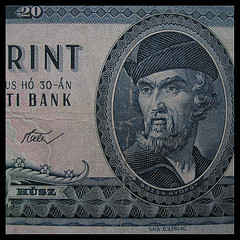
However, Dozsa was well on his way into the nationalist pantheon before Communist ascendancy. Nineteenth-century composer Ferenc Erkel, for instance,** wrote an opera about him, and poet/nationalist revolutionary Petofi Sandor saluted him in verse in 1847.

The latter text is available in Hungarian on Dozsa’s Hungarian Wikipedia page, which also attributes at least two plays about him to the Interwar period.

* aka Timisoara — in modern-day Romania, where the execution actually took place.

** Dozsa was actually captured in a fortress constructed by John Hunyadi, whose executed son is a fellow nationalist martyr (playing for the traditional-authority team), and the subject of one of Erkel’s more famous operas.


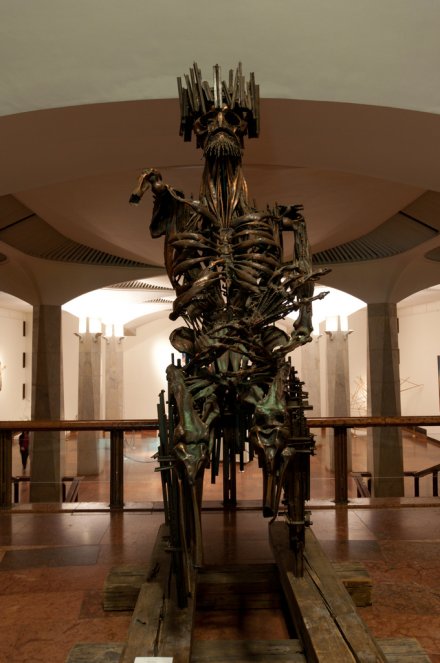
Sculpture of Gyorgy Dozsa burned on his throne, from Budapest’s Hungarian National Museum. (cc) image from redteam.

On this day..

1989: Nicolae and Elena Ceausescu

On this date in 1989, 71-year-old dictator Nicolae Ceausescu and his wife Elena were condemned by a secret military tribunal and immediately shot in Targoviste as Communism in Romania suddenly, stunningly collapsed.

The last of the Revolutions of 1989 that toppled Communism through much of Eastern Europe in a matter of weeks left the indelible image of the man who had dominated Romanian politics since the mid-60’s bewildered as a party-summoned mass rally at Bucharest’s Revolution Square turned against him.

It was to be Ceausescu’s last public address. Within a day, the country had slipped from his control; before week’s end, he would face a firing squad with “The Internationale” on his lips at the conclusion of a drumhead trial.

In a confused political situation — the police who intercepted Ceausescu and his wife held them for several hours, attempting to divine which way the winds were blowing before handing them over to the mutinous army — Romanian state television would soon broadcast footage of the trial and the first couple’s corpses (though not the execution itself).

Caution: This video contains graphic footage

Immediately afterwards, Romania abolished the death penalty. Nicolae and Elena Ceausescu remain the last people executed in that country.

On this day..