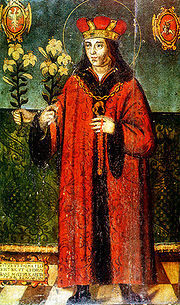
1400: Sir Thomas Blount, “bowels burning before him”

On this date in 1400, Sir Thomas Blount was drawn and quartered at Oxford.

He was a loyalist of the latterly deposed (and soon to be murdered) Richard II. Blount took part in the Epiphany Rising plot against the usurper Henry IV.

The chronicles supply an unusually graphic and detailed description (pdf) of this horrible manner of death. (Paragraph breaks have been added for readability.)

The King [Henry IV] commanded his chamberlain, Sir Thomas Erpingham, to have justice executed upon the lords who were taken prisoners, and to put them all to death, except a young knight whom he had dubbed the Saturday before his coronation, whom the King pardoned for rising in arms against him, on account of his youth and noble lineage.

Sir Thomas Blount and Sir Benet [Shelley] were drawn from Oxford unto the place of execution, a long league or more, and there they were hung; they then cut them down and made them speak, and placed them before a long fire. Then came the executioner with a razor in his hand, and kneeling down before Sir Thomas Blount, who had his hands tied, begged his foregiveness [sic] for putting him to death, for he was obliged to perform his office.

‘Are you he,’ said Sir Thomas, ‘who will deliver me from this world?’

The executioner replied, ‘Yes, my lord; I beg you to pardon me.’

The lord then kissed him and forgave him.

The executioner had with him a small basin and a razor, and kneeling between the fire and the lords, unbuttoned Sir Thomas Blount, and ripped open his stomach and tied the bowels with a piece of whipcord that the breath of the heart might not escape, and cast the bowels into the fire.

As Sir Thomas was thus seated before the fire, his bowels burning before him, Sir Thomas Erpingham said, ‘Now go and seek a master who will cure you.’

Sir Thomas Blount placed his hands together, saying, ‘Te Deum laudamus! Blessed be the hour when I was born, and blessed be this day, for I die this day in the service of my sovereign lord King Richard.’

After he had thus spoken, Sir Thomas Erpingham asked him, ‘Who are the lords, knights, and esquires who are of your accord, and treason?’

To which the good knight replied, suffering as he was, ‘Art thou the traitor Erpingham? Thou art more false than I am or ever was; and thou liest, false knight as thou art; for, by the death which I must suffer, I never spake ill of any knight, lord, or esquire, nor of anybody in the world; but thou utteredst thy false spleen like a false and disloyal traitor; for by thee, and by the false traitor the Earl of Rutland [who ratted out the conspiracy], the noble knighthood of England is destroyed.

‘Cursed be the hour when thou and he were born! I pray to God to pardon my sins: and thou traitor Rutland, and thou false Erpingham, I call you both to answer before the face of Jesus Christ for the great treason that you two have committed against our sovereign lord noble King Richard, and against his noble knighthood.’

The executioner then asked him if he would drink.

‘No,’ he replied, ‘you have taken away wherein to put it, thank God’! and then he begged the executioner to deliver him from this world, for it did him harm to see the traitors.

The executioner kneeled down, and, Sir Thomas having kissed him, the executioner cut off his head and quartered him; and he did the same to the other lords, and parboiled the quarters. And in Oxford castle many other knights and esquires were beheaded.

Thomas Erpingham doesn’t exactly exude charm in this account, going out of his way to bust on a guy having his entrails ripped out. But good guys and bad guys are a matter of perspective: Erpingham’s loyal service to the new dynasty got him a complimentary bit part in Shakespeare’s Henry V (Erpingham fought at Agincourt). Shakespeare’s young King Harry calls him his “Good old Knight”.

On this day..

1661: The effigy and books of Giuseppe Francesco Borri

Alchemist, prophet, and dashing Italian rogue, the Jesuit-educated Giuseppe Francesco Borri (English | Italian) was burned on this date in 1661.

Luckily, he was hundreds of kilometers away.

A Milanese noble by birth, Borri was studying in Rome when he experienced a vision and started expounding a mystical theology decidedly not acceptable to Catholic orthodoxy.

That Mary’s mother was conceived of the Holy Spirit, and therefore that the Madonna was a goddess. That, with the limitless proceeds of the philosopher’s stone, he’d bankroll a spiritual army under the wings of the archangel St. Michael.

The charismatic young prophet began attracting quite a following — including the eccentric Swedish Queen Christina, then hanging around Rome after her abdication and indulging her own taste for alchemy — and was soon obliged to flee Rome for Milan, and then Milan for Switzerland, with the Inquisition at his heels. (He’s supposed to have left behind the occult markings that adorn the Porta Alchemica.)

While the heresiarch was safe abroard, the Roman Inquisition went ahead with its business without him. It was ruled that Borri was

to be punished as a heretic for his errors, that he had incurred both the ‘general’ and ‘particular’ censures, that he was deprived of all honour and prerogative in the Church, of whose mercy he had proved himself unworthy, that he was expelled from her communion, and that his effigy should be handed over to the Cardinal Legate for the execution of the punishment he had deserved.

Nothing daunted, the “executed” Borri set up as a doctor, scientist, astrologer, and alchemist in northern Europe — Strasbourg, Amsterdam, and Copenhagen. Throughout the 1660s his alchemical arts attracted the patronage of royalty as well as an endless stream of ailing patients and curious hangers-on. Borri even claimed to have accomplished the feat of transmuting a base metal into gold, which magical product can still be seen at a Danish museum.


Borri’s alchemy gold.

In a way, he did: the guy became fabulously wealthy. And he never stopped promulgating his cabalistic spiritual theorems.

Unfortunately his Danish patron died in 1670, and while en route to his next gig in Turkey he was arrested in Hapsburg territory and handed over the papacy. Borri was not put to death bodily, but spent the remainder of his life imprisoned in Rome, finally dying in the Castel Sant’Angelo in 1695.

On this day..

1017: Eadric Streona, traitorous

On Christmas 1017, England’s King Cnut had the ealdorman Eadric Streona summarily axed.

While legend has it that Eadric Streona (“Grasping Eadric” or “Eadric the Acquisitor”) irritated the monarch by beating him in a game of chess, Middle Ages chroniclers attributed his fate to the just deserts of inveterate treachery.

A couple centuries of Viking raids and conquests had just culminated with the Northmen’s outright capture of the English throne, fifty years before the better-remembered Norman invasion.

Notwithstanding his best efforts at resistance, the Anglo-Saxon king Aethelred the Unready had been briefly driven into exile by Cnut’s father, Sweyn Forkbeard, and his house then decisively dispossessed by Cnut at the Battle of Assandun. (All kings had cooler names in the Anglo-Saxon period.)

Eadric figured into this period in the timeworn role of duplicitous nobleman. The BBC named him the worst Briton of the 11th century.

Though not of the highest pedigree himself, “his smooth tongue gained him wealth and high rank, and gifted with a subtle genius and persuasive eloquence he surpassed all his contemporaries in malice and perfidy, as well as in pride and cruelty.” (Florence of Worcester, whose chronicle dates to a century later.) Eadric maneuvered himself into a union with Aethelred’s daughter, but he didn’t exactly follow Corleone rules where the family was concerned.*

Plenty of lords were playing both sides of the Anglo-Saxon/Danish conflict, but Eadric did it as well as anyone. He was an exponent of the policy of appeasing the Northmen with the Danegeld tribute, rather than resisting by arms. (Eadric might have been helping himself to a rake of the Danegeld that passed through his own hands.) He’s slated with, on one occasion, dissuading Aethelred from falling upon a crippled Danish force that might have been destroyed.

His nemesis on the policy front was Aethelred’s combative son and heir Edmund Ironside. (Seriously: cooler names.)

Anyway, in 1015, when Aethelred and Cnut were pressing rival claims at arms, Eadric “seduced forty ships from the king, and they went over to Cnut.” Early the next year, he defected back.

By this time, Aethelred had died and Eadric’s old rival Edmund Ironside inherited leadership. What terms these two old foes came to when Eadric returned are a matter of speculation, but it can be no surprise that Eadric switched sides back to Cnut yet again at Assandun. Some chronicles like to attribute the whole fall of England to this backstab, but it’s more than likely the guy just recognized the balance of forces (the English got routed) and tacked to the wind.

And Eadric sure could tack. He even helpfully cleared out his and Cnut’s mutual rival Edmund Ironside, allowing Cnut to claim all the lands he’d just recently agreed to leave to Edmund. The most flinch-inducingly scabrous version of the assassination story goes that Eadric’s guys shot Edmund up the backside from a privy-hole. Guess that side wasn’t so iron.

But Eadric’s belief that he’d ingratiated himself with Cnut was as sorely mistaken as Edmund Ironside’s confidence in the loo. Kings tend to look askance upon traitors, and not a few usurpers have been known to extend that opprobrium to the very people who betrayed their predecessors. Cnut valued loyalty, and it was pretty clear he couldn’t rely upon Eadric in that department.

After tolerating this underhanded underling for a decent year or so,

[a]t the Lord’s Nativity, when [Cnut] was in London, he gave orders for the perfidious ealdorman Eadric to be killed in the palace, because he feared to be at some time deceived by his treachery, as his former lords Ethelred and Edmund had frequently been deceived; and he ordered his body to be thrown over the wall of the city and left unburied.

-Florence of Worcester (via)

The rich English-history podcast environment has various offerings touching this period, including …

* It needs to be said that Eadric is known through the testimony of hostile chronicles; given the dearth of primary documentation, his reputation lies at their mercy. One 20th century historian remarked that he takes on a bogeyman character in the texts, an all-purpose villain “to whom unknown crimes may be safely attributed.”

On this day..

1600: The corpses of John and Alexander Ruthven, for the Gowrie conspiracy

Remember, remember, the fifth of … August?

If you didn’t get August 5 off, your jurisdiction is ignoring the Scottish parliament’s 1600 decree: “in all times and ages to come the fifth of August should be solemnly kept with prayers, preachings, and thanksgiving for the benefit, discharging all work, labour, and other occupations upon the said day.”*

They didn’t mean to keep it out of excess reverence for St. Emygdius: rather, August 5 was the date of the Gowrie conspiracy, a sketchy supposed assassination attempt on King James VI of Scotland (soon also to become King James I of England). John Ruthven, Earl of Gowrie and his brother Alexander Ruthven were both slain on the spot during that event … but not until 15 weeks later did Parliament rule that “the said bodies of the said Traitors shall be carried, upon Monday next [i.e., November 17], to the publick cross of Edinburgh: and there to be hangd, quarter’d, and drawn, in presence of the hail People: and thereafter, the heads, quarters, and carcasses, to be affix’d upon the most patent parts and places of the Burroughs of Edinburgh, Perth, Dundee and Stirling.”

Did they deserve it?

Scottish writer John Prebble considered the Gowrie conspiracy one of his realm’s best mysteries. It’s a maddeningly perplexing sequence of ambiguous (or altogether dubious) events related by interested, partisan sources.

I am murtherit!

The summary official version — and we’re skipping over such writerly red herrings as a mystery man in the turret, a still-stabled horse, and a wild fable about a pot of foreign gold — is that while staying at the Ruthven estates, James’s courtiers saw him shouting out the window, “I am murtherit! Treassoun! My Lord of Mar, help! help!”

While Lord Mar and others spent half an hour (!) trying to batter down a locked entrance to the regicidal turret, a page named John Ramsay found another staircase in, where he came upon the king and Alexander Ruthven grappling. Ramsay stabbed Ruthven about the head and neck, and Ruthven fled down Ramsay’s same staircase: there he careened headlong into more arriving royal retainers who killed him flat. Ruthven died exclaiming “Allace! I had na wyte [blame] of it!”

Meanwhile, the Lord Gowrie — quite possibly knowing nothing but that there was a commotion involving the king in his home — had rallied outside the courtyard with his own household and marched in swords drawn, passing the fresh-slain body of his little brother on the way. He must have been in an evil temper when he burst into the chamber, there to discover Ramsay and friends, and only them: the king had been locked in another room for his protection. Ramsay demanded Gowrie’s submission and the two crossed swords, with Ramsay running the elder Ruthven through, too.

(Small wonder Ramsay went on to become a royal favorite.**)

“… if it be true”

“A very wonderful story, your Majesty, if it be true,” one lord is supposed to have replied to James upon hearing this amazing tale.

Suspicion was immediately rife that this “treason” stuff was a cover for the king to take out a rival noble. The Ruthvens had often been at odds with King Jamie’s own family; John and Alexander’s own father was beheaded in 1584 for trying to kidnap the then-teenaged king, and their grandfather had helped a gang of nobles destabilize James’s mother Mary by murdering her favorite courtier David Rizzio right before her eyes. And of course, the crown would be able to seize all the “traitors'” estates, nicely flipping around a significant cash debt owed to the Ruthven clan.

Edinburgh Presbyterian ministers openly disputed the Ruthvens’ guilt, refusing to thank God for James’s “deliverance”.† James found it necessary to forcibly quash this talk, and he would insist upon the Ruthvens’ guilt all his days. But those outside the reach of Scottish royal power had looser tongues.

French nobles who had met Gowrie on the latter’s recent return from his continental studies, and Queen Elizabeth, who had received Gowrie warmly at court, openly doubted the official account: it was thought wildly at odds with the young man’s character. The nature of the interaction between the king and Alexander Ruthven prior to the intervention of John Ramsay depends upon the account of the king himself — that account, and no other. The other witnesses were dead. And the object of the plot seems unclear: sure, maybe Alexander Ruthven could have killed the king mano a mano, but then what? There was no indication at all of confederates (even Alexander’s brother reacted in confusion), nor coherent design for some next step like massacring James’s courtiers or toppling the government or even escaping. These were scheming aristocrats, not deranged lone assassins. And both James and Gowrie had behaved for all the world before this incident as if the unpleasantness with the father was water under the bridge.

“The assassination of the Gowries was the most indefensible act that has ever appeared on the pages of Scottish history,” avers mildy a 1912 volume of the Ruthven family papers. It was “a cunning conspiracy that has disgraced the historical record for more than three hundred years.”

The jury’s still out

Still, the hypothetical account of a royal anti-Gowrie conspiracy seems if anything even less satisfying than the official story. Most of the happenings besides what passed between Alexander and James were witnessed by others, so … the king falsely yelled “treason” counting on the handful of his guys staying in the Ruthvens’ own place to kill the Ruthvens instead of the other way around? Events played out so chaotically that this convenient outcome seems mere [mis]chance. What was the plan if John Ramsay hadn’t found the unlocked second entrance?

And yet some 350 witnesses were examined without turning up any concrete design, and three Ruthven retainers hanged on August 23 insisting upon their innocence of any treasonable intent.

One can go a lot of ways from here, and it’s hard to spin any one story that satisfyingly accounts for all the evidence. A scheme to kidnap (and extract policy change from) the king, rather than murder him? Alexander an unwilling pawn, forced into it by his brother? Or, as one English envoy supposed, a destructive spiral of events proceeding from a silly misunderstanding wherein a chance reference to the Ruthvens’ executed father led Alexander to defend the family a little too hotly and the king to start shouting in panic when he realized he was unarmed in the company of an excited, and much larger, man?‡

We’ll never really know. Light a candle for epistemological uncertainty next August 5.

Much help drawn from a two-parter review of the contradictory evidence in The Scottish Historical Review, nos. 121 and 122 (April and October 1957) by W.F. Arbuckle.

* August 5 was indeed “solemnly kept” during the reign of James, according to F.C. Eeles in “The English Thanksgiving Service for King James’ Delivery from the Gowrie Conspiracy” from the July 1911 Scottish Historical Review. As the title of that piece suggests, there was even a service promulgated (though never incorporated into the Book of Common Prayer), beseeching God that James “may bee kept as the apple of thine eye, and thy kindnesse and mercy may follow him all the dayes of his life, with abundance of all thy blessings both heavenly and earthly upon his Majesty, our gracious Queene, the Prince …”

The Prince in question was the future King Charles I, which might cause one to doubt the prayer’s efficacy.

** Ramsay would be supplanted in the royal sun come the 1620s, by George Villiers.

† Religion affords another potential motivation here, although perhaps only retrospectively. James was working a long-term project to reintroduce episcopacy — crown-appointed bishops — to control the loose canons of Scotch Presbyterianism. “No bishop, no king,” in the aphorism attributed him.

With the Gowrie plot as backdrop, James was able to force radical ministers and their tin-foil hats out of Edinburgh and obtain the consent of the rest to James’s own hand-picked bishops — the camel’s nose under the tent, if you like. (See Maurice Lee, Jr., “James VI and the Revival of Episcopacy in Scotland: 1596-1600,” Church History, 43 (1974).) The Ruthven family papers volume also sets great stock by the idea that a Catholic party was out to get Lord Gowrie.

‡ “by occasion of a picture (as is sayde) or otherwise, speech happening of Earle Gourie his father executed, the k. angrelie sayde he was a traitour. Whereat the youth showing a greived and expostulatorie countenance and happilie Scot-like woords, the k. seeing hymself alone and wythout weapon cryed, ‘Treason, Treason’. The Mr [i.e., Alexander Ruthven], abashed much to see the k. to apprehend yt so … putt his hand with earnest deprecations to staie the k. showing his countenance to them with out in that moode, immediatlie falling on his knees to entreat the k.” Ramsay did say that when he entered the room he saw Alexander’s head under James’s arm, which might be consistent with this supplicatory pose … especially given that accounts of the men’s respective physiques suggest Alexander should have had the clear advantage in an actual scrap.

On this day..

1569: Vladimir of Staritsa, royal cousin

On this date in 1569, Vladimir of Staritsa was forced by Ivan the Terrible’s goons to drink poison.

Vladimir was Ivan’s (barely) younger cousin, both of them grandsons of Russia’s state-building Ivan the Great.

Ivan the Terrible, of course, was the heir to the throne, an inheritance he received at the tender age of three when his father died unexpectedly — leading to Ivan’s famously miserable childhood of being kicked around by the boyars.

The dreadful relationship thereby fostered between throne and nobles came to a crossroads in 1553, when Ivan the Terrible appeared to be on his deathbed. The fading tsar tried to get those boyars to swear loyalty to Ivan’s infant son. Most of the boyars openly preferred the adult Vladimir of Staritsa.

This dramatic encounter is a pivotal episode in Sergei Eisenstein’s classic film Ivan the Terrible.

Instead of dying, Ivan surprisingly recovered. Awkward!

Vladimir actually survived this episode, and he himself may not even have been actively trying to claim the throne: the boyars hated Ivan plenty without his seditious assistance.

And for a while it looked as if any ill feelings were water under the bridge. Vladimir swore loyalty to Ivan upon the latter’s recovery, fought military campaigns alongside Ivan, and was even depended upon by Ivan as a guarantor of peace among Ivan’s own several potentially rivalrous sons.*

But that was the 1550s.

As the 1560s unfolded, Ivan grew increasingly mistrustful of his boyars’ loyalty.** According to this volume, an elevation of Vladimir to the throne was the object of at least one plot during those years. As Ivan’s only male cousin, he was a natural successor should Ivan be deposed, and therefore a natural focal point for Ivan’s enemies.

When Ivan eventually gave rein to his paranoia and unleashed the bloody purges of the oprichnina, Vladimir inevitably succumbed. Ivan decreed his death and forced him to administer the sentence by his own hand with a draught of poison, even going so far as to extirpate Vladimir’s wife and children, too.†

In a twist of the cruel irony Russian history is so susceptible to, Ivan the Terrible’s homicidal suspicion of his relations helped to doom Ivan’s own Rurik dynasty: after Ivan accidentally killed his own son and heir in a fit of pique, the succession which might have found a backup option in Vladimir and his offspring instead utterly collapsed — plunging Russia into the “Time of Troubles” out of which one of those former boyar families, the Romanovs, emerged with the throne after all.

* See Sergei Bogatyrev, “Reinventing the Russian Monarchy in the 1550s: Ivan the Terrible, the Dynasty, and the Church”, The Slavonic and East European Review, Apr. 2007. (pdf here)

** Ivan’s nasty turn after 1560 might trace to the untimely death of his wife Anastasia Romanovna, whom Ivan suspected might have been poisoned by those hated boyars.

† One daughter Maria Vladimirovna of Staritsa, survived.

On this day..

1642: Henri Coiffier de Ruze, Marquis of Cinq-Mars

On this date in 1642, with the last words “Mon Dieu! Qu’est-ce que ce monde?”, 22-year-old former royal favorite Cinq-Mars was beheaded at Lyon’s Place des Terreaux.

Henri Coiffier de Ruze (English Wikipedia page | French) had been under Cardinal Richelieu’s protection since the boy’s father died in 1632; in 1639, the Red Eminence introduced the then-19-year-old whippersnapper to Louis XIII as a prospective royal favorite (read: lover).

Though the king did indeed take to the youth, Cinq-Mars, in the age-old custom of sullen teenagers everywhere, soon found the luxurious profligacy of the favorite’s life rather overbalanced by irritation at both of his sickly, aging patrons.

Tart talk to intimates graduated to something more serious after Richelieu rudely put the kibosh on Cinq-Mars’s (unrealistic) designs on a wealthy noblewoman — which was also a bid to parlay his tenuous favorite gig into some lasting power.

Now considering himself personally begrudged of the Cardinal, Cinq-Mars fell into the conspiracies (French link) to depose, assassinate, or otherwise replace him.

Eventually Cinq-Mars would go so far as a real blockbuster (French again): he signed a secret pact with the Spanish king to support a noble revolt in exchange for handing over French possessions, a seditious plan also backed by perennial plotter Gaston d’Orleans, the king’s scheming brother.

Our angry moppet had more than met his match in Richelieu, however: the cardinal’s agents intercepted (more French) the treasonable correspondence and had Cinq-Mars dispatched this date along with his confederate de Thou.


Execution of Cinq-Mars and De Thou in Paris (1642), engraving by Johann Luyken, Paris, BibliothĆØque nationale de France (via)

Richelieu himself was already dying as he undid this last conspiracy against him. The cardinal succumbed on December 4, 1642 … with Louis following him into the grave the next May.

While Richelieu’s name is fixed in the firmament of history and literature, Cinq-Mars has to make do as the namesake of a rarely-seen Gounod opera, based on the 1826 historical novel Cinq-Mars by Alfred de Vigny.

On this day..

1481: Michal Olelkowicz and Iwan Holszanski, Lithuanian princes

On this date in 1481, two Lithuanian princes were beheaded in Vilnius for plotting the assassination of the Polish-Lithuanian king.

This late 15th century was a heady time for Poland under the Jagiellon dynasty, and one of this dynasty’s going projects was keeping the adjacent realms of Poland and Lithuania linked together. In time, they would become formally joined, but at this point they were independent entities “united” only by the personal union of the Jagiellon monarch himself.

That monarch in the late 15th century was the redoubtable Casimir IV (Kazimierz IV): Grand Duke of Lithuania since 1440, King of Poland since 1447. Casimir’s family hailed from Lithuania; indeed, as that place had been last European place to Christianize, Casimir’s own father had been born a pagan.

Casimir IV’s eponymous son is St. Casimir, patron saint of both Lithuania and Poland; both actively honor his feast date of March 4.

Lithuania agonistes

Lithuania had a strong independent streak (pdf), and its boyars did not necessarily see eye to eye with the Grand Duke. Casimir was keen on centralizing Lithuania’s administration and checking the potential rivalry of the most powerful Lithuanian families, the classic seeds of crown-vs-nobility conflict the world over.

And both watched with a wary eye the growth of Muscovy under the energetic leadership of Ivan III, aka Ivan the Great.

That expanding state in the 1470s gobbled up the buffer city-state of Novgorod; Ivan III’s newly-minted honorific Tsar of all the Rus(sians) openly announced his designs on Lithuania’s own historically Slavic Ruthenian territory. “The gatherer of the Russian lands,” Ivan is known as … and Lithuania (much larger then than it is now) stood to be the gatheree.

The Great Stand on the River Ugra

Come 1480, Casimir was allied against Moscow with the Mongol Horde, the famous “Tatar yoke” that had been collecting Russian tribute for two-plus centuries. In Russian historiography this is the crucial moment when that yoke is thrown off, and the Muscovites accomplished that in part by crossing up the Lithuanians.

The Horde, having marched through Lithuanian territory, assembled on the banks of the Ugra River, opposite a waiting Muscovite army. Neither army attacked. Instead, they waited … and waited … and waited some more.

The Horde, for its part, was waiting for reinforcements from its Lithuanian ally. But those reinforcements never arrived, thanks in part to Russia’s alliance with Crimean khan Mengli Giray, who seems to have absorbed Casimir’s attention in the fall of 1480 with a vexing combination of raids into southern Lithuania and dilatory ceasefire diplomacy. Distracted by the homeland threat, Lithuania never got around to supporting the Horde … and the Horde, after freezing itself on the banks of the Ugra for a couple of months, simply marched away in frustration.

Moscow never again paid it tribute … and its Crimean ally destroyed the Great Horde utterly in 1502.

Chop

This was the context, back in Lithuania, for the attempt on Casimir’s life that would cost two princes their heads. Notwithstanding his unhelpful alliance with the Great Horde, it seems apparent that Casimir himself espoused a fundamentally western policy: the Jagiellon dynasty had branches in Hungary, Bohemia, Germany, and Casimir had more taste for meddling in these realms than dealing with Russia. One could imagine how a Lithuanian magnate out his lucrative Novgorod trade would feel like the head man didn’t really have his eye on the ball; in 1478, a Lithuanian delegation even requested that Casimir appoint a Lithuanian governor to look after the interests of the Grand Duchy. (Casimir refused.)

And these nobles were getting it at both ends, since Casimir’s state-centralization project meant that they were being cut down to size in terms of their internal political power, too.

Apparently with the support of Moscow itself (whose expansionary interest is self-evident) Iwan Holszanski and Fedor Bielski hatched a plan to murder the Grand Duke and his sons on Palm Sunday, 1481 — which was also the occasion of Fedor Bielski’s wedding. The idea was to replace him with Michal Olelkowicz (Mikhail Olelkevich), who had been Novgorod’s elected prince-ruler in the late 1460s; it’s not clear to me if Olelkowicz himself was actually in on the scheme.

Casimir, at any rate, caught wind of the plot. Legend has it that a servant decorating a room ran across the conspirators’ weapons niches and reported it; it’s alternately alleged that the assassins meant to jump Casimir while out on his favorite pastime, hunting.

However it was supposed to go down, it didn’t work. Bielski was able to flee to Moscow (ditching his newlywed bride), but left Holszanski and the coup’s prospective beneficiary Olelkowicz to suffer beheading this date upon evidence “brighter than the sun” of their treason.

Sources:

This webcache page.

The Polish-Lithuanian State 1386-1795, by Daniel Stone.

Russia’s Steppe Frontier: The Making of a Colonial Empire, 1500-1800, by Michael Khodarkovsky.

On this day..

1469: Richard Woodville, father of the queen

On this date in 1469, Richard Woodville, the father of the queen, lost his head.

Though he died as Earl Rivers, Woodville started life as a commoner.

As a retainer to the Duke of Bedford, Woodville drew escort duty for the mistress of the house when the master died suddenly. Not one to waste an opportunity, Woodville soon made the merry widow his merry wife: at the time, he was around 30 and she around 20, while the late husband had kicked off at age 46.

For this impertinent and unauthorized union, the couple paid a fine … and their descendants enjoyed royal power. Well-behaved women and knights-errant seldom make history, right?

Marrying nobility put Woodville into the War of Roses game of throne, where he again proved a deft hand with sneaky conjugation.

In 1464, he secretly married his widowed daughter Elizabeth to the young king Edward IV. Elizabeth Woodville became thereby the first commoner in history to marry an English king.

She also became a lightning-rod.

The Earl of Warwick, so powerful that he was known in this era of uneasy-resting crowns as “The Kingmaker”, was embarrassingly undercut by the Woodville match in his own machinations to pair Edward with a French princess. A stunned Privy Council castigated Edward when it found out — “however good and however fair she might be,” they grumbled “she was no wife for a prince such as himself; for she was not the daughter of a duke or earl” — but the young king stood by his lady.

A love match? We leave that question for the poets and the novelists.

From left to right, Philippa Gregory‘s books about Richard Woodville’s wife, daughter, and granddaughter. Gregory also wrote a nonfiction companion to this bestselling series, The Women of the Cousins’ War: The Duchess, the Queen, and the King’s Mother.

But politically, the Woodville marriage certainly upset the game board. Richard Woodville got promoted to Earl Rivers and others of the tribe profited likewise: this made good sense for Edward because these people would owe their positions, and loyalty, to him.

Contrast with the independent, arrogant aristocrat set like Warwick, who soon proceeded — and what part l’affaire Woodville plazed in his defection is up for speculation, although it was part of his own publicly asserted justification — to desert Edward’s Yorkist cause for the Lancastrian claimant.

Warwick’s rebellion succeeded in overthrowing Edward in 1469, and it was in the glow of this victory that Warwick had the obnoxious arriviste Richard Woodville beheaded as a traitor, together with the man’s son John.

Unfortunately for Warwick, it was but a moment.

Unable to govern, Warwick had to release his royal prisoner, and the sides slid back into open conflict. Edward decisively crushed the Lancastrians at the Battle of Tewkesbury, conveniently killing Warwick in the process.

Duly returned to her station, Elizabeth Woodville produced two sons for her husband, the boys history remembers as the Princes in the Tower — which is where the last LancastrianYorkist king Richard III is thought to have murdered them. In Shakespeare’s Richard III, Queen Elizabeth is quite the bummer.

Ay me, I see the ruin of my house!
The tiger now hath seiz’d the gentle hind;
Insulting tyranny begins to jet
Upon the innocent and aweless throne.
Welcome, destruction, blood, and massacre!
I see, as in a map, the end of all.

But her house wasn’t quite ruined after all: Elizabeth Woodville also produced a daughter, also named Elizabeth. This latter “Elizabeth of York” married another descendant of a commoner, who carried the Lancaster standard: this fellow of doubtful lineage would finally resolve the War of the Roses and reign as Henry VII. (Father, namesake, and predecessor, of course, to this site’s patron head-chopping monarch Henry VIII: Richard Woodville’s great-grandson.)

On this day..

1789: Joseph-Francois Foulon, corrupt financier, lynched

On this date, just days after the Bastille fell, so did the head of widely-loathed ancien regime pol Joseph-Francois Foulon (or Foullon) de Doue.

“This is that same Foulon,” says Carlyle, “named ame damnee du Parlement; a man grown gray in treachery, in griping, projecting, intriguing and iniquity: who once when it was objected, to some finance-scheme of his, ‘What will the people do?’ — made answer, in the fire of discussion, ‘The people may eat grass:’ hasty words, which fly abroad irrevocable, — and will send back tidings!”

Marie Antoinette, eat your cake out.

Foulon’s grass tidings would arrive courtesy of the king‘s July 11, 1789 dismissal of Finance Minister Jacques Necker and attempt to rule through an ultra-royalist government. It was fury over this apparent reactionary coup that led to the storming of the Bastille and catalyzed the French Revolution.

Foulon, now the Controller-General of Finances — and as Carlyle puts it, “a scoundrel; but of unmeasured wealth,” who had gorged himself at the public trough while the kingdom’s finances grew thin, and who was widely suspected of having manipulated the food supply out of cruel rapacity — apprehended the danger and fled town. He even staged a lavish funeral to put about word that he had died suddenly.

But “some living domestic or dependant, for none loves Foulon,” betrayed him (Carlyle’s version) — or by whatever means, the Parisian mob sniffed him out. Then it quickly did to him what the Parisian mob would soon become famous for. “His old head, which seventy-four years have bleached, is bare; they have tied an emblematic bundle of grass on his back; a garland of nettles and thistles is round his neck: in this manner; led with ropes; goaded on with curses and menaces, must he, with his old limbs, sprawl forward; the pitiablest, most unpitied of all old men.”

Carlyle spares little but the most animal pity for Foulon, but the mob did not even muster that. Summoned to be judged at the Hotel de Ville — the Marquis de Lafayette and the new mayor of Paris, Bailly, unsuccessfully attempted to intercede for proper procedure — Foulon found himself instead subject to the revolutionary judgment of the masses.

For Dickens, in A Tale of Two Cities, this incident forms one of the mileposts of the Revolution, when the waiting sans-culottes of Saint Antoine are transfigured, and leads the fictional long-time revolutionary conspirator Defarge to sigh to his even more implacable wife, “At last it is come, my dear!”

“Does everybody here recall old Foulon, who told the famished people that they might eat grass, and who died, and went to Hell?”

“Everybody!” from all throats.

“The news is of him. He is among us!”

“Among us!” from the universal throat again. “And dead?”

“Not dead! He feared us so much—and with reason—that he caused himself to be represented as dead, and had a grand mock-funeral. But they have found him alive, hiding in the country, and have brought him in. I have seen him but now, on his way to the Hotel de Ville, a prisoner. I have said that he had reason to fear us. Say all! Had he reason?”

Wretched old sinner of more than threescore years and ten, if he had never known it yet, he would have known it in his heart of hearts if he could have heard the answering cry.

A moment of profound silence followed. Defarge and his wife looked steadfastly at one another. The Vengeance stooped, and the jar of a drum was heard as she moved it at her feet behind the counter.

“Patriots!” said Defarge, in a determined voice, “are we ready?”

Instantly Madame Defarge’s knife was in her girdle; the drum was beating in the streets, as if it and a drummer had flown together by magic; and The Vengeance, uttering terrific shrieks, and flinging her arms about her head like all the forty Furies at once, was tearing from house to house, rousing the women.

The men were terrible, in the bloody-minded anger with which they looked from windows, caught up what arms they had, and came pouring down into the streets; but, the women were a sight to chill the boldest. From such household occupations as their bare poverty yielded, from their children, from their aged and their sick crouching on the bare ground famished and naked, they ran out with streaming hair, urging one another, and themselves, to madness with the wildest cries and actions. Villain Foulon taken, my sister! Old Foulon taken, my mother! Miscreant Foulon taken, my daughter! Then, a score of others ran into the midst of these, beating their breasts, tearing their hair, and screaming, Foulon alive! Foulon who told the starving people they might eat grass! Foulon who told my old father that he might eat grass, when I had no bread to give him! Foulon who told my baby it might suck grass, when these breasts were dry with want! O mother of God, this Foulon! O Heaven our suffering! Hear me, my dead baby and my withered father: I swear on my knees, on these stones, to avenge you on Foulon! Husbands, and brothers, and young men, Give us the blood of Foulon, Give us the head of Foulon, Give us the heart of Foulon, Give us the body and soul of Foulon, Rend Foulon to pieces, and dig him into the ground, that grass may grow from him! With these cries, numbers of the women, lashed into blind frenzy, whirled about, striking and tearing at their own friends until they dropped into a passionate swoon, and were only saved by the men belonging to them from being trampled under foot.

Nevertheless, not a moment was lost; not a moment! This Foulon was at the Hotel de Ville, and might be loosed. Never, if Saint Antoine knew his own sufferings, insults, and wrongs! Armed men and women flocked out of the Quarter so fast, and drew even these last dregs after them with such a force of suction, that within a quarter of an hour there was not a human creature in Saint Antoine’s bosom but a few old crones and the wailing children.

No. They were all by that time choking the Hall of Examination where this old man, ugly and wicked, was, and overflowing into the adjacent open space and streets. The Defarges, husband and wife, The Vengeance, and Jacques Three, were in the first press, and at no great distance from him in the Hall.

“See!” cried madame, pointing with her knife. “See the old villain bound with ropes. That was well done to tie a bunch of grass upon his back. Ha, ha! That was well done. Let him eat it now!” Madame put her knife under her arm, and clapped her hands as at a play.

The people immediately behind Madame Defarge, explaining the cause of her satisfaction to those behind them, and those again explaining to others, and those to others, the neighbouring streets resounded with the clapping of hands. Similarly, during two or three hours of drawl, and the winnowing of many bushels of words, Madame Defarge’s frequent expressions of impatience were taken up, with marvellous quickness, at a distance: the more readily, because certain men who had by some wonderful exercise of agility climbed up the external architecture to look in from the windows, knew Madame Defarge well, and acted as a telegraph between her and the crowd outside the building.

At length the sun rose so high that it struck a kindly ray as of hope or protection, directly down upon the old prisoner’s head. The favour was too much to bear; in an instant the barrier of dust and chaff that had stood surprisingly long, went to the winds, and Saint Antoine had got him!

It was known directly, to the furthest confines of the crowd. Defarge had but sprung over a railing and a table, and folded the miserable wretch in a deadly embrace—Madame Defarge had but followed and turned her hand in one of the ropes with which he was tied—The Vengeance and Jacques Three were not yet up with them, and the men at the windows had not yet swooped into the Hall, like birds of prey from their high perches—when the cry seemed to go up, all over the city, “Bring him out! Bring him to the lamp!”

Down, and up, and head foremost on the steps of the building; now, on his knees; now, on his feet; now, on his back; dragged, and struck at, and stifled by the bunches of grass and straw that were thrust into his face by hundreds of hands; torn, bruised, panting, bleeding, yet always entreating and beseeching for mercy; now full of vehement agony of action, with a small clear space about him as the people drew one another back that they might see; now, a log of dead wood drawn through a forest of legs; he was hauled to the nearest street corner where one of the fatal lamps swung, and there Madame Defarge let him go—as a cat might have done to a mouse—and silently and composedly looked at him while they made ready, and while he besought her: the women passionately screeching at him all the time, and the men sternly calling out to have him killed with grass in his mouth. Once, he went aloft, and the rope broke, and they caught him shrieking; twice, he went aloft, and the rope broke, and they caught him shrieking; then, the rope was merciful, and held him, and his head was soon upon a pike, with grass enough in the mouth for all Saint Antoine to dance at the sight of.

That grass-stuffed head on a pike was there waiting when the bloody banquet’s digestif arrived later that evening in the form of Foulon’s son-in-law Louis-Jean Bertier de Sauvigny: another government official arrested that day and drug to the same place, for the same fate.


Bertier de Sauvignon, Intendant of Paris, Is Led to His Punishment (Source, specifically image 25)

On this day..

1537: Janet Douglas, Lady Glamis

On this date in 1537, a Scottish noblewoman suffered the fate decreed for her treason — in the terse entry of the judicial record, combusta.

Knocking around Glamis Castle — where Shakespeare’s great villain Macbeth got his start, as Thane of Glamis* — Janet Douglas had the going enmity of Scottish king James V on the substantial grounds that Janet’s father had held the teen-king his virtual prisoner for a few years in the 1520s. Once James got free, he proscribed the lady’s brother, the Earl of Angus (whom Janet continued to shelter when occasioned), confiscated properties, forbade Douglases from approaching his person, and all that sort of thing.

Presumably according to this same anti-Douglas animus, an abortive attempt was made in 1531 to try our Lady Glamis for poisoning her late first husband, Lord Glamis. However, the charge foundered on the refusal of her peers to participate: “the lairds of Ardoch, Braco, Fingask, Abernethy, Piferran, Lawers, Carnock, Moncreiff, Anstruther, Lord Ruthven, Lord Oliphant, and many others, were fined for absenting themselves from the jury.”

Six years later she was more successfully returned to the dock, this time on a charge of plotting to poison the king himself. There seems to remain very little detail that would trace the precise unfolding of those years and offer later interlocutors a clear interpretation; while “innocent noble railroaded” is the most conventional read — Henry VIII’s agent reported that the conviction was secured “without any substanciall ground or proyf of mattir” — this book gives it a “maybe she did, maybe she didn’t” spin. That whole embittered proscription thing cuts both ways, as motives go.

At any rate, torture induced Janet Douglas’s own 16-year-old son John to testify that she had procured a potion intended to resolve that feud, and despite reported doubts and a spirited defense, the judges found her “committit art and part of the tressonabill Conspiratioune and ymaginatioune of the slauchter and destructioune of our soverane lordis” and therefore to “be had to Castell hill of Edinburghe, and thair brynt in ane fyre to the deid as ane Traytour.” (John was reprieved of this fate, but he still had to watch.)

King Jamie took over Glamis Castle and hung his spurs there until his own death in 1542 … whereupon his crown passed to Mary, Queen of Scots, and the castle reverted to that young John, the new Lord Glamis.

Glamis Castle still stands, picturesquely, and legend has it that the visitor there might encounter the burned woman’s ghost haunting the place as the Grey Lady.**

* Not actually true of the historical man Macbeth.

** Not to be confused with the New York Times. Actually, there are several ghosts who go by this colorless title.

On this day..