1970: Nineteen in Baghdad

From the Jan. 23, 1970 Times of India:

Damascus, January 22.

Iraq’s execution mill worked without let-up today with 36 people put to death in 24 hours — all but seven of them accused of plotting to overthrow the Government.

Seven of the men, not connected with the plot, were convicted in November of spying for the U.S., Radio Baghdad said.

It identified one of them, Albert Nounou, as a Jew.

The 29 people who were accused of trying to overthrow the leftist regime of President Ahmed Hassan al Bakr on Tuesday night and early yesterday faced firing squads or hangmen.

Mr. Bakr addressed crowds outside the Presidential palace, saying that any plot against his Government would “only lead to the cutting of the plotters’ throats,” Radio Baghdad said.

DETAILS GIVEN

The executioners worked past midnight yesterday, carrying out death sentences given to 22 persons convicted of the coup attempt.

Then at dawn, the seven people convicted in November were put to death. A few hours later, Radio Baghdad said six Army officers and a civilian were doomed by a special court for taking part in the attempted coup. Shortly thereafter, the military men were shot by firing squad and the civilian was hanged.

The Government newspaper, “Al Thawra,” said firing squads were using the plotters’ own weapons for the executions.

The Baghdad broadcast said that in addition to the six military men and civilians executed this morning, the court had sentenced three other people to life imprisonment. –U.N.I.

From the Jan. 23, 1970 London Times, under the headline “Toll of executions in Iraq reaches 41”:

Baghdad, Jan. 22. — The abortive coup d’etat in Iraq on Tuesday was engineered with the assistance of the Israel, American, and Iranian secret services, the Iraq news agency said tonight. It made the accusation after the executions of two more soldiers and three civilians, bringing to 41 the total number of alleged plotters executed in Baghdad either by firing squads or hanging since yesterday morning.

Two more men were waiting execution after sentence.

Some 3,000 sub-machineguns, 650,000 rounds of ammunition, and a mobile radio transmitted had been seized, the agency stated.

Earlier today Iraq accused the Iranian Ambassador and four members of his Embassy staff of being implicated in the coup attempt, and ordered them to leave the country within 24 hours.

In Teheran, Iran retaliated by giving the Iraq Ambassador, the military attache, and his three assistants 24 hours to leave Iranian soil. It also ordered the closure of all Iraq consulates in Iran. — Agence France Presse and Reuter

Part of the Daily Double: Saddam Hussein crushes a coup.

On this day..

1970: Twenty-two in Baghdad

From the Jan. 22, 1970 London Times:

Baghdad, Jan 21. — Twenty-two people were executed in Baghdad today for plotting to overthrow the Iraq Government.

First of all three retired Army men and two serving officers were executed by firing squad. Seventeen more executions were carried out tonight and Baghdad radio said a special three-man tribunal set up to try the plotters was still meeting.

The radio had interrupted its programmes to announce the discovery of a plot, crushed by tanks last night, against the ruling Baath Party. All the plotters were arrested, it said.

Two Government soldiers had died in putting down the conspiracy, the radio said. An official funeral for them will be held in Baghdad tomorrow, and the radio called on the people to attend in thousands.

Although there were no details of how many plotters were arrested, the fact that clashes occurred suggested to observers that an actual attempt had been made against the Government when the Army moved in. Tanks from Rashid Army camp, on the fringes of the capital’s suburbs, foiled the plot, according to the official Iraq news agency.

The radio claimed that the United States, Britain and West Germany were behind the attempted coup.

The Middle East News Agency said some Army officers pretended to join the conspirators and then reported them to the authorities.

The executed men were accused of plotting against the socialist regime of President Ahmed Hassan al-Bakr in the interests of “imperialism and Zionism”. –Reuter, A.P. and U.P.I.

Part of the Daily Double: Saddam Hussein crushes a coup.

On this day..

1922: Eleuterio Corral and Rumaldo Losano, escapees

(Thanks to Meaghan Good of the Charley Project for the guest post. -ed.)

On this day in 1922, Eleuterio Corral and Rumaldo Losano were hanged in New Mexico’s Grant County Jail in Silver City for the 1921 murder of a prison guard.


Corral (left) and Losano (right).

Losano and Corral were serving time in the Grant County Jail for robbery (Corral) and attempted larceny (Losano) in the spring of 1921. Losano had only fifteen days days left to go on his sentence. Nevertheless, on April 2, 1921, the two young men decided to make a break for it. The jailer, sixty-year-old Ventura Bencoma, had been sick with the flu and during the early morning hours he decided to have a lie-down. While Bencoma slept, Corral and Losano were able to get out of the cell they shared.

A nearby cell was unoccupied and used for storing coal and firewood, and had an ax. The two convicts sneaked up on Bencoma and brained him with the ax, took his gun and keys, and threatened to shoot the other prisoners if they made any noise. They tried to use the keys to release another prisoner, Jesus Rocha, but weren’t able to get the lock undone and gave up. As soon as the pair had run off into the darkness, the others started screaming for help and woke up the sheriff, who was also enjoying a siesta of his own up on the second floor and had missed the entire jailbreak.

Bencoma died within a few hours, as the sheriff and a posse of men were searching for Losano and Corral. On April 5, after a brief exchange of gunfire, the fugitives were captured hiding in a shack. Their statements are summarized in West C. Gilbreath’s Death on the Gallows: The Story of Legal Hangings in New Mexico, 1847-1923:

Both Eleuterio and Rumaldo bragged out loud of their escape and short freedom. Both men told Sheriff Casey it was Jesus Rocha who planned the escape and was to have joined them. Sheriff Casey learned from the two that after Jailer Bencoma’s keys and pistol were removed, they were to unlock the steel cell door to Jesus Rocha. Once he was released, the three were to go up to the second floor where Sheriff Casey’s quarters were and call him to the door. Once the Sheriff opened the door, he would be shot and killed with the jail’s pistol. The three would then arm themselves with the Sheriff’s rifles and ammunition. They planned to saddle the horses in the Sheriff’s corral and flee to Mexico. The plan began to fall apart after both failed to unlock the cell door to Jesus Rocha.

In light of this information, Jesus Rocha was charged with murder alongside his criminal colleagues. At trial, Losano and Corral recanted their statements about his involvement and claimed Rocha had not been a part of the escape plan. All three were convicted and sentenced to hang, but the Supreme Court of New Mexico subsequently reversed Rocha’s conviction, leaving Corral and Losano to face the noose without him.

Their families in Mexico pleaded for mercy, claiming that at the time of the murders, Corral was just sixteen years old and Losano seventeen. However, three physicians who examined them judged Corral was least nineteen and Losano was probably older than twenty.

A few days prior to the execution, the deputy warden conducted a surprise search of the condemned men’s cell. Both of their mattresses contained hacksaws and makeshift knives: they’d been planning another violent escape attempt. Unsurprisingly, the state governor, Merritt C. Mechem, refused to commute the sentences, telling Sheriff Casey, “Every guard’s life out there would be in danger with those two in the penitentiary.”

Officials set up the scaffold only about fifty feet from where Bencoma was murdered. Corral went first, then Losano. Both of them were calm and offered the standard prayers, apologies for their crimes and pleas for forgiveness.

On this day..

1894: John Hardy, desperate little man

On this date in 1894, West Virginia hanged before a crowd of 3,000 for a mining camp murder three months before.

Hardy was reportedly already at odds with Thomas Drews, a fellow laborer in the booming Appalachian coal industry, over their mutual pursuit of the same woman when Hardy lost big to Drews in a craps game on October 13, 1893.
While it’s true that twenty-five cents doesn’t really seem all that “big”, this sum could represent a decent slice of a day’s pay in the coal mining game, and that in an industry where downward wage pressure had generated a ferocious national strike only months before. Hardy was profoundly nonplussed to have to fork over the sweat of his brow to a love rival and, with the added incitement of whiskey, shot Drews dead. (Ten more spectators at his hanging wound up in stir themselves for drunk and disorderlies.)

Hardy’s execution has pride of place in Americana as the inspiration for the tune “John Hardy Was A Desperate Little Man”. (Or simply, “John Hardy”; as a folk figure, he has occasionally been confused or conflated with John Henry)

One of the most popular folk ballads in American history, the song has foggy origins but amazing reach: it has been performed, covered, and reinterpreted by a scores of artists including the Carter Family, Lead Belly, Duke Ellington, Woody Guthrie, Pete Seeger, and Bob Dylan with the Grateful Dead.

On this day..

1678: James Mitchell, Covenanter assassin

On this date in 1678, Covenanter radical James Mitchell was hanged at Edinburgh for attempting to murder the Archbishop of St. Andrews.

Mitchell’s intended victim, James Sharp by name, is one of Scottish history’s great villains — tasked as he was to cheat Presbyterians of the religious reform they had spent a generation seeking. After Cromwell had King Charles I beheaded, his heir Charles II was nothing but an exile pretending to the throne his father had been deposed from.

Desperate for allies, he made a reluctant pact with Scottish allies to promulgate Presbyterianism throughout the realm should he regain the kingdom: this meant, in practice, bottom-up church governance as against the top-down authority of bishops characterizing Episcopacy. For a king, this would entail ceding considerable power over religious matters.

Such a promise was more readily given than honored. When Charles II regained the English throne in 1660, he instead restored Episcopacy in the north and everywhere else — selecting our man James Sharp, up until then a Presbyterian minister of the moderate faction, to boss Scotland’s most exalted ecclesiastical post. “The great stain will always remain, that Sharp deserted and probably betrayed a cause which his brethren intrusted to him,” Walter Scott wrote.

From this position, whose very existence was obnoxious to his former friends, our Judas* was Charles’s point man for reintroducing and enforcing all those ecclesiastical prerogatives of the monarchy that the Presbyterians had been so desperate to abolish.

He drove from the church irreconcilable Covenanter ministers — so named for their adherence to the objectives of those discarded covenants. That faction despised Sharp, and he returned the sentiment. On one occasion, he had to call for the militia to disperse an angry mob, only to be told that the militia’s members had joined the mob too. After a Covenanter rising was put down at the Battle of Rullion Green, Sharp okayed the withdrawal of quarter for surrendered foes with the taunt “You were pardoned as soldiers, but you are not acquitted as subjects” — putting his episcopal imprimatur on numerous ensuing hangings.

It was only a matter of time before someone tried to murder him.

On the 11th of July in 1668, James Mitchell — a zealous but unordained freelance preacher and dyed-in-the-wool Covenanter — stepped to a carriage the archbishop was embarking and took a shot at him. Mitchell missed, and pinged one of the prelate’s companions in the wrist, crippling the hand.

Mitchell managed to escape and live for several years with sizable sum on his head and nobody interested in claiming it** before Sharp’s own brother finally captured him in 1674. The proceedings against him are surprisingly protracted considering the famous vindictiveness of his target, and resolved by (as Mitchell said at his hanging) “an extrajudicial confession, and the promise of life given to me thereupon by the chancellor, upon his own and the public faith of the kingdom.” Given his party, he ought not have been surprised that the promise was not kept; as an added bonus, his retraction of the confession — which was the only evidence against him — resulted in his torture by the boot.

In 1679, a different bunch of Covenanters finally succeeded in assassinating the hated Archbishop Sharp.


The Murder of Archbishop Sharpe on Magus Muir near St. Andrews, 1679, by William Allen (c. 1840).

There’s a public domain biography friendly to Sharp (and perforce extremely hostile to the Covenanters) here.

* Cromwell met Sharp — still a Presbyterian minister at that time — in a negotiation during the Protectorate and allegedly rated him “ane Atheist, and of noe principles at all.”

** At one point Mitchell resided in Edinburgh with another man bound for the scaffold, Major Weir

On this day..

1983: Wang Zhong, small-time grifter

On this date in 1983, Wang Zhong, once the Communist Party Secretary and district head of Haifeng county, Guangdong, was executed for corruption.

The first official of his rank to be so punished, Wang did business on a truly paltry scale relative to the titanic graft compassed by China’s latter-day oligarchs: his first booty was a 17″ black-and-white TV in 1979. In the end, between payola extorted and contraband expropriated, Wang sold his life for 69,000 yuan — a little over US $10,000.

The Associated Press translated a Canton newspaper report of Wang’s execution thus:

His crimes were read out and his sentence before more than 17,300 people at a rally at Swatow, 200 miles east of Canton.

Wang then was driven in a truck to an execution ground about 25 minutes away.

Between 600 and 700 bicycles were parked near the execution ground, and some people ran on foot to watch after the truck and its escorts passed by thousands of spectators along the route.

A cold wind blew and a light rain fell as the convoy arrived and a policeman asked Wang if he had any last words. It [was?] said he asked police to tell his children not to follow his examples.

At 2:45, Wang Zhong knelt facing south. The policeman carrying out the execution once again confirmed his identity. Then he picked up an automatic rifle and, ‘peng,’ a bullet pierced Wang Zhong’s heart.

On this day..

1630: Christina Plum, at the stake, in Cologne

On this date in 1630, the city of Cologne burned Christina Plum.

This aptly-named fruit vendor was a real peach. During Cologne’s 1627-1630 witch hunt, Plum in 1629 denounced a bushel of Cologne’s leading citizens for devilry. While threatening established elites with torture and the stake certainly seems downright bananas with benefit of hindsight, the free city had in 1627 burned an influential woman — and possibly Germany’s first female postmaster — named Katharina Henot. Indeed, it was Plum’s contention that such varied characters as the wife of the Burgermeister, the pastor of St. Alban’s Church, and Katharina Henot’s brother had all been keeping regular dates at the late Katharina’s Black Sabbath orgies.

The city was at that moment facing intense pressure by the Archbishop of Cologne Ferdinand of Bavaria — an imperial elector and enthusiastic hammer of witches — to root out Satan’s earthly minions. It was not at all past thinking that Plum’s accusations could have cut a swath through the city’s upper crust.

Instead, they destroyed the credibility of the witch hunts.

After unsuccessfully pressuring Plum to just pipe down and go away, the city had her arrested as a witch. After all, how did she know so much about who was going to the orgies? And, as was almost inevitable in such cases, the consequent interrogation proved sufficiently vigorous to force a confession from the woman’s lips.

In 1631, as the witch fever abated in Cologne, and elsewhere throughout Germany, the Cologne-educated jurist Friedrich Spee published one of the seminal takedowns of witch-hunting, Cautio Criminalis. (Spee himself lost a kinswoman to the Hexenprozesse.)

On this day..

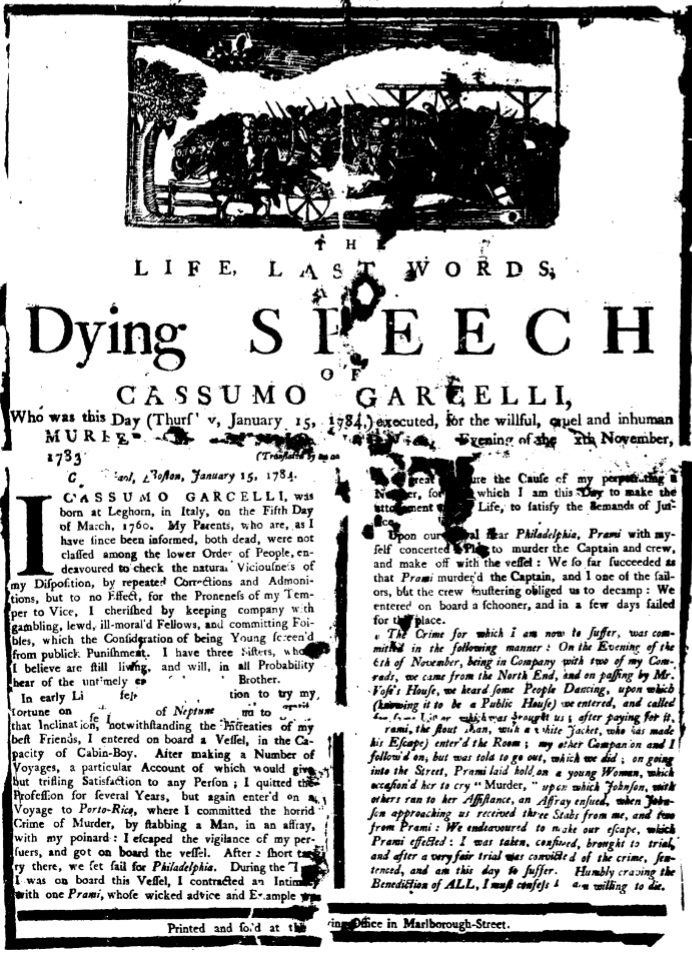
1784: Cassumo Garcelli, a Tuscan sailor on Boston Common

On this date in 1784, for a murder in a bar brawl he had committed with his hard-drinking cronies, Tuscan mariner Cassumo Garcelli was hanged on Boston Common.

To judge by the bog-standard broadsheet purporting to report the condemned man’s gallows’ shade contrition for his youthful vice and wicked examples, piratical Catholic seamen appear to have understood the spectacle of their public execution in a friendless foreign land in a manner quite suspiciously similar to the understanding likely to be held by a New England printer.

In the transcription that follows, I have made a few interpolations, and one outright elision, owing to sections of text obscured by printing faults on the preserved version of this document.


Click on the image to see the full original document.

Who was this Day (Thursday, January 15, 1784) executed, for the willful, cruel and inhuman murder of Mr. John Johnson on the evening of the sixth November, 1783.

I, Cassumo Garcelli, was born at Leghorn, in Italy, on the Fifth Day of March, 1760. My Parents, who are, as I have since been informed, both dead, were not classed among the lower Order of People, endeavoured to check the natural Viciousness of my Disposition, by repeated Corrections and Admonitions, but to no Effect, for the Proneness of my Temper to Vice, I cherished by keeping company with gambling, lewd, ill-moral’d Fellows, and committing Foibles, which the Consideration of being Young screen’d from publick Punishment. I have three Sisters, who I believe are still living, and will, in all Probability, here of the untimely [death of their] Brother.

In early Life […] to try my fortune … notwithstanding the Intreaties of my best Friends, I entered on board a Vessel, in the Capacity of Cabin-Boy. After making a Number of Voyages, a particular Account of which would give but trifling Satisfaction to any Person, I quitted the Profession for several Years, but again enter’d on a Voyage to Porto-Rico, where I committed the horrid Crime of Murder, by stabbing a Man, in an affray, with my poinard: I escaped the vigilance of my persuers, and got on board the vessel. After a short tarry there, we set sail for Philadelphia. During the Time I was on board this Vessel, I contracted an Intimacy with one Prami, whose wicked advice and Example was in a great Measure the Cause of my perpetrating a Number [sic], for [one of?] which I am this Day to make the attonement of my Life, to satisfy the demands of Justice.

Upon our arrival near Philadelphia, Prami with myself concerted a Platt to murder the Captain and crew, and make off with the vessel: We so far succeeded as that Prami murder’d the Captain, and I one of the sailors, but the crew mustering obliged us to decamp: We entered on board a schooner, and in a few days sailed for this place.

The Crime for which I am now to Suffer, was committed in the following manner: On the Evening of the 6th of November, being in Company with two of my Comrads [sic], we came from the North End, and on passing by Mr. Vose’s House, we heard some People Dancing, upon which (knowing it to be a Public House) we entered, and called for some Liquor, which was brought to us, after paying for it.

Vami, the stout man, with a white Jacket, who has made his Escape, enter’d the Room; my other Companion and I follow’d on, but was told to go out, which we did; on going into the Street, Prami laid hold on a young Woman, which occasion’d her to cry “Murder,” upon which Johnson, with others ran to her Assistance, an Affray ensued, when Johnson approaching us received three Stabs from me, and two from Prami: We endeavoured to make our escape, which Prami effected: I was taken, confined, brought to trial, and after a very fair trial was convicted of the crime, sentenced, and am this day to suffer. Humbly craving the Benediction of ALL, I must confess [and am] willing to die.

On this day..

1528: Leonhard Schiemer, Anabaptist pacifist

Forasmuch then as Christ hath suffered for us in the flesh, arm yourselves likewise with the same mind: for he that hath suffered in the flesh hath ceased from sin.

1 Peter 4:1, a verse very dear to this date’s principal*

Anabaptist Leonhard Schiemer was beheaded on this date in 1528 at Rattenberg.

Schiemer abandoned a Franciscan monastery, preferring to set his table with honest labor as a tailor, and to succor his soul with that that new heresy minting martyrs in northern Europe.

In 1527, Schiemer was both a vigorous missionary and an eloquent proponent of the pacificism for which the sect would eventually become known. In Schiemer’s time, before the catastrophe of Münster’s Anabaptist theocracy, this was quite naturally a hot dispute among the persecuted adherents trying to determine how to make their way in a world where they were considered heretical even by the other heretics: turn the other cheek, or come like Christ with a sword?

Schiemer’s answer was for the true Christian to give himself to the ordeal of Christ’s cross.

[The Holy Spirit] teaches no one, however, unless he despaired of all human comforting and wisdom first. He does not comfort or strengthen anyone unless he feels a horror and turns away from all comforting and power of man. This is why the Lord says, “Do not be called masters.” But this master, Christ, does not accept anyone as His pupil or disciple, unless he renounces and hates everything that he has, and follows Him and carries his cross daily. In doing this, one has to trust in the Lord’s comforting and keep still, as the Scriptures say in many passages, particularly in the Psalms, the Prophets, most of all in Isaiah and the Lamentations of Jeremiah.

The strength of all Christians consists in keeping still, by not forsaking the words of the Lord so quickly, by not losing courage so soon, but by being patient, waiting for the comfort of the Holy Spirit, in the midst of the greatest desolation and misery. This is true weakness of which the Scriptures speak, in particular Paul when he says, “For when I am weak I am strong.”

He also says, “For as we share abundantly in Christ’s suffering, so through Christ we share abundantly in comfort too.” That is what Christ means when He says, “A little while and you will see me no more, again a little while and you will see me.” And when the apostles asked Him what He meant by this, He answered, “Truly, truly, I say to you, you will weep and lament, but the world will rejoice; you will be sorrowful, but your sorrow will turn in to joy … Indeed the hour is coming when whoever kills you will think he is offering service to God.

The Threefold Grace

It is often suspected that Schiemer’s execution on January 14 might have inspired the Rattenberg grandee Pilgram Marpeck to convert — for he was dismissed from a post as a mining magistrate on January 28, and thereafter became an influential, itinerant Anabaptist “wandering citizen of heaven” crisscrossing southern Germany.

* According to an essay on Schiemer in The Anabaptists and Contemporary Baptists: Restoring New Testament Christianity.

On this day..

1864: Private Samuel Jones, in retaliation for Private Daniel Bright

The New York Times of January 23, 1864

Gen. Getty:

DEAR SIR: We, the subscribers, request to say that there was found this morning a dead man, and still hanging, in our neighborhood, as the inclosed scrip which was found pinned to his back, will show you by whom it was done. We have made a suitable box and buried him near the place he was found hung. Should his friends wish to get his body, they can get it by applying to any of the subscribers. We trust that you will not attach any blame to any of the citizens of this neighborhood, as we were entirely ignorant of any of the circumstances until we found the body. From all we can learn, he was brought across the Chowan River to this place, and as soon as the men who had him in charge hung him, they went back.

It was signed by ten people of Pasquotank County, North Carolina.

The note they enclosed, retrieved from the hanging body, read:

NOTICE

Here hangs Private Samuel Jones, of Company B, Fifth Ohio regiment, by order of Maj.-Gen. Pickett, in retaliation for Private Daniel Bright, of Company L, Sixty-second Georgia regiment, hung Dec. 18, 1863, by order of Brig.-Gen. Wild.

Bright, a member of the newly-formed 66th North Carolina guerrillas, had been hanged as a spy. Jones had been obtained by casting lots among Union prisoners of war held at the Confederate capital of Richmond, in response to Pickett’s demand for some Yankee to execute tit for tat. (Pickett’s proclivity for retaliatory executions would soon require him to quit the country at the end of the Civil War.)

On this day..