1553: Pedro de Valdivia, founder of Santiago

On Christmas Day of 1553, the Spanish conquistador Pedro de Valdivia, noted as the founder of Santiago, Chile,* was executed by Mapuche Indians who had captured him in battle.

Valdivia got his start in New World bloodsport in the train of the Pizarro brothers, and cashed in with mining concessions as a reward for his able service in the Pizarros’ campaign against yet another conquistador, Diego de Almagro.

Not content to wax fat on Incan silver, Valdivia secured permission to pick up Almagro’s aborted mission: the conquest of Chile. With a force of about 150 Spaniards and many times that number of native allies, he successfully crossed the Atacama desert (bypassing Andean tribes that had proven hostile to Almagro) and attained the Mapocho river valley. There he created Santiago** on February 12, 1541, and almost immediately established the Spanish colony — distinct from Peru — whose headquarters it would be.

It didn’t take long for these interlopers to incur native resistance which would long slow the imperial development of Chile. Later in 1541, an Indian attack razed Santiago, although its Spanish defenders just managed to hold on to the rubble and begin a laborious process of vigilant rebuilding.

While the future metropolis, which lies about the north-south midpoint of the present-day state, grew stone by stone, Valdivia endeavored to carry his conquest to the south. This would soon provoke the furious resistance of the Mapuche people and become the Arauco War, which simmered for decades. (Or centuries, depending on the degree of continuity one might attribute to various rebellions.)

Having seen the Spanish throw up a chain of forts in their territory the better to control new gold mines, the Mapuche counterattacked and overran the fort at Tucapel — led by a bold young commander named Lautaro, who had only recently fled from the personal service of Valdivia himself. Grievously underestimating the vigor of his foe, Valdivia set out to pacify the rebels with a mere 40 Spanish soldiers “because at that time the Indians were but lightly esteemed.” (Marmolejo; see below) Approaching an eerily empty Fort Tucapel on Christmas Day, his token force was suddenly engulfed by thousands of ambushing Mapuche and massacred to a man.

Almost to a man.

Valdivia had the misfortune of being taken alive.

The conquistador was put to death shortly after the battle. The chronicler Jeronimo de Vivar simply said that the commander Caupolican ordered him speared to death — but others went in for more frightful descriptions of an event they surely did not witness.

Alonso de Gongora Marmolejo, who like Vivar was a contemporary to the death of the governor, claimed (Spanish link) that “the Indians kindled a fire before him, and cut off his arms from the elbow to the wrist with their blades; they took care not to permit him his death, and so devoured his roasted flash before his eyes.”

As a founding figure in Chilean history, Valdivia has enjoyed frequent literary treatment, as has his impressive mistress Ines de Suarez. (Isabel Allende’s Ines of my Soul is a recent example.) It is likely that none will ever surpass in literary importance the 16th century epic of of the conquest of Chile La Araucana. Although its author, Alonso de Ercilla, did not sail for America until several years after Valdivia’s death, he — naturally — made the late conqueror one of his principal subjects.

* And the namesake of Valdivia, Chile.

** The name pays tribute to Saint James.

On this day..

1946: Gen. Leopold Okulicki murdered in Soviet prison

The fate of the last Commander in Chief of Home Army General Leopold Okulicki “Niedzwiadka”, imprisoned in Moscow and murdered there, symbolize the postwar fate of the Home Army and of Poland.

-2012 resolution of the Polish parliament

On this date in 1946, Polish Home Army General Leopold Okulicki was murdered by the NKVD in a Moscow prison.

Okulicki (English Wikipedia entry | the much more detailed Polish) embarked his military career at the tender age of 16, when he ditched school in favor of an Austrian legion on the eastern front of World War I — then segued directly into newly independent Poland‘s subsequent war against the Soviets.

Already a veteran soldier, Okulicki proceeded to the Warsaw military academy and made soldiering his career. He had advanced to the brass by the time Hitler and Stalin destroyed Poland in 1939. Okulicki had the tragic honor to maintain the hopeless defense of Warsaw, but went underground thereafter with the remains of the Polish state — hunted by Germans and Soviets alike.

The NKVD caught him in January 1941, but his residence in the discomfiting environs of Lubyanka prison was ended by the Soviet Union’s arrangement with Poland following Operation Barbarossa. Paroled back into the field, he played a leading part for the Polish Home Army for the balance of the war — finally becoming its supreme commander in the last weeks of the war.

Now that the Nazis were no longer knocking on the gates of Moscow, the Soviets renewed their interest in detaining Okulicki, which was again effected with relative ease. (Comparing German and Soviet secret police, Okulicki would say that the NKVD made the Gestapo look like child’s play.) Sentenced “only” to a 10-year prison term at the Russians’ postwar show trial of Polish leadership, Okulicki disappeared into Soviet detention and was never seen again.

In the Khrushchev era, the USSR revealed that Okulicki had died on Christmas eve of 1946 at Butyrka prison; subsequent revelations of the medical records there revealed that he had succumbed to organ damage suggestive of having been beaten to death — perhaps as punishment for hunger-striking.

The post-Communist Russian state has posthumously exonerated Okulicki of his show-trial conviction; he is, of course, an honored figure in post-Communist Poland where many streets and squares bear his name.


Plaque honoring Gen. Okulicki in Warsaw. (cc) image from Tadeusz Rudzki.

On this day..

1750: John Young, resisting

A piece titled “Extract of a Letter from Edinburgh, dated Dec. 20” in the May 16, 1751 edition of the Pennsylvania Gazette:


John Young, late Serjeant in Lord Ancram’s Regiment of Foot, was executed here Yesterday Afternoon, pursuant to the Sentence of the High Court of Justiciary, pronounced against him, on a Remit made to that Court by the Lords of Session; before whom a full Proof was deduced of Young’s having vended false Notes of the Royal Bank of Scotland, knowing them to be so forged and fabricated.

This unhappy Man had amused himself, before Trial, with the Hopes of being acquitted; after Sentence, with those of obtaining a Pardon; for which great Interest was used by the Officers of the Army, &c. though all to no Purpose; the Hurt done to publick Credit by such destructive Practices rendering it necessary that an Example should be made to deter others from committing the like in Time coming. Indeed this unfortunate Man complained bitterly of his hard Fate, in eing made the only Sacrifice to Justice, while two others, rather more culpable than he, (they being the very Engravers and Fabricators of the Notes) found Means to save themselves by turning Evidences against him, who did not scruple to accuse him of Perjury, though with what Truth I cannot determine.

Young, however, at the Day, nay, at the very Time of Execution, betook himself to a very unusual Expedient to save his Life for a Time, seeing then all his Hopes of Pardon entirely baffled: The Magistrates appointed to witness the Ceremony having assembled about two o’Clock, at the Prison Door, with the proper Officers, the Guard, and an infinite Multitude of Spectators; they, attended by two Clergymen, went up to the Prisoner, and having read over to him the Sentence, they asked his Objections to the executing the same. Young answer’d, that he had none: But observing the Sentence appointed the Execution to be performed betwixt the Hours of Two and Four in the Afternoon, that suggested a Thought to him, that if he could preserve his Life till past Four, the Magistrates could not afterwards execute him. Accordingly he desired Leave to retire a short Time with two reverend Ministers, for ghostly Consolation; which being granted, he return’d with them to the Iron Room, where he had been confin’d since under Sentence; and after talking a little with them, he begg’d they would allow him to spend a few Minutes in private Devotion, which seeming reasonable, they withdrew, and he usher’d the Clergymen to the outer Door of his Apartment, which shutting behind them, he retired to the inner Room, the Iron Door of which he also immediately bolted.

Soon after the Officers of Justice, surprized at his Delay, endeavoured to open the Door, which, to their great Surprize, they found bolted: Then they knock’d, and desired him to come out. No, said he, in this Place I am resolved to defend any Life to the utmost of my Power.

On this the Door was attempted to be forced, but it, as is said, being of Iron, in vain were the most violent Endeavours used for that Purpose.

This extraordinary Accident was immediately rumour’d about. My Lord Provost was sent for, and accordingly appeared in Person. The City Clock was stopp’d, and Surprize and Expectation appeared in every Face. A considerable Time being spent to no Purpose in forcing the Door, that Attempt was given over, and the only possible Method of getting in was found to be by breaking up the Floor of the Room over Head of the Prisoner, which at length was, in about two Hours, effectuated; and a Passage being opened, a Gun was presented to him, the Prisoner, in order to terrify him, and compel him to open the door; but this did not frighten him in the least; for he said, that as he liv’d, so he desired to die, like a Soldier. The Fellow, however, who held the Gun, being a little remiss, Young making a Leap up, laid hold of the Muzzle, and pulled it down, threatening, on getting Possession of the Piece, to shoot the first Man that dar’d to enter; but happily the Gun was unloaded, which prevented so fatal a Catastrophe. Rewards were then offered to such of the City Guard as would go down and seize him; and at length, after severals refusing, one Fellow had the Courage to go down, whom Young welcom’d with a violent Blow, on the Breast from the Butt of his Gun, that laid the Soldier on the Ground. Had Young been arm’d with a Sword or Bayonet, it is likely the Fate of the first Adventurer would have stopp’d the Attempts of a second; but he having only an empty Musket, and the Passage being wide, three or four more jump’d in at once, and at length after a violent Struggle, overpowered and bound the unhappy Victim, who still refusing to walk, the Door was opened, and he dragged headlong down Stairs, in a most deplorable Condition. When he was brought out, he ask’d if it was Four o’Clock (as indeed it then was) but being answered, That he should e hanged were it past Eight, he immediately composed himself to suffer that so much dreaded Death. Still however, did he refuse being accessary [sic] to his own Murder (as he was pleased to term it) by walking, as usual, to the Place of Execution: He was therefore forced upon a Cart, where the Hangman, fitting by him, holding the End of the Rope, which was immediately put about his Neck, he was in this Manner dragged to the Grass Market, amidst thousands of amaz’d Specattors; where again refusing to ascend the Scaffold, he was carried up by the Guard, and after about fifteen Minutes, being near Half an Hour past Four, and almost dark, he was hang’d by the Neck till he was dead.

This poor Man served in the Army many Years, with Reputation; was beloved by his Officers, being never before conicted of the least Offence, and was said to have been recommended to the first vacant Colours in his Corps.

The extraordinary Manner of his Exit, the strenuous Efforts to preserve his Life, and the unhappy Success that attended them, made him an Object truly worthy of Compassion.

He was a middle aged Man, very tall, and remarkably well-look’d.

On this day..

1946: One sex killer and four POW camp murderers

This date in 1946 saw the largest mass execution in Alberta: five men all hanged for murder.

One of these, Donald Sherman Staley, was a hated sex-murderer who had raped and killed boys in Calgary and Alberta that summer. But he is the undercard in this event.*

The remaining four were all German prisoners of war from the lately concluded world war. They did not, as their onetime commanders in Europe, face judgment for war crimes: no, Bruno Perzonowsky, Walter Wolf, Heinrich Busch and Willi Mueller had while marking time in the Medicine Hat POW camp contrived to execute a fellow-prisoner as a subversive.

Naturally this camp “execution” was rank murder from a legal perspective. But the day-to-day reality of the Medicine Hat camp was that the few Canadian officials banked on the 12,000 or so German detainees to run the place themselves.**

Medicine Hat’s German leadership consisted of Nazi ideologues, but the politics and life experiences of its inmates, regular grunts snatched from various battlefields, deviated widely from the Reich’s ideal. In 1943, convinced that the less fascist elements in camp were cogitating a plot to displace the Nazi silverbacks in camp, that clique convened a drumhead trial and hanged August Plaszek, a Catholic and former French Foreign Legionnaire.

After the war ended, this murder too resulted in a hanging — but as of the second killing that is the focus of this post, the Canadian investigation was being stonewalled and the true believer types still bossed Medicine Hat with near-impunity.

The second murder was triggered by a threat not to Nazi authority in Medicine Hat — but in Berlin.

After the shock of the Valkyrie plot that came within a whisker of assassinating Hitler, the Fuhrer publicly demanded a purge of traitors, anywhere and everywhere.

The POW Karl Lehmann was just such a one, to Hitlerian eyes. Another Catholic — a dubious class for sure — Lehmann was a husky former languages professor who had been dragooned into the military and subsequently captured in Tunisia.† He had been in Medicine Hat for two years when Col. Stauffenberg’s bomb went off in Wolfsschanze, growing ever bolder vilifying the Third Reich and anticipating its approaching defeat.

In September 1944, our quartet of future gallows-fodder lured Lehmann to a room where he sometimes gave lectures, and there began browbeating him about communists in camp. As Lehmann vainly denied any such connection, his assailants got a noose around him and hoisted him to his death.

Having now had two political assassinations on their watch, Canada finally got serious and threatened the entire population of prisoners with the prospect of being punished as murderers were they merely to fail to report a murder plot to which they had become privy. They also started reshuffling the prisoner population in an effort to break up the Nazi prison gang. Both measures worked — aided, of course, by the advance of Allied armies in the European theater — and nobody had the ill fortune to follow Karl Lehmann’s fate.

Lethbridge Gaol had to be outfitted with a whole new condemned bloc just to hold the prisoners bound for their end this date. (Its existing capacity was only two.)

* Staley’s desperate argument for clemency was that he was a “sexual insane” who could not govern his compulsions: “I must have been born this way and should not be held responsible for what I done, but should receive treatment of some kind instead of being condemned to die for something I can’t help.” “Merciful” proposals ran towards employing him as a guinea pig for mental health hospitals’ experiments with, e.g., lobotomy.

** Canada’s deference to German detainees also made it party to a scandalous execution of Wehrmacht deserters conducted by a surrendered German army in Canadian custody in 1945. (Canada helpfully supplied their prisoners the necessary guns.)

† Under Field Marshal Rommel‘s command, no less: though he was perhaps Hitler’s ablest general, the Desert Fox all but openly disdained national socialism. He was himself implicated in the July 20 plot, and made to commit suicide.

On this day..

1889: Abushiri, German East Africa rebel

On this date in 1889, the Germans hanged Abushiri as a rebel.

European empires arriving to East Africa naturally entered a going history of local conflicts and accommodations. In the case of the region at hand, the archipelago of Zanzibar lying just off the coast had been absorbed by, and then spun off from, the domain of the sultan of Oman. As we lay our scene in the late 19th century, it is an independent Sultanate of Zanzibar whose dominion extended to the adjacent Swahili coast and inland, an area also known as the Zanj.

Zanzibar was a British interest here, but the islands themselves do not quite enter this fray directly; the sultanate based there actually survived until 1964.

But in the 1880s, Germans scrambling for Africa arrived to gobble up the sultanate’s mainland possessions. Germany, truth be told, was a little bit late to this game, and although it secured some noteworthy footholds like Cameroon and Namibia, the Second Reich suffered a distinct little imperial brother complex vis-a-vis the British and the French — both of whom had more extensive holdings in Africa, to say nothing of everywhere else in the world.

Certainly the German public, flush with the boom of industrialization and having only just shown the French what-for on the battlefield, clamored for its rightful share of overseas acquisition. The popular thirst for expansion dragged along reluctant chancellor Otto von Bismarck into an adventure so inimical to the good order he prized.

One such German dreaming big dreams of bigger maps was a cocksure 29-year-old doctor of history, Carl Peters. Fresh off a few post-academic years knocking about in a London astir with the white man’s burden, Peters co-founded the German East Africa Company and then put that colonial corporation literally on the map with a bold expedition to Zanzibar. Within a few weeks of arriving in November 1884, and despite the explicit dissuasion of the German consulate there, Peters had obtained via just the right mixture of largesse and menace treaty rights to 155,400 square kilometers conferred by a number of coastal chiefs in the mainland ambit of the Sultan of Zanzibar.

When Peters returned in glory to Germany brandishing these concessions, Chancellor Bismarck was practically forced to accept them as a German protectorate … and charter Peters’s corporation to start exploiting it. The mid-1880s saw a minor local race between Peters and rival British explorers to establish their respective colonial presences on the Swahili coast,* resulting in an 1886 Anglo-German agreement formally dividing the region’s spheres of influence: British to the north, German to the south. Today this line, shooting near-straight to the southeast from Lake Victoria to the Indian Ocean with a slight bend round Mount Kilimanjaro, forms the border between Kenya and Tanzania.

We are, at length, arriving at the unfortunate party whose execution occasions this post.

The problem for young Master Peters with his personal agglomeration of the fatherland was nothing but that familiar difficulty for invaders from time immemorial — and Peters was ultimately an invader, no matter what treaties he could wrangle. For his short spell as the commercial governor of this distant land, Peters earned of his Bantu subjects the sobriquet Milkono wa Damu: the man with blood on his hands.

Diplomats could partition the land in Berlin, and could even compel the supine sultan to acknowledge their arrangements. But no edict could command legitimacy for the man with blood on his hands.

Beginning in September 1888, rebels comprising both Arabs and Swahili tribesmen sacked German East Africa Company assets up and down the coast Peters had so diligently won for Germany. Rousted from most of its towns and trading posts, the Company hunkered down in its territorial capital of Bagamoyo and cabled Berlin for help. Bismarck paternally relieved the in-over-its-head company with the aid of mercenaries hired from Egypt and Mozambique, crushed the uprising with customary roughness, and ushered Peters’s firm out of the colonial administration business in favor of adult supervision. The little protectorate soon became German East Africa, administered as a proper colonial appendage of the German Empire.

This Abushiri revolt (English Wikipedia entry | German) is named for its most prominent leader, a mixed-race Arab-Oromo coastal planter named Abushiri ibh Salim al-Harthi (English Wikipedia entry | German). He would be betrayed to German hands trying to escape and promptly executed; however, resistance by others continued to 1890.

They struck down
The flag of Islam
And now proposed
To raise their own.

They came to Pangani
Full of wrath,
They fitted up the house
And laid cannon.

And the ship at Maziwe
The whole town was humbled
And the Europeans
Strode about the streets.

The town was silent,
No one spoke,
Not a free man
Said a word.

-Swahili poet Hemedi al-Buhriy†

This new disturbance, whose suppression Britain also aided, helped lead London and Berlin back to the negotiating table for the Heligoland-Zanzibar Treaty of 1890 — a comprehensive African arrangement to settle up spheres of influence not only on the Swahili coast but touching Namibia and Togoland, too. Meanwhile, Germany gave up remaining claims north of the Swahili coast dividing line and ceded Zanzibar itself to British authority; in exchange, she obtained the islands of Heligoland off her northwest shoulder — closing a potential security vulnerability.**

Among the many curiosities of the years to follow for the great imperial powers concerned, few are more vexing than just why it was that England and Germany went to war in 1914. Profitable as that bloody effusion has been for these grim annals, it posed as antagonists two countries that had long been thought by keen observers to be natural allies — a belief shared by numerous British and German statesmen. Otto von Bismarck was certainly one of these; his desire for an English alliance (against France and Russia) was a pole star of the Iron Chancellor’s foreign policy. Indeed, he worked amicably with his British opposite number Lord Salisbury; Bismarck once opined of his unwillingly adopted East African holdings that they were “admirably suited to become the sacrificial ram on the altar of friendship” with Great Britain.

But that isn’t what happened.

The failure of these great powers’ flirtation with one another, and the arrangements they ultimately made with other powers instead, defined the belligerents of the Great War. And while we would scarcely propose to lay the charnel houses of Verdun and Gallipoli at the shores of Zanzibar, it has sometimes been postulated that the fatal obstacle to Britain’s arrangement with Germany might have been the paucity of horses to swap.

Thanks to far-flung colonial expansion, Britain had many borders with France all over the globe, and accordingly had frequent need to collaborate and an ample store of chips to trade. With Germany, she had but a few intersections, in Africa — and these were settled almost too comprehensively (pdf) after the Abushiri revolt.

* It goes without saying that the sultan was none too happy about this development, but he was made to get used to the idea. (Germany sent warships, and Great Britain declined to back the sultan.)

The Anglo-German agreement accordingly limited the sultan’s authority on the coast to a 10-mile strip. Although the European powers commanded whatever leases they desired from this zone, Zanzibar’s anomalous territorial claims on the mainland would not be extinguished until the post-colonial era. When that day came, the 10-mile strip made for quite a sticky wicket during negotiations for Kenyan independence in the 1960s. The whole situation lies very far from the scope of this post, but the connosseur of diplomatic Gordian knots should pause to enjoy this pdf exploring the whole mess.

** Each party valued the thing it received quite a bit more than the thing it traded away in this treaty. From Britain’s perspective, Heligoland would be nigh-indefensible in the event of war with Germany; from Germany’s perspective, the claims it gave up outside of German East Africa were little better than phantasmal.

† via Charles Pike’s “History and Imagination: Swahili Literature and Resistance to German Language Imperialism in Tanzania, 1885-1910,” The International Journal of African Historical Studies, Vol. 19, No. 2 (1986)

On this day..

1812: John Rickey but not Benjamin Jackson

The New York Evening Post published this item excerpted from the Philadelphia Democratic Press on Thursday, December 17, 1812.

On Friday, a large concourse of people assembled at Fort Mifflin, to witness the execution of John Rickey and Benjamin Jackson, soldiers of the 16th Regt. U.S. Infantry, sentenced to be shot for desertion, the former having deserted three times, the latter once.

They were conducted to the fatal spot at 1 o’clock, attended by about 600 soldiers of the 2d Artillery and 16th infantry. Rickey’s sentence having been carried into effect, Jackson was pardoned by the commanding officer.

We trust the execution of Rickey, and the exercise of mercy to Jackson, will operate as a warning to the deserters in and about this city. It is stated upon good authority, that every reasonable indulgence will be extended to such deserters as may deliver themselves up voluntarily, but those who are taken cannot expect to be shielded from the penalty of the law.

On this day..

1557: Galvarino, Mapuche warrior

On this date in 1557, the handless Mapuche cacique Galvarino was executed by the Spanish during the Arauco War.

The Mapuche people, still extant today, inhabited present-day Chile and Argentina; Spanish explorers pushing south from the wreck of the Inca Empire encountered them, and naturally antagonized them.

Rebellion broke out among the Mapuche in 1553, led by Caupolican and his able commander Lautaro; they won some signal victories but the conflict was never decisively finished by either side. The Arauco War — encompassing many distinct rebellions and campaigns punctuated by relative calm — ran until the early 19th century.

Our fellow Galvarino was elevated to folk hero status by the Spanish in the very first period of rebellion when he was captured in battle at Lagunillas. Instead of cutting off his head, the Europeans chopped off his hands — then sent him (with a number of like mutilated prisoners) back to his people. The intent was to make a terrifying example, but Galvarino made the example his own: brandishing the bloodied stumps and oratorical fury to match, he incited his comrades to further resistance.

At the Battle of Millarapue on this date in 1557, hours before his execution, the Spanish beheld him urging on the Mapuche:

My Brothers, why have you stopped attacking these Christians, seeing the manifest damage that from the day which they entered our kingdom until today they have done and are doing? And they still will do to you what you see that they have done and they are doing? And still they will do to you what you see that they have done to me, cut your hands off, if you are not diligent in making the most of wreaking destruction on these so injurious people for us and or or our children and women!

But by evening, the Spanish carried the day — and once again had Galvarino in their custody.

“The poet Ercilla, impressed by the Indian’s valor, made every effort to keep him from being executed, arguing that he had seen Galvarino changing sides and joining the Spanish troops,” writes Guillermo I. Castillo-Feliu in Culture and Customs of Chile. “Galvarino, displaying his mutilated arms, until then covered by a shawl, refused Ercilla’s offer to commute his death sentence and said that he only wished that he could tear his enemies apart with his teeth.”

They put him to death straightaway. Accounts of the execution method range from hanging to impalement to being thrown to dogs.

On this day..

1836: Six Creek rebels, amid removal

We ask you how the Muscogee Nation came by this country? You came from the west and took the country from another people who were in possession. After living here a great many years, the people from over the big waters came in large vessels and took some of the country from you and set up their own government, and made laws, & made you obey them …

you must be sensible that it will be impossible for you to remain, for any length of time, in your present situation, as a distinct society or nation, within the limits of Georgia, or any other State. Such a community is incompatible with our system, and must yield to it. This truth is too striking and obvious not to be seen by all of you, surrounded as you are by the people of the several States. You must either cease to be a distinct community, and become, at no distant period, a part of the State within whose limits you are, or remove beyond the limits of any State …

Brothers, we now tell you, what we, in the name of your Father the President, want you to do. We want the country you now occupy. It is within the limits of Georgia and Alabama. These States insist upon having their lines cleared. The President will do this by giving you a better country, and will aid you in removing; protect you where you may go, against whites and all others, and give you a solemn guaranty in the title and occupancy of the new country which you may select … By deciding for yourselves, it may prevent others from deciding for you.

-U.S. federal communication to the Muscogee Creek chiefs, Dec. 9, 1824


Brothers, you have been deceived. A snake has been coiled in the shade, and you are running into his mouth … drunk with the fire of the pale-face. Brothers, the hunting grounds of our fathers have been stolen by our chief and sold to the pale-face, whose gold is in his pouch. Brothers, our grounds are gone, and the plow of the pale-face will soon upturn the bones of our fathers. Brothers, are you tame? Will you submit?

–Opothle Yoholo

On this date in 1836, six Muscogee Creek rebels were hanged in Alabama as murderers.

This age of the bellicose Andrew Jackson comprised the peak years of America’s Indian Removal — a frightful term denoting the forcible expulsion of indigenous nations from America’s east to her frontier wastelands. This was the fate ordained for the Creek people of Alabama, just as it was with their “civilized tribes” brethren, the Choctaw of Mississippi and the Cherokee of Georgia and the Carolinas.

Jackson himself had tangled with the Creek during his career-making appearance as America’s up-and-coming caudillo in the War of 1812: the eponymous Fort Jackson in Alabama was the base from which the Tennessee militia captain had defeated rebellious natives in the 1813-1814 Creek War and forced upon them the Treaty of Fort Jackson.* “Numberless aggressions,” read that document, “had been committed [by the Creeks] against the peace, the property, and the lives of citizens of the United States.”

So small wonder that as President, Old Hickory — for whom Indian Removal was a signature policy — had no time for Creek appeals to Washington to uphold their treaty rights in Alabama and Georgia. Their defeat in 1814 had left the Creek polity a powerless dependency, whose rights and even survival extended precisely so far as the American government wished. With the shrunken remnant** of their ancestral lands increasingly sought by white settlers, all the pressure within Anglo America ran towards the ethnic cleansing option.

“Voluntary” emigration under steady white pressure gnawed away at Creek numbers in the Southeast for a decade or more preceding the events of this post, but there was always going to be a militant slice of the population for whom no inducement short of violence would suffice. In 1836, land incursions finally triggered a Creek revolt, and became the Second Creek War — Jackson’s justification at last for completing the long-sought elimination of the Creek in the East.†

“The Creek Indians, below the Federal Road, are all in arms and killing every white person they have fallen in with,” ran the May 12, 1836 Macon Messenger. Everything was in “confusion and disarray” — the fleeting advantage of initiative while Anglos mustered an overwhelming response.

Attacks on stagecoaches this same month “created a greater sensation throughout the country than any previous act of Indian hostility,” per this public domain history of Columbus, Ga. (The town abuts the Alabama border.)

Two stages carrying the United States mail, going from Columbus to Tuskegee, Ala., were attacked about eighteen miles from Columbus. The Indians killed Mr. Green, one of the drivers, and two horses, and robbed the mail. The next day a party of fifteen men started to come through to Columbus with two stages. Some of these men were passengers and others volunteers who accompanied the stages to assist in their protection.

It was for this raid that claimed Green’s life that Tuscoona Fixico and four others — never named in any source I have been able to find — were condemned to hang on Nov. 25, alongside a man named Chilancha for the unrelated killing of a man named Fannin during the uprising.

The Second Creek War went much the same way as the first, and proved those American diplomats prescient as to the inevitability of the conquered peoples’ fate. Today, the Poarch Creek — numbering barely 2,000 — are the only remaining band of Muscogee Creek in Alabama.

* It was from this engagement that Jackson proceeded to the famous Battle of New Orleans.

** In one vain bid to stanch the loss of Creek territory, the tribe — incensed by the Treaty of Indian Springs — had in 1821 enacted capital punishment for anyone who sold land to whites. It was on the strength of this statute that Creek assassins murdered/executed the collaborationist chief William McIntosh in 1825.

On this day..

1944: Joseph Watson and Willie Wimberly Jr.

(Thanks to Meaghan Good of the Charley Project for the guest post. -ed.)

On this date in 1944, Private Joseph Watson and Technician Fifth Grade Willie Wimberly Jr. of the U.S. Army were executed for a brutal attack on two French civilians.

They broke into a farmhouse only a few hundred yards from their company bivouac area, shot the elderly farmer and his unmarried daughter, and raped the woman. Their crimes and deaths are described in French L. MacLean’s book The Fifth Field: The Story of the 96 American Soldiers Sentenced to Death and Executed in Europe and North Africa in World War II.

At 8:00 p.m. on the evening of August 8, 1944, Watson and Wimberly, both of them already drunk, arrived at the farmhouse and bartered for a liter of apple cider. They spoke no French but were able to get their point across. The farmer and his daughter were wary of the inebriated pair and, after they left, barricaded the door.

Five minutes later, the two soldiers returned and battered it down.

Wimberly hit the man on the head with his Tommy gun and Watson forced the woman into a chair. Then, just like that, they left again. The two victims went upstairs, barricaded themselves into another room and double-locked it.

A few hours later the two soldiers returned and fired at least twenty .45 submachine gun rounds through the upstairs door, wounding both of the French civilians.

The farmer staggered downstairs and went to get help, but his daughter’s tibia was fractured and she was unable to flee. She was raped in turn by each of the men while the other held her at gunpoint.

At trial she couldn’t identify either of her attackers. The farmer identified Wimberly out of a lineup of six black soldiers, but wasn’t sure about Watson.

Their identification wasn’t really needed, however. Watson was found passed out at the crime scene in the morning, still wearing his bloodstained pants, with the fly unzipped. Wimberly had left, but he left his helmet liner (marked with a unique serial number) on the steps of the farmhouse.

When questioned, Wimberly blamed the entire thing on Watson. Watson made several contradictory statements about the night of the crime before pulling the old amnesia gag. He admitted he’d gone to the farmhouse with Wimberly and added, “I must have gotten drunk because the next thing I knew I was in the yard with a Colonel, two Lieutenants and two MPs.”

Given the circumstances, there wasn’t much either man could say to show why he should not be convicted and executed.

Justice was quick: they were hanged less than three months after their crime. Wimberly went first and was pronounced dead at 10:29 p.m. Watson followed and was dead by 10:48. Eight days later, General George S. Patton had a letter sent to the rape victim, apologizing for what she’d been through and for the soldiers’ part in it.

On this day..

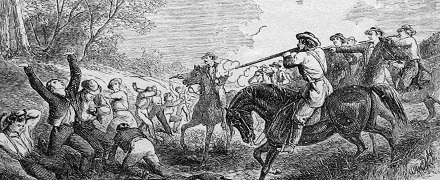
1863: William Griffith, for the Marais des Cygnes massacre

One of the signal outrages of Bleeding Kansas was avenged with a hanging on this date in 1863.

“Bleeding Kansas” was the guerrilla war over slavery in the late 1850s that presaged the conflagration about to consume the Republic; here on the frontier, pro- and anti-slavery partisans traded atrocities in their respective campaigns to secure Kansas’s imminent entry to the Union as either a slave or a free state. The stakes, had America continued her antebellum course, were vital Congressional votes on which the continuance of the peculiar institution might one day hang.

The naked brutality of the conflict shocked its contemporaries; as one particularly notorious example, the sons of abolitionist crusader John Brown executed pro-slavery captives with broadswords.

The Marais des Cygnes massacre was one of the last major horrors of that conflict: a party of 30 or so pro-slavery men led by Charles Hamilton seized 11 Free-Staters. They were mostly people who knew Hamilton personally, and seem to have gone along without resistance not anticipating what he had in store for them.

But Hamilton had told his men that on this campaign, “we are coming up there to kill snakes, and will treat all we find there as snakes.” (Source)

Much to their chagrin, these “snakes” were driven into a narrow ravine and lined up before Hamilton’s men’s guns. The volleys they delivered before fleeing back over the porous border into equally restive Missouri “only” killed five of their hostages: the other six survived by playing dead.


(Via)

Five years later, one of those survivors, William Hairgrove, supplied the identification that damned William Griffith — whose claim that he only helped capture the Marais des Cygnes victims, and didn’t help shoot them was an especially lame offering at the height of the Civil War.

According to Legal Executions in Nebraska, Kansas and Oklahoma Including the Indian Territory: A Comprehensive History, Griffith paid the forfeit for his role in the massacre “in a wood west of [Mound City, Mo.] on the opposite bank of Little Sugar Creek” before a crowd of thousands. There,

[a] little after noon Griffith was conveyed to the wood where he stepped onto the wooden platform a few inches above the ground. His wrists, knees and ankles were bound and the noose was adjusted. The black cap was pulled over his face at 1:07 p.m., and in but a moment William Hairgrove, one of the survivors of the massacre, cut the restraining rope with a hatchet; the four hundred pound weight dropped, jerking Griffith upward. The body rebounded and hung motionless while the attending physicians monitored his vital signs, and in twenty-five minutes they pronounced him dead.

Today, the site of the massacre is a U.S. National Historic Landmark. Quaker abolitionist poet John Greenleaf Whittier also memorialized the blood that was shed there in a poem titled “Le Marais du Cygne”:

A blush as of roses
Where rose never grew!
Great drops on the bunch-grass,
But not of the dew!
A taint in the sweet air
For wild bees to shun!
A stain that shall never
Bleach out in the sun!

Back, steed of the prairies!
Sweet song-bird, fly back!
Wheel hither, bald vulture!
Gray wolf, call thy pack!
The foul human vultures
Have feasted and fled;
The wolves of the Border
Have crept from the dead.

From the hearths of their cabins,
The fields of their corn,
Unwarned and unweaponed,
The victims were torn,—
By the whirlwind of murder
Swooped up and swept on
To the low, reedy fen-lands,
The Marsh of the Swan.

With a vain plea for mercy
No stout knee was crooked;
In the mouths of the rifles
Right manly they looked.
How paled the May sunshine,
O Marais du Cygne!
On death for the strong life,
On red grass for green!

In the homes of their rearing,
Yet warm with their lives,
Ye wait the dead only,
Poor children and wives!
Put out the red forge-fire,
The smith shall not come;
Unyoke the brown oxen,
The ploughman lies dumb.

Wind slow from the Swan’s Marsh,
O dreary death-train,
With pressed lips as bloodless
As lips of the slain!
Kiss down the young eyelids,
Smooth down the gray hairs;
Let tears quench the curses
That burn through your prayers.

Strong man of the prairies,
Mourn bitter and wild!
Wail, desolate woman!
Weep, fatherless child!
But the grain of God springs up
From ashes beneath,
And the crown of his harvest
Is life out of death.

Not in vain on the dial
The shade moves along,
To point the great contrasts
Of right and of wrong:
Free homes and free altars,
Free prairie and flood,—
The reeds of the Swan’s Marsh,
Whose bloom is of blood!

On the lintels of Kansas
That blood shall not dry;
Henceforth the Bad Angel
Shall harmless go by;
Henceforth to the sunset,
Unchecked on her way,
Shall Liberty follow
The march of the day.

On this day..