1559: Anne du Bourg

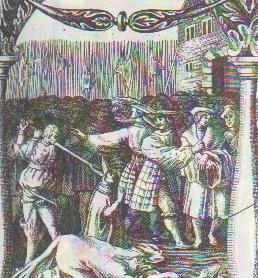
On this date in 1559, Protestant parliamentarian Anne du Bourg was publicly strung up and burned for his uncompromising defense of Calvinism.

All France burned, figuratively, with the Protestant Reformation — and literally, with Henri II‘s ruthless reaction against it. But that flame tempered and honed the Huguenots’ steel.

With the dissolute crowned head before him to attend a seating of Parlement considering the matter of the heretics’ suppression, Anne du Bourg delivered himself of a rebuke of “more courage than prudence” (Batiffol and Bodley):

While men are conducted to the stake for the sole crime of praying for their prince, a shameful license encourages and multiplies blasphemies, perjuries, debaucheries, and adulteries. (Martyn)

Incensed, the king had du Bourg and others of the “moderate” party arrested in Parlement and drug to the dungeon. And though his compatriots were satisfied to recant what imperiled them, du Bourg remained obdurate and even provocative, smuggling a pamphlet against the monarch out of prison.

Henri would not make good his vow to see du Bourg burnt, having been slain by a freak jousting accident. But it little availed du Bourg inasmuch as Henri’s untimely demise put the Catholic faction even more firmly in the saddle. The agitation of Protestants for du Bourg’s release went for naught, and the sharp-tongued minister of state had occasion to speak to posterity from the scaffold. “My friends, I am not here as a thief or a martyr, but for the evangelium.”

“His one speech did more harm to the Catholic Church than a hundred ministers could have done.”
-Eyewitness Florimond de Roemond, quoted in The Cambridge Modern History

The religious conflict that made an end of du Bourg soon exploded into civil war. Many more, like du Bourg, would find their triumph in death — until, after three bloody decades, a Protestant prince accepted triumph in apostasy by deciding that “Paris is worth a Mass.”

On this day..

1596: Francisca Nunez de Carvajal, her children, and four other crypto-Jews of her family

On this date in 1596, the Inquisition sent nine Jewish converts to Christianity to the stake in Mexico City for Judaizing — a cruel fate offering a window into a secret history of New World settlement.

When Spain expelled its Jews (and subsequently its Muslims), those who did not flee had to convert. Conversions at swordpoint being of suspect sincerity, the Inquisition spent much of the following centuries hunting Conversos — so-called “New Christians” — who secretly preserved their outlawed faiths.

For some crypto-Jews, the New World held an appeal akin to that which would draw later generations of northern Europe’s religious minorities.

Latin America in particular attracted considerable numbers of New Christians. The advantage of these territories was that they offered the New Christians a familiar culture and the possiblity of direct — even if infrequent — contact with the mother countries … These factors also helped permit [crypto-Jews] to practice Judaism.

The Carvajals (or Carabajals) were just such a family, settling in Monterrey under the aegis of their kinsman, Spanish governor Luis de Carvajal y Cueva.

But in 1590, the governor’s sister Francisa was tortured by the Inquisition into implicating her entire family in Judaism.

They got off with a humiliating public recantation, but evidence of a relapse a few years later resulted in Francisca being burned at the stake at an auto de fe — along with her children Isabel, Catalina, Leonor and Luis, and four of their in-laws. The 30-year-old Luis left a testimonial to his faith and his tortures.

A headstone in New Mexico, USA, suggests crypto-Jewish descent. Image used with permission.

Despite the grisly doings of this day, however, the Inquisition never could extirpate Jews from its American territory.

These hidden communities filtered into Mexico and north to the present-day United States, keeping adapted versions of Jewish traditions secretly alive.

Still, crypto-Jews produced scant potentially self-incriminating documentary evidence. Although DNA testing has latterly entered the scene, the true extent and nature of these populations has been the subject of lively scholarly controversy.

But the Carvajals and others like them, seemingly lost to the Inquisition’s depredations, are coming alive again. This day’s executions are the subject of a modern opera and a spring 2008 Texas A&M symposium.

And the wider community of crypto-Jews have their own umbrella organization and a burgeoning body of historical literature.

Books about crypto-Jews

On this day..

1581: Edmund Campion, Ralph Sherwin and Alexander Briant

On this date in 1581, three English Catholic martyrs were hanged, drawn and quartered at Tyburn, casualties of the bloody confrontation between religious and secular power of the English Reformation.

Edmund Campion — later sainted — was the towering figure among them and the great attraction for those that thronged the Tyburn scaffold on a rain-drenched Friday.

A brilliant Oxford scholar once tipped as a possible future Archibishop of Canterbury, Campion abjured his Anglican holy orders in favor of Rome — a mortal peril in Elizabethan England.

He slipped away to Ireland, then to the continent and safety. But at age 40, after nearly a decade abroad, the missionary zeal of the converted called him back to Albion as part of a secret Jesuit mission. Hunted from the day he set foot back in Britain, he survived a year on the run, an underground minister to an illicit faith.

Though priestly investiture alone technically made him capitally liable, a government with millions of Catholic citizens grappled for some firmer ground upon which to condemn the renowned intellectual. Since Campion succumbed neither to torture nor to blandishments, nor to the surreal interludes when he was hauled out of his dungeon and made to debate with the Crown’s theologians, he was finally convicted on the strength of made-to-order witness testimony to the effect that his mission had some vague upshot of undermining Queen Elizabeth’s hold on her subjects.

In effect, it was very much like convicting him for his faith: the Anglican-Catholic conflict had crystallized, and dozens of priests would follow the route of Campion in the years to come. Between a mutually implacable state and church, either flesh or soul must burn.

Not a few of those who trod the martyr’s path would take inspiration from the beatific Jesuit — as young Henry Walpole, whose own route to Calvary is said to have begun when he was spattered by Campion’s blood this day and come full circle to his own execution 15 years later. Walpole’s embrace of martyrdom fairly glows from his proscribed tribute to Campion:

Hys fare was hard, yet mylde & sweete his cheere,
his pryson close, yet free & loose his mynde,
his torture great, yet small or none his feare,
his offers lardge, yet nothing coulde him blynde.
O constant man, oh mynde, oh vyrtue straunge,
whome want, nor woe, nor feare, nor hope coulde chaunge.

…

Yee thought perhapps, when learned Campion dyes,
his pen must cease, his sugred townge be still.
But yow forget how lowd his deathe yt cryes,
how farre beyond the sownd of tounge or quill.
yow did not know how rare and great a good
yt was to write those precious guiftes in bloode.

That famous eloquence was Campion’s legacy, so overwhelmingly so that he presents in the lineup of men who might have written Shakespeare.

His best-know work was “Campion’s Brag”, the scornful nickname his foes gave to an apologia he produced while underground in England … and to whose steady words Edmund Campion proved true this day:

[B]e it known to you that we have made a league — all the Jesuits in the world, whose succession and multitude must overreach all the practices of England — cheerfully to carry the cross you shall lay upon us, and never to despair your recovery [to Catholicism], while we have a man left to enjoy your Tyburn, or to be racked with your torments, or consumed with your prisons. The expense is reckoned, the enterprise is begun; it is of God, it cannot be withstood. So the Faith was planted: so it must be restored.

But Protestant England did withstand the enterprise. The generation to come saw Catholic ideas and writing put to withering siege, Campion’s not least among them. For all the tribute of history to the man of Christlike fortitude, it is by no means apparent that the enjoyments of Tyburn and the kindred “practices of England” did not, after all, lay a cross heavier than English Catholics could bear.

On this day..

Feast Day of St. Catherine of the Wheel

This date annually is the feast of iconic — perhaps mythological — Christian martyr Saint Catherine, said to have been put to death in the 4th century for her faith.

St. Catherine in a 700-year-old stained glass at St. Mary’s Church of Deerhurst. Image courtesy of the Sacred Destinations Travel Guide.

One of the most popular Catholic saints, St. Catherine was reputed to have been a beautiful young maiden of Alexandria — so wise as to convert every pagan scholar sent to dispute her, so devoted as to be mystically betrothed to Christ.

Catherine was condemned by one of the last pagan rulers of Rome to torture on a breaking wheel, which shattered when it touched her — so she was simply beheaded. (The story is related in didactic iconography in this triptych.)

Despite this inauspicious debut, the breaking wheel was Catherine’s iconic attribute, by which her frequent appearances in devotional art can be recognized.

This gruesome instrument of torture was also known as the “Catherine wheel” in medieval Europe, from which English derives the deceptively winsome-sounding name of a firework.

The saint became the patron of those condemned to this horrific death as well as a diverse swath of the wider society: wheelwrights, mechanics, and other laborers who worked with wheels for apparent reasons; teachers, philosophers and scribes for her learning; girls, virgins and young maids for her purity. Single women seeking husbands still offer her supplication:

St. Catherine, St. Catherine, O lend me thine aid
And grant that I never may die an old maid.
A husband, St. Catherine.
A handsome one, St. Catherine.
A rich one, St. Catherine.
A nice one, St. Catherine.
And soon, St. Catherine.

Catholic recountings of the saint’s legend can be read here and here. More St. Catherine’s Day customs are enumerated here.

On this day..

1577: Soulmother of Kussnacht

On an uncertain date in November of 1577, a popular medium whose given name is lost to history was burned to death in a lakeside town for claiming to speak with the dead.

The Soulmother of Kussnacht ran a successful enterprise channeling spirits for those who survived them. Though her persecution by a Church ill-disposed to “wise women” seems a given in retrospect, she evidently ran this business openly for well over a decade, and was at least once before brought to the attention of authorities who found her harmless.


Kussnacht as seen in an old postcard. Image reproduced with permission.

Historian Carlo Ginzburg locates Die Seelenmutter within the cosmos of pre-Christian “shamanism” that persisted in Christendom under varying degrees of toleration. In Ginzburg’s Night Battles: Witchcraft and Agrarian Cults in the Sixteenth and Seventeenth Century, which chronicles the Inquisition’s crackdown on a sect of northern Italian occultists, the contemporaneous execution of the Soulmother is both barometer and precedent for Rome’s rising intolerance of heresy.

On this day..

1491: Eight current and converted Jews at an auto de fe

On this date in 1491, the murder of the Holy Child of La Guardia was punished with an auto de fe and the public execution of eight Jews — some practicing, some converted to Christianity (who enjoyed the mercy of strangulation before being burnt) — and three others already dead but exhumed for the occasion.

The auto de fe — literally, “act of faith” — was a public ritual of religious penance for the condemned. Though its performance did not always precede the execution of its participants, it became closely associated with the savagery of the Spanish Inquisition.

In the hysteria of the Holy Child of La Guardia case — one of history’s better-remembered instances of “blood libel” implicating Jews in the ritual murder of Christian children — the result was foreordained.

Knitting together (inconsistent) confessions obtained under torture, the famed Inquisitor Torquemada proved a conspiracy of Jews had kidnapped and crucified a child further to the concoction of a magic potion that depended on the heart of an innocent Christian — despite a fruitless high-and-low search for some missing child who might have been the actual victim.

After this day’s gaudy public slaughter, a cult sprang up around the supposed martyr, adored in a chapel erected where one of the prisoners had once had a home — the very spot, it was said, where the Jews conspired. The Holy Child was a staple of Spanish literature down to the 20th century and is still venerated in La Guardia.

But Torquemada aimed for results well beyond Christendom’s martyrology, and the wretches at the stake would not be this day’s only victims.

John Edward Longhurst argues in The Age of Torquemada that the Inquisitor seized on the Holy Child case to orchestrate “his heart’s desire — the expulsion of all Jews from Spain.”*

Early the next year, the Spanish monarchy obliged, permanently remaking Spain:

If Ferdinand and Isabella were hesitating over expelling the Jews from Spain, the discovery of this latest Jewish plot would surely resolve all doubts. The Auto de Fe of November, 1491, exploited the affair to its fullest, emphasizing not only all the gruesome details of the Murder but the Jewish menace to Christians intended by it. The sentence against the Jew Juce Franco, read aloud to the great crowd at the Auto de Fe, identifies him as a seducer of Christians to the Law of Moses in language that clearly foreshadows the Edict of Expulsion four months later

…

We may be sure that Ferdinand and Isabella were treated to a lengthy account of this case. It also is clear, from their own observations in the Edict of Expulsion, that Torquemada impressed on them the determination of the Jews to persist in their efforts to seduce Christians to Judaism. As long as they were permitted to remain, the danger of infection would never be eliminated, no matter how harsh the measures employed against them.

* Or, their forcible conversion … which would then keep the Inquisition in business for years to come.

On this day..

1226: Frederick of Isenberg

On this date in 1226, Count — although he had been stripped of this title — Frederick of Isenberg, a German noble, was broken on the wheel for the murder of his cousin, the Archbishop of Cologne.

The proximate cause of the dispute between the two was said to have been Frederick‘s exploitation for his own benefit of an abbey he administered, to which the Archbishop, Engelbert of Berg, took exception. Underlying the conflict are the the outlines of power politics in fractious medieval Germany.

Engelbert was an aggressive and effective Archbishop, and the power he won for his diocese came at the expense of other claimants. Frederick was not likely the only noble menaced by the inroads of the vigorous bishop. One theory has it that, despite the 47 wounds found on the cleric’s body, the ambush Frederick laid for him aimed only to capture him as a hostage — a not unheard-of negotiating strategem of the period.

No matter Frederick’s intent, what he achieved was excommunication and the loss of all lands, title and wealth — including his castle, razed by the Archbishop’s successor. A year after the murder Frederick was captured returning from Rome, where he had sought to have his excommunication lifted. He suffered one of the more excrutiating forms of execution, his shattered body lingering alive overnight displayed atop a stone pillar.

Engelbert, who in life had been no stranger to worldly politics and himself had been excommunicated in his youth for backing an anti-papal power, was incorporated into the Catholic Church’s martyrology for his death in defense of the abbey and (though never formally canonized) has sometimes been venerated as a saint.

On this day..

1520: Stockholm Bloodbath

On this date in 1520, four days after the Danish King Christian II gained the Swedish throne, nearly 100 prominent supporters of Swedish independence were executed en masse as a civil war’s apparent victors purged their enemies.

The Stockholm Bloodbath followed years of conflict between supporters of the Danish-dominated Kalmar Union and independence advocates under the banner of Sten Sture the Younger. With Sture’s death in battle earlier in 1520, the unionists had gained the upper hand. Stockholm, the last outpost of resistance, had held against four months’ siege before accepting a general amnesty in exchange for capitulation.

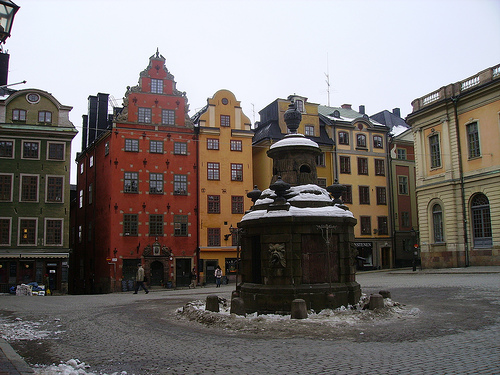
But with the city in hand, Christian — known to Swedish history as “Christian the Tyrant” — had its leaders charged for having deposed during the conflict the pro-union Archbishop Gustav Trolle, construed as an offense against the Church not in the temporal authority’s power to reprieve. Less than 24 hours after this legal maneuver was sprung, public beheadings of prelates, merchants and burgomasters were underway at Stortorget* — and Sture’s remains were exhumed and posthumously burnt at the stake.

Stortorget

It proved a Pyrrhic victory for the Danish party.

Inside of three years, Christian himself had been deposed with multiple lands and factions throughout his realm in open revolt. Gustav Vasa, whose father had been one of the Stockholm Bloodbath’s victims, would not only decisively break Denmark’s hold on Sweden but found the Vasa Dynasty under which Sweden would burgeon into one of Europe’s great powers.

*One Hans Brask survived the purge despite having endorsed the removal of Archbishop Trolle. Brask supposedly placed a note under his seal on this document saying “To this I am forced and compelled.” This cunning device gave the Swedish tongue the word Brasklapp — a secret reservation.

On this day..