1840: Zachariah Freeman

(Thanks for the guest post to American newsman and reformer John L. O’Sullivan. Best-known as the fellow who coined that potent brand for American empire, “manifest destiny,” O’Sullivan was also a vigorous advocate for abolishing capital punishment as a New York legislator in the 1840s, and made several proposals to that effect. The summary here is one of many reported in O’Sullivan’s appendix to his Report in favor of the abolition of punishment of death, by law, made to the legislature of the state of New York, April 14, 1841. The report did not achieve its objective. -ed.)

Tried in September, 1840, for the murder of Sarah Boyd, his quasiwife, in the town of Lysander, Onondaga county, on the 18th of May, 1840.

Both were negroes. They lived in the same house with his father, 80 years of age, his brother Elihu, and a woman who lived with his brother as his wife. Zachariah was much attached to Sarah, and had taken some steps toward making arrangements for a legal marriage with her.

Jealousy was the motive to the murder — or a combination of jealousy and insanity. They had some trifling dispute, in which she refused to comply with some domestic order of her husband, when he raised a chair, and struck her across the arm, knocking her down. On recovering herself, she declared she would never live with him again. He thereupon went to some woods at a short distance, and made an attempt to hang himself — whether in earnest, or to frighten them, does not appear clear. He was stopped with the rope round his neck, and brought back to the house.

While he was away she expressed great dread of his returning, saying, that if he did, she should be a corpse before morning — that though he had not threatened her, she saw it in his eye. While he was out, before returning to the house, he was praying and singing hymns. He entreated a reconciliation with her, which she refused; — he was willing to go down on his knees to her. She consented to leave it to the rest to decide the next morning, if he would now behave himself.

On this arrangement the rest went to bed — he remained up, smoking a pipe. He had insisted on smoking her pipe, refusing any other. According to his confession of what followed, he after a time leaned his head on the bed, and she kicked him. He then got the knife with which he committed the act, and went to some distance from the house for the purpose of killing himself; but while whetting it, determined to go back to see her once more. She was sitting up in bed. He placed his left hand on her shoulder, and attempted to kiss her. He had no thought of injuring her — “she was young, handsome, and everything that was nice, and it had not occurred to his mind to damage her at all.”

She refused to receive him, and slapped him on the face. He then gave her a stab, which was in a few moments fatal, immediately cutting his own throat also. Though a severe wound, this did not prove fatal.

The family were immediately roused, and eventually he was cured of his wound. He expressed much grief and repentance. He was jealous of his brother Elihu, whom he believed to have criminal intercourse with her. Zachariah had wished her to remove with him to another house, but she had refused. He said, after the affair, that “if she would not lie any more with him, he would not let her with any other man” — “he thought she should never sleep with another man, and he never with another woman.”

He said, he expected to be hanged, but added: “I shall go to the gallows in as good a cause as ever a man went.” His previous general character was good. He was hung November 19th, 1840.

On this day..

1888: Not Sarah J. Robinson

On this date in 1888, Massachusetts almost hanged Sarah J. Robinson.

The reader will easily infer from press appellations such as the “Massachusetts Borgia” or “Sommerville Borgia” that Mrs. Robinson was a prolific poisoner.
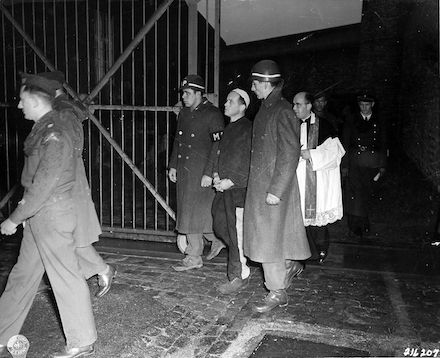
The true toll of Robinson’s career remains uncertain to this day but they monstrously included her own son and daughter — the victims that brought her within the shadow of the gallows.

An Irish immigrant, she had discovered the capacity of arsenic for relieving the financial burdens that, then as now, weighed upon the poor. In 1881, her landlord suspiciously died in her care, abating a debt of rent; a few years later, her husband did likewise, leaving her an insurance windfall, and then her sister too.

Still the maintenance of five children — four of her own, plus a nephew — harried her. To keep the wolves at bay she moved frequently, sold off furniture. And last, she enrolled two children in a working-class insurance fraternal and collected so speedily to attract the wrong attention. Her many murders afforded multiple bites at the legal apple, so when a jury hung on a charge of murdering her kids, they just turned around and got her for a nephew instead.

Mrs. Robinson was escorted to the court room … A large rocking chair was provided for her comfort in the rear of the court room outside the prisoner’s iron cage. She languidly sank into it, and as soon as seated requested a drink of water, which was brought her by Sheriff Tidd. Her hands trembled like leaves as she eagerly held the tumbler to her lips. (Boston Journal, June 29, 1888)

Notwithstanding her many victims, the prospect of noosing this trembling-hand, rocking-chair mother discomfited the public. The governor commuted her sentence to solitary imprisonment four days before her scheduled November 16, 1888 hanging.

On this day..

1822: Johan Wilhelm Gebhardt, Junior, slave-slayer

On this date in 1822, Johan Wilhelm Gebhardt was executed at the Dutch-founded South African settlement of Paarl. His offense, unusual but not unheard-of in our executioner’s annals: killing his slave.

According to Alex Mountain in An Unsung Heritage: Perspectives on Slavery, the 21-year-old Gebhardt, who managed the farm belonging to his father, Rev. Johan Wilhelm Gebhardt Sr., had ordered a slave named Joris flogged “for not working properly.”

the flogging was done repeatedly by a slave called November who had been warned by Gebhardt, who remained present throughout the torture, that he too would be severely punished if he did not flog Joris properly. The flogging was done with a variety of instruments and from time to time salt and vinegar were rubbed into his wounds.

It was only when Joris lost consciousness that the torture stopped.

Joris died that night.

The western Cape had recently been taken under British management, and these looked with surprising hostility on the murder of Joris. Gebhardt was not suffered to plead to manslaughter in order to escape his fate.

Mountain reproduces a photo of Gebhardt’s gravestone (found “being used as a small bridge across a ditch”) with the lines

Rest in Peace
Unfortunate Youth
Your Career was short
and you were led Astray
Few were the Pleasures of your Life
And many your Sufferings!

There’s no gravestone for Joris, of course.

On this day..

1945: The Rüsselsheim Massacre perpetrators

The U.S. Army hanged five German civilians as war criminals at Bruchsal Prison on this date in 1945. Their crime: lynching the crew of a downed American bomber, the day after Allied bombing raids devastated the manufacturing town of Rüsselsheim.

The lynching is known as the Rüsselsheim Massacre, and it claimed the lives of six of the nine flyers of a B-24 Liberator cheekily christened Wham! Bam! Thank You, Ma’m!. One of their number survived thanks to his shrapnel wounds, which saw him safely to hospital while his comrades were being transported.

The other two were simply lucky to survive the beatings administered by a mob of enraged civilians who caught sight of the Americans under the escort of only two German soldiers. On the night of August 25-26, Britain’s Royal Air Force had dumped more than 1,600 tons of explosives on Rüsselsheim to destroy the Opel factory and rail lines there. It was only the latest, and ultimately the largest, of several raids on the town dating back to July. A later U.S. study reckoned 315 Opel workers killed and 277 injured during the July-August raids, to say nothing of the devastation on other townspeople and on Opel’s slave labor.* A POW, Frenchman Pierre Cuillier, recorded of the August 25-26 attack that “a bomb fell on the dug-out for Russian women. We hear of 119 victims, a number that in reality is surely much higher.”

Under the circumstances, the good folk of Rüsselsheim were not pleased on the morning of the 26th to see Allied airmen in their town being marched to a train transfer … even if, and surely the distinction must fail to impress amid the smoldering rubble of one’s own hometown, this particular American crew had not been part of this particular British bombing. (The Americans had been shot down two days earlier en route to do a similar thing to Hanover.)

“There are the terror flyers. Tear them to pieces! Beat them to death! They have destroyed our houses!” cried Margarete Witzler and Käthe Reinhardt. As the Americans protested, the crowd overpowered the guards and took its rough revenge with whatever bludgeons were ready to hand.

At last, Joseph Hartgen, an air raid warden, finished them off with his pistol … or at least, finished off six before his chamber went empty.


Spoiler alert: it will not go well for Herr Hartgen.

Somehow the two un-shot men, Sgt. William M. Adams, and Sgt. Sidney E. Brown, still drew enough breath by the end of the ordeal to sneak away when they were being dumped into a mass grave. Captured again a few days later, they survived the war in a POW camp.**

Eleven Rüsselsheimers stood trial in Darmstadt for these Lynchmorde by July, when war was still raging in the Pacific: it was the very first war crimes proceeding under U.S. occupation.

The defendants tried out a pre-Nuremberg version of the “only following orders” defense, blaming Nazi propaganda against bomber crews for inciting the murders. The U.S. prosecutor† scoffed: “They were all grown men and women. If they are called on to commit the murder and they do, they are just as responsible as any other murderers.”

Harten and six others of the 11 caught death sentences, but the two women — Witzler and Reinhardt — both had their sentences reduced.

Warning: Although not graphic, this is a video of actual hangings.

* Quotes and figures from Working for the Enemy: Ford, General Motors, and Forced Labor in Germany During the Second World War, which is topical because Opel was a General Motors subsidiary.

** Brown lived long enough to return to Rüsselsheim at official invitation in 2001 for a formal apology. However, at the time of the trial, it was still mysterious how there came to be only six exhumed bodies from eight lynched airmen: Adams and Brown only emerged out of the mass of returning POWs after convictions had already been secured.

† The army prosecutor at the proceeding was one Lt. Col. Leon Jaworski, but he’s better known for hunting larger game later in his career as the special prosecutor during the Watergate investigations. (Jaworski is the guy embattled President Richard Nixon appointed after firing Archibald Cox in the Saturday Night Massacre.) Jaworski’s eventual legal victory over the White House in United States v. Nixon obtained the incriminating Watergate tapes in late July of 1974, forcing Nixon’s resignation just days afterwards, on August 9, 1974.

On this day..

1773: Eva Faschaunerin, the last tortured in Austria

On this date in 1773, Eva Faschaunerin was beheaded for the arsenic murder of her husband Jakob Kary, mere weeks after their 1770 marriage.

Faschaunerin (English Wikipedia entry | German), who was interrogated on the rack, is distinguished as the last victim in the Austrian empire of official judicial torture: the practice was abolished in 1776 by Maria Theresa.

She’s still well-known in her locale, the Alpine Lieser-Maltatal region and even further afield than that; the town of Gmünd has an Eva Faschaunerin museum in its former jail.

On this day..

2009: Xu Wei, Jilin gangster

China’s state-run Xinhua News Agency reported thusly:

CHANGCHUN, Nov. 5 (Xinhua) — A Mafia ring leader, who is also son of a former high-ranking city official, was executed Thursday by lethal injection in Changchun, capital of northeast China’s Jilin Province, according to a court statement.

Convicted of murder, kidnapping, intentional injury, extortion and other crimes, Xu Wei, 42, was sentenced to death by the Changchun Intermediate People’s Court on Sept. 20, 2007. The Higher People’s Court of Jilin Province ruled against Xu’s appeal and upheld the first-instance verdict on July 10, 2008. The Supreme People’s Court approved the death sentence after reviewing the case.

Xu, deputy manager of Yushu City Thermal Power Co. and son of Xu Fengshan, former deputy mayor of Yushu city, was found to have provided guns to two gangsters who shot dead Xu’s business rival in 1997. Xu even pulled strings through his police complice and bailed out one of the killers, the court was told.

Believing a township head didn’t pay him enough respect, Xu ordered his men to beat him to death in 1998. In the end, the man was struck into coma and died in hospital in 2000 at the age of 49, court verdict said.

In a separate case, the father Xu Fengshan was sentenced to death with a reprieve of two years for taking more than 20 million yuan (2.93 million U.S. dollars) in bribery and harboring criminal organizations.

On this day..

1807: Henry Niles

From the Greenfield (Massachusetts) Gazette, November 30, 1807:

NEW LONDON, (Con.) Nov. 11.

On Wednesday last, Henry Niles, an Indian, was executed in this city, for the murder of his wife, pursuant to the sentence of the Supreme Court.

The day before his execution the prisoner attempted to anticipate his sentence, and with a piece of the blade of a knife opened a vein in his thigh, from which a large quantity of blood issued before his purpose was prevented.

On the day of execution, he was taken from prison by the Sheriff and his Deputies, (the Independent Company acting as guards) and carried to the Presbyterian meeting house, where a sermon was preached by the Rev. Mr. [Abel] M’Ewen.

At the place of execution the prisoner made a short speech to the spectators, and was then launched into eternity.

It is 21 years since the execution of a criminal in this city, and the spectacle of the public death of a human being, though “a poor Indian,” drew together a large concourse of people; the number has, by many observers, been computed at 6, 8, and 10 thousand. The prisoner behaved with much calmness, and when passing from prison thro’ the crowd, his countenance bespoke the magnanimity of the American savage.

The death of his wife was occasioned by a quarrel produced by intoxication, the effects of which are known to be peculiarly mischievous among the aborigines of America.

On this day..

1913: Captain Manuel Sanchez Lopez

On this date in 1913, Spanish Captain Manuel Sanchez Lopez was shot for a scandalous affair of incest and murder.

You’ll need Spanish for most sources on this tawdry tale. Our principal was a vicious lowlife of long repute, having driven his wife away by dint of his ungovernable affection for cheap brothels, gambling dens, and drunken brawls.

His oldest daughter, María Luisa Sanchez Noguerol, would be his semi-willing accomplice in the crime that ended Captain Sanchez’s life, but she had for many years before that been his victim: not only of the blows the father meted out to all his children, but also to his sexual attentions.

Captain Sanchez forced this daughter into prostitution to support his own degeneracy but he had a larger score in mind when he encouraged her to accept an assignation with a wealthy widower, Rodrigo Garcia Jalon. At this rendezvous, the father — who probably would have been better advised to content himself with the rents of blackmail or robbery — sprang from concealment and fatally bludgeoned the gentleman with a hammer.

Father and daughter desperately dismembered the body in hopes of concealing the crime but another of Manuel Sanchez’s oft-thrashed children denounced them to the police, to the very great delight of scandal-mongering newspapers throughout Europe. Everything was rumored: that the father had once or twice impregnated his own progeny, that they had pulled the seduction/murder trick several times before.


The discovery of the victim’s remains.

The father had the privilege of shooting instead of a garrote, thanks to his military rank. The daughter received a long prison sentence.

On this day..

1907: Afanasi Matushenko

On this date in 1907,* revolutionary sailor Afanasi Mat(y)ushenko was executed for his part in tsarist Russia’s Potemkin mutiny.

The son of a liberated serf, the Ukrainian Matushenko (English Wikipedia entry | the more detailed Russian) absconded in his childhood to enter imperial Russia’s industrial economy. After spending the late 1890s — his mid teens to early twenties — on the railroads and the docks he was conscripted into the navy.

The revolutionary year of 1905 finds Matushenko a quartermaster aboard the soon-to-be-famous battleship Potemkin stationed at Sevastopol, already politically radicalized enough to have participated in a revolutionary barracks riot the previous November.

Eisenstein is mandatory where the Potemkin is concerned but the fact is that the mutiny was not spontaneously generated: it had been planned, and Matushenko was a part of the planning.

On the day of the rising, it was he who led brother-sailors in a protest against worm-ridden rations, and he who eventually crossed the rubicon into mutiny by calling them to arms. He personally killed several of the ship’s officers, and with the mutiny’s success he was elected the chair of the ship’s executive committee.

The Potemkin sailed for Odessa where her aspirations to catalyze a wider rebellion ran (metaphorically) aground, and eventually sailed for Romania. Matushenko lived abroad for two years as a political refugee, crossing paths with kindred souls but indistinct in his political outlook, nearly terroristic. The leftist writer Vladimir Posse met Matushenko in Geneva and found him

Matyushenko … did not go into theory. And his practice was to destroy — precisely the destruction, not the elimination, of all the chiefs, all the masters, and above all the officers. For him, the people were divided into masters and subordinates … the lower ranks can free themselves only when the officers are “simply” destroyed. He himself killed two or three of his superiors during a riot on the Potemkin. And it seemed to him that the essence of the revolution lay in such murders. In this spirit, he wrote bloodthirsty proclamations to sailors and soldiers, urging them to kill officers. He thought that with such a program it was easy to attract all the sailors and most of the soldiers to the side of the revolution …

He considered himself to be doomed to die in battle or on the scaffold … He considered living in an emigrant position to be dishonorable, something of a betrayal. In his view, a true revolutionary is one who not only kills, but also dies himself.

In June 1907 he acted on the latter beliefs and returned to Russia — where he was promptly arrested and condemned by a military court to fulfill his prophesied destiny.

Several cities in the Soviet Union, including Sevastopol itself, had streets named for Sailor Matyushenko, and a Black Sea minesweeper received that name in 1969.

* November 2, 1907 per the Gregorian calendar. Tsarist Russia was still hanging on to the Julian calendar at this time.

On this day..

1946: Arthur Robert Boyce, the king’s housekeeper’s lover

To begin the twelfth year of these morbid annals, we’d like to direct readers to another resource for almanac execution-posting: the Facebook page of venerable death penalty resource Capital Punishment UK.

We have several times guest-reblogged a few of the many feature articles to appear on this site; its copious archives are also a regular research stop for the Headsman and anyone else interested in death penalty history.

They’ve upped their Facebook game recently with daily anniversary-of posts frequently about individual cases from their annals.

Here’s a teaser from today’s entry:

In the summer of 1946 King George II of Greece had rented a house at 45 Chester Square, Belgravia. He required a house keeper and Elizabeth was appointed. She gave references which were found to have been written by Boyce. Although the property was being renovated, she lived in, alone. She invited Boyce to move in and he did so on the 1st of June, 1946.

Someone winds up on the gallows by November 1 of that same year. Read on to find out, and give the page a follow if you routinely thumb the book of faces.

On this day..