1894: William Whaley, “the horror of the situation”

This ghastly description of a botched hanging comes courtesy of the out-of-print The palace of death, or, the Ohio Penitentiary Annex: A human-interest story of incarceration and execution of Ohio’s murderers, with a detailed review of the incidents connected with each case by H.M. Fogle (1908):


Chapter 19

William Whaley
June 22, 1894

A negro robber who beat out the brains of Allen Wilson, near Yellow Springs, Ohio, with a dray pin. Hanged June 22, 1894

A Brutal Robber Meets a Just Fate


William Whaley, serial number 25,257, was executed in the Ohio Penitentiary Annex twelve minutes after the birth of a new day, June 22, 1894, for the brutal murder of Allen Wilson, a thrifty and hard working colored man.

The crime was committed near Yellow Springs, Greene County, Ohio, on the night of June 6, 1893. Robbery was the motive for the crime, and a dray pin the instrument of destruction. He sneaked upon his victim in the dark, and literally beat his brains out.

Whaley was a young man not over twenty-five years of age, and with perhaps one exception, was the most profane man that was ever incarcerated in the Ohio Penitentiary Annex. He refused all spiritual consolation, and cursed his executioners almost with his dying breath. He was a cowardly cur, and betrayed his cowardice while on the scaffold. Three times he sank to his knees as the noose was being adjusted. The attending Guards were compelled each time to assist him to his feet, and finally to hold him up by main strength until the rattle of the lever shot his body through the open trap. Being almost in a total state of collapse, the body instead of plunging straight through the opening, pitched forward, striking the side of the door, thus breaking the force of the fall. For this reason the neck was not broken, and death was produced by the slow and harrowing process of strangulation.

Reader, if you have never seen a sight of this kind you cannot understand or comprehend the horror of the situation. Time after time the limbs were drawn up with a convulsive motion, and then straightened out with a jerk. The whole body quivered and shook like one might with the ague; while the most hideous and sickening sounds came from the throat. This continued for eighteen minutes; but to one looking on it seemed an age. After eighteen minutes the sounds ceased; the body became perfectly still; the limbs began to stiffen; the heart-beats to weaken. In just twenty-six minutes after the drop fell the last pulsation was felt, and the doctor solemnly said: “Warden, I pronounce the man dead.”

The outraged law had been avenged, and a soul unprepared had been ushered into Eternity.

On this day..

1890: Elizabeth and Josiah Potts, wife and husband

On this date in 1890, an affectionate married couple hanged together in Elko, Nevada, for a murder they insisted they had not authored.

We obtain this headline and the associated (nationally circulated) story from the San Diego Union of June 26, 1890.

[Associated Press Dispatches.]

ELKO, Nev., June 20. — Elko is in a ferment of excitement, many parties pouring in to witness the execution of the Potts family for the murder of Miles Fawcett in January, 1888. Over sixteen women have already applied for permits to witness the execution, which were refused.

The conduct of Mrs. Potts during the past five days has been an alternation of hysterical crying, screaming and swearing at her husband, who mopes the time away in solitude. Yesterday morning at 5 o’clock she attempted to commit suicide, gashing her wrists and trying to smother herself. The vigilance of the death watch prevented further injury but she fainted from loss of blood. Both the Potts retired early last night in a nervous condition.

At 10:30 o’clock the Sheriff read the death-warrants to Josiah and Elizabeth Potts. The reading of the warrant took place in the doorway of the latticed cell, which Josiah has occupied for so long a period.

He stood in a despondent attitude, with his head bowed down against the iron bars, and not once during the reading of the warrant did he lift his head. His wife stood erect, clad in a neat muslin suit draped in black, with a red rose in her bodice. She was pale, but with a most determined aspect in every feature. During the reading of her own warrant only once did she show any emotion whatever, and she convulsively clutched her throat when her husband’s was being read, and when the words “hanged by the neck till you are dead” were reached, she gave a hysterical gasp and seemed to exhibit much feeling.

The reading of the warrants was finished at 10:30, and both the condemned people emerged from the jail, where they had been confined for eighteen months, and proceeded outside the door to the yard between the Courthouse and jail, in which the scaffold had been erected. The sunshine relieved in a measure the gruesome surroundings. During the readings of the warrants, and evidently owing to the intense nervous strain on every one, a Deputy Sheriff was so overcome that he had to call for a glass of water.

At the conclusion of the reading Mrs. Potts earnestly ejaculated:

I AM INNOCENT AND GOD KNOWS IT,

and Josiah Potts reiterated, “God knows we are innocent.” The gloomy procession led the way through a side door and with a bravery unexpected by the sixty-odd spectators, the condemned couple seated themselves on stools provided on the scaffold, while the deputies speedily proceeded to bind them with leather straps, Mrs. Potts helping to adjust them herself while Potts sat through it all in stolidity.

When everything had been properly adjusted, they were directed to rise and all of the attendants shook hands with the condemned unfortunates. The attendants held the strap attached to Mrs. Potts’ manacled wrists and Potts made several most earnest endeavors to clasp the hands of his wife but without accomplishing it. Finally a touch on her wrist caused her to turn her eyes toward his and a mute appeal of love caused their lips to meet. As the rope was stretched around Mrs. Potts’ neck she clasped her hands together, and lifting her eyes towards the sky, exclaimed “God help me; I am innocent.”

Her husband reiterated in a hollow tone, “God knows we are innocent,” as the black caps were drawn over their heads.

The words of the clergyman who had remained with them to the last broke the silence by saying: “Put your trust in God and He will see you righted,” and then the drop fell. Instantaneously,

MRS. POTTS WAS A CORPSE,

owing to her heavy weight. Her flacid [sic] flesh caused a rupture of the carotid artery and a stream of blood burst forth from under the chin of the dead woman, staining her white raiment. To the great surprise of all who had seen Potts’ emaciated condition his vitality was great, it being a fraction over fourteen minutes, as counted by the Associated Press reporter, before life was pronounced extinct by Drs. Meiggs and Petty.

At 11:08 the body of Mrs. Potts was cut down when it was seen that her excessive weight on the five foot and a half drop had almost dissevered her head from the trunk, the muscles in the back of her neck alone supporting the connection.

About nine minutes later Josiah Potts’ body was cut down and the body of himself and wife, in the absence of any claiming friends, were deposited in the potter’s field of the Elko grave yard half an hour later.

After the interment of the bodies of Mr. and Mrs. Potts, District Attorney Love, accompanied by an Associated Press reporter, placed in the potter’s field all the remains of the murdered Fawcett known to exist above the earth. The box of bones had been in the District Attorney’s office at the Courthouse from the time when he first started to search for the criminals.

THE CRIME

for which the couple was executed was the murder of Miles Fawcett, 70 years of age, at Carlin, January 1st, 1888, because he insisted on being paid some money due from Potts. He visited Potts and this was the last seen of him until his dead body was discovered some months after by a person who rented the house formerly occupied by Potts.


That’s the end of the Union article.

Despite the incriminating circumstances of Mr. Fawcett’s disappearance, many people found the Potts’s insistence upon their innocence persuasive … especially after a last message from Elizabeth Potts reached public ears.


Laramie (Wyoming) Daily Boomerang, June 24, 1624.

Innocent or guilty, Elizabeth Potts remains the first, last, and only woman ever legally executed in Nevada. As of this writing (mid-2018) the Silver State has not had any woman on death row since Priscilla Joyce Ford died in 2005.

On this day..

1944: Seisaku Nakamura, Hamamatsu Deaf Killer

(Thanks to Meaghan Good of the Charley Project for the guest post. -ed.)

On this date in 1944, nineteen-year-old serial killer Seisaku Nakamura was hanged for a series of horrific murders in wartime Japan. He killed at least nine people, perhaps as many as eleven, many of them while he was still a minor.

Nakamura, born deaf, was ostracized by both his family and society at large for his disability. Robert Keller, in his Asian Monsters: 28 Terrifying Serial Killers from Asia and the Far East,* notes:

It has been noted that many serial killers who suffer such ostracism retreat into a fantasy world, fueled most often by revenge fantasies. This was certainly the case with Seisaku Nakamura. He developed a near obsession with the Samurai culture and enjoyed watching movies where Samurai slaughtered their victims with lethal Katana swords.


The 47 Ronin (1941).

Yet on the surface all appeared normal. Seisaku was a bright boy who excelled at school. He was polite and deferential. He endured his condition without complaint. He’d grown, too, into a tall and strapping youth.

All was not normal, however.

According to Nakamura’s later confession, he committed his first two murders on August 22, 1938, when he was only fourteen. He tried to rape two women, he said, and murdered them after they resisted. This account has never been confirmed; perhaps he was boasting, or perhaps the murders did occur and the Japanese military government kept them out of the news.

Nearly three years passed before he committed another homicide: on August 18, 1941, Nakamura stabbed a woman to death and nearly killed another. Two days later, he stabbed and hacked another three victims to death. The police had a suspect description, but hushed up the information about the crimes for fear of causing a panic.

On September 27, Nakamura got into an argument with his brother at their parents’ home. The result was a bloodbath: he stabbed his brother in the chest, turned the knife on the rest of the family, stabbing and slashing his father, sister, niece and sister-in-law. Amazingly, only Nakamura’s brother died. Questioned by the police, the survivors refused to cooperate, saying they were afraid of retribution if they named their attacker.

Nearly a year passed with no bloodshed, but on August 30, 1942, Nakamura targeted another family. He saw a young woman on the street, followed her home, where her husband and three children were. Nakamura began his attack on the mother, and when her husband tried to defend her, he stabbed them both to death. He then slaughtered their two youngest children and turned his attention to the oldest, a girl. He started to rape her, then inexplicably broke off his assault and ran away, leaving her alive.

The survivor provided a good witness description to the police, who had their eye on Nakamura already; they had come to believe the reason his family wouldn’t say who attacked them the year before was because their attacker was one of their own.

The “Hamamatsu Deaf Killer” was arrested and quickly tried, found guilty, and sentenced to death in spite of his youth and the parade of witnesses ready to say he was insane.

Little is known about him and his crimes, as Japanese government suppressed most of the information.

* As we’ve previously noted, we cite the titles, we don’t write the titles.

On this day..

2011: Ruyati binti Sapubi, migrant worker beheaded on film

Indonesian migrant worker Ruyati binti Sapubi was beheaded in Mecca on this date in 2011 for the meat cleaver murder of her mistress. She numbered among the several hundred thousand Indonesian women hired as domestic servants in the Gulf kingdom.

“The maid carried out the killing after she was denied permission to leave the kingdom and return to her family in Indonesia, according to officials in Jakarta,” according to press reports on the very sketchy details allowed by Riyadh.

The mild and passive voice here conveys a wild overreaction by the help, but a moment’s consideration of the scenario — a terribly vulnerable imported domestic worker disallowed from leaving her job — puts matters into a different light. (To add diplomatic insult to injury, the Saudis failed to inform Indonesia when the actual execution was imminent.)

Indeed, just days after the execution, word leaked of a Sri Lankan domestic who had been secretly held in outright slavery for 14 years.

Mature Content: The execution was secretly recorded. This is a snuff film.

The Indonesian government slapped an immediate moratorium on overseas work in Saudi Arabia in the aftermath of this horror. Unfortunately, these and similar measures in the 2010s have only compounded the risk of trafficking, increasing the vulnerability of people desperate to secure work abroad.

On this day..

1581: Christman Genipperteinga

June 17 of 1581 was the alleged condemnation date — the best specific calendar date we have — for the German robber/murderer Christman Genipperteinga or Gniperdoliga, who was broken on the wheel for a reported 964 murders.


See? June 17.

A 1581 pamphlet “Erschröckliche newe Zeytung Von einem Mörder Christman genandt” is the earliest account we have of our inaptly named Christman (German Wikipedia entry | the surprisingly much more detailed English), and even this first source supplies us the seemingly outlandish body count.

Our man is supposed to have made a lair in the Rhineland wilds from which he preyed on German and French travelers, and even turned murderer of other bandits after partnering with them.

We of course lack any means to verify independently this murder toll exceeding six per month throughout the whole of his thirteen-year career; if we’re honest about it, we’re a little light on verification that this guy wasn’t a tall tale from the jump. Whether or not he really drew breath, or profited from the pre-modern propensity to overcounting bodies, his fame was certainly magnified by the burgeoning print culture … and its burgeoning fascination with crime. Joy Wiltenburg in Crime & Culture in Early Modern Germany:

It was in the 1570s that reports of robber bands multiplied, reaching a peak in the 1580s and continuing in lower numbers into the seventeenth century. Accounts of such activity were far-flung, from Moravia in the modern Czech Republic to Lucerne in Switzerland and from Wurttemberg in southwestern Germany to Bremen in the north. Although violence and malevolent magic were the most sensational aspects of the bands’ reported activities, stealing was central to their existence.

Even among these ubiquitous broadsheet outlaws, Christman Genipperteinga’s near-millennium stuck in the public imagination.

As years passed, the story has resurfaced in chronicles, histories, and popular lore running all the way down to our present era of listicle clickbait … and they’ve all somehow made this monster into an even more sinister figure than a mere nongenti sexagintuple slayer. Dubious evolutions include:

  • Genipperteinga kidnapping a woman and forcing her to become his mistress, murdering all the children they produced. (She subsequently betrays him to the authorities by arranging to leave a trail of peas to lead them to his hideout.)
  • Genipperteinga cannibalizing his victims, including his own infants.
  • And, Genipperteinga having literal supernatural powers (invisibility, congress with dwarven artificers).

For a larger-than-life criminal, a longer-than-death execution. The story goes that our Christman endured nine agonizing days on the breaking-wheel, his tormentors fortifying him with hearty drinks every day in order to prolong his sufferings.

Again, this real or fanciful detail profits by comparison to the trends in enforcement emerging to meet the social panic over crime. This was a period when Europe saw the death penalty flourish both in terms of its violent spectacle and, as Wiltenburg notes, its raw frequency:

There is some evidence that the swell in crime reports in the later decades of the sixteenth century coincided with a time of generally intense prosecution. According to figures compiled by Gerd Schwerhoff, a number of localities had especially high levels of execution in this period. Augsburg, for example, shows a distinct rise in the proportion of criminals executed in the last four decades of the sixteenth century — double or more the proportions of the preceding and following periods. Nuremberg too had a substantial rise in the last decades of the sixteenth century, with lower numbers before and much lower figures by the mid-seventeenth century. Zurich similarly executed a much higher proportion in the sixteenth century than in the fifteenth or the seventeenth, although its figures are not broken down by decade.

On this day..

1866: Barthelemy Cellier, true sangfroid

Dying graciously is a — in that blessed space of unfeigned equanimity, in between fright and bluster — is a difficult art. On this date in 1866, the central France town of Riom guillotined an otherwise forgettable criminal who attained that Stoical condition.

By the account of La Petit Journal (French, obviously), double murderer Barthelemy Cellier was awoken at 3 a.m. on the morning of his beheading, with news of the rejection of his appeals. “Ah, ah,” said Cellier calmly, “it’s today!” Well, it’s as good today as it is tomorrow!”

Cellier listened to the curé “avec beaucoup de calme”, called for a glass of Bourdeaux wine and a cigarette, and then,

bare-headed, dressed in the prison outfit: gray trousers, white clogs, a gray jacket thrown over his shoulders, smoking his cigarette, walked with a firm step between the two ecclesiastics … Behind came the executioners and mounted gendarmes.

The course was about two hundred meters. Throughout this journey, Cellier’s face was marked by the most perfect serenity; a gracious smile wandering in his eyes and on his lips gave him rather the countenance of a man walking towards his deliverance than of a criminal going to execution.

The scaffold was surrounded by a large number of people from Riom and the surrounding area; but, thanks to excellent preparation, the dismal machine was separated from the crowd by fifty yards at least. Detachments of soldiers rigorously maintained this perimeter.

Arriving at the foot of the scaffold, Cellier raised his head and looked, without pallor, the fatal cleaver.

He threw out his cigarette and crushed it with his foot.

Then, turning to the honorable priests, he spoke for a few seconds with them, kissed both effusively and climbed alone with a sure stride the steps separating him from the platform.

There, with a sudden movement, he dropped the jacket which hid his shoulders, and having with a glance examined the crowd, without bravado, without affectation, always with the same calm and the same smile, he twice graciously greeted the apparatus. Not a single word was spoken. The hour had just tolled. A sudden noise, immediately accompanied by a few women’s comments and a shriek from the crowd, announced that the supreme act had been accomplished. Cellier’s spirit had not been broken for a moment. He died demonstrating true sangfroid. The crowd slowly went away, deeply moved by the dreadful drama which had just been broken up in a few seconds.

On this day..

1797: Thomas Starr, penknife murderer

“Sermon preached at Haddam [Connecticut], June 14, 1797. On the day of the Execution of Thomas Starr, condemned for the murder of his kinsman Samuel Cornwell by seven wounds given him, by a penknife, in the trunk of his body, July 26th, 1796, of which he languished a few days and died; with a sketch of the life and character of said Starr,” by Enoch Huntington, pastor of the First Church of Christ of Middletown, Connecticut.


Also available online here.

The good minister was brother to the late governor of the state, and (eventually) maternal grandfather to abolitionist William Huntington Russell, co-founder of famed Yale secret society Skull and Bones. Russell was a personal friend of anti-slavery militant John Brown and received the honorary rank of Major General for his service organizing the Connecticut militia for the Civil War.

On this day..

1941: Pittsburgh Phil

On this date in 1941, Brooklyn gangster Pittsburgh Phil went to the Sing Sing electric chair.

The smart-dressed Pittsburgh Phil* — “Harry Strauss” to his parents or just plain “Pep” to his friends — was the most notorious contract killer of the Springsteen-worthy crime syndicate Murder, Inc.. He racked up an alleged body count well north of 100 — possibly several multiples of that figure — popping whomever some organized crime figure needed to be rid of. (Like this guy.)

Pep eschewed any single m.o., murdering with blades and bullets and garrotes and lungs full of water, and he rarely even carried a weapon lest it incriminate him on a chance arrest. Well did he know this tradecraft, for he beat no fewer than 17 prosecutions in New York. The man also took hit assignments all around the country, for other crime lords in cities whose patrolmen did not recognize him by name and reputation.

And fittingly, it took another assassin to kill him.

Fellow Murder, Inc. killer Abe “Kid Twist” Reles — a childhood buddy with whom he’d come up in the Prohibition crime world via Meyer Lansky‘s organization — got caught in the government’s sights and realized that his only probable purchase on life involved giving evidence against his mates.

We’ve seen that his testimony did in Frank Abbandando and Harry Maione, even though Reles had “fallen out of a window” before those goons sat in the mercy seat. Reles likewise gave up Pittsburgh Phil, who in Raymond Chandler’s was “electrocuted with a sneer on his face” on this date along with his fellow Murder, Inc. plugger Buggsy Goldstein.

* Why did they call him “Pittsburgh Phil”? Who knows! He is at any rate not to be confused with groundbreaking horse bettor George “Pittsburgh Phil” Smith.

On this day..

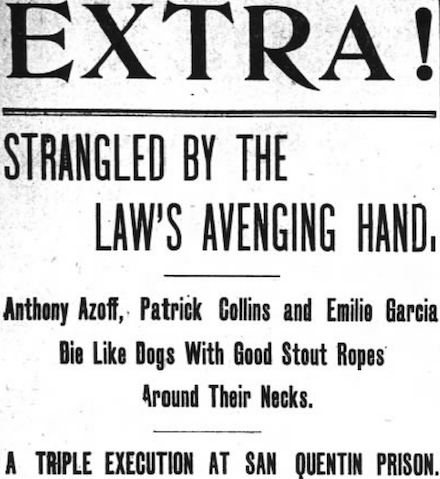
1895: A day in death penalty around the U.S. (McTeague edition)


Headline from the Tacoma (Wash.) Daily News, June 7, 1895.

On this date in 1895, the hangman noosed for the cycle with single, double, and triple executions in three different U.S. states.

Arkansas

In Morrilltown, William Downs or Downes for criminally assaulting a woman called Pauline Bridlebaugh.

“On the scaffold Downs declared that he was guilty of part but not all he was charged with,” according to multiple newspaper reports. The eight-foot fall failed to snap his neck, and Downs strangled to death over 15 agonizing minutes.

Alabama

“Lee Harris and Abe Mitchell, colored murderers, highwaymen and thieves, were hanged here [Birmingham] today before 2000 people for the murder of Grocerymen Merriweather and Thornton. Both bodies were turned over to the undertakers, who purchased them several weeks ago for $18 from the men themselves.”


From the Oakland Tribune, June 7, 1895.

California

Three Californians hanged, sequentially, at San Quentin prison on the morning of June 7 in an affair timed to ensue the arrival of the 7:40 train from San Francisco, carrying about 100 official witnesses.

Emilio Garcia stabbed and slashed to death a San Bernardino old timer whom he believed to possess a hoard of gold.

Anthony Azoff fatally shot a Southern Pacific detective in the course of a botched robbery of that railroad firm’s offices; he was balked of a suicide attempt in the hours before his execution.

And Patrick Collins acquired more lasting infamy than any of his scaffold brethren by sensationally stabbing to death his estranged wife at the kindergarten where she worked when she refused his demand to hand over her wages.

Collins’s guilt was very apparent, so his trial gave the horrified public ample rein to sketch the brute in terms of the era’s crackpot racist typologies. In one Examiner article tellingly titled “He Was Born for the Rope,” it was postulated that “if a good many of Patrick Collins’ ancestors did not die on the scaffold then either they escaped their desert or there is nothing in heredity … Seeing him you can understand that murder is as natural to such a man when his temper is up as hot speech is to the anger of the civilized.”


Various newspaper images of Patrick Collins, from The Construction of Irish Identity in American Literature.

Be they ever so headline-conquering in their time, such crimes are like to fade speedily from the public memory. Collins, the man who slaughtered his tightfisted wife, and Collins, the savage ethnic archetype, have improbably survived his moment of notoriety, by imparting to literature the inspiration for San Francisco novelist Frank Norris‘s 1899 offering McTeague.

In McTeague, a vicious husband murders the wife he has abandoned when she refuses him money. The murderer here presents as an overpowering ancestral beast within — attributable, says Christopher Dowd, to Norris’s “study of criminal anthropology, particularly the school of thinking developed by Cesare Lombroso regarding atavism, hereditary criminality, degeneration, and criminal physiognomy. According to Donald Pizer, by the time Norris wrote McTeague, he had developed a ‘preoccupation’ with the themes of atavism and reversion, and ‘particularly with the role of heredity in causing either an obvious physical or mental devolution or a return to an earlier family condition’. Suddenly, Norris had a way to explain the behavior of his murderous protagonist — he was born a criminal, having inherited the degenerate traits and predilections of his Irish ancestors. Combined with the newspaper reports of the Collins murder, criminal anthropology gave Norris all the tools he needed to write, what Pizer calls, ‘that mythical creature of literature, a naturalistic tragedy'”. For example, Norris zooms through the disordered mind of McTeague as he struggles to control himself on one occasion.

He was disturbed, still trembling, still vibrating with the throes of the crisis, but he was the master; the animal was downed, was cowed for this time, at least.

But for all that, the brute was there. Long dormant, it was now at last alive, awake. From now on he would feel its presence continually; would feel it tugging at its chain, watching its opportunity. Ah, the pity of it! Why could he not always love her purely, cleanly? What was this perverse, vicious thing that lived within him, knitted to his flesh?

Below the fine fabric of all that was good in him ran the foul stream of hereditary evil, like a sewer. The vices and sins of his father and of his father’s father, to the third and fourth and five hundredth generation, tainted him. The evil of an entire race flowed in his veins. Why should it be? He did not desire it. Was he to blame?

McTeague does not exit upon the gallows as did his real-life inspiration; instead, having murdered and robbed his wife, the fugitive flees to the scorching desert of Death Valley where he faces a fight to the finish with a friend/rival who has pursued him. McTeague overpowers this foe, but the man’s dying act is to handcuff himself to McTeague — condemning the latter to sure death.

McTeague has long been in the public domain; it can be perused here; a Librivox audio reading of the book is available here. It’s also been adapted to at least two films in the silent era — including one of the genre’s greats — plus a more recent PBS radio drama, an opera, and miscellaneous other media.

On this day..

1900: Guzeppi Micallef, Maltese felon

This tale of a dreadful Maltese wife-murder arrives via the Times of Malta’s roundup of sensational hanging crimes on that Mediterranean island. Now independent, Malta was still British-controlled at the time of the events in this excerpt.

A marker outside Corradino Prison records the people hanged on its gallows, including Guzeppi Micallef

The murder of 19-year-old Roza Micallef is undoubtedly the most sensational uxoricide of the 19th century. Roza was precious for her husband, Guzeppi, but he was fearful of losing her. This fear was the result of jealousy.

The couple, who had been married only for a few months, lived in a farmhouse at Maghtab. Roza’s parents objected to the marriage as Guzeppi’s brother was married to Roza’s sister and their marriage was not a happy one. However, Roza did not take heed her parents’ warnings and married Guzeppi.

Roza and her husband used to work in the fields with her parents. She was a lively woman and enjoyed talking to relatives and friends. Her husband objected to this behaviour and warned her to be less talkative. Two days prior to the murder, she was seen waving to her uncle, Alessandro. This affectionate gesture triggered off the quarrel Guzeppi had with his wife on the night of the murder.

After sunset on October 8, 1899, Roza’s brother, Teofilio, heard his brother-in-law crying for help as his wife had been hit by a shot accidentally fired by his shotgun. According to Guzeppi, the shotgun was resting against the wall when he accidentally hit it with his foot. The firearm slid to the ground and was discharged accidentally, hitting Roza in her breast.

When the police were called, Teofilio told them that some time before he heard the shot he called on his brother-in-law, Guzeppi, to give him some money. Teofilio said that when he was at his sister’s house he was sure that something wrong was afoot; however, he chose not to interfere.

Regarding the shot, Teofilio said that when he heard the firing of a shotgun he thought that Guzeppi had shot his neighbour’s dog which was barking at that time.

The post-mortem examination revealed that the shotgun had been discharged from a high position and not from the floor as Guzeppi had affirmed in his statement. Moreover, court experts appointed to investigate the case further confirmed that Roza did not die as a result of an accident.

Guzeppi was charged with his wife’s murder and his trial opened on May 28, 1900. The prosecution produced witnesses who testified that the accused was very jealous of his wife. However, Dr Etienne Micallef, the defence counsel, maintained that the accused was jealous because he feared he might lose his wife’s love and had no intention of killing her.

As the accused was found guilty with a unanimous vote, he was sentenced to death.

Representatives of the Chamber of Advocates, the president of the Chamber of Commerce and the Council of Government petitioned the [Lord] Grenfell [Governor of Malta] to commute the sentence but he refused the appeal.

Micallef was hanged on June 6, 1900. He was only 20 years old and the only man in Malta since 1800 to have been hanged for uxoricide.

On this day..