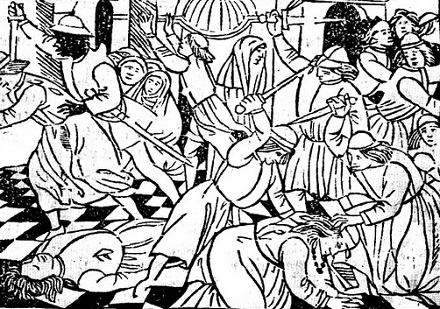
1476: Israel, the last execution of the Trent blood libel trial

We have covered in these pages the horrific blood libel trial that sent most of the Jews of Trent to execution for the supposed ritual murder of the child Simon of Trent.

The moral panic (and torture-aided interrogation) that broke out when Trent’s Jews were suspected of having killed a Christian child led to a batch of executions in June 1475. But that was only the first act of a drama that would reach all the way to the courts of popes and emperors in the subsequent months … a conflict that would not end even when the last “murderer”, Israel, was broken on the wheel on January 19, 1476.

Trent lay at the southern fringe of the Habsburg Holy Roman Empire,* literally halfway from Vienna to Rome … and Trent’s ambitious prince-bishop Johannes Hinderbach was likewise beholden to both those poles of authority.

The sitting pope, Sixtus IV, was pretty sympathetic to Jews in general and very definitely not okay with Hinderbach’s theater of torture and execution. Sixtus was certainly also feeling plenty of pushback from other Jewish communities in Europe to make sure Trent wouldn’t be a precedent for similar freakouts in the future, and from Christian elites who didn’t want muddleheaded fanatics running around.

In Trent, “the Jews” meant literally three households — a tiny handful of people. By contrast, in cosmopolitan, humanist Rome, Jews were prominent among the intelligentsia and their presence taken for granted. Sixtus had Jewish “advisors and physicians in the papal court. They were teachers of music, theater, and science. Rome was a center of Hebrew literature and publishing … Sixtus IV, like most of his predecessors, took his role as a defender of Jews from violence more or less for granted.”**

Sixtus ordered the proceedings halted “because many and important men began to murmur,” and instituted an apostolic commission to investigate.

But Hinderbach and the Trentini refused to cooperate (Italian link) with the investigation. Hinderbach, for his part, was all-in on the Simonino story: just like today, nobody on the hook for a wrongful execution is going to advance his career by acknowledging that fact.

Resentfully, Hinderbach put his unwelcome papal visitor Battista Dei Guidici up in a crappy room, and “many people, moved more by furor than reason, temerity than devotion, threatened to kill the commissioner in the streets of the city, if he did not confirm the miracles and the asserted martyrdom” of little Simon. If anyone in Trent thought otherwise, he did not dare make it known to the closely-watched investigator.

Trent still had Jews in prison at this point, but Hinderbach resolutely prevented the pope’s agent from interviewing with them. “It was to be feared,” Hinderbach said, “that if he talked to them, he or his men could give some sign to the Jews, who would be rendered more obstinate, since they were always saying, ‘A man will come to free us.'”

Book CoverThese quotes are via R. Po-Chia Hsia’s Trent 1475: Stories of a Ritual Murder Trial, which is likewise our guide for the tense diplomatic battle ensuing over the autumn of 1475.

After having bribed a servant to deliver word to the imprisoned Jewish women that they had an advocate, Dei Guidici relocated to nearby Venetian territory — “where innocent people are not killed, where Christians do not plunder Jews, as it was in Trent” — and papers started flying.

Dei Guidici appealed to — and eventually ordered — Hinderbach to release the remaining Jews in his custody, while the pope sent out directives quashing any preaching on Simon’s “martyrdom.” Italian Jews poured into Dei Guidici’s offices appealing for their fellows and attesting that they could not travel through Trent for fear of mob violence.† A verse from a Veronese rabbi dating to late 1475 curses the nearby city: “Hills of Trent, may you not have rain or dew / Seven times may you fall and not rise.”

Hinderbach, for his part, sent his own envoys to German cities that had persecuted Jews for ritual murder in the past to get his own paper trail establishing that, yes, the Hebrew liked a good drink of Christian blood. More significantly, as a prince-bishop, Hinderbach also sent his own appeals up the Holy Roman Empire’s secular chain of command, objecting to the ecclesiastical meddling.

Hinderbach’s only concession to his apostolic scold was to release the children he had in custody. In October 1475, his political machinations with the Habsburgs yielded authorization from the powerful Tirolean Archduke Sigismund to resume judicial proceedings against “the Jewish men and women you have in prison” and “render justice as it should be, and let the death sentences be carried out.”

Interrogations for six Jewish men still in custody resumed on October 25, again with the aid of the horrible strappado to confirm and elaborate upon the already-determined official story of Simon’s martyrdom.

Denial — or even confessing, but guessing the wrong detail to “admit” — was not an option, as this October 26 interrogation record indicates.

He was asked whether he saw the murdered boy.

JOAFF [one of the Jewish households’ servants]: In the ditch.

PODESTA: Think again.

JOAFF: In the antechamber of the synagogue.

PODESTA: Anywhere else?

JOAFF: No.

He was ordered stripped, tied by the rope, and hoisted up.

JOAFF: Let me down, I’ll speak the truth.

PODESTA: Speak it on the ropes.

JOAFF: I have never done anything evil.

He was hoisted up and dropped.

This continues until Joaff has been dropped enough times to agree that he saw Simon’s body on Saturday night, on a bench in the synagogue. They knew that was the truth because it confirmed what they already wanted to hear.

This would be the end of Trent’s Jewish men in January 1476.

Israel, a 23-year-old copyist, was the last to die, and his fate is particularly poignant.

He had half-escaped the pall of death by accepting baptism the previous spring, and lived freely during the following months under the name Wolfgang. Dei Guidici interviewed him, one of the few productive sessions the pope’s man was able to arrange in Trent, and learned thereby of the details of Hinderbach’s interrogations.

Once Dei Guidici withdrew to Venetian soil, Jews of that principality would begin reaching out to “Wolfgang” in their efforts to communicate with the remaining imprisoned Jews.

This skullduggery came came apart when the persecution fired back up in October, and Israel was re-arrested, and put again and repeatedly to the rope. He was a man bound to be crushed by the legal machinery arrayed against him, but it was not only that. As Israel was well-traveled, he was tortured for information about ritual murders in other German cities; his forced denunciation of 14 named Jews in Regensburg initiated a blood-libel proceeding in that city that was only aborted by intervention from the Emperor himself.

And while Israel struggled to portray himself as a faithful convert and appeal to little Simon for an exculpatory miracle that never came, he at least once threw aside the mask to give his tormenters a piece of his mind.

PODESTA: What did he think of the Christian faith?

ISRAEL: He wants to say the truth. He does not believe in anything of the Christian faith … It is a joke to say that God came down from heaven to earth, walked around and lived among men. He believes only in God and nothing more. He believes also that the Jewish faith is right and holy.

PODESTA: Does he believe that it is right, according to Jewish law, that Jews kill Christian children and drink and eat their blood as he himself had said.

ISAREL: He believes firmly that it is right that Jews kill Christian children and eat their blood. He wants to have Christian blood at Easter, even now that he is baptized he wants to die a Jew.

Four other Jews from Trent died by hanging earlier in January 1476. The last one put to death was Israel on January 19 — “thief, eater and drinker of Christian blood, poisoner, blasphemer, traitor, and an enemy of Christ and Godly majesty.”

Even his death did not finally put a stop to the affair, for the women of the Jewish community were still in prison, and still being tortured as late as March. They would eventually accept baptism as the price of their release.

Meanwhile, Hinderbach and Dei Guidici carried their scrap to the curia. Hinderbach’s dogged advocacy of his burgeoning cult of Simon — and the odd ad hominem against his foe here and there — won some allies against Dei Guidici’s protests against “the peril which would be incumbent on the Christian religion, on account of the dealings in Trent, and the lies that would reach the ignorant.”

In the end, the Church decided it on political grounds. It could not encourage more Trents; neither could it invite the scandal of disavowing the one that had already taken place. It upheld Hinderbach’s conduct while also reiterating standing prohibitions against blood-libel trials or oppressing the Jews.

Hinderbach very naturally took this as vindication and spent the balance of his life propagating the Simonino cult. Artwork throughout northern Italy, some of it still visible in situ today in its original public monuments and chapel frescoes, attested to his success.


The Martyrdom of Simonino, by Gandolfino d’Asti.


The Martyrdom of Saint Simonio, from the Trento school of Nicklaus Weckmann. (Via)

Indeed, the city of Trent itself‡ still has a street-viewable bas-relief depiction of Simonino’s ritual murder, with the Latin inscription:

In the dungeons of these buildings, where once a synagogue stood, and now a shrine, the blessed martyr Simon of Trent, in his 29th month of life, was killed with excruciating pain by the Jews in the deep of the night of April 10, 1475 A.D.

The Simon of Trent cult — never the face of Christianity that the institutional church really wanted to feature — was only officially suppressed in the 20th century with the Second Vatican Council.

* Trent’s position on the frontier of the Italian and German worlds is also the reason the next century’s major anti-Reformation Council of Trent was held there.

** Sixtus wasn’t all good news for Jews. More from political necessity than affirmative desire, he also authorized the Spanish Inquisition and appointed Torquemada.

† During this time, Dei Guidici also managed to extract a Trent resident named Anzelino Austoch. Under Dei Guidici’s torture, Austoch accused the man named der Schweizer, “the Swiss” — the very man who had suggested that the Jewish homes be searched for Simon’s body — of committing the murder. Dei Guidici clearly believed that either the Schweizer, or Austoch, or both, had actually killed Simon and intentionally framed the city’s Jews.

‡ Trent does not, of course, still avow the legitimacy of these proceedings; the city has elsewhere put up plaques apologizing for it.

On this day..

2013: A day in the death penalty around the world

United States

The first U.S. execution of 2013 was that of Robert Gleason, Jr. in Virginia last January 16.

Gleason was serving a life sentence for another murder when he conned a fellow-prisoner into letting him tie his hands as part of a supposed escape attempt. Instead, Gleason choked the poor bastard to death with a urine-soaked sponge.

The killer said he did this precisely in order to be executed.

“I murdered that man cold-bloodedly,” he told a reporter in 2010. “I planned it and I’m gonna do it again. Someone needs to stop it. The only way to stop me is to put me on death row.”

He was as good as his word. That summer, he got a necklace around the throat of a prisoner in a neighboring solitary pen and horribly throttled him to death. Virginia obliged Gleason’s heart’s desire with a death sentence that the killer did not contest.

Unusually, Gleason chose to die in the state’s 104-year-old oak electric chair, rather than by lethal injection. Virginia at the time was one of 10 states still allowing an inmate to choose electrocution, but Gleason was the first person to do so since 2010.

His last words: “Well, I hope Percy ain’t going to wet the sponge. Put me on the highway to Jackson and call my Irish buddies. Pog mo thoin. God bless.” As was widely reported after the fact, Pog mo thoin is Gaelic for “kiss my ass.”

His last words — and everything else about him — are remembered here by a reporter who got to know Gleason during his three-year journey to the death chamber.


Somalia

Dennis Allex, an agent of French intelligence held captive for over three years by al-Shabaab militants, was allegedly summarily executed on January 16 following an unsuccessful French raid to free him.

Allex, whose name is thought to be a pseudonym, had been seized in Mogadishu in 2009 and forced during his captivity to broadcast his captors’ demands.

Following the French intervention in Mali last January — an event potentially raising the danger for French hostages throughout the Islamic world — a commando unit attempted to free Allex on January 12.

The French suspect that Allex might have been killed during that operation. His captors, however, claimed that Allex survived it, and that they thereafter “reached a unanimous decision to execute the French intelligence officer, Dennis Allex.

“With the rescue attempt, France has voluntarily signed Allex’s death warrant”


Iran

On this date in 2013, Iran hanged a man in public in the city of Sabzevar.

Also in Sabzevar on the same day, another man suffered a spectacular public lashing.

Still another prisoner was reportedly hanged privately in Mashhad on January 16 in Iran.

On this day..

1876: Michael DeHay, in fire and maddened frenzy

(Thanks to Michael DeHay for the autobiographical guest post, originally published — too late for DeHay to see the byline — in the Prescott, Arizona Miner‘s January 21, 1876 edition. Prescott’s Sharlot Hall Museum unearthed this fascinating frontier confessional and posted it on its library archives site. The Prescott Daily Courier also published an abridged version, complete with an old photo of 1870s Cerbat (it’s a ghost town today). -ed.)

I, Michael DeHay, being fully aware of my approaching fate, and though recognizing the justice of my sentence, feel impelled to give to the world this, my dying statement, hoping that my fate may prove a warning to others similarly situated as I have been, and praying that the circumstances which have hurried me on to a disgraceful end may be avoided by others so situated.

I was born in Mongoup, Sullivan Co., N.Y., April 10, 1830, and am now 45 years of age. At 18 years of age, I went to Greenwood, McHenry Co., Ill., where my father and family had previously settled. In 1850 I went to California — crossing the plains. For three years I was mining and prospecting in different places there, and then returned to Illinois; afterwards going to Minnesota and thence to Wisconsin, where in 1856 I became acquainted with and married Esther Hemstock, near La Crosse.

In 1857 I returned to California with my family, where I remained for four years, working at mining and at my trade as a carpenter. These dates may not be correct, as I have only my memory to rely on, but they are as near as I can now remember.

In 1861 I removed to Nevada with my family; lived at Aurora in Esmerelda County, about seven years or until 1868, and then removed to White Pine, and the next Spring to Pioche, and thence to Parabnega Valley in Lincoln County, where my family resided, until in August 1875, at which time I was at work in Groom District (60 miles distant from my family), as there was no work nearer my home where I had a ranch.

I was working to get money ahead with which to remove my family to some place where I could educate my children, whom I deeply love. I was one of a Committee to get a school started, and had hired a teacher and made arrangements to remove my family to Hiko (NV). At this time, when I was filled with bright hopes for the future for my children, I was almost crazed to learn that my wife had left my home, taking with her my children, team and wagon and most of my household goods, and had started towards Arizona with a Mr. Suttonfield, an entire stranger to me, and who I learned had camped for a few weeks on my ranch. The man who gave me this information was a Constable, who at the same time served a summons on me in favor of Mr. Wilson, a store keeper, for $51, most of which my wife had obtained in supplies just before leaving for Arizona.

I immediately returned to my desolate home, and the next day started in pursuit. My first and great object in following was to get possession of my dear children. I passed them at Chloride, six miles from Mineral Park, where they had camped. Had I then followed the dictates of my almost crazed brain, I should have then and there stopped and shot both the man and woman who had, as I felt, brought ruin on both myself and children, but my better judgment prevailed and I went on to Mineral Park and laid my case before Mr. Davis, to whom I had been recommended to go for advice. Under his advice, I got out a process and had them brought into Mineral Park, but nothing came of it.

I then got a house for my family to live in, and went to work and got provisions for us to live on. I did all I could to make them comfortable, and tried by every means to induce my wife to live with me as before and was willing to forgive the past. To all my appeals she turned a deaf ear, continually declaring that she never would resume her marital relations with me.

During this time I was informed that she, from time to time, met Suttonfield at his house. This continued pressure upon my mind affected me both by day and night. I was troubled with horrid dreams, and at times was nearly crazed. The night the act was committed, I was completely weighed down with trouble and sorrow, and being suddenly awaked from my troubled sleep saw, or thought I saw, my wife standing over me with a butcher-knife in her hand. She had been sleeping in one room in our only bed with some of the children, and I in an adjoining room on the floor.

When I was thus suddenly awakened, I jumped up, clutching my revolver which was under my head and rushed after her into her room. She jumped into the bed and curled down, and I, in my frenzy, fired at her and drew her out on to the floor. When I saw the blood, and saw what I had done, I was horror-struck and rushed out of the house, determined to take my own life, and with this intent, placed my pistol to my breast and fired twice. I then ran down town and for hours have but a faint recollection of what occurred, except that I went up and down a ladder into a hay-loft. At the time I committed the deed, my brain seemed to be on fire and that my head was the center of fire and maddened frenzy.

During all the time after my arrival at Mineral Park, I had never thought or meditated on the murder of my wife, or to revenge myself on her for her act of desertion, but I had at times meditated on revenge upon Suttonfield, as I felt that he was the cause of all my misery. I had never had any serious difficulty with my wife more than a few hasty words such as are likely to occur between other husbands and wives.

I make this statement with a full knowledge that my end is drawing nigh, and that another day will launch me into eternity, where I shall meet my Maker face to face. I forgive all who have wronged me, as I hope myself to be forgiven by a kind and merciful God.

On this day..

1809: Seven Valladolid ruffians, by Napoleon

Upon this a question arises: whether it be better to be loved than feared or feared than loved? It may be answered that one should wish to be both, but, because it is difficult to unite them in one person, is much safer to be feared than loved, when, of the two, either must be dispensed with. Because this is to be asserted in general of men, that they are ungrateful, fickle, false, cowardly, covetous, and as long as you succeed they are yours entirely; they will offer you their blood, property, life and children, as is said above, when the need is far distant; but when it approaches they turn against you. And that prince who, relying entirely on their promises, has neglected other precautions, is ruined; because friendships that are obtained by payments, and not by greatness or nobility of mind, may indeed be earned, but they are not secured, and in time of need cannot be relied upon; and men have less scruple in offending one who is beloved than one who is feared, for love is preserved by the link of obligation which, owing to the baseness of men, is broken at every opportunity for their advantage; but fear preserves you by a dread of punishment which never fails.

Machiavelli, The Prince

This date in 1809, Napoleon gave that dread of punishment to the Spanish with the execution of seven insurgents at Valladolid, where he had come to collect grudging oaths of loyalty from that conquered nation’s grandees to his brother and puppet king Joseph.

We get this entry from Adolphe ThiersHistory of the consulate and the empire of France under Napoleon. We’ve added some paragraph breaks for readability.

Napoleon very distinctly discerned in the alleged devotion of the Spanish people for the house of Bourbon the demagogue passions that stirred them, and which took that strange way to manifest themselves; for it was the most violent democracy under the appearance of the purest royalism.

This people, extreme in all things, had in fact begun again the work of assassination in revenge for the disasters of the Spanish armies. Since the murders of the unfortunate marquis de Parales in Madrid, and of Don Juan Benito at Talavera, they had massacred in Ciudad Real Don Juan Duro, canon of Toledo, and a friend of the prince of the Peace; and at Malagon, the ex-minister of finance, Don Soler. Wherever there were no French armies, honest men trembled for their property and their lives.

Napoleon, resolving to make a severe example of the assassins, ordered the arrest in Valladolid of a dozen of ruffians known to have been concerned in all the massacres, particularly in that of the unfortunate governor of Segovia, Don Miguel Cevallos; and he had them executed, notwithstanding the apparent entreaties of the principal inhabitants of Valladolid.

“You must make yourself feared first, and loved afterwards,” was his frequent remark in his letters to his brother. “They have been soliciting me here for the pardon of some bandits who have committed murder and robbery, but they have been delighted not to obtain it, and subsequently everything has returned to its proper course.”

Our historian encloses as a footnote the text of a Napoleonic correspondence, documenting not only this date’s particular entry into the annals of execution but the Corsican’s methods generally.

The historian Thiers, it transpired, would soon be called upon to implement the sanguinary lessons of his study.

To the king of Spain

Valladolid, January 12, 1809 — noon.

The operation effected by Belliard is excellent. You must have a score of rascals hanged. To-morrow I hang seven here, notorious for having committed all sorts of atrocities, and whose presence was an affliction for the honest folks who secretly denounced them, and who are recovering courage since they are quit of them. You must do the same in Madrid. If a hundred incendiaries and brigands are not got rid of there, nothing is done. Of these hundred have a dozen or fifteen shot or hanged, and send the rest to France to the galleys. I have had quiet in France only in consequence of arresting 200 incendiaries, September murderers, and brigands, whom I sent off to the colonies. Since that time the tone of the capital changed as if at a whistle.

On this day..

1874: Three for misshapen love

On this date in 1874, two men and a woman hanged at H.M. Prison Gloucester for unsatisfactory affairs of the heart.

Charles Edward Butt

On August 17 of the previous year, Charles Edward Butt had besought the company of a Miss Amelia Phipps for an excursion to the next day’s Gloucester Cheese Fair.

Miss Phipps, long the object of the young farmer’s amorous suit, had unfortunately pledged her company to another gentleman, which disappointment Butt remedied by shooting the young lady to death.

Mary Anne Barry and Edwin Bailey

On that very same August 17, a Bristol teen mother named Mary Susan Jenkins attempted to relieve her baby’s colic by reaching for a packet of Steedman’s Soothing Powders.

Plumped for use by teething children, these packets had been helpfully delivered by the local Dorcas Society, a charitable network set up to provide essentials to the poor. And Miss Jenkins was quite poor indeed, after having been dismissed from her domestic service by a prosperous cobbler named Edwin Bailey after the latter impregnated her, and then refused to pay for the upbringing of his whelp.

Minutes after the treatment with Steedman’s, however, the whelp had breathed his last.

Investigation soon determined that the packages had been laced with lethal quantities of strychnine, and the package from the “Dorcas Society” in fact appeared to have been addressed by the hand of Edwin Bailey himself — whose maintenance payments of five shillings per week had now been mandated by a court.

Bailey’s motivation in the affair is obvious; much less so is that of Mary Anne Barry. Barry was another of Bailey’s servants, and she had taken to visiting the Jenkins family over the preceding months under the name only of “Anne” — representing herself as an emissary of the Dorcas Society.

Barry claimed that she had simply been dispatched by Bailey to attempt to ferret out the bastard child’s real paternity which he still violently denied. But a few days before the rat poison was administered it was she who had recommended Steedman’s powders and suggested that they could probably be procured of the Dorcas Society. Though this surely convinced her jury, that panel strongly recommended her to mercy, perhaps not entirely certain on the judge’s charge to them “whether there was not a view of her case consistent with her innocence.” Considering that she was informing Edwin Bailey of the conversations in what she perhaps thought was merely the capacity of a detective, there is indeed such a view.

Robert Anderson Evans

Aging executioner-relic William Calcraft, who would be forced into retirement later this year, was too sick to officiate, so the honors were done by Welsh hanging-hobbyist Robert Anderson Evans instead. Evans only rates a faint and distant blot on the British executioners’ star chart; this date’s trio was probably his piece de resistance. At Evans’s suggestion, the gallows was constructed not as a rising stage, but as a platform level with the ground, and built over a pit.

Evans was a doctor by training, but despite this he gave these patients an increasingly outdated physic: the short drop hanging, soon to be rendered entirely obsolete by William Marwood‘s variable-drop tables.

While the fall Anderson allowed on this occasion was sufficient for the men, the lightly-built Mary Anne Barry — for whom Marwood’s calculations would have called for a longer fall — choked to death for several minutes. Anderson even had to resort to pressing down on her dangling body to speed her death, possibly reflecting as he did on the advantage the elevated stage had for effecting this sort of extremity. (It was a regular occurrence at Calcraft executions.)* Ms. Barry, who confided on the platform that her dreams had long foretold this fate for her, turned out to have the distinction of being the last Englishwoman to die with a short-drop hanging.

* Anderson’s undistinguished hanging career might have been lengthened had he taken to heart the idea that the separation is in the preparation. Anderson didn’t even bring three ropes with him because he assumed that the woman in the group would be reprieved (and that he wouldn’t break a rope and have need for a handy backup). Mary Anne Barry’s noose was made up at short notice in the prison by a former navy man.

On this day..

1900: The private, decent, and humane execution of a human being named George Smiley

George Smiley’s execution in the Arizona Territory on this date in 1900 was a month late owing to a public relations debacle.

The first and only man ever hanged in Navajo County, Smiley had killed a railroad section foreman.

As his scheduled December 8 execution approached, sheriff Frank Wattron garlanded the routine invitation he was required to send to the official witnesses with a bit more exuberance than was usual for the genre.

Holbrook, Arizona ... 1899.

Mr. .....

You are hereby cordially invited to attend the hanging of one

GEORGE SMILEY, MURDERER.

His soul will be swung into eternity on Dec. 8, 1899, at 2 o'clock, p.m. sharp.

Latest improved methods in the art of scientific strangulation will be employed and everything possible will be done to make the proceedings cheerful and the execution a success.

F.J. WATTRON,
Sheriff of Navajo County

The jaunty, gilt-edged communique found its way into the hands of newsmen who soon reported it coast to coast.

U.S. President William McKinley — Wattron’s ultimate boss, since Arizona was a pre-statehood federal territory at this point — was not amused by the officer’s jollity, and ordered a 30-day reprieve for Smiley and a do-over with a little solemnity this time for Wattron.

The sheriff’s compliance was not altogether in the spirit of the directive. On the eve of the hanging, when it was much too late for news cycles to create any upstairs blowback, he dispatched a black-framed invitation dripping in sarcastic gravity.

Revised Statutes of Arizona, Penal Code, Title X, Section 1849, Page 807, makes it obligatory on sheriff to issue invitations to executions, form (unfortunately) not prescribed.

Holbrook, Arizona

Jan. 7, 1900.

With feelings of profound sorrow and regret, I hereby invite you to attend and witness the private, decent and humane execution of a human being; name, George Smiley, crime, murder.

The said George Smiley will be executed on Jan. 8, 1900, at 2 o’clock p.m.

You are expected to deport yourself in a respectful manner, and any “flippant” or “unseemly” language or conduct on your part will not be allowed. Conduct, on anyone’s part, bordering on ribaldry and tending to mar the solemnity of the occasion will not be tolerated.

F.J. Wattron,
Sheriff of Navajo County

I would suggest that a committee, consisting of Governor Murphy, Editors Dunbar, Randolph and Hull, wait on our next legislature and have a form of invitation to executions embodied in our laws.

On this day..

2015: Ahmed Ali and Ghulam Shabbir, Pakistan terrorists

Pakistan this morning has hanged at the central jail of Multan two members of the long-banned Sipah-e-Sahaba Sunni militant party.

Pakistan has been on an execution bender in recent weeks, following the terrorist massacre of 140-plus people at a Peshawar school on December 16.

Directly following that attack, Pakistan lifted a running moratorium on executions and began finalizing death sentences against various people with years-old terrorism death sentences having no particular connection to Peshawar; it carried out four cathartic hangings on December 20.

Ahmed Ali and Ghulam Shabbir both had death sentences from years-old murders (1998 and 2000) that Pakistan characterized as “terrorist” killings.

There have been a total of nine hangings since the Peshawar massacre, and at least eight more people have had mercy pleas officially rejected by Pakistan President Mamnoon Hussain, and could be executed soon.

While this is a fine clip for three weeks’ work, it might just be the tip of the iceberg: Pakistan has threatened to execute up to 500 prisoners over the coming months.

On this day..

1900: Geronimo Parra and Antonio Flores, the last hanged in El Paso

The last-ever hanging in El Paso, Texas, on this date in 1900* was distinguished by an astonishing attempted fight to the finish by the two doomed men.

Despite what Hollywood would have one believe, the dramatic bodily escape from the executioner is really never a thing. (Well, hardly ever.) Yet even if Geronimo Parra and Antonio Flores could not effect their escape that day, they would have been content, as Flores bellowed while brandishing his shank, if “You shall all go to hell with me!”

Parra, by far the more notable character in this drama, was long an infamous desperado in the borderlands. Though known for all manner of outlawry, he was specifically hunted by the Texas Rangers for slaying one of their number, John Fusselman, in a mountain ambush way back in 1890.

Parra was in jail in New Mexico for an unrelated robbery under an assumed name when he was recognized as the wanted murderer. Texas Ranger John R. Hughes cut a deal with the Sheriff of Dona Ana County, New Mexico — a lawman you might have heard of by the name of Pat Garrett.** Garrett wanted a fugitive hiding out in Texas, and arranged to extradite Parra in return if Hughes could find the man for him.

The second man doomed to die with Parra, Antonio Flores, was an altogether more everyday criminal: an avidity for a Smeltertown woman who would not have him led him to stab her to death, crying — as if he had not already done enough to poor Ramona Vizcaya without sending her to the next world with an eye-rolling banality — “If I cannot have you then no other man shall!”

Flores’s, shall we say, passion would prove an asset for the desperate duo on their final day.

The gallows had only a single trap, so the two men were to hang consecutively. When guards came to retrieve Antonio Flores, however, both he and Parra raced out of the open cell door wielding homemade blades — steel wire twisted and sharpened into makeshift daggers.


Dallas Morning News, January 6, 1900.

With the certainty of immediate death upon them, the prisoners made a desperate melee in the little hall.

Flores planted his cruel dirk into the stomach of a deputy named Ed Bryant, while Parra scored glancing blows on two men before he was shoved back into the cell. While the rustler looked on helplessly from behind bars, the available toughs piled onto Parra and subdued him.

Parra was trussed hand and foot and dragged straight to the scaffold for instant execution. On pain of prospective death by the constables’ revolvers, Parra too submitted when his turn came, and satisfied himself with declaring his innocence on the gallows — after which the noose nearly ripped the man’s head clean away.


San Antonio Express, January 6, 1900.

Spare a thought for these long-lost frontiersmen when next visiting the gorge where Ranger Fusselman caught that fatal bullet from Parra’s gang of cattle rustlers: Fusselman Canyon.

* Some sites give January 6 for the execution date. The primary sources here unambiguously show this is incorrect.

** Famous for shooting Billy the Kid. Pat Garrett served only a single term as sheriff of Lincoln County; his reputation for excessive violence and shady associations helped to give his career in New Mexico and Texas a somewhat vagabond quality.

On this day..

1477: Gerolamo Olgiati, ducal assassin


Dramatization of events in this post for the video game-derived film Assassin’s Creed: Lineage.

On this date in 1477, the assassins of the Duke of Milan suffered bitter death for fame eternal.

Famous for both his astute political machinations and for cruelty verging on the sadistic, Galeazzo Maria Sforza inherited leadership of Milan in at the age of 22 with the passing of his father, the great condottiero Francesco Sforza.

Francesco, the founder of the Sforza dynasty, had dynastically married himself to one Bianca Maria Visconti, a daughter of Milan’s previous ruling house.* But not all of the Visconti were at home with the Sforza.

A brash young man of that noble family, Carlo Visconti, as full of humanistic idealism as he was of bile for the licentious Duke’s alleged violation of his sister, joined a conspiracy also compassing two other gentlemen, Giovanni Andrea Lampugnani and Gerolamo Olgiati, to do Galeazzo Sforza to death.

At a St. Stephen’s Day service in a basilica christened to Stephen Lampugnani approached the prince feigning supplication for some audience, then produced a hidden blade and stabbed Galeazzo Sforza. Visconti and Olgiati then rushed on Sforza as well and before anyone realized what was happening the Duke, croaking some half-heard invocation of Mary, was falling dead on the church floor.


Illustration of Galeazzo Sforza’s murder on the title page of a 1476 Lament for the Duke decrying the assassination.

Pandemonium ensued, and in the ensuing helter-skelter, Sforza’s bodyguards fell on Lampugnani and killed him on the spot, while Olgiati managed to escape.**

“It now only remains for us to consider those dangers which follow after the execution of a plot,” Machiavelli mused in his “Of Conspiracies” typology of his Discourses. “These in fact resolve themselves into one, namely, that some should survive who will avenge the death of the murdered prince. The part of avenger is likely to be assumed by a son, a brother, or other kinsman of the deceased.”

Well, yeah.

The assassins of the Duke of Milan appear not to have burdened themselves overmuch with advance consideration of this danger, possibly indulging the dream of Brutus that by a dagger’s stroke alone they could restore the lost republic.

Needless to say, this beautiful hope vanished in the bloody revenge carnival that actually ensued the murder. Just a few days after the assassination, having taken refuge with a priest — his justly frightened family had closed its door on him and needed to make theatrical denunciations of his treason for their own safety — Olgiati was captured, put to a torturous interrogation, and publicly butchered. He had outlived the Duke by only a week, and his gashed carcass was hung up in sections around town by way of warning. The rotting heads of the conspirators remained impaled on lances on the city’s bell tower well into the 1490s.

According once again to Machiavelli, Olgiati “exhibited no less composure at his death than resolution in his previous conduct, for being stripped of his apparel, and in the hands of the executioner, who stood by with the sword unsheathed, ready to deprive him of life, he repeated the following words, in the Latin tongue, in which he was well versed

“‘Mors acerba, fama perpetua, stabit vetus memoria facti.'”

That is,

‘Death is bitter but fame is eternal, and the memory of the deed will endure.’

This attempt, quixotic and doomed, to depose an Italian tyrant by murdering him in church might well have formed the blueprint for a similar plot in Florence in 1478, the Pazzi conspiracy. That version was even less successful than its Milanese predecessor: at least Olgiati and company could say that they actually managed to kill their target before everything else hit the fan.

And republic or not, Sforza’s murder did shake up the polity. It put the Duchy of Milan in the hands of his wife, as the unsteady regent of a seven-year-old heir. A few years later, the late duke’s brother Ludovico displaced the regent and effectively bossed Milan until the French imprisoned him in 1500 during the Italian Wars.

While he had the run of the place, Ludovico Sforza commissioned of Leonardo da Vinci a monumental equestrian statue in memory of his brother that da Vinci never finished.† Quite strangely, the master’s notes were plumbed by a 20th century Pennsylvania airline pilot who dedicated the latter part of his life to actually casting “Leonardo’s Horse”.

* The names Visconti and Sforza are also associated with some of the earliest tarot decks and among the first to introduce to playing cards the use of trionfi, or “triumph” cards — that is, “trumps”. One can readily purchase present-day reprints of this historic pack.

** There is a positively maddening inconsistency, thus far irresolvable for this author, between accounts (here’s one example | and another) asserting that Carlo Visconti was slain by Sforza’s bodyguards directly after the assassination, and other accounts (like Gregory Lubkin’s 1994 history of Sforza’s Milan) that put Visconti on the scaffold beside Olgiati.

† Da Vinci’s ponderously slow progress on this high-profile project led Michelangelo to cattily impugn the rival artist’s bronze-casting aptitude.

On this day..

1868: Thomas Jones, bad uncle

(Thanks to Meaghan Good of the Charley Project for the guest post. -ed.)

Four days after Christmas in 1868, Thomas Jones was executed in London, Ontario for one of the most sensational murders perpetrated in the region at the time. He had brutally slaughtered his twelve-year-old niece in the town of Delaware.

Early that year, according to this article on the case, Jones had tried to rob his own brother’s house while wearing a false beard to disguise his identity. Unfortunately for him, young Mary Jones recognized her uncle and subsequently testified against him in the ensuing trial. Thomas Jones held this against her, as did Thomas’s daughter Elizabeth, who was thirteen.

On June 11, 1868, Mary’s mother sent her to Uncle Thomas’s house to fetch a cup of flour. (One wonders why she did so, given the history of bad blood between uncle and niece.) Mary never returned.

Suspicion inevitably fell on Thomas, who insisted she’d come and gotten the flour and left his home alive and well. Forty-eight hours after Mary’s disappearance, the search party got fed up, grabbed Thomas’s ten-year-old son and threatened to kill him if he didn’t tell what happened to his cousin.

The boy led them to her body, hidden in the woods under a fallen tree. Her skull had been fractured.

According to the child, both his father and his sister Elizabeth had participated in Mary’s murder. Public feeling ran high against the accused and the entire family had to be taken into custody and transported from Delaware to London to avoid a possible lynching. Only Thomas and Elizabeth faced murder charges, but according to this account, Thomas’s wife and younger son were kept in jail for four months and his two older sons, both in their teens, remained there until well after their father’s death.

The prosecution’s theory was that either Thomas had murdered his niece after Elizabeth lured her into the woods at his direction, or Thomas talked Elizabeth into committing the murder.

At trial, Elizabeth tried to take the rap for her father, claiming she’d beaten Mary to death entirely on her own and Thomas had only helped her hide the body. Thomas’s youngest son testified in support of this, saying he’d witnessed his sister striking Mary with a club.

Thomas used his underaged daughter’s statements like a shield — he would maintain his innocence to his dying breath — but in the end the jury convicted him of murder. What may have tipped the balance was the medical evidence, which indicated Mary had been dealt some powerful blows, stronger than a child could have inflicted.

Elizabeth was convicted of manslaughter and sentenced to ten years for her role in the crime, in spite of her youth. The older two of Thomas’s three sons, ages seventeen and fifteen, were finally released without charge in the spring of 1869. Elizabeth served seven years before she was freed.

In spite of the bitter cold many residents of Delaware came to watch Thomas hang at the Middlesex County Gaol. Around six thousand people were in the crowd — approximately half the population of London. This would be the last hanging in Middlesex county.

On this day..