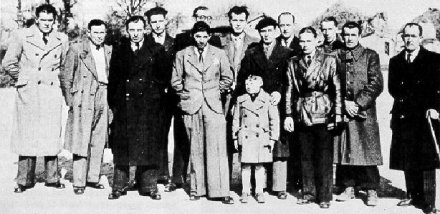
1278: Pierre de La Brosse, “out of spite and envy”

On this date in 1278, humiliatingly dressed like a buffoon, Pierre de La Brosse was strung up at Montfaucon without benefit of trial.

De La Brosse (English Wikipedia entry | French) was a court figure of the petty nobility.

He cut his teeth — and a holy beard — as a surgeon and barber in the court of Saint Louis. When Louis died on crusade in 1270, Philip the Bold succeeded to the throne. Philip was tight with Pierre, so this seemed like great news for the chamberlain — and indeed, de La Brosse advanced rapidly with the new king’s patronage in wealth and influence.

The power of this Touraine arriviste did not fail to attract the enmity of the realm’s hereditary lords. As their grandchildren would do in Enguerrand de Marigny‘s time, they nursed their resentments and awaited only their chance.

King Philip’s marriage in 1274 to Marie of Brabant* gave them that chance.

His influence eclipsed by the new bride, de La Brosse developed a dangerous rivalry with the royal consort. When Philip’s firstborn son by his previous marriage and the heir to the French throne died suspiciously in 1276, Pierre de La Brosse allegedly made bold to suggest that the new queen herself might have poisoned the youth off.**

Philip “investigated” this by sending emissaries to consult a clairvoyant who, knowing she was speaking to representatives of the royal family, gave a judiciously positive appraisal of the queen, leaving de La Brosse on very tenuous footing indeed. The barons cut that footing out from under their foe a few months later when they produced documents, likely forged, implicating de La Brosse in a treasonable arrangement with the Spanish crown. De La Brosse was imprisoned for six months and condemned without a regular judicial proceeding: he has the unenviable distinction of being the first victim of an extraordinary royal commission in France. That commission destroyed the evidence (or “evidence”) in the case, but to judge from the positive appraisal de La Brosse enjoyed from chroniclers the popular sentiment for his innocence was widespread.

Pierre de La Brosse is among the several French royal counselors who are sometimes apocryphally said to have built the Montfaucon gallows only to hang upon them. The last word on him (and the more interesting trivia) belongs to Dante, who stationed the man in Purgatory as one who was unjustly slain but without opportunity to cleanse his soul with a last repentance.

I saw the soul
cleft from its body out of spite and envy —
not, so it said, because it had been guilty —
I mean Pier de la Brosse,
and may the Lady of Brabant
while she’s still in this world, watch
her ways—or end among a sadder flock

* Not to be confused with the Bavarian princess of that name who was put to death for adultery.

** Another way to interpret this: poisoning suspicions that were afoot generally came to be ascribed specifically to de La Brosse.

On this day..

1944: A day in mass executions in Axis Europe

June 29, 1944, saw several noteworthy mass executions around Axis western Europe.

France: Seven Jewish hostages for the assassination of Philippe Henriot

Poet and journalist Philippe Henriot (English Wikipedia entry | French), the “French Goebbels”, was the Vichy government’s able chief propagandist.

On June 28, 1944, Henriot was assassinated by Maquis operatives disguised as milice paramlitaries.

Incensed, the real milice this morning gathered seven Jews already held in prison as hostages at Rillieux, drove them to the cemetery, and shot them one by one.

(Paul Touvier, who orchestrated this retaliatory execution, managed to stay underground until 1989. At his 1994 war crimes trial, he claimed that the Germans wanted 30 hostages killed, and therefore what he actually did was “save 23 human lives.” Touvier was convicted on the charge of crimes against humanity.)


Italy: Massacres in San Pancrazio, Cornia, and Civitella

As dawn broke this date, German soldiers retreating from liberated Rome fell upon several Tuscan villages.

German columns had been beset by partisans on the way, and standard operating procedure was to retaliate against partisans indirectly, by killing civilians — as in the notorious massacre in the Ardeatine caves. This vengeance was visited on the three towns: over 200 civilians were summarily executed on June 29, 1944.

“My mother later said she went to speak to my father,” remembered one San Pancrazio man. “A soldier turned her back and told her they were taking him to be tortured. She and my father both cried.” The father and those taken with him were shot in the basement of a farmhouse.

Caution: Graphic video.

The towns themselves have kept this date in remembrance, but the massacres were swept under the rug in the postwar settlement as Italy, Germany, and their former western enemies realigned for the Cold War. Only in the 21st century have they come to wider attention, when the discovery of secret archives documenting the atrocities enabled an Italian court to convict an aged German soldier in absentia.

There’s a CNN documentary on these events focusing particularly on San Pancrazio. Called “Terror in Tuscany”, it may be viewable here or here, depending on your location.


Denmark: The Hvidsten Group

The Danish resistance group named for a Jutland tavern was betrayed by a captured Brit under torture.

S. P. KRISTENSEN * 20. 8. 1887
ALBERT IVERSEN * 28. 9. 1896
NIELS N. KJÆR * 2. 4. 1903
JOH KJÆR HANSEN * 2. 4. 1907
HENNING ANDERSEN * 16. 7. 1917
MARIUS FIIL * 21. 6. 1893
PETER SØRENSEN * 8. 6. 1919
NIELS FIIL * 12. 6. 1920

1944 on the 29 June
They fell before German bullets
Precious is their memory to Denmark

Hvidsten Group stone photo is a (cc) image from Hansjorn.

On this day..

1944: Jakob Edelstein and family

(Thanks to Meaghan Good of the Charley Project for the guest post. -ed.)

On this date in 1944, Jakob Edelstein, his wife Miriam, their twelve-year-son Arieh and his mother-in-law Mrs. Olliner were shot to death at the Auschwitz Concentration Camp in Poland. They had been inmates in Auschwitz since the previous December; Jakob had been in an isolation cell the whole time while the others stayed in the so-called “Family Camp.”

For two years prior they’d lived in Theresienstadt (also known by its Czech name, Terezin), a the former Czech fortress town that had been turned into a city just for Jews. Jakob Edelstein was named Eldest of the Jews and was nominally in charge of the place, but in practice he had no choice but to cater to the whims of the Nazis. He was assisted by a deputy and a council of twelve.

Edelstein, a Czech Jew born in 1903, had been a leader within the Jewish community in Prague and had had papers for himself and his family to emigrate to Palestine. But when the Nazis took over Czechoslovakia, Edelstein and the other Zionist leaders decided it was their duty to stay and do what they could for the community during this time of crisis.

He became a liaison between the Germans the Jewish community and tried to facilitate immigration to Palestine. From 1939 to 1941 he made several trips back and forth between Czechoslovakia and Palestine, with permission from the Germans, trying to find ways for more Jews to emigrate.

Theresienstadt was a strange place: neither concentration camp nor ghetto but something in-between, it was billed as a “paradise” and a “gift” from Hitler to the Jewish people.

Elderly Jews were sent there, as well as Jews who were “prominent” for some reason or had Aryan connections (such as Jews who had a non-Jewish spouse). It was advertised as a luxurious resort community where they could live out the rest of their lives in ease and plenty.

Residents were allowed to receive food packages from the outside, and send postcards (one per month, limited to 30 words, and censored).

Many people believed the propaganda and were persuaded to go there voluntarily, signing all their possessions and assets to the German government in exchange for what they thought would be a comfortable and peaceful retirement.

The 500-ish Danish Jews who weren’t evacuated to Sweden by the Danish Underground right after the Nazi invasion of Denmark were ultimately sent to Theresienstadt. Many talented artists, actors, musicians and scholars lived there. The Nazis would ultimately make a propaganda film about how wonderful life was in Theresienstadt, and a Red Cross delegation toured the place and came away satisfied.

As you might have guessed, living conditions within the fortress city didn’t exactly live up to what it said in the brochures.

It’s true that it was possible to survive in Theresienstadt for an extended time period, even for the duration of the war. There were no gas chambers and relatively few executions. Certainly it was worlds apart from, say, Auschwitz or Treblinka. But that was as close to “paradise” as it got.

Theresienstadt was, as George E. Berkley says in his book Hitler’s Gift: The Story of Theresienstadt, “a joke hatched in hell.”

Yes, there were stores, more than a dozen of them, but their stock consisted of “goods the Nazis had originally confiscated from the residents and later found they didn’t need or want.”

Theresienstadt, like the Lodz Ghetto, had a bank and its own money, but there was nothing to spend it on. “The ghetto crowns,” Berkley says, “were used mostly like Monopoly money in playing cards and other games. Still, the bank staff kept themselves busy balancing their books, and auditors arrived regularly from Berlin to ensure the accuracy of the bank’s essentially fictitious accounts.”

Theresienstadt’s population, at its peak, was 58,497, in a town which before the war had a population of less than 10,000. Nearly everyone had lice, toilets and taps were scarce, and disease was rampant.

Families were separated, with husbands, wives and children each residing in different barracks.

“Horrendous as Theresienstadt housing conditions may have been,” Berkley says, “they were not the residents’ chief source of daily suffering. Food, or rather, the lack of it, weighed on them much more heavily.” The menu, he explains,

consisted chiefly of bread, potatoes, and a watery soup. Some margarine and sugar — about two ounces a week of the former and less than one and one-half ounces of the latter — were sometimes included. The residents were also to receive up to four ounces of meat, mostly horseflesh, and up to eight ounces of skim milk a week, though many a week would see less or none of those foodstuffs available. No fruits were ever officially distributed, and turnips were the only vegetable to show up with any regularity.

Estimates of total per capita calories provided daily ranged from 1300 or less, to 1800, with the lower figure being more frequently mentioned. This should be compared with the “Special Regime” given the worst offenders in the Soviet labor camps which provided about 2,000 calories.

According to modern nutritional guidelines, to maintain a healthy weight, the average adult with an average level of physical activity needs 2,000 to 2,500 calories a day. At Theresienstadt all inmates between age 14 and 70 had to work long hours, many of them at strenuous jobs. In addition to being calorie-deficient, the Theresienstadt rations lacked essential vitamins and minerals. It’s no wonder that one survivor later recalled, “After three months in Theresienstadt, there was only one feeling left in my body: hunger.”

Six months after his arrival, Edelstein and the Council of Elders made a difficult decision about the food problem, as Berkley records:

It became apparent that an even distribution of the food supply would not allow the ghetto to survive. Those doing heavy work needed more than those doing normal work, and the latter needed more than nonworkers. In addition, children required extra rations, for they represented the Jewish future…

Thus, heavy workers … began to receive a little over 2,000 calories of food a day. Children were to get 1,800 and regular workers a little over 1,500. But the daily intake for nonworkers, which included most of the elderly, fell to less than 1,000 calories.

This terrible choice, however necessary to the population’s long-term survival, consigned thousands of people to death.

But even though starvation and disease took many lives, the most deadly aspect of life in Theresienstadt was deportation.

Contrary to what the propaganda messages said about people living out their lives in Theresienstadt, it was largely a transit camp. Most people who arrived would be sent on “to the east” sooner or later; some of them lasted only a few days in the fortress city before being deported.

Although certain classes of people, such as decorated World War I veterans, “prominent” people and those over 65, were in theory exempted from deportation, in practice anyone could be sent away and just about everyone ultimately was.

Approximately 145,000 denizens passed through Theresienstadt during the course of its existence, most of them from Czechoslovakia, Germany, and Austria. About a quarter of these inmates died within Theresienstadt itself. Another 88,000 were deported to Auschwitz and other camps in the East, almost all of them dying there. Out of about 15,000 children who passed through Theresienstadt, less than 2,000 survived, and some estimates put the number in the low hundreds.

When the camp was liberated, it had a population of about 17,000, and most of those had arrived in the during the final months of the war.

Jakob Edelstein didn’t know about the gas chambers when he became Eldest of the Jews at Theresienstadt in December 1941, but he knew that conditions in the East were very bad and realized that, in order for the community to sustain itself, as many people as possible had to remain within Czechoslovakia.

As a committed Zionist, he hoped that the young people in the camp would survive and go on to colonize Israel. Like most other leaders of Jewish communities throughout Nazi-occupied Europe, he made the decision to cooperate with the occupiers in hopes of saving lives.

And as far as that goes, he failed, as the numbers quoted above indicate. But if he failed, so did everyone else.

Unlike many Jewish officials in the Nazi ghettos, he wasn’t corrupt and he wasn’t a toady to the Germans. It’s worth noting that he had many opportunities to flee the country with his family, even after the war started: all he had to do was not come back to Europe after one of his trips overseas.

But he stayed, because he felt he had a responsibility to his beleaguered people.

Edelstein did the best he could with what he had to work with, which is all you can say for anybody. He worked tirelessly, making himself available at all hours, and under his leadership the camp developed a welfare system as well as many cultural and sports activities.

His job as Eldest of the Jews in Theresienstadt, trying to play the balancing act between advocating for his people and not pissing off the Germans, was always extremely stressful, difficult and dangerous.

But things really started to go downhill for him after the city’s first commandant, Siegfried Siedl, got reassigned to Bergen-Belsen in July 1943.

Siedl’s replacement, Anton Burger, hated Czechs and took an immediate dislike to Edelstein as a result. He replaced Edelstein with Paul Eppstein [German language link, as is the next], a German, and demoted Edelstein to first deputy to Eppstein. Benjamin Murmelstein, an Austrian, became second deputy.

This wasn’t enough for Burger, however, as George Berkley records:

As leader of the Czech Jews, [Edelstein] naturally bore the brunt of Burger’s hatred for them. The new commandant had not only deported many of his countrymen and his chief aide … but had also moved Germans and Austrians into key positions formerly held by Czechs. Burger had apparently also stirred up his own superiors against him for during the fall some bakery workers, looking out the window, saw and heard Eichmann sharply dressing down Edelstein and even threatening to have him shot.

The incident alarmed Edelstein’s many loyal followers and the next day the leaders of Hechalutz, the largest Zionist organization in the camp, met with him to urge him to flee. They said they could help him escape … But though he suspected a Nazi scheme to get rid of him, Edelstein refused to run away.

In the end, the Nazis didn’t need to trump up any charges of insubordination or sabotage against their former Eldest of the Jews: they found some real “crimes.” It seems that Edelstein had been saving people from deportation by allowing them to remain in Theresienstadt, off the books, and adding the names of dead people to the transport lists to make the numbers match up.

He was immediately arrested. It was November 9, 1943, the fifth anniversary of Kristallnacht.

Edelstein was kept in custody in Theresienstadt until December 18, when he and his mother-in-law, his wife, and his young son were sent to Auschwitz with a transport of 2,500 others. The transport became part of the Auschwitz “Family Camp”, joining 5,000 Czech Jews who’d arrived there from Theresienstadt in September.

Edelstein’s family was allowed to join the Family Camp. Edelstein himself was put in the punishment block and subjected to interrogation although not, apparently, tortured. He gave nothing away.

In March 1944, the residents of the Family Camp who’d arrived in September were gassed. The December group was allowed to stay alive for the time being.

On June 20, an SS officer went to Edelstein’s cell and told him he’d been sentenced to death. While the condemned man (who’d become quite popular in jail) was taking leave of his fellow inmates, the SS officer got impatient and snapped, “quickly, quickly.”

Edelstein replied, “I am the master of my last movements.”

He was driven to the execution site and then the car went away to fetch Miriam, Ariah and Mrs. Olliner. Miriam had measles and had to be brought on a stretcher. The Nazis forced Jakob Edelstein to watch as his wife, child and mother-in-law were shot to death. He was the last of them to die.

The remaining residents of the family camp were gassed in early July 1944.

Paul Eppstein was executed in Theresienstadt in September. Murmelstein became Eldest of the Jews in his place and actually managed to survive the war. Because he had lived, he spent the rest of his life under a cloud of distrust and suspicion as a possible collaborator.

Siegfried Siedl was hanged for war crimes in 1947. Anton Burger escaped Allied custody (twice) after the war, assumed a new identity and died of natural causes in Essen in 1991. His true identity wasn’t discovered for years after his death.

After the war, the city of Theresienstadt reverted to its former name of Terezin, and the fortress became an internment camp for ethnic Germans, who found themselves quite unpopular in the newly liberated Czechoslovakia and were expelled from the country in droves. The internment camp closed in 1948.

The modern town of Terezin has a population of 3,500 and is noted for its manufacture of knitwork and furniture. Tourists from all over the world come to learn about its important role in one of the most tragic events in modern history.

On this day..

1920: Triple lynching in Duluth, Minnesota

On this date in 1920, a white mob perhaps 10,000 strong swarmed into the Duluth, Minn. jail and extracted three young African-American circus workers accused of gang-raping a white woman. Elias Clayton, Elmer Jackson and Isaac McGhie stood an immediate drumhead trial, then were lynched in the heart of Duluth as they vainly protested their innocence.

The self-congratulatory posed photograph of mob members with the bodies was made into a horrifying postcard, a frequent practice in lynch law America.


“What this looks like is the kind of photo you would see at a hunting lodge, where the guys had been out shooting bear, and they came back and they said, ‘We got three.’ You can see people on tip-toe. They’ve crowded into this shot. These are not people who are ashamed to be seen here. This is, ‘I want to be in this picture.'”

Michael Fedo, author of The Lynchings in Duluth

Nineteen-year-old Irene Tusker and her boyfriend James Sullivan had attended the one-day circus the evening before. What transpired that night remains unknown to this day: Irene eventually took the streetcar home without incident. Hours later, James Sullivan’s father claimed that the couple had been held at gunpoint by black carnies as Irene was gang-raped.

By the evening of the 15th, a vengeful mob had surrounded the police station/local lockup. Officers were ordered not to use deadly force against the townsfolk, so the battle to push into the premises was waged with brickbats against firehoses, and eventually with ineffectual pleas to let the law take its course.*

The incident drew nationwide reaction — usually condemnation (with a couple of exceptions). Occurring as it did in one of the continental states’ northernmost towns, it also underscored lynching as a nationwide problem rather than “merely” a southern one.

“Duluth has disgraced herself and has, by reason of her geographical position, disgraced the north,” the Cleveland Plain Dealer editorialized (June 17, 1920) — just one of innumerable newspaper editorials in the days following the Duluth outrage. “A city that has no more backbone than to submit to the rule of riot cannot be held blameless. But it will be surprising if Duluth and the state of Minnesota do not take steps to punish the murderers. The method of procedure was so deliberate and so brazenly open that identification and conviction of the ringleaders should be an easy matter.”

Brace for a surprise: according to the Minnesota Historical Society’s excellent site on the Duluth lynchings, only three whites served prison time (a shade over one year apiece) for rioting. Nobody was ever convicted for murdering Clayton, Jackson, or McGhie.

One black man, Max Mason, caught a long prison sentence for the supposed rape. He was paroled after five years on condition that he leave Minnesota for good.

“I was just short of nineteen the night that the bodies of McGhie, Jackson, and Clayton swung from a light pole in Duluth. I read the stories in the newspapers and put them down feeling sick, scared, and angry all at the same time. This was Minnesota, not Mississippi, but every Negro in the John Robinson Show had been suspect in the eyes of the police and guilty in the eyes of the mob … I found myself thinking of black people as a very vulnerable us — and white people as an unpredictable, violent them.”

-Minnesota-raised Roy Wilkins, the eventual director of the NAACP, in his autobiography (via)

The great-grandson of one of the lynch mob’s members wrote this book about the hangings’ legacy

The lynching was practically written out of the official state history most white children consumed at school in the middle part of the 20th century,** though the nine-year-old Lithuanian Jewish boy Abram Zimmerman who lived nearby the execution site later told his son all about it. Young Robert Allen Zimmerman tapped his father’s lynching stories under his subsequent nom de troubadour of Bob Dylan, and the Duluth atrocity is alluded to in Dylan’s “Desolation Row”.†

Latter-day Duluth has, to its credit, tried to manage something a little bit more overt.

In 2003, a monument commemorating Duluth’s moment of infamy was dedicated opposite the place where the young men were strung up and photographed. Minnesota Public Radio produced a series on the lynching during the construction of this monument which is still available online.


All images (cc) ArtStuffMatters. The photographer has a thoughtful recent blog post on the [dearth of] public lynch memorials in the United States.

* The law in Minnesota had no death penalty on the books, and still has none today.

** To be fair to the state, its immediate response did include passing anti-lynching legislation in 1921.

† “They’re selling postcards of the hanging/They’re painting the passports brown/The beauty parlor is filled with sailors/The circus is in town.”

On this day..

1944: Massacre at Oradour-sur-Glane


(cc) image from fintbo.

(Thanks to Meaghan Good of the Charley Project for the guest post. -ed.)

On this date in 1944, four days after the Allied invasion of Normandy, an SS battalion from the 2nd SS Panzer Division massacred almost the entire village of Oradour-sur-Glane in west central France, slaughtering in all 642 people.

You can read all about this hecatomb and its aftermath on this very thorough and impressive website dedicated to the atrocity, from which much of the information in this account is drawn.

The tiny village, which you could walk through in all of ten minutes, had been the victim of mistaken identity.

Twenty miles away was a somewhat larger town with a similar name, Oradour-sur-Vayres, which was known for its Resistance activity. Adolf Diekmann, commander of the SS battalion, had been informed that the French Resistance had captured an SS officer (possibly the kidnapped Waffen-SS Sturmbahnfuhrer Helmut Kampfe, who had been executed by the Resistance earlier that same day) in Oradour-sur-Vayres and decided reprisals were needed, but he got the two villages mixed up and went to Oradour-sur-Glane instead.

When the SS arrived in the village at lunchtime, they ordered all the inhabitants to assemble in the fairground to have their papers checked. Everyone had to come, including children and the sick. Six people who were not residents but happened to be in the village at the time were also sent to the fairground.

Twenty villagers who had some compelling reason to avoid the Nazis, or merely had a bad feeling about the whole thing, hid or left the village as soon as the SS division showed up. These twenty survived. One seven-year-old boy, Roger Godfrin, was spotted and shot at, but survived by playing dead. He was the only survivor in his family, and the youngest survivor from the town.

The women and children were locked in the village church, and the men were lead to barns and sheds where the machine guns were set up. They were shot in their lower bodies and legs, in order to prolong their deaths. One of the men, who’d lost a leg in World War I, supposedly cried out, “Those bastards! They have cut my other leg off!”

After the shooting, as the men of Oradour-sur-Glane lay helpless, the SS men locked the sheds and set them on fire.

Only six men were able to escape. They hid in some rabbit hutches for several hours before attempting to escape the village. Five of them made it, but Pierre-Henri Poutaraud was spotted later that day and shot dead. The SS man who shot him then tethered a horse to Poutaraud’s outstretched hand.

In all, 190 men were killed.

The SS division then went back to the church, set off a smoke bomb inside it, and set the building on fire. Anyone who tried to get out of the church was machine-gunned. One woman cried out that she was German, not French, and begged to be released, but the SS shoved her back into the flames.

47-year-old Marguerite Rouffanche was able to slip out the back window, and another woman followed her with her seven-month-old baby, but all three of them were shot and only Marguerite survived, hiding in a garden for more than 24 hours until help arrived. Her two daughters were killed. (Marguerite refused to leave Oradour after the massacre. She remained there for the rest of her ninety-one years and is now buried in the village cemetery.)

The church fire and shootings claimed the lives of 247 children and 205 women.


Children from the village’s girl’s school, in the 1942-1943 school year. All of these girls were killed in the massacre.

Unbeknownst to the Nazis, there were several Jews living in the village, among them five children between the ages of eight and fifteen. Twelve of them were killed. In the case of a Jewish family called Pinede, the parents decided to present themselves for inspection but told their three children to hide. The children survived; their parents did not. One of those three Jewish survivors was still alive as of 2004.

Several days passed for the 26 survivors were permitted to bury their dead. Only 52 of the bodies could be identified; the other ones were burned too badly to be recognizable.

Collective punishment in reprisal for the actions of others was par for the course in Nazi-occupied Europe, and Adolf Diekmann had directed his unit to commit a number of mass shootings. Even so, he didn’t have authorization for the bloody events at Oradour-sur-Glane and his commanding officer requested for a court-martial, saying, “I cannot allow the regiment to be charged with something like this.” Field Marshal Erwin Rommel supposedly volunteered to preside over the court-martial himself.

But before that could happen, the war took care of Diekmann: he was killed on the Normandy front on June 19, hit in the head with shrapnel, a mere nine days after his last atrocity. The front, in fact, took care of most of his unit: only 65 of the 200 members survived the war.

In 1953 in Bordeaux, a military tribunal convened to hear the case against the surviving members of the 2nd Panzer Division. Only 22 of them were present in the courtroom; the others were in East Germany, which refused to extradite them. All but one said they’d been conscripted into the SS; one of them admitted he’d joined voluntarily to fight Communism.

To further complicate matters, 15 of the defendants present were actually French nationals of German descent, from Alsace-Moselle, and 14 of them claimed they’d been drafted against their wishes.

(After they conquered France, Germany declared inhabitants of Alsace to be German citizens whether they wanted to be or not, and drafted the region’s men. The conscripts were known in France as Malgre-nous, meaning literally “despite ourselves.”)

In addition, eight of the French defendants had been under the age of 18 when they were drafted into the SS, making them minors under French law. Many French people, including some of the survivors of Oradour-sur-Glane, viewed the Alsatian conscripts as fellow-victims of Nazi Germany and didn’t believe they should be held responsible for their actions.

Most of the defendants were cagey.

They implicated each other, but not themselves, admitting to some specific offenses but denying other, far more serious ones. One man, for example, said he’d been part of an execution squad that shot 20 men, but insisted he’d only helped load the machine guns and hadn’t personally shot anyone. Another said he hadn’t been in Oradour-sur-Glane at all, but was stationed as a sentry outside the village to prevent escapes. Only one of the defendants had admitted to killing anyone at all prior to the trial.

Twelve members of the victims’ families came to watch the trial proceedings, including an eight-year-old girl whose father and grandfather had been killed. Marguerite Rouffanche was ill at the time of the trial and very weak, but she showed up anyway and testify about her experience. Roger Godfrin, the little boy who played dead, also testified.

The tribunal’s judge demanded the defendants view photographs of the charred corpses of the victims, saying, “Let them look at the glorious work of the valiant Third Company of Der Führer Regiment.”

When the prosecutor summed up the case, he referred to the defendants’ evasive statements and said, “You might as well say despite the heaps of ashes and ruins, that the massacre never took place. But the people of Oradour are dead.”

The tribunal deliberated for thirty-two hours before returning its verdicts. One of the defendants was able to prove he hadn’t been in Oradour-sur-Glane the day of the killings, and was acquitted. The rest were convicted.

The 46 members of the SS unit who hadn’t shown up for trial were sentenced to death in absentia, as was one of the German nationals and one of the French. The others got various prison sentences, mostly between five and eight years, none exceeding twelve years. The Germans tended to get longer prison terms than the French. In addition, the Germans were prohibited from residing in France for at least twenty years.


Survivors of the Oradour-sur-Glane massacre.

No one in France was happy with the tribunal’s ruling: some said the sentences were too harsh, others, too lenient. In the face of widespread protests from the Alsace area and threats to secede from France, the French National Assembly passed a bill granting amnesty to all Malgre-nous (at a vote of 319 to 211, with a whopping 83 abstentions) and 13 of the 14 Frenchmen were released only eight days after the verdict was rendered. (One of them, the one who had volunteered for the SS, got no sympathy from anyone and no such leniency.)

Germany was upset, saying it was unfair to pardon the French SS but not the Germans. But within five years, everyone had been freed. No one was actually executed.

In 1981, East German authorities tracked down Heinz Barth, a second lieutenant in the 2nd Panzer Division, and put him on trial in their country for his role in the Oradour-sur-Glane Massacre.

He never tried to deny his participation in the attack, and used the old “just following orders” defense, saying, “In war one acts harshly and with the means available.” Barth admitted he helped round up the village men and personally shot fifteen times into the crowd. He also acknowledged responsibility for the deaths of nearly 100 people in Czechoslovakia.

Barth was convicted in 1983 and sentenced to life in prison. In 1991, still behind bars, he was awarded a pension as a “war victim” because he’d been wounded in Normandy in August 1944 and lost a leg. The resulting howls of protest led the government of a newly reunited Germany to pass a law stripping convicted war criminals of their pensions.

Barth was released from prison in 1997, and managed to finagle his war pension back somehow. He died of cancer ten years later, at the age of 86.

Marguerite Rouffanche died in 1988. Her fellow-survivor Roger Godfrin died in 2004.

The survivors of Oradour-sur-Glane created a new village after the war, but the burned-out ruins of the old village remain, with rusted cars, sewing machines, bicycles and other personal items lying in plain sight on the street, a grim testimony to what happened there nearly seventy years ago.


The ruins of the village of Oradour-sur-Glane today. (cc) image from Olivier Lepicier.

On this day..

1884: Charles Henry, iced in the Arctic

On this date in 1884, U.S. Army Private Charles B. Henry of the Lady Franklin Bay Expedition (LFBE) was summarily executed in the distant northern reaches* of present-day Nunavut.


It’s waaaaaay up there. Click to view larger map, but don’t expect details.

The “Greely expedition” — so called after its commander, Adolphus Greely — was dispatched from Washington in the enthusiasm of the First International Polar Year. This was a multinational collaborative to gather scientific data about the globe’s frigid polar reaches; technically, this first IPY spanned 1882 to 1883, but the ill-starred Greely mission set out in 1881.

The LFBE was headed for a narrow icebound inlet named for a woman who lost her explorer husband on an Arctic voyage. That bay juts like a dead tree limb out of the Robeson Channel into the remote northern wildernesses of Ellesmere Island.

The mission laid down for the 25 men of the Lady Franklin Bay Expedition in 1881 was to establish a weather station, and to collect astronomical and geomagnetic data.

But long before the starving remnants of that crew put Private Henry to sudden death, they had supplanted that noble endeavor with the classic objective of polar adventure: mere survival.

Matters started promisingly enough: the ship that ferried these men to their ordeal dropped them without incident at a natural harbor in Lady Franklin Bay, where the intrepid men built Fort Conger — a sturdy frame house 65′ x 21′ x 14′. They would spend the next two years making scientific measurements, exploring, and awaiting planned resupply ships in the summers.

Ice-choked waters, however, do not open reliably to this location. The resupply missions in both 1882 and 1883 failed — and left the mission with a life-or-death choice.

Per prearranged contingency, the supply ships, should they not be able to reach Camp Conger, were to drop their provisions at a backup location. Much against his men’s will, Greely gave up Camp Conger to chase this hypothetical cache. Camp Conger was more difficult for any future ships to reach but was secure, warm enough, and blessed with seal-hunting enough to keep the team in good health.

Camp Sabine was reached only after a terrifying and near-fatal float down the coast in an ice floe (!) and it proved when they reached it a much less congenial spot for wilderness survival. The resupply missions that hadn’t reached Camp Conger had failed so thoroughly that only a very small drop had even made it to Camp Sabine. Conditions prevented the party from returning to Camp Conger or from crossing the water to another inhabited Arctic station: instead, they wintered in the mouth of hell; seal-hunting here was not favorable, and most days they were only able to supplement their dwindling cache of life-giving calories with a few shrimp and scraps of lichen peeled off the frozen rocks.

Not only ravenous hunger afflicted the party, but scurvy too, and still worse a morale collapse among party members who regarded Lieutenant Greely’s leadership very lightly. Huddled in a makeshift stone hut, three years gone from hearth and home, bored and helpless and stretching out less-than-subsistence rations as far as possible and farther, nerves began to fray … and party members began to succumb to conditions.

Charles Buck Henry did not wear well on this desperate party.

“Henry” was actually the new alias of a German immigrant formerly known as Charles Henry Buck. Buck had served time for embezzling whiskey money from a frontier cavalry company, then escaped and slew a Chinese man in a Deadwood, S.D. brawl. Henry stole from the expedition’s small store of food: he was not the only one, but he was perhaps the baldest thief and the one with the fewest redeeming features that would balance this behavior. He’d been confined in March to his sleeping bag as the closest thing to punishment that Greely could visit on him. Still, Henry stole more. Resentful comrades ostracized him, while silently sizing up the discomfiting likelihood that the hulking German would be odds-on to kill any man among them in a fair scrap.

This day, Greely finally caught him stealing once too often.

Notwithstanding promises given by Pvt C.B. Henry yesterday [to stop stealing] he has since as acknowledged to me tampered with seal thongs if not other food … This pertinacity and audacity is the destruction of this party if not at once ended. Pvt Henry will be Shot today all care being taken to prevent his injuring any one as his physical strength is greater than that of any two men. Decide the manner of death by two ball and one blank cartridge. This order is imperative & absolutely necessary for any chance of life.

A.W. Greely
1 Lt. 5 Cav. ASO & Asst
Cmdg. L.F.B. Expd

That order Greely issued to his able assistant, Sgt. David L. Brainard. Brainard proceeded to gather two other men who contrived to “execute” Henry by a stratagem of approaching Henry armed, but casual, and distracting the unrestrained condemned man long enough to get the drop on him. They shot him dead just as Henry recognized his danger and started to lunge for a nearby axe — an incredibly chancy engagement that could easily have turned the whole expedition into a hyperboreal edition of “The Most Dangerous Game” had the mountainous Henry avoided or survived that gunshot.

Instead, his body with its fatal bullet wound was discovered by accident when the Greely party was at long last rescued later that June, and returned along with just seven** (barely) living souls out of the 25 who set sail in 1881. Those fortunate survivors — the relief mission’s commander reported them “crying like children, hugging each other, frantic with joy”† as their rescue vessel pulled into view — would be forever defined by their participation in the LFBE: toasted for their survival story while also dogged by dark rumors of cannibalism.

According to polar and maritime historian Glenn Stein, FRGS, who spent several years researching this jaw-dropping case,‡ they also closely husbanded the story of their one-time mate’s execution. Mr. Stein is also U.S. Liaison a present-day polar journey, the South 2014 Expedition, and he was gracious enough to speak with Executed Today about the LFBE’s execution.


ET: The Lady Franklin Bay Expedition was a U.S. expedition launched as part of the first International Polar Year. Could you situate the LFBE in the context of polar expeditions at this time?

GS: In the years following the 1875-76 British Arctic Expedition, it was suggested that nations should stop competing for geographical discoveries and instead dispatch a series of coordinated expeditions dedicated to scientific research. Eleven nations took part in the first International Polar Year (IPY) 1882-83, and the United States contributed two components to its first participation in an international scientific effort. In 1881, it was decided that the U.S. Army Signal Corps would establish one scientific station 500 miles from the North Pole, at Lady Franklin Bay, Grinnell Land. The other station was at Point Barrow, Alaska.

The executed man in this instance is Charles Henry, formerly known as Charles Buck. This man had a pretty disreputable history. How was he able to get on this expedition? – And, how did he become the Chicago Times correspondent for this journey? Did he actually file any stories?

Buck enlisted in the Fifth Cavalry under the alias Charles B. Henry, and wrote to Lieutenant Greely from Fort Sidney, Nebraska, in April 1881, volunteering for the expedition. Henry had the strong recommendation of his company commander, Captain George T. Price, to back him up. Greely and Price were friends, so Greely leaned toward taking Henry (who repeatedly telegraphed Greely with reminders of his availability). Another story is that Henry joined from Fort Sidney when one of the original expedition members deserted just before it was to leave. However, as far as I’m aware, there was only one desertion from the LFBE, and that person was replaced by Private Roderick R. Schneider, First Artillery.

Supposedly, since Henry was the only volunteer from the Fifth Cavalry, with a strong recommendation from post commander Lieutenant Colonel Compton, Greely decided to take him.

According to A.L. Todd’s Abandoned (1961), before joining the expedition back East, Henry “got permission to stop off in Chicago to visit relatives, and managed to make an arrangement with the Chicago Times to act as that paper’s special correspondent with the Lady Franklin Bay Expedition.” In his Ghosts of Cape Sabine, Len Guttridge (2000) made references to Henry’s newspaper articles: “One or two eventually published in the Chicago Times attested to an effective if florid command of the English language.”

This expedition lasted three years, 1881-1884, and it came to a considerable amount of grief. Could you sketch out what happened to the LFBE, and how it found itself in such a perilous situation in its last months?

By the end of August 1881, a frame house was constructed at Lady Franklin Bay and named Fort Conger. Over the next two years scientific data was collected and sledging parties were sent out, discovering many new geographic features, and setting north, east, and west “farthest” records. Because of the mismanagement of resupply expeditions from the United States, expedition members initiated a planned retreat by boat to Cape Sabine in August 1883 — but the journey turned into a nightmare. The party eventually ended up at Cape Sabine, where the men constructed a stone house for the winter, with an upturned boat for a roof. It was christened Camp Clay. Throughout the following months, the men’s spirits and energy dwindled, and constant hunger was now their companion. Worse, food was being stolen from the commissary storehouse. More than once, angry accusations flew back and forth within the party. The daily ration for each type of food was measured out to hundredths of an ounce.

The first death occurred on Jan. 18, 1884, when Sergeant William H. Cross died of starvation. In spite of the privations, only one man died that winter, even though scurvy was also present. In the spring Death returned with a vengeance.

So by the end, there’s a party near to starvation, just scraping by on a starvation diet. Naturally there’s a temptation for people to steal from the camp rations.

Henry wasn’t the only person to have stolen, but it seems from your description like he was the most distinctly resented by the rest of the party. Why was that?

During his time at Fort Conger, Henry was the originator of many profane remarks, misdeeds, and lies, so Greely and others had learned not to trust him.

Until the publication of my article, “An Arctic Execution,” LFBE historians consistently wrote that no one on the expedition knew of Henry’s criminal history as a forger, thief and accused murderer. However, I discovered within Sergeant Brainard’s unpublished daily notes that he definitely knew of Henry’s past — so who else knew as well? In consequence, although others also stole food, Henry would have been treated with less tolerance.

The specific details of the execution, and the variations on the story that are given later, are quite fascinating. The execution was ordered by the camp commander, but Henry was not confined and had no idea what was coming, because the shooting party could have been in some danger as well. Given the rough and ready circumstances, why then, does the execution party go to such elaborate ends to anonymize the shooter? There’s the “three guns, two balls” order, and then they can’t comply with that since there’s only one usable rifle, so they swear an oath among themselves never to tell.

Firing squad duty obviously preys upon the conscious and subconscious mind. It’s possible that passing the rifle around and swearing an oath replaced the anonymity provided by the “three guns, two balls” order. Keep in mind that, if the three men survived their Arctic ordeal, their participation could impact them for the rest of their lives — in and out of the Army.

This was particularly true of Sergeant Brainard, who was promised a commission by Greely. Decades after the execution, Brainard declared that “no matter what the provocation, the family of a man doesn’t want to think of him as an executioner.”

As a factual matter, it was either Brainard or Francis Long who pulled the trigger, since Frederick distracted Henry and lured Henry into the trap.


Charles Henry (left), and his two potential executioners: David Brainard (center) and Francis Long (right).

What’s left of Henry is buried in New York. If you really wanted to find out what happened, you would have to exhume the remains. Henry’s sister, Dora Buck, did request the exhumation and autopsy of his body, but these were never allowed to take place. Officially, as my article notes, Henry’s remains were buried with full military honors. What we are left with today are cemetery records, which state that Charles Henry “Died of Starvation.”

And you think Brainard carefully managed the way the dangerous execution story got out.

Brainard is like a historian’s dream. Not only was he there, not only was he a very intelligent individual — but he made a record of many things, keeping daily notes that go from start to finish.

I hand-copied each page, three years of field notes, and I referenced these in my article. Those notes represent his impressions at the time they were written, not edited versions. One crucial thing Brainard recorded about Henry was that he “is a born thief as his 7th Cavalry name will show — a perfect fiend.” That’s significant, because it doesn’t appear in Brainard’s published writings. Why omit that piece of information? There’s one reason: Brainard knew beforehand that Henry was a criminal, and if it was known Brainard possessed this information, then he may appear prejudicial regarding the decision to shoot Henry.

It starts to add up, because who had control of the expedition members’ journals on the passage home? Brainard.

Who wrote up an incomplete journal on the way home — and then, many months later, turned in writings covering several more months — but ending in March 1884? Brainard.

I’ve examined the three volumes of his original journal. Everything was very carefully written, and Brainard made sure the story he wanted told got into these journals.

And what transpired afterward?

Sgt. Brainard had been promised a commission by Greely for his leadership on the LFBE. That’s a huge deal — to get commissioned from the ranks for gallant and meritorious service, and not even in wartime, but peacetime. At that time, and for many years thereafter, he was the only living officer of the Army, active or retired, holding a commission awarded for specific distinguished services. I believe Brainard was a “good guy” and a stand-up guy, but at the same time, would he really chance ruining his opportunity to get that commission? The whole execution business could have made things really difficult for him.

When they evacuated Fort Conger, and later on were literally floating south on a piece of ice, there was almost a mutiny. The mutineers went to Brainard, saying Greely had to be relieved of command, that he was going to get everyone killed. But Brainard wouldn’t go along with it — in part, he probably realized it would destroy his future.

You have to start looking at these motivations; and it’s not an entirely unsympathetic view, because people in these positions had jobs to do.

It took a lot of pushing to get Brainard’s commission to Second Lieutenant approved, and this didn’t happen until October 1886. In 1917, when he was near the end of his career, he was actually appointed Brigadier General. Brainard went from buck private to Brigadier General!

After the LFBE’s rescue later in 1884, how was the matter of the execution handled? I’m reading between the lines here, but it seems to me that, while it was not a secret, it was also downplayed as a public matter in the immediate aftermath — Henry buried with full military honors, that sort of thing. As it emerged more publicly thereafter, was there ever any controversy or a significant sentiment that Greely had handled the situation improperly? Was there ever a question about the legality of his order?

Greely made a verbal report regarding the execution to his departmental superiors several days before Henry’s burial. He then wrote to Adjutant General of the Army R.C. Drum in August 1884, to report Henry’s execution and request that a court of inquiry be ordered or a court martial convened regarding the matter. Drum responded in November 1884 that after examining the expedition’s records, “the Secretary of War entertains no doubt of the necessity, and the entire propriety of your action in ordering the execution of Private Henry, under the circumstances and in the manner set forth in your report.”

It was understood that any military officer operating in the field possesses a fair degree of discretion in carrying out orders, and Greely had Henry executed in order to preserve lives.

Newspaper articles certainly featured Henry’s execution, but stories of cannibalism (including the condition of Henry’s remains) and the political scandal related to the mishandling of the attempted relief of Greely prior to his rescue were much more high profile stories.

You have a professional interest in polar exploration, and obviously starvation risks are endemic to these situations when matters go awry. Have you encountered any similar instances of a polar party executing one of its members for the sake of maintaining discipline?

A somewhat similar execution scenario, also an attempt to preserve the lives of starving men, had played out during Sir John Franklin’s 1819-22 Arctic Land Expedition. A detachment of four men from the expedition, including Surgeon John Richardson, discovered that their comrade, Midshipman Robert Hood, had been murdered by an Iroquois voyageur named Michel Teroahauté (also known as Ferohaite).

Under the circumstances, Richardson shot Michel to save their own lives.

How did you come to find out about this story and why did you decide to research it in such depth? Over a century on from the events themselves, what does the fate of Charles Henry have to tell us today?

I can trace back my knowledge of the execution to at least September 1988, when I bought a copy of The Polar Passion, by Farley Mowat (1967). Several years later, I acquired a large collection of items once belonging to General Brainard, which included most of his medals and orders, photographs, books, and a bone knife he brought back from the Arctic. Brainard is a fascinating historical figure and human being (I like to call him the quintessential American), and I spent a good deal of time researching and writing about his life. In the process I discovered there were many contradictory details about the execution.

On July 13, 2005, I was sitting at an outside bar in Jamaica, when it dawned on me that if I dug deep enough, I just might be able to figure out what really happened during the execution of Private Henry.

So, I began jotting down notes on three 4″ x 5″ pieces of paper — “1. Primary Question: Who was the shooter?” Of the three men involved, the evidence dictates the trigger man must have been either Brainard or Long — but in the absence of conclusive evidence we’ll probably never know which one. And I ultimately decided that’s okay, because it’s the way the three wretched souls wanted it to be on that fateful summer day in 1884, and I needed to respect their wishes.

The events during the Lady Franklin Bay Expedition, especially Charles Henry’s fate, are reminders of how crises bring out the best — and worst — in human nature. At various times in our lives we’re all confronted with personal crises: how we deal with them is what counts. Writing “An Arctic Execution” forced me to stretch my mind beyond what I thought were its limits to attempt to understand defining moments in the lives of human beings who were at the brink of oblivion.

A few books about the Greely expedition

* This expedition established a “farthest north” record: it was for the next several years the most northerly latitude that any explorer could document ever attaining.

** One of the seven retrieved by the Thetis, Sgt. Joseph Elison, was at death’s door. Wasted to 78 pounds and stricken with frostbite and gangrene that required his rescuers to amputate both hands and both legs, Elison died at sea — leaving just six survivors of the Lady Franklin Bay Expedition who would ever again set foot on American soil.

San Francisco Bulletin, July 18, 1884, quoting Winfield Scott Schley — later famous as a Spanish-American War hero.

‡ Glenn M. Stein, “An Arctic Execution: Private Charles B. Henry of the United States Lady Franklin Bay Expedition 1881-84,” Arctic, Vol. 64, No. 4 (December 2011). Read it here (pdf).

On this day..

1541: Margaret Pole, Countess of Salisbury

Thanks for the guest post to Nancy Bilyeau, the author of The Crown and The Chalice, thrillers set in Tudor England. The main character is Joanna Stafford, a Dominican novice.

On this date in 1541, 68-year-old Margaret Pole, countess of Salisbury, was beheaded within the confines of the Tower of London, as befitted her rank. She was cousin to Henry VIII’s mother, and well trusted by the king for years. Yet this intelligent and dignified aristocrat died without trial in a horribly botched execution that is considered a low point of Henry’s reign.

Margaret knew better than most how difficult it was to survive royal storms if your family was close to the throne. Yet despite all her efforts to stay out of danger, it was her family that doomed her to the axe in the end.

George Plantagenet, Duke of Clarence and brother to Edward IV, was her father and Isabel Neville, oldest daughter of the “Kingmaker,” Earl of Warwick, her mother. This glittering pair didn’t last long. Mother died of disease (some whispered poison); the duke, disloyal to his brother the king, was drowned in a barrel of Malmsey in the Tower of London.

First Murderer. Take him over the costard with the hilts of thy
sword, and then we will chop him in the malmsey-butt
in the next room.

Second Murderer. O excellent devise! make a sop of him.

-Shakespeare’s Richard III, Act 3, Scene 4. Margaret Pole is an ensemble character with no lines in this play.

Once the Tudors were in charge, royal children were either imprisoned, such as Margaret’s brother, who spent the rest of his life in the Tower of London,* or assimilated. At the age of 14, Margaret was married to Sir Richard Pole, a trusted relation of Henry VII‘s. The marriage was not unhappy, and they had four sons and one daughter.

When Catherine of Aragon arrived in England to marry Prince Arthur, Margaret became one of her ladies and a deep friendship sprang up. Years later, when Margaret was a relatively young widow, tall and red-haired, and Catherine was married to Arthur’s brother, Henry VIII, Margaret was singled out for several great honors. In 1512, the king gave Margaret many of the lands of her Warwick grandfather and a family title. She became the countess of Salisbury in her own right.

Margaret was selected by king and queen to be the governor for the 9-year-old Princess Mary, their only child. In a separate, vast household, she would be the one to guide Mary toward her destiny as heir to the throne. Some of Margaret’s own children made excellent marriages, such as her daughter Ursula to the oldest son of the duke of Buckingham. Her son, Reginald, began to shine as a cleric and intellectual; Henry VIII paid for his studies at the University of Padua.

The Pole family fortunes crashed — as so many others did — after Anne Boleyn became the second wife of Henry VIII. Not surprisingly, Margaret had sided with Catherine and Mary during the divorce struggle. When in 1533, the king’s men came to Mary’s household to claim her jewels as part of Henry’s move to bastardize his daughter, Margaret refused to hand them over. She was then discharged from her office by the king, who called her a “fool.”

Margaret did and said nothing else that was publicly critical of the king. She never saw Catherine of Aragon again and rarely saw Mary, to whom she had been a second mother. She spent her time in country retirement. She adhered to traditional Catholic doctrine, and priests lived in her homes. This was not illegal, but as religious reform gained steam, it brought her under scrutiny.

However, from the safety of France and Italy, her son, Reginald, chose to make public remarks sharply critical of Henry VIII. He published a treatise in 1536 attacking the king’s claim to superiority over the English church and calling on the princes of Europe to depose him. The king was enraged.

Margaret and her oldest son, Henry Pole, Lord Montagu, wrote Reginald letters pleading with him to cease his attacks. “Do your duty or you will be my undoing,” she warned — correctly.

In 1538 another of Margaret’s sons, Geoffrey, was questioned and then confined in the Tower of London. He eventually gave statements that his brother, Montagu, and their relations and friends sympathized with Reginald Pole and had privately criticized Henry VIII. Under law, this was treason, punishable by death. All the noblemen accused of being part of the “Exeter Conspiracy” were executed. But there was no proof that Margaret Pole ever wrote or said anything that fell under the definition of treason.

It didn’t matter. She was questioned, held under house arrest, and then imprisoned in the Tower of London for two years. She suffered in the winters, and Henry VIII’s fifth wife, the teenage Catherine Howard, bravely sent her some warm clothes.

A minor rebellion broke out in England, led by a Neville, her mother’s family, but unconnected to Margaret. Nonetheless, it seems to have prompted Henry VIII to eliminate the woman whom he had once trusted and admired, who was his closest female relative after his daughters.

Early in the morning of May 27, the Constable of the Tower woke up Margaret to tell her she would die within the next few hours. The ailing countess replied she had never been charged with any crime.

Because of her royal descent, she was executed on the Tower grounds, on the same spot as Anne Boleyn five years earlier, before more than 100 spectators. There was not enough time to erect a scaffold; also, the executioner was not in residence, only his novice.

Margaret commended her soul to God and asked the spectators to pray for the king and queen, Prince Edward and of course the Princess Mary. Reports conflict on what happened next. Some say she refused to kneel before the block on the ground, or to stand still. The novice swung at her with his ax, hacking at her shoulders, before managing to kill her. It may have taken 10 chops.

Margaret Pole was buried in the Chapel of St Peter Ad Vincula, within the Tower, not far from Anne Boleyn, Thomas Cromwell, Sir Thomas More and Cardinal John Fisher. Within the year Catherine Howard would join them. In the 19th century Macauley said of St Peter Ad Vincula, “In truth there is no sadder spot on earth than that little cemetery.”

* The rest of Edward Plantagenet’s life ended at the block in 1499, after he tried to escape with Perkin Warbeck.

On this day..

1937: Camillo Berneri, anarchist intellectual

On this date in 1937, the Italian anarchist Camillo Berneri was kidnapped from his home by in Barcelona by armed paramilitaries. Berneri was shot that night.

Berneri (English Wikipedia entry | Spanish | timeline) had once been a University of Florence professor, but was forced into exile for opposing the fascist conquest of power in Italy.

When a coup threatened a similar right-wing conquest of power in Spain, Berneri organized the first column of Italian volunteers to oppose it.

International brigades poured into Spain to fight for the Republican government, but not everybody in the “popular front” was on the same side — a fact which became horrifyingly clear during Barcelona’s “May Days”, a week of internecine bloodletting in Republican Catalonia.

Anarcho-syndicalists of the CNT party and anti-Stalinist communists of POUM were the ones whose blood was mostly let; indeed, it might better be called a purge. The Moscow-backed Communist Party opposed the power of its putative comrades as much as or more than that of Franco. During the May Days, the Communists’ Catalan ally, a party called the PSUC, essentially took over Barcelona with the help of thousands of Assault Guards and killed, arrested, or dispersed the anarchists and Trotskyites.

Berneri clearly saw it coming, quoting Pravda in an April 1937 letter to the anarchist Health Minister criticizing his participation in the Popular Front government: “As for Catalonia, the purging of Trotskyist and anarcho-syndicalist elements has begun; this work will be carried out with the same energy with which it was done in the USSR.”

The British writer George Orwell served in a POUM unit, and the last third or so of his Spanish Civil War memoir Homage to Catalonia attempts to make sense of the chaotic scene.

Smitten when he arrived in Barcelona the previous December — “the first time that I had ever been in a town where the working class was in the saddle”* — the writer scoffed at the Communists’ official justification that anarchists and friends were a “counter-revolutionary” element, or even in actual league with their nationalist enemies.

It seemed queer, in the barber’s shop, to see the Anarchist notice still on the wall, explaining that tips were prohibited. ‘The Revolution has struck off our chains,’ the notice said. I felt like telling the barbers that their chains would soon be back again if they didn’t look out.

I wandered back to the centre of the town. Over the P.O.U.M. buildings the red flags had been torn down, Republican flags were floating in their place, and knots of armed Civil Guards were lounging in the doorways. At the Red Aid centre on the corner of the Plaza de Cataluña the police had amused themselves by smashing most of the windows. The P.O.U.M. book-stalls had been emptied of books and the notice-board farther down the Ramblas had been plastered with an anti-P.O.U.M. cartoon — the one representing the mask and the Fascist face beneath.

Down at the bottom of the Ramblas, near the quay, I came upon a queer sight; a row of militiamen, still ragged and muddy from the front, sprawling exhaustedly on the chairs placed there for the bootblacks. I knew who they were — indeed, I recognized one of them. They were P.O.U.M. militiamen who had come down the line on the previous day to find that the P.O.U.M. had been suppressed, and had had to spend the night in the streets because their homes had been raided. Any P.O.U.M. militiaman who returned to Barcelona at this time had the choice of going straight into hiding or into jail — not a pleasant reception after three or four months in the line.

Also a fighter of the liquidated POUM, Orwell too was proscribed: he had a job to make it out of Barcelona without winding up in someone’s dungeon or firing range. His disgust with what revolutionary Barcelona had come to would help to inform his subsequent anti-Soviet literary efforts.

Berneri, too, was an outspoken anti-Communist. Long a major intellectual in the anarchist camp, he was clearly targeted by name, and hauled from his house along with his brother-in-law Francesco Barbieri by a death squad. Their bodies turned up riddled with bullet holes the next morning.

There’s a collection of Berneri’s writings in English translation here, including one piece dated to the very day of his disappearance; also see this pdf of Berneri’s work. He was survived by his daughter, Marie-Louise Berneri, who herself became a noted anarchist activist of the 1940s.

* Orwell on Barcelona circa December 1936: “Practically every building of any size had been seized by the workers and was draped with red flags or with the red and black flag of the Anarchists; every wall was scrawled with the hammer and sickle and with the initials of the revolutionary parties; almost every church had been gutted and its images burnt … Waiters and shop-walkers looked you in the face and treated you as an equal. Servile and even ceremonial forms of speech had temporarily disappeared. Nobody said ‘Señor’ or ‘Don’ or even ‘Usted’ … Tipping was forbidden by law … revolutionary posters were everywhere, flaming from the walls in clean reds and blues that made the few remaining advertisements look like daubs of mud. Down the Ramblas, the wide central artery of the town where crowds of people streamed constantly to and fro, the loudspeakers were bellowing revolutionary songs all day and far into the night. And it was the aspect of the crowds that was the queerest thing of all. In outward appearance it was a town in which the wealthy classes had practically ceased to exist. Except for a small number of women and foreigners there were no ‘well-dressed’ people at all. Practically everyone wore rough working-class clothes, or blue overalls, or some variant of the militia uniform. All this was queer and moving. There was much in it that I did not understand, in some ways I did not even like it, but I recognized it immediately as a state of affairs worth fighting for.”

On this day..

998: Crescentius the Younger

On this date in 998, Crescentius the Younger was beheaded in Rome.

In the abject Eternal City, sacked and scattered and plucked of its glories, even the title of Roman Emperor now belonged to a line of absentee Germans — “neither holy, nor Roman, nor an Empire,” as Voltaire would later put it. But empire enough to push around the likes of Rome.

Rivalry between imperial and anti-imperial factions will write the city’s history for centuries to come. In the late 10th century, the 28-year-old emperor Otto II died unexpectedly, elevating his three-year-old son Otto III.

Anti-imperial Romans moved to capitalize on the turmoil, and Crescentius the Younger (his dad had the same name) raised himself up as the master of the city.

He was fruit of the the Crescentii family,* who attained their first rank in Roman politics a century before thanks to the propitious concubinage of a woman named Theodora and “her equally infamous daughters Marozia and Theodora, [who] filled the See of Peter with their paramours, their sons, and grandsons, who surpassed each other in vileness and wickedness of every kind.” (Johann Heinrich Kurtz) The fulminations of scribes against these libidinous, Machiavellian women** would eventually suggest to the history discipline one of its all-time best periodizations, the pornocracy. Sticks and stones, love: their lineage cast a long shadow on the Tiber throughout the 10th century.

Our guy Crescentius took the title Patricius Romanorum and bossed the town for a number of years in the late 980s and early 990s. There wasn’t much the Holy Romans and their boy-emperor could do about the scion of pornocrats.

But by 996, Otto III was all grown up to age 16, and marched down the Italic boot to set things straight in the Caput Mundi.

Temporarily cowed, Crescentius had to accept the appointment of Otto’s guy, Pope Gregory V, who then generously begged off an intended sentence of banishment for Crescentius, in the interests of comity.

Crescentius thanked the new pope, once Otto left town, by running Gregory out of Rome and setting up his own antipope and himself once more as big man on Campo Vecchio. Rome could not hope to match blows with the Germans, so the big idea here for Crescentius was to deliver his city to Byzantine protection; to this end, his antipope was Greek. Constantinople, however, was by this time much too weak in Italy for Crescentius to entertain realistic hope of success.

This in turn led Otto to re-invade in 997-998, and re-depose Crescentius, who retreated to the Castel Sant’Angelo. While Crescentius holed up there, his antipope was blinded, mutilated, and degraded out of the clergy, driven backward on an ass (literally ass-backward!) through the streets to the derision of the mob.† Certain of his control, the emperor set about restoring his authority while the friendless Patricius Romanorum and his followers cooled their heels in their dead-end fortress for two months.

Exactly how Crescentius came to die is sunken into the Tiber’s murky waters: was he lured from his redoubt by promise of royal clemency, or did he crawl to Otto to beg it? More probable is that the nigh-impregnable edifice was simply reduced over time until the Germans nigh-impregnated it; one version of the upstart’s end has him summarily executed on the battlements, his body thrown down into the moat below only to be dredged up and hung upside down on Monte Mario.

* Here’s an attempted family tree (pdf). They would evolve into the Crescenzi.

** Gibbon speculated that this period of female domination of the papacy might have lived on in popular memory as the medieval legend of Pope Joan.

† But not executed, more’s the pity for me.

On this day..

1945: The children of Bullenhuser Damm

On this date in 1945, as Adolf Hitler celebrated his 56th birthday within a Red Army cordon, one of the Second World War’s more tear-jerking little crimes against humanity happened in Hamburg.

Bullenhuser Dammstill to be found today — was a former Hamburg school which fell out of use as World War II progressed, owing to the devastation Allied bombings wrought on the surrounding area.

The school itself sustained little damage, however, which eventually facilitated its appropriation as a satellite building for the nearby Neuengamme concentration camp.

Over at Neuengamme, the SS doctor Kurt Heissmeyer had been conducting a litany of horror medical experiments on 20 Jewish children — mostly from Poland — culled from the concentration camps, seeking medical evidence for Nazi racial theories further to a cushy professorship. But as April 1945 was obviously endgame for the Third Reich, thoughts naturally turned to disposing of evidence of indictable offenses.


Photos of the eventual Bullenhuser Damm victims showing their surgical scars after Heissmeyer injected them with tuberculosis.

Bullenhuser Damm was just the place for disposal.

On April 20, the 20 kids were loaded up on trucks with their four adult caretakers — two French, two Dutch — plus six Soviet prisoners of war.

At Bullenhuser Damm, the kids were parked in a room and hung out, blissfully ignorant of their danger. “They had all their things with them — some food, some toys they had made themselves, etc,” physician Alfred Trzebinski later recalled at his own trial. “They sat on the benches and were happy that they had gotten out. They didn’t suspect a thing.”

In the next room, the 10 adults were being hanged.

According to Admitting the Holocaust, Trzebinski was impressed with his own compassionate use of this bit of down time: he generously gave the children morphine shots to sedate them before their own executions. Or rather, their murders … since the doctor could not but agree that “you cannot execute children, you can only murder them.”

I must say that in general the children’s condition was very good, except for one twelve-year-old boy who was in bad shape; he therefore fell asleep very quickly. Six or eight of the children were still awake — the others were already sleeping … Frahm [an orderly] lifted the twelve-year-old boy and said to the others that he was taking him to bed. He took him to a room that was maybe six or eight yards away, and there I saw a rope already attached to a hook. Frahm put the sleeping boy into the noose and with all his weight pulled down on the body of the boy so that the noose would tighten. (Trzebinski, again)

The other 19 children were disposed of in like manner, and then all 30 corpses cremated overnight … just in time for what must have been a much-needed 5 a.m. coffee.

After the war, the facility went back to use as an actual (creepy!) school, but it was eventually renamed Janusz Korczak School, for a Polish-Jewish educator gassed with his young charges at Treblinka. There’s a permanent exhibition (German) at the site, as well as a memorial rose garden with a variety of plaques commemorating the victims of Bullenhuser Damm.

Trzebinski’s take on his conduct this horrible night might have been good enough for his conscience, but it didn’t pass muster with his judges: he was hanged on a war crimes rap prominently including Bullenhuser Damm on October 8, 1946. Kurt Heissmeyer, however, avoided detection until 1959 and only received a long prison sentence in 1966, shortly before his death.

On this day..