On this date in 1939, French murderer Eugen Weidmann dropped his head in the basket outside a prison in Versailles. France’s signal history of public beheadings died along with him.
The career criminal Weidmann knocked around prison in his twenties.
Further to the maxim that penitentiaries are the school of crime, Weidmann’s stint for robbery connected him right up with a couple of accomplices who started up a kidnapping-robbery-murder ring when they got out.
They left several bodies (and miles of newspaper copy) in their wake in late 1937 before the inevitable capture, confession, condemnation. (Weidmann’s accomplices all managed to avoid the chop.)
The beheading this day did not come off well; a massive crowd* jostled for a view, a scene belied by the tame crowd photo of the execution’s official witnesses.
Two photographs of Eugen Weidmann’s execution in Versailles 17 June 1939. (Click for larger images.)
The government immediately banned public executions. Although it wouldn’t be the government much longer, the change stuck.
But the crowd scene wasn’t the half of it.
Still photos of the guillotine had been snapped for years, but a delay putting justice into its heavy downward-crashing motion that morning meant the execution took place in plenty of light for an illicit moving picture.
Caution: Mature content. This is video of the guillotine in action.
From the time this film cut, France’s national razor would do its cutting only behind prison walls. It would be another 38 years yet before it trimmed its last client.
Botak Chin, real name Wong Swee Chin, was one of Malaysia’s most wanted criminals.
His first taste of the underworld was when he joined Gang 306, participating in his first armed robbery in April 19, 1969. He was caught once and sentenced to seven years in jail after committing eight robberies.
When he got out, he did try to make a decent living as a vegetable trader but found the earnings to be pitiful. He eventually went on to form his own gang with Ng Cheng Wong, Beh Kok Chin and Teh Bok Lay — robbing banks, running illegal gambling dens and initiating gang wars (with the Lima Jari Gunung gang).
It all went downhill for Botak Chin when they tried to assassinate assistant police commissioner S. Kulasingam, and failed. His attempt spurred the formation of The Dirty Dozen: 12 policemen who established a force to specifically capture Botak Chin. This lead to his arrest in February 1976 after a shoot-out where he was shot six times but survived.
Thrown into Pudu Jail under the Internal Security Act, he attempted escape in 1981 but failed. He was finally hung to death on 11 June 1981.
A movie on his life was in production, directed by Dain Said (who also directed Dukun, about Mona Fandey). No updates on how that’s going …
This date in 1896 saw the Helena, Mont., hanging of frontiersman Bill Gay.
A ticket to Bill Gay’s hanging in December 1895 — which was, obviously, postponed.
As a prospector a generation earlier, Bill Gay had actually struck gold in the Black Hills, not far from Deadwood, S.D. The settlement that grew up around his claim, Gayville, was briefly in contention to be a key entrepot in the covered-wagon trade stripping Sioux land of precious metals.
Alas, Gayville burned down and became a ghost town, just like its founder became a ghost.
Maybe it was Bill Gay’s candle burning at both ends that caused the conflagration. The temporarily wealthy Gay (sporting furniture imported from the east coast!) had the pull to marry a dance-hall hottie … just, not so much pull that he had total impunity to ice a younger rival for his wife’s affections. After serving a turn in the clink for that murder — an abbreviated turn; the guy was rich, after all — Gay was back to square one as a prospecting plainsman, and moved on to Montana.
In Castle, Mont., where he settled (another mining camp later turned ghost town; see Ghost Towns of Montana), Gay fell into a mighty feud with local newspaperman John Benson.
When Benson’s establishment “mysteriously” burned down, a posse was detailed to bring in Gay, along with Gay’s brother-in-law. They killed a couple of deputies in the process of (successfully) blowing town; the in-law, Harry Gross, was never caught, but Gay was apprehended in California and returned to face the music.
Despite the Herculean efforts of his daughter, Maud — the wire report of the hanging (this one printed in the next day’s Omaha Morning World-Herald) complained that “never in the history of Montana have more efforts been made to save a criminal a neck” — he hanged this morning, still protesting that old Harry Gross had been the dead-eyed triggerman.
If the “revolutionary extremist” exists at all as an identifiable type, he exists in purest incarnation in Gracchus Babeuf. No revolutionary better fits the description “narrowminded to the point of genius”; few have defined their heaven more clearly or crusaded so fanatically, ascetically, so religiously to bring it to earth.
On this date in 1797, Francois-Noel Babeuf lost his head for the Conspiracy of Equals — the last Jacobin upheaval of the French Revolution, or the first Communist upheaval of post-Revolution modernity.
Francois-Noel — he styled himself “Gracchus” after the populist Roman tribunes — was a young man of Desmoulins‘ generation but from a considerably more hardscrabble background. Like the starry-eyed Dantonist scribbler, Babeuf discovered himself a brilliant journalist and pamphleteer with the onset of the Revolution; he did several prison stints during various revolutionary phases of the early 1790s for his too-radical-for-school opinions.
He did another in 1795 under the French Directory for his firebreathing rag Le Tribun du Peuple, which was particularly unfashionable stuff during the post-RobespierreThermidorian regime.
Nothing daunted, Babeuf emerged from prison the leading apostle of the Parisian proletariat which had by then been decisively separated from power.
The order of the day was class consolidation with the spoils of the aristocracy apportioned among a new oligarchy of wealth. As France rushed headlong towards Bonaparte and Bourbon restoration, Babeuf was the man left to rally “the party which desires the reign of pure equality.”
The French Revolution was nothing but a precursor of another revolution, one that will be bigger, more solemn, and which will be the last.
The people marched over the bodies of kings and priests who were in league against it: it will do the same to the new tyrants, the new political Tartuffes seated in the place of the old.
And if the Directory had known who Nicholas II would be, it would have had no intention of going the way of his family.
Instead, it shut him down in February, 1796: Napoleon Bonaparte personally carried out the operation, just days before he wed Josephine.
The Babeuf Conspiracy. Anonymous French print.
Babeuf’s party comes down to us as a “conspiracy,” under which word the state would charge him and which his follower Philippe Buonarroti would later rebrand the “Conspiracy of Equals”. It was not so much a grassy-knoll type of conspiracy as it was an underground organization.
When its adherents placarded Paris with the seditious “Analysis of the Doctrine of Babeuf” as the city endured a potentially dangerous economic crisis in April 1796, the government was put to a test of its strength.
It passed.
Having infiltrated Babeuf’s network, it arrested the principals on the eve of the Conspiracy’s intended insurrection. They were hailed out of Paris (a safeguard against sympathetic risings) to the commune of Vendome and there put on trial.* Babeuf and his associate Augustin Alexandre Darthe were condemned to death on May 26th and guillotined the very next day.
The last gasp of the French Revolution dropped with their heads into the basket.
Revolutionary Babeuvism, however, had scarcely just begun.
I don’t know what will become of the republicans, their families, and even the babies still at their mothers’ breasts, in the midst of the royalist fury that the counter-revolution will bring. O my friends! How heart-rending these thoughts are in my final moments! … To die for the fatherland, to leave a family, children, a beloved wife, all would be bearable if at the end of this I didn’t see liberty lost and all that belongs to sincere republicans wrapped in a horrible proscription.
* The trial of Babeuf was itself a jurisprudential milestone: it was the first French trial to be transcribed verbatim.
What might look today like a nifty little advance for efficient judicature was bitterly controversial in 1797. The French Revolution had overturned an ancien regime practice of professional magistrates accepting legal testimony by written deposition and deciding matters behind closed doors. The liberte, egalite, fraternite way would instead demand that testimony be given live in the courtroom where citizen jurors could weigh its credibility.
Babeuf’s lawyer, Pierre-Francois Real, protested against the court stenographers, arguing that “The law insists that the system of written depositions not be restored in any way. That system will undoubtedly return if any means are used to save testimony given orally.”
There’s a fascinating disquisition on the curious and contradictory development of this issue and the way it “violates … common assumptions about the advance of textuality in the West” during the French Revolution in Laura Mason, “The ‘Bosom of Proof’: Criminal Justice and the Renewal of Oral Culture during the French Revolution” The Journal of Modern History, March 2004.
On the run from the Gestapo — as a Jew or a Gypsy, a common criminal or a Resistance fighter whose cover is blown — you get wind of a man who can help.
“Dr. Eugène” will (for a fee) spirit you over the Pyrenees and thence to South America. In his house at rue le Sueur, you make the arrangements. One small matter: the tropics requires an inoculation, which le bon docteur will readily provide. One small prick of the needle and then …
The needle contained cyanide and the destination turned out to be a lime pit, and so “Dr. Eugène” — Marcel Petiot — was guillotined this date in 1946.
His opportunistic exploitation of the dangerous Vichy years is what he’s famous for, but Petiot had decades of crime behind him by the time he got his phony “underground railroad” up and running.
From youthful compulsive thieving, Petiot graduated into a shady medical practice in Villeneuve-sur-Yonne where he was the resident black market abortionist.
He’s thought to have killed a mistress there, and maybe a couple of others, but was able to segue into a political career by winning the mayoralty of Villaneuve when he sabotaged his opponent’s campaign appearances. The sticky-fingered Petiot naturally plundered the town treasury and was forced out of office in 1931.
By the time the war years had rolled around, Petiot had judiciously relocated to Paris where he retained his capacity for professional advancement in the face of profoundly disturbed behavior: he was institutionalized for kleptomania the same year he was appointed an official médecin d’état-civil.
So he had the requisite two-faced background for his whackadoodle wartime “escape route”, which he creepily code-named “Fly-Tox.”
Twists and turns elided — trutv.com and crimemagazine.com both have detailed biographies/case histories — Petiot’s enterprise was quasi-exposed early in 1944 when the stink of incinerating bodies prompted neighbors to summon the police and uncover his charnel house.
Amazingly, Petiot was able to beg off with the claim that he was a Resistance activist — these were French police — and that the victims were Nazis or collaborators who had been eliminated by his network on orders. The Gestapo had sniffed him out too late in the war to do anything about him, but its judgment that Petiot was a “dangerous lunatic” actually turned out to bolster the deranged doctor’s case that he was an anti-fascist.
The alibis fell apart as the war wrapped up, and Petiot was finally recognized in a Paris manhunt and brought to trial for 27 homicides. Police thought 60-plus was more like it — maybe even into the hundreds — but secured 26 of the 27 counts. That’s more than enough to do a man to death, especially since they were the for-fun-and-profit murders of desperate people already on the run from the late and hated occupying army. Bit of a touchy subject in France in ’46.
But there was good news.
This London Times (May 27, 1946) observed that Petiot’s beheading marked
the first time that the guillotine has been used since the war. Until now executions have been by firing squads. Although gruesome, it is one more indication of the return of this country to normal civil ways of life.
A buzz filled the air as people stood on their toes and filled every window in an attempt to get a glimpse of the great Jonathan Wild as he was paraded through the London streets on Monday, May 24, 1725. Despite the festive atmosphere surrounding the procession, Wild appeared to be unmoved by the shouts of the crowd, his attention focused instead on the Bible held open in his hands. After traveling about a third of the way to his destination, the procession stopped at the Griffin Tavern, so that Wild could drink a glass of wine.
Not long after leaving the Griffin Tavern, a rock thrown from a window hit Wild in the head, and blood began to pour down his face. The crowd roared with approval and people started to hurl insults at him, along with more stones and dirt. The cart stopped twice more before reaching its final destination: first at the White Lion, where Wild drank another glass of wine, and once again at the Oxford Arms, home of the bare-knuckle boxing champion James Figg, where Wild drank a tankard of beer and even more wine. His next and final stop was Tyburn Hill, where he was scheduled to be executed.
Convicts often stopped for drinks at various taverns during their march from Newgate Prison to Tyburn to be executed, so the fact that Wild stopped at three along the way to his execution was not unusual. What was unusual, however, was the fact that he was able to hold down his liquor, given that the previous night at two in the morning he had tried to kill himself in his jail cell by drinking a large dose of laudanum, a concoction of opium dissolved in alcohol. Wild was already in a half-stupefied state before his slow journey to the gallows and his wine drinking had even begun.
Wild’s dramatic execution marked a precipitous fall for a man who was perhaps the most influential person in England’s criminal justice system, even though he never held an official government position. As the self proclaimed “Thief-Taker General of Great Britain and Ireland,” Wild was instrumental in capturing and bringing to justice scores of petty thieves that plagued the London streets. He consulted the government on the passage of laws intended to encourage the capture of criminals. He also oversaw a vast criminal empire, the likes of which has never been duplicated.
Wild ran an Office for the Recovery of Lost and Stolen Property where people could apply to him for help in recovering their possessions for a fee that fell below what it would cost them to replace the objects. Wild would then use his connections in the criminal underworld to recover the goods and return them to the owner. His business proved to be extremely popular.
In addition to recovering lost and stolen property, Wild was particularly adept at catching and prosecuting criminals, a public service that enhanced his general reputation and gained the approval of the authorities. In the absence of a true police force, the government relied on rewards to encourage people to police the streets themselves. Anyone who could capture a thief and convict him or her with evidence received a reward of £40, far more than what most people in England could earn in a year. Wild benefited from this policy by collecting a fee every time he was able to prosecute a criminal. His office, then, essentially served as the de facto “Scotland Yard” of the day.
Wild’s knack for catching criminals brought him great renown. He often appeared at trials to give evidence against the criminals he helped to capture. He got to know the bailiffs of the prisons and could be seen socializing in the local taverns with Justices of the Peace. He entertained government officials in his house.
In point of fact, the man supposedly responsible for clearing the streets of criminals was also the head of a vast criminal empire and a well-oiled criminal machine. Wild’s Lost Property Office turned out to be a clearinghouse for stolen goods that members of his own organized gang had themselves acquired. The thieves he apprehended, supposedly for the good of the community, were fall guys; they either belonged to rival gangs, or were members of his own gang who tried to double-cross him, quit his business, or had ceased to be more valuable than the £40 reward given by the government for capturing and convicting a criminal. Wild sent many of these criminals to the gallows by appearing in court to give evidence — real or otherwise — against them. The unofficial head of crime prevention was in actuality the foremost perpetrator of crime and organizer of criminals in London and throughout Great Britain.
Wild’s downfall began when he helped prosecute the thief and burglar Jack Sheppard, whose daring and dramatic escapes from the notorious Newgate Prison turned him into a folk hero. Public opinion soured on the “Thief-Taker General” and his involvement with Sheppard’s execution … and when details of Wild’s criminal operation emerged after his arrest for receiving stolen goods, the public was furious.
When Wild finally reached the gallows at Tyburn, the noise from the crowd was so loud that the Ordinary of Newgate found it almost impossible to say his prayers with Wild and the three other criminals scheduled to die. The hangman, Richard Arnet, who years before had been a guest at Wild’s wedding, tried to give Wild as much time as he needed before preparing him for execution. The crowd, however, grew restless and threatened to tear Arnet to pieces if he did not proceed in carrying out his duties immediately. Reluctantly, Arnet placed a noose around Wild’s neck.
A great shout went up from the crowd as the cart drove away leaving the convicts dangling from the ropes tied around their necks. After the drop, Wild desperately grabbed onto Robert Harpham, who was being executed for coining, in an attempt to lift himself up and slacken the rope connected to his neck. Arnet intervened and separated the two, and after a few minutes, the life of Jonathan Wild came to an end at the age of about 42.
Almost as soon as Wild’s body was cut down, a rumor began to circulate that it was being carried off to the Surgeon’s Hall for dissection. The bodies of executed criminals were often used for such a medical purpose, but the practice usually led to a struggle between the surgeons, who were trying to take the body of the criminal away, and the disapproving crowd. In this case, Jonathan’s wife, Mary Wild, had arranged to circulate the rumor that he had been turned over to the surgeons as a ruse, so that his body could be properly buried without interference. Her plan didn’t work. Three or four days after it was buried Wild’s body was dug up from the St. Pancras churchyard by the surgeons.
Today, Jonathan Wild’s skeleton can be seen on display at the Hunterian Museum at the Royal College of Surgeons in Lincoln’s Inn Fields.
The skeleton of Jonathan Wild at the Hunterian Museum at the Royal College of Surgeons in Lincoln’s Inn Fields.
This small-timer would hardly rate a notice, but for the fact that Supreme Court Justice Harry Blackmun had chosen this otherwise forgettable murderer’s appeal to announce, in 1994, his belief that the death penalty was irreperably unconstitutional — probably the most famous comment on the death penalty to issue from the bench since capital punishment was reinstated with Blackmun’s concurrence in Gregg v. Georgia.
You’ll see the quote on anti-death penalty placards and apparel from now ’til kingdom come.
But there’s a bit more to it than what fits on a bumper sticker, and Blackmun’s reasoning is worth excerpting at greater length:
Within days, or perhaps hours, the memory of Callins will begin to fade. The wheels of justice will churn again, and somewhere another jury or another judge will have the unenviable task of determining whether some human being is to live or die. We hope, of course, that the defendant whose life is at risk will be represented by competent counsel — someone who is inspired by the awareness that a less-than-vigorous defense truly could have fatal consequences for the defendant. We hope that the attorney will investigate all aspects of the case, follow all evidentiary and procedural rules, and appear before a judge who is still committed to the protection of defendants’ rights — even now, as the prospect of meaningful judicial oversight has diminished. In the same vein, we hope that the prosecution, in urging the penalty of death, will have exercised its discretion wisely, free from bias, prejudice, or political motive, and will be humbled, rather than emboldened, by the awesome authority conferred by the State.
But even if we can feel confident that these actors will fulfill their roles to the best of their human ability, our collective conscience will remain uneasy. Twenty years have passed since this Court declared that the death penalty must be imposed fairly, and with reasonable consistency, or not at all, see Furman v. Georgia, 408 U.S. 238 (1972), and, despite the effort of the States and courts to devise legal formulas and procedural rules to meet this daunting challenge, the death penalty remains fraught with arbitrariness, discrimination, caprice, and mistake. This is not to say that the problems with the death penalty today are identical to those that were present 20 years ago. Rather, the problems that were pursued down one hole with procedural rules and verbal formulas have come to the surface somewhere else, just as virulent and pernicious as they were in their original form. Experience has taught us that the constitutional goal of eliminating arbitrariness and discrimination from the administration of death, see Furman v. Georgia, supra, can never be achieved without compromising an equally essential component of fundamental fairness – individualized sentencing. See Lockett v. Ohio, 438 U.S. 586 (1978).
It is tempting, when faced with conflicting constitutional commands, to sacrifice one for the other or to assume that an acceptable balance between them already has been struck. In the context of the death penalty, however, such jurisprudential maneuvers are wholly inappropriate. The death penalty must be imposed “fairly, and with reasonable consistency, or not at all.” Eddings v. Oklahoma, 455 U.S. 104, 112 (1982).
To be fair, a capital sentencing scheme must treat each person convicted of a capital offense with that “degree of respect due the uniqueness of the individual.” Lockett v. Ohio, 438 U.S. at 605 (plurality opinion). That means affording the sentencer the power and discretion to grant mercy in a particular case, and providing avenues for the consideration of any and all relevant mitigating evidence that would justify a sentence less than death. Reasonable consistency, on the other hand, requires that the death penalty be inflicted evenhandedly, in accordance with reason and objective standards, rather than by whim, caprice, or prejudice. Finally, because human error is inevitable, and because our criminal justice system is less than perfect, searching appellate review of death sentences and their underlying convictions is a prerequisite to a constitutional death penalty scheme.
On their face, these goals of individual fairness, reasonable consistency, and absence of error appear to be attainable: courts are in the very business of erecting procedural devices from which fair, equitable, and reliable outcomes are presumed to flow. Yet, in the death penalty area, this Court, in my view, has engaged in a futile effort to balance these constitutional demands, and now is retreating not only from the Furman promise of consistency and rationality, but from the requirement of individualized sentencing as well. Having virtually conceded that both fairness and rationality cannot be achieved in the administration of the death penalty, see McCleskey v. Kemp, 481 U.S. 279, 313 , n. 37 (1987), the Court has chosen to deregulate the entire enterprise, replacing, it would seem, substantive constitutional requirements with mere aesthetics, and abdicating its statutorily and constitutionally imposed duty to provide meaningful judicial oversight to the administration of death by the States.
From this day forward, I no longer shall tinker with the machinery of death. For more than 20 years, I have endeavored — indeed, I have struggled — along with a majority of this Court, to develop procedural and substantive rules that would lend more than the mere appearance of fairness to the death penalty endeavor. Rather than continue to coddle the Court’s delusion that the desired level of fairness has been achieved and the need for regulation eviscerated, I feel morally and intellectually obligated simply to concede that the death penalty experiment has failed. It is virtually self-evident to me now that no combination of procedural rules or substantive regulations ever can save the death penalty from its inherent constitutional deficiencies. The basic question — does the system accurately and consistently determine which defendants “deserve” to die? — cannot be answered in the affirmative.
Antonin Scalia, never one to let pass an opinion he could just as easily scorn, issued his retort in a concurrence with the 8-1 opinion to execute Callins:
Convictions in opposition to the death penalty are often passionate and deeply held. That would be no excuse for reading them into a Constitution that does not contain them, even if they represented the convictions of a majority of Americans. Much less is there any excuse for using that course to thrust a minority’s views upon the people.
Justice Blackmun begins his statement by describing with poignancy the death of a convicted murderer by lethal injection. He chooses, as the case in which to make that statement, one of the less brutal of the murders that regularly come before us, the murder of a man ripped by a bullet suddenly and unexpectedly, with no opportunity to prepare himself and his affairs, and left to bleed to death on the floor of a tavern.* The death-by-injection which Justice Blackmun describes looks pretty desirable next to that. It looks even better next to some of the other cases currently before us, which Justice Blackmun did not select as the vehicle for his announcement that the death penalty is always unconstitutional, for example, the case of the 11-year-old girl raped by four men and then killed by stuffing her panties down her throat. How enviable a quiet death by lethal injection compared with that!
Scalia’s mention of the “case of the 11-year-old girl” isn’t about Callins at all. The monster Scalia refers to here as obviously execution-worthy for his incendiary crime is Henry Lee McCollum … who in 2014 would be exonerated by DNA evidence after some 30 years on death row.
* Specifically, Callins wasted the patron of a strip bar who was insufficiently prompt at giving up his wallet. The $3 he took from the dying man’s pockets wouldn’t even have been enough to make it rain.
(As befits a blogger in the early 2000s, Cartwright also had a MySpace page, which remains active. “Chi-town” grew up in Chicago. He played youth hockey there, for this club. This is the sort of thing one learns about bloggers.)
Cartwright was admittedly involved in the robbery-murder, though he insisted he wasn’t the one who did the murdering.
Whatever one makes of that, his fairly prolific “Uncensored” series over the last six months of his life furnish a sometimes bracingly personal chronicle of a man among the lowest of the dead … and drawing nearer and nearer to a fate he realizes he cannot avert.
People are looking at me differently, like they are trying to instill into memory or something. They don’t mean to, but they do, and it is spooky. Like I am already dead.
In the year 1894 Mr. Smith, a carpenter, of Philadelphia, had patented a new saw-set. Wishing to make some money out of his invention, Mr. Smith was attracted by the sign:
B. F. PERRY
PATENTS BOUGHT AND SOLD
which he saw stretched across the window of a two-storied house, 1,316 Callowhill Street. He entered the house and made the acquaintance of Mr. Perry, a tall, dark, bony man, to whom he explained the merits of his invention. Perry listened with interest, and asked for a model. In the meantime he suggested that Smith should do some carpenter’s work for him in the house. Smith agreed, and on August 22, while at work there saw a man enter the house and go up with Perry to a room on the second story.
A few days later Smith called at Callowhill Street to ask Perry about the sale of the patent. He waited half an hour in the shop below, called out to Perry who, he thought, might be in the rooms above, received no answer and went away. Next day, September 4, Smith returned, found the place just as he had left it the day before; called Perry again, but again got no answer. Surprised, he went upstairs, and in the back room of the second story the morning sunshine, streaming through the window, showed him the dead body of a man, his face charred beyond recognition, lying with his feet to the window and his head to the door. There was evidence of some sort of explosion: a broken bottle that had contained an inflammable substance, a broken pipe filled with tobacco, and a burnt match lay by the side of the body.
The general appearance of the dead man answered to that of B. F. Perry. A medical examination of the body showed that death had been sudden, that there had been paralysis of the involuntary muscles, and that the stomach, besides showing symptoms of alcoholic irritation, emitted a strong odour of chloroform. An inquest was held, and a verdict returned that B. F. Perry had died of congestion of the lungs caused by the inhalation of flame or chloroform. After lying in the mortuary for eleven days the body was buried.
In the meantime the Philadelphia branch of the Fidelity Mutual Life Association had received a letter from one Jephtha D. Howe, an attorney at St. Louis, stating that the deceased B. F. Perry was Benjamin F. Pitezel of that city, who had been insured in their office for a sum of ten thousand dollars. The insurance had been effected in Chicago in the November of 1893. Mr. Howe proposed to come to Philadelphia with some members of the Pitezel family to identify the remains. Referring to their Chicago branch, the insurance company found that the only person who would seem to have known Pitezel when in that city, was a certain H. H. Holmes, living at Wilmette, Illinois. They got into communication with Mr. Holmes, and forwarded to him a cutting from a newspaper, which stated erroneously that the death of B. F. Perry had taken place in Chicago.
On September 18 they received a letter from Mr. Holmes, in which he offered what assistance he could toward the identification of B. F. Perry as B. F. Pitezel. He gave the name of a dentist in Chicago who would be able to recognise teeth which he had made for Pitezel, and himself furnished a description of the man, especially of a malformation of the knee and a warty growth on the back of the neck by which he could be further identified. Mr. Holmes offered, if his expenses were paid, to come to Chicago to view the body. Two days later he wrote again saying that he had seen by other papers that Perry’s death had taken place in Philadelphia and not in Chicago, and that as he had to be in Baltimore in a day or two, he would run over to Philadelphia and visit the office of the Fidelity Life Association.
On September 20 the assiduous Mr. Holmes called at the office of the Association in Philadelphia, inquired anxiously about the nature and cause of Perry’s death, gave again a description of him and, on learning that Mr. Howe, the attorney from St. Louis, was about to come to Philadelphia to represent the widow, Mrs. Pitezel, and complete the identification, said that he would return to give the company any further help he could in the matter. The following day Mr. Jephtha D. Howe, attorney of St. Louis, arrived in Philadelphia, accompanied by Alice Pitezel, a daughter of the deceased. Howe explained that Pitezel had taken the name of Perry owing to financial difficulties. The company said that they accepted the fact that Perry and Pitezel were one and the same man, but were not convinced that the body was Pitezel’s body. The visit of Holmes was mentioned. Howe said that he did not know Mr. Holmes, but would be willing to meet him. At this moment Holmes arrived at the office. He was introduced to Howe as a stranger, and recognised as a friend by Alice Pitezel, a shy, awkward girl of fourteen or fifteen years of age. It was then arranged that all the parties should meet again next day to identify, if possible, the body, which had been disinterred for that purpose.
The unpleasant duty of identifying the rapidly decomposing remains was greatly curtailed by the readiness of Mr. Holmes. When the party met on the 22nd at the Potter’s Field, where the body had been disinterred and laid out, the doctor present was unable to find the distinctive marks which would show Perry and Pitezel to have been the same man. Holmes at once stepped into the breach, took off his coat, rolled up his sleeves, put on the rubber gloves, and taking a surgeon’s knife from his pocket, cut off the wart at the back of the neck, showed the injury to the leg, and revealed also a bruised thumb-nail which had been another distinctive mark of Pitezel. The body was then covered up all but the teeth; the girl Alice was brought in, and she said that the teeth appeared to be like those of her father. The insurance company declared themselves satisfied, and handed to Mr. Howe a cheque for 9,175 dollars, and to Mr. Holmes ten dollars for his expenses. Smith, the carpenter, had been present at the proceedings at the Potter’s Field. For a moment he thought he detected a likeness in Mr. Holmes to the man who had visited Perry at Callowhill Street on August 22 and gone upstairs with him, but he did not feel sure enough of the fact to make any mention of it.
In the prison at St. Louis there languished in the year 1894 one Marion Hedgspeth, serving a sentence of twenty years’ imprisonment for an audacious train robbery. On the night of November 30, 1891, the “‘Friscow express from St. Louis had been boarded by four ruffians, the express car blown open with dynamite, and 10,000 dollars carried off. Hedgspeth and another man were tried for the robbery, and sentenced to twenty years’ imprisonment. On October 9, 1894, Hegspeth{sic} made a statement to the Governor of the St. Louis prison, which he said he wished to be communicated to the Fidelity Mutual Life Association. In the previous July Hedgspeth said that he had met in the prison a man of the name of H. M. Howard, who was charged with fraud, but had been released on bail later in the month. While in prison Howard told Hedgspeth that he had devised a scheme for swindling an insurance company of 10,000 dollars, and promised Hedgspeth that, if he would recommend him a lawyer suitable for such an enterprise, he should have 500 dollars as his share of the proceeds. Hedgspeth recommended Jephtha D. Howe. The latter entered with enthusiasm into the scheme, and told Hedgspeth that he thought Mr. Howard “one of the smoothest and slickest” men he had ever known. A corpse was to be found answering to Pitezel’s description, and to be so treated as to appear to have been the victim of an accidental explosion, while Pitezel himself would disappear to Germany. From Howe Hedgspeth learnt that the swindle had been carried out successfully, but he had never received from Howard the 500 dollars promised him. Consequently, he had but little compunction in divulging the plot to the authorities.
It was realised at once that H. M. Howard and H. H. Holmes were the same person, and that Jephtha D. Howe and Mr. Holmes were not the strangers to each other that they had affected to be when they met in Philadelphia. Though somewhat doubtful of the truth of Hedgspeth’s statement, the insurance company decided to set Pinkerton’s detectives on the track of Mr. H. H. Holmes. After more than a month’s search he was traced to his father’s house at Gilmanton, N. H., and arrested in Boston on November 17.
Inquiry showed that, early in 1894, Holmes and Pitezel had acquired some real property at Fort Worth in Texas and commenced building operations, but had soon after left Texas under a cloud, arising from the theft of a horse and other dubious transactions.
Holmes had obtained the property at Fort Worth from a Miss Minnie Williams, and transferred it to Pitezel. Pitezel was a drunken “crook,” of mean intelligence, a mesmeric subject entirely under the influence of Holmes, who claimed to have considerable hypnotic powers. Pitezel had a wife living at St. Louis and five children, three girls–Dessie, Alice, and Nellie–a boy, Howard, and a baby in arms. At the time of Holmes’ arrest Mrs. Pitezel, with her eldest daughter, Dessie, and her little baby, was living at a house rented by Holmes at Burlington, Vermont. She also was arrested on a charge of complicity in the insurance fraud and brought to Boston.
Two days after his arrest Holmes, who dreaded being sent back to Texas on a charge of horse-stealing, for which in that State the punishment is apt to be rough and ready, made a statement to the police, in which he acknowledged the fraud practised by him and Pitezel on the insurance company. The body substituted for Pitezel had been obtained, said Holmes, from a doctor in New York, packed in a trunk and sent to Philadelphia, but he declined for the present to give the doctor’s name. Pitezel, he said, had gone with three of his children–Alice, Nellie and Howard–to South America. This fact, however, Holmes had not communicated to Mrs. Pitezel. When she arrived at Boston, the poor woman was in great distress of mind. Questioned by the officers, she attempted to deny any complicity in the fraud, but her real anxiety was to get news of her husband and her three children. Alice she had not seen since the girl had gone to Philadelphia to identify the supposed remains of her father. Shortly after this Holmes had come to Mrs. Pitezel at St. Louis, and taken away Nellie and Howard to join Alice, who, he said, was in the care of a widow lady at Ovington, Kentucky. Since then Mrs. Pitezel had seen nothing of the children or her husband. At Holmes’ direction she had gone to Detroit, Toronto, Ogdensberg and, lastly, to Burlington in the hope of meeting either Pitezel or the children, but in vain. She believed that her husband had deserted her; her only desire was to recover her children.
On November 20 Holmes and Mrs. Pitezel were transferred from Boston to Philadelphia, and there, along with Benjamin Pitezel and Jephtha D. Howe, were charged with defrauding the Fidelity Life Association of 10,000 dollars. Soon after his arrival in Philadelphia Holmes, who was never averse to talking, was asked by an inspector of the insurance company who it was that had helped him to double up the body sent from New York and pack it into the trunk. He replied that he had done it alone, having learned the trick when studying medicine in Michigan. The inspector recollected that the body when removed from Callowhill Street had been straight and rigid. He asked Holmes what trick he had learnt in the course of his medical studies by which it was possible to re-stiffen a body once the rigor mortis had been broken. To this Holmes made no reply. But he realised his mistake, and a few weeks later volunteered a second statement. He now said that Pitezel, in a fit of depression, aggravated by his drinking habits, had committed suicide on the third story of the house in Callowhill Street. There Holmes had found his body,carried it down on to the floor below, and arranged it in the manner agreed upon for deceiving the insurance company. Pitezel, he said, had taken his life by lying on the floor and allowing chloroform to run slowly into his mouth through a rubber tube placed on a chair. The three children, Holmes now stated, had gone to England with a friend of his, Miss Minnie Williams.
Miss Minnie Williams was the lady, from whom Holmes was said to have acquired the property in Texas which he and Pitezel had set about developing. There was quite a tragedy, according to Holmes, connected with the life of Miss Williams. She had come to Holmes in 1893, as secretary, at a drug store which he was then keeping in Chicago. Their relations had become more intimate, and later in the year Miss Williams wrote to her sister, Nannie, saying that she was going to be married, and inviting her to the wedding. Nannie arrived, but unfortunately a violent quarrel broke out between the two sisters, and Holmes came home to find that Minnie in her rage had killed her sister. He had helped her out of the trouble by dropping Nannie’s body into the Chicago lake. After such a distressing occurrence Miss Williams was only too glad of the opportunity of leaving America with the Pitezel children. In the meantime Holmes, under the name of Bond, and Pitezel, under that of Lyman, had proceeded to deal with Miss Williams’ property in Texas.
For women Holmes would always appear to have possessed some power of attraction, a power of which he availed himself generously. Holmes, whose real name was Herman W. Mudgett, was thirty-four years of age at the time of his arrest. As a boy he had spent his life farming in Vermont, after which he had taken up medicine and acquired some kind of medical degree. In the course of his training Holmes and a fellow student, finding a body that bore a striking resemblance to the latter; obtained 1,000 dollars from an insurance company by a fraud similar to that in which Holmes had engaged subsequently with Pitezel. After spending some time on the staff of a lunatic asylum in Pennsylvania, Holmes set up as a druggist in Chicago. His affairs in this city prospered, and he was enabled to erect, at the corner of Wallace and Sixty-Third Streets, the four-storied building known later as “Holmes Castle.” It was a singular structure. The lower part consisted of a shop and offices. Holmes occupied the second floor, and had a laboratory on the third. In his office was a vault, air proof and sound proof. In the bathroom a trap-door, covered by a rug, opened on to a secret staircase leading down to the cellar, and a similar staircase connected the cellar with the laboratory. In the cellar was a large grate. To this building Miss Minnie Williams had invited her sister to come for her wedding with Holmes, and it was in this building, according to Holmes, that the tragedy of Nannie’s untimely death occurred.
“Holmes Castle”
In hoping to become Holmes’ wife, Miss Minnie Williams was not to enjoy an exclusive privilege. At the time of his arrest Holmes had three wives, each ignorant of the others’ existence. He had married the first in 1878, under the name of Mudgett, and was visiting her at Burlington, Vermont, when the Pinkerton detectives first got on his track. The second he had married at Chicago, under the name of Howard, and the third at Denver as recently as January, 1894, under the name of Holmes. The third Mrs. Holmes had been with him when he came to Philadelphia to identify Pitezel’s body. The appearance of Holmes was commonplace, but he was a man of plausible and ingratiating address, apparent candour, and able in case of necessity to “let loose,” as he phrased it, “the fount of emotion.”
The year 1895 opened to find the much enduring Holmes still a prisoner in Philadelphia. The authorities seemed in no haste to indict him for fraud; their interest was concentrated rather in endeavouring to find the whereabouts of Miss Williams and her children, and of one Edward Hatch, whom Holmes had described as helping him in arranging for their departure. The “great humiliation” of being a prisoner was very distressing to Holmes.
“I only know the sky has lost its blue,
The days are weary and the night is drear.”
These struck him as two beautiful lines very appropriate to his situation. He made a New Year’s resolve to give up meat during his close confinement. The visits of his third wife brought him some comfort. He was “agreeably surprised” to find that, as an unconvicted prisoner, he could order in his own meals and receive newspapers and periodicals. But he was hurt at an unfriendly suggestion on the part of the authorities that Pitezel had not died by his own hand, and that Edward Hatch was but a figment of his rich imagination. He would like to have been released on bail, but in the same unfriendly spirit was informed that, if he were, he would be detained on a charge of murder. And so the months dragged on. Holmes, studious, patient, injured, the authorities puzzled, suspicions, baffled — still no news of Miss Williams or the three children. It was not until June 3 that Holmes was put on his trial for fraud, and the following day pleaded guilty. Sentence was postponed.
The same day Holmes was sent for to the office of the District Attorney, who thus addressed him: “It is strongly suspected, Holmes, that you have not only murdered Pitezel, but that you have killed the children. The best way to remove this suspicion is to produce the children at once. Now, where are they?” Unfriendly as was this approach, Holmes met it calmly, reiterated his previous statement that the children had gone with Miss Williams to England, and gave her address in London, 80 Veder or Vadar Street, where, he said, Miss Williams had opened a massage establishment. He offered to draw up and insert a cipher advertisement in the New York Herald, by means of which, he said, Miss Williams and he had agreed to communicate, and almost tearfully he added, “Why should I kill innocent children?”
Asked to give the name of any person who had seen Miss Williams and the children in the course of their journeyings in America, he resented the disbelief implied in such a question, and strong was his manly indignation when one of the gentlemen present expressed his opinion that the story was a lie from beginning to end. This rude estimate of Holmes’ veracity was, however, in some degree confirmed when a cipher advertisement published in the New York Herald according to Holmes’ directions, produced no reply from Miss Williams, and inquiry showed that no such street as Veder or Vadar Street was to be found in London.
In spite of these disappointments, Holmes’ quiet confidence in his own good faith continued unshaken. When the hapless Mrs. Pitezel was released, he wrote her a long letter. “Knowing me as you do,” he said, “can you imagine me killing little and innocent children, especially without any motive?” But even Mrs. Pitezel was not wholly reassured. She recollected how Holmes had taken her just before his arrest to a house he had rented at Burlington, Vermont, how he had written asking her to carry a package of nitro-glycerine from the bottom to the top of the house, and how one day she had found him busily removing the boards in the cellar.
The District Attorney and the Insurance Company were not in agreement as to the fate of the Pitezel children. The former still inclined to the hope and belief that they were in England with Miss Williams, but the insurance company took a more sinister view. No trace of them existed except a tin box found among Holmes’ effects, containing letters they had written to their mother and grandparents from Cincinnati, Indianapolis, and Detroit, which had been given to Holmes to dispatch but had never reached their destination. The box contained letters from Mrs. Pitezel to her children, which Holmes had presumably intercepted.
It was decided to make a final attempt to resolve all doubts by sending an experienced detective over the route taken by the children in America. He was to make exhaustive inquiries in each city with a view to tracing the visits of Holmes or the three children. For this purpose a detective of the name of Geyer was chosen. The record of his search is a remarkable story of patient and persistent investigation.
Alice Pitezel had not seen her mother since she had gone with Holmes to identify her father’s remains in Philadelphia. From there Holmes had taken her to Indianapolis. In the meantime he had visited Mrs. Pitezel at St. Louis, and taken away with him the girl, Nellie, and the boy, Howard, alleging as his reason for doing so that they and Alice were to join their father, whose temporary effacement was necessary to carry out successfully the fraud on the insurance company, to which Mrs. Pitezel had been from the first an unwilling party. Holmes, Nellie and Howard had joined Alice at Indianapolis, and from there all four were believed to have gone to Cincinnati. It was here, accordingly, on June 27, 1895, that Geyer commenced his search.
After calling at a number of hotels, Geyer found that on Friday, September 28, 1894, a man, giving the name of Alexander E. Cook, and three children had stayed at a hotel called the Atlantic House. Geyer recollected that Holmes, when later on he had sent Mrs. Pitezel to the house in Burlington, had described her as Mrs. A. E. Cook and, though not positive, the hotel clerk thought that he recognised in the photographs of Holmes and he three children, which Geyer showed him, the four visitors to the hotel.
They had left the Atlantic House the next day, and on that same day, the 29th, Geyer found that Mr. A. E. Cook and three children had registered at the Bristol Hotel, where they had stayed until Sunday the 30th.
Knowing Holmes’ habit of renting houses, Geyer did not confine his enquiries to the hotels. He visited a number of estate agents and learnt that a man and a boy, identified as Holmes and Howard Pitezel, had occupied a house No. 305 Poplar Street. The man had given the name of A. C. Hayes. He had taken the house on Friday the 28th, and on the 29th had driven up to it with the boy in a furniture wagon. A curious neighbour, interested in the advent of a newcomer, saw the wagon arrive, and was somewhat astonished to observe that the only furniture taken into the house was a large iron cylinder stove. She was still further surprised when, on the following day, Mr. Hayes told her that he was not going after all to occupy the house, and made her a present of the cylinder stove.
From Cincinnati Geyer went to Indianapolis. Here inquiry showed that on September 30 three children had been brought by a man identified as Holmes to the Hotel English, and registered in the name of Canning. This was the maiden name of Mrs. Pitezel. The children had stayed at the hotel one night. After that Geyer seemed to lose track of them until he was reminded of a hotel then closed, called the Circle House. With some difficulty he got a sight of the books of the hotel, and found that the three Canning children had arrived there on October 1 and stayed until the 10th. From the former proprietor of the hotel he learnt that Holmes had described himself as the children’s uncle, and had said that Howard was a bad boy, whom he was trying to place in some institution. The children seldom went out; they would sit in their room drawing or writing, often they were found crying; they seemed homesick and unhappy.
There are letters of the children written from Indianapolis to their mothers, letters found in Holmes’ possession, which had never reached her. In these letters they ask their mother why she does not write to them. She had written, but her letters were in Holmes’ possession. Alice writes that she is reading “Uncle Tom’s Cabin.” She has read so much that her eyes hurt; they have bought a crystal pen for five cents which gives them some amusement; they had been to the Zoo in Cincinnati the Sunday before: “I expect this Sunday will pass away slower than I don’t know–Howard is two (sic) dirty to be seen out on the street to-day.” Sometimes they go and watch a man who paints “genuine oil paintings” in a shoe store, which are given away with every dollar purchase of shoes–“he can paint a picture in one and a half minutes, ain’t that quick!” Howard was getting a little troublesome. “I don’t like to tell you,” writes Alice, “but you ask me, so I will have to. Howard won’t mind me at all. He wanted a book and I got `Life of General Sheridan,’ and it is awful nice, but now he don’t read it at all hardly.” Poor Howard! One morning, says Alice, Mr. Holmes told him to stay in and wait for him, as he was coming to take him out, but Howard was disobedient, and when Mr. Holmes arrived he had gone out. Better for Howard had he never returned! “We have written two or three letters to you,” Alice tells her mother, “and I guess you will begin to get them now. She will not get them. Mr. Holmes is so very particular that the insurance company shall get no clue to the whereabouts of any member of the Pitezel family.
Geyer knew that from Indianapolis Holmes had gone to Detroit. He ascertained that two girls, “Etta and Nellie Canning,” had registered on October 12 at the New Western Hotel in that city, and from there had moved on the 15th to a boarding-house in Congress Street. From Detroit Alice had written to her grandparents. It was cold and wet, she wrote; she and Etta had colds and chapped hands: “We have to stay in all the time. All that Nell and I can do is to draw, and I get so tired sitting that I could get up and fly almost. I wish I could see you all. I am getting so homesick that I don’t know what to do. I suppose Wharton (their baby brother) walks by this time, don’t he? I would like to have him here, he would pass away the time a good deal.” As a fact little Wharton, his mother and sister Dessie, were at this very moment in Detroit, within ten minutes’ walk of the hotel at which Holmes had registered “Etta and Nellie Canning.”
On October 14 there had arrived in that city a weary, anxious-looking woman, with a girl and a little baby. They took a room at Geis’s Hotel, registering as Mrs. Adams and daughter. Mrs. Adams seemed in great distress of mind, and never left her room.
The housekeeper, being shown their photographs, identified the woman and the girl as Mrs. Pitezel and her eldest daughter Dessie. As the same time there had been staying at another hotel in Detroit a Mr. and Mrs. Holmes, whose photographs showed them to be the Mr. Holmes in question and his third wife. These three parties–the two children, Mrs. Pitezel and her baby, and the third Mrs. Holmes–were all ignorant of each other’s presence in Detroit; and under the secret guidance of Mr. Holmes the three parties (still unaware of their proximity to each other, left Detroit for Canada, arriving in Toronto on or about October 18, and registering at three separate hotels. The only one who had not to all appearances reached Toronto was the boy Howard.
In Toronto “Alice and Nellie Canning” stayed at the Albion Hotel.
They arrived there on October 19, and left on the 25th. During their stay a man, identified as Holmes, had called every morning for the two children, and taken them out; but they had come back alone, usually in time for supper. On the 25th he had called and taken them out, but they had not returned to supper. After that date Geyer could find no trace of them. Bearing in mind Holmes’ custom of renting houses, he compiled a list of all the house agents in Toronto, and laboriously applied to each one for information. The process was a slow one, and the result seemed likely to be disappointing.
To aid his search Geyer decided to call in the assistance of the Press. The newspapers readily published long accounts of the case and portraits of Holmes and the children. At last, after eight days of patient and untiring investigation, after following up more than one false clue, Geyer received a report that there was a house–No. 16 St. Vincent Street–which had been rented in the previous October by a man answering to the description of Holmes. The information came from an old Scottish gentleman living next door. Geyer hastened to see him. The old gentleman said that the man who had occupied No. 16 in October had told him that he had taken the house for his widowed sister, and he recognised the photograph of Alice Pitezel as one of the two girls accompanying him. The only furniture the man had taken into the house was a bed, a mattress and a trunk. During his stay at No. 16 this man had called on his neighbour about four o’clock one afternoon and borrowed a spade, saying that he wanted to dig a place in the cellar where his widowed sister could keep potatoes; he had returned the spade the following morning. The lady to whom the house belonged recognised Holmes’ portrait as that of the man to whom she had let No. 16.
At last Geyer seemed to be on the right track. He hurried back to St. Vincent Street, borrowed from the old gentleman at No. 18 the very spade which he had lent to Holmes in the previous October, and got the permission of the present occupier of No. 16 to make a search. In the centre of the kitchen Geyer found a trap-door leading down into a small cellar. In one corner of the cellar he saw that the earth had been recently dug up. With the help of the spade the loose earth was removed, and at a depth of some three feet, in a state of advanced decomposition, lay the remains of what appeared to be two children. A little toy wooden egg with a snake inside it, belonging to the Pitezel children, had been found by the tenant who had taken the house after Holmes; a later tenant had found stuffed into the chimney, but not burnt, some clothing that answered the description of that worn by Alice and Etta Pitezel; and by the teeth and hair of the two corpses Mrs. Pitezel was able to identify them as those of her two daughters. The very day that Alice and Etta had met their deaths at St. Vincent Street, their mother had been staying near them at a hotel in the same city, and later on the same day Holmes had persuaded her to leave Toronto for Ogdensburg. He said that they were being watched by detectives, and so it would be impossible for her husband to come to see her there.
But the problem was not yet wholly solved. What had become of Howard? So far Geyer’s search had shown that Holmes had rented three houses, one in Cincinnati, one in Detroit, and one in Toronto. Howard had been with his sisters at the hotels in Indianapolis, and in Detroit the house agents had said that, when Holmes had rented a house there, he had been accompanied by a boy. Yet an exhaustive search of that house had revealed no trace of him. Geyer returned to Detroit and again questioned the house agents; on being pressed their recollection of the boy who had accompanied Holmes seemed very vague and uncertain. This served only to justify a conclusion at which Geyer had already arrived, that Howard had never reached Detroit, but had disappeared in Indianapolis. Alice’s letters, written from there, had described how Holmes had wanted to take Howard out one day and how the boy had refused to stay in and wait for him. In the same way Holmes had called for the two girls at the Albion Hotel in Toronto on October 25 and taken them out with him, after which they had never been seen alive except by the old gentleman at No. 18 St. Vincent Street.
If Geyer could discover that Holmes had not departed in Indianapolis from his usual custom of renting houses, he might be on the high way to solving the mystery of Howard’s fate. Accordingly he returned to Indianapolis.
In the meantime, Holmes, in his prison at Philadelphia, learnt of the discovery at Toronto. “On the morning of the 16th of July,” he writes in his journal, “my newspaper was delivered to me about 8.30 a.m., and I had hardly opened it before I saw in large headlines the announcement of the finding of the children in Toronto. For the moment it seemed so impossible that I was inclined to think it was one of the frequent newspaper excitements that had attended the earlier part of the case, but, in attempting to gain some accurate comprehension of what was stated in the article, I became convinced that at least certain bodies had been found there, and upon comparing the date when the house was hired I knew it to be the same as when the children had been in Toronto; and thus being forced to realise the awfulness of what had probably happened, I gave up trying to read the article, and saw instead the two little faces as they had looked when I hurriedly left them–felt the innocent child’s kiss so timidly given, and heard again their earnest words of farewell, and realised that I had received another burden to carry to my grave with me, equal, if not worse, than the horrors of Nannie Williams’ death.”
Questioned by the district attorney, Holmes met this fresh evidence by evoking once again the mythical Edward Hatch and suggesting that Miss Minnie Williams, in a “hellish wish for vengeance” because of Holmes’ fancied desertion, and in order to make it appear probable that he, and not she, had murdered her sister, had prompted Hatch to commit the horrid deed. Holmes asked to be allowed to go to Toronto that he might collect any evidence which he could find there in his favour. The district attorney refused his request; he had determined to try Holmes in Philadelphia. “What more could, be said?” writes Holmes. Indeed, under the circumstances, and in the unaccountable absence of Edward Hatch and Minnie Williams, there was little more to be said.
Detective Geyer reopened his search in Indianapolis by obtaining a list of advertisements of houses to let in the city in 1894. Nine hundred of these were followed up in vain. He then turned his attention to the small towns lying around Indianapolis with no happier result. Geyer wrote in something of despair to his superiors: “By Monday we will have searched every outlying town except Irvington. After Irvington, I scarcely know where we shall go.” Thither he went on August 27, exactly two months from the day on which his quest had begun. As he entered the town he noticed the advertisement of an estate agent. He called at the office and found a “pleasant-faced old gentleman,” who greeted him amiably. Once again Geyer opened his now soiled and ragged packet of photographs, and asked the gentleman if in October, 1894, he had let a house to a man who said that he wanted one for a widowed sister. He showed him the portrait of Holmes.
The old man put on his glasses and looked at the photograph for some time. Yes, he said, he did remember that he had given the keys of a cottage in October, 1894, to a man of Holmes’ appearance, and he recollected the man the more distinctly for the uncivil abruptness with which he had asked for the keys; “I felt,” he said, “he should have had more respect for my grey hairs.”
From the old gentleman’s office Geyer hastened to the cottage, and made at once for the cellar. There he could find no sign of recent disturbance. But beneath the floor of a piazza adjoining the house he found the remains of a trunk, answering to the description of that which the Pitezel children had had with them, and in an outhouse he discovered the inevitable stove, Holmes’ one indispensable piece of furniture. It was stained with blood on the top. A neighbour had seen Holmes in the same October drive up to the house in the furniture wagon accompanied by a boy, and later in the day Holmes had asked him to come over to the cottage and help him to put up a stove. The neighbour asked him why he did not use gas; Holmes replied that he did not think gas was healthy for children. While the two men were putting up the stove, the little boy stood by and watched them. After further search there were discovered in the cellar chimney some bones, teeth, a pelvis and the baked remains of a stomach, liver and spleen.
Medical examination showed them to be the remains of a child between seven and ten years of age. A spinning top, a scarf-pin, a pair of shoes and some articles of clothing that had belonged to the little Pitezels, had been found in the house at different times, and were handed over to Geyer.
His search was ended. On September 1 he returned to Philadelphia.
Holmes was put on his trial on October 28, 1895, before the Court of Oyer and Terminer in Philadelphia, charged with the murder of Benjamin Pitezel. In the course of the trial the district attorney offered to put in evidence showing that Holmes had also murdered the three children of Pitezel, contending that such evidence was admissible on the ground that the murders of the children and their father were parts of the same transaction. The judge refused to admit the evidence, though expressing a doubt as to its inadmissibility. The defence did not dispute the identity of the body found in Callowhill Street, but contended that Pitezel had committed suicide. The medical evidence negatived such a theory. The position of the body, its condition when discovered, were entirely inconsistent with self-destruction, and the absence of irritation in the stomach showed that the chloroform found there must have been poured into it after death. In all probability, Holmes had chloroformed Pitezel when he was drunk or asleep. He had taken the chloroform to Callowhill Street as a proposed ingredient in a solution for cleaning clothes, which he and Pitezel were to patent. It was no doubt with the help of the same drug that he had done to death the little children, and failing the nitro-glycerine, with that drug he had intended to put Mrs. Pitezel and her two remaining children out of the way at the house in Burlington; for after his trial there was found there, hidden away in the cellar, a bottle containing eight or ten ounces of chloroform.
Though assisted by counsel, Holmes took an active part in his defence. He betrayed no feeling at the sight of Mrs. Pitezel, the greater part of whose family he had destroyed, but the appearance of his third wife as a witness he made an opportunity for “letting loose the fount of emotion,” taking care to inform his counsel beforehand that he intended to perform this touching feat. He was convicted and sentenced to death on November 2.
Previous to the trial of Holmes the police had made an exhaustive investigation of the mysterious building in Chicago known as “Holmes’ Castle.” The result was sufficiently sinister. In the stove in the cellar charred human bones were found, and in the middle of the room stood a large dissecting table stained with blood. On digging up the cellar floor some human ribs, sections of vertebrae and teeth were discovered buried in quicklime, and in other parts of the “castle” the police found more charred bones, some metal buttons, a trunk, and a piece of a watch chain.
The trunk and piece of watch chain were identified as having belonged to Miss Minnie Williams.
Inquiry showed that Miss Williams had entered Holmes’ employment as a typist in 1893, and had lived with him at the castle. In the latter part of the year she had invited her sister, Nannie, to be present at her wedding with Holmes. Nannie had come to Chicago for that purpose, and since then the two sisters had never been seen alive. In February in the following year Pitezel, under the name of Lyman, had deposited at Fort Worth, Texas, a deed according to which a man named Bond had transferred to him property in that city which had belonged to Miss Williams, and shortly after, Holmes, under the name of Pratt, joined him at Fort Worth, whereupon the two commenced building on Miss Williams’ land.
Other mysterious cases besides those of the Williams sisters revealed the Bluebeard-like character of this latterday castle of Mr. Holmes. In 1887 a man of the name of Connor entered Holmes’ employment. He brought with him to the castle a handsome, intelligent wife and a little girl of eight or nine years of age.
After a short time Connor quarrelled with his wife and went away, leaving Mrs. Connor and the little girl with Holmes. After 1892 Mrs. Connor and her daughter had disappeared, but in August, 1895, the police found in the castle some clothes identified as theirs, and the janitor, Quinlan, admitted having seen the dead body of Mrs. Connor in the castle. Holmes, questioned in his prison in Philadelphia, said that Mrs. Connor had died under an operation, but that he did not know what had become of the little girl.
In the year of Mrs. Connor’s disappearance, a typist named Emily Cigrand, who had been employed in a hospital in which Benjamin Pitezel had been a patient, was recommended by the latter to Holmes. She entered his employment, and she and Holmes soon became intimate, passing as “Mr. and Mrs. Gordon.” Emily Cigrand had been in the habit of writing regularly to her parents in Indiana, but after December 6, 1892, they had never heard from her again, nor could any further trace of her be found.
A man who worked for Holmes as a handy man at the castle stated to the police that in 1892 Holmes had given him a skeleton of a man to mount, and in January, 1893, showed him in the laboratory another male skeleton with some flesh still on it, which also he asked him to mount. As there was a set of surgical instruments in the laboratory and also a tank filled with a fluid preparation for removing flesh, the handy man thought that Holmes was engaged in some kind of surgical work.
About a month before his execution, when Holmes’ appeals from his sentence had failed and death appeared imminent, he sold to the newspapers for 7,500 dollars a confession in which he claimed to have committed twenty-seven murders in the course of his career. The day after it appeared he declared the whole confession to be a “fake.” He was tired, he said, of being accused by the newspapers of having committed every mysterious murder that had occurred during the last ten years. When it was pointed out to him that the account given in his confession of the murder of the Pitezel children was clearly untrue, he replied, “Of course, it is not true, but the newspapers wanted a sensation and they have got it.” The confession was certainly sensational enough to satisfy the most exacting of penny-a-liners, and a lasting tribute to Holmes’ undoubted power of extravagant romancing.
According to his story, some of his twenty-seven victims had met their death by poison, some by more violent methods, some had died a lingering death in the air-tight and sound-proof vault of the castle. Most of these he mentioned by name, but some of these were proved afterwards to be alive. Holmes had actually perpetrated, in all probability, about ten murders. But, given further time and opportunity, there is no reason why this peripatetic assassin should not have attained to the considerable figure with which he credited himself in his bogus confession.
Holmes was executed in Philadelphia on May 7, 1896. He seemed to meet his fate with indifference.
The motive of Holmes in murdering Pitezel and three of his children and in planning to murder his wife and remaining children, originated in all probability in a quarrel that occurred between Pitezel and himself in the July of 1894. Pitezel had tired apparently of Holmes and his doings, and wanted to break off the connection. But he must have known enough of Holmes’ past to make him a dangerous enemy. It was Pitezel who had introduced to Holmes Emily Cigrand, the typist, who had disappeared so mysteriously in the castle; Pitezel had been his partner in the fraudulent appropriation of Miss Minnie Williams’ property in Texas; it is more than likely, therefore, that Pitezel knew something of the fate of Miss Williams and her sister. By reviving, with Pitezel’s help, his old plan for defrauding insurance companies, Holmes saw the opportunity of making 10,000 dollars, which he needed sorely, and at the same time removing his inconvenient and now lukewarm associate. Having killed Pitezel and received the insurance money, Holmes appropriated to his own use the greater part of the 10,000 dollars, giving Mrs. Pitezel in return for her share of the plunder a bogus bill for 5,000 dollars. Having robbed Mrs. Pitezel of both her husband and her money, to this thoroughgoing criminal there seemed only one satisfactory way of escaping detection, and that was to exterminate her and the whole of her family.
Had Holmes not confided his scheme of the insurance fraud to Hedgspeth in St. Louis prison and then broken faith with him, there is no reason why the fraud should ever have been discovered. The subsequent murders had been so cunningly contrived that, had the Insurance Company not put the Pinkerton detectives on his track, Holmes would in all probability have ended by successfully disposing of Mrs. Pitezel, Dessie, and the baby at the house in Burlington, Vermont, and the entire Pitezel family would have disappeared as completely as his other victims.
Holmes admitted afterwards that his one mistake had been his confiding to Hedgspeth his plans for defrauding an insurance company–a mistake, the unfortunate results of which might have been avoided, if he had kept faith with the train robber and given him the 500 dollars which he had promised.
The case of Holmes illustrates the practical as well as the purely ethical value of “honour among thieves,” and shows how a comparatively insignificant misdeed may ruin a great and comprehensive plan of crime. To dare to attempt the extermination of a family of seven persons, and to succeed so nearly in effecting it, could be the work of no tyro, no beginner like J. B. Troppmann. It was the act of one who having already succeeded in putting out of the way a number of other persons undetected, might well and justifiably believe that he was born for greater and more compendious achievements in robbery and murder than any who had gone before him. One can almost subscribe to America’s claim that Holmes is the “greatest criminal” of a century boasting no mean record in such persons.
In the remarkable character of his achievements as an assassin we are apt to lose sight of Holmes’ singular skill and daring as a liar and a bigamist. As an instance of the former may be cited his audacious explanation to his family, when they heard of his having married a second time. He said that he had met with a serious accident to his head, and that when he left the hospital, found that he had entirely lost his memory; that, while in this state of oblivion, he had married again and then, when his memory returned, realised to his horror his unfortunate position. Plausibility would seem to have been one of Holmes’ most useful gifts; men and women alike — particularly the latter — he seems to have deceived with ease. His appearance was commonplace, in no way suggesting the conventional criminal, his manner courteous, ingratiating and seemingly candid, and like so many scoundrels, he could play consummately the man of sentiment.
The weak spot in Holmes’ armour as an enemy of society was a dangerous tendency to loquacity, the defect no doubt of his qualities of plausible and insinuating address and ever ready mendacity.
Q. Why is divorce so expensive?
A. Because it’s worth it!
This date brings us a cautionary parable of the dangers of wedlock.
John Chiesly (or Chiesley, or Cheisly), an ill-tempered bloke with a wife he’d wished to put aside, had been ordered in arbitration to support her (and their 11-strong brood) to the tune of a £93 annuity.
Chiesly had a counteroffer to this liberal award: he shot dead the magistrate, Sir George Lockhart, the highest-ranking judicial officer in Scotland.* And he did it in broad daylight, making no attempt to fly.
“I have taught the President how to do justice,” Chiesly boasted as he was arrested.
That was on March 31, 1689.
On April 1, he was tried and convicted (torture was authorized “for discovering if ther were any accomplices, advysers, or assisters to him in that horrid and most inhumane act … yet the samen shall be no preparative or warrand to proceed to torture at any tyme hereafter, nor homologatione of what hes bein done at any tyme bypast”).
On April 3, he was drawn to execution at either Drumsheugh or at the Gallowlee, had the offending right hand cut off while still alive, then was hanged in chains with the murder weapon around his neck.
Then his spirit went on to haunt Dalry as “One-Armed Johnny,” until his remains were discovered and properly buried in 1965.
Still.
If you think this guy had relationship issues, consider the fate of his daughter, Rachel.
When her husband tried to ditch her, the woman now known as Lady Grange stalked him so relentlessly that Lord Grange kidnapped her, faked her death, and held her secretly imprisoned in the Hebrides for 15 years. (More in this pdf)
Now that is an expensive divorce.
* Chiesly’s murder orphaned George Lockhart, later a notable anti-union politician; George’s brother Philip Lockhart was himself executed for the 1715 anti-Hanoverian Jacobite rising.

 The career criminal Weidmann knocked around prison in his twenties.


 On this date in 1797,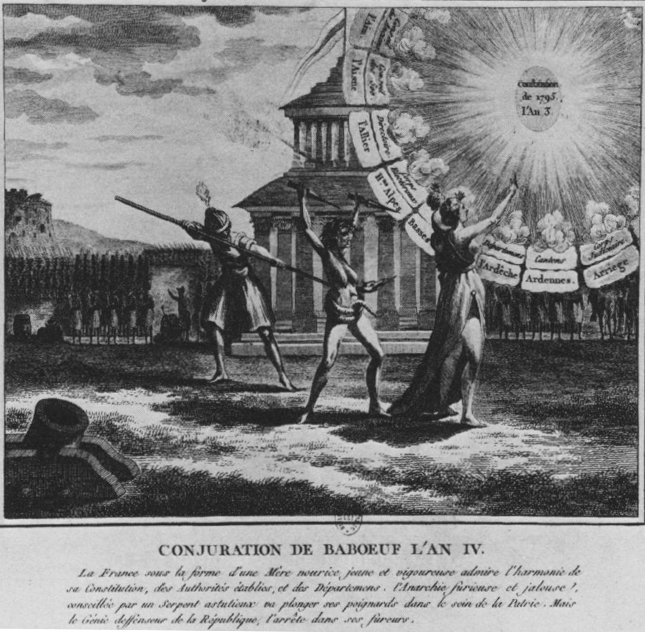
 The needle contained cyanide and the destination
  Wild’s dramatic execution marked a precipitous fall for a man who was perhaps the most influential person in England’s criminal justice system, even though he never held an official government position. As the self proclaimed “Thief-Taker General of Great Britain and Ireland,” Wild was instrumental in capturing and bringing to justice scores of petty thieves that plagued the London streets. He consulted the government on the passage of laws intended to encourage the capture of criminals. He also oversaw a vast criminal empire, the likes of which has never been duplicated.
 On this date in 1997, Bruce Edwin Callins was executed in Texas — part of the


