1673: Thomas Cornell, on spectral evidence

(Thanks to Meaghan Good of the Charley Project for the guest post. -ed.)

On this day in 1673, alleged mother-slayer and arsonist Thomas Cornell was hanged in Portsmouth in the colony of Rhode Island.

The death of his elderly mother, Rebecca, and the subsequent homicide investigation have got to be one of the strangest murder stories in American colonial history.

The Cornells were a respectable and prosperous Quaker family, the ancestors of the man who founded Cornell University. (Their descendants also included Lizzie Borden of the “forty whacks” fame, but that’s another story.)

Rebecca, a 73-year-old widow, was the legal owner of the family’s hundred-acre spread by Narragansett Bay. Her oldest son, Thomas, and his wife and six children lived there with her, along with one lodger and one male servant, a Narragansett Indian named Wickopash.

Crowded as the house was, Rebecca had the master bedroom all to herself. It was well known that Rebecca and Thomas didn’t get along. For some time, both parties had been complaining bitterly about each other to anyone who would listen. Thomas resented the fact that, at 46, he was still financially dependent on his mother, who had made generous gifts from her late husband’s estate to her other children but not to him. Rebecca, for her part, said Thomas was “a Terror to her” and that she was neglected and had to fetch her own firewood.

None of her complaints were taken seriously until after her mysterious death, which is chronicled in Elaine Forman Crane’s 2002 book Killed Strangely: The Death of Rebecca Cornell.

Rebecca died on the evening of February 8, 1673.

That night, she refused to join the family for dinner because she didn’t like what was being served. After the meal was over, her grandson came to her room to check on her and found her charred body lying on the floor by the fireplace, burnt “to a cole.” She was recognizable only by her shoes.

Her death was originally ruled “an unhappie accident.”

It could have been spontaneous human combustion, but a more likely explanation is that embers from the fireplace or from the pipe Rebecca smoked landed on her dress.


An alleged victim of spontaneous human combustion.

No one heard her scream, no one smelled smoke, and somehow the fire didn’t spread to the rest of the house. No one seems to have suspected foul play at that time.

Two nights later, however, Rebecca’s younger brother, John Briggs, received a spiritual visitation from his sister as she slept. “See how I was burned with fire,” she said. He inferred that someone had intentionally burned her.

Briggs didn’t report his experience for a week, but when he did his account was taken seriously by the superstitious colonials. Rebecca’s body was exhumed and given a thorough inspection, and this time a wound was found on her upper abdomen. The authorities decided she had been stabbed by something like “the iron spyndell of a spinning whelle.” No murder weapon was ever produced, however.

Thomas quickly became the prime suspect: he was the last person to see Rebecca alive, and the whole town knew of the enmity between them. After Rebecca’s death, Thomas and his wife Sarah reportedly made some incredibly crass remarks; Sarah said her mother-in-law’s demise was “a wonderfull thing,” and Thomas said that his mother had always liked a good fire, and “God had answered her ends, for now shee had it.”

This hearsay was presented as evidence at Thomas’s trial, along with John Briggs’s dream.

Thomas was convicted and, although many of the townspeople had doubts about the verdict and death sentence, he chose not to appeal. He was hung before a crowd of over one thousand people.

Did Thomas Cornell murder his mother?

Certainly he wasn’t the only one who had the opportunity to do so; the house was full of people that night. In fact, a year after Thomas’s death, the servant Wickopash was tried as an accomplice to the murder. Nothing is known about the case against him, but he was acquitted.

In 1675, Rebecca’s son William tried to make a case against Thomas’s wife for the murder, but he failed to produce any witnesses or evidence against her.

Was this even a murder at all?

The fire, as noted above, could have been accidental; as for the “suspicious wound” the authorities found after they dug up the body, Rebecca could have stabbed herself in her struggles after her dress caught fire, or perhaps those who performed the exhumation saw only what they expected to see.

And there is yet a third possibility: prior to her death, Rebecca told her daughter she had contemplated suicide on several occasions, but her religious beliefs prohibited such action.

One final note: Thomas’s wife, Sarah, was pregnant at the time of his execution and later gave birth to a daughter.

She named the baby Innocent.

On this day..

1691: Jacob Leisler, “a Walloon who has sett at the head of the Rable”

On this date in 1691, Jacob Leisler was executed in New York, a New World casualty of the Glorious Revolution back in the mother country.

In an era when transatlantic communication moved at the speed of a galleon, the 1688 overthrow of England’s Stuart monarchy initiated an agonizing period of political uncertainty in Albion’s far-flung American provinces.

And to the question of who was really in charge were appended the many local political issues of the colonies — religious, economic, political.

One of the empire’s dominant fault political fault lines in the foregoing years had been the succession to follow England’s last Catholic monarch, James II. For Calvinists whose dynastic champion was the House of Orange, the marriage of their guy William III to James’s daughter raised the prospect of an eventual claim on the English throne. Those hopes seemed dashed when James fathered a son, to the elation of Catholics who now aspired to a lasting Catholic line.

When word reached New York, still a majority-Dutch city thanks to its original mother country, of the ascent of that their countryman William III and England’s Protestant establishment had forcibly disinherited the infant prince and his dad, it did not take long for local Dutch factions to run off the former King James’s plenipotentiaries. (An irony, since New York was named for that very same now-deposed King James: he’d been the Duke of York when it was seized for the Dutch in the 1660s.)

That ex-monarch’s brief reign had seen the establishment of a much-resented Dominion of New England, welding together everything from New Jersey to Maine into a super-colony whose high-handed boss was arrested by a Boston mob. (He sailed for England.) That gentleman’s lieutenant, in New York, likewise absconded as his own authority crumbled … a sort of American Glorious Revolution shadowing the one across the pond.

The Frankfurt-born Leisler was a colonial mercantile magnate, one of the 17th century’s wealthiest New Yorkers, notable for his Orangist sympathies and Calvinist religious inclination. It was to this important private citizen (who was also a militia captain) that de facto executive power fell in the New York colony — and it was indeed the New York colony specifically, since the reassertion of local prerogatives and pre-1685 administrative units had been one of the immediate consequences of the shakeout in America.


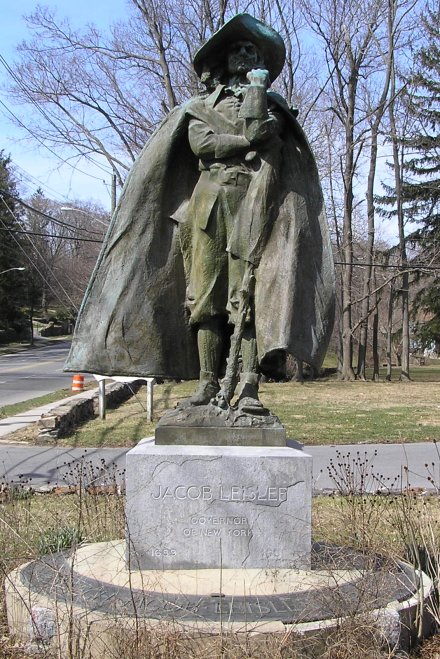
Statue of Jacob Leisler in New Rochelle, N.Y. — which Leisler helped create as a settlement for refugee Huguenots.

And once in the saddle, the Dutch Calvinist Leisler essentially ran a populist administration against the colonial oligarchy, which replied by vilifying him as a “usurper” and “rebel”.

Internal politics in New York and its neighbors during those months make fascinating reading.* Quakers and Catholics aligned against Protestants. Albany aligned against New York, until Leisler brought the former to heel. Clergy chose up sides. Leisler summoned a sort of proto-continental congress of colonial representatives (all the way to the West Indies) to hash out their situation.

And what was that situation? There had been a revolution, after all, and there was no agreed-upon representative of the royal authority present in New York. An assembly of militia leaders had asked Leisler to assume leadership, so was he really outside his rights to treat as his the London dispatches addressed to “such as, for the time being, take care for preserving the public peace and administering the law in New York”?

It’s a moment whose ferment of democratic energy can be read to presage the next century’s (proper) revolution.

Yet it was also not a revolution in the Cromwellian, world-turned-upside-down sense. For the English polity, and certainly for the conduct it preferred in its frontier possessions, continuity was the order of the day. Even in England herself, William and Mary were more than pleased to govern with Tories who could see their way to releasing their fealty to the Stuarts.

There was an empire to run, after all.

From that standpoint, Leisler’s anti-oligarchical policies and fractious disputes with other colonial elites were a bad business. There’s no sense in letting France make inroads because your governors are bickering over predestination or some such.

So formally, the realm’s new rulers continued all non-Catholic personnel in their posts. With the Dominion governors ejected, it was just a matter of dispatching fresh executives to take over. It’s just that this process required months … during which Leisler was managing New York the way he figured it ought to be managed, and his enemies were consequently painting him as a rebel.

Leisler pronounced himself, this whole time, anxious to submit his authority to the new governor upon the production of proper credentials. If he was surprised that the new monarchs tendered appointees of the very same factions recently expelled,** Leisler showed it only in his exactitude for procedure: because of a logistical cock-up, an aide to the new colonial governor arrived first, and when Leisler refused to hand over his fort without the royal warrant, a tense standoff ensued. It was resolved when the real governor, Henry Sloughter of ominous name, finally showed up.

Sloughter had his “predecessor” immediately arrested, along with others of his circle and harshly tried for treason and murder by a court stacked with anti-Leisler political enemies.†

Ultimately Leisler was condemned to die along with his secretary and son-in-law Jacob Milborne, but even Sloughter was loath to enforce the sentence. The story goes that Leisler’s most implacable foes had to get Sloughter drunk to put his signature on the death-warrant. (Sloughter died a couple of months later himself, for maximum operatic effect.)

On Saturday morning, May 16, 1691, the largest crowd ever gathered in New York City stood, rain soaked and weeping, all eyes fixed as a limp body was cut from the gallows and placed on the block. With a clean blow, the executioner’s ax cut off the head of the “halfe dead” Jacob Leisler — loyal lieutenant governor or rebel tyrant, depending on one’s point of view. Amid the “shrieks of the people,” fainting women (some “taken in labour”), and tumultuous jostling for “pieces of his garments” and strands of his hair, as “for a martyr,” the newly arrived and unfortunately named royal governor, Henry Sloughter, worried that his decision to execute Leisler might not, after all, end the “diseases and troubles of this Government.” Indeed, for years afterward New Yorkers bitterly divided over Leisler and the 1689 uprising that, in the wake of England’s Glorious Revolution, had led to his assumption of power in the provincial government.

-David Voorhees, who elsewhere contends that these divisions “continue to inform American politics to the present day.”*

A few years later, a more Leisler-friendly Parliament restored the dead man’s estate to his heirs, a sort of implicit admission that the whole head-chopping thing might have been a bit much.

This character figures to bear more historical consideration than he has heretofore enjoyed; further to that end, there’s a Jacob Leisler Papers Project devoted to marshaling at New York University the primary documents connected with Leisler.

* See, for instance, David Voorhees in “‘to assert our Right before it be quite lost’: The Leisler Rebellion in the Delaware River Valley” in Pennsylvania History, Winter 1997 — and, Voorhees again in “The ‘fervent Zeale’ of Jacob Leisler,” The William and Mary Quarterly, July 1994.

** Literally so: Francis Nicholson, whom Leisler ousted from New York, tried to get himself appointed governor; he was instead sent to Virginia and continued in royal service in the colonies for decades to come.

† e.g., Joseph Dudley, one of Leisler’s judges, whose penchant for authoritarian justice has been noted elsewhere in these pages.

On this day..

1730: James Dalton, Hogarth allusion

On this date in 1730, career criminal James Dalton was executed at Tyburn.

Detail view (click for full image) of James Dalton’s wig box depicted in the boudoir of prostitute Moll Hackabout in Hogarth’s A Harlot’s Progress.

Crime ran in the family for young master Dalton; his father hanged upon the information of notorious (and himself eventual gallows-bird) Jonathan Wild. According to the Ordinary of Newgate’s report, our day’s principal “went between his Father’s Legs in the Cart, to his fatal Exit at Tyburn.”*

Who knows but what naughty urchins (or parents) in the throng were deterred by that affecting spectacle. For the Daltons, it was more like Take Your Child to Work Day.

While the elder Dalton’s skills ran towards card-sharping, young master James went in for the more conventional varieties of larceny — both those practiced by stealth, and those practiced by force.

These pursuits saw him twice transported to America, for which we have to thank the English judiciary on account of Dalton’s resultant biography at Early American Crime.

(In)famous for his many dalliances, Dalton’s exploits could move copy in their day — and their author transgress the lines between the underworld and “legitimate” celebrity.

“In the height of all our Robberies” [Dalton] and his companions “used to go to the Playhouse, dressed like Gentlemen,” and that once, while watching The Beggar’s Opera, “Captain Macheath’s Fetters happening to be loose,” one of them “call’d out, Captain, Captain, your Bazzel is undone.” The real thieves, having shown up the actors with their superior knowledge of both irons and cant, then retired in style to an alehouse, “in four Chairs, with six Lights before each Chair.”**

Just another hanged thief.

Except, also not — because while his career in malefaction would undoubtedly have added up to a death sentence, his condemnation was secured upon the word of a perjurer upon a very doubtful charge.

A character named John Waller, an “affidavit man” whose profession was supplying bogus testimony to hang whomever could be hanged where a reward was available, insisted that Dalton had robbed him upon the roads. Dalton vigorously denied (and even rebutted with evidence) this charge even while admitting his general life of crime, but it was upon this dubious offense against Waller that he stretched his neck. Dalton died at Tyburn with three others, though a fifth member of their party, one Hugh Norton or Haughton, managed to cheat the executioner by hanging himself in his cell.†

It was the rough justice of the 18th century, a time frequently admitting opportunity to repay tit for tat.

In this case, the professional perjurer who hanged Dalton was two years later convicted himself after making a bogus accusation of highway robbery. Waller was condemned by the court to stand in the pillory at the Seven Dials — a dangerous punishment cousin to the era’s death penalty, inasmuch as the mob violence thereby invited not infrequently proved fatal.


John Waller bombarded with refuse in the pillory.

Waller had quite a reputation, but the fury of the crowd was nothing next to that of James Dalton’s brother, Edward — who, with a confederate, brazenly climbed onto the platform, wrenched the “assize man” out of his pillory, and savagely beat him to death.

* Cited in this impressive compendium of Dalton-related primary sources.

** Andrea McKenzie, “The Real Macheath: Social Satire, Appropriation, and Eighteenth-Century Criminal Biography,” Huntington Library Quarterly, Vol. 69, No. 4 (December 2006), with the quotes supplied by a 1730 publication called “The Life and Actions of James Dalton (the Noted Street-Robber)”

† Norton/Haughton was posthumously hanged in chains the next day.

On this day..

1766: Thomas Arthur de Lally-Tollendal, undiplomatic

On this date in 1766, a refugee noble with more honor than sense lost his head in Paris.

Thomas Arthur, comte de Lally, baron de Tollendal — more efficiently known as Lally, or as Lally-Tollendal, though he’s not to be confused in this with his son, a French Revolution bit player — entered this world in County Galway, the child of a minor lord.

Since said lord hewed to the Jacobite party favoring restoration of the Stuarts to the English throne, the family found itself relocated with the exiled Pretender to a continental power whose spiritual and temporal interests were similarly inimical to the Hanoverian king.

Our man landed himself, like a proper retainer of his adoptive liege, a gig in the French army in which capacity he actually served at the Jacobites’ last doomed British hurrah, the 1746 Battle of Falkirk.

But his problems came from his Bourbon service much further afield — in India.

There, his expeditionary force suffered reversal after reversal at the hands of the hated Brits, even then in the process of appending India to their dominions.

Our general’s military misadventures were compounded by impolitic high-handedness towards his officers and men, and to the locals whose alliances he needed. He was, in the main, a man ill-suited to the job entrusted to him. As the Memoirs of Sanson remark, “his temper, his obstinacy, and especially his contempt for all means of action except brutal strength, were destined to lead him into mistakes in a position demanding more knowledge of politics than science of war. Sixteen years before Lally-Tollendal’s appointment, Dupleix, with scanty forces, at enmity with the Company, receiving neither help nor subsidies from the mother country, had held in check English power in the Indian peninsula by mere diplomatic proficiency. Lally knew how to conquer; but he was incapable of studying and detecting the secrets of Dupleix’s policy.”

By the time the bad news that established all this hit France, the subcontinent was pretty much Britain’s to command — just another piece of the imperial butt-kicking France suffered in the Seven Years’ War.

And Lally’s enemies were holding him personally responsible as a potential traitor. After all, he was conveniently now in English custody.

Incensed at having his honor impugned, Lally unwisely obtained English parole to return to repel these charges. He proved no more diplomatic with the barristers than he had been with the Hindus:

he was so convinced of his own innocence that he was imprudent enough to impeach the officers who had served under his orders, together with the administrators of the colony. He charged them with such violence that his death and condemnation became indispensable for their justification … When the accused appeared before his judges, he was no more able to control his temper than when he was in India … answering, fuming, retorting, stigmatising the cowardice of some, the cupidity of others, and hinting that the only guilty party was the powerless Government.

Just the sort of vindication liable to appeal more to posterity than to said government. Louis XV, another man unequal to his position, was by this autumn of his reign plumbing the nadir of his unpopularity; for the officer who had risked his life in battle under French colors throughout adulthood, Louis calculated more profit in severity (or expedience) than in clemency. Hey, it had worked for the English.

And really, for a Stuart adherent, sacrificial execution was kind of an apt fate.

We guess it worked.

“The people were pleased with all that made his punishment ignominious: the cart, the handcuffs, and the gag,” recorded aristocrat-of-letters Madame du Deffand (Source) “He was a great rascal, and besides he was very disagreeable.”

Thomas Carlyle, in his The French Revolution, spared in Lally’s defense a few sentences of delicious invective for the rotting regime that did him in.

The Parlement of Paris may count itself an unloved body; mean, not magnanimous, on the political side. Were the King weak, always (as now) has his Parlement barked, cur-like at his heels; with what popular cry there might be. Were he strong, it barked before his face; hunting for him as his alert beagle. An unjust Body; where foul influences have more than once worked shameful perversion of judgment. Does not, in these very days, the blood of murdered Lally cry aloud for vengeance? Baited, circumvented, driven mad like the snared lion, Valour had to sink extinguished under vindictive Chicane. Behold him, that hapless Lally, his wild dark soul looking through his wild dark face; trailed on the ignominious death-hurdle; the voice of his despair choked by a wooden gag! The wild fire-soul that has known only peril and toil; and, for threescore years, has buffeted against Fate’s obstruction and men’s perfidy, like genius and courage amid poltroonery, dishonesty and commonplace; faithfully enduring and endeavouring,–O Parlement of Paris, dost thou reward it with a gibbet and a gag?

There’s a public-domain 19th century lecture on our man’s adventurous career here. And there’s a monument back home near Tuam, Ireland.

On this day..

1951: Willie McGee

As of today, it is sixty years since the Laurel, Mississippi execution of Willie McGee for rape — a lightning rod for controversy over race, crime, and justice in one of the Cold War’s principal antagonists.

McGee died silent in the state’s portable electric chair, rigged up in the very courtroom of his trial, right in front of the box from whence his all-white jury had retired two and a half minutes before convicting him. Fifty or so observers were there with him — plus those of the hundreds of local residents milling around outside intrepid enough to scale a tree for an illicit view through the courthouse windows.*

(Given the setting, some sources call this a “public execution,” which is not technically correct. This courtroom tableau was actually a standard deployment for the mobile electric chair.)

But McGee’s own silence hardly muted global outrage: for years, appeals for McGee’s life had deluged Mississippi and the White House from Europe, the Soviet Union, and what was quaintly known as “Red China.”

Oh, yes. The Reds.

Willie McGee’s case popped out of backwoods obscurity when he got from the pinko Civil Rights Congress a leftist young attorney — future U.S. Congresswoman Bella Abzug.

Once it got out there, it became the Free Mumia case of the nascent civil rights movement and the nascent Cold War. Its appeal to communist countries and cadres only raised the hackles of American establishment types. This was a Negro raping a white housewife literally and metaphorically.


Author Jessica Mitford (The American Way of Death) campaigning to save Willie McGee’s life. William Faulkner, Albert Einstein, and Josephine Baker also publicly supported McGee.

Whether there actually was a literal rape is the enduring mystery — the enduring Rorschach blot — of the McGee case. The accused himself remained silent on the matter for years; eventually, he claimed that the two were having a consensual but forbidden interracial affair and that he had been brutalized into a confession.

McGee’s defenders believed that the “victim” herself initiated the affair, and

threatened to cry rape if he refused her flirtatious advances … McGee reluctantly went [along] with Hawkins, fearing the tragic consequences of turning her away. “People who don’t know the South don’t know what would have happened to Willie if he told her no,” [Willie’s wife] Rosalee told a friend. “Down South you tell a woman like that no, and she’ll cry rape anyway. So what else could Willie do?”

At the Dark End of the Street: Black Women, Rape, and Resistance

(In this version, the manipulative Hawkins executed the threat when her husband — who later witnessed McGee’s electrocution — found out. McGee’s cited reason for changing his story was the very plausible fear of lynching.)

A Laurel African-American who was then a child remembers being taken by his family to view the body, and impress upon him the lesson of its electrical burns: “Don’t mess with white girls.”

McGee’s persecutors considered all that miscegenation stuff so much subversive rubbish, a “revolting insinuation,” in the words of the Mississippi Supreme Court.**

And if at its apex the controversy generated more heat than light, its historical fade to embers has not sufficed to resolve the factual questions.

McGee has benefited from a recent rediscovery — one that indicates such memories of the McGee case as persevere in Laurel still divide starkly along racial lines.

Explore this case and its many resonances (without the Perry Mason big reveal) in Alex Heard’s 2010 The Eyes of Willie McGee (review); and, in a spellbinding NPR series on “My Grandfather’s Execution” by Bridgette McGee-Robinson, which is exactly what it sounds like. (Direct links to several Radio Diaries mp3 episodes can be found from the RSS feed here.)

Both were facilitated by a recording of execution-night radio news coverage fortuitously preserved by a young Hattiesburg reporter.

Book Cover

* New York Times, May 8, 1951.

** McGee did at least win two retrials in Mississippi; federal courts gave him short shrift, with anti-civil rights judge Sidney Mize — later memorable for fighting the legal rearguard against integrating Ole Miss — lecturing Abzug in a last-ditch appeal that McGee’s “guilt is plain” and that “courts ought to rise up and defend themselves.” (Source)

Taken as an obvious given: “actually guilty” or not, a defendant executed for rape in the American South is certainly a black man with a white accuser.

On this day..

1705: Captain Thomas Green and two of his crew on the Worcester

On this date in 1705, another century’s supposed terrorist was hanged on Leith Sands with two of his “pirate” crew by a Scottish court “drunk with patriotic prejudice.”*

This execution took place in the feverish run-up to England and Scotland’s Acts of Union welding the neighboring realms into Great Britain in 1707.

Arising as it did from the same causes that animated that national marriage of convenience, Green’s execution also endangered it: Daniel Defoe, who was at this time a pro-Unionist mole (and prolific pamphleteer) for English pol Robert Harley, described this hanging as one of the six crises that had to be overcome en route to the Union.

A Man, A Plan, A Calamity

Panama.

That’s where it all started, for Green and Union alike.

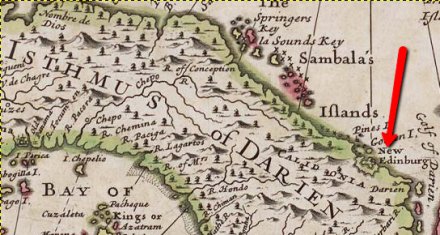
Mired in economic backwardness as neighboring European states carved up the world, Scotland made a bold, doomed bid for a chit in the empire game: the Darien scheme. One part visionary and (at least) two parts daft, this venture attempted to establish a Scottish colony on the Isthmus of Panama (aka the Isthmus of Darien) with a view to porting freight across the narrow strip of land separating Atlantic and Pacific, and dominating the dramatically more efficient east-west trade route that would result.


The intended Scottish colony in Panama; map from this University of Glasgow exhibit.

Students of the Panama Canal project will be aware that this malarial tropic would not be described as especially hospitable; to the natural disadvantages of the climate were added the political interpositions of England herself, whose hostility to the advent of her Caledonian neighbor as a New World rival was expressed in legislation choking the Darien adventure of foreign aid.

(Also a problem: Spain. The colony was abandoned at last under Spanish siege.)

So Scotland went it intrepidly, injudiciously alone in this last bid for real independent muscle in Europe. The hyperbole of the Isthmus’s publicists eventually sucked in 20 percent or more of the capital circulating in Scotland. And when Darien-dot-com went bust by 1700 at the cost of a couple thousand lives, it cratered the Scottish economy too. That set the stage for Edinburgh’s partnership in a different scheme: Great Britain.

Green with Envy

In the years following the Darien catastrophe, the Scottish corporation chartered to undertake it was still throwing stuff against the wall in the world trade game, trying to get something to stick to at least take the edge off the losses.

This company (theoretically a potential rival of England’s own East India Company) had suffered the further national indignity of having one of its ships, the Annandale, seized in the Thames for infringing the East India Company’s royal monopoly. Its appeals for redress falling on deaf ears, the Darien company apparently induced Scottish authorities to undertake the retaliatory seizure of an English merchant ship, the Worcester, that had the ill luck to weather a storm at the Firth of Forth.

Rumor soon connected this ship to another vanished Darien company vessel overdue from its return trip from the East Indies … and, as it quickly became understood by all right-thinking Scots, overtaken in the Indian Ocean by this same Worcester and its crew butchered.

Captain Thomas Green and his English crew were hailed before an Admiralty court** on piracy charges on this extremely fantastical connection in a virtual mob atmosphere.

It never was clearly established that an act of piracy had been committed as a distinct fact, but by putting certain circumstances together it was inferred that Green was guilty of piracy. The very shape in which the accusation is set forth, shows that the accusers could not point to the specific act of piracy which had been committed …

[There] was no specification as to the vessel taken, which might enable the accused to prove that it had not been taken; no names of parties murdered, who might be shown still to be alive; no ownership of cargo, which might admit of proof that the owner’s goods had arrived safe. As Green himself is made justly to say in the document published as his dying speech, “We are condemned as pirates and murderers on a coast far distant from this place — is there any of you who wants either a friend whom we have murdered, or whose goods we have taken?”

Worcester Sauce

The Worcester‘s Malabari cook provided a highly dubious charge — dubious, for he was not yet among the crew when it last called at the location he claimed the crime took place — of Green and crew hatchet-murdering approximately ten English-speaking mariners on an unnamed vessel off the Indian coast.

Upon this evidence, 14 or more members (the ready sources are a little loose on the total number) of the Worcester crew were condemned for piracy, and initially slated for three batches of hangings. Queen Anne‘s personal intervention managed a stay,

The Scottish Privy Council unto the very last hours debated what to do with the diplomatic appeals, with evidence forwarded from London to the effect that the crew these Worcester men had supposedly slaughtered were alive, their vessel having been hijacked in another place, by another man.

But a surging Scottish mob aggrieved by the preceding years’ misadventures and the impending shotgun marriage to Westminster rather than anything Green himself had really done was already engorged on the blood of the supposed English corsairs. Most of the Council thought better than to deny them their sacrifice.†

The Streets fill’d with Incredible Numbers of Men, Women and Children, calling for Justice upon those ENGLISH Murtherers. The Lord Chancellor Seafield‘s Coach happening to pass by, they stop’d it, broket he Sashes, haul’d him out, and oblig’d him to promise Execution should speedily be done before he could get from ’em … According to the Chancellors promise, soon after, on the same Day, being Wednesday, Captain Green, Madder [the mate], and Sympson [the gunner] were brought out, and convey’d to Execution, which was at Leith Road upon the Sands, and all the way was Huzza’d in Triumph as it were, and insulted with the sharpest and most bitter Invectives. Being come to the place of Execution, Good God! what a moving sight was it to see those Men stand upon the very Varge of Life, just launching in to Eternity, and at the same time see the whole Multitudet ransported with Joy!”

-From an anonymous Letter From Scotland To a Friend in London, quoted by James Kelly, “The Worcester Affair,” The Review of English Studies, Feb. 2000

In the event, these three were the only ones actually hanged; passions cooled enough for the other “pirates” to be quietly released.

But the wider, national passions unleashed by this date’s executions would long provide fodder for intemperate patriotic recrimination, and specifically anti-Unionist propaganda — on both sides of the border.

Competing propagandistic broadsides framed and re-framed the events, as the affair of unscrupulous English buccaneers or perfidious highland barbarians. (Defoe, maneuvering for Union, wrote to chill such bad-for-business hostility: “Nothing could be more horrid, than that the Scots should Execute these Men on a meer Pique at the English Nation. Nothing can be more like it, than to conclude rashly, that it is so, and improve it on purpose to Exasperate our People against the Scots.” (Kelly))

And that, of course, is precisely the viewpoint that prevailed.

While the hemp neckties issued to Green et al this date threatened to (ahem) scotch the Union project, that very danger might have ultimately hastened its completion — as elites recognized, in Defoe’s words, that Union represented “the only way to preserve the publick Tranquillity, and prevent the certain Mischiefs that threatened the whole Body,” (Kelly, again) and rammed it through with dispatch.‡

* English historian G.M. Trevelyan.

** A lengthy account of the trial can be found in this Google books freebie

† In their very scanty defense, the Scottish magistrates had reason to fear Scottish citizens.

‡ The ebb and flow of national resentment continued long after the Acts of Union, of course; continuing Scottish support for the restoration of the Stuart monarchy was one expression of Scottish nationalism and anti-Union sentiment.

On this day..

Unspecified year: Snowball’s animal fifth column

“Four days” after an unspecified “early spring” date in George Orwell’s classic allegory of Soviet communism, Animal Farm, a show trial and mass execution of animals purporting to work for the book’s Trotsky figure signals the titular farm’s unmistakable collapse into dystopia.

In the book, a revolution of animals displaces the farm’s human owner, Jones — the hated ruler of the ancien regime.

The farm’s early cooperative elan soon shatters, with a pig bearing the unsubtle name of Napoleon becoming the revolution’s autocrat, and fostering a paranoid security climate against phantasmal plots by his fellow swine and onetime comrade, the exiled Snowball.

Let’s watch.

Napoleon ordered all the animals to assemble in the yard. When they were all gathered together, Napoleon emerged from the farmhouse, wearing both his medals (for he had recently awarded himself “Animal Hero, First Class”, and “Animal Hero, Second Class”), with his nine huge dogs frisking round him and uttering growls that sent shivers down all the animals’ spines. They all cowered silently in their places, seeming to know in advance that some terrible thing was about to happen.

Napoleon stood sternly surveying his audience; then he uttered a high-pitched whimper. Immediately the dogs bounded forward, seized four of the pigs by the ear and dragged them, squealing with pain and terror, to Napoleon’s feet.0 …

The four pigs waited, trembling, with guilt written on every line of their countenances. Napoleon now called upon them to confess their crimes. … Without any further prompting they confessed that they had been secretly in touch with Snowball ever since his expulsion, that they had collaborated with him in destroying the windmill, and that they had entered into an agreement with him to hand over Animal Farm to Mr. Frederick. They added that Snowball had privately admitted to them that he had been Jones’s secret agent for years past. When they had finished their confession, the dogs promptly tore their throats out, and in a terrible voice Napoleon demanded whether any other animal had anything to confess.

The three hens who had been the ringleaders in the attempted rebellion over the eggs now came forward and stated that Snowball had appeared to them in a dream and incited them to disobey Napoleon’s orders. They, too, were slaughtered. Then a goose came forward and confessed to having secreted six ears of corn during the last year’s harvest and eaten them in the night. Then a sheep confessed to having urinated in the drinking pool — urged to do this, so she said, by Snowball — and two other sheep confessed to having murdered an old ram, an especially devoted follower of Napoleon, by chasing him round and round a bonfire when he was suffering from a cough. They were all slain on the spot. And so the tale of confessions and executions went on, until there was a pile of corpses lying before Napoleon’s feet and the air was heavy with the smell of blood, which had been unknown there since the expulsion of Jones.

When it was all over, the remaining animals, except for the pigs and dogs, crept away in a body. They were shaken and miserable. They did not know which was more shocking — the treachery of the animals who had leagued themselves with Snowball, or the cruel retribution they had just witnessed. In the old days there had often been scenes of bloodshed equally terrible, but it seemed to all of them that it was far worse now that it was happening among themselves. Since Jones had left the farm, until today, no animal had killed another animal.

Animal Farm was published in 1945. In this 1954 British animated feature, the downer of an ending — with the corrupt pig rulers becoming literally indistinguishable from people — was dumped in favor of an ending where the animals revolt again.

On this day..

1677: Giles Bland

On this date in 1677, Giles Bland was hanged in the Virginia colony for the late Bacon’s Rebellion.

Bland was in that remote colony as the agent of his father, the London merchant John Bland.

This John Bland fellow had an interesting career — as suggested by the title of Neville Williams’s “The Tribulations of John Bland, Merchant: London, Seville, Jamestown, Tangier, 1643-1680” in The Virginia Magazine of History and Biography (Jan. 1964). We elide here the former two and the last one except to observe that they made John Bland a very wealthy man, and landed him in Samuel Pepys’s diary.

Accordingly, John Bland’s New World interests were considerable, and we suppose that his son Giles, dispatched thither after John’s brothers had died in the New World, was a bit too conscious of the weight his surname carried.

He griped about colonial corruption, put about “malicious reports” of royal governor William Berkeley, “bespattered with … dirt … thrown upon the whole government of Virginia,” and — foreshadowing alert! — got into the drink to the detriment of his good judgment:

[G]oing to the house of Thomas Ludwell in company with Sir Henry Chicheley after they had drank plentifully there happened a discourse in which Giles Bland thought Ludwell’s speech too severe in relation to his father, and told Ludwell’s that he dealt basely and unworthily to cast such aspersions upon his father and himself, and being transported with passion upon “further exchange of language” came to blows, and exchanged gloves to meet in the morning. His son slept not all night, and continuing hot headed, hastened to the place appointed, where, missing Ludwell, he nailed the glove on the door of the Grand Assembly [house] writing some words under it. Ludwell more wisely sought reparation before the Governor and Council, where Giles Bland was ordered to ask forgiveness which he performed, and the Court fined him 500l. for his abuse done to the Assembly, the payment to be suspended for two years to enable him to supplicate his Majesty to remit the same, it being intended rather to deter him from the like rash actions in time to come, than to ruin him for what he had unadvisedly committed.

Put Giles down for “undeterred.”

As conflicts between the Virginia planters and Berkeley’s party came to a head — planters were sore about taxes, trade, and overly friendly Indian relations — Bland was tapped to represent the former back in the mother country.

But rather than sail for England, the young hothead hitched onto the rising of Nathaniel Bacon — and then was almost immediately intercepted by his foes. “Those who are best able to render an account of this affair do aver,” we read, “that there was no other treason made use of but their want of discretion, assisted by the juice of the grape.”

(Getting captured while distracted by more hedonistic pursuits was a pattern with these Bacon’s rebels, or at least a pattern of the propaganda written about them.)

Rather than summary execution, Giles Bland faced several months’ ill-treatment in irons. Still, Berkeley was in enough of a hurry to get the lad into the ground as the last of the Bacon’s Rebellion martyrs that he seems to have suppressed the prisoner’s legitimate appeal for royal clemency.

John Bland was in the winter of his years when this grim news arrived in London; he would die there in 1680 — having committed yet one more member of his family, his wife Sarah, to the Atlantic crossing, and “feeling no greater grief under my many adversities and infirmities … than her necessary absence in Virginia about my unhappy affairs and estates there.”

On this day..

1887: William Jackson Marion, who’d be pardoned 100 years later

On this date in 1887, William Jackson Marion was executed in Nebraska for the murder of his best friend, John Cameron.

Jackson had always upheld his innocence and his ignorance of Cameron’s fate; he was the picture of “utmost coolness” on the scaffold, declaring only “that I am a sinner, the same as other men. I have made no confession and have none to make. Go to the court dockets and see where men have been tried and acquitted and compare my case with them.”

And then, as given by the Gage County Democrat, the first, last, and only man hanged in Beatrice “stood erect upon the trap-door while his hands and feet were bound, the black cap drawn over his face, and the noose adjusted,” the trap sprung, and after a thousand-plus people had taken the opportunity to view this infamous corpse, it was buried in the potter’s field.


It was then 15 years since young “Jack” Marion and John Cameron had hauled out from Grasshopper Falls, Kansas, looking for work on a railroad.

Somewhere in the wilderness, John Cameron disappeared, and Marion returned to his mother-in-law’s saying his buddy had left. Marion’s whereabouts fade; he’s supposed to have drifted in Indian country: was it flight? It sure looked that way a year later, when a body turned up with clothes that matched Cameron’s … and bullet wounds in the head.

Only a decade after those railroad recruits had rolled out their mule-packs was Marion finally apprehended and tried, and even then, it would take four years (and two trials, and several appeals) to resolve this circumstantial and very cold case.

The matter was indeterminate; the newspapers in town sniped at each other over the proper course — “there is a strong under current of public sentiment that is opposed to hanging, and particularly upon circumstantial evidence, collected ten years after the trial [sic], and connected by the testimony of his mother-in-law who showed … personal malice” complained the Gage County Democrat. Up to the very last, the governor postponed hanging by two weeks in response to a citizens’ petition. As is so often the case, though, the will to grant outright executive clemency went begging.


In 1891, under the headline The Dead Is Alive!, the Beatrice Daily Express delivered a thunderbolt to its readers.

There has always lingered, and always will linger, in the minds of a number of people … a doubt of Jack Marion’s guilt of the murder of John Cameron, and for which crime he was executed in this city four years ago.

The Express has today received almost indisputable information which establishes the startling fact of Jack Marion’s innocence. In other words John Cameron is still alive and was seen at LaCrosse, Kansas, one week ago Saturday, and a statement was obtained of him regarding his whereabouts from the time he and Jack Marion separated … and upon which day the law says Jack Marion killed his boon companion and friend.

The “victim” hadn’t been killed at all — he’s just up and blown town, just like Jack Marion said.


Although John Cameron turned up alive four years after the hanging, it would take another ninety-five for John Law to set things right.

That was when the executed man’s grandson, Elbert Marion, officially petitioned for Jack Marion’s posthumous pardon.*

Considering the century’s wait, the Board acted with relative dispatch on the hand-written petition. The evidence, Elbert pointed out, “has been accepted as fact by many many people including the Nebraska State Historical Society” and the living Cameron’s identity considered well-established by his contemporaries.** Elbert’s documentary history was considerable; in the minutes of the meeting, it’s handled by unanimous vote with no more than a few minutes’ conversation — one board member (the Attorney General, no less) observing of a proposal to kick the can down the road to a later evidentiary hearing, “we have sufficient information now on which to act responsibly.”

Now that’s bureaucracy for you.

In 1986, the Nebraska Pardons Board unanimously voted to issue a posthumous pardon to William Jackson Marion, hanged on March 25, 1887, for the murder of John Cameron. Secretary of State Allen Beermann, a member of the Board, noted that this was only the second request for a posthumous pardon the board has heard during his 16-year tenure. Marion’s grandson, Elbert Marion, requested the pardon, arguing that the coroner had misidentified a skeleton as Cameron, and maintaining that Cameron was seen alive by two of Marion’s relatives four years after Marion’s execution. The Board justified the unconditional pardon by stating “that the public good would be served by granting such application and that a posthumous pardon should be bestowed by the government through its duly authorized officers, as an act of grace.” (Source, a pdf)

Nebraska’s In the Matter of a Posthumous Pardon to William Jackson Marion, under the signature of Gov. Bob Kerrey, took formal effect on the 100th anniversary of its title character’s death — March 25, 1987.

* Elbert Marion’s hypothesis — and it is only that — was that Cameron, fleeing a potential paternity suit, swapped outfits with an Indian who might also have been on the run from his own trouble. Elbert reckons that the trick might have worked a little too well, and Cameron’s pursuers ambushed the Indian by mistake.

** One of Elbert Marion’s letters to the Pardons Board contains an offhanded reference to Kansas’s 1907 abolition of the death penalty; Elbert Marion believed (or had heard) that his grandfather’s execution had helped influence the legislature’s decision, but I have not been able to further substantiate this notion.

With special thanks to Sonya Fauver at the Nebraska Pardons Board and Allen Beermann, Nebraska’s Secretary of State at the time (and one of the signatories on the posthumous pardon) for archival assistance on this story.

On this day..

1882: William Heilwagner, onion weeder

On this date in 1882, German immigrant William Heilwagner hanged for murdering his daughter-in-law outside Davenport, Iowa.

“A chain of circumstantial evidence wrapped itself around the old man,” writes Laura James. He “made no real effort to explain or defend himself.”

There was little doubt William resented his son’s wife Annie — “the low livedest thing around” he said on the day of her death. This sportive lass yearned for recreation not to be found on Midwestern onion farms, and the neighbors heard the triangular family dust-ups that resulted. There was not a whit of direct evidence against the defendant, but since Otto was out playing pinochle that night, it really only left one suspect.

After the inevitable conviction, a greenhorn aspiring journalist from Davenport, one Charles Edward Russell, took an interest in the queer case. William Heilwagner’s behavior unsettled him; Russell pressed him for a jailhouse interview.

As described in Russell’s 1914 memoir, These Shifting Scenes (available free here), the taciturn Bavarian gave Russell nothing but aggravation.

“Where were you on the night when your daughter-in-law was killed?”

“Who? Me?”

“Yes, you. Where were you?”

“Oh, I was in the house”

“Well, did you see her get killed?”

“Who? Me? No, I didn’t see her get killed.”

“Did you hear her cry out?”

“Who? Me?”

“Yes, you. Did you hear her cry out?”

“No, I didn’t hear nothing.”

“Did she go to bed as usual that night?”

“Who? Annie? Oh, yes, I guess. She go to bed all right.”

“Did you hear her get up in the night? Did you hear anybody come to the house? Did you hear any talking or fighting?”

“Who? Me?”

“Yes, you.”

“No, I didn’t hear nothing.”

“Well, you knew that she went to bed that night and she wasn’t there the next morning and she never came back. Didn’t you think that was strange?”

“Didn’t I think what was strange?”

“That she had gone away in the night and never come back. Didn’t you think that was strange?”

“Who? Me? No, I didn’t think nothing about it. I just go weed my onions.”

It’s enough to drive a body to distraction. Between the prisoner’s feeble story and apparent disinterest in his fate, Russell figured the old weirdo did it — discounting Heilwagner’s scaffold declaration of innocence.

“Gentlemen, I am innocent of this crime.” Not one of us that heard believed him. What guilty man is ever punished? What murderer, however hardened, or however certain his crime, fails to protest on the gallows in the like terms and with the same hardihood? All the experienced reporters there told me they had heard such assertions often on the like occasion and were moved not a whit.

Ten years later, Heilwagner’s son Otto leapt to his death from a bridge in Quincy, Illinois.

Otto left behind a suicide note confessing to the murder of his wife: he had secretly rowed back to the house in the dead of night, enticed Annie out of the house, and murdered her for infidelity. Heilwagners, father and son, kept their peace about the secret while William hanged.

“Who? Me?” the old man had said, in answer to my questions. He knew it all, he knew who killed Annie, and he went calmly to his death to save his guilty son. Dull old man, chill and repulsive, he had in him so much of the hero and so much of love. “For greater love hath no man than this.”

It was a rugged introduction for a novice to the business of crime detecting and legalized life-taking. If I had been expert at my trade I might have saved that man. Post facto illumination — how foolish it is! I can see now the indications and signs and hints that meant nothing to me then. But even though I knew at the time nothing of the full horror of that day the experience sickened me of hangings. I have never since acquiesced in any capital punishment. It is as illogical as it is profitless. I have had in my time more than my share of these spectacles and I take it as a fact worthy of serious reflection that I have seen the state put to death eleven persons and five of these I know to have been absolutely innocent, while of the guilt of a sixth and the mental responsibility of a seventh there were the gravest doubts. Murder upon murder, and if I should be asked what good or advantage society reaped from the death of any or all of these, I should be unable to say, nor has there yet appeared in my range of experience any person more expert than I to make that answer.

Among the innocent Russell reckoned were the Haymarket martyrs, whose hanging he covered a few years later for Joseph Pulitzer’s New York World.

His keen sense of injustice — and a somewhat better-developed nose for a story — led Russell on to a career as the “prince of muckrakers,” credited with some of the signature coups of turn-of-the-century journalism, and a place on the masthead as a co-founder of the NAACP.

On this day..