1393: John of Nepomuk, Bohemian rhapsody

This is the date in 1393 when the Catholic patron saint of Bohemia, John of Nepomuk (or John Nepomucene) was tossed from Prague’s Charles Bridge into the Vltava River to drown at the order of the Holy Roman Emperor Wenceslaus.

Baroque statue of John Nepomuk on the Charles Bridge from which he was hurled. (cc) image from Jaguar Julie

A relief detail ((cc) image from Charles Hoffman) on this statue depicts the moment of Nepomuk’s martyrdom.

This Wenceslaus — not be confused with the good King Wenceslaus of song — had a tetchy relationship with powers ecclesiastical and temporal.

But although Wenceslaus did martyr a fellow by the handle of John of Pomuk or Nepomuk, the latter makes this blog because of political tension centuries afterward. Despite the date of his corporeal death, John of Nepomuk is really a counter-reformation saint.

Between the late 14th century and Catholic Austria’s bloody 17th century triumph over Czech nationalism the historical Nepomucene parted company pretty definitively.

The real John of Nepomuk was the General Vicar of the local archbishop, John of Jenstein (or Jenzenstein), whose skirmishes with Wenceslaus over the boundaries of royal authority caused historian Albert Wratislaw to draw a Thomas a Becket comparison.*

In the event, the latest manifestation of that disputatious relationship — the king’s attempt to seize some monastic revenues — caused Wenceslaus to completely fly off the handle and arrest several of the archbishop’s advisors, among whom was our sainted martyr.

Wenceslaus personally oversaw their torture and ordered their drowning, but someone talked him out of the execution part. The king at that point had a sort of mini-Guantanamo Bay situation: he had in hand several people whom he had arrested arbitrarily and tortured, whose release would only further embarrass his own royal self. He therefore prevailed upon them to trade their silence for their liberty.

The other arrestees counted their blessings and accepted this expedient exchange. John of Nepomuk, perhaps because he was already tortured near to the point of death, refused. He was consequently “dragged through the streets to the bridge, there his hands were tied behind him, a piece of wood was thrust into his mouth, his feet were tied to his head in the form of a wheel, and he was thrown into the river.”*

The Nepomucene’s legend really grew after his death: in its most splendidly devotional form, as the proto-martyr for the seal of the confessional, which he supposedly kept as the queen’s confessor when Wenceslaus suspected her of infidelity. (An ironic inversion to say the least, since it was actually John’s more timorous co-accused who distinguished themselves with their silence.)

This is a much more edifying martyrdom altogether, so little wonder that the sourcing on John of Pomuk over the succeeding centuries is a hot mess; later scholars would actually speculate as to whether there might not have been two priests of this name who were both martyred by Wenceslaus, so dissimilar were the legends.

Nepomuk’s elevation to legend, and thereafter to the patron saint of Bohemia, would come in part thanks to a great Czech religious reformer who arose at the end of Wenceslaus’s reign — Jan Hus.

This other, heretical John became woven into the emerging Bohemian national sense; he still remains there today. When the Catholic authorities beat back a Protestant and nationalist revolt in 1620 and imposed Catholicism from above,** Saint John of Nepomuk, martyr, was ready at hand for propagandists of the new order. At least, the legendary, confessional-keeping Nepomuk was ready … because this was not a job for the random cleric-bureaucrat who’d been done to death in some forgotten dispute over rent.

For three hundred years two holy men have been rivals for the reverence of the Cech people. One of them, Saint John Nepomuk, was exalted by the Jesuits, who after the battle of the White Hill in 1620 sought to win back the Cechs to the Roman obedience. … His rival for the position of national hero has been Jan Hus, who, during the reign and under the favour of that same king Wenceslas, led the revolt of the Cechs against the ecclesiastical domination of Rome and the secular domination of Germany, and was martyred as a heretic and rebel at the council of Constance in 1415. From that date until the extinction of the independent Bohemian state by the forces of the Empire and the Counter-Reformation in 1620, Hus was publicly honoured by his fellow-countrymen as the champion of national and religious liberty. From 1620 to 1918 his rival was exalted in his place …†

John of Nepomuk today is depicted in statuary on the Charles Bridge (the spot on the bridge where he was thrown over is also marked with a plaque) and is well-represented throughout Catholic central and eastern Europe. Owing to his patronage portfolios of bridges and flood victims, you might also find the Nepomucene in many a topical posting throughout the world — like the very spot of Christianity’s European triumph, Rome’s Milvian Bridge.

(Somewhat less gloriously, the promulgation of this saint’s name and fame mean it also attaches to John Nepomuk Schrank, a Bavarian immigrant to the U.S. who attempted in 1912 to assassinate former president cum presidential candidate yet again Theodore Roosevelt.)

* Wratislaw, “John of Jenstein, Archbishop of Prague, 1378-1397,” Transactions of the Royal Historical Society, Vol. 7 (1878), pp. 30-57. Wratislaw wrote a now-public-domain book about St. John available here.

** Bohemia’s Catholicization is perhaps the classic case in early modern Europe of the Reformation being rolled back from above and from afar. The recent (and none too affordable) book Converting Bohemia: Force and Persuasion in the Catholic Reformation takes a nuanced survey of Bohemia’s transformation from a Protestant to a Catholic bastion … and as the title suggests, finds many of the Catholic components home-grown.

† R.R. Betts, “Jan Hus,” History, Volume 24, Issue 94 (September 1939), pp. 97–112.

On this day..

1536: Pargali Ibrahim Pasha, Suleiman the Magnificent’s friend and grand vizier

On this date in 1536,* the Ottoman Empire’s mightiest Grand Vizier was strangled at the order of the Sultan Suleiman the Magnificent.

Say what you will about the Grand Vizier, the man knew how to enjoy the fruits of his transitory power. This, his Istanbul palace, is today the Museum of Islamic and Turkish Arts. (cc) image from docman

An Albanian [update: and/or Greek] Christian, Ibrahim Pasha — not to be confused with several other historical figures of that name, notably an Egyptian general — found his way into the Ottoman slave quarters and became a boyhood friend of the young Suleiman.

Thereafter the two would rise together: as Sultan, Suleiman rapidly promoted his trusted friend, and even married a sister to him.

So absolute was Ibrahim’s power that Italian diplomats** called him “Ibrahim the Magnificent”. At the Ottomans’ acme, his word was law as surely as his distinguished master’s. Ibrahim’s achievements in war, diplomacy, and as a patron of the arts attested his worthiness of the honors.

Unfortunately, he may have taken those honorifics a little too much to heart.

We do not know the precise cause of Ibrahim Pasha’s fall: only that it was precipitous. Two months after returning from a campaign against the Safavids that reconquered Baghdad, he was put to death, reputedly spurning an opportunity to flee and loyally submitting himself to the Sultan’s punishment. Much as this smacks of poetic amplification, Ibrahim’s last meal was said to be taken dining alone with Suleiman.

It’s impossible that in 13 years as Grand Vizier, this Islamic convert and upstart slave had not won himself powerful enemies — but he lived in Suleiman’s favor, and was destroyed when that favor reversed. One theory of Ibrahim’s fall has it that his self-awarded titles started getting a little bit, er, “magnificent” and Suleiman jealously snuffed out any potential for actual political rivalry. Another looks towards the Ukrainian slave girl who was taking over Suleiman’s harem — Roxelana, who would ruthlessly destroy all the political obstacles to her son’s eventual succession.

Between those two, or other palace machinations, or factors yet un-guessed, Suleiman was induced to destroy his boyhood companion and right-hand man. And in the thirty years the sultan had to outlive his vizier, who knows what pangs conscience held in store.

Dear Lord! Shower me with your grace
Whether there is any remedy other than You I do not know.
Help me, forgive my sins,
Please, help me, forgive my sins.

poetry by Suleiman the Magnificent, writing as “Muhibbi”

* There are some other March 1536 dates out there, but the Ides seems like the strongest.

** Very tight with the Ottomans.

On this day..

2010: Jihan Mohammed Ali and Atef Rohyum Abd El Al Rohyum, lovers

You cannot do a kindness too soon, for you never know how soon it will be too late.

-Ralph Waldo Emerson

As of this date last year, the latterly deposed Hosni Mubarak still held power of life and death over subjects.

And on this date in 2010, he used it to turn thumbs-down to both Jihan Mohammed Ali and Atef Rohyum Abd El Al Rohyum.

Those two were condemned for the 2004 murder of Jihan’s husband, but Jihan apparently claimed to have acted alone, involving her lover only as an after-the-fact accessory to move the body.

(You know what they say … friends help you move. Good friends help you move bodies.)

Atef’s attempts to parlay this information into a new trial or some form of executive mercy fell on deaf ears, prompting a fruitless Amnesty International appeal that Egypt was risking a wrongful execution.

The two were executed on the same day, though not executed together; Jihan hanged in al-Kanater prison outside Cairo, while Atef was put to death in Isti’naf prison.

We suspect that ex-President Mubarak’s regrets, if any, run more to the prosaic opportunities missed in the maintenance and exploitation of power. But given the events of recent months, maybe his soul and his regime alike could have profited from fewer revengeful spirits like Atef.

On this day..

1968: Three blacks in Rhodesia, notwithstanding Queen Elizabeth II

On this date in 1968, Rhodesia earned global opprobrium with a triple hanging in Salisbury (today known as Harare).

Labour M.P. Anne Kerr lays a wreath at the Rhodesian embassy to protest this date’s hangings. A few months later, Kerr would be the one in the world’s headlines … when she was roughed up by Chicago police at the 1968 Democratic Convention.

This was the first “Rhodesian” execution, three years on into the white-supremacist (pdf) breakaway state — which had bucked orderly majority-rule decolonization by declaring independence under its settler government.

So it was hardly a matter of whether James Dhlamini, Victor Mlambo and Duly Shadrack were or were not “guilty”: springing the trap on the gallows was an act fraught with racial hostility within Rhodesia (today, Zimbabwe) and throughout a decolonizing world.

Queen Elizabeth II issued a royal reprieve and the British government warned of the “gravest personal responsibility” attaching to anyone who involved himself in the proposed hanging. Rhodesia royally ignored it.

I have been hanging people for years, but I have never had all this fuss before.

(white) executioner Ted “Lofty” Milton (n.b. seemingly pictured here)

“This fuss” would encompass cross-partisan fury in the British House of Commons as well as a moment of silence in the Indian parliament, denunciations by both America and the Soviet Union … basically everybody. Tanzanian-born British M.P. Andrew Faulds called for criminal sanctions “not excluding the death penalty”. (London Times, , Mar. 7 1968)

There were even demands for humanitarian intervention — amounting to a British military occupation — to protect the other hundred-plus blacks then awaiting the gallows. Needless to say, that wasn’t about to happen, so in the face of Salisbury’s intransigence, was it all just sound and fury?

Does the Secretary of State recall that it was Winston Churchill who said: “Grass grows quickly over the battlefield; over the scaffold, never.”?

-Still-sitting Conservative M.P. Peter Tapsell — then a pup of 38, now the Father of the House — during Parliament’s emotional March 6 debate

Rhodesia insisted on the point by hanging two more Africans five days afterwards … but it also announced 35 reprieves.

In its fifteen years, Rhodesia never did get itself clear of the fuss over white rule; it remained a global pariah and eventually succumbed to its long-running Bush War.

On this day..

2000: Hassan bin Awad al-Zubair, Sudanese sorcerer

On this date in 2000, Hassan bin Awad al-Zubair was publicly beheaded in the Saudi capital of Riyadh for sorcery.

In other news, Saudi Arabia executes people for sorcery.

And not just in the bad old days of the 20th century; a Lebanese television personality who had the impiety to proffer predictions on his call-in show has been facing execution after being collared by the upright citizens’ brigade while on the umrah pilgrimage. (He appears to have escaped beheading; the case made worldwide headlines in 2009-2010.)

Hassan bin Awad al-Zubair, a Sudanese national, was not fortunate enough to have a television audience and months of publicity. Amnesty International thinks that neither he nor his family was even aware that he was death-sentenced until that sentence was actually executed.

The Saudi Interior Ministry statement on this surprise beheading explained that he had asserted the power to heal the sick and “separate married couples.” (Maybe he should have been a television personality after all.)

On this day..

1570: Hegumen Kornily of the Pskov-Pechery Monastery

Though the primary sources are shaky, at least one chronicle avers that it was on this date in 1570 that the Russian tsar Ivan the Terrible had Hegumen Kornily [Cornelius] of the Pskov-Pechery Monastery put to death.

An icon of the sainted Cornelius marks the spot of his martyrdom at his Pskovo-Pechery monastery. From (cc) image by Usama.

This was the coda to Ivan’s bloody sack of Novgorod, part of the violent state consolidation carried out in Ivan’s terrible police state.

Having left Novgorod prostrate, Ivan marched westwards towards the edge of Livonia (what is now the Russian-Estonian frontier) to put Pskov in its place.

If Ivan’s depredations here were less extensive than in Novgorod — and they were less extensive — it might be due in no small measure to this date’s victim.

Over a period of four decades, Kornily had overseen the golden age of his priory — agglomerating lands, riches, and brethren. He had also charted a somewhat independent, contra-Moscow political course, and apparently harbored anti-Ivan refugee Andrei Kurbsky.*

[Ivan] came [to Pskov] in great wrath, roaring like a lion, for he wished to torture innocent people and to spill much blood. But the Lord God, all-bountiful and all-merciful lover of mankind … took pity on the human race … when the Grand Duke came before Pskov, he halted near the town and rested at the monastery of St Nicholas. And … when the Grand Duke heard all the bells ringing, his heart was softened and he came to himself, and ordered all his soldiers to blunt their swords with stones and forbade them to commit murder in the town … he was met by the Abbot of the Pechery monastery, Kornily, with all the clergy … and they went into the cathedral church of the Holy Trinity and heard mass.**


Ivan the Terrible begs Kornily for admission to the monastery, by Klavdy Lebedev. (Detail view; click for the full canvas.)

This all sounds friendly enough.

What we may have in the passage foregoing is a conflation of legends about the monk, who is unambiguously attested a martyr to Ivan at the gates of the monastery even as he’s credited with sparing the city as a whole from the tsar’s full fury. (This particular execution — or murder — date is cited in this popular history of Ivan; “February” sometime is generally agreed.)

So maybe it was one of the tyrant’s famous piques of rage — or maybe Kornily didn’t really charm him into altering his plans at all.

Although the particulars are half-obscured in legend, one can still visit at this gorgeous monastery the “Path of Blood”: the route from the gates to the cathedral along which the remorseful tsar allegedly carried his victim’s body. Ivan also made several gifts to the monastery.†

Kornily himself is still venerated on these sacred grounds, thanks not only to his holy martyrdom but to his worldly machinations. A decade after the abbott laid down his life, the walls he had raised around the monastery proved fortification enough to repel the Polish king Stephen Bathory‡ — helping cement Kornily’s reputation as the celestial defender of Pskov.

* See the title of the next footnote? Vassian Muromtsev was a protege of Kornily’s in the Pskov-Pechery monastery; Kurbsky actually had a running correspondence with Muromtsev.

Muromtsev “was put to death together with [Kornily],” reports Kurbsky, although his authority for this claim is doubtful. “They say that they were both crushed together on the same day by some kind of instrument of torture; and their holy martyred corpses were buried together.”

** Quoted in Nikolai Andreyev, “Kurbsky’s Letters to Vas’yan Muromtsev,” The Slavonic and East European Review, June 1955.

† Andreyev, “The Pskov-Pechery Monastery in the 16th Century,” The Slavonic and East European Review, June 1954.

‡ We’ve met Stephen Bathory’s infamous niece in these pages.

On this day..

1957: Walter James Bolton, the last hanged in New Zealand

New Zealand got itself permanently out of the execution business after hanging Walter Bolton this date in 1957 for the murder of his wife.

The 68-year-old farmer was condemned after his wife finally succumbed to a year-long bout with some mysterious recurring ailment — and the post-mortem revealed long-term arsenic poisoning. Since Bolton turned out to have been having an affair with his wife’s sister, the pieces just fell right into place.

Jurors found these circumstances credible enough to stretch Bolton’s neck, but there’s the small problem that Walter Bolton himself also tested for arsenic poisoning.

The defense argued that the farm’s wells must have soaked up the poison from sheep dip.

But if you like your wrongful executions more sinister than dunderheaded, you might turn a wary eye to that adulterous sister-in-law, Florence Doherty, who committed suicide a year after Bolton hanged. This 2001 Investigate magazine argues (beginning on p. 24 of the pdf) that Doherty may have been a serial arsenic poisoner.

(Bolton’s hanging was also botched, to complete the official dog’s breakfast.)

Whether or not Bolton was rightly accused, nothing along the lines of a public scandal over the case triggered death penalty abolition in New Zealand.

It was rather the First World’s collctive mid-20th century move away from capital punishment. Various abolition efforts building in the 1950’s finally led to a 1961 free vote on the matter, in which ten members of the conservative National Party broke party ranks to eliminate the death penalty for all ordinary crimes. (Decades later, a Labour government also eliminated the death penalty for treason; New Zealand has only ever hanged one person for that crime.)

On this day..

1688: Philip Standsfield

Oh Gentlemen, see, see dead Henrys wounds,
Open their congeal’d mouthes, and bleed afresh.
Blush, blush, thou lumpe of fowle Deformitie:
For ’tis thy presence that exhales this blood
From cold and empty Veines where no blood dwels.
Thy Deeds inhumane and unnaturall,
Provokes this Deluge most unnaturall.

Lady Anne Neville in Shakespeare’s Richard III

There long persisted superstition* of ancient vintage that the wounds of a murder victim will bleed in the presence of the murderer.**

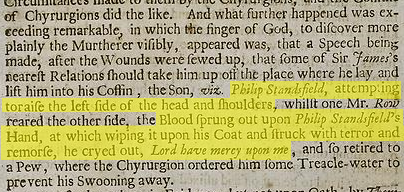
This date in 1688 saw the execution in Edinburgh of one Philip Standsfield (sometimes Stansfield or even Standfield) for parricide, his conviction being secured in part by the supposed accusation of his father’s corpse.

The prodigal firstborn of James Standsfield was an incorrigible scoundrel, and the state had a considerable circumstantial case to the effect that said scoundrel finally popped the old man to prevent disinheritance. (It also appeared that he’d tried to do it other times over the years.)

Circumstantial evidence is nice.

But how about some forensic evidence to really cinch a conviction? No DNA evidence here in the 17th century, so maybe something a little more … supernatural?


From A True Relation of a Barbarous Bloody Murther etc., available here.

The King’s Advocate insisted — over the objections of a defense attorney that “it was a superstitious observation, founded neither upon law nor reason” — that the corpse’s having bled on Philip Standsfield but none of the others in his party simultaneously attempting to move it “he must ascribe … to the wonderful Providence of God, who in this manner discovers murder.”

Divine forensics. That’s even better than the arson evidence Texas used to kill Cameron Willingham.

And it had the same result, to wit,

the said Philip Standsfield to be taken upon Wednesday next, being the 15th of February instant, to the Market-cross of Edinbrugh, and there, betwixt two and four o’clock in the afternoon, to be hanged on a gibbet till he be dead, and his tongue to be cut out and burnt upon a scaffold, and his right hand to be cut off and affixed to the east port of Haddingtoun, and his body to be carried to the Gallowlie betwixt Leith and Edinburgh, and there to be hanged up in chains; and ordains his name, fame, memory, and honours to be extinct, his arms to be riven forth and delete out of the books of arms …†

Well, you get the idea. Executed Today would like to apologize to the dempster of Edinburgh for keeping Philip Standsfield’s name, fame, and memory alive.

In our defense, we are hardly the only ones: this is thought to be the last time that Scottish law employed the bleeding-corpse “test”.

* Some other instances of purported “bleeding at the touch” may be perused here.

** In a 1927 piece in the Journal of the American Institute of Criminal Law and Criminology, Canadian jurist William Renwick Riddell says this folk belief “was wide spread and is not dead yet” and offers in a footnote (perhaps by way of explaining his interest) that “when at the Bar, I was once offered such evidence by my client; but I declined to use it.”

† The execution was botched, and the gibbeted body illicitly pulled down and tossed in a ditch — which is where the elder Standsfield’s had been discovered.

On this day..

1984: Maqbool Bhat, for Kashmir

On this date in 1984, India hanged Kashmiri nationalist Maqbool Bhat.

A terrorist to his enemies and a freedom fighter to his friends, Bhat was born in the Kashmir region back when it “was ruled by the Dogra Family and the entire Kashmiri nation was living a life of slavery.”

When Bhat was a nine-year-old child, the prince of Jammu and Kashmir inked a bitterly controversial accession of his domain to the foundling independent nation of India. Kashmir has been hitched to the adjective “troubled” ever since.

The broader Kashmir region remains a warren of competing claims among Pakistan, India, and China. Bhat operated not for any of these governments, but for Kashmiri independence … and since he came of age in the revolutionary twilight of colonialism, he did not shy from putting the fight in freedom fighter. Bhat was an early exponent of an armed independence struggle.

Both India and Pakistan proscribed as terrorist Bhat’s Jammu and Kashmir National Liberation Front (forerunner of the still-extant JKLF, which is the same acronym less the middle letter); both those longtime subcontinent antagonists arrested Bhat at different times for subversive activities. The most notable: Bhat engineered an airplane hijacking in 1971 to push his cause onto the world’s front pages.

But the hostage-taking game came a-cropper for the Kashmiri rebel.

Languishing under a dormant death sentence for the 1968 murder of an Indian policeman,* Bhat unexpectedly became the focus of his fellow-travelers’ revolutionary ardor: in Birmingham, England, Kashmiri activists kidnapped Indian diplomat Ravindra Mhatre in an attempt to force a hostage exchange.

When Delhi refused to deal, the captors executed Mhatre. Within days, India traded tit for tat by stringing up Bhat — a man who in life had been known for his boast that “nobody has the rope which can hang men.”

They may not have got their man, but they sure got a martyr.

Five years after Bhat’s execution, Kashmir finally broke into armed revolt — Bhat’s very own project, and one that has claimed tens of thousands of lives in the succeeding years.

That movement repeatedly demands the return of Bhat’s remains for burial. It annually marks this anniversary of his martyrdom with tributes and strikes.

* Bhat’s partisans insist that he was wrongly accused.

Update: Reprint of a 1984 article, “The last days of Maqbool Butt”

On this day..

1940: Robert Indrikovich Eikhe, “believing in the truth of Party policy as I have believed in it during my whole life”

On this date in 1940, the former Soviet People’s Commissar for Agriculture was shot for treason.

The 1930’s were a scary time in the USSR, but the agricultural posts — forced collectivizations, production quotas, and screw-ups that starved thousands — were particularly fraught.

R.I. Eikhe inherited the job from a fellow purged in the trial of the 21. And, unsurprisingly, he went the same way.

It was another former agricultural commissar (of Ukraine), Nikita Khrushchev, who managed to succeed Stalin.

When, in 1956, Khrushchev made his “secret speech” denouncing the savagery of his predecessor, the fate of his old comrade Eikhe was lamented in detail.

Excerpted below is the relevant portion of Khrushchev’s report, as cited here.


The great modesty of the genius of the revolution, Vladimir Ilyich Lenin, is known. Lenin had always stressed the role of the people as the creator of history, the directing and organizational role of the party as a living and creative organism, and also the role of the central committee.

Lenin never imposed by force his views upon his coworkers. He tried to convince; he patiently explained his opinions to others. Lenin always diligently observed that the norms of party life were realized, that the party statute was enforced, that the party congresses and the plenary sessions of the central committee took place at the proper intervals.

In addition to the great accomplishments of V. I. Lenin for the victory of the working class and of the working peasants, for the victory of our party and for the application of the ideas of scientific communism to life, his acute mind expressed itself also in this that lie detected in Stalin in time those negative characteristics which resulted later in grave consequences. Fearing the future fate of the party and of the Soviet nation, V.I. Lenin made a completely correct characterization of Stalin, pointing out that it was necessary to consider the question of transferring Stalin from the position of Secretary General because of the fact that Stalin is excessively rude, that he does not have a proper attitude toward his comrades, that lie is capricious, and abuses his power. . . .

Vladimir Ilyich said:

“Stalin is excessively rude, and this defect, which can be freely tolerated in our midst and in contacts among us Communists, becomes a defect which cannot be tolerated in one holding the position of the Secretary General. Because of this, I propose that the comrades consider the method by which Stalin would be removed from this position and by which another man would be selected for it, a man, who above all , would differ from Stalin in only one quality, namely, greater tolerance, greater loyalty, greater kindness, and more considerate attitude toward the comrades, a less capricious temper, etc.”

As later events have proven, Lenin’s anxiety was justified …

Stalin originated the concept enemy of the people. This term automatically rendered it unnecessary that the ideological errors of a man or men engaged in a controversy be proven; this term made possible the usage of the most cruel repression, violating all norms of revolutionary legality, against anyone who in any way disagreed with Stalin, against those who were only suspected of hostile intent, against those who had bad reputations. This concept, enemy of the people, actually eliminated the possibility of any kind of ideological fight or the making of one’s views known on this or that issue, even those of a practical character. In the main, and in actuality, the only proof of guilt used, against all norms of current legal science, was the confession of the accused himself, and, as subsequent probing proved, confessions were acquired through physical pressures against the accused. . . .

Lenin used severe methods only in the most necessary cases, when the exploiting classes were still in existence and were vigorously opposing the revolution, when the struggle for survival was decidedly assuming the sharpest forms, even including a civil war.

Stalin, on the other hand, used extreme methods and mass repressions at a time when the revolution was already victorious, when the Soviet state was strengthened, when the exploiting classes were already liquidated, and Socialist relations were rooted solidly in all phases of national economy, when our party was politically consolidated and had strengthened itself both numerically and ideologically. It is clear that here Stalin showed in a whole series of cases his intolerance, his brutality, and his abuse of power.

Stalin’s willfulness vis-a-vis the party and its central committee became fully evident after the 17th party congress, which took place in 1934. . . .

It was determined that of the 139 members and candidates of the party’s Central Committee who were elected at the 17th congress, 98 persons, that is, 70 percent, were arrested and shot (mostly in 1937-38). [Indignation in the hall.] . . .

The majority of the Central Committee members and candidates elected at the 17th congress and arrested in 1937-38 were expelled from the party illegally through the brutal abuse of the party statute, because the question of their expulsion was never studied at the Central Committee plenum.

Now when the cases of some of these so-called spies and saboteurs were examined it was found that all their cases were fabricated. Confessions of guilt of many- arrested and charged with enemy activity were gained with the help of cruel and inhuman tortures. . . .

An example of vile provocation of odious falsification and of criminal violation of revolutionary legality is the case of the former candidate for the central committee political bureau, one of the most eminent workers of the party and of the Soviet Government, Comrade Eikhe, who was a party member since 1905. [Commotion in the hall.]

Comrade Eikhe was arrested on April 29, 1938, on the basis of slanderous materials, without the sanction of the prosecutor of the USSR, which was finally received 15 months after the arrest.

Investigation of Eikhe’s case was made in a manner which most brutally violated Soviet legality and was accompanied by willfulness and falsification.

Eikhe was forced under torture to sign ahead of time a protocol of his confession prepared by the investigative judges, in which he and several other eminent party workers were accused of anti-Soviet activity.

On October 1, 1939, Eikhe sent his declaration to Stalin in which be categorically denied his guilt and asked for an examination of his case. In the declaration he wrote:

“There is no more bitter misery than to sit In the jail of a government for which I have always fought.”

On February 2, 1940, Eikhe was brought before the court. Here he did not confess any guilt and said as follows:

“In all the so-called confessions of mine there is not one letter written by me with the exception of my signatures under the protocols which were forced from me. I have made my confession under pressure from the investigative judge who from the time of my arrest tormented me. After that I began to write all this nonsense. The most important thing for me is to tell the court, the party and Stalin that I am not guilty. I have never been guilty of any conspiracy. I will die believing in the truth of party policy as I have believed in it during my whole life.”

On February 4 Eikhe was shot. [Indignation in the hall.] It has been definitely established now that Eikhe’s case was fabricated; he has been posthumously rehabilitated.

On this day..