A century ago today, eleven Japanese anarchists were hanged for plotting the assassination of the Emperor.
Radical journalist Shusui Kotoku challenged Meiji Japan from the insurrectionary anarchist left.
A socialist early on — he helped translate The Communist Manifesto into Japanese — Kotoku turned towards anarchism when he read Kropotkin while serving time for opposing the Russo-Japanese War. He “had gone [to jail] as a Marxian Socialist,” he said, “and returned as a radical Anarchist.”
After his release, and a trip to America which had just birthed the anarcho-syndicalist Industrial Workers of the World, Kotoku returned to Japan as his nation’s patriarch of anarchism.*
So, when police uncovered an apparent plot by other radicals to off Emperor Meiji, and opportunistically used it to sweep up as fellow-travelers a nationwide “conspiracy” of twenty-plus alleged plotters, Kotoku was naturally one of the bad apples they were pleased to indict.**
The twelve ultimately doomed to death were slated to receive their judicially appointed sanctions on this occasion, just six days after conviction. (The rest of the anarchist movement was harshly suppressed in the years ahead.)
The first eleven (all men) took so long that the twelfth doomed soul, Suga Kanno — Kotoku’s lover and a genuine bomb-plot participant, who enjoys the distinction of being the only woman her country ever hanged for treason — had her execution put off to the 25th for want of daylight.
Though he’s never been officially [judicially] exonerated, Kotoku’s native Nakamura voted in 2000 to declare his rehabilitation. A secret letter that surfaced only in 2010 appears to support that position.
Some of Kotoku’s writing is available online in Japanese here.
** George Elison translated a Kotoku Shusui letter denying any interest in the anarchist assassination racket. It appears as “Discussion of Violent Revolution, From a Jail Cell,” in the Vol. 22, No. 3/4 (1967) Monumenta Nipponica.
How is the anarchist revolution to be brought about if not by bomb-throwing attempts upon the life of the sovereign? The Japanese word for “revolution” — kakumei — is Chinese in origin. In China, the term was used to describe the process in which the emperor of dynasty A, receiving the Mandate of Heaven, replaced the emperor of dynasty B; so it signified mainly the change of emperors, the change of sovereigns. Our “revolution” has quite a different meaning. We do not place much value upon the mere transfer of power between potentates; we do not use the word “revolution” except to mean a fundamental change in the governmental system and in the organization of society.
… they who for the sake of universal peace and liberty participate in this revolution must endeavor as best they can to avoid violence, to avoid producing victims to the revolution. For it seems that the great revolutions of the past were accompanied by much violence and required a great number of victims … I only hope for the disappearance of the misconception that the anarchist revolution has as its objective the assassination of the sovereign …
the prosecution and the examiners first put the title “Violent Revolution” to what I had said and contrived the stern-sounding phrase “death-defying band,” with other similar phrases. And I believe they condemned us under this syllogism: “The anarchist revolution is concerned with the destruction of the Imperial Family. But Kotoku’s plan was to carry out a revolution by violence. Therefore, all who were party to this plot planned to commit the crime of High Treason.” So the fact that these people used to discuss such things as direct action and the revolutionary movement has now served to get them into trouble! This I deeply regret.
On this date in 1952, Iraq hanged Yosef Basri and Shalom Salah for an alleged Zionist bombing campaign in Baghdad.
The most remarkable thing about this campaign is that it was perpetrated against Iraq’s Jews — and if these men’s conviction was rightly secured, it was conducted by other Jews for the purpose of driving those Iraqi Jews to emigrate to the still-tenuous new state of Israel.
As the 1940s closed, well over 100,000 Jews lived in Iraq, a populace legendarily* dating to the Biblical Babylonian exile.
While this community had at certain moments in centuries past been the very flower of the diaspora, it was justifiably nervous here in the perilous 20th century.
In 1950-51, the Iraqi government offered its Jewish citizens an emigration window from a homeland tense with anti-Jewish hostility — at the same time the Israeli government was practically begging them to come. (The cost: give up Iraqi citizenship permanently. Iraq seems to have expected only a few thousand to depart.)
Against the grain of this “monstrous” mutuality of interest stood the natural obstacles for any emigre: affection for the familiarity of one’s native lands, the trauma and uncertainty of uprooting … plus the specific problem that most stood to lose their illiquid wealth either by hasty firesale disposal or (as eventually happened) outright confiscation. Particularly pending clarity in property remuneration, many Iraqi Jews were initially wary about departing.
Iraqi Jews also dismayed Zionist recruiters with their “lack [of] a Zionist outlook and even a Zionist instinct.”**
But these stick-in-the-Mesopotamians would soon receive some explosive encouragement: a headline-grabbing series of attacks on Jews and Jewish establishments during the emigration window encouraged thousands to seize the moment.
“The pace of registration for the citizenship waiver was slow in the beginning, but it increased as tensions rose between Jews and their neighbors and after acts of terror were perpetrated against Jewish businesses and institutions – especially the Mas’uda Shem-Tov Synagogue [bombed January 14, 1951]”
Israel historian Benny Morris summarizes the situation in this Q&A from 2009:
Iraqi Jews being airlifted to Israel.
Ultimately, Israel’s Operation Ezra and Nehemiah, named for two Old Testament prophets who led the Biblical Israelites out of bondage, relocated virtually the whole of Iraqi Jewry to Israel — more than 120,000 people. Today, virtually no Iraqi Jews remain.
Morris’s conclusion that Israeli intelligence did not engineer the bombing campaign that so spectacularly served its statecraft is the subject of vociferous dispute. It’s also, perhaps, a bit finely cut: a handful of zealots in the local Zionist underground, sensitive to the local sentiment and keen on the urgency of the brief denaturalization opportunity, might have undertaken the project freelance without actual straight-from-Jerusalem coordination.
Amazingly, this notion that some species of Zionist agents bombed Iraqi synagogues (pdf) in the interests of the Levant’s demographic future was commonly believed not only by Iraqi Arabs but by emigre Iraqi Jews themselves. Their suspicions can hardly have been allayed when a similar misadventure went down in Egypt a couple years later.
The inevitable dispute over the factual question can’t help but roll over into everything else that’s disputatious about the Zionist Entity.
An account already exists between us and the Arab world: the account of the compensation that accrues to the Arabs who left the territory of Israel and abandoned their property … The act that has now been perpetrated by the Kingdom of Iraq … forces us to link the two accounts . . . We will take into account the value of the Jewish property that has been frozen in Iraq when calculating the compensation that we have undertaken to pay the Arabs who abandoned property in Israel.
–Moshe Sharett, Israeli Foreign Minister, March 1951**
This sort of opportunistic ethnic arithmetic obviously loses its limited suasion to the extent that Jews can be held to have driven Jews out of Iraq — which is not to say that goring this or that ox is necessarily the reason for any one scholar’s taking this or that position.
One might, however, be less inclined to extend that benefit of the doubt to the Kingdom of Iraq itself. That realm was very pleased to point the finger at its absconding Jewry.
Our Zionist cadres, Yosef Basri and Shalom Salah, were hanged by that Iraqi Entity for three grenade attacks in the bombing series. Basri repudiated his confession in court, plausibly claiming it had been tortured out of him. (A third Jew was also convicted but not executed: Yehuda Tajar is the man Morris refers to, who returned to Israel after spending the Fifties imprisoned in Iraq.)
“Long live the state of Israel,” were their last words.
But not all “beneficiaries” of their alleged efforts shared the sentiment.
“That is God’s revenge on the movement that brought us to such depths,” one Iraqi Jewish refugee in the Holy Land reportedly exclaimed.**
Just where guilt really lies in all of this has been contested (pdf) ever since, a matter that mere hooded functionaries such as your author can hardly address with authority.
Jews Done It …
… They Never Did
* Not necessarily literally; the Mongol invasions are supposed to have broken the cultural chain of Jewish habitation of Babylon, with the city re-populated later by other Jewish migrants not of a lineal connection back to Nebuchadnezzar‘s conquests.
** Quoted by Yehouda Shenhav in “The Jews of Iraq, Zionist Ideology, and the Property of the Palestinian Refugees of 1948: An Anomaly of National Accounting,” International Journal of Middle East Studies (Nov., 1999)
[Lewis] held his Court in Heidelberg, and by him stood ever his dearest friend, Henry, Count of Leiningen, and to him one day the anxious wife sent a letter, beseeching he would use his influence to quicken her husband’s return. Another missive was dispatched at the same time to Duke Lewis … The old mistake was made, Duke Lewis received the letter destined for his friend, wherein the artless Duchess had assured Henry of Leiningen that, if he accompanied her lord in his return, her pleasure in welcoming him would be great.
Etcetera.
That Marie really did exist and really was beheaded on her husband’s authority for adultery appears to be about the extent of the certain information available to us.
This poignant scenario became embroidered into popular legend (and is supposed to have inspired the tale of one of the classic medieval faithful-accused-wife tales: that of Genevieve of Brabant).
The accusation evidently appeared quite doubtful in real life, since her husband and executioner Louis subsequently founded the Cistercian Furstenfeld Abbey in penitence.
She is not to be confused with Marie de Brabant, Queen of France later in the 13th century and a suspect in the poisoning death of the French heir … an affair that cost chamberlain Pierre de la Brosse his life. The words Dante wrote of that later Marie of Brabant would have suited our day’s heroine, too.
may the Lady of Brabant
while she’s still in this world, watch
her ways—or end among a sadder flock
On this date in 2010, six men from war-torn southern Sudan were hanged in Khartoum’s Kober prison for a deadly 2005 riot.
The protracted north-south Sudanese civil war had only just abated with a tenuous peace treaty earlier in 2005, when Sudanese security surrounded the refugee camp-cum-suburb of Soba Aradi outside Khartoum in May 2005 in a sudden bid to forcibly resettle its predominantly southern population.
The resulting riots burned down a police station and claimed around 13 policemen’s lives, along with many civilians.
“We were forced to protest when a police officer shot a seven year old boy three times in the head”, said Mr. Mile Michael, a South Sudanese living in the area since 1986.
Following the death of the young boy, the slum dwellers burnt down the police office in the area killing some of the officers with machetes and knives in a revenge attack. “We all participated in the burning of the police office because they deceived us that they would support us in resisting the soldiers but they were the first to kill our children, so we were willing to sacrifice ourselves for our children.”
While dozens were rounded up, Amnesty International charged that little save forced confessions and unfair trials distinguished the specific few marked out for hanging.
Sudan’s north-south sectional conflict is the backdrop to this month’s election, which might set the south on a path to political independence from the north.
Update: Embargoed as of this post’s publication, Joe Arridy’s growing ranks of supporters had submitted to Colorado Gov. Bill Ritter an application for a posthumous pardon. On January 7, 2011, Gov. Ritter granted that pardon — a fitting conclusion to a cinematically heart-rending story.
“Granting a posthumous pardon is an extraordinary remedy. But the tragic conviction of Mr. Arridy and his subsequent execution on Jan. 6, 1939, merit such relief based on the great likelihood that Mr. Arridy was, in fact, innocent of the crime for which he was executed, and his severe mental disability at the time of his trial and execution. Pardoning Mr. Arridy cannot undo this tragic event in Colorado history. It is in the interests of justice and simple decency, however, to restore his good name.”
-Gov. Bill Ritter
On this date in 1939, Joe Arridy “walked to his death with the faith of a child” (Los Angeles times, Jan. 7, 1939) up “Woodpecker Hill” — where the victims of Canon City, Colorado’s gas chamber (since retired) were buried.
Shortly before execution, Joe Arridy gives away the toy train he received from warden Roy Best to a fellow prisoner.
A young Syrian-American with the mental age of a six-year-old riding the rails during the Depression, Arridy was picked up for a teenage girl’s rape-murder in a literal lynch-mob environment: he was nearly pulled from his cell for summary punishment.
Instead, the good citizens let justice run its course to the same conclusion.
The damnable thing — well, the other damnable thing — is that we have about as much reason to believe Joe Arridy committed the crime as we do you or I.
He was linked to the murder by nothing but an evolving series of unreliable confessions fed by the sheriff to his suggestible prisoner (and, later, a single “matched” hair with a suspicious chain of custody; matching hair without DNA is still an unreliable forensic technique today). The real murderer was even in custody, and was executed for the same crime while Joe Arridy’s appeals ran their futile course.
“Believe me when I say that if he is gassed, it will take a long time for the state of Colorado to live down the disgrace,” Arridy’s appellate lawyer pleaded to a deaf court.
This post is an edited version of Perske’s affidavit to the governor’s office in support of the pardon.
On March 28, 1992, Sociologist Richard Voorhees sent me a poem from an out-of-print book that described a warden weeping as he watched a man in a death row cell playing with a toy train before being walked to a gas chamber (“The Clinic” (.doc) by Margeurite Young in Moderate Fables, 1944).
“The man you kill tonight is six years old,
He has no idea why he dies,”
Yet he must die in the room the state has walled
Transparent to its glassy eyes.
I sent a copy of the poem to Watt Espy, Director of the Capital Punishment Archives, in Headland, AL. Espy researched and responded with information that tied the poem to the life and trials of Joe Arridy who at age 23 was executed on January 6, 1939.
During the next two years after receiving the poem, I traveled up and down the Eastern Slope of the Rocky Mountains from Cheyenne to Pueblo, and to Grand Junction on the Western Slope. News stories were discovered from the reading of old microfilm rolls in The Pueblo Chieftain, The Denver Post, The Rocky Mountain News (Denver), The Daily Sentinel (Grand Junction) and Wyoming Tribune (Cheyenne). Archivists and historians were interviewed at The Regional History Division of Western Colorado (Grand Junction), Wyoming State Archives (Cheyenne), District Archives of the Pueblo Public Library, Local History Center of the Cañon City Public Library, and the Colorado State Archives (Denver).
Joe Arridy’s Earliest Years
Joe Arridy was born to non-English speaking Syrian immigrants in Pueblo, Colorado on April 29, 1915. He attended the first grade in Bessemer Elementary School. At the beginning of his second year, the principal called on the Arridy family and told them that their son could not learn and asked them to keep him at home. The parents reported that for the next four years, Joe stayed around the house. He was a passive but happy child. According to his parents he was the happiest when he was alone playing all by himself. His favorite pastime was making mud pies.
Intelligence Testing and Institutionalization
At age 10, Joe was committed to the Colorado State Home and Training School for Mental Defectives, in Grand Junction. He was administered the Binet-Simon Test. The results showed that he was unable to repeat four digits (4-3-7-9). When shown the color red, he said it was black and that green was blue. He usually spoke in incompete two or three word sentences. As the questions became harder to answer, he remained silent. The examiner listed him as “an imbecile with an IQ of 46.” Later his institutional records showed no critical incident reports. For the most part he was a shy and quiet loner.
Nine months later, Joe’s father missed his son. He asked for his son to be returned home. The request was granted. Upon his return, he tended to take lonely walks all over town. These walks continued for three years.
At age 14, the walks came to an end when a probation officer caught a gang of boys performing sexual acts on him. The officer wrote an angry letter to the court, labeling Joe as “one of the worst mental defective cases that I have ever seen.” The court ordered his immediate return to the institution in Grand Junction.
During the next seven years at the institution, his records show that he was incapable of working on the farm crews or sitting in classrooms. Therefore, he was given a “day activity,” working side by side with a kindly kitchen worker, “Mrs. Bowers.” The worker reported that Joe was only capable of “Tasks of not too long duration, can wash dishes, do mopping of floors, can do small chores and errands. He depends on others for leadership and suggestions.”
Railroad Boxcar Riding
At age 22, he and a few other inmates watched men riding on top of railroad boxcars that passed the institution. So together they wandered off the institution grounds and also jumped on boxcars. They took the 24-hour ride through the mountains to Pueblo. Later they took the trip back. Joe was last seen in Grand Junction on the evening of August 13, 1936. He was believed to have jumped onto a boxcar either that night or on the next morning.
After that, Arridy disappeared from sight until he walked up to the kitchen car of a railroad work gang on August 20, in the East Railroad Yards of Cheyenne, Wyoming, dirty and hungry.
Rape and Murder in Pueblo
On Saturday evening, August 15, 1936, slightly before or after midnight, Dorothy Drain, 15, and Barbara Drain, 12, were bludgeoned about their heads while sleeping together in the same bed, at 1536 Stone Avenue in Pueblo. Dorothy was raped and beaten to death. Barbara was near death, but survived. Later, she identified Frank Aguilar as the attacker at his trial. She was not present at Joe Arridy’s trial. She did not even identify Joe Arridy as a co-attacker.
Sheriff Gets a Confession from Arridy Even Though the Real Killer is Already in Custody
On August 26, 1936, Joe Arridy was arrested by two railroad detectives and turned over to Sheriff George Carroll. Carroll, like all law officers in all of the towns up and down Colorado’s Eastern Slope, was actively picking up suspects and interrogating them regarding the attacks on the Drain girls in Pueblo.
After an hour and a half of questioning, Carroll called a reporter and told him that he had just received a complete confession for the Pueblo crime from Arridy. He recited to at least one reporter a long series of wordy, complete sentences that Arridy purportedly uttered. According to Carroll, Arridy was the lone killer and he committed the crime with a club.
At first, when Pueblo Police Chief J. Arthur Grady received news of the confession, he was shocked. The real killer, Frank Aguilar, a former WPA worker who had been supervised by the Drain girls’ father, had already been arrested for the crime.
Aguilar had been arrested during the funeral of Dorothy Drain. The Pueblo police had even recovered the weapon used in the crime. It was the head of a hatchet with nicks that matched the wounds on the girls. The Pueblo police kept all this evidence in silence because Aguilar vehemently denied committing the crime.
Following that, Sheriff Carroll changed his story. After conducting another interrogation, he then reported to the press that a hatchet—not a club—was used in the crime. He also claimed that Arridy did not do the crime alone. According to Carroll, Arridy said he did it “with Frank.”
Sheriff Carroll was a famous but loquacious individual who was known to talk long and loud about being in the posse that finally caught up with and finished off the notorious Barker gang.
Now with his regular announcements to the press he remained at his long-worded best. Carroll had been so totally verbal in his interrogations of Arridy, nothing was written down on paper. Nor was any confession signed. Consequently the confessions and changes in them were dictated daily to reporters.
Later, in the trial of Arridy, Sheriff Carroll became the star of the case. He spoke in his heroic, over-wordy style. According to the press, he did not speak from a single note. He simply testified from memory.
Frank Aguilar is Quickly Convicted
Aguilar’s trial came quickly, starting on December 15, exactly four months after the crime. It ended seven days later. His executed came quickly, too: on August 15, 1937, just two days short of the anniversary of Dorothy Drain’s murder.
Aguilar Identified as Lone Murderer in an Identical Crime in the Same Neighborhood
After the death sentence, Aguilar was brought face to face with Mrs. R. O. McMurtree, 58, who identified Aguilar as the lone attacker in a similar crime that happened two weeks earlier and just three blocks away from the Drain crime. She and her aunt, Sally Crumply, 72, were sleeping in the same bed when Aguilar attacked. He beat them on the heads as he had done in the Drain home. Like Dorothy Drain, Sally Crumply was bludgeoned to death.
Sheriff Carroll Assumes Leadership in all Aspects of the Arridy Investigation
After announcing Arridy’s first confessions to reporters and Chief Grady, two Pueblo detectives sped through the night to Cheyenne. The next morning, they joined in an added interrogation with Carroll leading it. Then they drove back to Pueblo.
Later that day, Carroll drove Arridy to Pueblo. He was present at the Pueblo Police Station when Arridy and Augilar may have been brought together. He took leadership when Arridy was taken to the Drain home and the crime was reenacted. He was present at the prison in Cañon City when Aguilar gave a signed confession that marginally included Arridy’s initials in a lower left column. That confession was printed in its entirety in the Pueblo Chieftain but was withdrawn and was never heard in a court.
Sheriff Carroll Became Chief Presenter of Evidence Against Arridy
During the prosecutor’s evidentiary presentations, Sheriff Carroll took the stand five different times. The transcript shows how Carroll was allowed to launch forth as a riveting story teller. He testified that Arridy was in complete control of his thoughts, and speaking in clear sentences that described the colors on the walls in the bedroom and the colors of nightgowns that the girls wore, and even the colors of the dresses the girls would be wearing when they went to the Sunday church services.
The Joe Arridy that Carroll described was a far cry from the Arridy who often spoke in unfinished sentences and did not know who Franklin Delano Roosevelt was. Nor did he know what a hatchet was or that his own father was present in the courtroom.
The Defense Loses in a Sanity Hearing, and Eschews an Evidentiary Defense
The defense argued at a pre-trial sanity hearing that Arridy was “Not Guilty by Reason of Insanity”. The question before the court: “Does Joe Arridy have the capacity to tell good from evil and right from wrong?” If not, he should be found to be insane and not guilty. Three psychiatrists testified that Arridy did not know right from wrong, but they hedged by saying that he was not insane. According to them, one needed to be normal first before ever being insane, and they claimed that Arridy had never been normal.
The jury deadlocked at six to six, but an hour later, voted that Arridy would have to go on trial for murder.
As strange as it may seem today, the defense attorney had conducted no investigation in the case. At the beginning of the trial he announced that he would not present an evidentiary defense and would only cross-examine witnesses for the prosecution.
He then requested that the judge set aside the earlier sanity trial verdict and that he be given permission to argue a sanity case one more time. He furthermore requested permission to make his opening argument only after the prosecution had completed with its evidentiary case. The judge agreed to all of these conditions.
The same three psychiatrists (joined by a fourth) gave the same testimony once again.
But Sheriff Carroll voiced his views unchallenged. After touting his 30 years of experience and claiming that he interrogated Arridy for “six or seven hours,” the prosecutor asked him, “Based on your experience [is] Joe Arridy capable of distinquishing right and wrong?” Carroll responded, “I think there is no doubt, whatever, but what he is”.
A verdict of “guilty” was rendered on April 17, 1937, and Arridy was sentenced to death.
On August 13, 1937, Frank Aguilar was executed, and on the same day, Sheriff Carroll and two railroad detectives received a $1000 reward for making the arrest of Joe Arridy in Cheyenne.
For a year and a half, a pro bono “Citizen Lawyer” Gail Ireland fought valiantly to save the life of Joe Arridy. During that period, Ireland managed to win at least six stays.
On January 6, 1939 at 6:15 p.m., the Colorado Supreme Court voted 4-3 to deny the last petition. Governor Teller Ammons called the warden at 6:30 p.m. and ordered that the execution be carried out.
The chaplain administered the Roman Catholic Church’s “Last Rites for a Child.” It called for the Chaplain to recite each phrase of “The Lord’s Prayer,” one at a time with Arridy repeating it, all the way to the “Amen.”
Joe Arridy’s rusty motorcycle plate served as his grave marker for 71 years, until it was replaced with a headstone reading Here Lies an Innocent Man
This volume by Perske addresses the criminal justice system’s (mis)handling of the developmentally disabled. He’s written a number of other books, fiction and nonfiction, humanizing this.
Robert Perske also graciously agreed to address a few additional questions that we had for him.
ET: How did you come to this case?
RP: It’s almost a magical thing to me. Back in 1991, I got a poem from a valued colleague of mine who is a professor, a sociologist. He was digging through some old books in Greenwich Village, and he found a poem about a warden weeping before the pellets were dropped and all of that, and how the warden cried, and how he complained about how this man playing with a toy train would die.
And I got ahold of it and went down to my buddy Watt Espy [of the Espy file -ed.], and he found it. He really dug for me, what a guy, and he found it and I headed for Pueblo and dug and dug and dug from 1991 to 1995.
What motivated me was that after coming out of World War II, I went to school and became a chaplain at an institution for mentally disabled people in Kansas. I worked my ass off to be a good pastor to them, and so when I found this much, I really started digging.
Did they lead him into the confession?
Oh, yes. He was arrested in the railyard by Sheriff George Carroll. And Carroll was a swashbuckler. He was a hero, and he was a mouthy sonofagun, and he pretty well set up the case.
As soon as he got the so-called confession, he [Carroll] didn’t call the police chief first — he called the press. He said he had the guy who did it.
But they already had the guy in Pueblo, Frank Aguilar.
Was there outright misconduct by the investigators here? Did they realize, or should they have, that they might be railroading someone?
Here’s the deal. People with so-called mental retardation were seen as nobodies in those days. They didn’t have community services, so they all went like Joe, to the institution.
In the year I was born, 1927, Oliver Wendell Holmes issued his ruling that all such people could be sterilized.
Carroll knew he had somebody like that in Joe. There was a lynch mob starting to form in Pueblo, because this head of the WPA was a good solid citizen, and when his daughters were hit, and one killed and raped, there was a lot of hiding of people.
I’ve known a lot of Joes. And he’s lovable, and he’s trusting, and he’s naive, and he’s concrete-thinking, so half of the things he says, he doesn’t really understand. But on the other hand, very dependable, and very lovable. Nobody in Pueblo saw that, but [Warden Roy] Best picked it up, and then the inmates in prison picked it up too.
In their hearts of hearts, yeah, they knew. But they figured he wasn’t worth anything. He was retarded, mentally defective was the word they used. They knew they had the real killer, but they go back and get Joe to amend the confession and now he was there “with Frank”.
If you’ve got a serious mental limitation and you’re facing a capital charge in the criminal justice system today, what’s going to happen to you?
In the year 2002, Atkins v. Virginia, they banned the death penalty in those cases. And they played around with the IQ number, but in some states they’re going farther than that because you have all kinds of other disabilities. I’d say by and large, except for Texas, people are looking at these people — not more kindly, but not looking at them as people who should be executed.
If we would have had that for Joe, he would not have been executed.
Can you give us a lay definition of developmental disability?
The most prominent one I’ve seen when I worked in the institution, and yet today when I work the streets and agencies and group homes and that sort of thing, is the inability to abstract from concrete things. For example, I’ve had guys say to me, I’d say, “why did you waive the right?” and they say, “you’ve got to waive it the right, you can’t waive it the wrong.”
Barry Fairchild, down in Arkansas — Barry thought that the reading of the rights was some kind of opening prayer.
These people survive on the basis of having abstract thinkers as their friends and protectors, so consequently guys like Richard LaPointe had cops as their friends, because they leaned on authority figures. And of course the police department are committed to secure the safety of the neighborhood, but then if there’s a terrible murder and somebody starts to blame them, they’re going to cooperate with that.
I’ve got one where, on a tape recorder, they’re saying, “if you tell us, we’ll all go home”. So that’s concrete thinking that my guys usually have.
Richard Lapointe is still in prison, not on death row. He has hydrocephalus, it’s called Dandy-Walker syndrome, so he’s a guy with all kinds of disabilities. He’s not athletic at all and gets dizzy when he stands up or stops suddenly, and yet they got him to confess to a highly athletic murder of a woman with multiple violent stab wounds and moving the body.
On this date in 1917, Edwin Dyett was shot for desertion and cowardice.
After the disastrously ineffective Somme offensive in late 1916, British Field Marshal Douglas Haig decided to pick up the men’s spirits. And what better way to motivate than by shooting more officers?
If one proceeds from the premise of the British brass that the main problem with its military ineffectiveness was the men in the field, there was something in the cruelly “progressive” about the order: luckless enlisted fellows from the lower classes were smoking last cigarettes by the bushel, but gentry-stock officers were more liable to get the kid-gloves treatment .
Haig was taking the kid gloves off.
“A soldier’s tale cut in stone to melt all hearts,” said Winston Churchill of this pathbreaking novel thought to be based on Edwin Dyett. The first novel about executed World War I deserters, it is thought to have influenced later portrayals of such executions and the sub-heroic literary context for the Great War.
Within two months of that order, our man Dyett was up against the stake at St. Firmin, France — perhaps the most famous shooting among the officer corps.
Perhaps presuming upon the traditional leniency extended to the better classes, Dyett had little inkling of his fate during the weeks after his arrest. He’d been collared during the aforementioned Somme campaign for “deserting” for two days when he’d taken umbrage at being directed to the front by an inferior officer and instead returned to headquarters for orders.
As late as Christmas Eve, he was still keeping his parents in the dark, certain that the misunderstanding was not enough to even “cause a sitting.”
That sitting, however, occurred forthwith on Boxing Day, with only a half-hour for the defense to prepare. That defense was less than robust, and the court clearly disinclined to a sympathetic reading of the circumstances.
Dyett had only just turned 21, but clemency appeals around youth and the confusion of the situation would cut no ice. “”If a private behaved as he did,” wrote the officer charged to review it, “it is highly likely he would be shot.”
Lt. Dyett had only a single evening from hearing the bad news to prepare himself for what must have seemed to him a shocking turn of events. This time, he posted a different sort of missive to the home front.
Dearest Mother Mine, I hope by now you will have had the news. Dearest, I am leaving you now because He has willed it. My sorrow tonight is for the trouble I have caused you and dad. Please excuse any mistakes, but if it were not for the kind support of the Rev. W.C. — who is with me tonight, I should not be able to write myself. I should like you to write to him, as he has been my friend. I am leaving all my effects to you, dearest; will you give a little — half the sum you have of mine? Give dear Dad my love and wish him luck. I feel for you so much and I am sorry for bringing dishonour upon you all. Give — my love. She will, I expect, understand – and give her back the presents, photos, cards, etc., she has sent me, poor girl. So now dearest Mother, I must close. May God bless and protect you all now and for evermore. Amen.
Dad didn’t take it with the stiff upper lip; after a futile campaign to clear the boy, he renounced his citizenship and emigrated to America.
On this date in 1786, Elizabeth Wilson was hanged in Chester, Pennsylvania for the murder of her infant twins.
“One of the melodramas of the early American republic,” our Elizabeth (sometimes called “Harriot Wilson” in the accounts) was a farmer’s daughter of Chester County who got knocked up by a passing sailor. When this gentleman declined to make an honest woman of her after she had borne the bastards, the kids disappeared — later to be discovered dead in the woods by a hunter.
The fallen woman denied having killed them directly, but “acknowledged having placed the children by the road-side, in order that any person passing that way, and who had humanity enough, might take them up.”
She would eventually, after condemnation, accuse her lover of having slain the children.
Elizabeth’s brother William Wilson vigorously undertook on this basis to secure her a pardon at the hands of the Commonwealth’s executive authority, the Supreme Executive Council — then under the leadership of no less august a character than Benjamin Franklin.
And he found a sympathetic audience. Council Vice-President Charles Biddle* “firmly believed her innocent, for to me it appeared highly improbable that a mother, after suckling her children for six weeks, could murder them … there was a large majority would have been for pardoning her.”
Instead of an outright commutation, it granted a stay of execution for William Wilson to investigate further, which he did to no successful effect.
“But here we must drop a tear!” exclaims the Faithful Narrative of Elizabeth Wilson, a popular pamphlet (pdf) sensationalizing the case. “What heart so hard, as not to melt at human woe!”
For William Wilson’s suit on behalf of his sister had succeeded in earning, on the eve of the Jan. 3 hanging, a second respite on Biddle’s certain anticipation that clemency would be forthcoming. Ill himself, William took the stay of execution from Biddle’s own hands and raced through a fearful storm on the 15-mile ride from Philadelphia to Chester … but
did not arrive until twenty-three minutes after the solemn scene was closed. When he came with the respite in his hand, and saw his sister irrecoverably gone, beheld her motionless, and sunk in death, who can paint the mournful scene?
Let imagination if she can!
Imagination can do quite a lot with this sort of material, and so the tale of Elizabeth Wilson — the intrinsic pathos of the condemned, her widely-suspected innocence, her evangelical-friendly repentance, the cliffhanger conclusion — became widely re-circulated, and undoubtedly embroidered.
Quaker colonial diarist Elizabeth Drinker (who had firsthand experience of official injustice, when suspicious-of-Quakers revolutionaries had banished her husband from Philadelphia) was still seeing these publications over a decade after Wilson’s death.
May 16 [1797]. Unsettled. Wind variable. Read a narrative of Elizabeth Wilson, who was executed at Chester, Jany ’86, charged with the murder of her twin infants. A reprieve arrived 20 minutes after her execution, by her brother from Philadelphia. She persisted to the last in her account of the murder being committed by the father of the children, which was generally believed to be the truth. I recollect having heard the sad tale at the time of the transaction.
The Wilson story actually persisted (and persists) for centuries yet. Her shaken brother, William, withdrew himself from society and lived out his last years in a cave: he entered folklore as the Pennsylvania Hermit, affixed with his tragic sister to all manner of spook stories, like a spectral horseman galloping to Chester, or a ghostly woman rummaging the leaves where the bodies were found. You’ll hear all about the Pennsylvania Hermit when touring his former stomping grounds, now open to the public (for a fee, my friend) as Indian Echo Caverns.
* Biddle was a future U.S. Senator, but he’s probably best known through his son. Born just five days after Elizabeth Wilson’s execution, Nicholas Biddle was a bitterly controversial character as one of antebellum America’s original banksters.
Charles Biddle’s notes on the case veer into the era’s philosophical concern with the timeless problem of making a just response to infanticide.
“Perhaps,” he muses “the punishment of death is too great for an unmarried woman who destroys her child. They are generally led to it from a fear of being exposed … [and] while death is the punishment, a jury will seldom find a verdict against them.”
The rebels were hunted to their retreat: the other brother was caught in a cave and summarily executed, which must have been at the back of Aberra and Asfawossen’s mind when they surrendered under a pledge of safe conduct.
‘Now I tell you to surrender’, wrote Graziani, ‘and I assure you nothing will happen to you. Why do you want to die uselessly?’
Only his cousins had remained with Dejaz Aberra: Mesfin Sileshi and the two younger men, Lij Merid Mangasha and Lij Abiye Abebe. They suspected Italian treachery. ‘If you want to be killed’, said Mesfin, ‘shall I kill you?’ …
The exact sequence of the events that followed is difficult to disentangle … Aberra and Asfawossen finally decided to submit. Aberra however sent his wife and baby son away with Mesfin and the two cousins, a last-minute concession to their pleas and threats.
A letter was sent up to General [Ruggero] Tracchia who had now occupied Fikke:
“To General Tracchia
“As you have assured me in your letter ot me that our lives will be spared, we shall assemble our armies and receive you by peaceful parade in a place called Bidigon.
“Aberra Kassa”
Ras Hailu in person led Aberra and Asfawossen to General Tracchia’s camp. While they were in the tent drinking coffee with the General, the men of their escort were disarmed, apparently without difficulty, and taken away (they were released the next morning). A group or carabinieri entered the tent and arrested the two brothers. It was 21 December, three days after Ras Imru had surrendered. At 7 p.m. the men in the escort heard a volley of shots in the centre of the town.
Tracchia sent a laconic cable to Graziani: ‘Dejaz Aberra and brother shot dusk in piazza of Fikke’. Graziani sent a cable to Lessona (Italian link) repeating Tracchia’s message and adding ‘Situation Salale liquidated’.
This reference to the Salale or Selale branch of the Ethiopian royal family was not entirely correct, however.
Not liquidated was the youngest brother, Asrate Kassa, who had escaped to exile and would return with Haile Selassie’s post-Mussolini government. Asrate ultimately qualified for these dolorous pages himself, however, as one of the victims of the 1974 Derg purge.
Of more immediate concern for Graziani and his ilk: Abera Kassa’s widow Kebedech Seyoum (French link) legendarily rose from childbirth after learning of her husband’s execution to become one of the Ethiopian resistance’s greatest military leaders. She’s a national hero in Ethiopia … and there’s also a Laboratorio Femminista Kebedech Seyoum in Rome, dedicated to the study of ant-fascist women.
On an uncertain date speculatively identified with December 6, in either 1208 or (more usually attributed) 1209, the near-riotous townspeople of Oxford hanged two or three student “clerks” at that settlement’s famous university.
About this time, a certain clerk engaged in the liberal arts at Oxford killed a certain woman by accident and when he found that she was dead he decided to flee.
But when the mayor of the city and many others who had gathered found the dead woman they began to search for the killer in his house which he had rented together with three of his fellow clerks.
Not finding the man accused of the deed they seized his three fellow clerks who said they were wholly ignorant of the murder and threw them into prison; then a few days later they were, by order of the King of the English, in contempt of the rights of the church, taken outside the city and hanged.
When the deed had been done, both masters and pupils, to the number of three thousand clerks, left Oxford so that not one remained out of the whole university; they left Oxford empty, some engaging in liberal studies at Cambridge and some at Reading.
This ugly affair rooted in the ancient conflict between university and town caused much of the ancient academy‘s student population to flee town — some proceeding to found Oxford’s rival institution Cambridge. (This pdf short story on the Cambridge site dramatizes events.)
The conflict between the town and university at Oxford over this bloodletting persisted until 1214 when a Papal legate settled the dispute in favor of the university.
The authors of the hanging were required to carry the bodies to an honorable resting place, and the town was required to host a dinner for poor students once every year — on St. Nicholas‘s day, Dec. 6, which on that basis has become associated with the otherwise never-specified date of the unfortunate clerks’ demise.
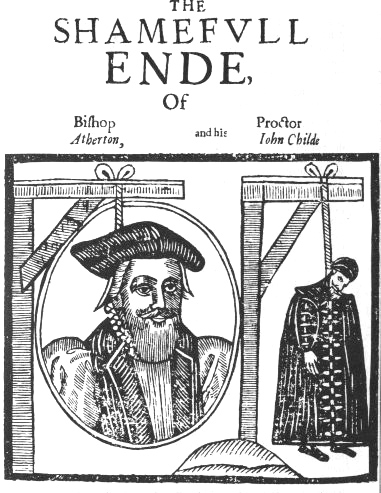
On this date in 1640, John Atherton achieved the unenviable distinction of being the only Anglican bishop hanged for buggery.* (His proctor, and alleged lover, John Childe, got the same treatment a few months later.)
Suppose a Devill from th’infernall Pit,
More Monsterlike, then ere was Devill yet,
Contrary to course, taking a male fiend
To Sodomize with him, such was the mind
Of this Lord Bishop, he did take a Childe
By name, not years, acting a sinne so vilde
-From the text of the pamphlet this image decorates
It may well have been the internecine politics of the day that claimed Atherton’s life, just as the civil wars they engendered in the ensuing decades claimed the original trial records.
While posterity is left to speculation, Atherton was defended in print in those years as well. (Defended as no homo, that is — not defended on principle against ubiquitous anti-gay laws.) If it wasn’t really a voracious sexual appetite (not exclusively same-sex**), goes this argument, it was intra-Protestant infighting, with Atherton’s successful clawback of land for the weak Irish Anglican church stepping on the toes of the local land barons who had recently expropriated it.
Mother Leakey was Atherton’s mother-in-law, and Somerset family members claimed she haunted them — including with a message for the bishop that one of his sisters-in-law actually went to deliver in Ireland. The message isn’t known; in legend, this was a warning from beyond against the prelate’s ungodly behavior; in reality, it was more probably a family shakedown.‡
Despite the skepticism of the Leakey family’s own contemporaries, the facts, allegations, suppositions, and pure flights of fancy somehow managed to blend and recombine into a lasting tale of the paranormal that Minehead still retails to this day.
And it goes right back to the public opprobrium Bishop Atherton endured — as described in that 1641 hanging pamphlet:
“demonstrates the link between the stories of Mother Leakey and Bishop John Atherton … in a highly readable and often entertaining fashion”
… through pride, high fare, and lustfull life,
Incest committed with the Sister of his wife,
For which he sued his pardon, and then fled
To Ireland, where a worser life he led
…
He surely warned was to mend his life,
By his own Sister Master Leakies wife,
Which Master Leakies Mother being dead,
And in her life-time conscious how he led
His lustfull life, her Ghoast in gastful wise
Did oft appeare before her Sisters Eyes,
But she feare-strucken durst not speak unto it,
Till oft appearing forced her to doe it:
Then thus she spake, Mother in Law what cause
You from your rest, to my unrest thus drawes?
Who answered, daughter tis the wicked life
Your Brother leads, warne him to mend his life;
If not, then plainely tell him tis decreed,
He shall be hangd, bid him repent with speede:
Then shall my restless spirit be at rest,
And not till then; Thus vanisht. She addrest
Herselfe for travaile, Into Ireland went
With this sad message unto him was sent:
Which how he tooke to heart may plaine appeare
By the slight answer he returned her,
What must be, shalbe: If I must, I must dye,
Mariage, and hanging, come by destiny.
Thus scoft her counsell, sent her back, and when
Shee was returnd, he grew farre viler then
He was before, if Viler man may be,
For one bad Act before, committed three.
* According to Who’s Who in Gay and Lesbian History, Atherton and Childe were the second pair of alleged homosexual lovers executed in the British Isles. The first was the Earl of Castlehaven in 1631, along with his manservants.
** “[O]ne should note the compound sexual nature of the ‘sodomy’ charge in this context, a portmanteau omnibus of non-procreative sex, which is what ’sodomy’ was widely held to be.”
† Walter Scott footnotes this legend in Rokeby: “Mrs Leakey … dispatched her [daughter-in-law] to an Irish prelate, famous for his crimes and misfortunes, to exhort him to repentance, and to apprize him that otherwise he would be hanged; and how the bishop was satisfied with replying, that if he was born to be hanged, he should not be drowned.”
‡ Archbishop William Laud dispatched a team of ghost-whisperers to investigate the Leakey story well before the ectoplasm hit the fan for Atherton, and they weren’t buying: “certainly it is a fiction and a practice … it may be some money business.” Bishop Atherton had left home under a cloud with the suspicion that he’d had an affair with his wife’s sister, and this was part of the eventual Irish complaint against the horny goat.

 Radical journalist Shusui Kotoku challenged Meiji Japan from the insurrectionary anarchist left.


 After the disastrously ineffective