1327: Adso’s lover in The Name of the Rose

On an unspecified date presumably around early December of 1327 — the timeframe is approximated by action’s story’s commencing on “a beautiful morning at the end of November” — the Inquisition burns the nameless peasant lover of the narrator in Umberto Eco’s novel The Name of the Rose.

Adso of Melk is apprenticed to the scientific-minded William of Baskerville — a deliberate allusion to Sherlock Holmes — when the monk is dispatched to an Italian monastery to sniff about for heresy.

The Name of the Rose unfolds a labyrinthine murder mystery around a literal labyrinth (a maze-like library) as William and Adso fight crime and the superstitious dogmatism of the Church. Well … William fights these things. Young Adso mostly comes along for the ride and keeps the action signposted for the reader with his cluelessness.

As a teenage boy, Adso has his own demons to confront.

During their short stay at the monastery, Adso has a chance, and scorching, sexual encounter with a peasant girl from the lands owned by the monks. This subplot intersects with a relentless Inquisitor — the real-life historical figure Bernard Gui* — in pursuit of refugee Dolcinians and other heretical types who were actually running around northern Italy at this time.

The long and short of it is that the girl is condemned to the stake as a sorceress on ridiculous circumstantial evidence that the reason-favoring duo is in no position to repel, and that Gui is eager to trump up further to politically muscling Dolcinian-friendly monks.

The very watchable 1986 cinematic adaptation of the novel, starring Sean Connery as Brother William and Christian Slater as Adso, takes some liberties with Eco’s text on the matter of the girl.

In the novel, her execution happens “off-camera” but with a numbing certitude; it’s an evil in the world that no protagonist can prevent, and Adso just has to get used to the idea.

I was tempted to follow her … William, grim, restrained me. “Be still, fool,” he said. “The girl is lost; she is burnt flesh.”

Directly after convicting the girl for witchcraft, and nabbing two heretical monks in the process, Gui departs the convent towards the papacy’s then-residence at Avignon for a gratifying show trial. The monks are the real prize; Brother William prophesies that the girl

will be burned beforehand, along the way, to the edification of some Catharist village along the coast. I have heard it said that Bernard is to meet his colleague Jacques Fournier (remember that name: for the present he is burning Albigensians, but he has higher ambitions), and a beautiful witch to throw on the fire will increase the prestige and the fame of both.

The smitten Adso is heartbroken over this cruelty.

“So the cellarer was right: the simple folk always pay for all, even for those who speak in their favor … who with their words of penance have driven the simple to rebel!”

The only sure thing was that the girl would be burned. And I felt responsible, because it was as if she would also expiate on the pyre the sin I had committed with her.

I burst shamefully into sobs and fled to my cell, where all through the night I chewed my pallet and moaned helplessly, for I was not even allowed — as they did in the romances of chivalry I had read with my companions at Melk — to lament and call out the beloved’s name.

This was the only earthly love of my life, and I could not, then or ever after, call that love by name.

The film indulges a happier and very implausible fate for Adso’s hot little number: in this version, the executions take place on-site at the monastery, and other peasants riot, murder the Inquisitor, and free our oblate’s muse. Hey, in a work that’s all about faith, why not a little deus ex machina?

Warning: Spoilers The Name of the Rose is a detective story, and the clips below intercut the execution scene with the mystery’s big reveal. Don’t watch them if you want to approach the film or the book without knowing how it all plays out.

The movie’s softhearted approach has the benefit of allowing a more cinematic and literal presentation of Adso’s choice between the life of the mind/soul and the life of the flesh. The clip below is spoiler-safe, since you already know which one he chooses.

To geek out on this book’s complex tapestry of allusions, you could do worse than this archived study guide.

* Played by F. Murray Abraham in the film. Gui wrote a notable tract on examining heretics; dust off your Latin to read it on Google books here, or get the gist with this English-translated excerpt.

On this day..

1539: Don Carlos Ometochtzin, Aztec heretic

On this date in 1539, the Spanish Inquisition had Aztec noble Don Carlos Ometochtzin (or Don Carlos Chichimecatecuhi, or Don Carlos Ahuachpitzactzin) burned at the stake for reverting to the pre-Columbian indigenous religion.

Just another Mesoamerican depredation?

Surprisingly, this execution stands out as an exception in the first generations of its conquest. It even cost the first bishop of Mexico, Juan de Zumarraga, a reprimand for his excess severity. Why?

Certainly any European Christian would have had trouble with the Inquisition if, like Don Carlos (Spanish Wikipedia entry | English), he had been caught with idols of Xipe Totec in his place.

But it was precisely the point that these weren’t Europeans. In 16th century “New Spain,” syncretisms of Christianity and the native Mexican cults still in living memory were the norm, a scenario recalling early Christianity co-opting the pagan rites it supplanted.*


Respect Xipe Totec’s authoritah!

And that created for the Spanish a problem: how stringently to insist upon an alien orthodoxy for its new subjects? The problem was pragmatic at least as much as it was theological, because the business of winning converts for Christ had to coexist with the business of running an empire. No sense provoking civil war just because the newest souls in the fold don’t have the Te Deum down; Cortes himself, in his initial conquest, had prohibited human sacrifice but not risked closing native temples.* That wasn’t done until 1525.

Over the 1530’s, a campaign unfolded to pare down the many holdover native behaviors — polygamy, idolatry — and cement Christianity. Of particular concern were the “converted” elites who had both means (their social position) and motive (privileges lost to the Spanish) to use nostalgia for the old ways to make trouble.

So, a powerful indigenous priest who “converted” and then went about preaching heretically was investigated by Zumarraga, wielding the Inquisitorial authority, in 1536.

But even that didn’t draw a death sentence.

In Zumarraga’s 19 Inquisitorial trials involving at least 75 suspects, the one and only instance of an Indian being “relaxed” to the secular authorities for execution came in 1539, when Zumarraga was tipped that the hereditary ruler of one of the Aztec Triple Alliance‘s principal city-states was a secret idolator, and a public declaimer of treasonable utterances like this:

Who are those that undo us and disturb us and live on us and we have them on our backs and they subjugate us? … no one shall equal us, that this is our land, and our treasure and our jewel, and our possession, and the Dominion is ours and belongs to us.

Don Carlos was ultimately acquitted of the idolatry stuff, but convicted of heretical dogmatizing.

So far, so good, right? Executions for heresy might be horrible in general, but if you live in a world where they’re routine, surely having your colonial satrap out there calling the empire parasitical, and telling the unwashed masses to go ahead and take multiple wives (Aztec elites seem to have been especially piqued by the lifestyle austerity preached by Franciscan missionaries) is the sort of thing that’ll get you burned at the stake.** And there were plenty more like him out there.

But though the Christianizing campaign of the 1530’s would continue in many forms for decades still to come, the bloodletting which Don Carlos figured to presage was abruptly canceled.

According to Patricia Lopes Don’s “Franciscans, Indian Sorcerers, and the Inquisition in New Spain, 1536–1543,” in Journal of World History, Vol. 17, No. 1,

[a] holocaust was most probably at hand in the spring of 1540. However, when the Council of the Indies in Spain learned of Don Carlos’s execution, they reprimanded Zumárraga, sent a visitador, an inspector-auditor, to New Spain to take away the bishop’s inquisitorial powers, and left him in a state of some humiliation until his death in 1548. All indications were that they feared further such executions would lead to widespread indigenous rebellion in New Spain. As was the case with the Muslims in the Old World, although orthodox Christianity was central to the concept of Spain and the monarchy, when the imperial Spanish needed to choose between religious orthodoxy and the security of the state, they could learn very quickly to be flexible and politique, yet express their concerns in judicious language. In a letter of 22 November 1540, Francisco de Nava, bishop of Seville, explained to Zumárraga that while he understood that he had executed Don Carlos “in the belief that burning would put fear into others and make an example of him,” the Indians, he suggested, “might be more persuaded with love than with rigor.”

When the Inquisition was formally instituted in New Spain in 1571, the native populace was explicitly outside its jurisdiction: its job was to monitor the European population for covert Protestants, Muslims, and Jews.

Although this development has to count as a break for the locals, it’s interesting to note that the theological superstructure of the Spanish policy tension between religious conformity and practical colonialism turned at least in part on a condescending dispute over the “capacity” of Indians to truly become Christian. In that dispute, Zumarraga and his Franciscan order were the ones who thought more highly of the indigenous “capacity”, as against the more skeptical Dominicans; the logical consequence of the Franciscan position was to impose upon those capacious natives the fullest severity of God’s law.

* Though not to be underestimated is the persistence within the citadel of Christendom of everyday folk beliefs, and occasional social movements, at odds with ecclesiastical dogma.

** Treasonous quote and details about the investigation and trial from Richard E. Greenleaf, “Persistence of Native Values: The Inquisition and the Indians of Colonial Mexico”, The Americas, Vol. 50, No. 3 (Jan., 1994)

On this day..

1903: Tom Horn

On this date in 1903, Tom Horn hanged in Cheyenne — a frontier legend lost in the post-frontier world.

Tom Horn passed the months between trial and execution braiding rope. Legend obviously holds that he made the noose that hanged him.

Horn‘s forty-three colorful years traced the waning days of the Wild West: he was a cavalry scout who helped capture Apache warrior Geronimo, a Pinkerton agent, a hired gun in the murderous Wyoming cattle wars. (He made a side trip to Florida during the Spanish-American War to organize Teddy Roosevelt’s supply train before the Battle of San Juan Hill.)

He had hunted many rustlers to their deaths, though he may have swung for a killing he didn’t do; the verdict against him in the murder of 14-year-old Willie Nickell is still hotly disputed to this day. It turned on a dubious liquor-induced “confession” as recorded by the lawmen who wanted to arrest him.

Horn’s death, to the hymn of “Life’s Railway to Heaven”, is a milestone in the passing of the frontier West; too, it was a milestone in a weird experimental cul-de-sac for modern America’s fascination with technological innovation on the scaffold. A contraption called the “Julian gallows,” named for the man who designed it, used the prisoner’s weight on the trap to open a water valve that filled a barrel that knocked over a post supporting the trap, causing the prisoner to eventually drop without any hangman’s hand on a lever.

A steady,* solitary man, Horn took it all in with equanimity. Maybe it was written: not for this rugged plains gunslinger to lurk on as a relic into the age of flight, cubism, trench warfare. Already in his lifetime the frontier had disappeared into kitsch.

Tom Horn lives on in Wyoming lore, and the tale has no greater curator than Wyoming’s Chip Carlson. Carlson manages www.tom-horn.com and is the author of Tom Horn: Blood on the Moon; he was good enough to chat with Executed Today about our day’s subject.

First things first — did Tom Horn actually do the crime for which he hanged?

Tom Horn was convicted because of social pressure (the fact that he represented the cattle barons) and the political ambitions of the prosecutor and presiding judge.

So what was different in Wyoming after Horn’s execution?

The cattle barons and other big business entities (e.g., mining barons, railroad barons, etc.) had much less influence on public affairs.

He seems like an almost self-consciously inscrutable character. What drove him?

He was a faithful and reliable employee, but seemed to thrive on adrenaline.

Was he just, at the end, a man who couldn’t change as his world changed around him?

Yes, he was out of date and out of the times.

Did people of his own time also see him as a part of the frontier West that was no more?

Yes.

How did you become so interested in Tom Horn? As the go-to expert on his life, what do you find draws others to him, and what sorts of lessons do people draw from his story?

He is the number one Name in Wyoming history, because of the controversies about whether he killed 14-year-old Willie Nickell (tom-horn.com page) and how his trial was conducted. (tom-horn.com page)

I had read every book published about him up till the time I started researching him, and when contrasting the various testimonies in the inquest with the trial, puzzled, how the hell could they have ever convicted him? All this is laid out in my book, Tom Horn: Blood on the Moon.

Two films about Tom Horn — Mr. Horn, starring David Carradine, and Tom Horn, starring Steve McQueen — were released within months of each other in 1979-80.

* His reported last words were coolly directed at one of his executioners who showed anxiety — “Ain’t losing your nerve, are you, Joe?”

On this day..

1865: Henry Wirz, for detainee abuse

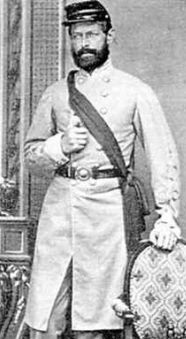
On this date in 1865, Henry Wirz was hanged in Washington, D.C. for running a notorious Confederate prison camp.

A Swiss-born doctor (“Henrich” was the real handle) whom time and tide found practicing in Louisiana at the onset of the Civil War, Wirz apparently got into the prison-guarding ranks when a war injury left him unfit for the front lines.

But it was front-line fitness in the northern army that would set the scene for his controversial hanging.

The North’s advantage in men and materiel shaped Union strategy as the war progressed, and it eventually caused the Union to halt prisoner exchanges. Exchanging casualty for casualty was a winning strategy on the battlefield, so why return to your enemy a man for a man? Besides,

[Grant] said that I would agree with him that by the exchange of prisoners we get no men fit to go into our army, and every soldier we gave the Confederates went immediately into theirs, so that the exchange was virtually so much aid to them and none to us.

Benjamin Butler (we’ve met him before)

As designed, then, the South began piling up more and more POWs to maintain with its ever-straitened resources late in the war. And if exchange was out, that really only left one form of “release”.


Andersonville Prison survivor John L. Ransom’s view of the prison, from the Library of Congress.

Andersonville — officially, Camp Sumter, located near the tiny Georgia town of Andersonville — was only established in 1864, but acquired considerable notoriety in northern propaganda for the year and change that Wirz ran it. The prisoners didn’t enjoy it much, either.

Wuld that I was an artist & had the material to paint this camp & all its horors or the tounge of some eloquent Statesman and had the privleage of expresing my mind to our hon. rulers at Washington, I should gloery to describe this hell on earth where it takes 7 of its ocupiants to make a shadow.

Union prisoner diary, July 1864. Note the prisoner’s anger at Washington — whose refusal to exchange naturally infuriated its stranded POWs

Out of some 45,000 prisoners held at Andersonville during its existence (not all at one time), nearly 13,000 succumbed to disease and malnutrition.* After the war, photos of wasted survivors inflamed (northern) public opinion, already tetchy over Abraham Lincoln’s assassination. Walt Whitman wrote of Andersonville,

There are deeds, crimes that may be forgiven but this is not among them. It steeps its perpetrators in blackest, escapeless, endless damnation.

Damnation is up to higher powers, of course, but the North wanted somebody to answer for Andersonville on this mortal coil. Lincoln’s successor Andrew Johnson overruled mooted charges against Confederate President Jefferson Davis and his Secretary of War James Seddon, leaving — in that great American tradition — Heinrich Wirz holding the bag.**

Shatner sighting!

The trial had an undeniable aspect of victor’s justice.† Even at the gallows, the Union guards chanted, “Wirz, remember Andersonville!” as the condemned man was readied for the noose, and then dropped. The hanging failed to break the man’s neck, and he strangled as the chant continued.

Southern efforts to reshape the story of Andersonville began in the lifetimes of Wirz’s contemporaries; this fulsome volume supporting the charges answered Jefferson Davis in terms that sound strikingly contemporary:

So long as Southern leaders continue to distort history (and rekindle embers in order to make the opportunity for distorting it), so long will there rise up defenders of the truth of history … To deny the horrors of Andersonville is to deny there was a rebellion. Both are historic facts placed beyond the realm of doubt.

But of course, it does not require denying the horrors of Andersonville to notice the circumstances — the privation of the entire South late in the war — and to wonder that Wirz and Wirz alone was held to account. Plenty of people think he got a bum rap.


Daughters of the Confederacy monument to Wirz. (cc) image from divemasterking2000.


Pro-Wirz marker in Andersonville, Ga. (Click for easier-on-the-eyes version, reading in part, “Had he been an angel from heaven, he could not have changed the pitiful tale of privation and hunger unless he had possessed the power to repeat the miracle of the loaves and fishes”). (cc) image from Mark D L.

Recommended for general reading: the UMKC Famous Trials page on this case, several of whose pages have been linked in this entry. A number of nineteenth-century texts by (or citing) Andersonville survivors are available from Google books, including:

Since this is a controversy of the Civil War — and one that can be engaged without having to get into that whole slavery thing — there have been thousands of published pages written about it, with many more sure to come in future years.

A few books about Henry Wirz and Andersonville

As an interesting aside, Civil War POW camps including Andersonville (but not only Andersonville) gave us the term “deadline,” which had a more startlingly literal definition in the 1860s — a perimeter beyond which prisoners would be shot on sight, which policy could make a handy stand-in for walls. Gratuitously killing an insane prisoner who crossed Camp Sumter’s “dead line” was one of the atrocities laid to Wirz, who we take it would not have been at home to the word’s decreasingly urgent appropriation in the wider culture.

* Wirz’s defense showed, to no avail, that the prisoners and the guards received the same rations, with similarly deleterious effects among both, and that the commandant was on record pleading with his superiors for more.

** Wirz’s attorney claimed that his man was offered (and refused to take) a last-minute pardon on November 9 in exchange for implicating Jefferson Davis.

† Wirz and borderlands guerrilla Champ Ferguson were the only Confederates executed for their “war crimes”. There was at least one other prison guard who faced similar charges of prisoner maltreatment, John Henry Gee; Gee was acquitted and released in 1866. (For more on the latter, see “A Little-known Case from the American Civil War: The War Crimes Trial of Major General John H. Gee” by Guénaël Mettraux in the Journal of International Criminal Justice, 2010.)

On this day..

1991: Barrios Altos massacre

(Thanks to Michael Baney for the guest post. -ed.)

On this date in 1991, a Peruvian death squad showed up at the wrong party, and altered its country’s history.

In 1980 the Communist Party of Peru, better known as the Shining Path, launched its “People’s War,” which was never actually supported by the majority of Peruvians. Latin America had had its share of Marxist revolts, but this one was different from the others. There was nothing romantic about the revolutionaries, who wore plain clothes rather than uniforms, attacked the civilian population rather than invest significant capital to win them over to the Shining Path cause, and rose up in an effort to overthrow a democracy rather than a dictatorship.

The Shining Path was based mainly in Andean villages, but once they began to take serious losses in their own territory, they made a concerted effort to accelerate the war by pushing into the capital city, Lima. Both the Shining Path and the Peruvian military were committing deplorable human rights violations by the time Alberto Fujimori was elected president in 1990, although the vast majority of the violence had been confined to the hinterlands of the country up until then.

With Fujimori’s election, more urban-based death squad activities began. Perhaps the most famous was the November 3, 1991 massacre in the Barrios Altos neighborhood of Lima, a poor barrio only a few minutes’ drive away from the Congress and the Presidential Palace.

The murders are described in great detail in this old US government document (pdf) once classified as secret, but since declassified thanks to the efforts of expert Tamara Feinstein of the National Security Archive.

This date’s incident occurred when members of Grupo Colina (English Wikipedia entry | Spanish), a death squad that was part of the Army Intelligence Service, believed that they had identified a group of Shining Path militants having a pollada, which is a traditional fundraiser in Peru where a party is held so that chicken and beer can be sold to the neighbors. (Here’s a description, in Spanish)

A Grupo Colina squad drove to the building where this terrorist pollada was supposed to be taking place, lined the partygoers up, and extrajudicially executed them with submachine guns with silencers that the army had provided the group for the operation. Then the leader of the group, Santiago Martin Rivas, shot a young child who came running over to the body of his father. The troops got back into their vehicles, turned on their sirens to appear like they were the police in an effort to shift blame over the killings, and got drunk at the beach to celebrate.

Almost immediately it became clear that the death squad members had completely screwed up their hit.

The people who had been murdered were indeed having a pollada … not to fund the Shining Path’s Maoist agrarian war, but to fix the pipes in their building

And it transpired that that fateful night of Nov. 3, there was a different pollada being held on a different floor in the very same building. The participants of that other party fled the building, never to return. There were reports that upon searching the rooms of those who fled, police uncovered many issues of El Dario, the Shining Path newspaper.

If Grupo Colina indeed crashed the wrong party, then it not only slaughtered a bunch of innocent people — it helpfully tipped the Shining Path to the fact that the army was onto them.

In any event, the executions became a media spectacle and the police had to at least go through the motions of investigating them. At first, the government suggested that the murders might have been actually carried out by the Shining Path, and as evidence of this theory they showed that one of the people who had been killed was previously a member of a Ronda, which is a peasant patrol group that fought against cattle rustling and, in some cases, the Shining Path. But it later turned out that the man had been a member of the Rondas many years before and hundred of miles away from the killings, and it seemed extremely improbable that the Shining Path would even bother to target him.

By December 4, 1991, the US embassy in Lima was informing the Secretary of State that the Peruvian government lacked the political will to investigate the murders, and had lied about whether or not the guns used in the extrajudicial executions were equipped with silencers in “an apparently deliberate attempt to obfuscate the situation.”

The Congress created a committee to investigate the crimes, which was a real threat to the Fujimori government because the Fujimoristas did not have a majority in Congress.

This ceased to be a problem on April 5, 1992, when Fujimori suspended the Congress, permanently disbanded the Senate, and fired a good number of the judges in the country, all in total violation of the Constitution. That ended the investigation.

Under pressure from the international community, a new Congress stacked with Fujimoristas was convened to write a new Constitution, and the investigation of the Barrios Altos killing nominally restarted. When the Congress called Nicolas Hermoza Rios de Bari, the Chairman of the Joint Command of the Armed Forces to testify, he took the oppotunity to remind the Congress that the military would never tolerate being “insulted.” When hearings continued, Hermoza Rios held an impromptu tank parade directly in front of the Congress. The few brave Congressmen and women who actually desired to expose the truth about the killings got the message loud and clear: the case would never go anywhere as long as Fujimori remained president.

When it finally looked like the perpetrators might be punished, for example, Fujimori rammed a law through the Congress that provided a general amnesty to everyone who had violated human rights “in defense of the fatherland.” When a judge ruled the amnesty law unconstitutional, Fujimori’s Congress stripped the power of judicial review from the courts in cases of amnesty laws.

In a very real sense, the Peruvian government had legalized illegality. Fujimori created a system in which there was no way to punish — or even investigate — murder so long as someone, somewhere considered the crime to have been committed for patriotic reasons.

All that changed in 2000, however, when Fujimori’s government collapsed amid scandal.

An opposition figure who vowed to create a Truth and Reconciliation Commission was sworn in as into office, and Peru reaffirmed its commitment to the American Convention on Human Rights. In 2001, in a groundbreaking decision, the Inter-American Court of Human Rights ruled in its Barrios Altos case that countries cannot issue an amnesty for “serious human rights violations.” The amnesty was thrown out and Grupo Colina members were arrested.

In 2007, Alberto Fujimori was extradited from Chile, where he had traveled, to Peru. In 2009, the Peruvian courts convicted Fujimori of a number of human rights abuses, including ordering the Barrios Altos murders. Just last month, justice was finally served when the members of Grupo Colina were convicted of murder, kidnapping, forced disappearance, and conspiracy, and were given various sentences ranging up to 25 years of prison. After 19 years, the Peruvian government has finally acknowledged that the extrajudicial executions that took place during that country’s cold war were crimes that must not go unpunished.

On this day..

2008: Greg Wright, still fighting for exoneration

Two years on from his execution in Texas this date in 2008, the website FreeGregWright.com still bears its namesake’s now-hopeless case for exoneration.


Wright’s wife Connie (the woman on the right) and their friend Bente Hjortshøj released this photo of Greg Wright 15 minutes after execution “to show the world the cruel and unusual punishment and its horrible consequences.”

Wright and another homeless man, John Adams, were taken in by a generous 52-year-old widow named Donna Vick. Vick paid for her charity with her life … but who was the killer?

Adams fingered Wright, but Wright always insisted that Adams killed her. Late-arriving DNA evidence appeared to back Wright. So did too-late-to-matter confessions by Adams. (Adams, for his part, was also convicted for capital murder; each man was separately tried on the theory that he was the murderer and the other the bystander.)

The disputed facts of this case are a muddier affair that don’t readily admit a slam-dunk exoneration. An episode of the Dallas DNA television series looked at Wright’s case and disappointed Wright’s supporters with its unfavorable view of the subject’s case.

Wright, nevertheless, maintained his innocence from the execution gurney.

John Adams lied. He went to the police and told them a story. He made deals and sold stuff to keep from going to prison. I left the house, and I left him there. My only act or involvement was not telling on him. John Adams is the one that killed Donna Vick. I took a polygraph and passed. John Adams never volunteered to take one. … I was in the bathroom when [Adams] attacked [Vick]. I am deaf in one ear and I thought the T.V. was up too loud. I ran in to the bedroom. By the time I came in, when I tried to help her, with first aid, it was too late. The veins were cut on her throat. He stabbed her in her heart, and that’s what killed her. I told John Adams, “turn yourself in or hit the high road.” I owed him a favor because he pulled someone off my back. I was in a fight downtown. Two or three days later he turned on me. I have done everything to prove my innocence. Before you is an innocent man.

The victim’s son — for whom little ice was cut by Wright’s admitted failure to summon medical help for the victim, or to turn in the alleged killer Adams — complained that the statement was “the same thing we’ve got since day one, each of them blaming it on the other one.”

Former congresswoman Cynthia McKinney witnessed the execution, taking a break from her Green Party presidential bid.

One of the crime scene investigators in this case, Eric George Rosenstrom, is now himself wanted for murder.

On this day..

1941: Twenty Red Army officers


Top to bottom: Proskurov, Rychagov, Shtern, and Smushkevich.

“Quantity has a quality all its own.”

-Stalin

The aphoristic Uncle Joe doomed Soviet officers in both quantity and quality on this date in 1941, shooting 20 Soviet officers at the very moment when Mother Russia could have used them most.

This wouldn’t seem like the ideal time for a purge, but old habits are hard to break.

As the Wehrmacht closed in on Moscow, these prisoners had been evacuated to the Volga city of Kuybyshev (today, Samara). In this, they were already treated more courteously than some.

But any semblance of consideration for these fallen brass — to say nothing of bourgeois indulgences like due process — went out the window when an order arrived from Lavrenty Beria:

“Investigation to be stopped, all to be executed by firing squad without delay.”

They were.

Those “all” included:

Many of this day’s victims were rehabilitated after Stalin fell.

Cold comfort, perhaps, but for their survivors there was bloodier satisfaction: the personal order Beria gave to execute them was in turn used against Beria when he was purged.

It’s a bit tangential, but here‘s an interesting interview with one of their contemporaries in Soviet combat aviation, who managed to survive those terrible years (despite being “taken out to be shot on three occasions” while a POW in Spain). There are some pictures of the planes these men would have used in this thread of a Spanish-language military forum.

On this day..

1769: Nicolas de Lafreniere and four others for the Louisiana Rebellion

On this date in 1769, five French Creoles were shot in New Orleans for a revolt the previous year against a Spanish takeover.

This date’s story begins with the French King Louis XV getting his French clock cleaned in the French and Indian War. This conflict blew an ill wind all over Francophone North America, much of which was taken by the British. Result: a quarter-millennium later, this blog is in English.

Even what France kept, she did not keep. In a secret pact, France ceded to wartime ally Spain “the country known as Louisiana, as well as New Orleans and the island in which the city is situated.”

This projection onto New World colonists of Old World diplomatic horse-trading was rife with potential hostility among the traded horses. In this instance, Louisianans were widely dismayed when they were finally informed that they’d become Spaniards.

When they did get the memo — and Louis XV declined to reconsider — they launched the Louisiana Rebellion of 1768, expelling the new Spanish govenror Antonio de Ulloa.*

These weren’t mere rabble who showed Ulloa “insubordination … a sense of liberty and independence,” but elites of French New Orleans. Nicolas de Lafreniere was the attorney general.

“The name of Lafreniere deserves rank with those of foremost American patriots,” Americans later reckoned. O’Reilly’s reputation did not fare as well in the patriotic literature, but he perhaps had the best of the law.

Between a rock and a hard place, the leftover French adjutant Charles-Philippe Aubry refused to support the rebels, but also refused to fire on fellow Frenchmen. Meanwhile, Ulloa refused to provide his credentials to the uppity colonists. Louis XV refused to receive the delegations sent to implore him to keep Louisiana.

All these refuseniks found the matter adjudicated by immigrant Irish officer Alejandro O’Reilly, plucked out of Cuba to replace Ulloa and lay down the law. He spoke softly when he landed, but the amnesty he offered was followed a few months later by the surprise arrest of the chief rebels.

Lafreniere, Joseph Milhet, Jean-Baptiste Noyan, Pierre Caresse, and Pierre Marquis were ordered hanged on this date. Noyan, nephew of the city’s founder and a young man just married, was offered his pardon, but melodramatically refused.

It was found that there was no hangman in the colony, so the condemned prisoners were ordered to be shot. When the day of execution came, hundreds of people left the city. Those who could not leave went into their houses, closed the doors and windows and waited in an agony of sickening dread to hear the fatal shots. Only the tramping of soldiers broke the deathlike stillness which brooded over the crushed and helpless city. At three o’clock on a perfect October afternoon in 1769, the condemned men were led to the Spanish barracks. Lafreniere, it is said, gave the order to fire. A volley of muskets broke out on the still air, and five patriots went to their death, — the first Louisianians to give their blood for the cause of freedom.

A History of Louisiana

The details and historiography of this event are the subject of this 146-page master’s thesis. (pdf)

Whether or not all that stuff about Louisiana planters as freedom-loving patriots trod down by the barbarous Spanish has any real merit to it, that’s the way they’ve been memorialized.

Lafreniere Park in Metairie, La. — home of anti-death penalty VIP Sister Helen Prejean — is named for Nick Lafreniere.

When next visiting the Louisiana State House, keep an eye out for this day’s victims on the frieze to the right of the main entrance. And when next visiting New Orleans, keep an ear out for the ghost of the priest that buried them.

* Ulloa was also a scientist and gave his name to the Ulloa Halo, a “physical illusion consisting of a white luminous ring or arch that can sometimes be seen in mountainous regions, typically in foggy weather, while facing an area opposite the Sun.”

On this day..

1553: Prince Mustafa, heir to Suleiman the Magnificent

On this date in 1553, the capable heir apparent to Ottoman Emperor Suleiman the Magnificent was strangled at dad’s order — casualty of the the realm’s lethal harem politics.

If ’tis state thou seekest like the world-adorning sun’s array,
Lowly e’en as water rub thy face in earth’s dust every day.
Fair to see, but short enduring is this picture bright, the world;
‘Tis a proverb: Fleeting like the realm of dreams is earth’s display.
Through the needle of its eyelash never hath the heart’s thread past;
Like unto the Lord Messiah bide I half-road on the way.
Athlete of the Universe through self-reliance grows the Heart,
With the ball, the Sphere—Time, Fortune—like an apple doth it play.
Mukhlisi, thy frame was formed from but one drop, yet, wonder great!
When thou verses sing’st, thy spirit like the ocean swells, they say.

-Prince Mustafa, about himself

Suleiman’s first-born son by his first concubine, Mustafa seemed well-positioned to emerge in the Ottomans’ fratricidal succession.

The racket: when the current sultan dies, all his sons by his various concubines make a rush from their provincial outposts for the capital and fight it out, the winner killing off his half-brothers to consolidate his rule.

This disorderly ascension made, while dad still lived, for fraught internal politicking among the sons for the inside track: the most prestigious positions, and the assignments closest to Istanbul. The various mothers of the contenders jockeyed just as aggressively on behalf of their various entrants in the imperial sweepstakes.

Mustafa was the capable eldest son in a kingdom at its very acme,* but to his misfortune, and the empire’s too, he found himself pitted against one of the ablest women ever to call the Ottoman harem home: Hürrem Sultan, also known as Roxelana (or Roxolana).

A Ukrainian woman kidnapped to the harem by Tartar slavers, Roxelana enchanted Suleiman and soon became his favorite. Therefore, Roxelana also became the rival, with her son and her own potential heir, to Mustafa and his mother.

As the story is told, Roxelana at length contrived to convince Suleiman that Mustafa was in cahoots with the rival Safavid Empire to supplant Suleiman on the throne; Suleiman had his firstborn summoned to his tent on campaign in Anatolia, and straightaway put to death. He’s supposed to have sat by the body in grief for days afterwards, and barely averted a revolt by his elite Janissaries, who much favored the talented Mustafa.

“This terrible tragedy exercised an effect on Ottoman affairs resembling that which the Massacre of St. Bartholomew had on the history of France,” according to The Cambridge Modern History (vol. 3). Roxelana’s unimpressive son “Prince Selim, in whose favour the crime was committed, was the first of a series of degenerate Sultans, sunk in pleasure-seeking or stricken with Imperial mania, under whose sway the Empire went to ruin.”

Consequently, Mustafa is still mourned in Turkey as a tragic turning-point; visitors pay homage to his tomb at Bursa.

Westerners had word of this fascinating palace intrigue through diplomatic correspondents who were not privy to the actual harem, and adopted the story themselves while imaginatively filling in the orientalizing details. Inevitably these imaginings have helped shape the story as it comes to us.

The scenario blending the familiar and the exotic — a European in the court of the Turk; a slave woman dominating the conqueror; fratricidal princes and the alluring seraglio — all set in the heart of the feared Muslim state proved irresistible to literary interlocutors. These made of Suleiman, Mustafa (Mustapha), and Roxelana moral fables, theater (endorsed by Samuel Pepys!), symphony

… and opera (many librettos, this by Hasse):

Not to mention, of course, more titillating fare.

* The PBS documentary Islam, The Empire of Faith does engrossing coverage of Suleiman (including his relationship with Roxelana and the execution of Mustafa) in these video segments: 3, 4, 5.

On this day..

2008: A son, all in the family

On this date in 2008, Abura Apalalu of Longorinyangai village, Namalu Sub-county, in Nakapiripirit District of Uganda convened a traditional (but illegal) tribunal to try his two sons for raping their sister.

Apalalu found the youths guilty and condemned his own flesh and blood to death … after which they were both beaten by fellow-villagers, one of them fatally.

The incident illustrates the challenge of getting people in the Karamoja region, where traditional systems are used to serve justice, to conform to the rule of law as enshrined in Uganda’s constitution.

Last year alone, according to the UPDF 3rd Division spokesman, Capt. Henry Obbo, five people were hanged on orders of the Karimojong traditional clan court sitting at Namalu in Nakapiripirit District.

Nakapiripirit District Community Development Officer Michael Edikoi says under the traditional justice system, a person who kills is supposed to be killed. “You are told to dig two graves, one for the person you have killed and the other for yourself. Then you are forced to bury the dead before being stoned to death and buried in the other grave next to your victim,” he said.

On this day..