1432: Francesco Bussone da Carmagnola, scheming condottiero

Italian mercenary Francesco Bussone da Carmagnola was beheaded on this date in 1432.

A successful condottiero was defined by a mixture of battlefield success and cutthroat scheming, and it was his clumsiness with the latter that did in Carmagnola.

His name denotes his origin, from a town in the Piedmont where despite his low birth, his talents raised him to a command for Filippo Maria Visconti‘s brutally successful campaign* to reunite his father’s divided patrimony and make the Duchy of Milan a peninsular power.

So you might think that Carmagnola stood to reap ample rewards for fastening himself to a rising star. But Visconti, perhaps fearing the prospect of a subordinate accumulating enough power to mount a coup d’etat, used a niggardly hand with the emoluments that his general was anticipating — and this led Carmagnola to ditch the Duchy and make an arrangement with its rival, Venice.

The turncoat had the satisfaction of smashing his former Milanese mates at the 1427 Battle of Maclodio, a battle that helped to achieve for Serene Republic its largest-ever Italian territorial expanse.

But his failure to follow up the victory aggressively soon tested the patience of his new patrons. After a short interval of peace, Venice resumed war with Milan in 1431, and here Carmagnola dilated unacceptably (Italian link), failing to advance on Cremona and instead proposing to winter his army — in August.

The Venetian Council of Ten also caught wind that Carmagnola was maintaining a secret correspondence with Milan and exploring the prospect of changing teams yet again.

Determined to have done with the snake, it summoned him back to Venice under the pretense of convening a war council for the 1432 campaign season. He arrived to find that it was too late in the day to meet the Doge, but as he started for his gondola to retire one of the Venetian gentlemen who had been sent to meet him instead directed his steps away.

“That is not my way,” Carmagnola objected.

“Yes, yes, this is your right path,” the man insisted — and Bussone, beholding him gesturing to the yawning gate of the Piombi dungeon, could only exclaim, “I am lost!”


The arrest of Francesco Bussone da Carmagnola

He was beheaded as a traitor between the scenic columns of San Marco and San Todaro. His widow returned to Milan and eventually repatriated the late commander’s remains to his native soil.

* Carmagnola left a nasty legacy to the world’s architectural heritage during this time by collapsing the Trezzo sull’Adda Bridge, the widest-spanning single-arch bridge ever built before the industrial age.

On this day..

1910: Mathias Muff, reproached by 15 orphans

Thanks to the outstanding Trove digitized records of Australian newspapers, we have this item from the Advertiser (Adelaide) published May 4, 1910, concerning an affair from two days previous on the other side of the globe.

The death penalty was barely in use in Switzerland at this point; Muff’s execution would be the fifth-last for common crimes in Swiss history.


LONDON, May 3.

Mathias Muff, who some time ago murdered four persons in the canton of Lucerne, was executed in Lucerne, the capital, yesterday, the guillotine being used.

This is the first execution which has taken place for many years in Switzerland, Lucerne being one of the cantons which have re-enacted the death penalty after its abolition. Muff, when urged to sign a petition to the President for the commutation of the death sentenced, refused, saying, “I cannot live to hear the voices of fifteen orphans reproaching me.”

There was some difficulty in obtaining a guillotine, there being none in existence in Switzerland, and the authorities were compelled to secure the loan of one from the French Government. In France there are but two official guillotines, and both are kept in Paris, but one is specially reserved for executions in the provinces. Neither of these could be spared, but one was obtained from the French colonies, which between them have nine.

The cost of the guillotines is said to be £250 each, but they are well made, for the two now in use in France were made in 1870 in the place of those burnt during the Commune and by all accounts they still work as well as when first tested on a bundle of straw.

On this day..

1889: The first executions in French-occupied Tunis

TUNIS.

PARIS, April 28.

The first execution in Tunis since the French occupation took place yesterday. Three Kroumirs, Ali Ben Debbah, Mahomed Ben Salah, and Ali Ben Salah, who had assassinated two Kabyle merchants in order to rob them, were guillotined in the morning at the Saadoun Gate.


The Saadoun Gate circa 1880. (Via)

At half-past 4 o’clock, M. Herbault, the Procureur of the Republic, in presence of several officials, announced to the condemned men that their appeal for mercy had been rejected. They received the statement very quietly, although they protested, as they had previously done, that they were innocent. As the prison is at some distance from the place of execution, it was not till 25 minutes past 5 that the prison van, preceded and followed by a company of Zeuaves, reached the place of execution, where a large crowd had assembled. At half-past 5 the bodies were removed to the Sadiki Hospital.

In order to put down any attempt at disturbance a large number of soldiers were drawn up near the guillotine, but there was no occasion for their services. There were very few natives among those present at the execution. A fourth Kroumir, who was condemned to death for the same crime, was informed yesterday that his sentence had been commuted by the President of the Republic.

London Times, April 29 1889

On this day..

1824: Three Bondy brigands

Bondy, today a Paris suburb, was in the Middle Ages a forest notorious for the bandits and murderers who laired in its leafy shadows — a reputation stretching back to antiquity. The Merovingian king Childeric II was assassinated while hunting there.

Just as the French Revolution swept away the titles and prerogatives left over from feudal Europe, it put the onetime thieves’ forest on the track to respectability. The golden age of the highwayman was rapidly closing anyway; as the 19th century unfolded, the lumberman, the railroad, and the police inspector combined to drain away the outlaw’s arboreal habitat.


Take the tram where angels once feared to tread. ((cc) image from gasdub.

But such transitions do not happen overnight, and on this date in 1824 were guillotined in Paris three representatives of this vanishing species — brigands from a ferocious gang who, in the words of their executioners’ memoirs, “excelled in the art of waylaying stage-coaches, and killing the passengers if they refused to give up their money.”

Renaud, Ochard and Delaporte were their names; five others of their band had received sentences of life in prison at hard labor.

On this day..

1322: Bartholomew de Badlesmere

On this date in 1322, Bartholomew de Badlesmere, the first (of only two) Baron Badlesmere, lost his head.

The barons in the dangerous age of Edward II were marked by where they made their political allegiances between the king and his rival the Earl of Lancaster.

Badlesmere? He … evolved.

The man could tack to the wind with the very best of them, or the very worst; he was reviled as the Benedict Arnold of 14th century England for chickenheartedly failing to protect the Earl of Gloucester when the latter impetuously charged to his death at Bannockburn. As a bard of the time put it,

This is the traitorous man Bartholomew, whom in all victories may God confound, because he has been to his master as changeable as a pharisee. Hence, as the representative of Judas, he shall be condemned to death … because he refused to come to his master’s support this traitor has deserved to be put to the rack … deserved to suffer judgment of decapitation.

As the 1320s began, he was a stalwart of what has been termed the “Middle Party”, whose position vis-a-vis Edward and Lancaster was what you would expect from the name.

Badlesmere badly misplayed a strong hand by defecting in the so-called “Despenser War” to the anti-Edwardian party, even though Lancaster pretty much hated his guts — and now the king did, too,* dissipating any mutual goodwill that might have been earned a few years before when the king’s favorite (and the war’s namesake) Hugh Despenser went and rescued Badlesmere’s wife from an attack.

And unlike at Bannockburn, Badlesmere here stepped into the trap rather than out of it.

Lancaster’s party was decisively defeated on March 16, 1322 at the Battle of Boroughbridge.

Days after the battle, Badlesmere was caught skulking in a glade by the Earl of Mar and shipped to Canterbury for trial. He was condemned to death on this date, and sent directly from court to a hurdle dragged by a horse to Blean three miles away, where he was hanged and beheaded. He was one of 20 or so lords and knights Edward had put to death.

Lancaster himself was another — although a “Contrariant” whom he didn’t execute, Roger Mortimer, would make Edward regret his clemency by overthrowing the king four years later.

* In an affair that Edward II biographer Kathryn Warner thinks was neatly contrived by the king, his Queen Isabella called on Badlesmere’s wife when the latter held Leeds Castle sans husband. Lady Badlesmere refused to admit the queen, giving Edward a welcome excuse for besieging a fortress holding out against its sovereign.

On this day..

1756: Veronika Zeritschin, the last witch executed in Germany

When did Europe stop executing witches?

Early modern Europe’s witch hunt era wound down in the 18th century, but the precise milestone dates are surprisingly tricky to pin down. The superstition outlived the judicial machinery, and some of the last reputed “witches” — like Anna Göldi and Barbara Zdunk — don’t seem to have been formally charged with sorcery.

The clear “lasts” we do have are country by country, earlier or later depending on the vigor of the pushback witch-hunters could muster against the the onset of rationalism.

The last witch execution that can be documented in the Holy Roman Empire’s illustrious history took place on this date in 1756, in Landshut, during the age of Maria Theresa.* Its subject was a 15-year-old named Veronika Zeritschin, who was beheaded and then burned.

There is scant information readily available online as to how she came to that dreadful pass, perhaps because the distinction was long thought to be held by a woman named Anna Maria Schwegelin (English Wikipedia entry | German) — condemned for her Satanic intercourse in 1775. That sentence, it was only latterly discovered, was not actually carried out, leaving poor Anna to die in prison in 1781.

As one might infer, Veronika Zeritschin’s own distinction might not be entirely secure against subsequent documentary discoveries. But as of now, she appears to be the last person executed on German soil as a witch.


Salvator Rosa, Witches at their Incantations (c. 1646). “Rosa has a secret to tell us: how the romantic imagination feeds on terrors and beliefs that were once all too real.”

* Marie Antoinette‘s mother. Maria Theresa’s absolutism was not quite that of the Enlightenment; she was a staunch foe of the trend towards religious toleration:

What, without a dominant religion? Toleration, indifferentism, are exactly the right means to undermine everything … What other restraint exists? None. Neither the gallows nor the wheel … I speak politically now, not as a Christian. Nothing is so necessary and beneficial as religion. Would you allow everyone to act according to his fantasy? If there were no fixed cult, no subjection to the Church, where should we be? The law of might would take command. (Source)

On this day..

1307: Murcod Ballagh, beheaded

“In the yeare 1307 the first of Aprill,” Holinshed’s Chronicles of England, Scotland, and Ireland records, “Murcod Ballagh was beheaded neere to Merton by sir David Caunton knight.”

First published in 1577, this document — heavily mined by Shakespeare for his histories — is silent as to the further particulars of the beheading. But the accompanying image depicting the execution surprisingly presents a guillotine-like device being employed for the task.

As John Wilson Croker’s History of the Guillotine observes, this one illustration 270 years after the fact scarcely suffices to establish that a guillotine precursor really was in use in Ireland in the first years of the 14th century. Were that the case, this might be the earliest quote-unquote “documented” execution by a beheading-machine.

(Executions in Halifax, Scotland, can be sourced as early as the 1280s, but it is not known if the famed Halifax Gibbet was in use at that early date.)

But it does at least establish the authors’ awareness of such technology — perhaps by familiarity with the Scottish Maiden, or perhaps by having caught wind of similar gadgets in France and Italy.

“This mode of execution was common on the Continent in the sixteenth and seventeenth centuries,” Croker concludes with a bit of overstatement. “And yet had passed into such entire desuetude and oblivion as to have appeared as a perfect novelty when proposed by Dr. Guillotin.”

“This is certainly a striking illustration of the proverb that there is nothing new under the sun.”

On this day..

1531: Sikke Freriks, Menno Simons inspiration

Dutch artisan Sikke Freriks, beheaded on this date in 1531 in Leeuwarden‘s market, was the first Anabaptist put to death in that Friesland city.

While a minor milestone in the crowded history of Reformation martyrdoms, Freriks had a noteworthy posthumous effect: word of his heresy — adherence to adult, rather than infant, baptism — came to the ears of a Catholic priest, who later wrote that a man’s dying for this illicit doctrine led him to investigate it further.

To his amazement, the priest found no scriptural support for the established church’s practice of baptizing infants before they developed the maturity and volition to embrace Christ from the will of their own hearts. Christians are “cheated” by the loss of that opportunity of freely giving oneself in baptism, he later wrote.

This man, Menno Simons, would follow his discomfiting scrutiny of holy writ all the way out of the priesthood and into that same forbidden sect. His preeminence in the Anabaptist movement after its disastrous Münster rebellion — and particularly his pacifistic orientation — eventually ennobled him as the founder as well as the namesake of the Mennonites, a term that in Menno Simons’s own lifetime became all but synonymous for Dutch Anabaptism.

On this day..

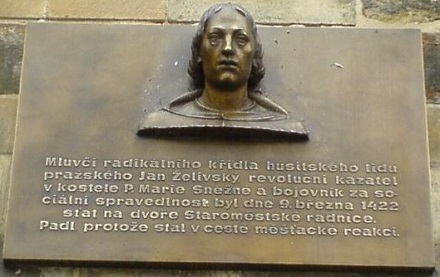
1422: Jan Zelivsky, Hussite defenestrator

Radical Hussite Jan Želivský was beheaded on this date in 1422.


1952 memorial plaque of Zelivsky in Prague

Zelivsky (English Wikipedia entry | Czech), a priest, emerges in the 1410s as a fiery populist orator at Prague’s Church of Our Lady of the Snows.

After the treacherous capture and execution of Jan Hus, the Hussite movement split between radical and moderate factions. The firebrand Zelivsky became the chief voice of the lower-class, radical Hussites and led the dramatic Defenestration of Prague wherein a Hussite mob pitched several Catholic city ministers out the window of the Prague town hall — triggering a revolution and 15 years of war.

Over the ensuing year, Zelivsky came to dominate politics in Prague. But he had to struggle for his power against both the external threat of Hapsburg armies, and the internal rivalry of moderate Hussites — and these factions did not scruple to deploy the executioner for mastery of Prague.

Zelivsky in the summer of 1421 mounted a coup against moderate Hussites who were negotiating with the Catholic nobility, and even executed some of those movement apostates. But power was wrested away from him in the ensuing months and he was arrested by surprise at a town meeting and secretly put to death.

On this day..

1785: Barbara Erni, the Golden Boos

Tiny Liechtenstein last conducted an execution 230 years ago today: Barbara Erni — the legendary “Golden Boos”.

Nicknamed for her strawberry blond hair, the Golden Boos had an ingenious scam that required every bit of her Bunyanesque strength: she would wander the countryside and check into inns with a large chest or pack. Intimating that the parcel contained something of great value, she would insist upon its overnight safekeeping in a very secure room.

Once the inn had tucked in for the night, a diminutive accomplice would emerge from the trunk, plunder the lonely room of its valuables, and the two would escape into the night. Evidently, secure rooms in 18th century Liechtenstein were never secured from the inside.

She admitted to 17 such thefts. Liechtentein, whose population at the present time numbers fewer than 40,000 souls, had to import the executioner to chop off Barbara Erni’s Golden Boos on a public scaffold in Vaduz on February 26, 1785.

Liechtenstein officiall abolished the death penalty in 1987.

On this day..