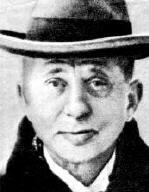
1936: Adolf Seefeldt, Uncle Tick-Tock

German serial killer Adolf Seefeldt was beheaded on this date in 1936 by the Third Reich.

The tramp timepiece-fixer with twenty-plus years of child molestation prison time in his 66 years of life, “Uncle Tick Tock” killed at least a dozen boys in the early 1930s whose creepy uniting feature was sailor suit garb. Their bodies — peacefully posed and innocent of any visible sign of violence — would be discovered in protected forest preserves; the nature of the killings makes it possible that he had other prey who have never been recognized as murder victims, but simply taken for natural deaths. Given that he’d dodged a previous murder charge as far back as 1908 one can’t help but wonder.

It’s been debated whether Seefeldt (English Wikipedia entry | German) poisoned his victims, as he confessed, or suffocated them, or even — fanciful hypothesis — dropped them into a hypnotic sleep only to abandon them outdoors to death by exposure.

On this day..

1538: John Forest and the image of Saint Derfel Gadarn

English Franciscan John Forest was burned at Smithfield on this date in 1538 … the undercard to the simultaneous “execution” of a downthrown idol of Saint Derfel Gadarn.

The latter had been ripped from its shrine at Llandderfel in Gwynedd, Wales: the place gets its name from Derfel himself and its devotion to its Celtic patron had not waned in the centuries since but fostered a thriving pilgrimage site where the icon received the offerings of devotees in trust of the saint’s supernatural protection.

Such rituals really infuriated the iconoclastic, monastery-shuttering reformers abroad in England in Henrician England post-Anne Boleyn and in 1538 Derfel G. came in for special “punishment.”

“There is an image of Derfel Gadarn within the said diocese, in whom the people have so great confidence, hope, and trust, that they come daily on pilgrimage unto him, some with kyne, other with oxen or horses, and the rest with money,” fumed the king’s own scaffold-bound Lord Chancellor, Thomas Cromwell. “In so much that there was five or six hundred pilgrims, to a man’s estimation, that offered to the said Image the fifth day of this present month of April.”

Cromwell and team were very keen to show up the superstition, hypocrisy, and money-grubbing wrapped up in these quaint old idols, to expose to the public gaze the contraptions that allowed statues to weep or the priests that dined hearty on the victuals sacrificed by poor pilgrims … and so it came to pass that the May 22, 1538 death of John Forest at the stake was also a great demystifying of old Saint Derfel. Hauled to London from its native haunts, this image was railed at in a showboating sermon by the scaffold-bound Bishop of Worcester, Hugh Latimer.

In this spectacle designed for the cheap seats, Latimer spent hours ceremonially exhorting the patiently trussed John Forest to abjure his heresies. Forest predictably declining, the image of Saint Derfel was then produced and challenged to intervene for his spiritual bannerman, even engaged in a stagey grappling match — until finally the discredited simulacrum was tossed as mere fuel into the pyre that swallowed John Forest. (Forest has the distinction of being the only Catholic martyr burned at the stake during the English Reformation.)

The always enjoyable History of England podcast delves into the frightful fate of Saint Derfel’s icon and Blessed John Forest’s living flesh in episode 236.

On this day..

1832: Elizabeth Jeffery, Carluke poisoner

This broadside comes from the National Library of Scotland’s vast collection of print ephemera, “The Word on the Street”.


Account of the Execution of Elizabeth Nicklson, or Shafto, or Jeffrey, when was Executed in front of the Jail, this morning, for a Double Murder, 1st, with administering, on the 4th October last, to Ann Newal or Carl, residing in Carluke, a quantity of arsenic, which she mixed with meal and water and whisky, in consequence of which she died; 2d, with having administered to Hugh Munro, then labourer or miner at’ carluke, a quantity of arsenic, which she mixed with porridge; and Hugh Munro died in consequence of having partaken of the same.

It will be recollected that the unhappy woman who has this day justly forfeited her life to the offended laws of God, and of man, was tried at our last Assizes. The indictment against the prisoner ran thus —

You the said Elizabeth Nicklson or Shafto or Jeffrey, lately residing at Carluke, are charged with administering on the 4th of October, last, to Ann Newal or Carl residing in Carluke, a quantity. of arsenic, which you mixed up with meal and water and whisky, and which you pretended was a medicine for her benefit and the said Ann Newal or Carl having drank there of, became violently ill, and died next day in consequence of having swallowed the said mixture.

You are also charged with having on the 28th of October last, administered to to Hugh Munro, then labourer or miner at Carluke, and lodging with you, a quantity of arsenic which you had mixed up with porridge and the said Hugh Munro having partaken of the porridge became ill and, continued so the two following days. You are likewise accused of having on the 30th, October last, administered to the said Hugh Monro a quantity of arsenic which you had mixed up with rhubarb and the said Hugh Munro died in consequence of having partaken of the same.

The prisoner pleaded Not Guilty, and the trial proceeded. Never before was there so connected and convincing a chain of circumstancial evidence developed in a Court of Justice. The following is a sort of summing up of the facts of the case, as they were sworn to on the trial. It appeared the no suspicion had been excited against the prisoner amongst the villagers of Carluke, on the death of the old woman, Carl, who resided next door to the prisoner — but that when her lodger Munro died in excruciating agony about four weeks after, and was buried by request of the prisoner, (as indeed Carl was also) in a great hurry, reports not favourable to her began to be openly made, and to such a length did the matter go, that both bodies were raised from their graves, and certain portions of the stomachs extracted for medical examination. It afterwards appeared from the evidence of the two surgeonss at Carluke as well as from that of two highly experienced chemists in Edinburgh, to whom portions of the matter found in the stomach s has been transmitted, that minute quantities of arsenic, but quite sufficient to cause death, had been discovered in each of the stomachs. It was also proven that the prisoner had purchased arsenic at two different times, by the hands of another person, for the ostensible purpose, as was alleged, of killing rats, by which she said her house was infested, although none of the witnesses on that spot had ever seen a rat about the premises. These purchases, be it observed, were made immediately preceding the death of Carl and Munro. Add to this it was proven that the prisoner mixed up the dose for the sick woman Carl herself and also made the porridge by which her lodger Munro was poisoned. With regard to this poor highlander, it appeared that he came home on a Saturday, in as good health and high glee as ever he was in his life, looking forward, no doubt to a happy meeting he was soon expecting to have with his friends in Skye, and that having partaken of some porridge made by the prisoner, he was soon after seized with dreadful thirst and pain, in this state the continued for two days when she again tendered him mixture of rhubarb as she alleged; soon after which she expired in great agony. The prisoner owed Munro five pounds, which she could not pay, and this seemed to be the only cause she had for committing so diabolical a crime. About the period of the murder, Jeffrey used many ineffectual tricks to makevthe friends of the deceased believe that she had accounted on the money to the deceased, but it came clearly out that she had not paid a farthing of it. With regard to the murder of the old woman, Carl, the Depute-Advocate’s theory was, that the prisoner had tried her hand on her to discover how much poison it would take to kill the young man, Munro, but the villagers say the houses were very scarce at Carluke, and that the prisoner wished to make room for a more productive lodger. There were many other facts came out in detail, all tending to criminate the prisoner, who after a trial of 18 hours, was found Guilty, and sentenced to be executed this day, but recommended to mercy by the Jury — for what reason, or on what grounds, was not mentioned. On this recommendation the prisoner had great hopes until Thursday, when an answer to an application to Lord John Russell, from a few Quakers and other eccentric individuals in this City, was refused; These characters say it was a mighty piece of unheard-of cruelty to execute BURKE!

But we have no patience with them — their maukish ravings are an outrage on nature and common sense, how humane, and kind, and charitable they are to the cold blooded murderer — while not a sigh is given to the innocent butchered victims!

When the prisoner understood there was no hope, (Which had been so unproperly raised) she betook herself to her devotions, and has continued almost since, engaged in prayer. The crowd, this morning, around the, scaffold was large. After some time spent in earnest prayer with the clergymen who assisted her; she gave the signal, when the drop fell, and in a minute she ceased to exist. The crowd then left the ground in good order.

Muir, Printer, Glasgow.

On this day..

1952: Jan Bula, Czechoslovakian priest

Catholic priest Jan Bula was hanged on this date in 1952 at Jihlava

A Rokytnice pastor, Bula (English Wikipedia entry | the more detailed Czech and German) put himself in the gunsights of the postwar Communist state by defying its strictures on proselytization and commenting publicly against them.

Although perhaps a gadfly from the state’s perspective he was by no means a dissident consequential enough to have merited his eventual treatment; however, he was cruelly rolled into a notorious 1951 show trial called the Babice Case. Occasioned by a fatal raid launched by anti-Communist terrorists, the Babice trials targeted a huge number of ideological enemies and eventually resulted in 107 convictions and 11 death sentences.* Bula was among them, speciously condemned a traitor for complicity in the attack — a move that also opportunistically accelerated a case that state agents had for some time been attempting with little success to construct by means of entrapment.

“We human beings do not love God enough,” he wrote in a letter to his parents before his hanging. “That is the only thing for which we must ask forgiveness.”

The Catholic Church is currently considering this modern martyr for beatification.

* After the Cold War these sentences were retrospectively overturned or reduced, and a judge in the Babice case, Pavel Vitek, was prosecuted for his role in it.

On this day..

1893: Ai Yone

For today’s post we refer you to the fine and regrettably retired blog Made In Thailand, which describes in detail the May 19, 1893 beheading of a man named Ai Yone. Although the post admits to a bit of novelization in service of dramatization, this was absolutely a real execution in Siam.

At 7:15 a.m., the procession arrived at Wat Matkasan, where preparations for the execution got underway. Ai Yone remained bound and shackled on board the boat, smoking and engaging in animated conversation with those around him. Meanwhile, the executioners — seven in number — began the lengthy ritual, first making offerings of boar’s head, fowls, rice and betels at the temporary altar, erected for the occasion. The swords to be used for the execution were placed on the altar and duly consecrated and anointed. Looking on from the boat, Ai Yone seemed disinterested and detached as he received the last ministrations of the Buddhist monks. He held his head high, and showed no signs of fear.

Promptly, he was brought onto land and placed on the grass. The executioners were arrayed in red, and had wrapped red sashes around their foreheads. They knelt in front of Ai Yone and asked his pardon for what they were about to do. Some of the executioners took Ai Yone a little distance away, where they removed his neck-chain and handcuffs, then tied his elbows to a bamboo post, securely planted in the ground. He sat cross-legged on freshly-cut plantain leaves, neck exposed to receive the fatal blow, murmuring prayers and holding lighted tapers between his pressed palms. Next, his ears were closed with wet clay, so that he would not hear the deadly approach of the executioner. A line was drawn across his neck, to guide the descending sword; a white cloth wrapped around his body. All was ready.

Ready for what? Read on.

On this day..

1632: Topal Recep Pasha, Grand Vizier

Ottoman Grand Vizier Topal Recep Pasha was put to death by Sultan Murad IV on this date in 1632.

Come to the throne as a mere boy of 11, Murad’s early reign was long constrained by the rivalries and factions of the court — not to mention a huge war with Persia.

A sovereign endures such a contingent existence at his own peril, as could be attested by no small number of deposed sultans including Murad’s own teenage predecessor, who was murdered by his Janissaries.

A 1631-1632 revolt by this same corps might have done for Murad, too; indeed, it so menaced him that he was forced to give over Grand Vizier Hafiz Ahmed Pasha to their fury early in 1632. Instead, it catalyzed Murad’s capture of absolutist power — as experienced to his distress by the subsequent Grand Vizier, who was also Murad’s brother-in-law.

For some two months the janissaries and the sipahis of the Porte gave free rein to their licence and indiscipline at Istanbul. Murad IV waited until the time was opportune and then struck hard, removing from the scene Rejeb Pasha, whom he considered to be one of the most active personalities behind the recent troubles. The execution of Rejeb Pasha was carried out on 18 May 1632 — a date which saw the sultan liberated once and for all from the tutelage of the great officials and which marked the real beginning of his reign. He had grown to manhood in a world of danger and duress. His character was tempered to the hardness of steel in the harsh and bitter experiences of his youth. A ferocious and inexorable resolve to be the master in his own house would henceforth dominate his actions. It is not surprising that in the eight years of life remaining to him he was to become perhaps the most feared and terrible of all the Ottoman sultans. (Source)

The reputations for brutality and efficacy earned by Murad for the balance of his reign until cirrhosis of the liver claimed his life in 1640 were inextricably linked to one another, a fact amply underscored by the fate of the libertine brother who succeeded him and was, yes, overthrown and murdered by the Janissaries.

On this day..

1872: Matias Salazar

Venezuelan caudillo Matias Salazar was shot on this date in 1872.

A commander who had adhered himself to Antonio Guzman Blanco‘s 1870 “April Revolution”, Salazar gradually became alienated from his chief and in 1871 orchestrated an unsuccessful assassination attempt on Guzman.

The resulting exile Salazar used as an opportunity to mount an invasion — but he was intercepted trying to march into Venezuela through Colombia’s bordering Arauca region and given over to a war council for his fate.

There’s a Spanish-language public domain biography of Salazar here.

On this day..

1979: Kampatimar Shankariya

“I have murdered in vain,” said India’s most prolific serial killer as he went to the gallows in Jaipur on this date in 1979. “Nobody should become like me.”

Becoming like Kampatiyar Shankariya would entail committing upwards of 70 hammer-bludgeon murders.

On this day..

1903: Victoriano Lorenzo, cholo

Panamanian indigenous leader Victoriano Lorenzo was shot on this date in 1903.

He was a cholo (mixed-race; Lorenzo had both African and Amerindian ancestry) peasant who in the 1890s rose to become the most prominent indigenous leader in Cocle, a Pacific-facing province on the isthmus back when Panama was still a part of Colombia.

Lorenzo (English Wikipedia entry | Spanish) would lead indigenous forces in the Thousand Days’ War — a civil war between Colombia’s Conservative and Liberal Parties. Lorenzo fought in alliance with the Liberals; they lost the war, and with it the native land rights that Lorenzo fought for.

While the war was settled by the last days of 1902, the now-ascendant Conservative government accused Lorenzo and followers of continuing to fight and put him to a rial on grounds of murder and robbery that culminated in his public shooting in Panama City. The affair was so irregular that it’s commonly maligned as an “assassination”.

Scholars have interpreted the strange circumstances of his death as Conservative vengeance, the destruction of a hero and powerful symbol for impoverished people, the establishment of oligarchy, and as the forgetting of indigenous people as emblematic in the new Republic of Panama. Lorenzo has been interpreted as a martyr and the first victim of North American imperialism related to the Canal because he was held aboard the United States ship Bogota before his assassination. Seven days before his assassination, Esteban Huertas publicly announced that there was nothing more dangerous for the Canal construction than “guerrillas” and their activities in the mountains of Cocle …

The Conservative narrative of Lorenzo as “guerrilla” fighter permeated Panamanian national history, and schoolchildren learned to see Lorenzo negatively. National Panamanian history depicted Lorenzo shamefully as a “dirty cholo” …

In contrast, northern Cocle oral history memorializes, in cyclical time, Lorenzo as a cultural hero who continues to live, and understands his fight for land rights and political autonomy as the same fight of Urraca that is still ongoing today. People identify strongly with a liberation theology quote attributed to Lorenzo shortly before his death, “I forgive all. I die like Jesus Christ died,” wherein the cultural hero continued the cycle of death to defend land in this epoch. Rufino Peres J., born in 1941, recalls:

My people were illiterate, when he lived. They wore plant fiber loincloth (pampanillas) to go to Penonome … Why did they kill Victoriano Lorenzo? He died fighting for our land, and they formed a war, and that Victoriano Lorenzo, a cholo, won that war! It was not the president who won the war; it was Victoriano Lorenzo. They could never kill him: they used machetes, sticks, smoke, and they didn’t kill him. How was that? Then Victoriano Lorenzo went to the Presidency, and there they killed him. But Victoriano Lorenzo has stayed in History. So, now, whenever a campesino starts any kind of movement, they are scared because because we are the blood of Victoriano Lorenzo.

He uses the word blood (sangre) to mean how much someone is dedicated to the land and lineages in struggle, and adds, “Now youth don’t have blood like before, they have to be ready to die.” (from The Blood of Victoriano Lorenzo: An Ethnography of the Cholos of Northern Cocle Province, Panama)

Panama broke away from Colombia later that same year of 1903, and its new constitution abolished the death penalty outright. Independent Panama has never conducted an execution — so Lorenzo’s appears to be the isthmus’s last.

On this day..

1855: Giovanni Pianori

On this date in 1855, Giovanni Pianori submitted to the guillotine for an unsuccessful assassination attempt — pictured above — on the French Emperor Napoleon III.

Himself an Italian nationalist in his youth, Napoleon as prince had gutted his former cause by intervening to crush the revolutionary Roman Republic and restore the exiled pope to power. No small number of fellow-travelers in the patriotic cause thought Napoleon’s betrayal deserved a bullet.

Pianori’s were launched, without effect, on the Champs-Elysees on April 28, 1855, just sixteen days before his execution.

On this day..