1610: Blessed George Napier

On this date in 1610, the Catholic priest George Napier (or Napper, or Nappier) was hanged, drawn, and quartered at Oxford, having said Mass that very morning.

A son of Oxford himself who went abroad to France for ordination in his outlawed faith, Napier cut a fairly typical martyrology for the Catholic clergy. He was caught red-handed with the implements of the Roman church, refused to avow the supremacy of the English crown, and aggravated his offense by converting a fellow-prisoner to Catholicism.

This unfortunate has made headlines recently around the fourth centennial of his martyrdom, for which occasion a pilgrimage of Catholic faithful unveiled a plaque in Nappier’s honor at Oxford Castle.


Archbishop Bernard Longley blessing on Oct. 23, 2010 the marker honoring George Napier. Images on this page (cc) Joseph Shaw.

On this day..

1619: Lucilio Vanini, aka Giulio Cesare

On this date* in 1619, Italian freethinker Lucilio Vanini was adorned with a placard reading ‘Ateiste et blasphemateur du nom de Dieu’ and taken to Toulouse’s Place du Salin where he had his blasphemous tongue cut out,** then was strangled and burned at the stake.

You can think of Vanini as a sort of Giordano Bruno mini-me — a bit less intellectually distinguished, a bit less famous, but doing the same peripatetic, pantheistic act before orthodoxy ran him down.

Ordained a priest (like Bruno), Vanini’s 34 years were spent perambulating (like Bruno): France, Switzerland, the Low Countries, even England, where he briefly auditioned Anglicanism.

Alas, (like Bruno) the libertine monk’s occult philosophy had no real home; he fled Paris for Toulouse (the place Bruno earned his doctorate), and was there charged with blasphemy.

Vanini veiled his dangerous speculations in nominally pietistic cant, but he probably could have done better misdirection than a title like De Admirandis Naturae Reginae Deaeque Mortalium Arcanis (Of the Marvelous Secrets of the Queen and Goddess Nature — available in Latin from Google books).

Vanini was bold enough to suggest an equivalency between human and animal souls, and reckon both mortal. Though his works purported to prove the existence of God, and he even made to his accusers a version of the “first cause” argument, they thought (probably rightly) he wasn’t being serious.

They also thought (again, probably rightly) Vanini and his aristocratic patrons were debauched; Vanini’s execution kicked off a dangerous crisis for hedonists in France and elsewhere in the 1620s.

There’s much more about Vanini in French here, and in English in this chapter of the public-domain The Skeptics of the Italian Renaissance.

* Some sources report Feb. 19. The source of this discrepancy isn’t clear to me; the then-10-day gap between the Julian and Gregorian calendars is an obvious suspect, but as this execution took place in Catholic France, the modern Gregorian calendar had been adopted decades before.

In any event, primary documentation appears to me to support the 9th.

” le samedi neuvième du mois de février … fut donné arrêt au rapport de M. de Catel, conseiller au parlement, par lequel il [Vanini] fut condamné à être traîné sur une claie, droit à l’Eglise Saint-Etienne, où il serait dépouillé en chemise, tenant un flambeau ardent en main, la hart [la corde avec laquelle on étranglait les criminels.] au col, et, tout à genoux devant la grande porte de la dite église, demanderait pardon à Dieu, au roi, à la justice, et de là … serait conduit à la place du Salin où, assis sur un poteau, la langue lui serait coupée, puis serait étranglé, son corps brûlé et réduit en cendres; ce qui fut exécuté le même jour.”

** “Before putting fire to the stake, Vanini was ordered to put forth his sacrilegious tongue for the knife. He refused; it was necessary to employ pincers to draw it forth, and when the executioner’s instrument seized and cut it off never was heard a more horrible cry. One might have thought that he heard the bellowing of an ox which was being slaughtered.” (Source) This account of the magistrate Gramont has to be considered in view of his interest in showing the condemned inadequate to his jaunty resolve, “Let us go, let us go joyfully to die, as becomes a philosopher.”

On this day..

1611: Louis Gaufridi, sorceror-prince

On this date in 1611, the pathetic figure of a former priest — his body shaved to expose Devil’s marks, a noose about his neck — was conveyed to the secular powers to be tortured one last time, then hauled through the streets of Aix-en-Provence and burned to ashes.

Witchsmellers were thick on the ground in pre-Thirty Years’ War France, as elsewhere.

In our scene in the south of France, we find a characteristic entry in this horrible catalogue.

Parish priest and lothario Louis Gaufridi, having seduced a local teenager, found himself in hot water when she contracted the trendy disorder of demonic possession and started raving about the times she went with the cleric to see Black Sabbath.


Not this Black Sabbath.

Other inmates at the convent to which Gaufridi’s paramour had been conveyed were soon in on the act, indicting him for cannibalism, exotic sexual perversions, and — of course — devil-worship.

Gaufridi’s denials were overcome in the usual way, with the support of doctors who filed a report scientifically vouching that the infernal powers had laid their mark upon the subject. The priest soon saw the wisdom in copping to the charges, and not only his torture-adduced confessions (which he vainly attempted to repudiate in court) but the veritable original contract specifying the terms of his demoniacal servitude was produced for magisterial consideration.

I, Louis, a priest, renounce each and every one of the spiritual and corporal gifts which may accrue to me from God, from the Virgin, and from all the saints, and especially from my patron John the Baptist, and the apostles Peter and Paul and St. Francis. And to you, Lucifer, now before me, I give myself and all the good I may accomplish, except the returns from the sacrament in the cases where I may administer it; all of which I sign and attest.

I, Lucifer, bind myself to give you, Louis Gaufridi, priest, the faculty and power of bewitching by blowing with the mouth, all and any of the women and girls you may desire; in proof of which I sign myself Lucifer.

That’s right. He did it all for the nookie.

(That, and to “be esteemed and honored above all the priests of this country.” Thomas Wright, in his omnivorous and freely available chronicle of European witch trials, remarks that these two attributed motives suggest “the reason why Gaufridi was persecuted by the rest of the clergy.” And oh, but the ladykiller — or rather, the reverse — still starred in the fantasies of the possessed years after his death. (French link))

Gaufridi’s execution immediately freed his erstwhile lover from her satanic affliction. Madeleine de la Palud, however, having officially established herself as susceptible to the penetrations of the Evil One, would remain suspect in the eyes of the inquisition for the 60 years remaining of her life. She twice faced witchcraft charges herself.

On this day..

1615: St. John Ogilvie

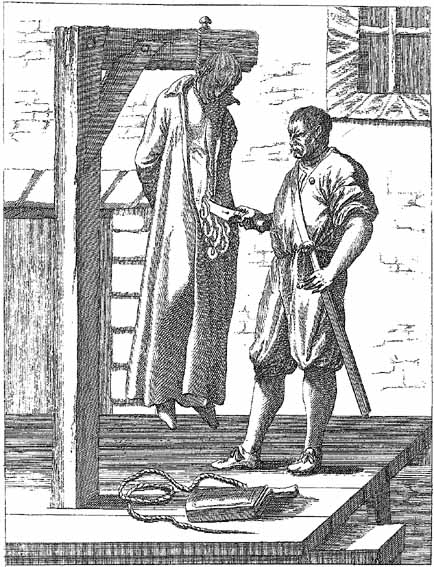
On this date in 1615, Scotland’s only post-Reformation Catholic martyr was hanged at Glasgow Cross.

The Protestant-born Ogilvie had been educated in Europe and there fallen under the sway of the Catholic faith forbidden in his homeland. He converted, trained as a Jesuit, and at his own request returned to minister to the secret Catholic population in Glasgow.

Within a year he was in irons, awaiting a death sentence he refused to spurn with a timely submission to King James‘ spiritual supremacy. Ogilvie greeted his conviction for treason — and like most Catholic martyrs in the British Isles, he protested his loyalty in vain — with the words,

God have mercie upon mee! … if there bee heere anie hidden catholikes, let them pray for me, but the Prayers of Heretickes I will not have.


John Ogilvie? (See Update below)

There’s a multilingual Jesuit text celebrating Ogilvie available free from Google books.

Glaswegians can watch for more demonstrative tribute at St. Andrew’s Cathedral, which is poised to produce a monumental mural by Peter Howson.

Part of the Themed Set: The Church confronts its competition.


Update: Friend of the blog Louise Yeoman, whose guest post on a witchcraft execution remains one of the best pieces in this humble space, has an interesting correction to offer on Saint J.O. According to Yeoman, disemboweling “was not part of Scots law until 1708, when the British government wanted to hang draw and quarter some of those involved in the abortive Jacobite uprising of that year and were shocked to find that Scotland had no such penalty.” She’s backed by this contemporaneous account of Ogilvie’s death, which observes that even the “quartering” part of the sentence was not carried out.

So, what gives with the image, if Ogilvie’s corpse wasn’t carved up?

It’s from this (U.S.) Library of Congress page which marks it as a representation of Ogilvie in a late 17th-century text of Bohemian Jesuit propagandist Matthias Tanner. That provenance, of course, would be consistent with a bit of sanguinary exaggeration. It’s also possible that it’s mislabeled on the Library of Congress page, whose identification of it seems a bit oblique.

Working as I am from secondary sources, I tread cautiously here and welcome further clarification or correction.

On this day..

1613: Ivan Susanin, a life for the tsar

On an uncertain date in February (perhaps) 1613 — so says a cherished Russian national legend — a villager met a Polish army intent on deposing the Russian tsar, offered to guide it on a “shortcut,” and proceeded to lead it into a forest or fen where it succumbed to the elements.

A monument to Ivan Susanin in Kostroma. Image courtesy of Barbara Partee (Barbara adds: to help prevent future executions of the wrongly convicted, check out the Innocence Project.)

That peasant, Ivan Susanin, is supposed to have been put to death as the army realized its folly and imminent doom — the fate one would expect, although also not the sort that would leave a lot of corroborating witnesses.

Though the particulars are of doubtful veracity, Susanin’s son-in-law was awarded estates for the man’s tortures by enemy armies seeking the tsar — so the story is not completely baseless.

It was tsarist public relations, however, that gave us Susanin in his dramatic, familiar* form with the trackless wilderness.

This Susanin embodies the Russian people’s sacrificial love for their autocrat … and more specifically, since this was the Time of Troubles when the Russian crown’s succession was contested, for the Romanov dynasty whose first scion chosen in February 1613 would have been the Poles’ target.**

Thus, Glinka’s 19th century opera A Life for the Tsar.

But Glinka and Ivan proved up to the shifting needs of authority as the tsar gave way to the Politburo, and that to the post-Soviet state.

In a fascinating 2006 academic disquisition,† Marina Frolova-Walker dissects A Life for the Tsar‘s transmutation into Ivan Susanin, a Stalin-era opera with the same score but a libretto altered to expunge the tsar — and the success this adaptation of a national classic enjoyed vis-a-vis Soviet artists’ original creations under the impossible aesthetic and political restrictions of official censorship.

Not only did this now-nationalist composition thrive in the USSR, it has been successfully re-staged in its Soviet form, or as a fresh amalgamation of Stalin and Glinka, in the Putin era.‡

From the days of serfdom via the days of the gulag past the fall of the Iron Curtain, here’s Ivan Susanin‘s stirring finale performed by the Russian army at the Vatican, and broadcast on Russian television.

* Familiar to Russians, certainly, and you can call one who gets you lost “susanin”.

** And we all know how they left the throne.

† Marina Frolova-Walker, ‘The Soviet opera project: Ivan Dzerzhinsky vs. Ivan Susanin’, Cambridge Opera Journal (2006), 18:2:181-216

‡ In the Yeltsin era, the opera was staged in its pre-Soviet form. Frolova-Walker argues that the version incorporating Stalinist edits actually speaks to contemporary Russia more aptly than the original, an operatic mirror of the state’s re-adopting the Stalinist national anthem after having used a tsarist piece (written by Glinka!) during the 1990’s.

The reappearance of these cultural tokens is occurring because high Stalinism provides the most easily assimilable model for Russian nationalism today: it is less remote than its nineteenth-century counterpart … The eclectic and confident nationalist of the new Susanin contains the appropriate message for those Russian citizens wealthy enough to attend the Bolshoi today.

On this day..

1615: Kate McNiven, the Witch of Monzie

(It’s Samhain — the ancient, pagan wellspring of Halloween. Thanks to Royelen for this timely remembrance of a completely undated witch-burning from Scottish folklore.)

A gurgling fountain at the property border announces a gentle place. The fountain has a small pond filled with friendly goldfish which swim your way. They are hoping for morsel of food but it feels like an appropriate welcome to a local herb shop.

The mission is to find a remedy for leg pain. For a few moments the pain can wait while the lemon thyme gets rubbed by fingers gathering up the smell for a delightful inhalation. And then there is the basil, the chocolate mint, the rosemary — and so it goes with rows and rows of little pots of tiny green plants, each fragrant in a unique way. Each creating its own sensation.

When sated with nasal stimulation, it’s time to enter the house. It causes no surprise when cheery sounding chimes ring as the door opens. Inside the walls are lined with shelves. Each shelf is filled with glass jars. Each jar has a different dried leaf. There are many jars. An herb shop employee is happy to help.

“Pain, long-standing muscle pain? In your leg. Uh-huh. It’s possibly a nutritional deficiency, you want to take calcium, two pills twice-a-day. You’ll know in two weeks if this is the cause.”

This knowledge, long forgotten and now denied by Western medicine, may have been the kind of knowledge that got Kate McNiven killed.

Scottish lore has it that Kate McNiven’s community of Monzie in Scotland first sought her out for her wisdom, maybe for her herb cures and curse-ending charms. Then, in the era of witch burnings, her community pulled her from her service and burned her to death. After killing her, Kate McNiven’s community made her a local legend.

Today we might assess Kate McNiven as a real witch based on the power of the curse she left behind — a curse which the generations passed down and which now comes to us across the Internet; a curse which leaves us the tale of a talisman known as the Inchbrakie Moonstone.

Though there are no official records, the curse is said to begin in 1615* when Kate was accused of witchcraft. Having been found guilty, word spread of her immediate execution by fire. A landowner of a nearby estate, having come upon the fire preparations, asked the gathered crowd to stop their execution plan. While he had no success, he did win favor from the named witch.

As the fires around her grew, Kate McNiven began her curse. The landowner of execution site was cursed, then the area known as Monzie was cursed, and finally she honored the unsuccessful estate owner who attempted to stop her execution. She threw from the fires a charm — a blue stone that had been around her neck — and told him that if he kept it close, he would always be blessed with sons and they would always be blessed with lands.

The legend goes that the cursing was successful. The landlord on whose land she died was not able to pass the property on. Monzie withered.

Of course, the land owner who pleaded her case kept the stone near as directed. As the legend goes it always was put on the fingers of the daughter-in-laws and heirs were always produced. Centuries of fecundity were enjoyed until one descendant made the mistake of allowing the stone to be moved outside of the estate. That was the end of the good run and proof of Kate’s powers as a witch.

Is the legend of the Witch of Monzie a romantic retelling of a woman’s death or is it a community reassuring itself that the executed woman was guilty of her crimes? Maybe both. Maybe more.

Swiss psychotherapy pioneer Carl Jung’s theory of the shadow tells us that Kate McNiven’s peers attributed to her what they could not accept in themselves. They found her untrustworthy and capable of doing strange things. For some reason, she of all people was chosen as the one to be the scapegoat. It may have been for no other reason than she didn’t point the finger at someone else. The people of Monzie did not fight for her release, and they likely felt relieved that the pressure was off of them. Their untrustworthiness and strange behaviors were not under scrutiny. For the moment, they were safe.

It’s easy to imagine Kate McNiven as Tessie in Shirley Jackson’s short story, “The Lottery”:,

The children had stones already. And someone gave little Davy Hutchinson a few pebbles.

Tessie Hutchinson was in the center of a cleared space by now, and she held her hands out desperately as the villagers moved in on her. “It isn’t fair,” she said. A stone hit her on the side of the head. Old Man Warner was saying, “Come on, come on, everyone.” Steve Adams was in the front of the crowd of villagers, with Mrs. Graves beside him.

“It isn’t fair, it isn’t right,” Mrs. Hutchinson screamed, and then they were upon her.

* Not only the year but the century of Kate McNiven’s — or M’Niven, McNieven or Nicniven — execution is disputed. Sources report both 1615 (in the midst of King James’ witch-sniffing reign), and 1715 (which would make her one of the last witchcraft executions in Scotland).

But there is no original documentation — a University of Dundee archivist has confirmed this for Executed Today — and McNiven is not listed in Scotland’s witch executions database. She was promulgated in a 19th-century text, The Holocaust, or, the Witch of Monzie and could be entirely fictional. (Update: The myth dissected in comments.)

On this day..