1788: William “Deacon” Brodie, Dr. Jekyll and Mr. Hyde inspiration

On this date in 1788, the real-life Dr. Jekyll and Mr. Hyde was hanged at Edinburgh.


The Execution of Deacon Brodie, by Alexander Hay Ritchie.

William Brodie, respectable burgher by day, Deacon of the Guild of Wrights, wasn’t the type for the gallows. Actually, the upright citizen is said to have proposed an improvement in the old Tolbooth gallows, replacing the old-school ladders with a forward-thinking drop mechanism.

“Brodie,” says Traditions of Edinburgh, “was the first who proved the excellence of [the] improvement … He inspected the thing with a professional air, and seemed to view the result of his ingenuity with a smile of satisfaction.”*

Insouciance in the face of mortality … but Brodie had plenty of practice in compartmentalization.

With a gambling habit, a couple of mistresses, and five kids, Brodie the oleaginous society man had a double life, or treble, or more. By and by, the well-known tendency of such profligate pastimes to lead a man to venture his neck in order to keep up appearances worked its will upon Brodie, who began using his contracts with Edinburgh’s upper crust to case their houses and copy their keys … returning at night to burgle his employers.

It was taking on partners that did in the budding master thief; inevitably, someone flipped to dodge the gallows himself. Brodie’s cover was blown, and he hanged with his confederate George Smith, keeping up appearances to the very end.

A century later, native Edinburgher Robert Louis Stevenson would tap this extraordinary local history (and maybe some similar predecessors) as inspiration for that classic novelistic exploration of the soul’s duality, The Strange Case of Dr. Jekyll and Mr. Hyde.

In fact, prior to that work’s 1886 publication, Stevenson (who grew up with Brodie furniture in the house) co-wrote a play called Deacon Brodie, or The Double Life.

That earlier composition hasn’t been entrusted to celluloid, to my knowledge (though there is a Deacon Brodie film of recent vintage). But Jekyll and Hyde has been.

Brodie’s striking case does not live on only through his literary doppleganger(s); you can enjoy the company of the hanged criminal to this day on Edinburgh’s Royal Mile at Deacon Brodie’s Tavern.

Brodie himself is supposed to have made his own bid to live on by surviving the hanging. William Roughead in Classic Crimes describes these machinations whose generally attested failure is now and again disputed anew.

Of the plans, various and futile, formed for the resuscitation of the Deacon there are two contemporary and competing versions. One is that the hangman was bribed to tamper with the rope, so as to give a short fall and avoid dislocation of the vertebrae. But by an excess of caution that officer first made it too short and then too long. The body, when cut down, was placed in a cart and driven furiously round the back of the Castle to the Deacon’s woodyard at the foot of Brodie’s Close, so that animation might be restored as in the historic case of “half-hangit Maggie Dickson,” a lady whose departed spirit was recalled by similar Jehu methods. In his own workshop his veins were opened by a French surgeon, whose services had been retained to that end; but all the resources of science could not bring the Deacon back to life. According to another account, he had, before leaving his cell for the last time, been supplied with a small silver tube for insertion in his throat at the final ceremony in order to prevent suffocation, and wires were carried down both his sides from head to foot to counteract the jerk of the fall. In spite of these precautions and of subsequent bleeding by a surgeon, his friends had reluctantly to admit that “Brodie was fairly gone.”

* This “tradition” of Edinburgh is kin to a folkloric subgenre and should not at all be presumed dependable. Roughead:

Of the many picturesque legends of old Edinburgh which, in defiance of truth, cling like ivy about her vanished past, one of the most persistent is that Deacon Brodie was the first to suffer upon the new drop which he himself designed. This myth, upon research, I found myself reluctantly compelled to disprove. He may have planned the “moveable platform for the execution of criminals,” which the Town Council caused to be erected in 1786 at the west end of the Tolbooth; but it was certainly not of his construction, nor was he the first to benefit by its ingenuity. The place of execution was the roof of a low building which projected from the west gable of the prison — roughly where the Buccleuch statue now stands. A beam was drawn out from an aperture in the wall above the platform and from this depended the fatal rope.

On this day..

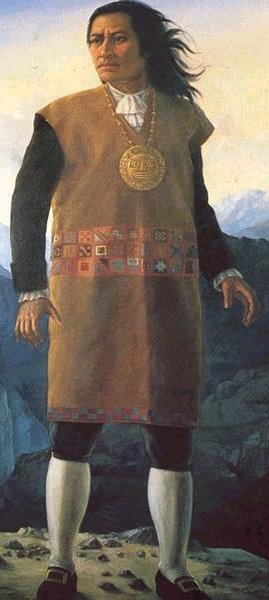
1781: Tupac Amaru II, Incan insurgent

On this date in 1781, the last name in Incan rebellion met a horrible end in the ancient Incan capital of Cusco.

José Gabriel Condorcanqui — rechristened Tupac Amaru II, as he was a distant descendant of the last Incan king — was a member of the privileged indigenous population depended upon by the Spanish to administer the forced and extorted labor that made its New World empire worth having.

Condorcanqui evidently had an epiphany.

In November 1780, he launched a well-planned rebellion by engineering the public execution of a hated corregidor Antonio de Arriaga at the hands of his own servant.

“From this day, no longer shall the Spanish feast on your poverty!”

This attention-grabbing entry onto the political chessboard was followed with an exemplary victory over Spanish forces. His revolt rapidly metastasized into an ethno-religious crusade, with all the accumulated bitterness of the Indians’ two-plus centuries maltreatment ferociously visited upon the Spanish.

It was a heady moment — but only a moment; within a few months, the Spanish had rallied and Tupac Amaru was betrayed into their hands.

The rebel had seized Incan symbology for his own purposes — speaking at ancient shrines, for instance — and the Spanish sentence against him included not only the inevitably horrific execution (of both Tupac Amaru and his wife and family) but a comprehensive and explicit programme of cultural annihilation to consign the Incan identity to the past. This lengthy sentence is well worth the read. (Sourced here, a pdf file; the bolded sections are my highlights.)

I must and do condemn José G. Túpac Amaru to be taken out to the main public square of [Cuzco], dragged out to the place of execution, where he shall witness the execution of the sentences imposed on his wife, Micaela Bastidas [Spanish link]; his two sons, Hipólito and Fernando Túpac Amaru; his uncle, Francisco Túpac Amaru; and his brother-in-law, Antonio Bastidas, as well as some of the principal captains and aides in his iniquitous and perverse intent or project, all of whom must die on the same day.

And once these sentences have been carried out, the executioner will cut out his tongue, and he will then be tied or bound by strong cords on each one of his arms and feet in such a way that each rope can be easily tied or fastened to others hanging from t he saddle straps of four horses, so that, in this position, each one of these horses, facing opposite corners of the square, will pull toward his own direction; and let the horses be urged or jolted into motion at the same time so that his body be divided into as many parts and then, once it is done, the parts should be carried to the hill or high ground known as “Picchu,” which is where he came to intimidate, lay siege to, and demand the surrender of this city; and let there be lit a fire which shall be prepared in advance and then let ashes be thrown into the air and a stone tablet placed there detailing his main crimes and manner of his death as the only record and statement of his loathsome action.

His head will be sent to the town of Tinta where, after being three days on the gallows, it shall be placed on a stake at the most public entrance to the town, one of his arms will go to the town of Tungasuca, where he was chief, where it will be treated in like manner, and the other in the capital of the province of Carabaya; one of the legs shall likewise be sent for the same kind of demonstration to the town of Libitaca in the province of Chumbilcas, while the remaining one shall go to Santa Rosa in the province of Lampa along with the affidavit and order to the respective chief magistrates, or territorial judges that this sentence be proclaimed publicly with the greatest solemnity as soon as it arrives in their hands, and on the same day every year thereafter; and they will give notice in writing of this to their superiors in government who are familiar with the said territories.

Since this traitor managed to arm himself and form an army and forces against the royal arms by making use of or seducing and leading with his falsehood the chiefs who are the second in command in the villages, since these villages, being of Indians, are not governed by such chiefs but rather by mayors who are elected annually by the vote or nomination of the chiefs: let these same electoral communities and the chief magistrates that care to give preference to candidates who know Spanish, and who are of the best behavior, reputation, and customs so that they will treat their subjects well and lovingly, honoring only those who have demonstrated honestly their inclination and faithfulness, eagerness, respect, obedience, submission, and gratitude to the greater glory of our great Monarch through the sacrificed of their lives, properties, or ranches in deference of their country or religion, receiving with brave disdain the threats and offers of the aforesaid reel leader and his military chiefs, yet taking care that these elected leaders are the only ones with the right to the title of chief or governor of their ayllus [communities] or towns, and that they cannot transmit their position to their children or other family members.

To this same end, it is prohibited that the Indians wear heathen clothes, especially those who belong to the nobility, since it only serves to symbolize those worn by their Inca ancestors, reminding them of memories which serve no other end than to increase their hatred toward the dominant nation; not to mention that their appear is ridiculous and very little in accordance with the purity of our relics, since they place in different parts images of the sun, which was their primary deity; and this prohibition is to be extended to all the provinces of this southern America, in order to completely eliminate such clothing, especially those items which represent the bestialities of their heathen kings through emblems such and the unco, which is a kind of vest; yacollas, which are very rich blankets or shawls of black velvet or taffeta; the macapaycha, which is a circle in the shape of a crown from which they hand a certain emblem of ancient nobility signified by a tuft or tassel of red-colored alpaca wool, as well as many other things of this kind and symbolism. All of this shall be proclaimed in writing in each province, that they dispose of or surrender to the magistrates whatever clothing of this kind exists in the province, as well as all the paintings or likenesses of their Incas which are extremely abundant in the houses of the Indians who consider themselves to be nobles and who use them to prove their claim or boast of their lineage.

These latter shall be erased without fail since they do not merit the dignity of being painted in such places, and with the same end in mind there shall also be erased, so that no sign remains, any portraits that might be found on walls or other solid objects; in churches, monasteries, hospitals, holy places or private homes, such duties fall under the jurisdiction of the reverend archbishops or bishops of both viceroyalties in those areas pertaining to the churches; and in their place it would be best to replace such adornments with images of the King and our other Catholic sovereigns should that be necessary. Also, the ministers and chief magistrates should ensure that in no town of their respective provinces be performed plays or other public functions of the kind that the Indians are accustomed to put on to commemorate their former Incas; and having carried out the order, these ministers shall give a certified account to the secretaries of the respective governments. In like manner shall be prohibited and confiscated the trumpets or bugles that the Indians use for their ceremonies and which they call pututos, being seashells with a strange and mournful sound that celebrate the mourning and pitiful memorial they make for their antiquity; and there shall also be prohibited the custom of using or wearing black clothing as a sign of mourning, a custom that drags on in some provinces in memory of their deceased monarchs and also of the day or time of the conquest which they consider disastrous and we consider fortunate since it brought them into the company of the Catholic Church and the very loving and gentle domination of our Kings.

With the same goal it is absolutely forbidden that the Indians sign themselves as “Incas,” since it is a title that anyone can assume but which makes a lasting impression on those of their class; and it is ordered, as is required of all those who have genealogical trees or documents that prove in some way their descent, that they produce them or send them certified and without cost by mail to the respective secretaries of both viceroyalties so that the formalities may be observed by those persons responsible to their excellencies the viceroys, consulting His Majesty where necessary according to each case; and the chief magistrates are charged to oversee the fulfillment of such requirements, to seek out and discover anyone who does not observe them correctly, in order to have it done to collect the documents with the aim of sending them to the proper authorities after giving their owners a receipt.

And so that these Indians renounce the hatred that they have conceived against the Spaniards, and that they adhere to the dress which the laws indicate, adopting our Spanish customs and speaking Castilian [Spanish], we shall introduce more vigorously than we have done up to now the use of schools, imposing the most rigorous and fair penalties on those who do not attend once enough time has passed for them to have learned the language; the duties and responsibilities involved in this plan going to the very reverend ecclesiastical prelates so that, in the opposition between parishes and doctrinas, they take care that those candidates bring affidavits from the provincial judges as to the numbers of people who speak the Said Castilian in those provinces … it being left up to the sovereign discretion of His Majesty to reward and honor those towns whose inhabitants have rendered, under the present circumstances, their due loyalty and faithfulness.

Finally, the manufacture of cannons of all kinds shall be prohibited under the penalty that any noble found manufacturing such items will be sentenced to ten years of prison in one of the presidios in Africa and any commoner will receive two hundred lashes as well as the same penalty for the same time period; reserving for a future time a similar resolution with regards to the manufacture of powder. And since there cannons of almost every caliber in the many ore-crushing mills and timber yards in these provinces, they will be gathered up by the magistrates once of the pacification of this uprising has been completely terminated in order to give account of them to the respective captaincy general so that he may determine whatever use he deems proper for them. Thus have I visualized, ordered, and signed: this is my final judgment.

José Antonio de Areche.

Tupac Lives.

The Spanish campaign to eradicate his name and identity didn’t exactly have legs.

The savagery of the crackdown helped generate Incan support for the rebellions that would shake off Spanish authority in the generations to come. He entered the official iconography of the post-colonial state, and can be found on Peruvian currency.

The very name Tupac Amaru became pregnant with the spirit of resistance — both in Peru, where it was adopted by a 1990’s revolutionary movement, and abroad, where a New York City Black Panther activist (pdf) gave the name to a son: Tupac Amaru Shakur.

On this day..

1781: John Donellan, Esq.

On this date in 1781, John Donellan was hanged for murdering his brother-in-law to secure an inheritance.

JOHN DONELLAN had been a captain in the army, and was the son of Colonel Donellan. He certainly distinguished himself as a good soldier, for not only had he been much wounded in the service, but, if his own account may be credited, he was singularly instrumental in the taking of Mazulapatam. … In June, 1777, he married Miss Boughton; and on Friday, 30th of March, 1781, he was tried at the assizes at Warwick for the wilful murder of Sir Theodosius Edward Allesley Boughton, Bart., his brother-in-law.

… Sir Theodosius was twenty years old on the 3rd of August past. On his coming of age he would have been entitled to above two thousand pounds a year, and in the event of his dying a minor the greater part of his fortune was to descend to his sister, the wife of Mr Donellan. It was known in the family on the evening of Tuesday, the 26th that Sir Theodosius was to take his physic the next morning. … As he was taking it he observed that it smelled and tasted very nauseous; upon which [his mother, Lady Boughton] said: “I think it smells very strongly like bitter almonds.” He then remarked that he thought he should not be able to keep the medicine upon his stomach.

Here a bottle was delivered to Lady Boughton containing the genuine draught, which she was desired to smell, and inform the Court whether it smelled like the medicine Sir Theodosius took. She answered in the negative. She was then desired to smell another containing the draught, with the addition of laurel-water, which she said had a smell very much like that of the medicine she gave to Sir Theodosius. … Two minutes after Sir Theodosius had taken the draught he struggled very much. It appeared to her as if it was to keep the draught down. He made a prodigious rattling in his stomach, and guggling …

She saw Mr Donellan less than five minutes after. … he asked her where the physic bottle was; on which she showed him two draughts; when he took up one of the bottles and said, “Is this it?” she answered, “Yes.” He then rinsed it, and emptied it into some dirty water that was in a washhand-basin; and on his doing so she said: “What are you at? You should not meddle with the bottles.” Upon that he snatched up the other bottle and rinsed it …

We omit the forensic testimony presented to confirm that the victim was indeed poisoned.

As well as the latter-day observer can tell, we have a guilty — and fairly clumsy — poisoner after his brother-in-law’s boodle.

We’ll never know the answer, but the Newgate author hints at other family members who might have had the same means, motive and opportunity … like Donellan’s wife:

[Lady Boughton] soon afterwards went into the parlour, where she found Mr and Mrs Donellan; and the former told his wife that her mother had been pleased to take notice of his washing the bottles, and that he did not know what he should have done if he had not thought of saying that he had put the water into them to put his finger to it to taste.

Lady Boughton’s just full of evidence! Don’t suppose she could have had anything to gain, hmm? Let’s ask a jailhouse snitch:

John Darbyshire deposed that he had been a prisoner in Warwick jail for debt, and that Mr Donellan and he had had a bed in the same room for a month or five weeks. He remembered to have had a conversation with him about Sir Theodosius being poisoned. On his asking him whether the body was poisoned or not, he said there was no doubt of it. The witness said: “For God’s sake, Captain, who could do it?” He answered it was amongst themselves; he had no hand in it. The witness asked whom he meant by themselves. He said: “Sir Theodosius himself, Lady Boughton, the footman and the apothecary.” The witness replied, “Sure, Sir Theodosius could not do it himself!” He said he did not think he did — he could not believe he would. The witness answered: “The apothecary could hardly do it — he would lose a good patient; the footman could have no interest in it; and it is unnatural to suppose that Lady Boughton would do it.” The Captain said how covetous Lady Boughton was: she had received an anonymous letter the day after Sir Theodosius’s death charging her plump with poisoning him; that she called him and read it to him, and trembled. She desired he would not let his wife know of that letter, and asked him if he would give up his right to the personal estate, and to some estates of about two hundred pounds a year belonging to the family. The conversation was about a month after the Captain came into the jail. At other times he said that it was impossible he could do a thing that never was in his power.

Stranger things have happened, but it sounds like a weak attempt to set mom up; it sounded weak to the jury, too.

At seven o’clock on the next day, the 2nd of April, 1781, he was carried to the place of execution at Warwick, in a mourning-coach, followed by a hearse and the sheriff officers in deep mourning. As he went on he frequently put his head out of the coach, desiring the prayers of the people around him.

On his arrival at the fatal spot he alighted from the coach and, ascending a few steps of the ladder, prayed for a considerable time, and then joined in the usual service with the greatest appearance of devotion; he next, in an audible tone of voice, addressed the spectators to this effect: that as he was then going to appear before God, to Whom all deceit was known, he solemnly declared that he was innocent of the crime for which he was to suffer; that he had drawn up a vindication of himself, which he hoped the world would believe, for it was of more consequence to him to speak truth than falsehood, and he had no doubt but that time would reveal the many mysteries that had arisen in his trial.

After praying fervently some time he let his handkerchief fall — a signal agreed upon between him and the executioner — and was launched into eternity. When the body had hung the usual time it was put into a black coffin and conveyed to the town hall to be dissected.

Part of the Themed Set: Selections from the Newgate Calendar.

On this day..

1789: Catherine Murphy, Britain’s last burning at the stake

On this date in 1789, Catherine Murphy was led past the hanging bodies of her husband and their other male codefendants at Newgate Prison, secured to a stake, and put to the last burning at the stake in English history.

The convicted coiners — counterfeiting rated as high treason at the time — were the last heirs to gender-specific execution methods before the Treason Act of 1790 gave coin-shaving ladies equal access to the halter.

Though Murphy thereby earned an unenviable historical footnote, the de facto practice on the scaffold had long since been changed to spare lawmen the spectacle of a woman roasting to death. Murphy, in fact, was killed by hanging — and the “burning” part of the sentence only imposed upon her corpse. (This, however, was still more than enough: NIMBYing prison neighbors appalled by the stench of burning flesh had lent their support to the Treason Act’s reforms.)

On this day..

1781: Mutinous ringleaders of the New Jersey line

On this date in 1781, George Washington quelled a dangerous mutiny in his starving Continental Army with a couple of salutary summary executions.

Weeks before, the Pennsylvania Line had mutinied for better pay — successfully. (When approached by British agents offering hard currency should they turn coat, the mutinous troops patriotically arrested the agents.)

General Washington had cause to fear widespread discontent in his chronically undersupplied army, however. He circulated to Congress and to several state governors an urgent appeal (.pdf) for more aid to hold up morale.

The aggravated calamities and distresses that have resulted from the total want of pay for nearly twelve months, the want of clothing at a severe season, and not unfrequently the want of provisions, are beyond description … it is vain to think an army can be kept together much longer under such a variety of sufferings as ours has experienced … unless some immediate and spirited measures are adopted to furnish at least three months’ pay to the troops in money, which will be of some value to them, and at the same time ways and means are devised to clothe and feed them better … the worst that can befall us may be expected.

Washington vowed in the meantime to “continue to exert every means I am possessed of to prevent an extension of the mischief.”

The mischief, however, extended.

The New Jersey line at Pompton imitated — and the imitation was reportedly explicit — the Pennsylvania line. They had legitimate grievances, like nearly everyone in the Continental Army, and that was precisely the problem: if mutiny became the means to resolve grievances, Washington wouldn’t have a Continental Army much longer.

Washington detailed Gen. Robert Howe to make an example.

Sir: You are to take the command of the detachment, which has been ordered to march from this post against the mutineers of the Jersey line. You will rendezvous the whole of your command at Ringwood or Pompton as you find best from circumstances. The object of your detachment is to compel the mutineers to unconditional submission, and I am to desire you will grant no terms while they are with arms in their hands in a state of resistance. The manner of executing this I leave to your discretion according to circumstances. If you succeed in compelling the revolted troops to a surrender you will instantly execute a few of the most active and most incendiary leaders.

And as Washington reported this afternoon to New Jersey Governor William Livingstonsuccess.

Dr. Sir: I have the pleasure to inform your Excellency, that the measures concerted for quelling the mutiny in the Jersey line were this morning carried into full execution. The mutineers were unexpectedly surrounded and awed into an unconditional surrender with little hesitation and no resistance. Two of the principal actors were executed on the spot, the rest pardonned. The spirit of mutiny seems now to have completely subsided and to have given place to a genuine repentance. This was very far from being the case previous to this step, notwithstanding the apparent submission which the assurances of redress had produced; they still continued insolent and refractory and disobedient to the commands of their officers.

A general pardon was promised by Colonel Dayton, on condition of an immediate and full return to duty. This condition was not performed on the part of the mutineers and of course they were not entitled to the benefit of the promise; besides which the existence of the Army called for an example. I have the honor etc.

That second paragraph of the letter hints at a bit of ass-covering from Washington. The officer on the scene, Elias Dayton, had, according to Charles Patrick Neimeyer, already smoothed the disturbance by promising that a state commission would adjudicate discharge claims.

The placated “mutineers” were therefore surprised to be roused from their beds at Ringwood, N.J., by Howe’s forces and forced to form a firing squad to execute their own sergeants. (Neimeyer also claims that the first six-man squad intentionally missed.)

This in-the-field execution to enforce military discipline was a precedent later cited by Alexander Mackenzie to justify hanging Philip Spencer, Samuel Cromwell and Elisha Small at sea for mutiny.

On this day..

1786: Hannah Ocuish, age 12

(Thanks to Caitlin at Vast Public Indifference for the guest post -ed.)

On December 20, 1786, the Sheriff of New London, Conn., led a distraught 12-year-old girl to the gallows, placed a rope around her neck, and hanged her in front of a crowd of spectators. The girl was Hannah Ocuish, a young member of the Pequot nation. She was charged with the murder of six-year-old Eunice Bolles, a white girl with whom Hannah had quarreled the previous summer.

While it is difficult to get a clear picture of Hannah’s life from the available sources, it is clear that hers was not a comfortable existence. An appendix to Rev. Henry Channing’s execution sermon notes that Hannah’s mother was “an abandoned creature, much addicted to the vice of drunkenness,” who sent Hannah to work as a servant in a white family’s home. At the age of six, Hannah was accused of beating a white child while trying to steal her necklace. The anonymous author describes Hannah’s character thus:

Her conduct, as appeared in evidence before the honorable Superior Court was marked with almost every thing bad. Theft and lying were her common vices. To these were added a maliciousness of disposition which made the children in the neighborhood much afraid of her. She had a degree of artful cunning and sagacity beyond many of her years.

This description, expressed in terms designed to emphasize the importance of training children in obedience, may or may not be accurate. Regardless, all evidence suggests that Hannah was alone in a hostile world.

On July 21, 1786, someone found Eunice Bolles’ body at the side of the road outside Norwich, Conn. The corpse displayed signs of extreme trauma: “the head and body were mangled in a shocking manner, the back and one arm broken, and a number of heavy stones placed on the body, arms and legs.” Investigators questioned Hannah, who initially denied any involvement, but mentioned that she had seen a group of boys on the road earlier. The town officials did not believe her. On July 22, “she was closely questioned, but repeatedly denied that she was guilty.” Still unconvinced, the investigators “carried [Hannah] to the house where the body lay, and being charged with the crime, burst into tears and confessed that she killed her, saying if she could be forgiven she would never do so again.”

Hannah’s confession, which was accepted as truth by the court, indicated that she had sought revenge on Eunice because the younger girl had “complained of her in strawberry time … for taking away her strawberries.” When Hannah saw Eunice walking to school alone, she beat and choked her, covering the body with rocks “to make people think that the wall fell upon her and killed her.”

Rev. Henry Channing, a talented local minister, visited Hannah in prison many times, urging her to repent so that her soul might be spared. On the day of her execution, he delivered a thundering sermon entitled, God Admonishing His People of Their Duty as Parents and Masters, which held Hannah up as an example of what could happen if parents did not raise their children to be “dutiful and obedient.”

Her crimes, he argued, were the “natural consequences of too great parental indulgence,” and warned that “appetites and passions unrestrained in childhood become furious in youth; and ensure dishonour, disease and an untimely death.” In the portion of the sermon directed at Hannah herself, Channing did his best to scare her into repentance:

HANNAH! — prisoner at the bar– agreeably to the laws of the land you have arraigned, tried and convicted of the crime of murder … The good and safety of society requires, that no one, of such a malignant character, shall be suffered to live, and the punishment of death is but the just demerit of your crime: and the sparing you on account of your age, would, as the law says, be of dangerous consequence to the publick, by holding up an idea, that children might commit such atrocious crimes with impunity … And you must consider that after death you must undergo another trial, infinitely more solemn and awful than what you have here passed through, before that God against whom you offended; at whose bar the deceased child will appear as a swift witness against you — And you will be condemned and consigned to an everlasting punishment, unless you now obtain a pardon, by confessing and sincerely repenting of your sins, and applying to his sovereign grace, through the merits of his Son, Jesus Christ, for mercy, who is able and willing to save the greatest offenders, who repent and believe in him.

At her trial in October, Hannah “appeared entirely unconcerned,” but as the date of her execution approached, she began to show fear. In early December, visitors began to ask her how long she had to live, and Hannah “would tell the Number of her Days with manifest Agitation.” On December 19th, she “appeared in great Distress . . . and continued in Tears most of the Day, and until her Execution.” Witnesses to her execution reported that Hannah “seemed greatly afraid when at the Gallows.” With her last words, she “thanked the Sheriff for his kindness, and launched into the eternal World.”

In the United States, the youngest children put to death by the government have all be children of color. James Arcene, a Cherokee boy, was only 10 or 11 years old when he was hanged for committed a robbery and murder that resulted in his 1885 hanging in Arkansas.* At 12, Hannah Ocuish was the youngest female offender executed by any state. In the 20th century, the youngest children executed were both African-American: 13-year-old Fortune Ferguson of Florida (1927) and 14-year-old George Stinney of South Carolina (1944).

In 2005, the United States Supreme Court abolished the death penalty for criminals who committed their crimes as juveniles (Roper v. Simmons). The court split 5-4, with Jutices Scalia, O’Connor, Thomas, and Chief Justice Rehnquist dissenting. In his dissent, Justice Scalia excoriated the majority for considering international consensus (along with the laws of 30 of the 50 U.S. states) on the cruelty of executing children under the age of 18 when determining the standard for “cruel and unusual.” Justice Scalia, an avowed proponent of Constitutional originalism, proclaimed, “I do not believe that the meaning of our Eighth Amendment, any more than the meaning of other provisions of our Constitution, should be determined by the subjective views of five Members of this Court and like-minded foreigners.”

* This post originally asserted that Arcene was a juvenile when hanged. In fact, he was (or claimed to have been) 10 years old or so at the time he committed the crime, but was not tried and hanged until over a decade later. (This is corrected in the Arcene post.) -ed.

On this day..

1783: The first hangings at Newgate Prison

On this date in 1783, London’s colorful penal history moved across town.

For centuries, public executions had been carried out at the storied Tyburn gallows, a ribald, rambunctious affair that involved carting the doomed from Newgate Prison through teeming city streets, by way of ale house pit stops.

The Tyburn era drew to a close late in the 18th century. Five weeks before, its last victim swung there.


The former hanging grounds of Tyburn, sketched by William Capon in 1785. The gallery still standing was privately erected, to sell tickets to spectators eager for a view.

Little more than a month later, the curtain raised and the trap fell on a new chapter for the London hanged.

Henceforth, the processional would be dispensed with, and the condemned simply walked across a courtyard and up a flight of stairs to a public gallows just outside the prison.

These were still public executions, and hardly eliminated the carnival atmosphere as this c. 1789 sketch will attest:

But it marked a move towards, if not altogether to, a version of the death penalty more familiar to modern eyes. For one thing, the prison itself became the site of punishment, absent the elaborate and occasionally dangerous theater of the trip to Tyburn; at Newgate, they were regularized, an extension of the frightful dungeon, and as the crowd itself was controlled and separated from the elevated platform, the natural next step would be at last to withdraw inside the prison’s walls.

At the same time, there is a technological advance towards “scientific” hangings geared to minimize suffering: the ‘New Drop’.

This system, whereby a trap sprung beneath the prisoner’s feet suspended him on the gallows, was not strictly new — a form of it had been used at Tyburn as early as 1760, though not repeated.* But the new drop (still just a variety of short drop, where strangulation is likely) marks a distinct shift towards a mechanistic punishment, clearly removed from the sometimes fraught physical confrontation between a prisoner and a hangman attempting to force him or her from the cart, and an antechamber into the grim 19th century science of reckoning hangman’s drops for the precise effect of snapping (without severing) the neck.

Of course, progress always has its detractors.

74-year-old Samuel Johnson groused at the “innovation” of leaving Tyburn:

[T]hey object that the old method drew together too many spectators. Sir, executions are intended to draw spectators; If they do not draw spectators, they don’t answer their purpose. The old method was most satisfactory to all parties; the public were gratified by a procession and the criminal was supported by it.

Approaching the matter from a very different perspective, Lord Byron found the Italian beheadings of Mastro Titta “altogether more impressive than the vulgar and ungentlemanly dirty ‘new drop’, and dog-like agony of infliction upon the sufferers of the English sentence.”

* In the correspondence of an early 19th century Secretary of the Admiralty, we have confirmation of this in a letter of Sir Peter Laurie, available from Google Books here and here. Laurie reports that “something like a drop in hanging criminals”

was not adopted as the general mode of execution till 1783, when ten felons were executed on the 9th of December in that year for the first time in front of Newgate, on a new drop or scaffold hung with black … The gallows used at Tyburn was purchased by a carpenter who, having no sentiment in his composition, converted it into stands for beer butts in the cellars of a public house called the “Carpenter’s Arms” in Adam Street.

On this day..

1780: David Dawson and Ralph Morden, Quaker “traitors”

On this date in 1780, two unconnected Quakers were hanged for two unconnected treason convictions in two different cities in Pennsylvania.

The public executions of Ralph Morden in Easton, Pa., and David Dawson in Philadelphia (in a double hanging along with counterfeiter Richard Chamberlain) had the unusual distinction of being treason convictions against the state of Pennsylvania during the Revolutionary War, rather than against any sort of federal entity.

According to the Espy File of American executions, there were only 15 people put to death for treason* during the Revolutionary War. It’s a remarkably low figure under the circumstances — separatist colonial conflict that often pitted revolutionary neighbor against loyalist neighbor.

Morden, a Quaker who kept his head down during the war, agreed to guide one Robert Land, a Tory who needed to slip past Continental sentries, and of course didn’t make it. His case is summarized here, here and here.**

Less is readily available about Dawson, but a fellow-prisoner (and fellow-Quaker) left an account remembering that he and the counterfeiter Chamberlain

were taken out amidst a crowd of spectators — they walked after a cart in which were two coffins and a ladder, etc., each had a rope about his neck and their arms tied behin [sic] them … they were both hanged in the commons of this city abt. 1 o’clock.

This prisoner, Samuel Rowland Fisher, kept a two-year journal (pdf) of his imprisonment in Philadelphia for Tory sympathies, and as one might imagine paints an unflattering picture of the revolutionary “State as they call it.” In his view, Dawson’s hanging was a

greater act of Cruelty in the present Rulers than anything they have heretofore done, for they never gave him even a shadow of a tryal in their own fashion & they have executed him merely as what they call a proscribed person because he came into the City while the Brittish Army lay here, the circumstances of which was, that he was coming from his abode with his Waggon, that being in danger of his life from some of Washington’s Men he fled into the City & left & lost his Wagon, Horses, provisions &c — He never acted in any manner under Brittish, nor had he taken the Test to the present Usurpers, he did not go with the Brittish Army to New York, but had secreted himself in various places till he was betrayed by Jamed Reed last Spring & taken prisoner

Quaker Notes

Quakers who stuck by the sect’s pacifist teachings had a tough go of the American Revolution, often lumped in as Tories by patriots and subject to spasms of popular abuse, official writs confiscating their property, and other indignities from those who considered them “the unfriendly Quakers … notoriously disaffected to the cause of American Liberty.”† That same prejudice occasionally exposed Quakers to the severest punishments for perceived crimes.

Thus Morden, who presumably helped the British agent as a personal gesture of assistance, an everyday “crime” for which hanging was an extreme stricture: one hundred Continental dollars from Chamberlain’s press to the reader who can demonstrate that this was one of the 15 most treasonable acts committed behind American lines. But confronted with the request in a time of war, what was the neutral, pacifist choice?

“A man was hanged this morning,” one British officer’s diary recorded, “for piloting some people through the back woods, to the Indians. He was very old and left a wife and 9 children. His death was chiefly owing to his being a noted friend of Government.” (Cited by John Coleman in “The Treason of Ralph Morden and Robert Land,” The Pennsylvania Magazine of History and Biography, Oct. 1955)

Dawson, meanwhile, had worked for the British during the city’s recent occupation by General William Howe and was one of many so-called Loyalists “attainted of High Treason” and stripped of property by the state. Still, the British had been gone more than two years by the time he hanged.

Egged by Benedict

What might have upgraded Dawson’s sentence to a capital one was having the bad sense to be apprehended around the same time news arrived that Benedict Arnold had betrayed the Revolutionary cause two months before this date.

Arnold had recently been stationed in Philadelphia, and there controversially married into a Tory family. The betrayal he wrought thereafter was keenly felt in the cradle of liberty, and Arnold’s

effigy was paraded through the streets and hanged, his wife was ordered to leave the city within fourteen days, and his estate was confiscated. Still more rigorous proceedings were instituted against the tories and Quakers, one of whom [Dawson -ed.] was convicted of high treason and hanged. (Source.)

Discipline and Punish

Since we are students of the morbid here, let us also pause to notice the strikingly throwback nature of the punishment — not merely the fact that the Dawson-Chamberlain hanging was public, but that they were so theatrically marched to it, with ropes drawn about necks like the false Martin Guerre.

Not only did the treason conviction belong to a pre-American jurisprudence — against the state, yes, but also of a broader British conception of treason that the still-to-come U.S. Constitution would sharply curtail — but the resulting sentence is sharply at odds with Pennsylvania’s historical image as a a haven of penal reform.

Before the decade was out, the Keystone State would establish itself as an international epicenter of the movement away from harsh and (to us) primitive-sounding judicial sanctions, reconceptualizing punishment into the ordered prison system still familiar today. Pennsylvania abolished the death penalty for all crimes but murder by the turn of the century (it had made liberal use of the rope to punish crimes like burglary before that), and even murder hangings were not frequent.

Quakers, and Quaker philosophy, were instrumental in the shift.

If the thought that led to that sea change came from a deeper place, it may yet have been informed by the episodic recent history of the revolution: according to Gail Stuart Rowe’s Embattled Bench, there were around 700 indictments and attainders for treason or misprision of treason in Pennsylvania throughout the American Revolution, and these resulted in only four hangings.

All four of the hanged were Quakers.

* The Espy file is an outstanding resource, with the intent to document every execution that took place in what is now the United States since its colonial antecedents. However, it is not necessarily reliable that it actually does this, so the precise figure of 15 should not be depended upon too greatly.

** Land himself managed to escape from the ambush, leaving only Morden to face the music. The interest in his fate seems to come from genealogists; according to this site, Charles Lindbergh numbered among his descendants — bringing us to another century’s death penalty.

† That was George Washington, cited in George Washington and Slavery. However, according to this listing of famous Quakers, other notable patriots like revolutionary Gen. Nathanael Greene, flag-stitcher Betsy Ross and polemicist Thomas Paine were Quakers, too.

On this day..

1783: John Austin

On this date in 1783, highwayman John Austin was hanged at Tyburn for robbing and murdering John Spicer on the road to London.

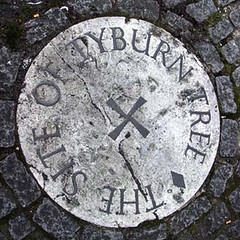
The village Tyburn on the outskirts of London had been used for public hangings dating to the 12th century. Though not the only site of executions in London, it was the iconic one. Situated at the modern intersection of Edgware and Bayswater Roads on the northeast corner of Hyde Park, the distinctive “Tyburn tree” — a triangular gallows capable of hanging over twenty prisoners simultaneously — made a foreboding landmark round which teemed thousands of spectators on execution days. Some 1,200 people were executed on this singular device.

Public executions typically began four kilometers away at Newgate Prison, where the condemned were loaded into ox carts for a two-to-three-hour procession through public streets now at the very core of London, perhaps including stops at public ale houses.


View Larger Map

While Tyburn carved its niche during England’s age of religious bloodletting, its social role had changed significantly by the 18th century. Most of the doomed were offenders against property, often executed for stealing negligible sums or else reprieved for transport to the New World or, later, Australia. Peter Linebaugh’s The London Hanged intriguingly suggests that hangings of this era were an assertion of nascent capitalism, violently throwing off the remains of feudal labor relations. (Summarized more thoroughly in this friendly review.)

Even that formative age was receding. Once a neighboring village, Tyburn had been swallowed up by the city; a generation before Austin’s death, residents of the now-upscale neighborhood had successfully pushed for the removal of the macabre “Tyburn tree”.

Austin was hanged, instead, on a portable gallows, a typical penitent imploring heavenly mercy and taking 10 minutes to strangle to death — the very last execution at that somber and storied crossroads.

Here’s the story of the Tyburn hangings from London writer Peter Ackroyd:

On this day..