1789: Skitch, amidst the tears of thousands

London Times, April 14, 1789:

Exeter, April 8. Friday last were executed at Heavitree-gallows, William Snow, alias Skitch, for breaking the house of Richard Adams, in the parish of Romansleigh, and stealing a quantity of plate thereout; and James Waybourn, for robbing farmer Stokes, near Bickley-wood. They were perfectly resigned to their fate; yet it was with difficulty that Waybourn was induced to answer any questions respecting his guilt.

The behaviour of Skitch manifested how little there is in the approach of death, when the human mind is brought into a calm and pious disposition, by serious meditation on the attributes of an all powerful and gracious Deity. He declared that day to be the happiest of his life; and exhorted the spectators to avoid his errors. He had hung but a few seconds, when the rope slipped from the gallows, and he fell to the ground. It is impossible to describe the feelings of the multitude at the thought of his being again suspended; yet was this painful interval less afflicting to the magnanimous sufferer than to the spectators. Skitch heard their sorrowful exclamations, and said, with an air of compassion, “Good people, be not hurried; I can wait a little:” and the executioner wishing to lengthen the rope, which had slipped, Skitch calmly waited till Waybourn was quite dead, when the rope was taken from the deceased’s arms, in order to compleat the execution of Skitch, who was a second time launched from the cart amidst the tears of thousands.


An overgrown gravestone in a Heavitree church cemetery. (cc) image from HayneZ.

On this day..

1786: Elizabeth Wilson, her reprieve too late

On this date in 1786, Elizabeth Wilson was hanged in Chester, Pennsylvania for the murder of her infant twins.

“One of the melodramas of the early American republic,” our Elizabeth (sometimes called “Harriot Wilson” in the accounts) was a farmer’s daughter of Chester County who got knocked up by a passing sailor. When this gentleman declined to make an honest woman of her after she had borne the bastards, the kids disappeared — later to be discovered dead in the woods by a hunter.

The fallen woman denied having killed them directly, but “acknowledged having placed the children by the road-side, in order that any person passing that way, and who had humanity enough, might take them up.”

She would eventually, after condemnation, accuse her lover of having slain the children.

Elizabeth’s brother William Wilson vigorously undertook on this basis to secure her a pardon at the hands of the Commonwealth’s executive authority, the Supreme Executive Council — then under the leadership of no less august a character than Benjamin Franklin.

And he found a sympathetic audience. Council Vice-President Charles Biddle* “firmly believed her innocent, for to me it appeared highly improbable that a mother, after suckling her children for six weeks, could murder them … there was a large majority would have been for pardoning her.”

Instead of an outright commutation, it granted a stay of execution for William Wilson to investigate further, which he did to no successful effect.

“But here we must drop a tear!” exclaims the Faithful Narrative of Elizabeth Wilson, a popular pamphlet (pdf) sensationalizing the case. “What heart so hard, as not to melt at human woe!”

For William Wilson’s suit on behalf of his sister had succeeded in earning, on the eve of the Jan. 3 hanging, a second respite on Biddle’s certain anticipation that clemency would be forthcoming. Ill himself, William took the stay of execution from Biddle’s own hands and raced through a fearful storm on the 15-mile ride from Philadelphia to Chester … but

did not arrive until twenty-three minutes after the solemn scene was closed. When he came with the respite in his hand, and saw his sister irrecoverably gone, beheld her motionless, and sunk in death, who can paint the mournful scene?

Let imagination if she can!

Imagination can do quite a lot with this sort of material, and so the tale of Elizabeth Wilson — the intrinsic pathos of the condemned, her widely-suspected innocence, her evangelical-friendly repentance, the cliffhanger conclusion — became widely re-circulated, and undoubtedly embroidered.

Quaker colonial diarist Elizabeth Drinker (who had firsthand experience of official injustice, when suspicious-of-Quakers revolutionaries had banished her husband from Philadelphia) was still seeing these publications over a decade after Wilson’s death.

May 16 [1797]. Unsettled. Wind variable. Read a narrative of Elizabeth Wilson, who was executed at Chester, Jany ’86, charged with the murder of her twin infants. A reprieve arrived 20 minutes after her execution, by her brother from Philadelphia. She persisted to the last in her account of the murder being committed by the father of the children, which was generally believed to be the truth. I recollect having heard the sad tale at the time of the transaction.

The Wilson story actually persisted (and persists) for centuries yet. Her shaken brother, William, withdrew himself from society and lived out his last years in a cave: he entered folklore as the Pennsylvania Hermit, affixed with his tragic sister to all manner of spook stories, like a spectral horseman galloping to Chester, or a ghostly woman rummaging the leaves where the bodies were found. You’ll hear all about the Pennsylvania Hermit when touring his former stomping grounds, now open to the public (for a fee, my friend) as Indian Echo Caverns.

* Biddle was a future U.S. Senator, but he’s probably best known through his son. Born just five days after Elizabeth Wilson’s execution, Nicholas Biddle was a bitterly controversial character as one of antebellum America’s original banksters.

Charles Biddle’s notes on the case veer into the era’s philosophical concern with the timeless problem of making a just response to infanticide.

“Perhaps,” he muses “the punishment of death is too great for an unmarried woman who destroys her child. They are generally led to it from a fear of being exposed … [and] while death is the punishment, a jury will seldom find a verdict against them.”

On this day..

1789: The Canadian Burglars

“More solemnity was perhaps never observed at any execution before” the hanging this date in 1789 of William Mooney Fitzgerald and John Clark in St. John, New Brunswick.

The fate of these two Irish career criminals is one of many arresting stories told on the Early American Crime blog, whose entry (and complementary podcast) this site could hardly improve upon.

Connoisseurs of historical executions are well-advised to subscribe.

On this day..

1783: Johanna Catharina Höhn, by Goethe’s vote

“To think is easy. To act is hard. But the hardest thing in the world is to act in accordance with your thinking.”

-Goethe

On this date in 1783, Johanna Catharina Höhn lost her head for infanticide … thanks to the vote of the man who wrote the most recognizable infanticide story in literature.

Eleven years before, then-22-year-old Johann Wolfgang von Goethe had been a firsthand witness to the trial of another infanticide who ultimately lost her head. This case very likely inspired the character Gretchen in Goethe’s best-known work, Faust.

Faust was a lifelong project for the author, but evidently the same could not be said of empathy for infanticidal mothers.

As a Privy Councilor to Carl (or Karl) August, Grand Duke of Saxe-Weimar-Eisenach, Goethe was presented with the case of Höhn, a 24-year-old unmarried servant girl who cut her newborn son’s throat.

Infanticide was an Enlightenment wedge issue touching not only evolving standards of humane criminal justice, but “as the main eighteenth-century area of conflict surrounding social repression and female sexuality.”*

Was it justice to put mothers to death for infanticide? Was it efficacious for a state to do so — given that such crimes were committed in a state of desperation that might negate deterrence, and that the offenders attracted the pity of potentially unruly scaffold mobs?

And if the executioner’s sword** was not depended upon to keep women keeping it in their britches, what social policies ought to replace it?

Infanticide and its prevention was the favorite theme of the criminologists of that time. [Christian] Rothenberger calls attention to the wide discussion of means to care for the poor, to the evil effects of luxury, and then to a “formliche Kindermordlitteratur.”† [L.W.] Seyffarth, the editor of the best edition of [Johann Heinrich] Pestalozzi‘s works, says: “The question how infanticide might be stopped was at that time a burning one.”

The great interest in infanticide can best be brought to view by the contest for a prize of 100 ducats offered by [Karl Theodor] von Dalberg, intendant of the Mannheim theater, for the best essay on the subject: “What are the best and most practicable means to eradicate infanticide without promoting prostitution?” The contest closed at Whitsuntide, 1781. The offer of the prize was published in most of the newspapers and magazines of that time and was generally accompanied by editorial comments. The editorial in August Ludwig Schlozer‘s magazine Briefwechsel is typical. “There are crimes committed among us,” the editor writes, “which are the most horrible and at the same time the most common, and among these is infanticide; crimes which are related to virtues, virtues which develop into vices, and among these too is infanticide; crimes which experience teaches are not made less frequent by increasing the severity of the punishment, while not to punish them would bring disgrace to mankind and destruction to law and order, and among these too is infanticide … How long shall we lead to the block these unfortunate girls as sacrificial victims, whose love and the natural weakness of their sex, whose adornment of innocence and modesty has made them to be mothers and murderesses?

The Duke inclined very strongly to the progressive answer gaining ground at the time, and when Hohn’s case surfaced, he put to his aides the prospect of eliminating the death penalty for infanticide and replacing it with other legal sanctions.

Those aides produced a mixed response. Goethe, perhaps the duke’s closest advisor, was ultimately in a position to exercise decisive influence on whether to adopt the duke’s proposal. (Whether it was the decisive influence is a matter of some dispute.)‡

Despite his sensitive portrayal of the fictional Gretchen/Margarete in Faust, the great writer took a distinctly retrograde stance on sparing actual flesh-and-blood women … and Goethe’s position, which he formally voted only 24 days before the execution, carried the day.

The evidence is clear that there was substantial (though not necessarily unanimous) agreement with the duke’s proposal to abolish the death penalty for infanticide.

… Without doubt, then, Goethe’s vote carried considerable weight. How could it not? He was the duke’s best friend and thus easily the most powerful member of the Council after Carl August because of his immense influence over him … [and] Goethe unquestionably cast his vote to retain the death penalty for a crime that was widely seen in his time as resulting from social injustice and harbouring wide potential for extenuating circumstances (in principle, not only in particular cases). His vote thus ran entirely counter to his depiction of the case of Margarete in Faust, in which ‘extenuating circumstances’ abound. While the question of Goethe’s guilt is a moral one that need not concern us, his part in the responsibility for retaining the death penalty for infanticide and thus also for the execution of Johanna Hohn is crystal-clear.*

A Weimar journalist called it “state murder.”

Hohn’s body was delivered to a Jena professor for anatomization.

A recent German book, Goethes Hinrichtung (Goethe’s Execution), novelizes the case.

* W. Daniel Wilson “Goether, his Duke, and Infanticide: New Documents and Reflections on a Controversial Execution,” German Life and Letters, January 2008. This volume includes the (German) text of the previously unpublished Halsgericht, a very detailed “script” for the actual execution. This volume of German Life and Letters also features a ceremonious dialogue between der Scharfrichter, the executioner, and der Richter, the judge, conveying possession of the criminal and legal direction for her punishment, which would all have been enacted in public in the doomed woman’s presence.

** Hohn was beheaded with a sword; this was itself a “mercy,” as she could have been dispatched by drowning.

† Most notably, Die Kindermörderin by Heinrich Leopold Wagner (both German links).

‡ Note that the consideration at the level of the Privy Council was formally about whether to abolish the death penalty for infanticide in general — not directly about Hohn’s case, which proceeded on a separate track. It seems to be generally agreed that Goethe and all other parties understood Hohn would live or die based on the statutory decision.

On this day..

1781: Isaac Hayne, paroled prisoner of war

On this date in 1781, South Carolina patriot Isaac Hayne was hanged for breaking his conditional British parole and re-enlisting in the American Revolution.

Though Hayne is not, to us, the most famous revolutionary executed by the British, he might have been considered by his contemporaries as the most prominent individual to go to the scaffold for the cause.

A wealthy planter (lots of slaves!) whose home and grave can still be toured in Jacksonboro, Hayne was among 5,000 to surrender to the British when the latter captured Charleston in 1780.

These prisoners were required to swear an oath of allegiance to the crown in exchange for their parole, which Hayne reluctantly agreed to do because his family had been hit with smallpox.

He declared to a friend that,

as they [the British] allow no other alternative than submission, or confinement in the capital, at a distance from my wife and family, at a time when they are in the most pressing need of my presence and support, I must, for the present, yield to the demands of the conquerors. I request you to bear in mind, that previous to my taking this step, I declare that it is contrary to my inclination, and forced on me by hard necessity. I will never bear arms against my country … I do not mean to desert the cause of America.

But as the British southern campaign foundered over the year ahead, the mother country eventually attempted to call him up to do just that: bear arms against his country.

Hayne thought his parole terms protected him from ever having to serve against the colonies, so he simply got back into the fight on the revolutionary side instead. He was captured in that capacity.

The British commander Francis Rawdon handled his relapsed prisoner with uncommon severity, putting him to a drumhead military tribunal with a preordained outcome and refusing the many public pleas for leniency.

The irregular and vengeful nature of these proceedings, and Hayne’s seemingly honorable conduct, raised hackles on both sides of the Atlantic; shortly after hanging Hayne, Rawdon returned to the British Isles to find a good deal of pointed criticism of his behavior. (Parliament quashed any damaging official inquiry, and Lord Rawdon actually extracted an apology from the peer who had the temerity to motion the investigation — an intolerable impeachment on Rawdon’s honor.)

The Hayne incident was widely understood to have been conditioned by British frustration at its failing fortunes in the war. By the time of the execution, the redcoats held nothing of South Carolina save Charleston itself. General Cornwallis had recently marched north from the Palmetto State; in a few weeks’ time, he would surrender his sword and the British cause alike after the decisive British defeat at Yorktown, Virginia.

And though the commandants at Charleston scarcely anticipated that stunning reversal, they had only a few months before suffered the upsetting (but more legally tenable) hanging of the honorable British Major John Andre as a result of the Benedict Arnold affair. British forces were reputedly on the lookout for any opportunity to trade tit for tat.

Continental Gen. Nathaniel Greene alleged that the British officer who received the petition for Hayne’s life simply wrote on it John Andre — and sent it back.


Isaac Hayne was the great-uncle of South Carolina pol Robert Y. Hayne, best remembered for a hot sectional debate with Massachusetts Sen. Daniel Webster. (Read it all here, if you must.)

It was during this exchange of Senatorial disquisitions that Webster delivered one of the noted orations of the antebellum era, the aptly-named Second Reply to Hayne:

I have not allowed myself, Sir, to look beyond the Union, to see what might lie hidden in the dark recess behind. I have not coolly weighed the chances of preserving liberty when the bonds that unite us together shall be broken asunder. I have not accustomed myself to hang over the precipice of disunion, to see whether, with my short sight, I can fathom the depth of the abyss below; nor could I regard him as a safe counselor in the affairs of this government, whose thoughts should be mainly bent on considering, not how the Union may be best preserved, but how tolerable might be the condition of the people when it should be broken up and destroyed. While the Union lasts, we have high, exciting, gratifying prospects spread out before us and our children. Beyond that I seek not to penetrate the veil. God grant that in my day, at least, that curtain may not rise! God grant that on my vision never may be opened what lies behind! When my eyes shall be turned to behold for the last time the sun in heaven, may I not see him shine on the broken and dishonored fragments of a once glorious Union; on States dissevered, discordant, belligerent; on a land rent with civil feuds, or drenched, it may be, in fraternal blood! Let their last feeble and lingering glance rather behold the gorgeous ensign of the republic, now known and honored throughout the earth, still full high advanced, its arms and trophies streaming in their original lustre, not a stripe erased or polluted, not a single star obscured, bearing for its motto, no such miserable interrogatory as “What is all this worth?” nor those other words of delusion and folly, “Liberty first and Union afterwards”; but everywhere, spread all over in characters of living light, blazing on all it sample folds, as they float over the sea and over the land, and in every wind under the whole heavens, that other sentiment, dear to every true American heart, – Liberty and Union, now and for ever, one and inseperable!

When not being rhetorically posterized by New England gasbags, Robert Hayne made time to pen a justification for his famous forebear’s conduct for the Southern Review in 1828 — comparing the British behavior of executing rather than detaining a prisoner who broke parole to the massacre at Jaffa Napoleon notoriously ordered in 1799.

(Actually, Isaac Hayne’s old nemesis Francis Rawdon had only died in 1826; Robert Hayne wrote his piece to confute a vindication of himself that Lord Rawdon — also recognized by his subsequent titles, Earl of Moira and Marquess of Hastings — had authored, decades after the fact, of his conduct in the Hayne matter.)

Though this 37-page slog of Robert Hayne’s is obviously in the public domain by now, it appears it is not yet freely available online. However, it’s the source of the otherwise unattributed quotes in this article.

Part of the Themed Set: The Empire Strikes Back.

On this day..

1782: Captain Joshua Huddy

On this date in 1782, Captain Joshua Huddy of the revolutionary New Jersey patriot militia was summarily (and extrajudicially) hanged on the New Jersey coast by the British Tories.

Huddy was a troublesome rascal in civilian life, a regular denizen of courts in his native Salem, Mass., and (upon transplant in 1778) Monmouth County, N.J.

Tory British Loyalists found him troublesome in the bare-knuckled revolutionary conflict in Monmouth, “often engaged in raids and revenge executions, which continued even after the war’s end.”

Huddy mounted various guerrilla raids in the area from 1779; his Loyalist opposite number actually captured him in 1780, but Huddy was freed by his comrades before he could be taken to the British.

Not so lucky this time.

On March 24, 1782, Loyalists overwhelmed Huddy’s fort at Toms River, N.J..

This was, de facto if not de jure, within the compass of those raids occurring after the war’s end, since at five months after Yorktown, the American Revolution was settled in all but name.

Huddy figured to be exchanged for Loyalist prisoners, but word came that a Monmouth County Tory named Philip White had been killed.

The last English royal governor of New Jersey, William Franklin,* ordered Huddy’s execution in retaliation-slash-punishment without any form of court-martial. (It seems the Loyalist position was that Huddy had himself been involved in White’s death; the Patriots insisted that Huddy was already in British hands when White was killed.)

A note was found pinned to Huddy’s body, reading,

We the refugees, having with grief long beheld the cruel murders of our brethern, and finding nothing but such measures daily carrying into execution — we, therefore, determine not to suffer without taking vengeance for the numerous cruelties; and thus begin, and, I say, may those lose their liberty who do not follow on, and have made use of Captain Huddy as the first object to present to your view; and further determine to hang man for man while there is a refugee existing. Up goes Huddy for Philip White.

(Two other prisoners taken with Huddy were exchanged, and had the story to tell — including Huddy’s remark that he would “dye innocent and in a good cause.”)

This, of course, caused quite a hue and cry for vengeance on the Patriot side.

George Washington demanded Huddy’s executioner for a bit of tit-for-tat, but although the British repudiated the lawless hanging, they refused to give Washington his man. Richard Lippencott (or Lippincott) instead got a British trial in New York, skated on an only-following-orders defense, and subsequently retired to Canada to live to the ripe old age of 81.

The frustrated proto-Americans resorted to selecting a captured Yorktown officer by lot for a reprisal execution.

This lottery was “won” by the young British officer Charles Asgill, who stood for some months in danger of a politically awkward hanging even as the sides maneuvered towards the official end of the war.

Since Asgill turned out to be a charismatic, youthful officer of unblemished honor, nobody felt good about the situation; even Huddy’s widow asked for Asgill’s life to be spared. (Though that might also be because Huddy stiffed her in the will he scribbled out moments before death, written on the head of the barrel they used to hang him.)

Eventually, pressure from the Revolution’s French patrons — the hostage had a Huguenot mother — helped Asgill avoid hanging.**

Returned to the British, Asgill went on to become a very prominent general.

Nobody ever expiated Captain Joshua Huddy’s hanging.


Memorial for Joshua Huddy at Huddy Park in Highlands, N.J. Image (c) Sheena Chi and used with permission.

* Son of American patriotic luminary Benjamin Franklin. This is why you don’t talk politics with family.

** Upon his release from American custody, Asgill traveled to France to thank personally his royal saviors. Louis XVI and Marie Antoinette could hardly have imagined that they would one day soon stand in Huddy’s shoes.

On this day..

1781: The slaves of the Zong, for the insurance

Beginning this day in 1781, the captain of the slave ship Zong began throwing his cargo overboard in a still-notorious case combining the horrors of the Middle Passage with the cruel rapacity of capital.

The Liverpool-based ship was en route from Africa to Jamaica, there to exchange its human chattel for New World produce bound for the European market.

Characteristically for slave ships, it was inhumanly packed: more economical for a slaver to overcrowd its captives and write off the ones who died than to maximize slaves’ chances of survival. And on this particular ship, malnutrition and disease claimed more than 60 slaves (as well as seven crew members).


Underwater sculpture off Grenada commemorating slaves thrown overboard during the Middle Passage.

With many more in danger of expiring, Captain Luke Collingwood reasoned that the cargo would be a loss if it succumbed, but that shippers’ insurance would reimburse the firm “when slaves are killed, or thrown into thrown into the sea in order to quell an insurrection.” Over a three-day span beginning Nov. 29, 1781, Collingwood had 133 still-living but sick slaves cast overboard;* “the last ten victims sprang disdainfully from the grasp of their executioners, and leaped into the sea triumphantly embracing death.” (Source)

This gave the ship’s owners — the good captain himself was not among them — the chance to attempt an insurance scam.

This historical-philosophical book (review, a pdf) analyzes the Zong affair as the emblematic “inauguration of a long twentieth century underwritten by the development of an Atlantic cycle of capital accumulation.”

When the Zong landed having lost in total more than half of its original 440 slaves (and Collingwood himself, that fastidious servant of his shareholders), its owners did indeed attempt to recoup the many who had been intentionally killed. Smelling fraud, the insurer refused to pay.

There followed the signal case of Gregson v. Gilbert, a dry insurance trial that also became a beacon of the slave system’s blood-chilling jurisprudential logic.

After a jury sided with the claimant shippers against the insurers, the matter hit a wide public on appeal before Lord Chief Justice Mansfield when abolitionist activists Granville Sharp and Olaudah Equiano seized upon its conscience-shocking quality.

While Sharp and Equiano agitated unavailingly for a homicide investigation, the insurer — which was itself in the very same business of human bondage as the shipper — self-righteously posed “as counsel for millions of mankind, and the cause of humanity in general.” (Source) Its interests, after all, would be served by the least possible indemnity for slaves murdered in passage.

Solicitor-General John Lee — “the learned advocate for Liverpool iniquity,” in Sharp’s estimation — successfully insisted upon limiting the case to its commercial considerations.

What is this claim that human people have been thrown overboard? This is a case of chattels or goods. Blacks are goods and property; it is madness to accuse these well serving honourable men of murder. They acted out of necessity and in the most appropriate manner for the cause. The late Captain Collingwood acted in the interest of his ship to protect the safety of his crew. To question the judgment of an experienced, well-travelled captain held in the highest regard is one of folly, especially when talking of slaves. The case is the same as if horses had been thrown overboard. (Quoted here; Wikipedia has it “as if wood had been thrown overboard.”)

Lord Mansfield agreed, “(though it shocks one very much) that the case of slaves was the same as … horses,” and simply found with the insurers that no liability attached them since the killings were voluntary rather than necessary.

Nobody was ever prosecuted.


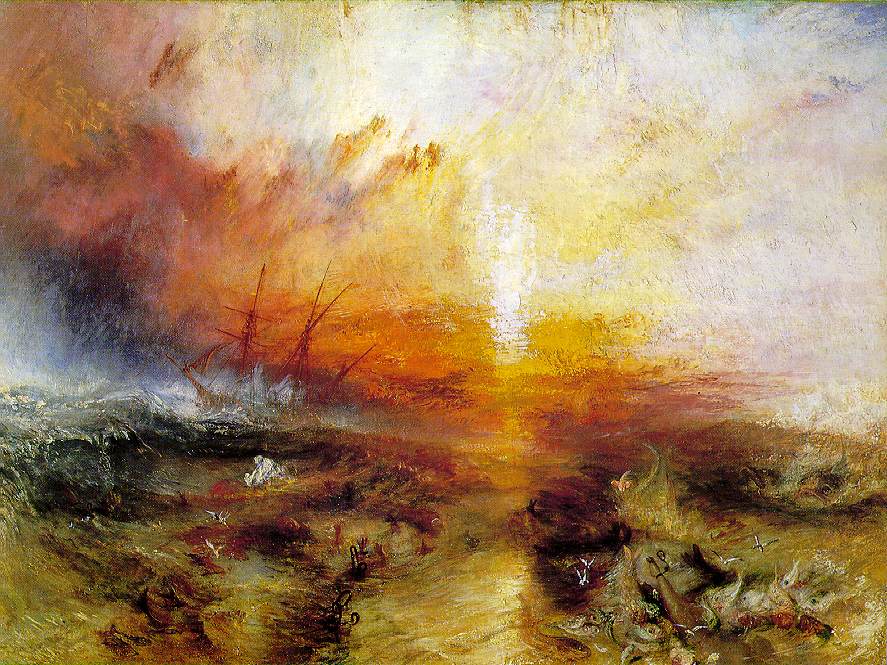
The disturbing 1840 Turner seascape “Slavers throwing overboard the Dead and Dying – Typon [sic] coming on”, also known simply as “The Slave Ship”, is widely thought to have been inspired by the Zong episode. The allusion would have been well-known to his contemporaries.

* One of the 133 survived by climbing back aboard the ship.

On this day..

1780: Corregidor Antonio de Arriaga, by his slave

On this date in 1780, Incan-Peruvian indigenous leader Tupac Amaru launched his insurrection against the Spanish with the public execution of a Spanish corregidor.

Antonio de Arriaga, as Spain’s man in Tungasuca, had as part of his job description forcing curacas to extract the crown’s tribute from the natives. This put some tension between him and the likes of the strong-willed Tupac Amaru, who advocated fiercely enough for his people’s rights that Arriaga threatened him with death.

It also made Arriaga’s death an invitingly emblematic scene to open the indigenous revolt.

On Nov. 4, 1780, Tupac Amaru kidnapped Arriaga returning from a dinner party, then forced him to sign letters summoning Spaniards and curacas alike to Tungasuca.

There, he mustered his own force of armed natives and performed for them a “carefully staged public ceremony.”

According to a primary source excerpted in The Tupac Amaru and Catarista Rebellions

Account of the Most Horrible Crime Committed by Jose Gabriel Tupac Amaru, Cacique of Pampamarca

On the morning of Friday, November 10th, Tupac Amaru ordered that three columns … be organized from all the people from his Province that were already there. Two were composed of Spaniards and Mestizos armed with muskets, sabers, and sticks; and one of Indians with slings. In the middle of this, he brought out the Corregidor, dressed in his military uniform, and publicly started taking his uniform off, stripping him of his rank following the rituals he had understood and seen in other occasions, until he was left in his shirt. He then put a shroud on him … that had the title of La Caridad on it. He then gave the order to take him to the gallows, accompanied by the Priest and two other clergymen, where he went with a resignation and patience worthy of somebody who was already touching the portals of eternity.

Once on the gallows the Corregidor was forced by the tyrant to publicly declare that he deserved to die in that way. A black slave of the Corregidor [named Antonio Oblitas -ed.] served as his executioner, but the ropes snapped and both fell to the ground. But they suspended them again with a lariat around their necks, and thus they completed the execution in clear sight and tolerance of all his Province. [“they” is as rendered in the book; I have no indication that more than one person was executed. -ed.] Not one voice was raised that would disturb the operation. And most surprising of all was that those same Collectors and those close to the Corregidor were the ones who (oh, what an awful spectacle of perfidy!) sped his way to the ignominious place of execution, and who pulled on his feet so he could die even more violently.

The rebellion, needless to say, was on.

On this day..

1789: The murderers of the baker Francois

On this date in 1789, two working stiffs literally became stiffs for a noteworthy bread riot during the French Revolution’s early days.

Ah, 1789.

It was the best of times, it was the worst of times … it was the season of Light, it was the season of Darkness; it was the spring of hope, it was the winter of despair. And we know how all that ends.

Just three months after the Bastille was stormed, France was merely pregnant with its coming Terrors. The Revolution was in its “moderate stage”.

Some moderation.


“Events of the 22nd of October, 1789: The hanging of a man named Francois, a baker”. Despite the title, sources (like this French-language study in the Annales historiques de la Revolution francaise, overwhelmingly date the baker’s murder to the 21st.

The tumbrils may not have been running (actually, the Revolution’s iconic execution device had not yet even been created), but the “October Days” had enough to scare you, especially if you were a sensible constitutionalist type like the Marquis de Lafayette.*

Like a mob dragging the King back to Paris from Versailles, with the heads of his royal guards on pikestaffs.

A drought had created a calamitous bread shortage, which in turn helped stir the Revolutionary pot. The mob that invaded Louis XVI‘s palace a couple of weeks before had celebrated his return to Paris singing “We Have the Baker, the Baker’s Wife, and the Baker’s Son. We Shall Have Bread.” When the king’s presence failed to ease the shortage, fresh disturbances followed.

On October 21, 1789,** the baker Denis Francois became the unfortunate focus of one such, when a famished woman spuriously denounced him a monopolist. A frenzied crowd lynched the hapless boulanger before he could get a word in edgewise.

This event occasioned the Constituent Assembly to pass a martial law decree, permitting a municipality to signal martial law by raising a red flag, whereupon anyone failing to disperse made him- or herself liable to summary military execution.

According to Lafayette (cited in Revolutionary Justice in Paris: 1789-1790):

During the disturbance stirred up against the baker Francois, another one broke out in the Faubourg Saint-Antoine, the object of which was to unite with the Faubourg Saint-Marcel for purposes of reducing the price of bread, and for getting into the convents under the pretext of taking the muskets stored there. The National Guard, in breaking up these seditions, arrested the assassin of the baker [a dock porter named Blin] and the principal instigator of the faubourg [i.e., the Faubourg Saint-Antoine, namely a laborer named Michel Adrien†]. Both were judged and hanged the next day.

* We meet Lafayette here as captain of the National Guard; in a few years, the progress of the Revolution that he struggled to contain and direct will make him persona non grata in his country.

** Six Thousand Years of Bread: Its Holy and Unholy History gives the date as Oct. 20, though it’s not clear upon what authority. Archibald Alison placed it on the 19th. Whenever the murder of Francois occurred, the martial law decree’s passage on the 21st appears to be firmly dependable, which would mean the supposed malefactors’ deaths on this date should be as well.

† Revolutionary propagandist Camille Desmoulins later seized on the very skimpily justified Adrien execution — he “was judged and hanged in twenty-four hours for circulating a seditious flyer, although he didn’t know how to read” — to contrast with the outsized tenderheartedness shown for aristocrats who have “different weights on the scales of justice.” (Revolutionary Justice in Paris: 1789-1790)

On this day..

1789: Rachel Wall, female pirate

(Thanks to Jonathan Shipley of A Writer’s Desk for the guest post. -ed.)

“Into the hands of the Almighty God I commit my soul, relying on his mercy … and die an unworthy member of the Presbyterian Church, in the 29th year of my age.”

These were the last words of Rachel Wall, on this date in 1789. It was she, whom the Presbyterians must have frowned upon mightily, who was the last woman hanged in Massachusetts and, further, the first noted American-born female pirate.

No walking the plank for her. She was hanged, proven guilty of robbery, by Sheriff Joe Robinson on a beautiful fall day. Her downfall after a brief career with her husband of piracy, thievery and murder? A pretty bonnet.

Rachel, around the age of 16, loved the water. The boats and dockyards always spoke to her. Born on a farm outside of Carlisle, Pennsylvania, it bored her; so, while in Harrisburg, she went to the docks. She was harassed, harangued and attacked by a group of girls. Enter George Wall –- a fisherman and former privateer who served in the Revolutionary War. He saved Rachel from the girls and Rachel, against her devout Presbyterian parents, eloped with him.

They went to Boston where she stayed on as a servant girl while George plundered. He convinced her to join him and his cohorts in piracy. It proved successful, for a time.

Their plan was this: anchor near an island during a storm. When it passed, make their boat appear damaged. When another boat came, Rachel would shout for help. Help would come. They’d then murder the would-be rescuers, steal their valuables, and sink their ship. Those awaiting the unfortunate sailors would think simply that the storm had taken them away, not Mr. and Mrs. Wall. Between 1781 and 1782 they captured 12 boats, murdered 24 sailors and kept around $6,000 in booty for themselves.

Another Brick in the Wall

This plan worked quite well, until September of 1782 when one storm proved too powerful. George Wall and his motley crew drowned. The only survivor was Rachel. She returned to Boston and in the remaining years of her life she became a maid, a petty thief, and possibly a prostitute, stealing from johns as they slept.

Then, the bonnet incident.

One day Margaret Bender, a 17-year-old Bostonian, was minding her own business, walking down the street, a pretty bonnet affixed to her head. Wall, seeing said bonnet, pushed Bender down, stole the bonnet and then tried to rip out the girl’s tongue. Wall ran from the police when they were summoned. She was caught, put in jail and tried on September 10, 1789 for robbery (she copped to her piratical career, but claimed she had never killed anyone). Less than a month later, she hung from the gallows.

Part of the Themed Set: Women Who Kill.

On this day..