1789: Joseph-Francois Foulon, corrupt financier, lynched

On this date, just days after the Bastille fell, so did the head of widely-loathed ancien regime pol Joseph-Francois Foulon (or Foullon) de Doue.

“This is that same Foulon,” says Carlyle, “named ame damnee du Parlement; a man grown gray in treachery, in griping, projecting, intriguing and iniquity: who once when it was objected, to some finance-scheme of his, ‘What will the people do?’ — made answer, in the fire of discussion, ‘The people may eat grass:’ hasty words, which fly abroad irrevocable, — and will send back tidings!”

Marie Antoinette, eat your cake out.

Foulon’s grass tidings would arrive courtesy of the king‘s July 11, 1789 dismissal of Finance Minister Jacques Necker and attempt to rule through an ultra-royalist government. It was fury over this apparent reactionary coup that led to the storming of the Bastille and catalyzed the French Revolution.

Foulon, now the Controller-General of Finances — and as Carlyle puts it, “a scoundrel; but of unmeasured wealth,” who had gorged himself at the public trough while the kingdom’s finances grew thin, and who was widely suspected of having manipulated the food supply out of cruel rapacity — apprehended the danger and fled town. He even staged a lavish funeral to put about word that he had died suddenly.

But “some living domestic or dependant, for none loves Foulon,” betrayed him (Carlyle’s version) — or by whatever means, the Parisian mob sniffed him out. Then it quickly did to him what the Parisian mob would soon become famous for. “His old head, which seventy-four years have bleached, is bare; they have tied an emblematic bundle of grass on his back; a garland of nettles and thistles is round his neck: in this manner; led with ropes; goaded on with curses and menaces, must he, with his old limbs, sprawl forward; the pitiablest, most unpitied of all old men.”

Carlyle spares little but the most animal pity for Foulon, but the mob did not even muster that. Summoned to be judged at the Hotel de Ville — the Marquis de Lafayette and the new mayor of Paris, Bailly, unsuccessfully attempted to intercede for proper procedure — Foulon found himself instead subject to the revolutionary judgment of the masses.

For Dickens, in A Tale of Two Cities, this incident forms one of the mileposts of the Revolution, when the waiting sans-culottes of Saint Antoine are transfigured, and leads the fictional long-time revolutionary conspirator Defarge to sigh to his even more implacable wife, “At last it is come, my dear!”

“Does everybody here recall old Foulon, who told the famished people that they might eat grass, and who died, and went to Hell?”

“Everybody!” from all throats.

“The news is of him. He is among us!”

“Among us!” from the universal throat again. “And dead?”

“Not dead! He feared us so much—and with reason—that he caused himself to be represented as dead, and had a grand mock-funeral. But they have found him alive, hiding in the country, and have brought him in. I have seen him but now, on his way to the Hotel de Ville, a prisoner. I have said that he had reason to fear us. Say all! Had he reason?”

Wretched old sinner of more than threescore years and ten, if he had never known it yet, he would have known it in his heart of hearts if he could have heard the answering cry.

A moment of profound silence followed. Defarge and his wife looked steadfastly at one another. The Vengeance stooped, and the jar of a drum was heard as she moved it at her feet behind the counter.

“Patriots!” said Defarge, in a determined voice, “are we ready?”

Instantly Madame Defarge’s knife was in her girdle; the drum was beating in the streets, as if it and a drummer had flown together by magic; and The Vengeance, uttering terrific shrieks, and flinging her arms about her head like all the forty Furies at once, was tearing from house to house, rousing the women.

The men were terrible, in the bloody-minded anger with which they looked from windows, caught up what arms they had, and came pouring down into the streets; but, the women were a sight to chill the boldest. From such household occupations as their bare poverty yielded, from their children, from their aged and their sick crouching on the bare ground famished and naked, they ran out with streaming hair, urging one another, and themselves, to madness with the wildest cries and actions. Villain Foulon taken, my sister! Old Foulon taken, my mother! Miscreant Foulon taken, my daughter! Then, a score of others ran into the midst of these, beating their breasts, tearing their hair, and screaming, Foulon alive! Foulon who told the starving people they might eat grass! Foulon who told my old father that he might eat grass, when I had no bread to give him! Foulon who told my baby it might suck grass, when these breasts were dry with want! O mother of God, this Foulon! O Heaven our suffering! Hear me, my dead baby and my withered father: I swear on my knees, on these stones, to avenge you on Foulon! Husbands, and brothers, and young men, Give us the blood of Foulon, Give us the head of Foulon, Give us the heart of Foulon, Give us the body and soul of Foulon, Rend Foulon to pieces, and dig him into the ground, that grass may grow from him! With these cries, numbers of the women, lashed into blind frenzy, whirled about, striking and tearing at their own friends until they dropped into a passionate swoon, and were only saved by the men belonging to them from being trampled under foot.

Nevertheless, not a moment was lost; not a moment! This Foulon was at the Hotel de Ville, and might be loosed. Never, if Saint Antoine knew his own sufferings, insults, and wrongs! Armed men and women flocked out of the Quarter so fast, and drew even these last dregs after them with such a force of suction, that within a quarter of an hour there was not a human creature in Saint Antoine’s bosom but a few old crones and the wailing children.

No. They were all by that time choking the Hall of Examination where this old man, ugly and wicked, was, and overflowing into the adjacent open space and streets. The Defarges, husband and wife, The Vengeance, and Jacques Three, were in the first press, and at no great distance from him in the Hall.

“See!” cried madame, pointing with her knife. “See the old villain bound with ropes. That was well done to tie a bunch of grass upon his back. Ha, ha! That was well done. Let him eat it now!” Madame put her knife under her arm, and clapped her hands as at a play.

The people immediately behind Madame Defarge, explaining the cause of her satisfaction to those behind them, and those again explaining to others, and those to others, the neighbouring streets resounded with the clapping of hands. Similarly, during two or three hours of drawl, and the winnowing of many bushels of words, Madame Defarge’s frequent expressions of impatience were taken up, with marvellous quickness, at a distance: the more readily, because certain men who had by some wonderful exercise of agility climbed up the external architecture to look in from the windows, knew Madame Defarge well, and acted as a telegraph between her and the crowd outside the building.

At length the sun rose so high that it struck a kindly ray as of hope or protection, directly down upon the old prisoner’s head. The favour was too much to bear; in an instant the barrier of dust and chaff that had stood surprisingly long, went to the winds, and Saint Antoine had got him!

It was known directly, to the furthest confines of the crowd. Defarge had but sprung over a railing and a table, and folded the miserable wretch in a deadly embrace—Madame Defarge had but followed and turned her hand in one of the ropes with which he was tied—The Vengeance and Jacques Three were not yet up with them, and the men at the windows had not yet swooped into the Hall, like birds of prey from their high perches—when the cry seemed to go up, all over the city, “Bring him out! Bring him to the lamp!”

Down, and up, and head foremost on the steps of the building; now, on his knees; now, on his feet; now, on his back; dragged, and struck at, and stifled by the bunches of grass and straw that were thrust into his face by hundreds of hands; torn, bruised, panting, bleeding, yet always entreating and beseeching for mercy; now full of vehement agony of action, with a small clear space about him as the people drew one another back that they might see; now, a log of dead wood drawn through a forest of legs; he was hauled to the nearest street corner where one of the fatal lamps swung, and there Madame Defarge let him go—as a cat might have done to a mouse—and silently and composedly looked at him while they made ready, and while he besought her: the women passionately screeching at him all the time, and the men sternly calling out to have him killed with grass in his mouth. Once, he went aloft, and the rope broke, and they caught him shrieking; twice, he went aloft, and the rope broke, and they caught him shrieking; then, the rope was merciful, and held him, and his head was soon upon a pike, with grass enough in the mouth for all Saint Antoine to dance at the sight of.

That grass-stuffed head on a pike was there waiting when the bloody banquet’s digestif arrived later that evening in the form of Foulon’s son-in-law Louis-Jean Bertier de Sauvigny: another government official arrested that day and drug to the same place, for the same fate.


Bertier de Sauvignon, Intendant of Paris, Is Led to His Punishment (Source, specifically image 25)

On this day..

1784: Jean Saint Malo, New Orleans Maroon

On this date in 1784,* Jean Saint Malo was hanged in the New Orleans square that’s since been christened Jackson Square, after American president Andrew Jackson.

Saint Malo, the namesake of a 19th century fishing village that formed perhaps the first Filipino settlement in the U.S., was the leader of outlaw settlements of escaped slaves who found refuge in the French colony’s bayous.

“Prior to the sugar boom,” writes Daniel Rasmussen in his well-received American Uprising, “New Orleans was a poor, multi-cultural city with very few social controls.”

The lines between slavery and freedom were not clearly drawn, and slaves frequently escaped into the swamps to form maroon colonies. There was a history of armed resistance in these areas that drew on French, Creole, and Kongolese traditions. These insurrectionary traditions shaped the lives of the slaves and represented an alternative political culture to that of the planters.

As testimony to that hazy line, Saint Malo had widespread support not only from the escaped slaves who joined him, but from those that remained on plantations. The communities were linked by blood and by trade; attempts to send creole militias out to hunt the maroons tended to founder on the draftees’ fear of retaliation by the kith and kin of their targets.

According to Gwendolyn Midlo Hall, Saint Malo’s prosecutor complained that slaves would grumble, affront their masters, leave land uncultivated … and that owners dared but few disciplinary measures lest they disappear into the swamps.

“Malheur au blanc qui passera ces bornes” (“Woe to the white who would pass this boundary”), was the declaration attributed our man, burying an ax dramatically into a tree outside his largest village, Ville Gaillarde. (The maroons lived in permanent settlements.)

It took several years, several tries, and more than several casualties for Louisiana planters to finally bring Saint Malo’s maroons to heel. And when they did — well, the dirge recorded from a fellow maroon (as related in Creole New Orleans: Race and Americanization) describes Malo’s fate.

Alas, young men, come make lament,
For poor St. Malo in distress!
They chased, they hunted him with dogs,
They fired a rifle at him.
They dragged him from the cypress swamp.
His arms they tied behind his back.
They tied his hands in front of him.
They tied him to a horse’s tail.
They dragged him up into the town.
Before those grand Cabildo men.
They charged that he had made a plot
To cut the throats of all the whites.
They asked him who his comrades were.
Poor St. Malo said not a word!
The judge his sentence read to him,
And then they raised the gallows tree.
They drew the horse — the cart moved off
And left St. Malo hanging there.
The sun was up an hour high
When on the levee he was hung.
They left his body swinging there
For carrion crows to feed upon.

* Coincidentally, June 19 would later become Juneteenth, marking the end of slavery in the United States at the conclusion of the Civil War.

On this day..

1782: William Crawford, expeditioneer

On this date in 1782, Col. William Crawford was burned to death by Delaware Indians after being captured leading a punitive expedition to Ohio’s Sandusky River.

Originally an Atlantic coast peoples — “Manhattan” is a Delaware word, although “Delaware” itself isn’t — the Delawares or Lenape had with other native peoples removed to an Ohio territory supposed to be reserved against white settlement. It was the fruit of a deal that kept them on the British side (or at least, off the French side) in the Seven Years’ War.

But staying out of it would be a nonstarter during the American Revolution, because said territory was situated right between the British in Detroit and the westward American settlements in the Ohio Valley. Our man William Crawford was on hand to sign the colonists’ 1778 Treaty of Fort Pitt making nice with the Delawares: it’s the first written treaty between the United States and any Native Americans, and like most of that genre it didn’t last long.

The Delawares were okay with letting colonists march through their territory to attack Detroit, but when the U.S. pushed for them to get into the fight themselves — and when frontiersman murdered the pro-neutrality chief — it pushed many Delawares over to the British side. Opinion among their neighbors, the Shawnee, Wyandot and Mingo, likewise tended to range from “hoping to stay out of it” to “allying with the British,” and the latter sentiment was further encouraged by a kindling sentiment among peoples all along the frontier that uniting their efforts was their only hope of holding back imminent Anglo expansion.

Back east, the colonists beat the British at Yorktown in October 1781, more or less clinching independence. Hostilities around the eastern seaboard settled down in the run-up to the war’s formal diplomatic conclusion in 1783.

“Quite otherwise,” said M.M. Quaife in a 1930 address to Ohio’s Wittenberg College* “was the situation west of the Alleghenies. In this area the war was prosecuted with increased vigor and fury throughout 1782, which thereafter acquired the significant designation, the Bloody Year.” It was not a clean fight by any party.

In March of 1782, an expedition by colonials hunting settler-killing Indian raiders resulted in the Gnadenhütten massacre, the wholesale butchery of a settlement of noncombatant Delawares — Christian converts, no less.

In May of that same year, finding Indian raids not deterred, the Crawford Expedition finally set out: a party of officially-blessed volunteer frontiersmen whose object was “to destroy with fire and sword (if practicable) the [Delaware] Indian town and settlement at Sandusky, by which we hope to give ease and safety to the inhabitants of this country; but, if impracticable, then you will doubtless perform such other services in your power as will, in their consequences, have a tendency to answer this great end.” (General William Irvine)

Crawford had come out of retirement for this great end. And he made out his will before he departed.

The expedition came to grief within days, as an attempt to fall back by nightfall from a spot called Battle Island (actually a copse of trees in an open space, not an island in a river) deteriorated into a disordered rout. And though most of the expedition was able to flee safely back to their point of departure, Crawford himself and a few subalterns became separated, and lost.

When Indians picked them up, with Gnadenhütten still on their minds … well, Crawford made out that will for a reason. Most of the lesser prisoners were simply tomahawked and disposed of, but Crawford and a Dr. John Knight were reserved for more fearful treatment.

Knight — who would escape before his own execution — left this blood-chilling description** of his compatriot’s end, under the eyes of the British agent Simon Girty. (Knight later also composed a ballad about the expedition.†)

When we went to the fire the colonel was stripped naked, ordered to sit down by the fire, and then they beat him with sticks and their fists. Presently after I was treated in the same manner. They then tied a rope to the foot of a post about fifteen feet high, bound the colonel’s hands behind his back and fastened the rope to the ligature between his wrists. The rope was long enough for him to sit down or walk round the post once or twice, and return the same way. The colonel then called to Girty, and asked if they intended to burn him? Girty answered, “Yes.” The colonel said he would take it all patiently. Upon this Captain Pipe, a Delaware chief, mae a speech to the Indians, viz., about thirty or forty men, sixty or seventy squaws and boys.

When the speech was finished they all yelled a hideous and hearty assent to what had been said. The Indian men then took up their guns and shot powder into the Colonel’s body, from his feet as far up as his neck. I think not less than seventy loads were discharged upon his naked body. They then crowded about him, and to the best of my observation, cut off his ears; when the throng had dispersed a little, I saw the blood running from both sides of his head in consequence thereof.

The fire was about six or seven yards from the post to which the Colonel was tied; it was made of small hickory poles, burnt quite through in the middle, each end of the poles remaining about six feet in length. Three or four Indians by turns would take up, individually one of these burning pieces of wood and apply it to his naked body, already burnt black with the powder These tormentors presented themselves on every side of him with the burning fagots and poles. Some of the squaws took broad boards, upon which they would carry a quantity of burning coals and hot embers and throw on him, so that in short time he had nothing but coals of fire and hot ashes to walk upon.

In the midst of these extreme tortures he called to Simon Girty and begged of him to shoot him; but Girty making no answer, he called to him again. Girty then, by way of derision, told the colonel he had no gun, at the same time turning about to an Indian who was behind him, laughed heartily, and by all his gestures seemed delighted at the horrid scene.

Girty then came up and bade me prepare for death. He said, however, I was not to die at that place, but to be burnt by the Shawanese towns. He swore by G-d I need not expect to escape death, but should suffer it in all its extremities …

Col. Crawford, at this period of his sufferings, besought the Almighty to have mercy on hi soul, spoke very low, and bore his torments with the most manly fortitude. He continued in all the extremities of pain for an hour and three-quarters or two hours longer, as near as I can judge, when at last, being almost exhausted, he lay down on his belly; they then scalped him, and repeatedly threw the scalp in my face, telling me that “that was my great captain.” An old squaw (whose appearance every way answered the ideas people entertain of the devil) got a board, took a parcel of coals and ashes and laid them on his back and head, after he had been scalped; he then raised himself upon his feet and began to walk round the post; they next put a burning stick to him, as usual, but he seemed more insensible to pain than before.

The Indian fellow who ha me in charge now took me away to Capt. Pipe’s house, about three-quarters of a mile from the place of the colonel’s execution. I was bound all night, and thus prevented from seeing the last of the horrid spectacle. Next morning, being June 12, the Indian untied me, painted me black [signaling his imminent execution -ed.], and we set off for the Shawanese town, which he told me was somewhat less than forty miles distant from that place. We soon came to the spot where the colonel had been burnt, as it was partly in our way; I saw his bones lying among the remain of the fire, almost burnt to ashes: I suppose, after he was dead, they laid his body on the fire. The Indian told me that was my big captain, and gave the scalp halloo.


Detail image (click for the full view) of an illustration of Crawford’s torture and execution. Here’s another.

Counties in both Pennsylvania and Ohio bear Crawford’s name; several historical markers in Ohio chart the course of the ill-starred Sandusky campaign … including a phallic monument at the approximate spot of the burning, just north of the tiny town of Crawford, Ohio. (Map)

* Printed as “The Ohio Campaigns of 1782” in The Mississippi Valley Historical Review, March 1931.

** Here’s another description by another white eyewitness (alleged, anyway), who was taken in an unrelated raid some weeks before.

† A recent mp3 rendition of “Crawford’s Defeat by the Indians” is available for a 99-cent download.

Part of the Themed Set: Ohio.

On this day..

1788: Archibald Taylor, but not Joseph Taylor

On this date in 1788, two highwaymen were hanged at Boston Neck: Archibald Taylor, and Joseph Taylor.*

According to a letter later published purporting to be from that Joseph Taylor, however, he and a sympathetic doctor actually engineered one of the most amazing scaffold escapes on record. It all got started when Joseph Taylor found his fellow-condemned Archibald in high spirits one day on death row.

I never, even after my condemnation, realized that I was suddenly to die in so awful a manner, until a gentleman, who I afterwards found was a doctor, came and talked privately with the late unhappy sufferer, and my fellow convict, Archibald Taylor, who, when the gentleman was gone, came to me with money in his hand, and so smiling a countenance, that I thought he had received it in charity. But he soon undeceived me, telling me with an air of gaiety, that it was the price of his body.

This doctor dropped was doing the workaday ghoulishness of procuring imminent corpses for medical cadavers.

Such practices were still highly taboo, viscerally shocking in this case to Joseph Taylor:

This was the first time since my condemnation that I thought what it was to die. The shock was terrible, and Taylor increased it, saying that the doctor had desired him to bargain with me for my body also. The thoughts of my bones not being permitted to remain in the grave in peace, and my body, which my poor mother had so oten caressed and dandled on her knee, and wich had been so pampered by my friends in my better days, being slashed and mangled by the doctors, was too much for me. I had been deaf to the pious exhortations of the priests; but now my conscience was awakened, and hell seemed indeed to yawn for me.

What a night of horror was the next night! — When the doctor came in the morning to bargain for my body, I was in a cold sweat; my knees smote together, and my tongue seemed to cleave to the roof of my mouth.

According to the letter, the doctor “perceived the agony of my soul” and in the conversation as it unfolded agreed to try to help Joseph Taylor survive the hanging — advising him, in order to “not dislocate the Vertebrae of the Neck,” to “Work the Knot behind your Neck and Press your Throat upon the Halter which will prevent the Necks breaking and likewise the Compression of the Jugular and preserve the circulations in some degree.” (This is actually sound advice in case you ever find yourself about to be hanged in the 18th century.)

And the doctor — remember, he was only there in the first place to get his hands on some raw materials that he could autopsy the day after the hanging — even agreed to receive the “body” in secret from Taylor’s confederates and try to restore it to life.

This bit is essential to the narrative, but the skeptical reader can’t help but doubt. What an enormous and unprofitable risk for the unnamed physician to take on behalf of a slab of meat!

I want to propose (and this is too delicious to be anything better than baseless speculation) a false-flag operation on behalf of the medical profession, which just days before the Taylors’ hanging had suffered an astounding public relations debacle. Obnoxious Manhattan medical students had wantonly displayed severed limbs from one of their subjects to schoolboys, whose frightened reports of it ultimately set off the “Doctors Mob”.

Ordinary people hated and feared anatomization, and resented “resurrection men” who stole corpses (sometimes made corpses) for the industry. The mob smashed up the hospital, thrashed the med students, and made off with the human remains.

This is the idiom for Joseph Taylor’s revulsion at being propositioned with the body trade. Although it nevertheless turned out to be his path to salvation, it is evident in his remarks that even then, something in Taylor himself rebels at the coldly utilitarian use to which he himself must put his flesh and bones, and his consequent “reliance on the doctor”, as inimical to the interests of his soul.

The state of my mind after my conversation with the doctor, until the day of execution, it is impossible for me to describe. This glimpse of hope, this mere chance of escaping the jaws of death, and of avoiding the eyes of an offended Judge, at whose bar I was no ways prepared to appear, semed to render my mind but more distracted. I sometimes indulged myself with the thoughts of being recovered t life; and as I had fortunately concealed my real name, that I might return, like the Prodigal, to my parents, and live a life devoted to God and their comfort. But I oftener feared the means might fail to bring me to life: and then I wished that this scheme had never been mentioned, as the hopes of life seemed to prevent my conversion; and then, to be surprised into another world, totally unprepared, how terrible!

According to the writer, the arrival of execution day wonderfully concentrated the mind on its big plan and put those pesky qualms of conscience to rest.

Walking out to the gallows with a case of stagefright — he was worried that his demeanor as he thought about worldly subterfuge rather than spiritual salvation would give away the game — Taylor nonetheless

preserved my presence of mind; and when the halter was fastened, remembered the doctor’s directions, and while the prayer was making I kept gently turning my head so as to bring the knot on the back of my neck … When the trap fell I had all my senses about me; and though I have no remembrance of hearing any sounds among the people, yet I believe I did not lose my sense until some minutes after. My first feelings after the shock of falling was a violent strangling and oppression for want of breath: this soon gave way to a pain in my eyes, which seemed to be burned by two balls of fire which appeared before them, which seemed to dart on and off like lightning; settling ever and anon upon my shoulders as if they weighed ten hundred tons; and after one terrible flash, in which the two balls seemed to join in one, I sunk away without pain, like one falling to sleep. [compare to this account from a survived hanging. -ed.]

As promised, his buddies got hold of the body and spirited it away to the doctor. After the application of a conveniently unreported treatment, Joseph Taylor quickened back to life two hours and forty-three minutes after he had been “turned off” with the knot at the back of his neck. The reawakening — “I cannot describe the intolerable agony of that moment. Ten thousand stranglings are trifling to it!” — was no more pleasant than the passing had been.


Now … is this account true? In the completely unverifiable and also completely sensational version that circulated (quite widely) in periodicals on both sides of the Atlantic, Taylor completed his escape by sailing for the Old World, disappearing thence into obscurity.

However, according to another, killjoy newspaper (Western Star, Feb. 2, 1790) some early-American Mythbusters team got wind of this popular fable and went to dig up Joe Taylor’s alleged grave — finding the highwayman securely taking his dirt nap after all.

That may be so, but the reader will kindly observe that two-plus centuries on, nobody’s posting anything about Archibald Taylor.

* No relation between the two Taylors, to judge by the indifferent way Joseph writes about Archibald.

On this day..

1784: Anton Joseph Suter, Appenzell politician

On this date in 1784, 64-year-old former Landammann of Appenzell,** was beheaded in a nasty bout of local politics.

The amiable and fair-minded Suter (wee German bio), a tavernkeeper, won election to his position at the head of a popular party — in the process defeating a local aristocrat who expected the gig as his birthright and nursed a terrible grudge against Suter for the defeat.


The cantonal form of direct democracy by which Suter was elected, the Landsgemeinde, is still practiced in Appenzell. This (cc) image from Götz A. Primke shows the 2009 assembly in Appenzell, at which crotchety, longsword-bearing residents voted a ban on nude hiking.

This aggrieved aristocrat, Geiger by name, had to bide his time all through the 1760s and into the 1770s, until the political stars aligned against Suter.

It seems a neighboring town had been able to take possession of a lush alpine slope in Appenzell’s environs by dint of an unpaid mortgage, a terrible wound to Appenzell’s pride and no small inconvenience to its residents.

Suter pushed an attempt to force repurchase of this land in a suit at the Swiss Diet, a sort of United Nations of otherwise-autonomous Swiss cantons. But he lost the suit, and the Diet demanded that Appenzell cough up the court costs as well.

Accustomed as we are today to the suits and countersuits that constitute the very cogs of late capitalism, it’s a little hard to understand how the trifling matter of a court fee could suffice to topple a government — but it did. Geiger’s people prevailed upon the canton’s executive council to drop the suit (Suter pursued it on his own), and now persuaded it to drop Suter.

Well, persuaded. It’s more like, it did several days frantic retail politicking from the pulpits and in the streets, then showed up when the council met to shout down Suter and drag him out by force, not neglecting to disenfranchise Suter’s many supporters who fought them on the point. As Suter fled into exile, Appenzell pronounced him a rebel on the strength of some super-secret documents.

That really could have been that, but Suter’s foes were so intent on his head that they contrived a ruse to lure him back into the canton’s territory on the pretext of a secret meeting with his daughter — then arrested him, tortured him with thumbscrews and the rack, and finally sentenced him to death.

On the day appointed the scaffold was closely surrounded by troops. Suter, maimed and pale, was assisted to his place. Standing there a moment he addressed the people, declaring himself robbed and murdered by his country. He then knelt down and in clear tones thrice pronounced the Ave Maria. With the last word of the last repetition of the prayer the sword descended and his head fell …

The sight of the blood of the ex-Landamman filled the people with rage. They had looked for a reprieve to the very last; and now that all hope was gone, they fell upon such of the victim’s enemies as were to be found lingering in the streets and fought and struggled with them in their desperation … The enemies of Suter were found to form no exception to the rule that retribution pursues the murderer. No sooner was the ex-Landamman in his grave than the Furies took up their task … Geiger, who formerly had gone about demanding Suter’s life, now — a pitiable victim to remorse — went about acknowledging that for seven long years he had pursued him without a cause. It is related concerning the member of the Blood Court that they all ever afterwards were harassed by terrors of conscience, one to such an extent that he even became insane. The guilt of Suter’s murder settled upon Inner-Rhoden irretrievably … like the very brand of Cain. Time went by and changes occurred, but that remained. Finally in 1829, forty-five years after the execution, the Great Council met and, with a solemnity befitting he occasion, unanimously revrsed the findings of the court by which Suer had been banished, as also of that by which he had been sent to the block.

Another summary of Suter’s career and sad end can be found here.

* Thanks to the same public-domain source, we’ve visited Appenzell before.

On this day..

1781: Tupac Katari

On or about this date in 1781,* the native Aymara revolutionary Tupac Katari (or Tupac Catari, or Tupaj Katari) was torn apart in the Bolivian village of Penas — a messianic warning on his lips of his Spanish captors’ future comeuppance.

Hard on the heels of Tupac Amaru‘s public dismembering in nearby Cuzco (present-day Peru), Julian Apasa Nina took up the name and mantle of recent Bolivian insurgent Tomas Katari.

Julian Apasa’s new name Tupac Katari was as ambitious as his plans, for he took the thousands of indigenous Americans who flocked to his banner and laid siege to La Paz from the adjacent El Alto.**

The object was not mere plunder, but rolling back Spanish domination full stop.

A friar who met Katari reported that the Spanish tongue was forbidden on pain of death, and the rebel leader aimed to “totally separate himself from all Customs of the Spanish.” (Source) He did not shrink from ferocity to achieve his ends, hanging captives outside the walls of the city, enforcing military discipline ruthlessly. (Source) The Aymara fought with “a spirit and pretentiousness so horrible that … it can serve as an example as the most valiant nation.” (Source)

Though the siege† reduced Spanish defenders to eating bark and horseflesh, and starved out thousands, the city held out and the siege was at length lifted and Tupac Katari betrayed into his enemies’ hands.

Condemned to death (a fate his wife Bartolina Sisa would share months later), Katari was lashed to four horses who strained until his body ripped into quarters suitable for placarding towns of the district. But before he went, Katari bequeathed posterity a legendary final sentiment.

“I shall return, and I shall be millions.”

* It appears that the primary sources themselves are unclear on the precise date, and there are citations for the execution taking place anywhere from Nov. 13 to Nov. 18. Nov. 15 appears to be the best-preferred by scholars, or the co-number one with Nov. 14, and we’re inclined to prefer this date because of the 20th century Indian social justice movement which explicitly cited Katari’s inspiration — the Movimiento 15 de Noviembre (more in Spanish). It’s part of an entire political tendency in Bolivia called Katarismo. If the date is good enough for the Aymara, it’s good enough for this blog.

That wasn’t the only 20th century movement to situate itself as Katari’s heirs. A set of Marxist indigenous guerrillas styled themselves the Tupac Katari Guerrilla Army, and a former member of this Che-inspired militia is currently Bolivia’s vice president.

** From the Aymara siege of La Paz developed the local tradition of Ekeko.

† Actually, two distinct sieges in 1781, one lasting just over three months and the next lasting just over two.

On this day..

1782: David Tyrie, the last hanged, drawn, and quartered

On this date in 1782, a crowd contemporaries pegged at 100,000 mobbed the gruesome public execution of David Tyrie — the last man hanged, drawn, and quartered in British history.

Tyrie was a Scotsman clerking at a Portsmouth naval office, who was caught in a treacherous correspondence with the French. He lacked political pull of his own and either the means or inclination to shop confederates, and therefore faced the full weight of the treason statute.

Said venerable statute, a theatrically bloody relic of the Middle Ages popularized by Edward I for terrorizing malcontent subjects, had persisted for half a millennium or so and in its grisly Tudor efflorescence crowned the careers of saints, terrorists, lovers, fighters, and Shakespeare characters.

Tyrie might have been small time by those standards, but he wore it well this date — “played the man,” in the old parlance — before the throng on Southsea Common.

From the time he was put on the sledge, till be came to the gibbet, he continued in an unconcerned conversation with the gaoler, in which he expressed that he thought there were not three better, sounder, or honester hearts in the kingdom, than his own, which was just going to be burnt. That there was only one thing which gave him concern, which was, that his father was living, and he feared this misfortune would bring his grey hairs with sorrow to the grave. He declined saying a word to the populace, observing, that he knew not why he was to feed or gratify the idle curiosity of the multitude. He never hung his head the whole time. — When arrived at the place of execution, no halter was provided, upon which he smiled, and expressed astonishment as the inattention and neglect of his executioners; and indeed the business would have been retarded for some time, had not a rope and pulley been procured out of a lugger that lay under shore, during which time he read several passages in a bible he carried in his hand. – Before he was drawn up, he delivered a paper, setting forth, that he had authorised no person to publish any account of his life, nor was there any one who knew sufficiently of him to give any genuine particulars of his transactions in the world.

After hanging exactly twenty-two minutes, he was lowered upon the sledge, and the sentence literally put in execution. His head was severed from his body, his heart taken out and burnt, his privities cut off, and his body quartered. He was then put into a coffin, and buried among the pebbles by the sea-side; but no sooner had the officers retired, but the sailors dug up the coffin, took out the body, and cut it in a thousand pieces, every one carrying away a piece of his body to shew their messmates on board. — A more dreadful, affecting execution was perhaps never seen.


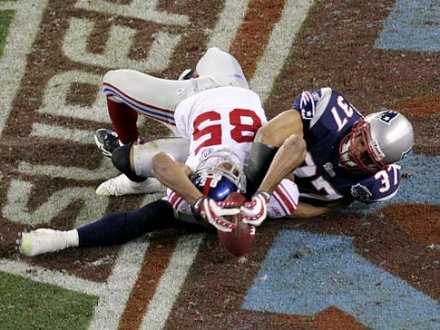
Before disemboweling, he was probably stretched out somewhat like David Tyree.

In fact, it was so dreadful (including many injuries in the distasteful rush for souvenirs) that they stopped doing it. Only gradually: Edward Marcus Despard, for instance, was sentenced to drawing and quartering, but they only hanged him to death and cut off his head posthumously. In 1814, that sentence — hanging plus posthumous beheading — formally replaced the old disemboweling-and-quartering bit as the penalty for treason.

(The invaluable CapitalPunishmentUK.org says that one James O’Coigley suffered hanging, drawing, and quartering in 1798 for that year’s Irish Rebellion; however, the Newgate Calendar’s record says that O’Coigley was “merely” hanged and beheaded, like Despard.)

On this day..

1780: Five for the Gordon Riots

This date in 1780 saw three men and two women hanged at various spots around London for the previous month’s Gordon Riots. They were the first five souls among 19 who would suffer the last extremity of the law for that disturbance.

The eponymous Protestant Lord George Gordon, had inflamed a mob against the 1778 Papists Act, which disencumbered British Catholics of some of their legal disabilities. (In part to pad out the redcoat ranks as the army found itself stretched thin by the American Revolution.)

The Gordon Riots started from Lord Gordon’s march on Parliament to serve it an anti-Catholic petition, and turned into five days of anti-Catholic mayhem before the troops were finally called out to quell it. (The want of a standing professional police force was among the deficiencies London encountered.)


This did not help Britain’s diplomatic overtures towards Habsburg Austria.

But the matter metastasized well beyond a merely sectarian event: a mass rally originating in the working-class Moorfields took an unmistakable class dynamic — assailing Newgate Prison and The Clink, liberating convicts in the process. The latter dungeon would never resume operations. “Crimping houses” for impressed sailors and “sponging houses” imprisoning debtors were also liberated.

Alongside white sailors and day laborers, London’s emerging black population would feature prominently in this affair. A “copper coloured person,” a former slave named John Glover, was observed at the front rank of those torching Newgate. Peter Linebaugh attributes to Glover the incendiary (and, as it turned out, credible) threat, “Damn you, Open the Gate or we will Burn you down and have Everybody out.” (Glover was condemned to death, but reprieved for likely-fatal servitude on the African coast.)

Three of the five executed in London on this date were hanged at Tower Hill, including both women, Mary Roberts and Charlotte Gardiner. Gardiner, like Glover, was an African; she and Roberts had helped sack the house of an Italian Catholic innkeeper.

Although nineteen folks put to death within a month and a half hardly constitutes giving the rioters a pass, it’s somewhat striking in view of the unabashedly anti-authority conflagration in hemp-happy 18th-century England that the death toll wasn’t greater. And it could have been: in a treatment in the December 1997 History Today, Marika Sherwood reports that fully 326 people were tried for some role in the Gordon Riots. But elites’ sense of the situation may well be captured by Edmund Burke’s remark,

If I understand the temper of the publick at this moment a very great part of the lower, and some of the middling people of this city, are in a very critical disposition, and such as ought to be managed with firmness and delicacy.

Less than two score were actually condemned to death for all this mess, and barely half of them were actually executed.


The 19th century writer Charles Dickens set his very first historical novel,* Barnaby Rudge, during the riots, and has his fictitious lead characters among the crops doomed to the scaffold.

(As we have seen several times, Dickens abhorred public executions, a circumstance also apparent in this passage.)

Barnaby would have mounted the steps at the same time — indeed he would have gone before them, but in both attempts he was restrained, as he was to undergo the sentence elsewhere. In a few minutes the sheriffs reappeared, the same procession was again formed, and they passed through various rooms and passages to another door — that at which the cart was waiting. He held down his head to avoid seeing what he knew his eyes must otherwise encounter, and took his seat sorrowfully, — and yet with something of a childish pride and pleasure, — in the vehicle. The officers fell into their places at the sides, in front and in the rear; the sheriffs’ carriages rolled on; a guard of soldiers surrounded the whole; and they moved slowly forward through the throng and pressure toward Lord Mansfield‘s** ruined house.

It was a sad sight — all the show, and strength, and glitter, assembled round one helpless creature — and sadder yet to note, as he rode along, how his wandering thoughts found strange encouragement in the crowded windows and the concourse in the streets; and how, even then, he felt the influence of the bright sky, and looked up, smiling, into its deep unfathomable blue. But there had been many such sights since the riots were over — some so moving in their nature, and so repulsive too, that they were far more calculated to awaken pity for the sufferers, than respect for that law whose strong arm seemed in more than one case to be as wantonly stretched forth now that all was safe, as it had been basely paralysed in time of danger.

Two cripples — both mere boys — one with a leg of wood, one who dragged his twisted limbs along by the help of a crutch, were hanged in this same Bloomsbury Square. As the cart was about to glide from under them, it was observed that they stood with their faces from, not to, the house they had assisted to despoil; and their misery was protracted that this omission might be remedied. Another boy was hanged in Bow Street; other young lads in various quarters of the town. Four wretched women,† too, were put to death. In a word, those who suffered as rioters were, for the most part, the weakest, meanest, and most miserable among them. It was a most exquisite satire upon the false religious cry which had led to so much misery, that some of these people owned themselves to be Catholics, and begged to be attended by their own priests.

One young man was hanged in Bishopsgate Street, whose aged grey-headed father waited for him at the gallows, kissed him at its foot when he arrived, and sat there, on the ground, till they took him down. They would have given him the body of his child; but he had no hearse, no coffin, nothing to remove it in, being too poor — and walked meekly away beside the cart that took it back to prison, trying, as he went, to touch its lifeless hand.


Gordon himself, an odd duck, had better resources than these poor saps, and repelled a treason prosecution.

However, fate still ordained him a death in Newgate Prison — by illness many years later, after being convicted of defaming Marie Antoinette. By that time, the former Anglican rabble-rouser had converted to Orthodox Judaism, circumcision and all.

* The first of just two historical novels for Dickens; the second, of course, was A Tale of Two Cities.

** We’ve met Lord Mansfield before, articulating the jurisprudence of a slave society. His home was also targeted by Moorsfield rioters.

† Dickens is wrong about “four wretched women” being hanged: Gardiner and Roberts, our day’s pair, were the only two. Evidently, though, these two were arresting enough in the public conscience to forge “memories” of entire cartloads of ladies gone to Tyburn. (n.b.: none of the Gordon Rioters were hanged at Tyburn, either.)

On this day..

1786: David Nelson, but not William Horbord

This date in 1786 offers us the fine legal salami-slicing of how to stanch a race war with a noose.

Our salami’s name is David Nelson, a furloughed veteran of the Queen’s Rangers in the late American Revolution relocated to the environs of Fredericton, New Brunswick.

There, he and a fellow veteran named William Horbord or Horboard shot dead a native Maliseet for stealing their hog.

This brought neighboring peoples to a deadly tense standoff. The Maliseet demanded justice for their victim; white Canadians demanded … well, the right to shoot Maliseet without fear of their own neck.

Nelson and Horbord went right on trial, but how to finesse the situation?

According to an exhibit that unfortunately seems to have vanished from the Virtual Museum of Canada, natives “camped out around the presiding Judge Kingsclear’s home.” That must have got his commute off to an awkward start each day.

So a Solomonic compromise obtained: after the two were duly convicted and doomed to hang, Nelson, the principal offender, was measured for his coffin … while Horbord, deemed less culpable, received a pardon.

Now that’s gallows diplomacy.

On this day..

1783: Philip, a negro slave of Henry Garrett

From the Chronicles of the Scotch-Irish settlement in Virginia

Called Court on Philip, a negro slave of Henry Garrett, and formerly property of Major Thomas Johnston, of Louisa County, charged with murdering Alexander Hunter, of Augusta County, and wounding the wife of Samuel Henry.–Guilty and to be hanged on 16th April next at 10 o’clock a. m. His value is fixed at £65.

On this day..