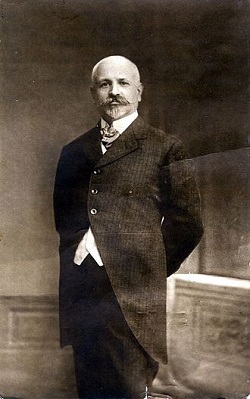
1900: William Pepo, the first hanged in Teton County, Montana

Today’s entry of the mystery man who was the maiden execution in Teton County, Montana unfolds via the period reportage of the Anaconda Standard.


Anaconda Standard, June 5, 1899

Great Falls, June 4. — William Pepo is guilty of the murder of Julius Plath. So the jury in Teton county has decided, but as his lawyers have decided to appeal the case, William may escape paying the penalty which a verdict of guilty of murder in the first degree is supposed to carry.

All of the evidence was of the circumstantial kind, but it points clearly to the guilt of Pepo.

The facts of the crime, whose story has been told before in this column, are these:

One day during the last summer a ranch hand rode into the town of Choteau and sought the office of the sheriff. He said that the body of an unknown man had been found in a deserted cabin on the Muddy, with all the earmarks of foul play surrounding it.

No one knew the name of the dead man, and there was nothing to give a direct clue to it.

Several people had seen two men pass their places and one of them tallied in description with the dead man. One woman, at whose house the pair had stayed overnight, remembered that they came from Canada, and were evidently Germans.

William Hagen, the sheriff of Teton county, went to work on the case, and, following up slight clues, and helped perhaps a trifle by chance, came to the conclusion that the victim was Julius Plath of Pembroke, Ontario, who had been working on the Crows’ Nest Pass railway.

Then came the search for his companion, and after many months he was found working under an assumed name as a ranch hand near Spokane. He was arrested and brought back.

Then came some steady painstaking work, which followed the course of the two men up to where the body was found, and so thoroughly was this chain of evidence established that the denials of Pepo as to acquaintance with Plath, with the crime or with the neighborhood were not credited by the jury, although they debated the case all night before agreement.

Charles Simons, charged with having shot and killed Charles Buckley in a barroom row, was found guilty of manslaughter and the jury fixed the punishment at the minimum — one year in the penitentiary.


Anaconda Standard, Jan. 23, 1900

Special Dispatch to the Standard.

Helena, Jan. 22. — William Pepo, convicted in Teton county for the murder of Julius Plath, in the summer of 1898, will have to pay the penalty of his crime upon the gallows, unless the governor interferes, which is hardly possible, as the supreme court to-day affirmed the judgment of the lower court.

“We find no error in the record, and must affirm the judgment and order appealed from,” says the supreme court in concluding a decision by Associate Justice Hunt. The opinion deals with the various points raised by Pepo’s counsel, but finds none of them of sufficient merit to warrant an interference with the action of the lower court.

One of the errors assigned by Pepo’s counsel was the alleged misconduct of the jury, it being claimed that while the jury was deliberating on the case, the bailiff entered the jury room and remained several hours.

One of jurors, by the name of Dehass, made affidavit to that effect. The bailiff made counter affidavit to the effect that early one morning he entered the jury room, taking some lunch and bedding. All but four of the jurors were asleep. The four who were awake were talking in the other end of the room, but not about the case.

The bailiff took a two-hour nap in the room and then left. He swore positively that he heard not one word of the conversation. Some of the jurors made affidavit to the same effect.

“From the foregoing affidavits, we think it is fair to say that there was no misconduct on the part of the jury, which tended in any way to prejudice the substantial rights of this defendant,” says the court, in disposing of this contention.

Another alleged error was the action of the lower court in allowing a witness to relate a conversation between Plath and the witness, when it was claimed the defendant was not present. The decision find no error in this, since the same witness subsequently testified Pepo was present. The action of the lower court in refusing to give an instruction that a witness having a casual acquaintance with a party is not entitled to much evidence is sustained.

“We are also asked to reverse the judgment because the verdict is not sustained by the evidence,” continues the opinion. “To this assignment, we have given the most attentive consideration, and our judgment is that it is very seldom that a case presents itself which so entirely fulfills the exact requirements of the law in relation to the measure of proof demanded to sustain a conviction of murder, where the state relies upon circumstantial evidence.

Under this assignment the argument is advanced that the evidence as to the identity of the body is unreliable and unsatisfactory. Counsel makes the point that there was no direct evidence to identify the body found as that of Julius Plath, who was alleged to have been killed by the defendant, Pepo.

Section 358 of the penal code provides that ‘No person can be convicted of murder or manslaughter unless the death of the person alleged to have been killed, and the fact of the killing by the defendant as alleged, are established as independent facts: the former by direct proof and the latter beyond a reasonable doubt.’

This statute is taken from the New York code, which is identical in its language, with this exception, that the New York code provides that the death of the person alleged to have been killed and the fact of the killing of the defendant as alleged, shall each have been established as independent facts. But we think that the same rules of interpretation should be applied to the Montana statute that controls in New York. The evidence in all respects sustains the verdict of murder.

The murder of Plath was one of the mysteries of Northern Montana and a crime that was not explained for some time. In an abandoned claim on the Muddy river to the northwest of Great Falls, the body in a bad state of decomposition was found in June, 1898, by a farm hand, who went into the place to get a mower sickle

A piece of iron, covered with blood, showed the weapon used.

The body was dressed in clothing that afterwards assisted in the identification, although for the time being nothing was found to show who this murdered man was.

A locket lying on the floor and a memorandum book in the pocket of an overcoat hanging on the wall also assisted in the identification. One proved to be the property of Plath and the other of Pepo.

Pepo and his victim, it was subsequently learned, came to Montana together from the Northwest Territory.

Both left the railroad at Shelby. Plath is known to have had $120 in his possession, and this is supposed to have furnished the motive for the crime.

During the trial it developed that several persons had seen two men corresponding to Pepo and Plath. They said they were going to Choteau. A farmer directed them to the cabin where the body was found as a good place to sleep on the way.

Others remembered them by such identifications as the charm on Plath’s watch, the photographs of him sent from Canada, his clothing and other articles.

A reward by the authorities and diligent work on the part of the Teton county authorities, assisted by relatives and acquaintances of the murdered man in Canada, finally fixed Pepo as the murderer and Plath as the victim.

The murderer was arrested in Washington. This was nine months after the discovery of the body. Pepo, when arrested, was living under an assumed name. He carried the very watch that Plath was known to have owned. Pepo’s trial and conviction followed.

Judge Smith of Kalispell will probably sentence him to be hanged at Choteau in a few weeks.


Anaconda Standard, Apr. 4, 1900
Special Dispatch to the Standard.

Helena, April 3. — An appeal to Governor Smith in behalf of executive clemency for another murderer was turned down to-day, when the governor announced that he could not see his way clear to interfere with the judgment of the courts in the case of William Pepo, under sentence of death to hang at Choteau next Saturday, April 7. Pepo was convicted of killing Julius Plath in a cabin on the banks of the Muddy river, in Teton county, a few miles north of Great Falls.

The murder was committed June 14 or 15, 1898. The decomposed body of Plath was not found until several days after the crime was committed. A farm hand who had occasion to enter the cabin to procure a mowing machine sickle came across the body lying upon a bunk in a sickening state of decomposition.

There appeared to be no clew to the murderer and it was several months afterward before suspicion was attached to Pepo. He was brought back to Montana, tried and convicted. The supreme court refused to grant him a new trial and he was sentenced to expiate his crime upon the gallows.

J.G. Bair, his attorney, appealed to the governor for a commutation of sentence to life imprisonment on the ground of lack of evidence to connect Pepo with the crime. The governor has been examining the record in the case for several days and this afternoon he sent a letter to Mr. Bair stating that he could not interfere. The letter was very brief. It follows:

I have finished reading the transcript in the matter of the application for executive clemency for William Pepo. In this case the evidence is so convincing and clear the jury could not have reached any other conclusion. It shows a most cold-blooded murder and there is no doubt Pepo was the murderer. I must absolutely refuse to interfere with the sentence of the court.

Pepo is said to be without a friend in the world save the Choteau attorney who sought to save his neck. His execution will be the first legal hanging that ever took place in Teton county.


Anaconda Standard, Apr. 8, 1900

Special Dispatch to the Standard.

Great Falls, April 7. — In the yard of the county jail in Choteau this morning at 6:09 o’clock William Pepo was hanged for the murder of Julius Plath. He exhibited no nervousness or fear and his last words were:

Gentlemen, I have nothing to say, only that I am about to be hanged an innocent man.

It was the first legal execution in Teton county, and from start to finish went without the slightest hitch of any kind.

There were about 50 spectators. The only outside officer of the law present was Sheriff Hubbard of Kalispell.

After all visitors had left last night the condemned man employed his time in writing, playing cards and conversation with the death watch until 3 o’clock this morning, when he went to bed and dropped off to sleep at once.

At 5:15 a.m., when he was aroused by Deputy McDonald, he was sleeping so soundly it was necessary to call several times to awaken him. After getting up he greeted the guards pleasantly and ordered breakfast, but later countermanded the order with the remark that his time was too short to waste any of it in eating.

At his request Father Snell was admitted and talked with him alone for some time, after which he asked that Attorney Bair, who has defended him throughout, be admitted to his cell, and in a few moments’ conversation he bade him goodbye and reiterated his innocence. Rev. Cunningham next conversed with him and Pepo listened to him very attentively and answered him earnestly.

At 6 o’clock the death warrant was read to him in his cell by Under Sheriff Haggerty and he was led out into the corridor, where he bade an earnest goodbye to the officers who had been his keepers for the past 18 months, and spoke a pleasant word to each.

His arms were strapped down and the walk to the scaffold began, the condemned man walking firmly and without assistance between Deputies Devlin and Armstrong, followed by Sheriff Hagen and Under Sheriff Haggerty and Rev. Cunningham.


To the Gallows.

As they walked down the north side of the jail in the alleyway formed by the high board fence erected about the yard, the morning air was crisp and chill, and the condemned man, turning to one of the officers, said jokingly: “It’s a little cool out here; this must be like the weather they tell about in North Dakota,” and smiled pleasantly.

Some of the guards had previously been talking of North Dakota weather to him, and his last earthly joke referred to the conversation.

As he turned the angle of the building and stepped under the gallows, he faced the silent, uncovered crowd, who had been admitted a few minutes before, calmly and quietly, by far the most self-possessed man present, and looking them over, he bowed pleasantly three or four times to parties he knew and said in a low voice, though clearly and distinctly:

Gentlemen, I have nothing to say, only that I am about to be hanged an innocent man.

Sheriff Hagen placed the strap about his knees and the condemned looked down with apparent interest and carefully placed his feet together so as to assist the sheriff.

The noose was placed about his neck, but he never flinched a hair’s breadth.

Rev. Cunningham, in a low tone, recited the prayers for the dead. For a moment, Pepo closed his eyes, as if listening.

A meadow lark in the field outside the prison walls whistled its morning note loud and clear; the condemned man opened his eyes again and looked out upon the crowd of awe struck faces and uncovered heads and the early morning sunlight which he never again would see.

The voice of the minister, broken and low, sounded monotonously.

Pepo glanced up inquiringly and Sheriff Hagen dropped down over his head and face the terrible black cap, shutting out all view of the world and sunlight from William Pepo forever.

Instantly the sheriff sprang away and gave the signal to the unknown man in the box alongside the gallows; the 400 pound weight fell to the ground like a plummet and the body shot up in the air four feet and settled down again without a perceptible tremor or more sign of life than if a block of wood. His neck was broken instantly.

Drs. Brooks and Cooper watched the pulse that in 10 minutes was forever stilled, and in 20 minutes the body was cut down and placed in a coffin, and the long strain upon all the officials connected with the case was over.

For the Epworth league was left a long letter of thanks for their services to him. To Rev. Cunningham was left a letter with the superscription, “Not to be opened until after my death.” In this letter he said in part:

“I Am Not Guilty.”

I am not guilty and consequently should not be held responsible for the crime. If this crime is really and truly atoned for by the ator in this world while you live, I hope you will tell those that have been instrumental in fastening it on me that they have my forgiveness as I have been forgiven. When you read this I will stand before the throne of God, whose grace passes all understanding. Amen.

Those are his last written words, and from them can be seen how strongly he urged his innocence and how far from any such thing as an admission he stood.

Since the action of Rev. Warman in the matter of Hurst‘s confession he has been particularly anxious to impress upon every one his innocence and feared lest some one should allege some such thing of him after his death.

He was buried this afternoon, Rev. Cunningham conducting the services.

With the hanging of William Pepo, the man of mystery, was closed a chapter in the book of one man’s life which will never be read by mortal eye, for just as sure as was his taking off, his name was not Pepo, and some time in the past he has trod walks of life other than those which he has during the time that the evidence in his case has been traced to him.

Looking at him last night calmly smoking and chatting cheerfully with those about him it was hard to recognize about him any of the accepted tributes of the common murderer. Pleasant faced, intelligent, well read, iron nerved and ready witted, he showed by every action the man of education and good raising. He refused at all times to give any chance for his photograph being taken, even by a kodak, and his last statement to Attorney Bair, the one man nearer to him in the effort to save his life than any other, was,

They do not know my name, nor do you. I shall not bring disgrace upon my family by letting them know that I have died a felon’s death. I will carry it with me out of the world.

A Man of Mystery.

Absolutely nothing has been learned of his past life further than six years back except what he himself has told and that, when investigated, was found not to be true.

He has not asked that one human being be sent for, nor had he ever mentioned the name of a person whom he wished to know of his terrible position.

Of his past life he has been as silent as the tomb except as to the indefinite stories mentioned.

That a man of his age, intelligence, ability and strong personality should not have in the wanderings of a lifetime one single friend or relative to come forward at such an hour, if called upon, seems incredible. In speaking with Under Sheriff Haggerty yesterday he referred to the Hurst and to the Calder cases. Of Rev. Mr. Warman he spoke very bitterly for giving publicity to the Hurst confession, and said Hurst’s wife and family would curse him for his action in the case until their dying day.

Speaking of Calder, he said:

I had made up my mind to go out of the world as Calder did, cursing God and man, but Rev. Mr. Rogers’, Rev. Mr. Cunningham’s and Father Snell’s talks to me have changed my mind, and I forgive every one connected with my trial. I firmly believe there is a God and I will go to Him expecting to receive the justice in the other world which has been denied in this world.

He expressed thanks for the favors which the sheriff’s office had shown him, breaking down for a few moments and shedding tears. Yesterday, Rev. Mr. Cunningham and members of the Epworth league had services in the corridor, as they have had every day for the past week, and at his request sang certain hymns.

Not once since a week after his sentence has his appetite failed him, and his sleep has been as regular and peaceful as a child’s.

His Iron Nerve.

His favorite pastime when no visitors were present has been playing cards with the death watch, and when he won he laughed as heartily as if he never had a care in the world.

Yesterday his beard was trimmed up and he was dressed in a new suit of clothes, and when the Standard reporter visited him he was received as courteously as though an invited guest.

Pepo was smoking and politely passed a package of cigars out through the iron bars, urging acceptance with the uncanny remark that there was more than enough to last him until 7 o’clock a.m. and after that he wouldn’t need any.

In the corridor with the death watch were many who came to visit him, and as Pepo recognized each one he shook hands heartily and expressed his pleasure at his meeting them and talked pleasantly on the topics of the day, alluding every little while to his own case as though it were an incident which he did not care to have those present feel any embarrassment in commenting on.

To one of the death watch he laughingly related the fact that “Tom” was to be one of the watchers.

“Did you think of it?” he continued. “You and Tom were the death watches the first night of my sentence, and now you will be with me my last night.”

The incident did not appear to strike the death watch addressed as at all humorous, but Pepo laughed softly again at the recollection.

At first he was disinclined to speak of his case for publication, as he believed the newspapers had not treated him fairly, but later he talked quite freely. He asked his attorney, who was present, to write a contradiction of a statement which appeared in a Dupuyer paper, in which he was quoted as saying that certain men in Washington would testify that he was working in that state June 15, 1898, which was the supposed date of the murder of Plath.

He dictated the writing, took the sheet of paper and read it with satisfaction and signed his name without a tremor, asking that Under Sheriff Haggerty and the Standard men sign it as witnesses. The statement reads:

His statement.

In an interview published in your paper some time since you quoted me as having said that I could obtain evidence from Washington showing I was there, in Washington, on or about June 15, 1898. This is a mistake; I meant to say I could get witnesses there who would testify that I was in Washington at work on the date that James Hannan testified to having seen me trying to cross the mountains, namely, on July 29, 1898.

In explaining this, Pepo said:

I don’t wish any injustice done my attorney; had I been able to secure such evidence I would have told him and I would not now be here with but six or eight hours to live; such evidence would have cleared me. Men would testify I commenced work there on July 4, but that would not do. I don’t know when I commenced to work there myself, as I was drunk for a long time. When the sheriff arrested me in Washington for murder I was never so surprised in my life. They say I was seen here after the murder. I never was in Choteau in my life until brought back by the sheriff. On June 14, when I am said to have done this thing, I expressed a package in Lethbridge at the express office there. The newspapers did not treat me fairly. They condemned me before I was tried and branded me a low-browed murderer. Had I friends to call upon, and state my side, the case might have been different. I am innocent and God knows it. But it is all over now, and I don’t want to make you people sick of listening to my troubles. They will soon be over, anyhow; let what is gone by go: it can make no difference now and talking of it does no good.

And all this without the slightest attempt at bravado or whine. One of the guards offered him a whiskey cocktail, but he refused it and said, smilingly:

No; I have had one and that is enough now; I don’t want you to think I need or wish courage to meet the end.

All the evening of the many who visited him he was the most calm and unembarrassed. His voice was clear and even and at no time did he evince the slightest excitement or nervousness, and, though he referred quite frequently to his coming death, it was without regret or a semblance of more interest than if it were the getting of his morning meal.

A little white kitten romped upon the floor of his cell and he expressed concern as to what would be its fate after the morning, when he would be taken away and he could feet it no longer. One of the officials promised to look after the kitten and he seemed much relieved.

For quiet, unostentatious iron nerve and calm placidity in the face of death upon the gallows, Pepo’s every word and movement last night and also this morning must stand alone.

Either he went to death innocent, which the evidence flatly disproves, or his career in crime has sent more men than Julius Plath out of the world unshriven.

He was not in the class of most moral degenerates and must go down, if guilty, as an iron-nerved prince of criminals, who played his last card, and losing, paid the forfeit with his life without the quiver of an eyelash.

The crime for which William Pepo to-day suffered the death penalty was the murder of Julius Plath in a cabin on the Muddy river, about 20 miles from Choteau, in Teton county, about the 15th of June, 1898. The case throughout was circumstantial and most remarkably illustrates that “murder will out,” no matter how carefully guarded.

Pepo and Julius Plath were acquainted in Canada, and early in June, 1898, left Lethbridge together to come to the United States, Plath having $120 in currency on his person.

They came in over the narrow guage [sic] and beat their way over the railroad as far as Pondera, where they left the railway and started together for Choteau.

The last seen of them was June 14, when they were directed to the cabin where the murder was committed.

On June 29, parties finding the cabin door fastened forced it open and found the body of a man who the evidence afterwards tended to show was Plath. The dead man had been killed while asleep by having his skull crushed by a large iron bolt, which was found lying near.

All the dead man’s clothes were taken charge of by the authorities and afterwards identified as belonging to Plath. Near the body was found an overcoat, in the pocket of which was a memorandum book belonging to and written in by Pepo.

The dead man was unidentified and was buried unknown.

Months after, when the murder had almost been forgotten, a letter came from Plath’s brother in Toronto, Canada, asking for the whereabouts of Julius, and by chance it fell into the hands of some one who thought it worth while to refer it to the authorities.

Further inquiry brought a photograph of the dead man, and this photograph was the first link in the chain which brought William Pepo to the gallows to-day and gave Sheriff Hagen the first ray of light upon a murder whose darkness seemed impenetrable.

The dead man when found was too badly decomposed for identification, but a man who had seen Pepo and Plath traveling together identified the photograph as being that of the smaller of the two men.

The clothing shown in the photograph also corresponded exactly with that found upon the dead man. The photograph was taken by Neapole, Pembroke, Canada, and is marked “exhibit D.” Later Plath’s brother came from Canada and identified the clothing as that of his brother Julius.

Then began the search for Pepo, who had disappeared as completely as though the earth had swallowed him up. Search was unavailing, until one day a letter came from a young lady to friends in Canada, who stated that she had met Pepo, but that he was going under the name of William Ferris and did not wish her to say anything about it.

The letter was from Davenport, Wash., and the young lady was unaware that Pepo was wanted on any charge; and again the hand of fate pointed out the murderer when all chances of discovery seemed buried forever.

The information was correct. Pepo was found in Davenport under the name of William Ferris, and was promptly arrested in May last and brought to Choteau, where link by link the evidence was forged against him, and last June he was found guilty of the murder of Julius Plath and sentenced to hang on July 17.

John G. Bair of Choteau was appointed to the defense of Pepo and County Attorney Erickson prosecuted. On both sides the battle was a stubborn one and well contested, but the evidence for the prosecution was too strong to overcome.

After the sentence Pepo’s attorney continued the fight and carried the case to the supreme court on appeal, and the doomed man was given a brief respite, but the judgment of the lower court was sustained, and on the 6th of last month Pepo was again called before Judge Smith in the court room at Choteau and for the second time listened to the death sentence, which was carried out to-day.

During the trial and after Pepo refused to allow his picture to be taken and in going to and from the court house pulled his coat collar above his neck to baffle any chance for snap shots. The accompanying pictures is a very good one and is from a pen sketch done by W.H. Clinkerbread, the Choteau artist. [Unfortunately the picture alluded to does not in fact appear in the paper. -ed.]

Pepo was a German and had not a friend, relative or acquaintance in the United States. He was a man of large frame, weighing about 180 pounds, and being 5 foot 10. He was 40 years of age.

After his second sentence for a while he refused to eat and expressed the intention of starving himself, but his fortitude was unequal to the task and he gave the trial up.

Although without money, his case was fought by his attorney to a finish just the same, and 10 days ago Mr. Bair went to Helena and personally appeared before Governor Smith and made a plea for life imprisonment for his client on the grounds of the evidence being circumstantial throughout and that there was a chance for a reasonable doubt.

When Mr. Bair appeared before the governor the case of Hurst, who was hanged at Glendive, had just been presented, with petitions containing 7,000 names, asking for clemency. For Pepo the case was different. He was unknown, without a dollar and had not a relative or friend in the state but his attorney to speak for him; but the result was the same.

The governor refused to commute the sentence of either man — the one with relatives and thousands of friends petitioning, the other without a friend save his faithful attorney. Hurst was hanged on March 30 and Pepo to-day. In refusing to commute the death sentence in Pepo’s case Governor Smith wrote his attorney Tuesday:

Mr. J.B. Bair, Choteau, Mont. —

Dear Sir: I have finished reading the transcript in th ematter of the application for executive clemency for William Pepo. In this case the evidence is so convincing and clear the jury could not have reached any other conclusion. It shows a most cold-blooded murder, and there is no doubt Pepo was the murderer. I must absolutely refuse to interfere with the sentence of the court. I am, very respectfully,

ROBERT B. SMITH, Governor.

On this day..

1902: Joe Higginbotham, criminal assailant

On this date in 1902, Joe Higginbotham was hanged for raping and slashing the throat of a Mrs. Ralph Webber.

The State (Columbia, S.C.), Jan. 24, 1902

This headline-making outrage occurred in Lynchburg, Virginia, and the town was on the verge of living up to its name before officers spirited the black janitor away to Roanoke for safekeeping; in Roanoke, military guardsmen were scrambled for security against a rumor that Higginbotham’s life would be attempted even there.

One might well wonder why the bother, as the formal proceedings against the culprit blessed by the law entailed very little deliberation beyond Judge Lynch. Mrs. Webber survived her injury and once her condition stabilized, she was brought to the jail on January 21 to make an identification. “She at once identified him as the man who assaulted her. The negro broke down and confessed to the crime with which he is charged, and further stated that he had attempted some months ago to assault a white girl who was a patient in a Lynchburg hospital.” (Charlotte Observer, Jan. 22, 1902)

Two days after that meeting, Higginbotham pleaded guilty at a short trial under heavy guard back in Lynchburg. The sentence was imposed for exactly one month out — plus one more day so as not to fall on a Sunday — and it went off as scheduled, undisturbed by any appeal or reprieve.

The Higginbotham name will be distinctive to students of 20th century American law, as it was borne by Judge A. Leon Higginbotham, one of the greatest jurists never to reach the Supreme Court.* (Higginbotham was reportedly considered for the seat Thurgood Marshall eventually received.) Since it appears from this message board that Higginbotham descendants in the Lynchburg and Amherst County part of Virginia count the judge among their kin, we couldn’t help but wonder whether, like radio host Tom Joyner discovered, there might be an execution hidden in the family tree.

Resident genealogist and occasional guest poster Golde Singer did some research on this proposition.

Judge Higginbotham grew up in New Jersey but census records confirm that his father Aloysius was in fact born in Virginia to a family with deep roots in Amherst County. Aloysius’s move to the Trenton, N.J. area in the first decade of the 20th century would have put him on the leading edge of the Great Migration of southern blacks to northern industrial cities.

Suggestive as that might be, Golde’s search through Aloysius’s family did not appear to turn up any clear link to a Joseph Higginbotham; indeed, Higginbotham the criminal assailant was reportedly himself an adopted or foster child whose lineage appears obscure. The trail from this point dissipates in history’s marshes. The Higginbotham name is quite widespread in the Lynchburg area; family ancestries for the African-American Higginbothams appear to trace back to slavery among the white family of Captain John Higginbotham, a Revolutionary War officer whose own father relocated to Amherst, Va. from Barbados. (Different English Higginbothams made good in India.)

A generalist site such as ours leaves off short of the close reading of archival records or research into family lore that would required here. (Perhaps there are some readers prepared to shed some light?) In the end, of course, any hypothetical family connection between these two very different men would count as little more than historical curiosity.

* Full disclosure: this author never had the privilege of meeting Judge Higginbotham, but counts as a mentor to his death penalty interest one of the judge’s proteges.

On this day..

1906: Robert E. Newcomb and John Mueller

(Thanks to Meaghan Good of the Charley Project for the guest post. -ed.)

On this day in 1906, Robert E. Newcomb and John Mueller were hanged together in Chicago, Illinois. Both were multiple murderers, with six deaths between them.

Newcomb, who was, described as “crazed” and “maddened,” hanged for the murder of Chicago police sergeant John Peter Shine.

On October 10 the previous year, Shine heard reports of a gunman terrorizing people on the streets of Englewood. Newcomb had already shot three people and one, a woman named Florence Poore who was the wife of Newcomb’s friend, was dead. Shine found out the gunman had barricaded himself in his apartment. Although he was off duty, he decided to make the arrest himself.

When he knocked on the apartment door and demanded entry, however, Newcomb simply fired through the closed door, hitting Shine in the abdomen and mortally wounding him. The officer died two hours later at Englewood Union Hospital, at the age of 42. Walter Blue, one of the others Newcomb had shot, also died of his wounds.

After Shine was shot, over 100 police officers surrounded Newcomb’s apartment and fired into it, hoping to apprehend or kill the gunman. After a long siege, Newcomb surrendered to an equally certain death in the judiciary.

Little is known about John Mueller or his crimes. Daniel Allen Hearn, in his book Legal Executions in Illinois, Indiana, Iowa, Kentucky and Missouri: A Comprehensive Registry, 1866-1965, describes Mueller as “a drunk and a loser who went berserk when refused money with which to buy liquor.” The 32-year-old slaughtered his wife, Annie, and their two daughters, two-year-old Martha and 18-month-old Mary, by shooting them and slashing them repeatedly with a razor.

The two killers were executed in the Cook County Jail. It was an integrated execution: Newcomb was black and Mueller was white.

On this day..

1903: Amelia Sach and Annie Walters, the Finchley baby farmers

On this date in 1903, the Finchley baby farmers hanged together at Holloway Prison.

Though “both repulsive in type” according to the cold notes of their hangman, Amelia Sach and Annie Walters were plenty appealing to young ladies in a certain condition.

Sach’s lying-in house in the north London suburb was a destination of choice for inconveniently pregnant women for a couple of years at the dawn of the 1900s, and there they could deliver discreetly and pay a surcharge for adoption services to place the child with a family.

Except, as the mothers must have understood, few if any of those children were destined to find a doting parent.

The baby farming business stood as cover for post-partum abortion in a society exacting penalties legal, medical, and social against single motherhood and terminated pregnancies alike. The solutions an unexpectedly pregnant maid might turn to were all desperate and unappealing, and in the absence of better provisions for orphans and mothers a significant pattern of infanticide was baked into Victorian* England.


Risky home-brew abortifacients like pennyroyal were another option.

The £25-30 donative solicited of mothers by the Goodwife Sach was not enough to maintain the little darlings surrendered to her care: only enough to ease the conscience to forgetfulness. After delivery under Sach’s eye, the infants would be spirited away by Annie Walters for “adoption.” In her hands, they’d be chloroformed or strangled.

Nobody knows how many souls who might have grown up to serve as cannon meat at the Somme were destroyed untimely by our subtle duo; in the end, they were only tripped up by Walters’s surprisingly careless decision to take one of her charges home — where a neighboring, and nosy, police officer noticed it before it mysteriously disappeared.

Their joint death was the most recent occasion Great Britain carried out a double hanging in which both of the executed were women. For a novelization of the case, pick up Nicola Upson’s Two For Sorrow (review).

* For gratification of the pedants: Queen Victoria died in 1901.

On this day..

1905: John Johnson

(Thanks to Meaghan Good of the Charley Project for the guest post. -ed.)

On this date in 1905, John Johnson was hanged for the murder of Patrolman Dennis Fitzgerald of the Chicago Police Department.

On September 26, 1903, Johnson and another man, Louis Tedford, were being drunk and disorderly near the corner of 44th Street and Indiana Avenue. Fitzgerald told them to move along. In response, the two men beat him to a pulp and shot him with his own gun.

Fitzgerald was a strong man and he lingered for four months before he died on January 20, 1904. Authorities determined his death was a direct result of his wounds. He was buried in Mount Olivet Catholic Cemetery.

As for the two offenders, both were convicted of murder, but Tedford got off relatively easily with a fourteen-year sentence. The jury determined Johnson was the one most responsible for the officer’s death, and so he paid for it with his life, a year to the day after Fitzgerald died. “Please hurry things along,” were his last words.

It was a busy day with the rope around North America.


Macon (Ga.) Telegraph, Jan 21, 1905


Grand Forks (N.D.) Herald, Jan. 21, 1905

On this day..

1905: Ed Lamb, bully

This date in 1905 was — in the title of the Manatee County Historical Society publication about the case — The Day They Hanged Ed Lamb in Braidentown/Bradentown/Bradenton.

It all started in the schoolyard.

Lamb’s son was the resident bully at the local Braden River School until one day that January he picked a fight with the son of Dave Kennedy and surprisingly got his — the bully’s — ass kicked.

Like many a child since, young master Lamb sent his problem up the generational chain of command. Ed Lamb, a mill hand, raised the beef with Dave Kennedy, a farmer, when the latter stopped by the mill a few days later to sell his wares, even menacing Kennedy with a knife.

But for the second time, a Kennedy went all lion on a Lamb and overpowered his antagonist. Enraged and embarrassed, Lamb stalked away to his nearby home, got a shotgun, and wasted Dave Kennedy. Masculinity: vindicated. Stunned bystanders allowed Lamb to escape.

Our Manatee County correspondent gives the surreal vignette from his own family history of the Kennedy children — being dismissed from school at news of the murder — walking home on a dirt road that very day and passing the disgraced Lamb family on a wagon with their possessions, heading out of town. “One of the children standing beside the roadway became frightened thinking that Ed Lamb would pop out fo the trunk at any moment.” He didn’t: Ed was on a lam all his own, and was recaptured the next morning and spirited away to Tampa to protect him from lynching. Lamb spent the months between his conviction and his execution harrying the local newspaper with letters entreating folks straighten up and get right with God, letters that notably failed to breathe word one of apology to the Kennedies.

The drop fell at 12 minutes past 12:00 non. But the rope slipped and the prisoner was raised a second time and shot into eternity. He was rendered unconscious by the first shock and never knew that he was let to fall a second time. His neck was broken by the second fall and he was pronounced dead by Dr. John Holten of Sarasota. He mounted the gallows cool and fearless and died without a murmur or a struggle. Inside the jail, 40 witnesses were in the jail when the execution took place, the gallows being inside the building. A few white people and a great many Negroes were congregated around the jail, but perfect order was maintained.

Lamb’s son, brother and sister-in-law were present when he mounted the scaffold, but were overcome and left before the drop fell. The doomed man kissed them goodbye and asked them to meet him in heaven. His wife was unable to come to the jail to see him for the last time. Was photographed. Lamb dressed himself for the scaffold with great deliberation. And at his request, was photographed after being attired for death. He talked freely. But in his last speech he said nothing about the crime for which he suffered. He said that he was willing to die. That he had made his peace with God and wanted all of his heirs to meet him in a better world. Sheriff Wyatt was cool and carried out his part well. The noose was adjusted and the black cap pulled down over the prisoner’s face. And the trap sprung that sent the murderer to meet his maker. The death warrant directed that the execution take place in private between the hours of 11:30 and 12:00, but the sheriff allowed the condemned man 12 minutes longer lease on life.

Manatee County paid Coursey and Barnett $16.70 for Lamb’s hangin’ suit, and paid J.W. Wilhelm & Co. $21.35 for his coffin.

On this day..

1903: Edgar Edwards, sash weight killer

On this date in 1903, Edgar Edwards was hanged in Wandsworth Prison for a minor-league* triple murder.

Of course, the killing was anything but trivial to its victims, a Camberwell grocer and his wife along with their infant daughter. The couple put their business up for sale: Edwards answered the ad but had a different transaction in mind. Contriving to separate man and wife in the course of the interview, he bashed Beatrice Darby to death and strangled the infant child. Evidently he had some proficiency wielding a five-pound sash weight. The reader may perceive that this weapon, albeit improvised, is a crueler device than its accessorizing name might suggest.

Having done with the wife, he lured unwitting husband John to his makeshift abattoir and murdered him in the same horrid fashion.

That occurred way back in November, but it wasn’t until Edwards tried the same ploy using the same type of bludgeon** against a London businessman a month later that the earlier homicide unraveled. As the investigation led back to Leyton (thanks in part to Edwards’s foolish possession off John Darby’s business cards) the neighbors all started remembering that he’d been awfully keen about burying something in the garden a few weeks back. Rear Window this ain’t.

The motive for all this was just to take possession of the stock and sell it quietly for ready cash. Edwards had little recourse when captured but to try to draw out a family history of insanity, a ploy could not have impressed jurors much in view off the crime’s calculated ferocity.

* A century and God knows how many murders onward, this crime may be an imperceptible drop in the sea; in its day, however, it earned Edwards wax statuary at Madame Tussaud’s.

** The humble sash weight has its niche in the crime annals; it was also the weapon used by Double Indemnity inspirations Ruth Snyder and Judd Gray.

On this day..

1909: Francisco Ferrer, martyred teacher

(Thanks to Emma Goldman for the guest post on her anarchist contemporary; it originally appeared in her Anarchism and Other Essays -ed.)

Experience has come to be considered the best school of life. The man or woman who does not learn some vital lesson in that school is looked upon as a dunce indeed. Yet strange to say, that though organized institutions continue perpetuating errors, though they learn nothing from experience, we acquiesce, as a matter of course.

There lived and worked in Barcelona a man by the name of Francisco Ferrer. A teacher of children he was, known and loved by his people. Outside of Spain only the cultured few knew of Francisco Ferrer’s work. To the world at large this teacher was non-existent.

On the first of September, 1909, the Spanish government — at the behest of the Catholic Church — arrested Francisco Ferrer. On the thirteenth of October, after a mock trial, he was placed in the ditch at Montjuich prison, against the hideous wall of many sighs, and shot dead. Instantly Ferrer, the obscure teacher, became a universal figure, blazing forth the indignation and wrath of the whole civilized world against the wanton murder.

The killing of Francisco Ferrer was not the first crime committed by the Spanish government and the Catholic Church. The history of these institutions is one long stream of fire and blood. Still they have not learned through experience, nor yet come to realize that every frail being slain by Church and State grows and grows into a mighty giant, who will some day free humanity from their perilous hold.

Francisco Ferrer was born in 1859, of humble parents. They were Catholics, and therefore hoped to raise their son in the same faith. They did not know that the boy was to become the harbinger of a great truth, that his mind would refuse to travel in the old path. At an early age Ferrer began to question the faith of his fathers. He demanded to know how it is that the God who spoke to him of goodness and love would mar the sleep of the innocent child with dread and awe of tortures, of suffering, of hell. Alert and of a vivid and investigating mind, it did not take him long to discover the hideousness of that black monster, the Catholic Church. He would have none of it.

Francisco Ferrer was not only a doubter, a searcher for truth; he was also a rebel. His spirit would rise in just indignation against the iron régime of his country, and when a band of rebels, led by the brave patriot General Villacampa, under the banner of the Republican ideal, made an onslaught on that regime, none was more ardent a fighter than young Francisco Ferrer. The Republican ideal, — I hope no one will confound it with the Republicanism of this country. Whatever objection I, as an Anarchist, have to the Republicans of Latin countries, I know they tower high above that corrupt and reactionary party which, in America, is destroying every vestige of liberty and justice. One has but to think of the Mazzinis, the Garibaldis, the scores of others, to realize that their efforts were directed, not merely against the overthrow of despotism, but particularly against the Catholic Church, which from its very inception has been the enemy of all progress and liberalism.

In America it is just the reverse. Republicanism stands for vested rights, for imperialism, for graft, for the annihilation of every semblance of liberty. Its ideal is the oily, creepy respectability of a McKinley, and the brutal arrogance of a Roosevelt.

The Spanish republican rebels were subdued. It takes more than one brave effort to split the rock of ages, to cut off the head of that hydra monster, the Catholic Church and the Spanish throne. Arrest, persecution, and punishment followed the heroic attempt of the little band. Those who could escape the bloodhounds had to flee for safety to foreign shores. Francisco Ferrer was among the latter. He went to France.

How his soul must have expanded in the new land! France, the cradle of liberty, of ideas, of action. Paris, the ever young, intense Paris, with her pulsating life, after the gloom of his own belated country, — how she must have inspired him. What opportunities, what a glorious chance for a young idealist.

Francisco Ferrer lost no time. Like one famished he threw himself into the various liberal movements, met all kinds of people, learned, absorbed, and grew. While there, he also saw in operation the Modern School, which was to play such an important and fatal part in his life.

The Modern School in France was founded long before Ferrer’s time. Its originator, though on a small scale, was that sweet spirit Louise Michel. Whether consciously or unconsciously, our own great Louise felt long ago that the future belongs to the young generation; that unless the young be rescued from that mind and soul-destroying institution, the bourgeois school, social evils will continue to exist. Perhaps she thought, with Ibsen, that the atmosphere is saturated with ghosts, that the adult man and woman have so many superstitions to overcome. No sooner do they outgrow the deathlike grip of one spook, lo! they find themselves in the thraldom of ninety-nine other spooks. Thus but a few reach the mountain peak of complete regeneration.

The child, however, has no traditions to overcome. Its mind is not burdened with set ideas, its heart has not grown cold with class and caste distinctions. The child is to the teacher what clay is to the sculptor. Whether the world will receive a work of art or a wretched imitation, depends to a large extent on the creative power of the teacher.

Francisco Ferrer could not escape this great wave of Modern School attempts. He saw its possibilities, not merely in theoretic form, but in their practical application to every-day needs. He must have realized that Spain, more than any other country, stands in need of just such schools, if it is ever to throw off the double yoke of priest and soldier.

When we consider that the entire system of education in Spain is in the hands of the Catholic Church, and when we further remember the Catholic formula, “To inculcate Catholicism in the mind of the child until it is nine years of age is to ruin it forever for any other idea,” we will understand the tremendous task of Ferrer in bringing the new light to his people. Fate soon assisted him in realizing his great dream.

Mlle. Meunier, a pupil of Francisco Ferrer, and a lady of wealth, became interested in the Modern School project. When she died, she left Ferrer some valuable property and twelve thousand francs yearly income for the School.

It is said that mean souls can conceive of naught but mean ideas. If so, the contemptible methods of the Catholic Church to blackguard Ferrer’s character, in order to justify her own black crime, can readily be explained. Thus the lie was spread in American Catholic papers that Ferrer used his intimacy with Mlle. Meunier to get passession of her money.

Personally, I hold that the intimacy, of whatever nature, between a man and a woman, is their own affair, their sacred own. I would therefore not lose a word in referring to the matter, if it were not one of the many dastardly lies circulated about Ferrer. Of course, those who know the purity of the Catholic clergy will understand the insinuation. Have the Catholic priests ever looked upon woman as anything but a sex commodity? The historical data regarding the discoveries in the cloisters and monasteries will bear me out in that. How, then, are they to understand the co-operation of a man and a woman, except on a sex basis?

As a matter of fact, Mlle. Meunier was considerably Ferrer’s senior. Having spent her childhood and girlhood with a miserly father and a submissive mother, she could easily appreciate the necessity of love and joy in child life. She must have seen that Francisco Ferrer was a teacher, not college, machine, or diploma-made, but one endowed with genius for that calling.

Equipped with knowledge, with experience, and with the necessary means; above all, imbued with the divine fire of his mission, our Comrade came back to Spain, and there began his life’s work. On the ninth of September, 1901, the first Modern School was opened. It was enthusiastically received by the people of Barcelona, who pledged their support. In a short address at the opening of the School, Ferrer submitted his program to his friends. He said: “I am not a speaker, not a propagandist, not a fighter. I am a teacher; I love children above everything. I think I understand them. I want my contribution to the cause of liberty to be a young generation ready to meet a new era.” He was cautioned by his friends to be careful in his opposition to the Catholic Church. They knew to what lengths she would go to dispose of an enemy. Ferrer, too, knew. But, like Brand, he believed in all or nothing. He would not erect the Modern School on the same old lie. He would be frank and honest and open with the children.

Francisco Ferrer became a marked man. From the very first day of the opening of the School, he was shadowed. The school building was watched his little home in Mangat was watched. He was followed every step, even when he went to France or England to confer with his colleagues. He was a marked man, and it was only a question of time when the lurking enemy would tighten the noose.

It succeeded, almost, in 1906, when Ferrer was implicated in the attempt on the life of Alfonso. The evidence exonerating him was too strong even for the black crows; they had to let him go — not for good, however. They waited. Oh, they can wait, when they have set themselves to trap a victim.

The moment came at last, during the anti-military uprising in Spain, in July, 1909. One will have to search in vain the annals of revolutionary history to find a more remarkable protest against militarism. Having been soldier-ridden for centuries, the people of Spain could stand the yoke no longer. They would refuse to participate in useless slaughter. They saw no reason for aiding a despotic government in subduing and oppressing a small people fighting for their independence, as did the brave Riffs. No, they would not bear arms against them.

For eighteen hundred years the Catholic Church has preached the gospel of peace. Yet, when the people actually wanted to make this gospel a living reality, she urged the authorities to force them to bear arms. Thus the dynasty of Spain followed the murderous methods of the Russian dynasty, — the people were forced to the battlefield.

Then, and not until then, was their power of endurance at an end. Then, and not until then, did the workers of Spain turn against their masters, against those who, like leeches, had drained their strength, their very life — blood. Yes, they attacked the churches and the priests, but if the latter had a thousand lives, they could not possibly pay for the terrible outrages and crimes perpetrated upon the Spanish people.

Francisco Ferrer was arrested on the first of September, 1909. Until October first his friends and comrades did not even know what had become of him. On that day a letter was received by L’Humanité from which can be learned the whole mockery of the trial. And the next day his companion, Soledad Villafranca, received the following letter:

No reason to worry; you know I am absolutely innocent. Today I am particularly hopeful and joyous. It is the first time I can write to you, and the first time since my arrest that I can bathe in the rays of the sun, streaming generously through my cell window. You, too, must be joyous.

How pathetic that Ferrer should have believed, as late as October fourth, that he would not be condemned to death. Even more pathetic that his friends and comrades should once more have made the blunder in crediting the enemy with a sense of justice. Time and again they had placed faith in the judicial powers, only to see their brothers killed before their very eyes. They made no preparation to rescue Ferrer, not even a protest of any extent; nothing. “Why, it is impossible to condemn Ferrer; he is innocent.” But everything is possible with the Catholic Church. Is she not a practiced henchman, whose trials of her enemies are the worst mockery of justice?

On October fourth Ferrer sent the following letter to L’Humanite:

The Prison Cell, Oct. 4, 1909.

My dear Friends — Notwithstanding most absolute innocence, the prosecutor demands the death penalty, based on denunciations of the police, representing me as the chief of the world’s Anarchists, directing the labor syndicates of France, and guilty of conspiracies and insurrections everywhere, and declaring that my voyages to London and Paris were undertaken with no other object.

With such infamous lies they are trying to kill me.

The messenger is about to depart and I have not time for more. All the evidence presented to the investigating judge by the police is nothing but a tissue of lies and calumnious insinuations. But no proofs against me, having done nothing at all.

FERRER.

October thirteenth, 1909, Ferrer’s heart, so brave, so staunch, so loyal, was stilled. Poor fools! The last agonized throb of that heart had barely died away when it began to beat a hundredfold in the hearts of the civilized world, until it grew into terrific thunder, hurling forth its malediction upon the instigators of the black crime. Murderers of black garb and pious mien, to the bar of justice!

Did Francisco Ferrer participate in the anti-military uprising? According to the first indictment, which appeared in a Catholic paper in Madrid, signed by the Bishop and all the prelates of Barcelona, he was not even accused of participation. The indictment was to the effect that Francisco Ferrer was guilty of having organized godless schools, and having circulated godless literature. But in the twentieth century men can not be burned merely for their godless beliefs. Something else had to be devised; hence the charge of instigating the uprising.

In no authentic source so far investigated could a single proof be found to connect Ferrer with the uprising. But then, no proofs were wanted, or accepted, by the authorities. There were seventy-two witnesses, to be sure, but their testimony was taken on paper. They never were confronted with Ferrer, or he with them.

Is it psychologically possible that Ferrer should have participated? I do not believe it is, and here are my reasons. Francisco Ferrer was not only a great teacher, but he was also undoubtedly a marvelous organizer. In eight years, between 1901–1909, he had organized in Spain one hundred and nine schools, besides inducing the liberal element of his country to organize three hundred and eight other schools. In connection with his own school work, Ferrer had equipped a modern printing plant, organized a staff of translators, and spread broadcast one hundred and fifty thousand copies of modern scientific and sociologic works, not to forget the large quantity of rationalist text books. Surely none but the most methodical and efficient organizer could have accomplished such a feat.

On the other hand, it was absolutely proven that the anti-military uprising was not at all organized; that it came as a surprise to the people themselves, like a great many revolutionary waves on previous occasions. The people of Barcelona, for instance, had the city in their control for four days, and, according to the statement of tourists, greater order and peace never prevailed. Of course, the people were so little prepared that when the time came, they did not know what to do. In this regard they were like the people of Paris during the Commune of 1871. They, too, were unprepared. While they were starving, they protected the warehouses filled to the brim with provisions. They placed sentinels to guard the Bank of France, where the bourgeoisie kept the stolen money. The workers of Barcelona, too, watched over the spoils of their masters.

How pathetic is the stupidity of the underdog; how terribly tragic! But, then, have not his fetters been forged so deeply into his flesh, that he would not, even if he could, break them? The awe of authority, of law, of private property, hundredfold burned into his soul, — how is he to throw it off unprepared, unexpectedly?

Can anyone assume for a moment that a man like Ferrer would affiliate himself with such a spontaneous, unorganized effort? Would he not have known that it would result in a defeat, a disastrous defeat for the people? And is it not more likely that if he would have taken part, he, the experienced entrepreneur, would have thoroughly organized the attempt? If all other proofs were lacking, that one factor would be sufficient to exonerate Francisco Ferrer. But there are others equally convincing.

For the very date of the outbreak, July twenty-fifth, Ferrer had called a conference of his teachers and members of the League of Rational Education. It was to consider the autumn work, and particularly the publication of Elisée Reclus‘ great book, L’Homme et la Terre, and Peter Kropotkin‘s Great French Revolution. Is it at all likely, is it at all plausible that Ferrer, knowing of the uprising, being a party to it, would in cold blood invite his friends and colleagues to Barcelona for the day on which he realized their lives would be endangered? Surely, only the criminal, vicious mind of a Jesuit could credit such deliberate murder.

Francisco Ferrer had his life-work mapped out; he had everything to lose and nothing to gain, except ruin and disaster, were he to lend assistance to the outbreak. Not that he doubted the justice of the people’s wrath; but his work, his hope, his very nature was directed toward another goal.

In vain are the frantic efforts of the Catholic Church, her lies, falsehoods, calumnies. She stands condemned by the awakened human conscience of having once more repeated the foul crimes of the past.

Francisco Ferrer is accused of teaching the children the most blood-curdling ideas, — to hate God, for instance. Horrors! Francisco Ferrer did not believe in the existence of a God. Why teach the child to hate something which does not exist? Is it not more likely that he took the children out into the open, that he showed them the splendor of the sunset, the brilliancy of the starry heavens, the awe-inspiring wonder of the mountains and seas; that he explained to them in his simple, direct way the law of growth, of development, of the interrelation of all life? In so doing he made it forever impossible for the poisonous weeds of the Catholic Church to take root in the child’s mind.

It has been stated that Ferrer prepared the children to destroy the rich. Ghost stories of old maids. Is it not more likely that he prepared them to succor the poor? That he taught them the humiliation, the degradation, the awfulness of poverty, which is a vice and not a virtue; that he taught the dignity and importance of all creative efforts, which alone sustain life and build character. Is it not the best and most effective way of bringing into the proper light the absolute uselessness and injury of parasitism?

Last, but not least, Ferrer is charged with undermining the army by inculcating anti-military ideas. Indeed? He must have believed with Tolstoy that war is legalized slaughter, that it perpetuates hatred and arrogance, that it eats away the heart of nations, and turns them into raving maniacs.

However, we have Ferrer’s own word regarding his ideas of modern education:

I would like to call the attention of my readers to this idea: All the value of education rests in the respect for the physical, intellectual, and moral will of the child. Just as in science no demonstration is possible save by facts, just so there is no real education save that which is exempt from all dogmatism, which leaves to the child itself the direction of its effort, and confines itself to the seconding of its effort. Now, there is nothing easier than to alter this purpose, and nothing harder than to respect it. Education is always imposing, violating, constraining; the real educator is he who can best protect the child against his (the teacher’s) own ideas, his peculiar whims; he who can best appeal to the child’s own energies.

We are convinced that the education of the future will be of an entirely spontaneous nature; certainly we can not as yet realize it, but the evolution of methods in the direction of a wider comprehension of the phenomena of life, and the fact that all advances toward perfection mean the overcoming of restraint, — all this indicates that we are in the right when we hope for the deliverance of the child through science.

Let us not fear to say that we want men capable of evolving without stopping, capable of destroying and renewing their environments without cessation, of renewing themselves also; men, whose intellectual independence will be their greatest force, who will attach themselves to nothing, always ready to accept what is best, happy in the triumph of new ideas, aspiring to live multiple lives in one life. Society fears such men; we therefore must not hope that it will ever want an education able to give them to us.

We shall follow the labors of the scientists who study the child with the greatest attention, and we shall eagerly seek for means of applying their experience to the education which we want to build up, in the direction of an ever fuller liberation of the individual. But how can we attain our end? Shall it not be by putting ourselves directly to the work favoring the foundation of new schools, which shall be ruled as much as possible by this spirit of liberty, which we forefeel will dominate the entire work of education in the future?

A trial has been made, which, for the present, has already given excellent results. We can destroy all which in the present school answers to the organization of constraint, the artificial surroundings by which children are separated from nature and life, the intellectual and moral discipline made use of to impose ready-made ideas upon them, beliefs which deprave and annihilate natural bent. Without fear of deceiving ourselves, we can restore the child to the environment which entices it, the environment of nature in which he will be in contact with all that he loves, and in which impressions of life will replace fastidious book-learning. If we did no more than that, we should already have prepared in great part the deliverance of the child.

In such conditions we might already freely apply the data of science and labor most fruitfully.

I know very well we could not thus realize all our hopes, that we should often be forced, for lack of knowledge, to employ undesirable methods; but a certitude would sustain us in our efforts — namely, that even without reaching our aim completely we should do more and better in our still imperfect work than the present school accomplishes. I like the free spontaneity of a child who knows nothing, better than the world-knowledge and intellectual deformity of a child who has been subjected to our present education.

Had Ferrer actually organized the riots, had he fought on the barricades, had he hurled a hundred bombs, he could not have been so dangerous to the Catholic Church and to despotism, as with his opposition to discipline and restraint. Discipline and restraint — are they not back of all the evils in the world? Slavery, submission, poverty, all misery, all social iniquities result from discipline and restraint. Indeed, Ferrer was dangerous. Therefore he had to die, October thirteenth, 1909, in the ditch of Montjuich. Yet who dare say his death was in vain? In view of the tempestuous rise of universal indignation: Italy naming streets in memory of Francisco Ferrer, Belgium inaugurating a movement to erect a memorial; France calling to the front her most illustrious men to resume the heritage of the martyr; England being the first to issue a biography; all countries uniting in perpetuating the great work of Francisco Ferrer; America, even, tardy always in progressive ideas, giving birth to a Francisco Ferrer Association, its aim being to publish a complete life of Ferrer and to organize Modern Schools all over the country, — in the face of this international revolutionary wave, who is there to say Ferrer died in vain?

That death at Montjuich, — how wonderful, how dramatic it was, how it stirs the human soul. Proud and erect, the inner eye turned toward the light, Francisco Ferrer needed no lying priests to give him courage, nor did he upbraid a phantom for forsaking him. The consciousness that his executioners represented a dying age, and that his was the living truth, sustained him in the last heroic moments.

A dying age and a living truth,

The living burying the dead.

On this day..

1902: John C. Best

From the Boston Morning Journal, Sept. 9, 1902.

BEST COOL TO THE END

Bailey’s Murderer Executed Just After Midnight.


Assisted the Guards and Uttered Never a Word.


Dreadful Current Did Work Swiftly and Surely.

John C. Best was put to death by electricity this morning at Charlestown State Prison at 12.22 o’clock, paying the supreme penalty of the law for the murder of George E. Bailey of Saugus on Oct. 8, 1900. He maintained the air of coolness, and even indifference, which has marked his conduct since his arrest, to the the [sic] last. He walked to the chair unassisted and without even being held by the guards in attendance; sat down composedly, as one would waiting for a train at a station; assisted the guards even in the operations of confining his hands and legs, and awaited the shock of the current in perfect composure.

He had no word to say at the end, uttered no groan, and was pronounced dead by the attending physicians at 12.27. The witnesses were Dr. Joseph F. McLaughlin, prison physician; Dr. Robert A. Blood, Surgeon General of the State; Dr. George Stedman, Associate Medical Examiner of the District; Deputy Sheriff William Cronin, the presence of whom is prescribed by the Statutes; Rev. I. Murray Mellish of Salem, attending to the spiritual wants of the prisoner, and a representative of the press.

The Crime of Best.

The crime for which Best was executed was the murder of George E. Bailey, the caretaker of Breakheart Farm, Saugus. The murder took place in October, 1900, and Best was condemned by the Superior Court sitting at Salem June 14, 1901.

In the early part of October, 1900, Bailey was missed. Best was employed on the farm, and his replies as to the whereabouts of Bailey gave the impression that the missing man had gone to Maine. Inquiry failed to locate him, and until the morning of Oct. 17 nothing definite was known of his whereabouts.

On that morning the dismembered body of a man was found in Floating Bridge Pond, the mutilated torso encased in a sack. Later the arms, legs and head were found and the body was identified as that of George E. Bailey.

Suspicion pointed toward Best, and he was arrested Oct. 18, the day after the gruesome find at the pond. He appeared in the Lynn Police Court Oct. 20, and was remanded to Salem Jail, pending the hearing, which was held Nov. 8.

Judge Berry of the Lynn Police Court after a prolonged hearing, found “probable cause,” and Best was sent to jail to await the action of the Grand Jury which, on Jan. 25 following, indicted him for murder.

In Superior Court.

Best was arraigned in the Superior Court Jan. 30, and entered a plea of not guilty. The trial began March 18, and continued until March 29, when a verdict of murder in the first degree was rendered. The prosecution was conducted by Attorney General Knowlton, District Attorney Peters and his assistant, Roland H. Sherman. Best was represented by James H. Sisk and N. D. A. Clark of Lynn.

The day after the verdict was returned, counsel for Best filed exceptions and offered a motion for a new trial. Oct. 18 counsel conferred with Presiding Justices Sherman and Fox, and on Nov. 23 the exceptions were approved and allowed to go to the Supreme Court.

A hearing was given in the Supreme Court Jan. 6, 1902, and on Feb. 27, a rescript overruling the exceptions was filed. March 29 other exceptions were taken to a denial of amotion for a new trial, and the Supreme Court heard the arguments on May 19.

On June 3, in a rescript, the Court said:

After the exceptions in this case were disposed of a motion for a new trial was made upon the ground that one of the jurors was deaf. Evidence was put in on the subject before the Judges who had taken part in the trial, a portion of the evidence being an examination of the juror himself. The motion was denied, the Judges stating that they were satisfied that the juror heard substantially all the evidence. The argument addressed to us is a pure argument of fact as to what the proper finding would have been, a question with which we have nothing to do, and upon which the Judges considered not merely the testimony reported but what they saw at the time, as it was proper that they should. Assuming every proposition of law that could be urged in favor of the defendant, there is no ground for an exception.

After the first motion had been overruled another motion was made that the hearing be reopened and the defendant be allowed to introduce further evidence, cumulative in character, being the testimony of a doctor who had been consulted by the juror a little more than three months before the trial. The Judges refused this motion on the ground that the doctor’s statement did not change their opinion. The defendant’s counsel again attempted to save an exception. Apart from what else might be said, the same answer may be made to this as to the other exception. It is perfectly plain that the defendant had no ground for bringing his case here a second time. Exceptions overruled.

Counsel’s Great Fight.

All that could be done by devoted counsel to save Best from death sentence has been done, save an appeal to the Governor for a commutation of the final decree of the Court this forenoon, and it is understood that this will be made.

Of late Best has had frequent conferences with his spiritual adviser, Rev. Isaac M. Mellish of Salem. He steadfastly maintained his innocence of the crime.*

* In a last letter to his parents that later hit the presses, Best maintained his innocence: “One thing I would like to impress on the mind of you, my father and mother, is that it is not God’s will that I lose this life that he has given me, but through the vengeance and ignorance of men … I am not afraid to die, but I would like to live. I don’t compare myself to Christ, our Savior, but my condemnation is on the same line as His, and I will meet death as calmly as he did. If these lines, my dear father and mother, will give you any comfort, I am well paid for writing them.”

This excerpt is from The Evening Times (Pawtucket, R.I.), Sept. 20, 1902 — which also reported that Best felt out the prison physicians as to the prospect of their attempting a post-electric chair reanimation experiment. (The doctors turned him down.)

On this day..

1901: Three Boer rebels against the Cape Colony

On this date in 1901, Petrus Jacobus Fourie, Jan van Rensburg, and Lodewyk Francois Stephanus Pfeiffer were shot by the British at Graaff-Reinet.

They were among the numerous subjects of the British Cape Colony whose sympathy with the independent Boer republics which Britain was in the process of conquering extended so far as aiding their Dutch brethren’s resistance. In this case, the young men joined the famed Boer guerrilla Gideon Scheepers — and whatever one might say about the fuzziness of ethnic and national identity in a frontier region, this rated in London’s eyes as rebellion.

On July 6, 1901, Scheepers executed a raid on the town of Murraysburg — “Scheepersburg”, he called it — and put loyalist houses to the torch.

The British Gen. John French sent columns of men into the rugged Camdeboo Mountains in an effort to trap the irksome commando. Scheepers and most of his troop of about 240 men escaped, but about 27 or 28 Cape Colony rebels were captured (along with a few free staters, who could not be charged as rebels).

A particularly revolting incident happened in the execution of the three who were shot. This was, that the firing parties were a body of ten men, five with ball, and five with blank cartridges. After the word “present,” which brings the rifle to the shoulder, one of them “‘pulled off” before the command “fire” was given, and the bullet blew off the top of one man’s head.

-British guard Wilfrid H. Harrison in his Memoirs of a Socialist in South Africa

Eight of these people were executed as rebels over the ensuing weeks, with the aid of Jan Momberg, one of their erstwhile mates who turned Crown’s evidence against them to save his own life.

After Fourie, van Rensburg and Pfeiffer were shot on Aug. 19, Ignatius Nel and Daniel Olwagen — both teenagers — died at Graaff-Reinet on August 26; and, Hendrik van Vuuren, Fredrick Toy and Hendrik Veenstra were shot at Colesberg on September 4.

Though the British made an effort to obscure the final resting-places of these potential martyr figures, their graves were located. Fourie, van Rensburg and Pfeiffer, along with Ignatius Nel and Daniel Olwagen, are among the men subsequently exhumed and placed in a collective grave. A monument in Graaff-Reinet honors these and three other guerrillas executed there … one of whom is Gideon Scheepers himself, who was captured in October of 1901 and executed the following January.

There’s a good deal more about Scheeper’s rebels, and these men in particular, in a two-part article by a descendant of van Rensburg here: part 1 | part 2.

On this day..