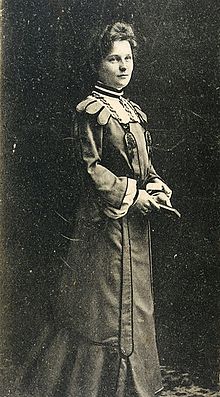
1908: Grete Beier, who wanted the fairy tale

Marie Margarethe (Grete) Beier, the daughter of the late Mayor of Brand-Erbisdorf, was beheaded on the fallbeil on this date in 1908 for murdering her fiance. While her crime was banal, the consequent spectacle lit up newswires all the globe ’round.


Despite the marquee half of this contradictory headline in the Adelaide, Australia Advertiser (Aug. 26, 1908), the execution occurred behind prison walls. About two hundred tickets were distributed to members of the public (all men), but thousands of applicants (which included many women) were denied them. These “ticket holders rushed in pell mell in their eagerness to get the best places. Men fell and fought wildly.”

Secretly carrying on with a lover named Johannes Merker, Beier (German Wikipedia link) was forced by her parents — a working-class couple made good — into pledging her troth to a respectable engineer named Heinrich Pressler.

With “the face of an angel and the heart of a fiend”* the charming Beier contrived a plan to truly have it all: on May 13, 1907, she visited her would-be husband and spiked his drink with potassium cyanide — then to be sure of her project, had him close his eyes and open his mouth on her flirty promise of a sweet surprise. Then she shoved his own revolver between his lips and fired, abandoning at the scene of her crime a forged will to her benefit, a forged suicide note lamenting a purported affair with a vengeful Italian woman, and forged love letters corroborating the latter, fictional, relationship.

She was some weeks on towards her way to getting away with it — the coroner did indeed take Herr Pressler for a suicide — before suspicions as to the dead man’s testament led police to set a watch on her and unravel the web. Grete Beier confessed, in an unsuccessful gambit to secure mercy.

She reportedly died bravely, albeit slightly appalled by the size of the audience that had been admitted to gawk at her disgraceful finale.


Detail view (click for the full image) of the courthouse yard at Freiburg being readied for Grete Beier’s beheading. Image via the invaluable Bois de Justice.

* Her feminine fiendishness was greatly exacerbated to contemporaries by stories that she had also aborted three bastard children.

On this day..

1909: Garry Richard Barrett

(Thanks to Meaghan Good of the Charley Project for the guest post. -ed.)

On this date in 1909, two-­time murderer Garry Barrett was executed at the Alberta Penitentiary, a federal prison in Canada. To quote the Edmonton Journal, he’d made the least of his second chance.

Barrett, an American born in Michigan, had been a farmer who lived with his wife and stepchildren in Saskatchewan. He had a fairly normal existence but was prone to bouts of severe depression. It was during one of these times, on October 16, 1907, that he flew into a rage, pointed a gun at his wife, and pulled the trigger.

The gun failed to go off.

Barrett’s stepson, Burnett, threw himself in front of his mother. Barrett pulled the trigger again. This time the gun did go off. Burnett was shot and ultimately died of his injuries.

There was little he could say for himself at his murder trial, given the evidence against him, and he was accordingly convicted and sentenced to death. However, the jury recommended mercy, and the authorities commuted his sentence to life in prison and sent him to the Alberta Penitentiary in Edmonton.

On April 15, 1909, less than a year later, Barrett was working in the prison carpentry shop when he suddenly picked up a hatchet and planted it in the skull of Deputy Warden Richard Stedman.

There seemed to be no motive for his actions, as Stedman was well­-liked and popular among the prison inmates. However, that day Barrett had asked to see a doctor and Stedman hadn’t gotten one for him.

One month and two days later, Barrett found himself again before a judge facing a murder charge. This time there would be no recommendation of mercy.

Rather than summon a professional hangman to execute the condemned man, the prison used one of its own guards. Barrett’s last words were, “Gentlemen, I am going to be hanged, but I killed the deputy warden in self­-defense. Had I not done so my flesh would now be the food for vultures.” He then began denouncing members of the Masonic Order, until his speech was cut short and the chaplain commenced with the Lord’s Prayer.

Barrett’s execution was badly botched, as the Edmonton Journal records:

It was a long, slow death. The noose wasn’t properly tied, and the knot slipped out of position when the trap was sprung. The hangman twice began to cut down the body, but both times the doctor stepped in because Barrett wasn’t yet dead. He was finally declared dead of strangulation 15 minutes later.

The guard/executioner then cut the rope into pieces and distributed it to his fellow guards as souvenirs.

Barrett’s body was claimed by his son, who buried it in Butte, Montana.

On this day..

1900: Benjamin Snell, electricity in his head

(Thanks to Robert Elder of Last Words of the Executed — the blog, and the book — for the guest post. Fans of this here site are highly likely to enjoy following Elder’s own pithy, almanac-style collection of last words on the scaffold. -ed.)

As the rope was placed around his throat:

“Oh, I’ll smother with that on. I’ve got electricity in my head now.*”

– Benjamin Snell, convicted of murder, hanging,** Washington, DC.
Executed June 29, 1900

“A man of education and good family,” Snell was convicted of murder after breaking in to the house of child Lizzie Weisenberger and cutting her throat with a razor. Other prisoners shunned Snell, and when Frank Funk heard that he was to be executed on the same day and scaffold as Snell, he petitioned the courts to change the day. President McKinley reprieved Funk for several days, and Snell and Funk maintained “bitter hatred” until Snell’s death.


* Snell, who pursued an insanity defense that was not persuasive to the jury but was convincing enough to induce the entire Congressional delegation of his home state of Georgia to petition President McKinley for a commutation, regularly complained of electricity buzzing in his brain. “I told a physician about it and he laughed at me,” Snell complained (Washington Evening Star, June 28, 1900) of the incredulity this complaint elicited. -ed.

** A giant at two meters tall and a reported 17 stone on the day of his execution, Stone was nearly decapitated by the noose — presumably the consequence of the characteristic American practice of making an impressionistic guess at the right length of the drop, rather than scientifically calculating it.


San Jose (Calif.) Evening News, June 30, 1900.

The victim’s father had the goriest seat in the house for this, standing “directly at the foot of the scaffold, within a few feet of where the body swung after the fall” (Evening Star, June 29, 1900) at the private hanging. -ed.

On this day..

1906: Richard Ivens, hypnotized?

On this date in 1906, “with terror stamped on his colorless face and almost in a state of collapse,” Richard Ivens hanged for a murder that remains to this day an unsettling indictment of witness reliability — even when it is his own crime the witness describes.

The tenor of the crime and of its consequent sensation — a Chicago society matron sexually assaulted by a young hoodlum who proceeds to garrot her with a wire — is readily apparent in the headlines of the day; editors from coast to coast plunged into their thesauruses to titillate their subscribers with the most bombastic invective


Baltimore American, Jan. 14, 1906.

As this image also indicates, Ivens confessed soon after he was detained. (He reported finding, or “finding”, the body to his father and the two of them went to the police; the police immediately detained the youth, separated from Ivens pere.)

Usually, a confession is the “and shut” part of an open-and-shut case. Indeed, for most of human history, given a paucity of useful forensic evidence, legal cases have come down to eyewitnesses and confessions: hence the formalization of torture as part of the investigative process courts of bygone years.* A perpetrator’s own testimony against himself is the evidentiary gold standard.

Today, this long-unquestioned bedrock of criminal justice is dissolving. A quarter or more of the wrongful-conviction exonerations from death row have been cases involving false confessions; witness testimony by victims or third parties has frequently been shown to be unreliable. Our behavioral models once implied that the brain stored memories like a faithful photograph, a view suggesting that witnesses could be either accurate or liars without much room in between. Today, it’s ever more widely understood that memories are constructed, and reconstructed, amid the interpolations of fragmentary data and the subtle feedback of others’ suggestion and influence.

But Ivens put this idea to the test more than a century ago. Backed by friendly alibi witnesses who placed him away from the scene of the murder, Ivens recanted his confession and “declared that the police locked him up in a room at the police station with a number of officers and that their questioning so confused him that he said ‘yes’ to everything they asked him.”**

Perhaps this was just the gambit of a desperate defense counsel with few cards to play. But it did briefly make the Ivens case a referendum on the reliability of the confession.

Ivens intimated that the circumstances of his interrogation might have intimidated him into confessing, but his subsequent claim to have no memory at all of those events led a defense “alienist”, J. Sanderson Christison, to argue that the whole story of the crime had been planted in his mind when he was in a hypnotic state.
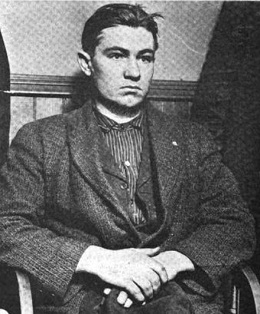
According to Christison, this Chicago Tribune photo of the accused a few hours after his arrest “shows the hypnotic expression of face in passive attitude.”

Christon’s pamphlet excoriating the way the young man was handled makes interesting reading. Titled “The ‘Confessions’ of Ivens”, its core thesis that Ivens was “dominated by police statements” is a strikingly forward-thinking one.†

we find in the “confessions” a mixture of fact with “suggested” fiction … he was first forcefully charged with the crime in a brutal manner and after being confounded and subjugated, a current of leading questions were put to him on a stupid police hypothesis, so that the first “confession” is composed of a few vague and contradictory statements. And it is both evident and acknowledged that all the other official “confessions” are the products of question suggestions, almost entirely.

For Christison, Ivens was a dull and easily controlled personality; the doctor’s explication of “hypnosis” suggests to modern eyes a laughably Mephistophelean sleepy, verrrry sleeeeepy caricature. But maybe we would do better to view it as the best framework available in 1906 to grasp the incomprehensible circumstance of a person accusing himself of a crime: the most ready illustration of outside influences entering the mind. A century later, we are only just now developing an understanding of wrongful confessions that might be shared widely enough to speak with mutual understanding about disorientation, suggestibility, leading questions, confirmation bias, and the malleability of memory.

But by any name, the notion was not ridiculous to Christison’s peers.

Christison consulted with Hugo Munsterburg, the German-American psychologist credited with founding the field of forensic psychology: Munsterburg shared Christison’s opinion, and expounded on it (without mentioning Ivens by name) in his subsequent magnum opus On The Witness Stand:

the accused was hanged; yet, if scientific conviction has the right to stand frankly for the truth, I have to say again that he was hanged for a crime of which he was no more guilty than you or I, and the only difference which the last few months have brought about is the fact that, as I have been informed on good authority, the most sober-minded people of Chicago to-day share this sad opinion.

I felt sure from the first that no one was to be blamed. Court and jury had evidently done their best to find the facts and to weigh the evidence; they are not to be expected to be experts in the analysis of unusual mental states. The proof of the alibi seemed sufficient to some, but insufficient to others; most various facts allowed of different interpretation, but all hesitation had to be overcome by the one fundamental argument which excluded every doubt: there was a complete confesslon. And if the sensational press did not manifest a judicial temper, that seemed this time very excusable. The whole population had been at the highest nervous tension from the frequency of brutal murders in the streets of Chicago. Too often the human beast escaped justice: this time at last they had found the villain who confessed — he at least was not to escape the gallows.

For many years no murder case had so deeply excited the whole city. Truly, as long as a demand for further psychological inquiry appeared to the masses simply as “another way of possibly cheating justice” and as a method tending “towards emasculating court procedure and discouraging and disgusting every faithful officer of the law,” the newspapers were almost in duty bound to rush on in the tracks of popular prejudice.

[I]f I examine these endless reports for a real argument why the accused youth was guilty of the heinous crime, everything comes back after all to the statement constantly repeated that it would be “inconceivable that any man who was innocent of it should claim the infamy of guilt.” Months have passed since the neck of the young man was broken and “thousands of persons crowded Michigan Street, jamming that thoroughfare from Clark Street to Dearborn Avenue, waiting for the undertaker’s wagon to leave the jail yard.” The discussion is thus long since removed to the sphere of theoretical argument; and so the hour may be more favourable now for asking once more whether it is really “inconceivable” that an innocent man can confess to a crime of which he is wholly ignorant. Yet the theoretical question may perhaps demand no later than tomorrow a practical answer, when perhaps again a weak mind shall work itself into an untrue confession and the community again rely thereon satisfied, hypnotised by the spell of the dangerous belief that “murder will out.” The history of crime in Chicago has shown sufficiently that murder will not “out.”

It is important that the court, instead of bringing out the guilty thought, shall not bring it “in” into an innocent consciousness. Of course in a criminal procedure there cannot be any better evidence than a confession, provided that it is reliable and well proved. If the accused acknowledges in express words the guilt in a criminal charge, the purpose of the procedure seems to have been reached; and yet at all times and in all nations experience has suggested a certain distrust of confessions.

Munsterburg wrote this under the heading of “Untrue Confessions” but he did not exempt himself from susceptibility to the hypnotic tricks of the mind: Munsterburg himself once found his house burgled, and realized that the evidence he subsequently gave about what he found was wildly inaccurate. “In spite of my best intentions, in spite of good memory and calm mood, a whole series of confusions, of illusions, of forgetting, of wrong conclusions, and of yielding to suggestions were mingled with what I had to report under oath, and my only consolation is the fact that in a thousand courts at a thousand places all over the world, witnesses every day affirm by oath in exactly the same way much worse mixtures of truth and untruth, combinations of memory and of illusion, of knowledge and of suggestion, of experience and wrong conclusions.”

We do know at a minimum that Ivens was being interrogated alone for a number of hours by officers who evidently presumed him to be guilty. Right down to the present day, any number of fully cogent adults (many still languishing in dungeons as I write this) have falsely implicated themselves in terrible crimes during similar confinements, under manipulative interrogation techniques evincing much more interest in getting to “yes” than probing truth. (Just one of many reasons we caution the reader against ever talking to the police.)


Lexington Herald, March 20, 1906.

The Richard Ivens case, needless to say, is impossibly cold. It is quite difficult from several generations’ distance to form a convincing affirmative confidence in Ivens’s innocence. But as all those involved for good or ill have gone to their own graves too, perhaps it is enough for us to leave that door open just crack — enough to let in the humility before we print a man’s epitaph.


Wilkes-Barre Times, June 22, 1906.

* Of relevance: a suspect tortured into a confession was usually required to repeat the confession free of torture in open court in order for it to count. Such people did sometimes refuse to do so and even blame the torture for having given a previous incriminating statement; the standard reward for such reticence was, naturally, more torture.

** Baltimore American, March 20, 1906. This is the Chicago Police Department we’re talking about.

† Christison is also noted for theories about the shapes of the ears as criminal indicators, and the pamphlet explicitly cites Ivens’s phrenological characteristics as exculpatory. We all have our hits and our misses.

On this day..

1905: Elisabeth Wiese, the angel-maker of St. Pauli

On this date in 1905, “baby farmer” Elisabeth Wiese was beheaded in Hamburg.

In a luridly reported case “revolting in the extreme, proving the woman to be a monster of iniquity” Wiese stepped into a quintessential fin de siecle moral panic as a former convict whose larcenous past had forced her trade away from the legitimate field of midwifery towards the more shady precincts of mercenary fostering.

From scandal-averse single mothers in England as well as Germany, she collected children with maintenance fees running to US $1,000 plus a hush-money surcharge tacked on. For this donative, she represented a capacity to distribute these whelps to willing adoptive families: in reality, most of them she disposed of with morphine. (As an added inflammation to public opinion, she had also forced her own illegitimate daughter into prostitution; Paula, whose own infant was among Wiese’s victims, repaid that ill turn by appearing as a witness against her mother.)

When Wiese fell under suspicion, the neighbors’ reports of her kitchen glowing like hellfire and belching revolting stenches led police to the remains of these little ones burnt up in her stove.

Condemned for five murders — it’s thought that the true count must have run much higher — Wiese is known as the “angel-maker of St. Pauli” after the suburb where she plied her trade.

On this day..

1900: The private, decent, and humane execution of a human being named George Smiley

George Smiley’s execution in the Arizona Territory on this date in 1900 was a month late owing to a public relations debacle.

The first and only man ever hanged in Navajo County, Smiley had killed a railroad section foreman.

As his scheduled December 8 execution approached, sheriff Frank Wattron garlanded the routine invitation he was required to send to the official witnesses with a bit more exuberance than was usual for the genre.

Holbrook, Arizona ... 1899.

Mr. .....

You are hereby cordially invited to attend the hanging of one

GEORGE SMILEY, MURDERER.

His soul will be swung into eternity on Dec. 8, 1899, at 2 o'clock, p.m. sharp.

Latest improved methods in the art of scientific strangulation will be employed and everything possible will be done to make the proceedings cheerful and the execution a success.

F.J. WATTRON,
Sheriff of Navajo County

The jaunty, gilt-edged communique found its way into the hands of newsmen who soon reported it coast to coast.

U.S. President William McKinley — Wattron’s ultimate boss, since Arizona was a pre-statehood federal territory at this point — was not amused by the officer’s jollity, and ordered a 30-day reprieve for Smiley and a do-over with a little solemnity this time for Wattron.

The sheriff’s compliance was not altogether in the spirit of the directive. On the eve of the hanging, when it was much too late for news cycles to create any upstairs blowback, he dispatched a black-framed invitation dripping in sarcastic gravity.

Revised Statutes of Arizona, Penal Code, Title X, Section 1849, Page 807, makes it obligatory on sheriff to issue invitations to executions, form (unfortunately) not prescribed.

Holbrook, Arizona

Jan. 7, 1900.

With feelings of profound sorrow and regret, I hereby invite you to attend and witness the private, decent and humane execution of a human being; name, George Smiley, crime, murder.

The said George Smiley will be executed on Jan. 8, 1900, at 2 o’clock p.m.

You are expected to deport yourself in a respectful manner, and any “flippant” or “unseemly” language or conduct on your part will not be allowed. Conduct, on anyone’s part, bordering on ribaldry and tending to mar the solemnity of the occasion will not be tolerated.

F.J. Wattron,
Sheriff of Navajo County

I would suggest that a committee, consisting of Governor Murphy, Editors Dunbar, Randolph and Hull, wait on our next legislature and have a form of invitation to executions embodied in our laws.

On this day..

1905: A.I. Volioshnikov, police spy

On this date in 1905,* the druzhinniki (militia) of Moscow’s insurrectionary Red Presnia district barged into the apartment of 37-year-old police detective A.I. Volioshnikov.

In front of his shrieking children, “they read the verdict of the Revolutionary Committee, according to which Volioshnikov had to be shot” — as a police spy surveilling rebels, according to Trotsky — then taken outside and executed directly at the Prokhorovka textile factory.**

The tsar’s artillery began barraging Red Presnia the very next day, and had overrun it — complete with summary executions of their own — before the calendar turned over to 1906.

* December 28 per the Gregorian calendar; it was December 15 per the Julian calendar still in use at the time in Russia.

** There’s a “Druzhinniki Street” in Moscow near the Krasnopresnenskaya metro station — and the Prokhorovka factory (dating to 1799) still stands nearby.

On this day..

1900: Joseph Holden, killer of his own grandson

This morning in 1900, Bury ironturner Joseph Holden was executed at Manchester’s Strangeways Prison for the murder of his grandson.

“The convict’s sanity had been in some doubt,” in the bloodless words of the next day’s London Times. To read it a century later is to see a man deeply in need of help.

It was his married daughter Mary Dawes who tried to give it to him by taking him in under her own roof after Holden was reduced to living in a workhouse.

In August of 1900 he took another of his grandchildren — not by Mary Dawes — to a quarry to cut tobacco, then hurled a stone that hit the child in the head. George Eldred was badly injured, but survived.

The mental deterioration betokened by such behavior must have put Mary Dawes or any other kin with an interest in the patriarch’s well-being into a terrible bind. What resources of state or charity could they have called upon, short of consigning him to the miasma of some gaol? At 57 years of age, Holden was already 10 years past the male life expectancy for the time and looked still older thanks to the ravages of alcoholism. Maybe Mary thought that having him at her hearth would stabilize him well enough to dignify whatever little measure of life remained to her father.

That is nothing but a speculative assessment of these bare and tragic facts: Mary Dawes took her father in; days later, on September 5, Mary’s father took Mary’s son John to a quarry and drowned him.


Hampshire Advertiser, September 12, 1900.

Holden’s only defense — practically the only one really available to him — was insanity. But Holden wasn’t starkers; his mind perambulated that foggy wilderness between lucidity and dementia and this was simply insufficient disturbance for the then-prevailing legal standard of madness, the M’Naghten Test. Basically, if he could understand what he’d done, he was sane enough to hang. Still to this day the basis of competency assessments in much of the English-speaking world, M’Naghten offers only a narrow ground for avoiding the full measure of criminal responsibility. And Holden was clearly competent enough by that test; indeed, he had complained of his treatment in Mary’s house, hinting at a real motive.

Although Holden’s death sentence was automatic upon the unhelpful sanity assessment of the doctors,* he was thought a prime candidate for a reprieve from the Home Secretary. This too did not materialize; Holden’s own contrition and resignation to his fate in the days leading up to the execution might have contributed to the judgment that he was in fact sane enough to die. That’s some catch: the best there is.

A murderer named Oscar Mattson — a Russian sailor who had slain a young English prostitute named Mary Ann Macguire in a rage over stolen money and rebuffed advances — did win a Home Secretary reprieve on the same day that Holden hanged.

* It was only necessary for doctors to find him competent enough to make his own plea. When they did so, he simply pleaded guilty.

Part of the Themed Set: Filicide.

On this day..

1904: Newly caught Herero prisoners-of-war

“Newly caught Herero prisoners-of-war were hung by the neck. Since that day, I would often see Herero swaying from the branch of a tree.”

-Diary of German soldier Emil Malzahn, writing of prisoners captured and summarily executed 26 September 1904 at the waterhole of Owisombo-Owidimbo during the Herero genocide

On this day..

1902: Hirsh Lekert, Jewish assassin

On this date in 1902, the Jewish socialist Hirsh Lekert was hanged in Vilna (Vilnius) for his attempt on that city’s governor.

The 22-year-old shoemaker, active in the Bund since childhood, was aggrieved along with many others by repressive measures taken against that leftist council by Vilna governor Victor von Wahl — culminating with the calculated humiliation he inflicted by personally overseeing the flogging of 20 Jews and 6 Poles arrested at a May Day demonstration.

As was the style at the time, Lekert took some retaliatory potshots at the municipal dictator on May 18, 1902. He scored a couple of flesh wounds before the police on hand beat him all to hell.

And that was pretty well that. Lekert got sent to face a military tribunal with a foreordained result. But he made his bones with posterity by refusing to apologize and instead fearlessly vindicating his action as a defense of the Jewish worker’s dignity.

This carried his legend in the early 20th century Jewish community much further than one might assume.

For Jewish Workers Bund, “the first great attempt at the organization of the Jewish masses for secular and independent political activity,”* Lekert’s uncompromising embrace of revolutionary violence created an internal controversy: radical workers saw a martyred hero; elites, and the Bund officially, were much more wary of terrorism provoking official backlash in an empire where Jewish communities were still liable to be targeted by pogroms at any time. All this during a renaissance of cultural and political thought among Eastern European Jewry.

Even decades later, the esteem remaining Lekert from his sacrifice gave his name power. Another generation of Jewish terrorists — in Mandate Palestine — was incensed at the British for flogging some Irgun members, leading Menachem Begin to invoke Lekert as his justification for kidnapping several British soldiers and flogging them. (Source) The British had no stomach for this, and desisted with floggings.

Artistic tributes followed as well — folk songs; plays by Arn Kushnirov and H. Leyvik; the bust that illustrates this post; a monument in Soviet Minsk; even this appearance in a 1927 silent film called His Excellency:

And from the hellish Vilna Ghetto under Nazi occupation, the great poet of the Holocaust Abraham Sutzkever depicted his “Teacher Mira” trying to keep her students’ heads up by reminding them of the Vilna cobbler who fought back.

Her skin, a windowpane in stains of dusk,
Mira must not reveal the darkness thus.
She bites her lip, of courage she will tell:
About Hirsh Lekert, how he fought and fell.

* Koppel Pinson, “Arkady Kremer, Vladimir Medem, and the Ideology of the Jewish ‘Bund'”, Jewish Social Studies July 1945.

On this day..