2003: Two Palestinian collaborators

On this date in 2003, Samer Ufi and Mohamed Faraj (some sources give the latter’s name as Suleiman) were publicly shot by masked al-Aqsa gunmen in the West Bank town of Tulkarem (or Tulkarm) for Israeli collaboration.

A videotape of the two admitting to supplying Israel information which led to militants’ assassination was played in the camp on the eve of their shooting. The dead men’s families contended that they had been tortured into the confession.

Tulkarem in 2003 was a place easy to feel under siege.

Recently prosperous, the fertile district close upon the Israeli border was suffering the effects of the ongoing Palestinian rising.

Tulkarem was in the process of being riven by Israel’s “apartheid wall”splintering communities and devastating a recently prosperous economy.

Isabel Kershner reports in Barrier: The Seam of the Israeli-Palestinian Conflict:

Some eighteen to twenty-two thousand Palestinian laborers from the Tulkarm district used to go and work in Israel every day. Now they are prevented by the security barrier that went up during 2003 … an eight-meter-high concrete wall complete with round gray watchtowers, built to prevent Palestinian snipers from shooting at passing cars on the Trans-Israel Highway that skirts Tulkarm to the west. Additional stretches of fence hermetically seal the surrounding villages off from Israel, as well as from some of their agricultural land.

Meanwhile, as elsewhere in the West Bank and Gaza, a a fast-growing list of assassinations struck militants in the community.

We don’t know in these parts whether the executed men truly were informers, but Israel is known to obtain many such targets by way of informers — often reluctant Palestinians it blackmails or bribes. Accused informers are regularly executed in the Palestinian territories.

“For myself, if I were Palestinian, I would hate them to death,” an Israeli intelligence advisor told the BBC of the collaborators recruited by Tel Aviv. “He is a traitor — I need him — but he’s a traitor”.

Part of the Themed Set: Illegitimate Power.

On this day..

2009: Four Tibetans

On this date in 2009, China executed four Tibetans widely considered political prisoners.

The previous year, widespread unrest over Chinese control had shaken the country, most notably riots in the capital, Lhasa that targeted Chinese persons and shops.

(There’s a BBC page preserving a good deal of the original coverage here.)

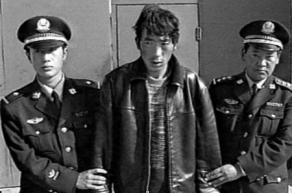
Loyak, one of those executed Oct. 20, 2009.

The two most prominent prisoners — in fact, the only two confirmed in some of the first media reports — were Lhasa residents Lobsang Gyaltsen and Loyak. A court spokesperson said both had been “given death penalties had committed extremely serious crimes and have to be executed to assuage the people’s anger.”

Specifically, both had been convicted of torching shops during the Lhasa riots, which arsons both led to deaths.

The other two executed, a woman named Penki (also for arson) and an unnamed man, received less comment, although they might have been executed despite having been condemned only to a “suspended” death sentence, which for China is generally no death sentence at all.

Executions in Tibet turn out to be relatively rare; these were the first known Tibetan executions since early 2003. Widely condemned abroad, this date’s events were barely or not at all reported internally by Chinese state media.

Part of the Themed Set: Illegitimate Power.

On this day..

2007: Majid and Hossein Kavousifar

On this date in 2007, cousins Majid and Hossein Kavousifar (or Kavoosifar, or Kavoosi-far) were publicly hanged in Tehran for murdering a judge.

The judge in question had been noted for clapping some democracy activists in jail, but the authorities insisted that the case wasn’t political — that Majid admitted targeting Hassan Moghaddas (whose outsized portrait grotesquely decorated the scene) in a personal vendetta, as well as killing a couple of other people in a string of robberies.

The first public executions in the capital in five years, these hangings attracted an ample crowd, amply armed with the ubiquitous digital media equipment that characterizes our age.


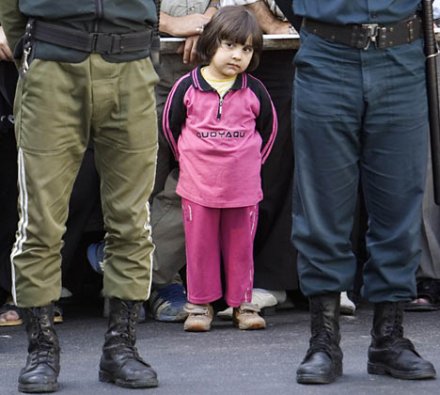
Age-appropriate entertainment? A spectator at the hanging.

And while the 24-year-old Hossein died in fright, 28-year-old Majid played to those onlookers in the most insouciant execution pictures you’ll ever want to see.

Warning: Graphic images (and video) follow. (Many more can be searched up around the web.)

… and the inevitable video.

On this day..

2006: Rocky Barton, suicidal

On this date in 2006, Ohio murderer Rocky Barton died by lethal injection for murdering his wife.

Say this for Barton: the experience of failed marriages had not jaded him on the institution. When his fourth wife, Kimbirli Jo, proposed to leave him, he was distraught enough to shoot her dead in a fit of passion, and then turn the gun on himself, too. “I couldn’t stand the thought of living without her,” he explained.

And say this, too: he wasn’t one for any special pleading.

“”It was an act of anger. Evidently it was not too thought out or I wouldn’t be where I am today,” he told a reporter just days before his execution. “I strongly believe in the death penalty. And for the ruthless, cold-blooded act that I committed, if I was sitting over there [in the jury box], I’d hold out for the death penalty.”

Voluntarily dropping his appeals, he spent less than three years on the “greased lightning” track to the Ohio gurney, only some 42 months overall from murder to execution. Kimbirli’s daughter, and Rocky’s stepdaughter, got a special release from a county jail where she was serving a drug sentence to witness the execution.

His suicide attempt, though unsuccessful, required “four surgeries to insert pins, wires and screws to hold his eyes in their sockets and the cadaver’s jaw to replace his shattered one,” and hundreds of thousands in public expenses to post special guard details for said reconstructive surgeries.

On this day..

2007: Christopher Newton

After Christopher Newton’s death in Lucasville, Ohio by lethal injection on this day in 2007, his attorney read a prepared last statement that apologized for the murder of a fellow inmate: “If I could take it back, I would.”

But the evidence of the “bizarre” execution says Newton was right where he wanted to be.

From the time the obese career criminal (pdf) garroted his cellmate in 2001,* he cooperated with investigators only to the extent that cooperation would grease the wheels of that so-called machinery of death. The entire thing was engineered to get Newton his last parole.

It still took him over five years to land on a gurney, but if you think that’s inefficient, get a load of the execution itself.

For going on two hours, the injection team poked and prodded at Newton’s veins in vain, trying to squeeze a lethal shunt into its gargantuan subject.

“We have told the team to take their time,” read a sign that a prison spokesperson held up in the hush-hush viewing chamber an hour into this discomfiting procedure. “His size is creating a problem.”

Minutes later, the 19-stone condemned man got a bathroom break during his own execution.

So far as anyone could see, the delay was anything but agony for Newton, who was generally observed smiling, laughing, and chatting it up with the prison personnel who were struggling to kill him. Finally, they managed to do it — an achievement which Ohio has latterly demonstrated is by no means a given.

* And allegedly drank some of Jason Brewer’s blood to boot, though this claim proceeding from a man who was intentionally pursuing a death sentence merits skepticism.

On this day..

2001: Terrance Anthony James, snitch-killer

On this date in 2001, Terrance Anthony James suffered lethal injection in Oklahoma for the vicious murder of a suspected jailhouse snitch.

Awaiting trial in 1983 for theft of government property, James became convinced that a fellow-inmate was responsible for his arrest, and proceeded to strangle Mark Allen Berry with a wire.

Usually, in death penalty cases, it’s the jailhouse snitch who does the killing.

On this day..

2005: Shanmugam Murugesu, for the chronic

On this date in 2005, Singapore hanged a 34-year-old for pot.

Shanmugam Murugesu, an ethnically Tamil Singaporean, was nabbed carrying a kilo of marijuana.

Your basic “wtf drug war” case study, this divorced father actually represented Singapore at international watersports competitions and otherwise led a productive, non-criminal life.

The city-state: a mite crazy over drugs. (And over the death penalty.) Mere mary jane is among the substances that can get you a death sentence there — carrying 500 grams or more is supposed to trigger automatic execution.

While awaiting that fate, Shanmugam befriended the young Australian drug mule and “simple soul” Van Tuong Nguyen, who was bound to follow in his footsteps; Shanmugam’s last appeal to his lawyer was “to save Nguyen Tuong Van’s life at all costs.”

(No luck, but it’s the thought that counts.)

Shanmugam Murugesu’s hanging was also notable as a civic event in Singapore for the landmark public protest (organized in large measure by the hanged man’s own family) it generated — a rarity for that “Disneyland with the death penalty”.

Public Forum on Death Penalty and Campaign for Shanmugam Murugesu from Jacob George on Vimeo.

On this day..

2000: An adulteress, by stoning

On this date in 2000, according to the New York Times,

Afghanistan’s hard-line Taliban religious rulers stoned a mother of seven to death in northern Afghanistan today after she was found guilty of committing adultery, the Taliban radio said.

The last execution of a woman in Taliban territory was in November, when a woman was shot three times by a Taliban soldier after she was found guilty of killing her abusive husband with an ax.

The stoning today was carried out at a sports stadium in Mazar-e-Sharif in northern Afghanistan before several thousand spectators.

On this day..

2001: Five machine-gunned in Thailand

On this date a decade ago, Thailand machine-gunned in Bangkwang Prison five men — four convicted drug-smugglers, and one murderer.

Lee Yuan-kuang, one of those executed this date.

Bazillionaire populist Thaksin Sinawatra had just become the country’s Prime Minister, and would soon stake his administration on a notorious drug suppression push that would be linked to 2,000-plus extrajudicial killings.

This date’s harvest, perhaps, was its judicial preview. Amnesty International complained that it was “outrageous … to flaunt its tough anti-drugs stance by executing people,” and that’s probably exactly the sort of reaction Thaksin had in mind.

According to the BBC, one of the traffickers had been caught with 50,000 methamphetamine pills — meth being the rising drug problem (pdf) du jour — and another with 30 kilos of heroin.

Thailand executed three more drug traffickers later in 2001.


Thailand’s execution arrangement, further described here.

On this day..

2009: Four Iranians

If not for China, Iran’s hundreds of annual executions would put it in a class all its own for capital punishment.

The legions of hanged in Iran are more than this site will ever manage with the biographical care that their friends might demand for their lives: we are doomed to know only a few, and often what we “know” is little more than a name and what an authority figure has accused him of. Ever it is thus: the kings and potentates, the star-crossed lovers and epic villains, make the history books. But most of the headsman’s clients are, like he himself, obscurities.

From Iran Human Rights, March 14, 2009.

March 14: Four people were executed by hanging in the Adelabad prison of Shiraz, reported the Iranian daily newspaper Etemaad today.

According to the report the men were identified as:

  • Abolhassan (age not given), convicted of a murder in 1981
  • 26 years old man (name not given), convicted of murder
  • Young man (name and age not given), convicted of murder
  • 23 years old man (name and age at the time of committing the offence not given), convicted of raping two boys.

    According to our sources, there are several minor offenders on death row in the Adelabad prison of Shiraz.

    In 2008, at least two minor offenders were executed in the Adelabad prison of Shiraz.

On this day..