1751: James Field, pugilist

On this date in 1751, Irish boxer James Field was hanged at Tyburn.

He had ditched his criminal record in Dublin for the burgeoning London metropolis and hung out a shingle at a pub on Drury Lane. (Perhaps he knew the Muffin Man.)


“dustmen, scavengers, flue-fakers, gardeners, fish-fags, and brick-layer’s labourers … the Hibernian was relating the ill usage he had been subjected to, and the necessity he had of making a hasty retreat from the quarters he had taken up” (Description of Drury Lane … from 1821. Close enough.)

Field soon developed a blackhearted reputation in London, and because he was a big bad boxer on the brute squad, constables were known to “fail to recognize” him the better to get home safe to dinner.

Even in a city without a professional police force, though, that’s a thin reed to rest one’s liberty upon. Eventually the mighty British Empire marshaled the marshals necessary to run Field to ground for a violent heist. This time, his hulking build clinched his sure identification, and he earned the hemp for his felonies.

Field lives on in William Hogarth‘s anti-animal cruelty engravings Four Stages of Cruelty, published later in 1751. He’s the model for the hanged corpse being carved apart in the dissection theater in the last plate.

Second Plate:


In Hogarth’s Second Stage of Cruelty, a small poster in the background advertises a James Field bout against George Taylor.

Fourth Plate:


In Hogarth’s Reward of Cruelty, the hanged corpse laid out for dissection (and dog food) is modeled on James Field.

On this day..

1923: Eligiusz Niewiadomski, assassin-artist

On this date in 1923, Polish nationalist painter Eligiusz Niewiadomski was executed for assassinating Poland’s first president.

After more than a century under German, Austrian, and (most especially hated) Russian domination, Poland had established itself an independent republic in the first world war’s imperial wreckage.

Niewiadomski (English Wikipedia entry | Polish), whose father had taken part in the 19th century’s anti-Russian January Uprising, was a talented painter with a serious nationalist streak.

And that was really the done thing for his time and generation: his painting career from the 1890’s into the early 20th century maps the Young Poland movement of up-and-coming artists experimenting with new forms and celebrating romantic attachment to their prostrate homeland.


“The conscience of Polish literature,” Young Poland writer Stefan Zeromski, as depicted by Niewiadomski.

When not promoting patriotic appreciation of the Tatra Mountains, Niewiadomski enjoyed supporting Polish National Democracy, a right-wing movement raging against the Cossack yoke.

Niewiadomski was a true enough believer to serve time in a tsarist prison, but he was far from the leading light of either the artistic or political movements. By the time Poland attained independence (Niewiadomski worked for Polish intelligence during World War I, and even finagled a cameo on the front lines), he was in his fifties and seemingly settling in for a slow moulder into obsolescence in bureaucratic posts and artistic monographs.

(Of course, had he done so, the next decades would have brought him their own surprises.)

Instead, the 1922 election for President of the Polish Republic, which was decided in that country’s National Assembly, saw parliamentary horsetrading elevate an engineer on the strength of the left parties’ votes — a shock victory over Niewiadomski’s preferred right-wing candidate Count Maurycy Klemens Zamoyski, the infant republic’s Bush v. Gore.

It came to street disturbances, to assaulting members of parliament, to demonstrations “for” and “against.” There were casualties. Lumps of dirty snow were thrown at the carriage of the president-elect as it drove across the town. Newspapers dreamt of “a lump of snow that will change into an avalanche” and about removal of that man-“hindrance,” that man-“obstacle.” … The infamous ride through the streets of Warsaw was a ride down death’s lane. Someone hit the first president of the republic in the head with a stick, someone else waved brass knuckles in his face …

-Anna Bojarska in From the Polish Underground

So, five days into Gabriel Narutowicz‘s term, Niewiadomski did what any violent, disaffected patriot would do: he gunned down the new Polish president at the Zacheta art gallery. It’s always great to see artists participating in the political dialogue.

This event is the subject of the 1977 Polish film Smierc prezydenta (Death of a President).

The shots by Niewiadomski marked an end to the week of hatred. Poland suffered a shock — even the Right did. National reconciliation bloomed like a thousand flowers. The president’s funeral became an occasion for a deeply disturbed society to demonstrate. Half a million people walked in the funeral procession!

-Bojarska, again

Less than seven weeks later, Niewiadomski christened that national reconciliation with his blood … at a fortress the Russians had once used to garrison his country, Warsaw Citadel.

On this day..

1801: James Legg, crucified ecorche

On this date in 1801, 73-year-old James Legg(e) was hanged for murdering his mate William Lamb(e) at Chelsea Hospital.

Both men were pensioned ensigns from His Majesty’s service. According to the trial transcript, Legg was sinking into obvious depression. A nurse of long acquaintance remarked on

a lowness, a melancholy and deranged state; knowing him so long, I took the opportunity of asking him what was the matter with him, and the reason of his melancholy; he told me his mind was confused; that he had no rest night or day; that he was hurried from place to place, and could not tell what he was doing; and I really was afraid he would make away with himself; I was always unhappy when he was out of my sight, for fear he should do himself an injury; I never mentioned it to the doctor, because he was harmless … sometimes when I spoke to him, he would start like a person surprized out of a sleep; sometimes he would give me an answer, and sometimes only just a bow; I still observed that lowness and melancholy, and that his head was always confused down to the time of this unfortunate event.

Ah. The “unfortunate event.” Legg took it to mind that Lamb was “a tyrannical tempered man” who gave him “repeated insults” and challenged him to a duel. (Lamb’s widow, the only witness to the murder, said her husband had no beef with his killer.)

When Lamb quizzically (or scornfully) discarded the pistol that the irate Legg had forced into his hand, Legg just shot him dead.

He probably had no expectation that he’d just punched his ticket to artistic immortality.

Legg hanged exactly a month after the homicide. During the interval, three Royal Academy of Arts members — sculptor Thomas Banks and painters Benjamin West and Richard Cosway — pulled some strings with the Chelsea Hospital surgeon Joseph Carpue to get Legg’s body after death.

These gentlemen had an idea that centuries of artistic representation of Christ’s crucifixion were nonsense from a physiological point of view.


Giotto crucifixion fresco, c. 1300.

It was a natural outgrowth of Europe’s long fascination with anatomical accuracy — a fascination that made liberal use of executed bodies.

Despite the centrality of Christ’s crucifixion to western culture, nobody had seen an actual crucifixion — not for centuries. So, sure, you can make the guy on the cross look like a proportioned, three-dimensional human being …


Possible Michelangelo (otherwise, Marcello Venusti) Crucifixion with the Madonna, St. John and Two Mourning Angels.

… but is this really what a proportioned, three-dimensional human being would look like when nailed to a cross?

That Chelsea surgeon Carpue and his artist friends had the best way to find out. (Well … the second-best.)

“A building was erected near the place of the execution; a cross provided,” Carpue recorded. After hanging, “the subject was nailed on the cross; the cross suspended … the body, being warm, fell into the position that a dead body must fall into … When cool, a cast was made, under the direction of Mr. Banks, and when the mob was dispersed it was removed to my theatre.” West supposedly exclaimed that he had “never before seen the human hand” until he saw James Legg’s nailed and stretched.

Carpue proceeded to flay the cadaver and make a second cast from the grisly skin-less ecorche … an artistic/anatomical practice of the age whose best-known product is Smugglerius, also cast from a hanged man.

That latter ecorche still survives, and the despondent veteran James Legg’s last pose, hypothetically in the manner of the Savior, can be seen to this day the Royal Academy.

(Debate and experimentation over the particulars of an execution by cross also continue to this day.)

On this day..

1994: Not Arthur Judah Angel, death row artist

On this date in 1994, 38 people were executed at Nigeria’s Enugu Prison … but artist Arthur Judah Angel somehow was not among them.

Angel was convicted of armed robbery and murder: tortured and framed, he says, by corrupt police under the military dictatorship of Gen. Ibrahim Babangida.

At the time, Nigeria was liable to put to death condemned prisoners without warning at any time, like Japan does today … except that Nigeria carried out such executions by the dozens. In one instance Angel witnessed, there were 58 executions in a single day.

On August 2, 1994, a Tuesday, that occasion finally arrived for Arthur Judah Angel — or so it seemed.

“I was chained; I was given my last meal that was August 2, 1994,” Angel said in an interview. “38 others were executed that very day. Only God knew how I was spared. He was the one that made my name disappeared in the book. I did not know how it happened. But it happened. I died, in fact, every person on the death row dies every day.”

Who exactly it was that saved Angel on that date I have not seen conclusively documented, but they say that God helps those who help themselves. In this case, Angel helped himself with his charcoal sketches on death row, which soon brought him to the attention of some well-placed people in the prison bureaucracy, a Catholic bishop — even a British arts organization which organized exhibitions of his work in 1993 and 1994.

Angel’s death sentence was commuted in 1995, and he was released outright in 2000. He well knows that, like those other 38 people who hanged this date, he’d be forgotten if not for his fortuitous escape. Life is just too damn cheap for exonerating the dead.

“I am able to clear my name because I am alive,” Angel said. “If I had been executed, nobody would believe that I was innocent. If I didn’t make it, no one would know. I knew many people who were innocent in prison. Yet they died in prison. Only people like me, who were close to them until their death, knew they were innocent. The rest of the world learnt that armed robbers were executed on so and so day; nobody knew they were innocent.”

But Angel did survive, and is remembered — not only for his exoneration, but for the 51 startling sketches he made of Nigeria’s death row. They (and other anti-death penalty art Angel has created since) have been exhibited worldwide by human rights NGOs.

Angel, who’ll turn 50 this November, continues to work as an artist from a studio outside Lagos — and uses his art to campaign against the death penalty, as one might imagine. He has written a book, I Refused to Die; unfortunately for its prospective international readership, the book requires expensive shipping from Nigeria.

(There’s also a bit of video from a news report here.)

Part of the Themed Set: Scary Escapes.

On this day..

1680: A Madrid auto de fe

On this date in 1680, the Spanish capital of Madrid celebrated an enormous auto de fe, culminating with 18 executions plus eight people posthumously burned and 22 fugitives “executed” in effigy. (Source of the numbers)

This signal event needed every drop of sunlight from the long summer’s day. Staged for the appearance of the royal family itself, it likewise pulled in every available case from around Spain: the regional cities shipped their apostates and heretics to Madrid to dignify the main event with a suitable quantity of prey.

It began with a morning ceremonial procession of prisoners, nearly a hundred — every source seems to have a slightly different figure — in the traditional Inquisitorial manner. This account comes from an English contemporary, as reprinted in Human Judgment: The Eye of the Beholder. (Note: paragraph breaks added, and ubiquitous capitalization of nouns removed, for better readability.)

A scaffold, fifty feet in length, was erected in the Square, which was raised to the same height with the balcony made for the King to sit in. At the end, and along the whole breadth of the scaffold, at the right of the King’s balcony, an amphitheatre was raised, to which they ascend by twenty-five or thirty steps; and this was appointed for the Council of the Inquisition, and the other Councils of Spain. Above these steps, and under a canopy, the Grand Inquisitor’s rostrum was placed so that he was raised much higher than the King’s balcony. At the left of the scaffold and balcony, a second amphitheatre was erected of the same extent with the former, for the criminals to stand in.

A month after proclamation had been made of the Act of Faith, the ceremony opened with a procession [on June 29], which proceeded from St. Mary’s church in the following order. The march was preceded by an hundred coal merchants, all arm’d with pikes and muskets; these people furnishing the wood with which the criminals are burnt. They were followed by Dominicans, before whom a white cross was carried. Then came the Duke of Medina-Celi, carrying the Standard of the Inquisition. Afterwards was brought forwards a green cross covered with black crepe; which was followed by several grandees and other persons of quality, who were familiars of the Inquisition. The march was clos’d by fifty guards belonging to the Inquisition, clothed with black and white garments and commanded by the Marquis of Povar, hereditary Protector of the Inquisition.

The procession having marched in this order before the palace, proceeded afterwards to the square, where the standard and the green cross were placed on the scaffold, where none but the Dominicans stayed, the rest being retired. These friars spent part of the night in singing of psalms, and several Masses were celebrated on the altar from daybreak to six in the morning. An hour after, the King and Queen of Spain, the Queen-Mother, and all the ladies of quality, appeared in the balconies.

At eight o’clock the procession began, in like manner as the day before, with the company of coal merchants, who placed themselves on the left of the King’s balcony, his guards standing on his right (the rest of the balconies and scaffolds being fill’d by the embassadors, the nobility and gentry).

Afterwards came thirty men, carrying images made in pasteboard, as big as life. Some of these represented those who were dead in prison, whose bones were also brought in trunks, with flames painted round them; and the rest of the figures represented those who having escaped the hands of the Inquisition, were outlaws. These figures were placed at one end of the amphitheatre.

After these there came twelve men and women, with ropes about their necks and torches in their hands, with pasteboard caps three feet high, on which their crimes were written, or represented, in different manners. These were followed by fifty others, having torches also in their hands and cloathed with a yellow sanbenito or great coat without sleeves, with a large St. Andrew’s cross, of a red colour, before and behind.


Detail view (click for the full image) of a Goya painting of Inquisition prisoners in the sambenito.

These were criminals who (this being the first time of their imprisonment) had repented of their crimes; these are usually condemned either to some years imprisonment or to wear the sanbenito, which is looked upon to be the greatest disgrace that can happen to a family. Each of the criminals were led by two familiars of the Inquisition.

Next came twenty more criminals, of both sexes, who had relapsed thrice into their former errors and were condemn’d to the flames. Those who had given some tokens of repentance were to be strangled before they were burnt; but for the rest, for having persisted obstinately in their errors, were to be burnt alive. These wore linen sanbenitos, having devils and flames painted on them, and caps after the same manner: five or six among them, who were more obstinate than the rest, were gagged to prevent their uttering any blasphemous tenets. Such as were condemned to die were surrounded, besides the two familiars, with four or five monks, who were preparing them for death as they went along.

[skipping the seating arrangements … ]

About twelve o’clock they began to read the sentence of the condemned criminals. That of the criminals who died in prison, or were outlaws, was first read. Their figures in pasteboard were carried up into a little scaffold and put into small cages made for that purpose. They then went on to read the sentences to each criminal, who thereupon were put into the said cages one by one in order for all men to know them. The whole ceremony lasted till nine at night; and when they had finished the celebration of the Mass the King withdrew and the criminals who had been condemn’d to be burnt were delivered over to the secular arm, and being mounted upon asses were carried through the gate called Foncaral, and at midnight near this place were all executed.


Francisco Ricci‘s grand painting of the Madrid auto de fe represents events from throughout the day simultaneously. Image from Wikimedia Commons.

As best I can determine, two condemned people bought their lives with last-second conversions, leaving 18 to die for Judaizing … or, in one case, for converting to Islam. It will suffice to say that a very large, very ornate, and very long ceremony unfolded, and that at the end of it the flames consumed a number of people (and even more mannequins) associated with the Abrahamic faith.

“These punishments,” observed a French diplomat who witnessed the proceedings, “do not significantly diminish the number of Jews in Spain and above all in Madrid where, while some are punished with great severity, one sees several others employed in finance, esteemed and respected though known to be of Jewish origin.” Actual eliminationist Jew-hunting was so 1492.

Great as were these astounding spectacles, their day was passing. In fact, this was it — the long, sweltering, tiresomely gaudy day that it passed.

Spain in 1680 was in the grip of plague, famine, and deflation; though there’s value to the state in the distraction of a circus, there’s also the very substantial cost of putting the bloody thing on, especially on such a scale, especially when you’re going to let off most of the victims but not until you sock them away in prison and feed them for months or years until the next auto.

It seems that by the 17th century this end-zone spike of the Inquisition had become quite an encumbrance: procedures required the Inquisition to dispose of certain cases in autos de fe, which, because they had to be put on just so, were increasingly rare, and clogged up gaol cells in the meanwhile. There’s a reason besides spectacle that all the rest of Spain gratefully dumped its religious criminals on Madrid on this date.

The model just wasn’t sustainable.

Over the 1680s, practical pushback reconfigured the venerable ritual into something less burdensome to the public purse. This date’s event was very far from the last auto de fe in Spain, but it’s seen as the last of the classic, public-festival spectaculars evoked by the term. They would, in the future, become (mostly) smaller, (usually) shorter, and (somewhat) less garish affairs conducted not on public plazas but on church grounds, and with most cases of reconciliation simply handled quickly, quietly, and locally.

On this day..

1575: The intrepid Torii Suneemon

On this date in 1575* a Japanese soldier was crucified under the walls of his castle … and entered his country’s folklore.

Torii Suneemon was a footman of the Okudaira family late in Japan’s fratricidal Warring States Period.

The Okudaira, allies of the wars’ eventually-victorious Tokugawa clan, found themselves besieged by the Takeda. This would result in the important Battle of Nagashino.


Kurosawa’s masterpiece Kagemusha imagines the Takeda where the (real) late daimyo Shingen was succeeded after his (real) 1573 death (fictitiously) by an imposter thief posing as the great commander. In the film, the imposter is unmasked and deposed, but witnesses the climactic Battle of Nagashino … and then makes a futile charge under the Takeda banner after that side is slaughtered.

After an initial Takeda attempt to take the fortress by storm, the Takeda settled in for a brief siege — knowing the defenders to have only a few days’ supplies on hand. Enter Torii Suneemon.

Under cover of darkness on the night of the 22nd-23rd, Suneemon slipped out of the Yagyu gate and picked his way through Takeda tripwires to escape the investment … and summon help.


Torii Suneemon embarks on his mission: 19th century woodblock print of Yoshitoshi‘s “24 Accomplishments of Imperial Japan” series. The same artist also depicted that event in this triptych.

He made it on the 23rd to Tokugawa Ieyasu and Oda Nobunaga, who upon hearing his report pledged to dispatch a relief force the very next day.

Alas for him, Suneemon’s attempt to sneak back into the encircled fortress to deliver the good news was detected on the 24th, and he came as a prisoner to the Takeda commander. The Takeda prevailed upon their helpless captive to exchange his life for a signal service: approach the fortress walls and shout to the garrison that no help was on the way.

This Suneemon agreed to do.

The legends differ as to whether he walked on up to deliver this bogus bad news, or whether the Takeda lifted him up on a cross to impress upon their new agent the penalty for any funny business. Either way, Torii Suneemon had the last laugh: he immediately began hollering to the defenders that help was coming if they could just hang on a few more days.


Torii Suneemon goes off-script. Another Yoshitoshi creation, from here or from this detailed French post.

The besiegers, of course, crucified him immediately … but everyone could appreciate the doomed man’s heroism.

While the grateful Okudaira elevated his family to samurai rank, even an enemy Takeda commander who witnessed the event was so moved that he adopted the image of the defiantly crucified soldier for his battle standard.

Heck, there’s apparently even a Japanese monument in San Antonio, Texas that compares Suneemon to the Alamo defenders.

Nor was the brave soldier’s sacrifice in vain. The garrison did hold on — and their allies did relieve them, and did rout the Takeda in the resulting Battle of Nagashino. (The scenario is widely reproduced in video games nowadays).

* Some sites give this as “May 16”, but I believe the primary sources here actually indicate the 16th day of the 5th month on the traditional Japanese lunisolar calendar. This date corresponds to June 24, 1575 of the Julian calendar. (1570s conversion aid in this pdf, or use this converter).

On this day..

1776: Benjamin Harley and Thomas Henman, Smugglerius?

On this date in 1776, smugglers Benjamin Harley and Thomas Henman were hanged at Tyburn for murdering a customs-house officer who had intercepted them trafficking tea on the Deptford turnpike.

One of these two gentleman might well be the flesh-and-bones person behind the ghoulish ecorche sculpture known as “Smugglerius”.

This beautifully ghastly item was commissioned of sculptor Agostino Carlini by the anatomist William Hunter: it is the cast of a hanged man, meticulously flayed of his skin to reveal the musculature for the convenience of future students’ sketches. Those students gave their subject the jocular nickname, since in life it was thought to be a smuggler.

For good measure, Carlini posed the corpse in the manner of the Hellenistic marble Dying Gaul.


Dying Gaul (known in the 18th century as Dying Gladiator), one of the world’s best-known classical sculptures. (cc) image from Tom Magliery.

Of the “Dying Gladiator”, Byron wrote:

He recked not of the life he lost, nor prize,
But where his rude hut by the Danube lay,
There were his young barbarians all at play,
There was their Dacian mother, — he their sire,
Butchered to make a Roman holiday; —
All this rushed with his blood; — Shall he expire,
And unavenged? — Arise! ye Goths, and glut your ire!


A copy of Agostino Carlini‘s bronze cast of “Smugglerius”, displayed in Edinburgh. (cc) image from Chris Hill.

So that is Smugglerius, an astonishing artifact. For decades, it (actually a copy of Carlini’s original, which is long lost) has been parked at the Edinburgh College of Art, translating thence into countless students’ anatomical sketch pads.


William Linnell‘s 1840 drawing of Smugglerius.

To trace the ecorche‘s origin, we have, to start with, this letter from John Deare … not the tractor guy, but a noteworthy Liverpool sculptor. At time of writing in 1776, he was a 15-year-old matriculating art student:

One of the men bid me tell you, that Mr. Carter would give me half-a-guinea, at least, a week, for the first part of my time, and fifteen shillings for the latter part; but you will write to him, and ask him what he proposes: he is, just as they say, a blustering fellow, but a good man. I have seen two men hanged, and one with his breast cut open at Surgeons’ Hall. The other being a fine subject, they took him to the Royal Academy, and covered him with plaster of Paris, after they had put him in the position of the Dying Gladiator. In this Hall there are some casts from Nature that are cut from the middle of the forehead down to the lower part of the body, one part excoriated, and the other whole.

With the direct reference to the Dying Gladiator/Dying Gaul pose, we seem very clearly to have a bead on the creation of Smugglerius, and the letter suggests that it was one man taken from a pair of hanging subjects. Conveniently (or inconveniently) there were just two such pairs of executions at Tyburn in the spring of 1776: those of Benjamin Harley and Thomas Henman on May 27; and, those of Samuel Whitlow and James Langar on April 12.

Now, artist Joan Smith and anthropologist Jeanne Cannizzo have recently, and very publicly, argued that Smugglerius is not Harley or Henman, but James Langar — a man from the earlier hanging pair. This claim even teased an exhibition carrying the perhaps unfortunate title Smugglerius Unveiled.

The case for Langar basically has two components:

  1. Deare dated his letter about the “Dying Gladiator” on May 1, so the executions must precede that date — which means that it’s one of Langar or Whitlow.
  2. It’s more likely that Langar, a soldier, would have had the outstanding physique to attract Hunter’s interest. (Whitlow was a domestic servant who robbed his master in an unrelated crime.)

Headlines aside, this sleuthing obviously falls well shot of airtightness.

Historian Tim Hitchcock, incidentally a moving spirit behind the creation of the invaluable Old Bailey Online database, doesn’t find James Langar a persuasive candidate. In private communication with this site (4 April 2012), he remained “still very much of the opinion that [Smugglerius] is either Thomas Henman or Benjamin Harley … I am even more convinced now than before.” Here’s the case for one of the Harley/Henman pair:

  1. Harley and Henman were smugglers. You know … like Smugglerius?
  2. Trial records indicate death-sentenced prisoners also condemned to anatomization, and they do not say that about Whitlow and Langar, who were merely thieves
  3. Harley and Henman, by contrast, had killed; they were therefore subject to the Murder Act, and accordingly sentenced “to be afterwards dissected and anatomized; which sentence was executed upon them”*

All things equal outside of the date on Deare’s letter, Harley and Henman look much the likelier source of Smugglerius. (If so, we seem to lack any good reason to prefer Harley as the Smugglerius model as against Henman, or vice versa. Flip a coin.)

The historiography for Langar depends inordinately upon the present-day interlocutor’s confidence in the “1 May” date a Georgian-era teenager slapped onto a bit of personal correspondence with, one can be sure, nothing resembling academic gravity. May 1 could be mistaken outright (maybe it was June 1, and he wrote “May” out of the previous 31 days’ habit); or, it could be only a reference to when Deare began a letter that he might have composed over several weeks; or, it could be that the author had some trivial reason of personal expediency to backdate.

Maybe so, maybe not. But who would have thought anyone would be interested in Harley or Henman (or Langar) going on two and a half centuries after their deaths.

Executed Today had occasion to discuss this fascinating object d’art and its discomfiting origin with one of Hitchcock’s collaborators, IUPUI Professor of British History Jason M. Kelly.

ET: What’s the background? Why is Smugglerius being produced at all in 1770s Britain?

JK: Well, 1768 marked the establishment of the Royal Academy of Arts. It took over 20 years to create.

The idea was to give Britain a school of art — of painting, sculpture, and architecture — to rival its continental peers. The French had established art academies in the previous century; they were among the premier art schools in Europe, if not the premier schools.

The British didn’t have anything comparable. And, in an age of rivalries, both political and cultural, artists and patrons alike saw the Royal Academy as central to British national identity.

The Academy hired William Hunter to be the professor of anatomy. He was an anatomist — a doctor — by training, not an artist, so he was very interested in teaching things like musculature, skeletal structure, and the circulatory system.

Smugglerius was not William Hunter’s only ecorche. He had made at least one other as a teaching aid, and he was proud to associate himself with it. He even poses for a portrait with a miniature version of it.


Miniature portrait of William Hunter holding a miniature bronze from Michael Henry Spang‘s reduction of an earlier ecorched figure. (The full-sized figure can be seen in the background of this sketch.)

What actually goes into producing an ecorche?

They had to get the body from the gallows to the art academy. Then they flayed it. In this case, somebody decided to pose the corpse as the Dying Gladiator.

They had some time prior to rigor mortis to get everything situated. in this case, they flayed him, posed him, then let him dry out, possibly overnight, so that they could make a mold of his body.

Beyond its immediate use as a teaching device, it’s also an art object for appreciation in its own right. How do you read that phenomenon?

This is very much a representation of the power of the state, the unrestrained power.

The execution itself is a display of power, but the government went further when in 1752 it passed the Murder Act allowing the College of Surgeons to get six bodies a year to dissect.

Ordinary people had no desire to have their remains used in this way. In the example of Smugglerius, the criminal was executed. Then, the body was desecrated — transformed into an art object for elite connoisseurs.

The sculpture was meant to represent ideal beauty as well as the terrifying strength of the state. The very people who were meant to appreciate the model of the Dying Gaul were the same people holding the reigns of power. In a sense, this image reinforced the elites’ view of the world, both aesthetically and politically.

Why pose the figure in this way, as the Dying Gaul or Dying Gladiator?

There’s one reading of Smugglerius to the effect that it was very subversive because the Dying Gladiator was seen as emblematic of the decline of Rome: the sculpture represented Rome’s decadence and corruption.

an inveterate abuse, which degraded a civilised nation below the condition of savage cannibals. Several hundred, perhaps several thousand, victims were annually slaughtered in the great cities of the empire; and the month of December, more peculiarly devoted to the combats of gladiators, still [in the early 5th century] exhibited to the eyes of the Roman people a grateful spectacle of blood and cruelty … which had so long resisted the voice of humanity and religion.

-Edward Gibbon in The Decline and Fall of the Roman Empire

So, you could speculate that this pose slyly represented contemporary executions under the Bloody Code in the same critical way.

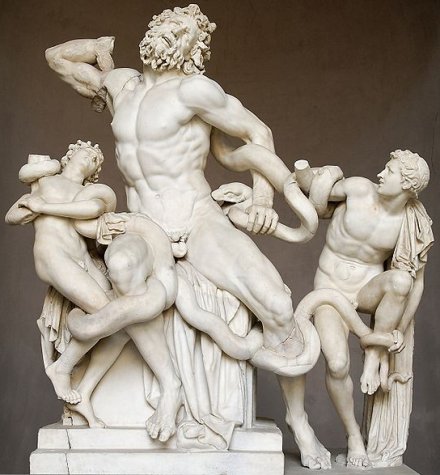
The Gladiator was also one of the best-known and -admired classical sculptures in all of Europe, along with the Laocoön.

In the 18th century they were compared as two examples of dignified dying. Contemporaries saw a certain stoicism in the sculptures — even though Virgil wrote that Laocoön cried out.

Ultimately, Smugglerius reminds us what happens when power is unrestrained. In a world where most people don’t have a voice, the state can ignore the rights and dignity of individuals. The real story here is the story of arbitrary authority and the importance of an enfranchised citizenry with the ability to put limits on those wielding power.

* Hanged felons not sentenced to anatomization could still wind up being taken apart in an operating theater, either as a result of their striking a direct bargain with the surgeons, or involuntarily via London’s growing trade in illicit corpses.

On this day..

1719: Mary Hamilton, lady in waiting

On this date in 1719, Mary (Marie) Hamilton, lady-in-waiting upon the tsaritsa Catherine I, was beheaded in St. Petersburg for infanticide.

A frightened Mary Hamilton contemplates her imminent execution in this 1904 painting by Pavel Svedomsky.

Lady Hamilton — her Scottish family had emigrated generations earlier — did not like to wait on her libido.

She could tell you if Peter the Great deserved his nickname, and dish on any number of other courtiers, nobles, and hangers-on.

This pleasing sport, of course, assumes with it the risks imposed by an equally impatient biology. Hamilton’s gallantries two or three times quickened her womb.

Her decision to dispose of these unwanted descendants in the expedient way — once by abortion, and again by infanticide — was done on the sly (voluminous court gowns helped) but surely also with no expectation of such a severe sanction in the unlikely event of detection.

But according to Eve Levin,* Russia’s longtime slap-on-the-wrist policy for infanticide was changing, and beginning “to distinguish between a woman who killed her child to hide illicit sexual conduct, and a woman who killed her child because she was too poor to care for it. In the first instance, the killing of the child reflected selfish behavior and was considered to be murder.”

Mary Hamilton was obviously not too poor to raise children.

In 1717, an unrelated investigation of another of Hamilton’s lovers led him to accuse the libertine lady-in-waiting of practicing post-natal birth control, which Mary admitted to,** certainly expecting her mistress the queen and her paramour the king to look forward, not back.

Peter, the towering and intense “learned druzhina” with his eye fixed on the West and a modernity that Russia lagged behind, was a liberal man in many respects. But he remained eminently capable of ruthlessness in service of an idea. This affair played out, after all, in his brand-new capital St. Petersburg, built on the bones of thousands peasants who threw up the city over swampland at Peter’s command. In 1718, he’d had his own son knouted to death.

Apparently infanticide was one of those ideas.

After all, executing women for infanticide was happening where the Hamiltons had come from. And it would still be good enough for late 18th century Enlightenment philosophers.

On the day of the execution, the prisoner appeared on the scaffold in a white silk gown trimmed with black ribbons. Peter climbed the structure to stand beside her and spoke quietly into her ear. The condemned woman and most of the spectators assumed that this would be her last-minute reprieve. Instead, the Tsar gave her a kiss and said sadly, “I cannot violate the laws to save your life. Support your punishment with courage, and, in the hope that God may forgive you your sins, address your prayers to him with a heart full of faith and contrition.” Miss Hamilton knelt and prayed, the Tsar turned away and the headsman struck.

Then, the bystanding tsar picked up the severed head that had once shared his pillow and discoursed to the multitude on its anatomical features — another idea imported from the West. That strange tsar afterward had the disembodied dome preserved in a jar until Catherine the Great ran across it and (after remarking that the woman’s youthful beauty had been preserved this half-century) had it decently buried.

Something else of Mary Hamilton outlasted her pickled cranium, however.

In one of those unaccountable twists of history, Hamilton maybe became conflated with the “four Marys”, Ladies-in-Waiting of Mary, Queen of Scots — and the story seemingly became translated backwards into this altogether different time and place. This is a much-disputed hypothesis† but for purposes of a blog post is well worth the noticing, while resigning to wiser heads the literary forensics at stake.

There was no “Mary Hamilton” among the Queen of Scots’s attendants, but in at least some of the many different versions of this ballad that survive, a person of this name is held to have become the lover of the king (“the highest Stuart,” in this case) and been put to death for killing her illegitimate child.‡ It is, at the very least, rather difficult to miss the parallel.

O little did my mother ken,
The day she cradled me,
The lands I was to travel in,
Or the dog’s death I wad d’ee!

Variants of this ballad remain popular to this day.

* “Infanticide in Pre-Petrine Russia,” Jahrbücher für Geschichte Osteuropas, Neue Folge, Bd. 34, H. 2 (1986).

** She had also pilfered some effects from the Queen.

† Dissenting opinions on identifying the “Mary Hamilton” of the ballad with our Mary Hamilton can be read here and here.

Presumed basis for the conflation: an actual 1563 infanticide scandal featuring the illicit offspring of Mary’s apothecary and “a Frenchwoman that served in the Queen’s bedchamber.”

On this day..

1724: Jack Sheppard, celebrity escape artist

“Yes sir, I am The Sheppard, and all the gaolers in the town are my flocks, and I cannot stir into the country but they are at my heels baaing after me.”

Jack Sheppard

On this date in 1724, the hangman finally got Jack Sheppard.

Sheppard was a thief, a romantic hero, a highwayman of the urban proletariat, a Houdini whom no prison could hold.

It had become possible in his time to ride criminal notoriety into celebrity: Jack Sheppard, a mere 22 at his death, proved as adept with that quicksilver element during his personal annus mirabilis of 1724 as he was with a lockpick.

Sheppard’s world had him fitted to wield a hammer better than thieves’ tools — but at about age 20, a young man awash in the illicit liberty of London’s underbelly, he ditched the square carpenter to whom he was apprenticed to live free by his wits.

Peter Linebaug’s The London Hanged finds in Jack Sheppard’s career and his runaway popularity an important marker of the capital city’s “refusal of subordination: — contra Foucaultian discipline, which “makes the rulers of government and society seem all-powerful.”

An important meaning of liberation … [consisted of] the growing propensity, skill and success of London working people in escaping from the newly created institutions that were designed to discipline people by closing them in. This tendency I have dubbed ‘excarceration’ because I wish to draw attention to the activity of freedom in contrast to its ideological or theoretical expressions…

This lithe youth is most famous for his literal talent for freedom: four times in 1724 he escaped from custody in ever more dramatic fashion.

He busted out through the ceiling of St. Giles Roundhouse. He rappelled with a bedsheet rope down the 20-foot wall of Clerkenwell Prison with his lover.

This sort of thing won the enterprising rogue growing folk hero status. The vaunted Sheppard “made such a noise in the town, that it was thought the common people would have gone mad about him, there being not a porter to be had for love nor money, nor getting into an ale-house, for butchers, shoemakers and barbers, all engaged in controversies and wagers about Sheppard.”*

It also drew the unwanted attention of 1720s London’s Jabba the Hutt: “thief-taker” Jonathan Wild, who managed a vast thieving cartel enforced by Wild’s willingness to turn in non-participants in his ingenious cover role as the city’ preeminent lawman. That’s some protection racket.

Sheppard, to the fame of his memory, scorned obeisance to the crime lord as much as to any guild carpenter and worked for no man but himself. A vengeful Wild shopped him to the authorities.

This time, Sheppard was actually condemned to death for burglary but broke prison again, using yet another classic ruse: the “disguised in smuggled women’s clothes.”

Back on the lam, he posted a cocky letter to his executioner “Jack Ketch” giving his regrets at not having joined two fellow-sufferers on the scheduled hanging date. (September 4.)

I thank you for the favour you intended me this day: I am a Gentleman, and allow you to be the same, and I hope can forgive injuries; fond Nature pointed, I follow’d, Oh, propitious minute! and to show that I am in charity, I am now drinking your health, and a Bon Repo to poor Joseph and Anthony. I am gone a few days for the air, but design speedily to embark, and this night I am going upon a mansion for a supply; its a stout fortification, but what difficulties can’t I encounter, when, dear Jack, you find that bars and chains are but trifling obstacles in the way of your Friend and Servant

JOHN SHEPPARD

London’s finest were determined to put an end to this character’s preposterous run of prison breaks, so when they caught him the fourth time Sheppard found himself loaded with manacles and chained to the floor of a special strongroom in Newgate Prison. Get out of that, Jack.

Somehow, Jack got out of it.

On the night of Oct. 14, Sheppard authored the sublimest breakout in Newgate’s voluminous annals. Picking the locks of his fetters with a small nail, our acrobat scurried up a chimney, picked, prised, or otherwise passed a succession of locked doors in the dead of night, paused to rest on the condemned pew of the gaol chapel, forced a grille, reached the roof, and threw another homemade rope over the wall to scamper down to safety.

And then “he promptly went forth and robbed a pawnbroker’s shop in Drury Lane of a sword, a suit of apparel, snuff boxes, rings, &c., and suddenly made a startling appearance among his friends, rigged out as a gentleman from top to toe.”

There’s no doubt but that Jack had showmanship, but at a certain point he could have done with just the tiniest measure of discretion. But then, this was a man writing his own legend. Sure, he could have put his head down and tried to disappear into some nameless Puritan settlement in the New World. (His distraught mother kept telling him to get out of the country.) He traded those dull and toilsome years for the fame of generations: his candle burned at both ends.

When next Sheppard was detained, it was towards his apotheosis. It was the only time he would be arrested and fail to escape.

A throng of thousands mobbed London’s route to execution this date, almost universally supporting the ace escapologist. And Sheppard very nearly had for them the piece de resistance in his career of magical disappearances: it was only at the last moment before boarding the fatal tumbril that Sheppard’s executioners found the penknife their prey had secreted on his person, evidently intending to cut his cords and spring from the cart into the safety of the surging crowd. What an exploit that would have been.


Detail view (click for full image) of George Cruikshank‘s illustration of Sheppard’s death for William Ainsworth‘s Victorian novel about the legendary criminal. More of these illustrations here.

This indomitable soul has enjoyed a long afterlife as a subversive hero.

A celebrity in his own time, his execution-eve portrait was taken by the Hanover court painter himself, James Thornhill. Sheppard is a very likely candidate as an inspiration for the criminal Macheath in The Beggar’s Opera completed just a few years after his death; likewise, his abandoned apprenticeship makes him the most apparent model for Hogarth‘s “idle prentice” plates.

A century later, prolific historical novelist William Ainsworth** claimed the convict-martyr for an 1839 retelling. This popular potboiler — read it free online here — came in for a spate of 19th century social panic when it was learned that a notorious servant-on-master murder had been carried out by a young man who had recently read it. A two-decade ban on public plays based on the Jack Sheppard novel ensued.

For as much as Jack Sheppard is romanticized in his remarkable individual characteristics, his story has always had a class undertow that raises the hackles of the powerful — and is celebrated by the people who menace that power. Linebaugh, again:

Jack Sheppard, housebreaker and gaol-breaker, was once the single most well-known name from eighteenth-century England. His fame spread across oceans and the centuries. When the bandit Ned Kelly was alive, the Australian press was full of comparisons between him and Sheppard. At the same time on the other side of the globe in Missouri, Frank and Jesse James wrote letters to the Kansas City Star signed ‘Jack Sheppard’. In England his name cut deep into the landscape of popular consciousness. Henry Mayhew noted that Cambridgeshire gypsies accepted Sheppard stories as the archetype of ‘blackguard tales’. Among English sailors anyone with the surname of ‘Sheppard’ was automatically called ‘Jack’. Within the Manchester proletariat of the 1840s his name was more widely known than that of the Queen herself. One of these lads said, ‘I was employed in a warehouse at 6s. 6d. a week, and was allowed 6d. of it for myself, and with that I went regularly to the play. I saw Jack Sheppard four times in one week.’

The oral history of Sheppard has maintained his memory within human contexts where books were scarce and working-class resources for an independent historiography were non-existent. Moreover, that memory was kept in contexts of social struggle in which a continuity, if not a development, with earlier moral and political conflicts was suggested.

* cited in Andrea McKenzie, “The Real Macheath: Social Satire, Appropriation, and Eighteenth-Century Criminal Biography,” Huntington Library Quarterly, December 2006

** Ainsworth is also known for a novel about Sheppard’s near-contemporary, highwayman Dick Turpin.

On this day..

1324: Petronilla de Meath, the first Irish woman burned for heresy

On this date in 1324, Ireland entered the witch-burning club by burning to death servant Petronilla de Meath for the infernal traffickings of her escaped mistress.

Alice Kyteler, the stock of a successful family in the prosperous medieval trading hub, was the real target of what Jeffrey Burton Russell reckoned “complex machinations prompted by politics and greed.”

Kyteler was on to her fourth husband and had done well from her previous matches: a little too well, in fact. The various stepchildren from Kyteler’s various marriages were aggrieved that she took the assets she married into, and lavished them on her own son from the first union — a lad sporting the unfortunate handle of William Outlaw, and the unfortunate profession of moneylender.

When these restive relations presented to the local bishop a complaint couched in a supernatural hocus-pocus, family spat met an emerging and violent continent-wide jurisprudence around hunting impiety. That bishop was English-born and French-trained Franciscan Richard de Ledrede, who saw behind the tissue of rumor and folklore a diabolical hand bent on tearing down the edifice of faith.

In this he was merely a man before his time. Civil law in these parts had previously treated witchcraft as a petty criminal offense, but in the century to come it would be promoted to existential menace, with the body count to match. That transformation was already well underway closer to Europe’s continental heart.

A veritable witches’ brew of dangerous charges against Alice ensued: that she spellbound men to steal their money; that she conducted arcane magical rituals to summon demonic aid; that she took a supernatural familiar to bed; and more. Alice and William had their own clout, however, and the case graduated into a rousing political donnybrook against the controversial bishop, “this vile, rustic vagabond from England”** — who, not obtaining the cooperation expected, outraged and/or terrified his congregants further by placing his diocese under an interdict.*

Alice eventually escaped Ireland no worse the wear — at least bodily — while William Outlaw got off with a penance.

But their politically punchless servant Petronilla (or Petronella) de Meath was left holding the bag and achieving an unwanted milestone. She would be made to confess to a litany that, while familiar by now, must have been exotic stuff in 1324 Kilkenny — a brand-new import courtesy of the church hierarchy. We’ll give this as translated from the Latin Contemporary Narrative of the proceedings by William Renwick Riddell in “The First Execution for Witchcraft in Ireland,” Journal of the American Institute of Criminal Law and Criminology, Mar. 1917

On this same day was burned Petronilla of Midia, the heretic, one of the accomplices of the said Dame Alice, who after she had been flogged by the Bishop through six parishes for her sorceries, then being in custody, confessed publicly before all the clergy and the people that at the instance of the said Alice she had wholly denied the faith of Christ and of the Church, and that she had at Alice’s instigation sacrificed in three places to devils, in each of which places she had sacrificed three cocks at cross-roads without the city to a certain demon. who called himself Robert Artson (filiam Artis) one of the inferior order from Hell, by shedding their blood and tearing them limb from limb, from the intestines of which, with spiders and black worms like scorpions with a certain plant called millefoil and other plants and disgusting worms along with the brain and the swaddling bands of a child dead without baptism, she, in the skull of a certain thief who had been beheaded, and on the instruction of the said Alice, made many confections, ointments, and powders for afflicting the bodies of the faithful, and for producing love and hatred and for making the faces of certain women on the use of certain incantations appear to certain persons to be hored like goats. She also confessed that many times she at the instance of the said Alice and sometimes in her presence had consulted devils and received responses; and that she had agreed with her (Alice) that she (Alice) should be the mediator between her and the said devil Robert, her (Alice’s) friend.

She also confessed publicly that with her own eyes she was a witness when the said demon in the form of three Ethopians carrying three iron rods in their hands appeared to her said mistress (Alice) in broad daylight and (while she was looking on) knew her (Alice) carnally, and after such a shameful act he with his own hand wiped clean the place where the crime was committed with linen from her bed.

Amongst other things she said that she with her said mistress often made a sentence of excommunication against her own husband with wax candles lighted and repeated expectoration, as their rules required. And though she was indeed herself an adept in this accursed art of theirs, she said she was nothing in comparison with her mistress, from whom she had learned all these things and many more; and indeed in all the realm of the King of England there was none more
skilled or equal to her in this art …

Publicly confessing her detestable crimes, she was burned in presence of an infinite multitude of people with due solemnity.

And this was the first heretical sorceress burned in Ireland.

A podcast about this case for Irish Heritage Week can be found here or here. (Two different links, but the same podcast.)

Feminist artist Judy Chicago set a place for this unfortunate woman at her Dinner Party, an installation piece featuring dining places for 39 notable women from history.

Here’s a picture of Petronilla’s place setting at the “dinner party”, and an interpretive description from the Brooklyn Museum.

* More on the political jousting in Bernadette Williams, “The Sorcery Trial of Alice Kyteler,” History Ireland, Winter 1994.

** Comment by one of Dame Kyteler’s kinsmen and allies.

On this day..