1354: Cola di Rienzi, last of the Roman Tribunes

On this date in 1354, Cola di Rienzi (or Rienzo) was slain by a miserly Roman mob — rather a lynching than an execution, but by any name the tragic end to one of history’s most amazing political careers.*

“Almost the only man,” in the estimation of his admiring biographer Edward Bulwer-Lytton,** “who ever rose from the rank of a citizen to a power equal to that of monarchs without a single act of violence or treachery.”

So magnetic was that era’s revival of classical learning that young Rienzi’s plebeian parents found a way on an innkeeper’s wages to immerse the boy in Cicero, Seneca, and the rest. As Gibbon put it, “the gift of a liberal education, which they painfully bestowed, was the cause of his glory and untimely end.” (Surely this is an object lesson for present-day families contemplating the daunting cost of university education.)

And the oratorical gifts he thereby developed found ready exercise lamenting Rome’s medieval degradation.


This View of the Campo Vaccino actually dates to 1636, but you get the idea. “Campo Vaccino”: that’s “cow pasture,” also known (to you, me, and Julius Caesar) as the Roman Forum.

Rome had bled away the grandeur of its imperial past without recovering the liberty of its populace. A haughty and dissolute aristocracy tyrannized the brackish city: a brawl between rival factions took Rienzi’s own brother’s life, with no prospect of justice.


Rienzi vows to obtain justice for his murdered brother, depicted in a pre-Raphaelite painting by the young William Holman Hunt.

Added to this civic humiliation (though only fortuitous for Rienzi’s political opportunity), the papacy itself had decamped for its captivity in Avignon.

What to do?

How about — overthrow the bastards?

Astonishingly, for Rienzi, to dare was to do: on Pentecost in 1347, he rallied a Roman mob and proclaimed the Republic re-established — taking for himself the ancient honorific of Tribune and the real power of an autocrat. The nobility routed in disarray, or else submitted to the sudden new authority.

For the balance of the year, Rienzi’s word was law in Rome, and as a messianic, popular dictator he cleared woods of bandits, imposed the death penalty for (all) murderers, and beat the aristocracy’s re-invasion with a citizen militia. He audaciously began to resume the primacy of the caput mundi: as “Tribune”, Rienzi summoned delegations from the other Italian cities, and presumed to arbitrate the disputes of neighboring kingdoms. Audacity veered into delirium as he pressed demands on the likes of the Holy Roman Emperor. He acquired a taste for fine wine and good clothes.

“Never perhaps has the energy and effect of a single mind been more remarkably felt than in the sudden, though transient, reformation of Rome by the tribune Rienzi,” Gibbon marveled. “A den of robbers was converted to the discipline of a camp or convent: patient to hear, swift to redress, inexorable to punish, his tribunal was always accessible to the poor and stranger; nor could birth, or dignity, or the immunities of the church, protect the offender or his accomplices.”

The great humanist Petrarch, Rienzi’s contemporary, was smitten by the unfolding revolution.

But almost as soon as Rienzi’s republic began, the man fell: another invasion found the Roman in the street deaf to the alarm bells, and Rienzi fled.

“He was a dreamer rather than a man of action,” is the charge of the Catholic encyclopedia; excitable, injudicious, spendthrift, and prey to the “Asiatic” emoluments of his station.

This career alone would merit a remembrance, but Rienzi had a second act.


Richard Wagner’s first hit opera — though hard to come by in the wild nowadays — was Rienzi, der Letzte der Tribunen (synopsis), from a libretto based on Bulwer-Lytton’s homage.

After a long spell in exile, he was captured by the Holy Roman Emperor and transferred to the papacy, where he remained comfortably imprisoned for a couple of years. When the pontiff’s hat changed heads to Innocent VI, the latter freed the illustrious ex-Tribune and dispatched him back to Rome under the title of Senator — intending him a catspaw to re-assert the supremacy the papacy had abandoned by moving away.

Within weeks of arrival in 1354, Rienzi again made himself master of the city.

And within months thereafter, he had fallen again — to his death.

He is charged in this last term with severity (the execution of a high-born freebooter, Fra Monreale, in particular), with avarice and abuse of power and once more with political incompetence.

Gibbon claims that Rienzi “contracted the habits of intemperance and cruelty: adversity had chilled his enthusiasm, without fortifying his reason or virtue; and that youthful hope, that lively assurance, which is the pledge of success, was now succeeded by the cold impotence of distrust and despair.” We incline to prefer Bulwer-Lytton’s more generous estimation of a man who with no resource save his own brilliance twice recovered to his low-born person the tattered remnants of the purple and dared against a thousand mighty antagonists to lift it on the standard of the Gracchi. Flaws, and they fatal, he possessed in abundance: but greatness even more.

At any rate, all the scolds upon Rienzi’s imperfections were so much froth in 1354. He certainly did not succumb to the greater virtue of the polis, but merely to its shortsighted refusal to bear a levy:

it was from a gabelle on wine and salt that he fell. To preserve Rome from the tyrants it was necessary to maintain an armed force; to pay the force a tax was necessary; the tax was imposed — and the multitude joined with the tyrants, and their cry was, “Perish the traitor who has made the gabelle!” This was their only charge — this the only crime that their passions and their fury could cite against him.

Rienzi’s eloquence, so often his decisive weapon, failed to move the shortsighted mob that besieged him, and he was hauled to a platform in the Capitol where public executions had been performed at his behest. “A whole hour, without voice or motion, he stood amidst the multitude half naked and half dead: their rage was hushed into curiosity and wonder: the last feelings of reverence and compassion yet struggled in his favour; and they might have prevailed, if a bold assassin had not plunged a dagger in his breast.” (Gibbon)

If this amazing character’s contradictions seem difficult to reconcile and his actions sometimes perplexing, Bulwer-Lytton argues in Rienzi’s defense that we must view him as a complex man ultimately fired not by political ambition but by religious zealotry. One thinks of Savonarola, the prim monk who mastered Florence and perished in flames, save for the essential detail: Rienzi’s loss “was bitterly regretted … for centuries afterwards, whenever that wretched and degenerate populace dreamed of glory or sighed for justice, they recalled the bright vision of their own victim, and deplored the fate of Cola di Rienzi.”


Statue of Rienzi in Rome. (cc) image from ZeroOne.

* And surely in keeping with the time-honored way for Roman chiefs to fall.

** We’ve encountered Bulwer-Lytton glancingly in these pages; his novel Zanoni climaxes with the beheading of its fictional title character in one of the last carts of the French Revolution’s Terror, and he wrote a novel (savaged by Thackeray) about executed intellectual Eugene Aram. The “biography” in question for this piece is actually a work of historical fiction, Rienzi, Last of the Roman Tribunes; the quoted sections are from Bulwer-Lytton’s (non-fiction) afterword.

On this day..

1899: Ologbosere, of the Benin Empire

On this date in 1899, British forces occupying Benin City hanged a local tribal leader for the massacre whose perpetration had justified London’s, er, “humanitarian” intervention.

The locale of today’s post is “Benin”, but it’s important to note that this is not the modern country of Benin but rather the land just to the east currently situated in southern Nigeria — which was then the Benin Empire, at the tail end of a very long run.

Ruled from Benin City (also presently in Nigeria), this great African state had been in direct contact with European countries since the 15th century.

By the 19th, of course, it had waned with colonial incursions — but Benin itself had sagely declined to extend “free trade” to the powers that meant to dominate it, nor to cede sovereignty by signing a “protectorate” arrangement.

It was only a matter of time before Britain (or someone else) made an offer Benin couldn’t refuse.

In January 1897, a British expedition attempting to enter Benin during a religious festival against the orders of its oba (king) was slaughtered by a Benin force led by the oba‘s son-in-law, Ologbosere (alternatively, Ologbosheri). Britain claimed it was a diplomatic mission; Benin apparently believed the deputation meant to attack.

Regardless, the tactical victory would prove a strategic debacle.


New York Times, Jan. 21, 1897. The last paragraph of this article innocently observes that “the country is said to be very rich, and it would not be surprising to find that one result of the punitive expedition would be the annexation of the whole territory to the British possessions in West Africa.”

The circumstances of this encounter remain murky and hotly disputed to this day. (Here’s a Benin-sympathetic take.) We at Executed Today are confident that a global superpower would never misrepresent its intentions nor engineer a provocation in order to unseat a resource-rich dictator.

As we learn from the London Times (June 12, 1897),

The object of the mission is described as peaceful, and one version even asserts that the party were unarmed … it was intended to send a party to Benin city to ask the King to remove the obstacles which he places in the way of trade …

The King and his capital have a bad reputation. He is a “Ju Ju” follower and addicted to human sacrifices, the gruesome remains of which are to be found in abundance in his capital. He is said recently to have threatened death to the next white man who attempted to visit him, and there is but too good reason to fear that he has kept his word. A military expedition against him probably would have been necessary in any event sooner or later.


Why, less than a teaspoon of Ju-Ju is enough to …

Dispatched within days, the retaliatory Benin punitive expedition sacked Benin City by the end of February, sending its reigning oba into exile. The Benin Empire had fallen; as the journalist had predicted, it was folded into Britain’s colonial administration.

Punitive force personnel reported a veritable bloodbath perpetrated within Benin City by its outgoing administration, including that trump taboo, human sacrifice.

Naval intelligence officer R.H. Bacon wrote,

The one lasting remembrance of Benin in my mind is its smells. Crucifixions, human sacrifices, and every horror the eye could get accustomed to, to a large extent, but the smells no white man’s internal economy could stand. …

Blood was everywhere; smeared over bronzes, ivory, and even the walls, and spoke the history of that awful city in a clearer way than writing ever could. And this had been going on for centuries! Not the lust of one king, not the climax of a bloody reign, but the religion (save the word!) of the race …

the atrocities of Benin, originating in blood lust and desire to terrorise the neighbouring states, the brutal love of mutilation and torture, and the wholesale manner in which the caprices of the King and Juju were satisfied, could only have been the result of stagnant brutality …

[I saw] a crucifixion tree with a double crucifixion on it, the two poor wretches stretched out facing the west, with their arms bound together in the middle. The construction of this tree was peculiar, being absolutely built for the purpose of crucifixion. At the base were skulls and bones, literally strewn about; the debris of former sacrifices … and down every main road were two or more human sacrifices.

The synoptic reports of two other officers are excerpted in this tome; e.g.,

Seven large sacrifice compounds were found inclosed by walls … [containing earthen] altars [that] were covered with streams of dried human blood … [and] open pits filled with human bodies giving forth the most trying odours.

Whilst Britain set about making Benin safe for the olfactory nerves of long-barred merchandisers, Ologbosere persisted in the bush for more than two years. He was finally snared with the connivance of some local tribal chiefs keen to do business with the new boss.


Ologbosere, captured.

Tried on June 27 — just one day before his actual execution; the verdict, of course, foreordained — Ologbosere was damned by those chiefs’ testimony that the strike force he had led back in 1897 to precipitate the intervention “was not sent to kill white men — and we therefore decide that according to native law his life is forfeited.”
Ologbosere said otherwise, to no avail.

The king told me that he had heard that the white men were coming to fight with him, and that I must get ready to go and fight the white men … when all the people called the mass meeting at Benin City and selected me to go and fight the white men, I went. I had no palaver with the white men before.

The day I was selected to go from Benin City to meet the white men all the chiefs here present were in the meeting, and now they want to put the whole thing on my shoulders.


Great Britain’s punitive expedition also resulted in the capture of many hundreds of metal objects scattered to European museums and collections — collectively known as the Benin Bronzes. (It’s a misnomer: they’re actually brass.)

Hocked to defray the expense of their plundering, their diffusion around the empires’ continent helped broaden European appreciation for African art, and influenced modernist art movements. (Notably (pdf) German expressionism: tons of the bronzes ended up in Germany, and many can still be seen at Berlin’s Ethnological Museum.)

Nigeria, and the successor obas of Benin, have for decades besought their return in vain.


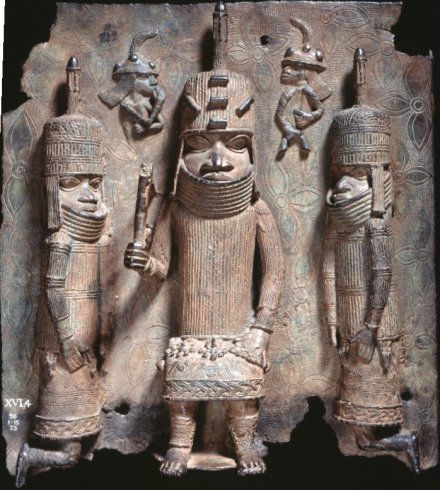
Cultural encounter: this Benin “bronze” shows the oba with two attendants, and the smaller floating heads of two European (Portuguese) traders.

More on this object, and its place in the story of Benin and Europe, in this episode of the BBC’s History of the World in 100 Objects; or, at the “bronze’s” page at the British Museum website.

On this day..

1606: Caravaggio murders Ranuccio Tomassoni

This site is occasionally prepared to stray outside its execution-anniversary beat to cover especially fascinating manifestations of the death penalty in history.

So for this date, we observe the anniversary not of a punishment, but of the crime itself: a capital homicide in the capital of the world that changed art forever.

NNDB summarizes Caravaggio as a “temperamental painter,” but a less generous interlocutor might prefer a descriptor like “lowlife.”

Painter, he certainly was.

Caravaggio’s pioneering realism and flair for the dramatic …


Caravaggio’s Judith Beheading Holofernes, 1598-1599. Though the young painter on the make would hardly want for models of public decapitation in 16th century Rome, the gendered intimacy with the act invites consideration of Caravaggio’s likely attendance at the execution of Beatrice Cenci.

… made him a rock star on the canvas.

Though the papacy in its dogmatic counter-reformation aspect may have viewed Caravaggio’s eye-catching chiaroscuro with suspicion, there were scudi enough to burst the coinpurse of a talent who could grace a chapel with awe-inspiring stuff like this:


Caravaggio’s Crucifixion of St. Peter, painted in 1601 for Rome’s Santa Maria del Popolo.

However many souls his stark brushwork won for the Church, Caravaggio’s reverential fare belied the creator’s own distinctly profane pastimes: gambling, boozing, brawling, and whoring around. He needed the intervention of well-placed patrons to duck prosecution on several occasions.

May 29, 1606 finds our “temperamental” antihero encountering a wealthy scoundrel by the handle of Ranuccio Tomassoni and a problem that would outstrip any political pull the artist could muster.

Allegedly, the two met to settle a paltry tennis wager, although this may have been a cover story for a rivalry over a courtesan.*

On whatever pretext, the young hotheads fell into a melee. Caravaggio won … and Tomassoni bled to death from the gash his foe dealt to his femoral artery.**

Caravaggio now had mortal blood on his hands. Homicides were treated very harshly by the authorities. Caravaggio was about to have a price put on his head, and if he were caught, that head would be summarily removed from his body and hung on a public street. Allies of Ranuccio bent on revenge were likely to be after him as well. … Caravaggio, the celebrated Italian painter, was now a notorious wanted killer. (Source)

Condemned an outlaw by Pope Paul V — himself fruit of Rome’s Borghese family, great patrons of art in their own right — Caravaggio fled the Eternal City. His brilliance went with him, perhaps even amplified by the exile.

“The fall from grace was huge,” a curator of late Caravaggio works argued. “It had a profound impact. He started expressing the psychological essence of the stories he is telling.”

The painter and killer had four years left to him — an exile spent sleeping clothed and armed, forever looking over his shoulder. But what his jangled nerves could still spare for the canvas would help launch the baroque artistic epoch and still influences us today.

Flight, fancy, and fortune took Caravaggio to Malta and to Sicily, but the year or so he spent as Naples’ visiting genius would make his artistic legacy: that city’s succeeding generations of painters took enthusiastic inspiration from Caravaggio’s Neapolitan offerings — like a Seven Works of Mercy that must have carried a very personal meaning for the hunted man.

He was reportedly as arrogant and hot-tempered on the run as he had been in Rome, but Caravaggio’s art in exile also traces his desperate attempts to undo the consequences of his bad behavior.

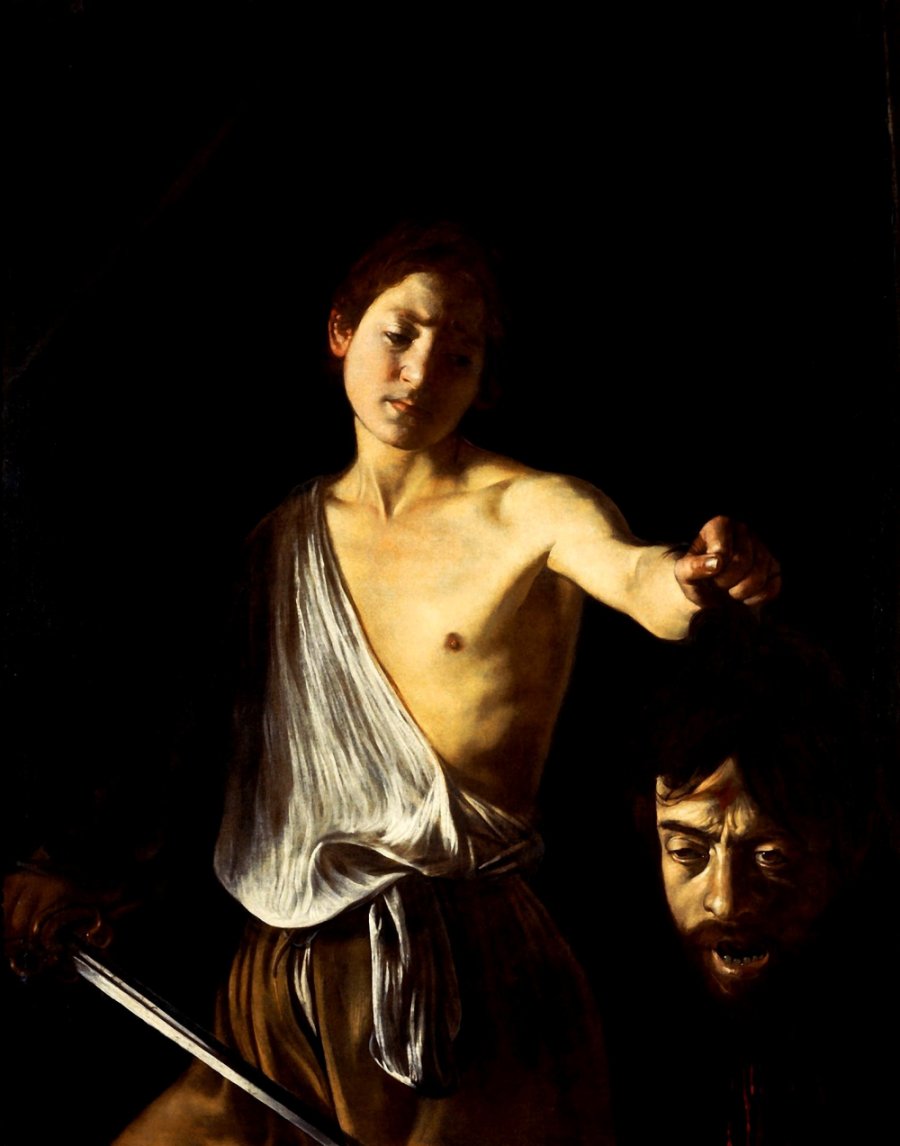
Exploiting his apparent affinity for the sawing off of heads, Caravaggio rendered his own head in a severed state in at least two apparently penitential paintings during this vulnerable period.

This Salome with the Head of John the Baptist was made for the Grand Master of the Knights of Malta after the latter had in 1608 booted Caravaggio from that island refuge:

While David with the Head of Goliath seems to have been created shortly before Caravaggio’s own death for the pope’s art-hounding “Cardinal Nephew” Scipione Borghese, in a bid to earn a pardon. Caravaggio’s self-portrait as the dead man, and Latin inscription “humility kills pride” on the Israelite hero’s sword, suggest an attempt to effect through his creative virtuosity his own execution in effigy.

That would be, at any rate, the only execution Caravaggio ultimately had to endure. He died in the summer of 1610 under unclear — and inevitably suspicious — circumstances while attempting to return to Rome.

A few biographical books about Caravaggio …

… and some Caravaggio art books

* Ranuccio Tomassoni was the pimp and lover of a prostitute named Fillide whom Caravaggio had painted years before, and become enamored of. This Fillide was also Caravaggio’s model for Judith in the arresting painting of the Biblical heroine in mid-decapitation above.

** Possibly, if you like the love triangle angle, in a botched attempt to castrate his rival.

On this day..

Feast Day of St. George

This is the feast date, and the traditionally-ascribed execution date in 303, of St. George — legendary dragon-slayer and patron saint of half the world and darn near everything that the original apostles didn’t nail down.

Saint George is supposed to have been a well-favored officer in Diocletian‘s army who suicidally announced his Christian faith during the latter’s persecutions, and refused every sop and entreaty to renounce it. He was martyred at Nicomedia.

Pretty standard persecution fare — and there’s next to nothing that can be reliably verified about his life — but George did well by his future cult to get into the martyr’s game right before Christianity’s official triumph. Still, at the end of the day, it’s one of those unaccountable accidents of history that this particular fellow ended up as perhaps Christendom’s most widely venerated champion.

He’s most immediately recognizable for the story of having slain a dragon, a plain metaphor for paganism (and usable metaphor for anything and everything else) that’s been depicted in all its scaly corporeality by innumerable artists.

England has liked him jolly well ever since his suitability to the chivalric ethos positioned him to supplant Edmund the Martyr as that realm’s patron saint during the Middle Ages. The red cross on the English flag is a St. George’s cross.

And so there he is, too, in one of Shakespeare’s most rousing patriotic monologues:

I see you stand like greyhounds in the slips,
Straining upon the start. The game’s afoot:
Follow your spirit, and upon this charge
Cry ‘God for Harry, England, and Saint George!’

But George gets around, and England has to share him.

That St. George’s Cross also adorns the flag of Georgia (the country, that is: it’s so hard core that it’s named for the guy), and he’s claimed as a sponsor throughout Orthodox Christendom: Serbia (which celebrates a major holiday when April 23 hits on the Julian calendar); Bulgaria; Greece; Ethiopia; the city of Constantinople and its heir, the city of Moscow, and Russia generally. There were two George’s [Yuri’s] Days on Old Russia’s calendar, and the autumn one was marked as the one time in the year that serfs were permitted to change their landlords, at least until Boris Godunov canceled the privilege and left Russian with the idiom “so much for Yuri’s day!” to mark an expectation disappointed.

George is big in Spain, and even bigger in Portugal; through its Portuguese heritage, he’s also venerated in Brazil, where he’s the patron saint of the Corinthians football club. He’s the sponsor (via that dragon connection) of the snaky Hungarian military order that gave Vlad the Impaler the immortal sobriquet of Dracula.

There are other countries and any number of cities who also trust the dragon-slayer’s patronage; George accepts the further devotions of saddle-makers, lepers, animal husbandmen, shepherds, Crusader knights, butchers, the Maltese, gypsies, farmers, archers, syphilis-sufferers, cavalrymen and therefore also armored tankmen, Palestinian Christians, and the Boy Scouts of America. He’s generally got a stupendous worldwide collection of churches, art, legends, and devotional rites dedicated to his name.

On this day..

Feast Day of St. Agatha

(Thanks to Carl Pyrdum, III, the author of the hilariously incisive blog Got Medieval, for this guest post — which originally appeared as part of his decidedly irreverent Medieval Months stroll through the Catholic Church’s quirky calendar of saintly feast days. -ed.)

While not one of the Holy Helpers proper, St. Agatha, whose feast falls on February 5, has special powers to heal ailments of the breasts, on account of having had hers cut off for refusing to worship pagan idols.

Like Bartholomew, she is usually depicted in the unfortunate after state in iconography, carrying her severed breasts before her on a tray or plate.

Because detached breasts sort of resemble bells, she’s the patron saint of bellfounders, and because they also kind of resemble dough, she works double duty as the patron of bakers, too. Oh, and just to be clear, that last sentence isn’t one of those clearly nonsensical sentences I pepper my writing with for purposes of the comedy. Agatha is the patron saint of severed boobs and everything that kind of looks like a severed boob.


The treats on the left are a traditional Catania cassata known as “Agatha’s breasts” or “Virgin breasts” (“Minni di Vergini”). Image (c) Gergely Sipos and used with permission.

On this day..

1611: Three accomplices of Elizabeth Báthory, the Countess of Blood

Four hundred years ago today, on Jan. 7 1611, three servants of the legendary “Countess of Blood” Elizabeth Bathory (Báthory Erzsébet, in the Hungarian) were tried, convicted, and immediately put to death for the noblewoman’s stupendous career of homicide.

This date’s entry is occasioned by the deaths of three subalterns — manservant Janos Ujvary, beheaded; and female attendants Ilona Jo and Dorottya Szentes, fingers ripped off and burned — but the headline attraction is their employer, who was never tried or condemned.

Not, at least, juridically. Posterity’s condemnation of this classic vampire inspiration has been little short of … voluptuous.


A 1971 film based on Elizabeth Bathory’s exploits. Horror star Ingrid Pitt later reprised her “role” with guest vocals on a Cradle of Filth concept album devoted to the Countess, Cruelty and the Beast.

Bathory was rarefied Hungarian nobility, the niece of the King of Poland, which is also the biography of countless aristocrats you’ve never heard of.

The world remembers Elizabeth Bathory because she exploited her rank to butcher hundreds of peasant girls, allegedly to bathe in their rejuvenating blood.

On one occasion, a lady’s-maid saw something wrong in [Elizabeth Bathory’s] head-dress, and as a recompence for observing it, received such a severe box on the ears that the blood gushed from her nose, and spirted on to her mistress’s face. When the blood drops were washed off her face, her skin appeared much more beautiful — whiter and more transparent on the spots where the blood had been.

Elizabeth formed the resolution to bathe her face and her whole body in human blood so as to enhance her beauty.


McFarlane Toys figurine of Erzsebet (Elizabeth) Bathory from its grotesque “Faces of Madness” series.

These scrub-ups are what the Countess of Blood is best remembered for, but however striking the visual, it’s an atrocity that actually doesn’t turn up in the trial records.

But she could hardly complain of the embroidery, having given her interlocutors so much material.

Elizabeth Bathory is supposed to be responsible for over six hundred deaths, starting while her husband was away on campaign, and then carrying on into a wholesale operation after he died. When she and her servants were finally busted at Csejte Castle the end of 1610, their captors found a dead girl, a dying girl, and several others imprisoned and awaiting that fate.


Elizabeth Bathory, a sexually charged 1893 painting by Hungarian impressionist Istvan Csok depicting one of the countess’s victims being drenched in icy water for death by exposure.

So although the confessions the servants made this date to seal their own fates were undoubtedly torture-adduced, the documentary record turns out to be amazingly strong for such a fantastical spree. Hungarian King Matthias II convened a tribunal that examined 200 to 300 witnesses.

One can postulate that the woman ran afoul of a patriarchal culture affronted by her exercise of power or that she became a parable for the “unnatural” lust of a middle-aged woman … but so far as we are left to understand, Erzsebet Bathory really did lure young girls to her castle, and then inflict (pdf) a Nazi doctors’ litany of sadism on them … like jabbing them with needles to drain out their blood. She even kept a log of the victims in her own hand.

So, locals disappearing into the creepy castle, never to be seen again, or possibly to turn up pallid and dead. (Disposing of all those corpses became a logistical problem for the creepy castle.) No surprise to find it associated with the vampire legend.*

And no surprise that the tale became magnified, twisted, and reconfigured by popular culture.

In 1817, as accounts of the testimonies about the alleged murders and sadistic tortures were published for the first time, national and international headlines sensationalized the already misconceived story. From that on [sic], the literary countess took on a life of her own: the Grimm brothers wrote a short story about her, the romantic German writer, Johann Ludwig Tieck (1774 – 1853), cast her as a Gothic femme fatale, Swanhilda, in his short story Wake Not the Dead. It is alleged that Sheridan le Fanu shaped his female vampire Carmilla on Elizabeth Bathory. If we can believe some etymological explanation the compound English word blood-bath is of mid-nineteenth century origin possibly connected to the bloody countess’ rising popularity in England.

-László Kürti, “The Symbolic Construction of the Monstrous — The Elizabeth Bathory Story,” Croatian Journal Of Ethnology and Folklore Research, Jan. 2009

A few books about Erzsebet Bathory

To say nothing of the death porn (link not safe for work).

The noblewoman never faced an executioner herself, owing to her rank; she was shut up in the castle.

* As it turns out, a Bathory ancestor actually fought with the “original Dracula” Vlad the Impaler in the 15th century.

On this day..

1888: Prado, before Gauguin

On this date in 1888, “Prado” — also known as “Count Linska de Castillon”; he never copped to his real identity — was beheaded as a thief and murderer at Paris.

The trial of this intrepid criminal promised, in the London Times‘ Nov. 6, 1888 preview, to be “one of the most extraordinary of our times”

He [Prado] is a Spaniard, and was brought up at Gijon, but he refused to say who he was. When 14 years of age he visited Mozambique, India, China, California, the West Indies, and North America. In 1872 he was a sub-lieutenant in the Carlist bands. He then lived by his wits. He once crossed the French frontier and stole 8,000f. At the battle of Somorrostro he was wounded by a shell, and removed to a hospital, from which he enticed the sister of the Order of Saint Vincent de Paul who nursed him. She belonged to one of the first families in England. He married her, and with her visited the Holy Land, but her health failed, and she died on their return to Italy. Prado says he married a second wife at Lima, with a dowry of 1,200,000f., and that after her death he committed many daring robberies.

He’s the most interesting man in the world.

This vagabond upon the overgrown lost highways of fortune eventually ditched wife #2 in penury in Spain and proceeded to France where he mooched off a local girl and her absentee American sugar daddy, until one night he slashed the throat a dame named Marie Aguetant, the lover of a late-working croupier, and plundered their domicile of chattels.

Prado eluded capture for some time, keeping his lover, taking another — both of whom ended up in the dock with their insolent Don Juan, along with various male intimates in various aspects of accesorizing. None of those others drew a death sentence, but as the interest of the London Times suggests — it fronted near-daily trial dispatches from Paris — all this stuff about cabals of swarthy men ravishing women of their virtue and their valuables made global news.

It also moved Third Republic bodice-ripping true crime like this zippy little volume, “Prado ou Le Tueur de Filles,” with a copyright notice as late as 1931.

A savage crime by a strange character, but now that it’s long departed all living memory, it scarcely stands out. Legion are the lotharios who have slain for the pedestrian motivation of gold.

In a post-bourgeois order, “we will no longer see men like Pranzini, Prado, Berland, Anastay and others who kill in order to have this metal,” the French terrorist Ravachol‘s suppressed address to the courtroom declared in 1892. “The cause of all crimes is always the same, and you have to be foolish not to see this.”

Yes, I repeat it: it is society that makes criminals and you, jury members, instead of striking you should use your intelligence and your strength to transform society. In one fell swoop you’ll suppress all crime. And your work, in attacking causes, will be greater and more fruitful than your justice, which belittles itself in punishing its effects.

-Ravachol


Just a few days before this headline-grabbing execution, impressionist painter Vincent van Gogh undertook the most famous thing he ever did off-canvas: after his latest dispute with roommate and fellow-artist Paul Gauguin, van Gogh sliced off his own left earlobe.*

It was in this abnormal circumstance that Gauguin, fresh to Paris fleeing from the scene of the self-mutilation in Arles, attended Prado’s beheading, even forcing his way through a line of gendarmes to obtain a closer view.

“[H]e may have had the counterphobic desire to reassure himself of his courage by taking an unflinching look at Prado’s execution,” writes Bradley Collins. “Gauguin may have identified with both the executioner and his victim. On the one hand, by watching the state kill a man, he could vicariously release some of his pent-up aggression toward Vincent. On the other, by identifying with Prado he could vicariously atone for the guilt he felt about precipitating Vincent’s breakdown and abandoning [Arles].”

Aptly for Gauguin’s personal demons, the guillotine managed to botch this job, too — giving Prado a non-fatal facial injury and requiring the now-wounded condemned to be repositioned for another chop.

All this pate-slashing sure seems to have found its way into Gauguin’s next creation:


Gauguin’s grotesque “Jug in the form of a Head, Self-Portrait”. “Within one work, he has become both the bloody, earless Vincent [Van Gogh] and the guillotined Prado.” –Collins

* Latter-day revisionist hypothesis: Gauguin actually cut off van Gogh’s ear in a fight, but both painters kept to a cover story to keep everyone out of trouble. That version would only thicken the psychological stew for Gauguin’s pilgrimage to the guillotine and subsequent “self-portrait”.

On this day..

Feast Day of St. Cecilia, patron of music

This is the feast day of the early Christian saint Cecilia.

There’s more than serendipity in that name’s pop culture connection: Cecilia is the patron saint of music for the rather slight reason that her heart sung only for God even when she was forced to marry the pagan Valerian. Seriously, Christianity didn’t have any early martyr with a stronger biographical context for a portfolio as significant as music?*

Being the go-to divine intermediary for something this big made Cece a popular saint centuries after her martyrdom, supposed to be either later in the 2nd century or early in the 3rd. (As with many other martyrs’ legends, Cecilia survives several executions before the Romans finally manage to cut her head off.)

Musician and songwriter Paul Simon knew enough St. Cecilia lore to explicitly use her in her musical-patronage role in a different song, “The Coast” (lyrics). The song “Cecilia” deepens immensely if it’s understood as mixed frustration and exaltation with the minstrel’s inconstant artistic muse.

Nor would that be the only 20th century musical homage for this accessible saint. In a more traditional vein, Benjamin Britten set to music a W.H. Auden poem about Cecilia, creating the Hymn to St. Cecilia.

Blessed Cecilia, appear in visions
To all musicians, appear and inspire:
Translated Daughter, come down and startle
Composing mortals with immortal fire.

Fans of classical music should hit YouTube for Handel’s Ode for St. Cecilia’s Day, which appropriately premiered on this date in 1739. Here’s a nibble:

* So far as we know, blogging remains a niche of divine patronage as-yet unfilled. We propose to accept the protection of the patron saint of lost causes.

On this day..

Unspecified Year: The Last Day of a Condemned Man

On an unspecified date around this time in the late 1820s, the narrator of Victor Hugo’s Last Day of a Condemned Man leaves off his diary — bound for the guillotine.

An illustration from The Last Day of a Condemned Man.

The young Hugo‘s first major work of fiction, this 1829 story dramatizes the torment of an unnamed man doomed for an unstated crime. By abstracting its central character, Hugo generalizes its unabashed anti-death penalty message … but one of the few morsels of specificity places the man’s conviction on “a beautiful morning at the close of August,” with the action unfolding over the ensuing six weeks until his date with the guillotine.

If not exactly Hugo’s greatest work, this emotional rendering of a man’s anguish awaiting death well befits an artist deeply sensitive to the passion of the scaffold — and a period when many writers witnessed, critiqued, contested, and even faced the phenomenon of public execution.

They say that it is nothing,–that one does not suffer; that it is an easy death. Ah! then, what do they call this agony of six weeks,–this summing-up in one day? What, then, is the anguish of this irreparable day, which is passing so slowly and yet so fast? What is this ladder of tortures which terminates in the scaffold? Are they not the same convulsions whether life is taken away drop by drop, or intellect extinguished thought by thought?

Now I must fortify myself, and think firmly of the Executioner, the cart, the gendarmes, the crowd in the street and the windows.

I have still an hour to familiarize myself with these ideas. All the people will laugh and clap their hands, and applaud; yet among those men, now free, unknown to jailors, and who run with joy to an execution,–in that throng there is more than one man destined to follow me sooner or later, on the scaffold.

More than one who is here to-day on my account, will come hereafter on his own.


Hungarian painter Mihaly Munkacsy‘s The Last Day of a Condemned Man has no relationship to Hugo’s book, but deals in a similar mood. It won an award from the Paris salon in 1870.

The Last Day of a Condemned Man is available free online (English | French), or in throwback print form from Amazon.com.

* The prisoner finds in his cell the names of then-notable criminals who previously occupied it — a concession to period specificity. The last of these names is Castaing, meaning our man’s story takes place after that poisoner’s 1823 beheading. A subsequent reference to Louis-Auguste Papavoine, executed in 1825, would push the execution to the even narrower window of October 1825, 1826, 1827, or 1828.

On this day..

1927: Martyrdom of Five Christeros

Artist unknown. The inscription reads:

Execution of Cristeros by federal soldiers on the outskirts of San Gabriel, Jalisco, October 8, 1927. On the same site, the soldiers were ambushed, suffering the same fate.

On this day..