1927: Sacco and Vanzetti (and Celestino Madeiros)

America Sacco & Vanzetti must not die

-Allen Ginsberg, “America” (mp3)

We have now reached a stage of the case the details of which shake one’s confidence in the whole course of the proceedings and reveal a situation which undermines the respect usually to be accorded to a jury’s verdict.

-Felix Frankfurter in The Atlantic

America our nation has been beaten by strangers who have turned our language inside out who have taken the clean words our fathers spoke and made them slimy and foul

their hired men sit on the judge`s bench they sit back with their feet on the tables under the dome of the State House they are ignorant of our beliefs they have the dollars the guns the armed forces the powerplants

they have built the electricchair and hired the executioner to throw the switch

all right we are two nations

. . .

but do they know the old words of the immigrants are being renewed in blood and agony tonight do they know the old American speech of the haters of oppression is new tonight in the mouth of an old woman from Pittsburgh of a husky boilermaker from Frisco who hopped freights clear from the Coast to come here …

the men in the deathhouse made the old words new before they died.

John Dos Passos, The Big Money (part of the U.S.A. trilogy)

Let us abandon then our gardens and go home
And sit in the sitting room.
Shall the larkspur blossom or the corn grow under this cloud?
Sour to the fruitful seed
Is the cold earth under this cloud,
Fostering quack and weed, we have marched upon but cannot conquer;
We have bent the blades of our hoes against the stalks of them.

Let us go home, and sit in the sitting room.
Not in our day
Shall the cloud go over and the sun rise as before,
Beneficent upon us
Out of the glittering bay,
And the warm winds be blown inward from the sea
Moving the blades of corn
With a peaceful sound.
Forlorn, forlorn,
Stands the blue hay-rack by the empty mow.
And the petals drop to the ground,
Leaving the tree unfruited.
The sun that warmed our stooping backs and withered the weed uprooted
We shall not feel it again.
We shall die in darkness, and be buried in the rain.

What from the splendid dead
We have inherited —
Furrows sweet to the grain, and the weed subdued —
See now the slug and the mildew plunder.
Evil does overwhelm
The larkspur and the corn;
We have seen them go under.

Let us sit here, sit still,
Here is the sitting-room until we die;
At the step of Death on the walk, rise and go;
Leaving to our children`s children this beautiful doorway,
And this elm,
And a blighted earth to till
With a broken hoe.

-Edna St. Vincent Millay, “Justice Denied in Massachusetts”

If it had not been for these things, I might have lived out my life talking at street corners to scorning men. I might have died, unmarked, unknown, a failure. Now we are not a failure. This is our career and our triumph. Never in our full life could we hope to do such work for tolerance, for justice, for man’s understanding of man as now we do by accident. Our words — our lives — our pains — nothing! The taking of our lives — lives of a good shoemaker and a poor fish-peddler — all! That last moment belongs to us — that agony is our triumph.

-Bartolomeo Vanzetti


Ben Shahn, The Passion of Sacco and Vanzetti

A recently discovered letter indicates that Upton Sinclair was convinced of his subjects’ guilt.

“Alone in a hotel room with Fred [Moore], I begged him to tell me the full truth … He then told me that the men were guilty, and he told me in every detail how he had framed a set of alibis for them … I faced the most difficult ethical problem of my life at that point … I had come to Boston with the announcement that I was going to write the truth about the case.”

But Sinclair had reasons beyond the “ethical” to tell what he saw as the larger truth. From a different letter:

“My wife is absolutely certain that if I tell what I believe, I will be called a traitor to the movement and may not live to finish the book … Of course, the next big case may be a frame-up, and my telling the truth about the Sacco-Vanzetti case will make things harder for the victims … It is much better copy as a naïve defense of Sacco and Vanzetti because this is what all my foreign readers expect, and they are 90% of my public.”

Well, the dying time came, the legal midnight hour,
The moment set by law for the Chair to be at work,
To substantiate the majesty of the State of Massachusetts
That hour was at hand, had arrived, was struck by the clocks,
The time for two men to be carried cool on a cooling board
Beyond the immeasurably thin walls between day and night,
Beyond the reach of airmail, telegrams, radiophones,
Beyond the brotherhoods of blood into the fraternities
Of mist and foggy dew, of stars and ice.
 The time was on for two men
 To march beyond blood into dust —
 A time that comes to all men,
 Some with a few loved ones at a bedside,
 Some alone in the wilderness or the wide sea,
 Some before a vast audience of all manking.

 Now Sacco saw the witnesses
 As the straps were fitted on
 Tying him down in the Chair —
 And seeing the witnesses were
Respectable men and responsible citizens
And even though there had been no introductions,
 Sacco said, “Good-evening, gentlemen.”
And before the last of the straps was fastened so to hold
Sacco murmured, “Farewell, mother.”

Then came Vanzetti.
He wished the vast audience of all mankind
To know something he carried in his breast.
This was the time to tell it.
He had to speak now or hold his peace forever.
The headgear was being clamped on.
The straps muffling his mouth were going on.
He shouted, “I wish to forgive some people
  for what they are now doing.”
 And so now
 the dead are dead????

-Carl Sandburg, “Legal Midnight Hour”


(The executions took place just after midnight Aug. 22-23)

THE names of the “good shoe-maker and poor fish-peddler” have ceased to represent merely two Italian workingmen. Throughout the civilised world Sacco and Vanzetti have become a symbol, the shibboleth of Justice crushed by Might. That is the great historic significance of this twentieth century crucifixion, and truly prophetic, were the words of Vanzetti when he declared, “The last moment belongs to us–that agony is our triumph.”

Vanzetti was right when he declared that his execution was his greatest triumph, for all through history it has been the martyrs of progress that have ultimately triumphed. Where are the Caesars and Torquemadas of yesterday? Who remembers the names of the judges who condemned Giordano Bruno and John Brown? The Parsons and the Ferrers, the Saccos and Vanzettis live eternal and their spirits still march on.

-Alexander Berkman and Emma Goldman, “Sacco and Vanzetti”

Starting points for the many Sacco and Vanzetti resources online: Famous American Trials | Wikipedia | Massachusetts Supreme Court virtual tour | American Writers and the Sacco-Vanzetti Case

On this day..

1672: Cornelis and Johan de Witt lynched

Chapter 1. A Grateful People

On the 20th of August, 1672, the city of the Hague, always so lively, so neat, and so trim that one might believe every day to be Sunday, with its shady park, with its tall trees, spreading over its Gothic houses, with its canals like large mirrors, in which its steeples and its almost Eastern cupolas are reflected,–the city of the Hague, the capital of the Seven United Provinces, was swelling in all its arteries with a black and red stream of hurried, panting, and restless citizens, who, with their knives in their girdles, muskets on their shoulders, or sticks in their hands, were pushing on to the Buytenhof, a terrible prison, the grated windows of which are still shown, where, on the charge of attempted murder preferred against him by the surgeon Tyckelaer, Cornelius de Witt, the brother of the Grand Pensionary of Holland was confined.

the whole town was crowding towards the Buytenhof, to witness the departure of Cornelius de Witt from prison, as he was going to exile; and to see what traces the torture of the rack had left on the noble frame of the man who knew his Horace so well.

Yet all this multitude was not crowding to the Buytenhof with the innocent view of merely feasting their eyes with the spectacle; there were many who went there to play an active part in it, and to take upon themselves an office which they conceived had been badly filled,–that of the executioner.

There were, indeed, others with less hostile intentions. All that they cared for was the spectacle, always so attractive to the mob, whose instinctive pride is flattered by it,–the sight of greatness hurled down into the dust.

-Alexandre Dumas, pere, The Black Tulip

That ominous mob got its spectacle this date in 1672, lynching the Dutch Republic’s longtime de facto head of state, Johan de Witt along with his brother Cornelis/Cornelius.


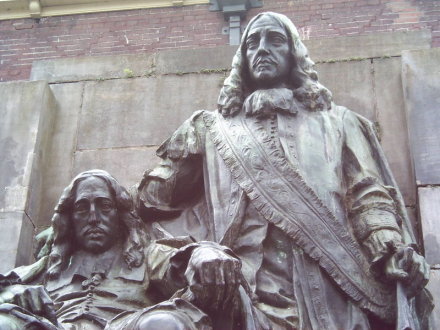
A statue of Johan (standing) and Cornelis de Witt in their native Dordrecht.

The mercantile powerhouse that was the 17th century Dutch Republic was the stage for a long-running conflict between the Orange monarchists (hence the soccer uniforms) and the Republican merchant class.

With the sudden death of the young William II, Prince of Orange in 1650, leaving the (non-hereditary) executive office of stadtholder vacant, the Republicans became ascendant.

And the outstanding figure of the First Stadtholderless Period was Johan de Witt, scion of a Dordrecht merchant family powerful enough that William II had imprisoned de Witt’s own father during a power struggle.

Elevated in 1653 and at the tender age of 28 to the leadership position of Grand Pensionary, Johan de Witt’s “eloquence, sagacity and business talents” guided the Dutch ship of state for essentially the remainder of his life.

This was the apex of the Dutch Golden Age. The Dutch East India Company dominated Asian trade routes,* and the Low Countries’ culture thrived on the wealth: Rembrandt and Vermeer were at the height of their talents; Spinoza revolutionized philosophy; van Leeuwenhoek invented the microscope.

While all these guys were landing themselves in their respective canons, Johan de Witt was trying to keep the age Golden.

Having only relatively recently broken free of Spain, the small country was an up-and-comer on the horns of a serious security dilemma: its leading commercial position put it into maritime competition with England, while its continental location made it vulnerable to the enormous army of the neighboring continental hegemon, France. Ultimately, even with its trade wealth, it did not have the resources to keep up with both of western Europe’s leading powers.

For a generation, de Witt’s statecraft kept the men of the Low Countries out of that predicament, while his brother Cornelis chipped in with a couple of timely naval victories. (Actually authored by Michiel de Ruyter, but Cornelis rode shotgun.)

In 1654, Johan brought the First Anglo-Dutch War to a close, making with Oliver Cromwell a secret pact he was only too happy to enforce never to allow William II’s son, the eventual William III, to be named stadtholder. Reason being: William III was the grandson of the Stuart king Cromwell beheaded, Charles I, and thus a potential claimant to the English throne. Both Protestant Republics had a distinct interest in keeping this monarchist well away from power. (Both would be sorely disappointed.)

A decade and a Stuart Restoration later, de Witt maintained (mostly) Dutch dominance of the seas in the Second Anglo-Dutch War, then held off France (with the help of a timely alliance with the recent adversary, England) in the War of Devolution.

In each case, he kept at least one of England or France on the sideline, or in his own camp.

But the Third Anglo-Dutch War was the charm — as it was also the Franco-Dutch War, and therefore 1672 was Rampjaar: disaster year. While the Dutch were aces on the waves, a massive French invasion easily overwhelmed them on terra firma.

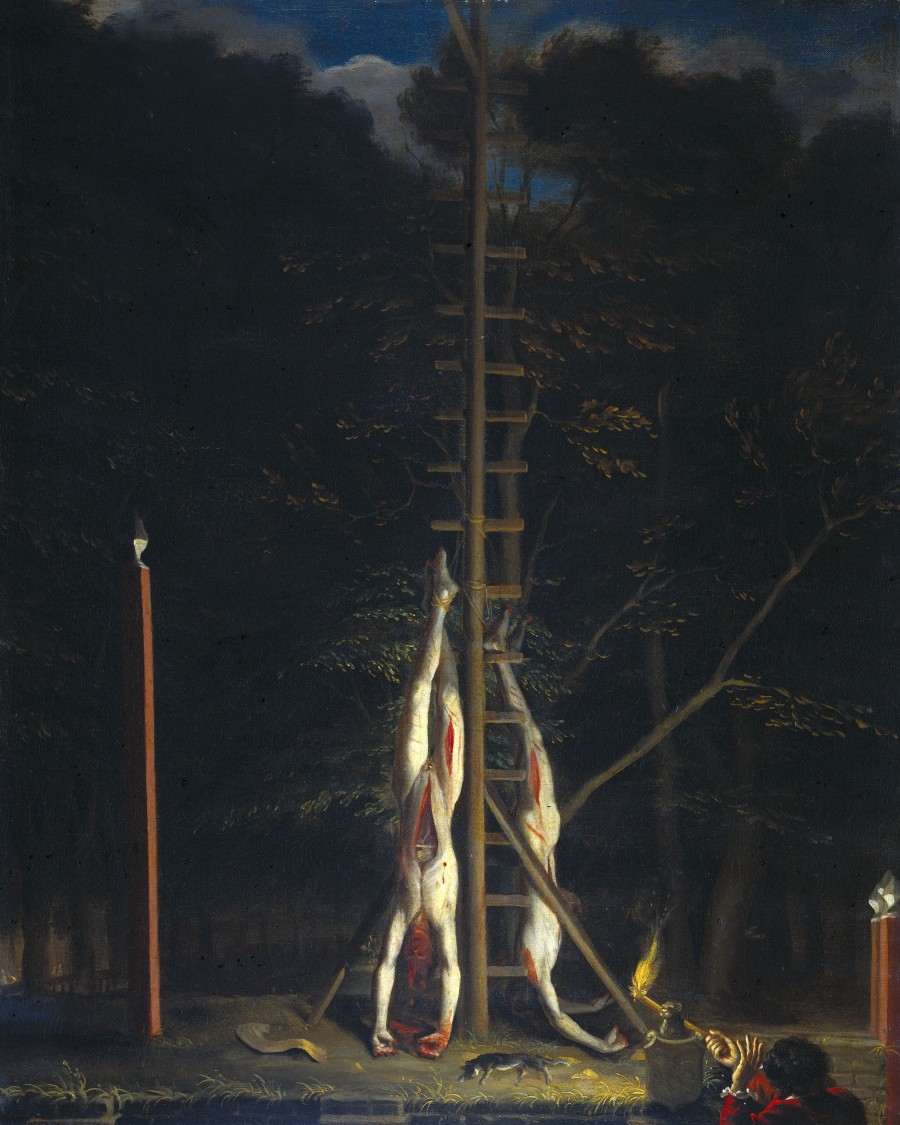
Detail view (click for the full image) of a grisly painting of the mutilated de Witt brothers strung up at The Hague. It’s attributed to Jan de Baen, who in better times took Johan de Witt’s portrait.

De Witt’s never-beloved mercantile oligarchy speedily collapsed with the military reverses, and the now all-grown-up William III was there to pick up the pieces to popular acclaim. Arrested for treason, Cornelis sustained torture without confessing, but when Johan visited him in prison — and William III incriminatingly withdrew the cavalry protecting the brothers — the mob quenched its fury with the de Witts’ blood.

every one of the miscreants, emboldened by his [Johan’s] fall, wanted to fire his gun at him, or strike him with blows of the sledge-hammer, or stab him with a knife or swords, every one wanted to draw a drop of blood from the fallen hero, and tear off a shred from his garments.

And after having mangled, and torn, and completely stripped the two brothers, the mob dragged their naked and bloody bodies to an extemporised gibbet, where amateur executioners hung them up by the feet.

Then came the most dastardly scoundrels of all, who not having dared to strike the living flesh, cut the dead in pieces, and then went about the town selling small slices of the bodies of John and Cornelius at ten sous a piece.

-Dumas

The word “ungrateful” comes to mind.

De Witt stood altogether on a lower plane than Cromwell. We regard him rather as a man of rare and singular talent, than as one of the chosen great ones of the earth, which Cromwell was. He stands far above the common run of men; and he was head and shoulders above nearly all the notable men of his time. He would have been greater if the movement of his limbs had been less burdened with the Dutch governing apparatus … He is not one whom the world can ever greatly admire or love.

History of the administration of John De Witt, grand pensionary of Holland, a Google books freebie.

(Here’s another, and here’s a 17th century volume de Witt himself coauthored.)

The rise of William III came with the decline of that Dutch Golden Age: the country fended off the immediate military threat, but it increasingly slipped behind its larger neighbors. Costly as was the Franco-Dutch War, it is a step on the path towards the present-day Europe, and this gives us enough excuse to notice that the Eurovision lead-in tune is actually from a Te Deum composed to mark its end.

But William’s own ascent to this wealthy sovereignty was just the beginning for him. Sixteen years later, the House of Orange’s champion vindicated Cromwell’s trepidation about him and gained a far more satisfactory position from which to do battle with his Gallic rival Louis XIV by stunningly overthrowing the Stuart dynasty and becoming King of England in the Glorious Revolution.**

* The Dutch remained the sole western contact of closed Japan until 1854, which is why Japan’s eventual period of scientific advancement became known as ‘Dutch Learning’.

** Albion did not forget the de Witts, either: according to this 1785 cant dictionary, the term “dewitted” had a 17th-18th century run in English to denote — well, exactly what happened to Cornelis and Johan.

On this day..

1501: Antonio Rinaldeschi, bad gambler

This date in 1501,* the Italian city-state of Florence celebrated a “double feast”: that of St. Mary Magdalene, which marked a civic carnival every July 22; and, the hanging of sacrilegious gambler Antonio Rinaldeschi on the walls of the Bargello.

Eleven days prior, Rinaldeschi was having a bad run of wagering at The Fig Tree tavern.

Like Jesus is some people’s co-pilot, the Virgin Mary must have been Rinaldeschi’s card-counter — for, stalking out of the premises much the poorer, our doomed punter blasphemously uttered “words that are better kept silent” about her. Then, passing an image of Holy Mother at the piazza Santa Maria de Alberighi, he gathered up some nearby dung and flung it at the sacred pic.

This dry poo maybe should have just slid right off, but the Lord works in mysterious ways.

Write William Connell and Giles Constable in “Sacrilege and Redemption in Renaissance Florence: The Case of Antonio Rinaldeschi” (Journal of the Warburg and Courtauld Institutes, vol. 61 (1998), and the source of most of this entry’s narrative),

a portion of it, resembling a rosette (‘quasi pareva una rosetta secha’), stuck to the Virgin’s diadem, above the nape of her neck. The dirtied image drew much attention. The archbishop came to look. Candles and votive images were brought before the fresco, which quickly became an object of popular devotion.

Someone saw something and the trail led back to the ill-tempered cardsharp within days, who tried to stab himself to death when he realized what was about to go down. He copped to the crime pretty quickly (at least one source says it was so that he could be executed in preference to being lynched), and his corpse dangling out the Bargello window decorated the other Mary’s regularly-scheduled homage of parades and horse-races.

(And, now that it was no longer needed as evidence, the miraculous ordure was cleaned off the statue.)

Florence at the dawn of the 16th century was truly a place where religion could get you killed. This was the city that had elevated severe Dominican friar Savonarola to dictator and morals enforcer in the 1490s (Savonarola especially hated gambling), then overthrew and burned him in 1498.

Our authors think there’s some evidence that the first couple years of the 1500s were a period when the populist religious fanatics who once grooved on Savonarola’s violent party pooper act were back on the march as against, say, the more out-of-touch syphilitic reckless gambling blasphemer element that was now, post-Savonarola, enjoying free run of the town. Having one of the latter excrement-ize a Marian monument is the sort of thing that would have led the Florentine Fox News: naturally, he had to be made an example of.

To help you bear that example in mind, a nine-panel painting, “The History of Antonio Rinaldeschi”, attributed to the hanged man’s contemporary Filippo Dolciati, can be seen in Firenze’s Stibbert Museum.

Madonna + manure, meanwhile, has its own art legacy … and the combination is still good for raising a ruckus to this day.


The Holy Virgin Mary, by Chris Ofili: a black Mary smeared with elephant dung.

* The primary sourcing on the chronology of the execution is sketchy enough that it’s possible Rinaldeschi was hanged on July 21, before midnight — rather than in the dark early hours of July 22.

On this day..

1892: Ravachol, anarchist terrorist

On this date in 1892, French anarchist François Claudius Koenigstein — better known as Ravachol — was guillotined at Montbrison for a series of bomb attacks on right-wing judges.

He took the name “Ravachol”, his mother’s, after his Dutch father ditched his mom, leaving the family in poverty.

Young Ravachol supported himself as best he could in proletarian labor and crime, as he attempted to observe* at his trial.

Ravachol, as painted by Charles Maurin.

There are many people who will feel sorry for the victims, but who’ll tell you they can’t do anything about it. Let everyone scrape by as he can! What can he who lacks the necessities when he’s working do when he loses his job? He has only to let himself die of hunger. Then they’ll throw a few pious words on his corpse. This is what I wanted to leave to others. I preferred to make of myself a trafficker in contraband, a counterfeiter, a murderer and assassin. I could have begged, but it’s degrading and cowardly and even punished by your laws, which make poverty a crime. If all those in need, instead of waiting took, wherever and by whatever means, the self-satisfied would understand perhaps a bit more quickly that it’s dangerous to want to consecrate the existing social state, where worry is permanent and life threatened at every moment.

Personal want segued into political conviction for Ravachol, whose crimes were justified by the principle of reprise individuelle.

And the political led him to reprisals of a less individual nature, when French state violence against radicals caused him to dynamite several magistrates’ homes.

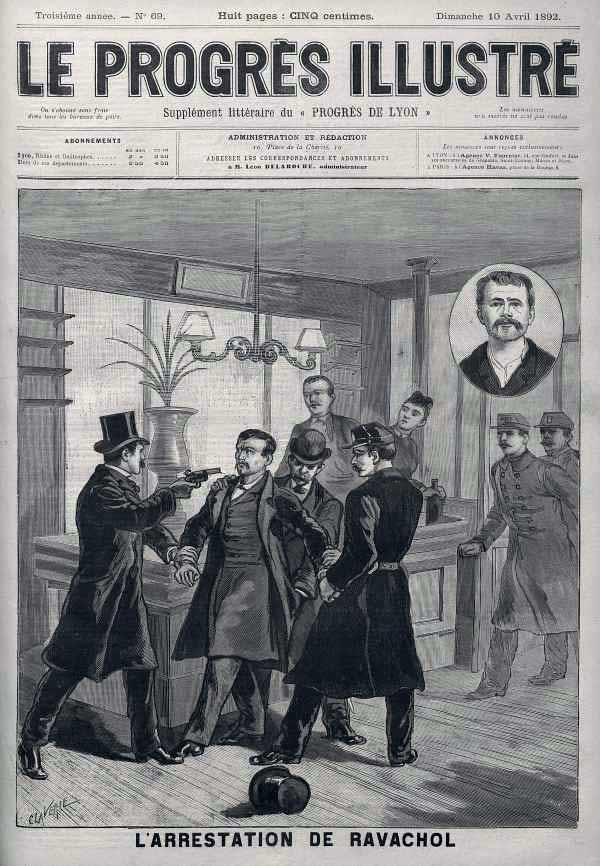
He was caught in a restaurant,** brought to trial, and let off with penal servitude for life. Then another jury, intimidated by public outcry, reversed the decision and sent him to the guillotine.

The Banquet Years: The Origins of the Avant-Garde in France 1885 to World War I, which argues that anarchists “unsettle[d] the political smugness of the Third Republic … [and] challenge[d] any formulated aesthetic. The dynamism of prewar artistic activity ran a close parallel to anarchism; postwar Dada and surrealism look like its artistic parodies†.”

Anarchism, that revolutionary specter stalking fin-de-siecle Europe, burnt its fuse at both ends, but Ravachol’s falling head‡ left a legacy for his fellow-travelers. The next year, Auguste Vaillant tossed a bomb into the French Chamber of Deputies to avenge Ravachol. (Vaillant was himself guillotined, and himself avenged by Emile Henry and Sante Geronimo Caserio.)

Ravachol was also honored in a song, La Ravachole — set to the jauntily menacing tune of La Carmagnole, it cheers, “Long live the sound of the explosion!”

* This incendiary speech was cut off by the court.

** The table where the terrorist was nabbed got its own inscription: “Here ate Ravachol the day of his arrest.”

† e.g., Dadaist Marcel Janco‘s recollection:

We had lost confidence in our culture. Everything had to be demolished. We would begin again after the ‘tabula rasa’. At the Cabaret Voltaire we began by shocking common sense, public opinion, education, institutions, museums, good taste, in short, the whole prevailing order.

‡ Ravachol was guillotined midway through a parting exclamation, “Vive la Re-“. Initial newspaper reports implausibly rendered this as the patriotic classic “Vive la Republique!” rather than a much more in-character word like, oh, “Revolution”.

Weeks of controversy ensued over some witnesses’ claims that the head post-severing had actually completed the word “-publique”, a notion of a piece with the idea that the severed head survives decapitation by a few seconds. Scienticians countered that obviously excited witnesses were maybe hearing air escaping from the headless trunk and filling in the rest of the scene in their heads.

On this day..

1572: The Martyrs of Gorkum

On this date in 1572, Dutch Calvinists fighting to break away from Spanish domination hanged 19 Catholics at Brielle.


The Martyrs of Gorkum, by Cesare Fracassini.

The heretofore abortive — and severely suppressedDutch Revolt blossomed in 1572 with the April 1 capture of Brielle by the Protestant raiders nicknamed Sea Beggars.

Dutch schoolchildren learn the occasion with the punny rhyme — bril, “glasses”, is a near-homophone for Brielle

“Op 1 april verloor Alva zijn bril”

On April 1st, the Duke of Alva lost his glasses

The mailed fist of imperial Spain in the Low Countries, the Duke of Alva (or Alba) would be forced by Calvinist gains this year onto the back foot; despite a vigorous counterattack that regained some lost territory in 1573, he was soon forced into retirement.

This was still just the opening saga of the Eighty Years’ War, but the Dutch Revolt would weave together theology and nationalism for Netherlands separatists. It already had.

So, small surprise that weeks after nicking the Duke of Alva’s glasses, Dutch rebels conquering other towns started making prisoners of Catholic clergy whose loyalties were suspiciously Habsburgish. Our day’s principals (here are their names; a batch of Franciscans taken are the largest contingent, to which various lay brothers, parish priests, and others were appended) were seized at and around Gorkum (Gorinchem).

The author of this intrepid iconoclastic incursion, William II de la Marck, was likewise the author of these Catholic martyrs’ doom once they had been removed back to Brielle. They were hanged without benefit of trial at an abandoned monastery.

Every sectarian propagandist of 16th century Europe made lurid heroes of his own side’s martyrs, and these were no exception to the pattern; we read in this Catholic source (perhaps while contemplating this devotional image) that

[i]t was on the 9th July 1572 when the execution of the pious sufferers began. On their side they had fully prepared themselves for it by confession and prayer. The executioner went so slowly to work that two hours had elapsed ere the last of the martyrs had taken his place on the gallows, and many of them still lived when morning broke. But the fury of the soldiers was not yet satisfied. They mutilated the dead bodies, cut off their noses and ears, and other limbs, and, alas, shame seems to touch the pen with which we write, bound them to their hats, and returned with these melancholy trophies in triumph into the city!

The location where this day’s unfortunates suffered became a pilgrimage destination, and they were formally enrolled in the minor leagues of Rome’s competitive hagiography circuit in the 19th century.

On this day..

1441: Corrado Trinci, Lord of Foligno

On this date in 1441, Corrado Trinci was executed in Foligno.

Once the hereditary lord of that venerable town,* Trinci (English Wikipedia page | Italian), had turned tetchy with his Guelph family’s onetime papal patrons and suffered the consequences.

As the proper captain of an Italian city-state in the 15th century, Trinci had taken a few spins around the wheel of fortune in battle with his neighbors. He kicked off his reign in operatically sanguinary style when a neighboring town‘s castellan murdered Trinci’s brothers, suspecting one of them of adultery with his wife. Trinci revenged himself by sacking Nocera Umbra, which still holds a civic relay race (Italian link) commemorating the occasion.

Trinci didn’t fare as well when it came to picking on someone his own size.

For the next generation, Trinci would do the Machiavellian dance characteristic of his time and station — by turns allied with, at war with, or plotting with the papacy, Condottiero Francesco Sforza, the archbishop of Florence, and miscellaneous other peninsular neighbors and rivals. He was down. He was back up. He was beaten. He fought back. Etc.

Trinci pushed the wheel of fortune one turn too far by rebelling (again) against papal authority in the mid-1430s. His march on the Vatican-controlled Duchy of Spoleto was an initial success —

Corrado brought to Foligno four hundred youths of Spoleto, the standard of Spoleto, the chains, the locks from the city gates, the seal, and the clapper from the great bell of the commune.

Durante Dorio, as quoted and translated by Sergio Bertelli

That was in 1436. By 1439, Foligno itself (with Trinci inside it) had capitulated to a papal siege. Spoleto really wanted its clapper back.

Trinci was imprisoned with his family, and after a couple years’ languishing, put to death on this date. While both the English and Italian Wikipedia entries currently assert that he was strangled, the principal source for this gentleman’s biography, the freely-available Istoria della Famiglia Trinci by Durante Dorio, flatly asserts that the washed-up brawler was dispatched by decapitato.

By whatever method Corrado laid down his life, he retired with it not only the fame of his family but its Lordship of Foligno. The title fell extinct: Foligno became part of the Papal States and remain so right up to Italy’s 19th century unification.

* When next in central Italy, be sure to visit the lovely Palazzo Trinci. Corrado commissioned the Ottaviano Nelli frescoes in the chapel.

On this day..

1671: Stenka Razin, Cossack rebel

On this date* in 1671, famed rebel Stepan (Stenka) Razin was publicly butchered in Moscow.


On that day, following four days of torture, he was led to an executioner’s scaffold in Red Square in the company of his younger brother, Frol. The list of Razin’s crimes and then his sentence were read out to him. The punishment was to be “an evil death befitting the wicked — by quartering.” According to eyewitness accounts, Razin then crossed himself and submitted to the executioner. Normally, death by quartering requires that the executioner first chop off the right arm of the convicted man at the elbow, then his left leg at the knee, then the left arm at the elbow, then the right leg at the knee, ending the whole gruesome process by decapitation. In the case of Razin, the executioner made only the first two cuts when, for some reason — perhaps for fear of Razin’s power over the assembled multitude — he was told to end it all and chop off the head. To complete the sentence, the executioner then went back and severed the remaining limbs of the already headless Razin. The limbs and the severed head were taken to Bolotnaia ploshchad’ across the Moscow River and displayed on spikes. The body was thrown to the dogs. Frol, who was supposed to be executed in a similar manner, began screaming his willingness to cooperate with the authorities midway through his brother’s execution. He was led back to prison, interrogated further, and executed on 26 May 1676.

Playing Robin Hood: The Legend as Performance in Five Centuries

Stenka Razin’s unpleasant end came with the consolation of a ticket to immortality as Russia’s go-to folklore bandit.

In life, Razin led the most renowned internal rising against the Romanovs, lasting from 1667 to 1671.

Marshaling the underclasses (literally, the “naked ones”: the Cossacks had class issues) in the semi-lawless southern reaches of the realm, Razin segued smoothly from from a career of brigandage into suzerainty over a quasi-state around the Volga with the help of a sympathetic peasant uprising.


Stepan Razin on the Volga (1918), by Boris Kustodiev.

Throw back a frosty glass of Stepan Razin beer, brewed in St. Petersburg since 1795.

Razin’s revolt had scope and duration enough to trounce a Persian expedition against him. He bestrode the Volga — sailed the Caspian — raided foreign lands — established a Cossack republic.

It was an impressive run while it lasted. But like most peasant revolts, it was ultimately on the receiving end of the trouncing.

Captured and hailed to Moscow for his demonstrative end, Razin’s story lives strong in Russian culture and folklore even though his body ended up in bits and pieces.

Razin is the subject, for instance, of the first Russian feature film, a 1908 silent.

According to the Russian Wikipedia, Razin was even the subject of the first foreign dissertation about a Russian figure.

During the late 19th century’s reactionary period, Boris Glazunov put Razin’s capture to symphony.

In the Soviet era, poet Yevgeny Yevtushenko wrote about Razin’s execution, and so did Dmitri Shostakovich.

Best-recognized and most universally beloved is the folk tune “Ponizovaya Volnitsa”, which celebrates Stenka and the mighty waterway that bore him to posterity, the Volga.

* June 6, 1671 per the Julian calendar. It was June 16 in those countries that had already adopted the Gregorian calendar.

On this day..

1641: Thomas Wentworth, Earl of Strafford

On this date in 1641, the doomed English monarch Charles I regretfully sacrificed one of his ablest ministers to the headsman.

Thomas Wentworth and loyal doggie, painted c. 1639 by Anthony van Dyck.

Thomas Wentworth, Earl of Strafford had cut his teeth in Parliament in the 1620s as an advocate of the rights of the Commons as against those of the king, but the notion that he’d be hoisted by his own petard would be little comfort to a King soon destined to find himself in similar straits.

After Parliament forced through the 1628 Petition of Right (and Wentworth’s pro-monarchist personal rival George Villiers, Duke of Buckingham had been conveniently assassinated) Wentworth went over to the king’s camp with the sententious declaration

The authority of a king is the keystone which closeth up the arch of order and government.

The authority of that king, which Wentworth now worked vigorously to uphold during the crown’s Parliament-free Personal Rule of the 1630s, also elevated Wentworth to higher honors.

He would have occasion to exercise his own “personal rule” as dictatorial viceroy in Ireland, and when push came to shove between King and Commons, advocated the most tyrannical measures to compel the compliance of obstinate Englishmen.

By 1640, Wentworth had become in the eyes of his enemies the very embodiment of the monarch’s every sin, and when Charles was obliged by his deteriorating situation to summon Parliament once more, its first order of business was the impeachment of this obnoxious retainer. When Wentworth skillfully repelled the charges and won acquittal on April 10, his parliamentarian opponents simply passed a bill of attainder condemning him to death anyway.

The only thing that stood in the way of the chop was the signature of that ruler whom Wentworth had served so loyally. As Charles dithered — for he had personally guaranteed Wentworth his safety upon his most recent summons to London — popular hatred for the Earl threatened to escalate the crisis into something much more dangerous for the throne.

In one last gesture of fealty, Wentworth dashed off a note to his sovereign, magnanimously releasing him from any obligation save political calculation.

Sire, out of much sadness, I am come to a resolution of that which I take to be the best becoming me; and that is, to look upon the prosperity of your sacred person and the commonwealth as infinitely to be preferred before any man’s private interest. And therefore, in few words, as I have placed myself wholly upon the honour and justice of my peers, I do most humbly beseech you, for the preventing of such mischiefs as may happen by your refusal to pass this bill, by this means to remove this unfortunate thing forth of the way towards that blessed agreement, which God, I trust, shall for ever establish betwixt you and your subjects. Sire, my consent herein shall acquit you more to God than all the world can do beside. To a willing man there is no injury done; and as, by God’s grace, I forgive all the world with a calmness and meekness of infinite contentment to my disloding soul, so, Sire, I can give the life of this world with all cheerfulness imaginable, in the just acknowledgment of your exceeding favours; and only beg that, in your goodness, you would vouchsafe to cast your gracious regard upon my poor son and his three sisters, less or more, and no otherwise, than their unfortunate father shall appear more or less guilty of this death. (Quoted here)

This letter’s place in the annals of sacrificial loyalty is compromised only slightly by its author’s dismay upon finding out that his feckless majesty had quickly taken up the offer:* Wentworth rolled his eyes heavenward and exclaimed

Put not your trust in princes, in a son of man, in whom there is no salvation.**

But the miscalculation was done.

Two days after Charles signed off, Wentworth was beheaded on Tower Hill to the rapture of an audience supposed to have numbered 200,000 strong.


Strafford Led to Execution, by Paul Delaroche, with Thomas Wentworth, Earl of Stafford, receiving the blessing of his ally, the imprisoned Archbishop William Laud.


1642 pamphlet illustration of the beheading, from here.

As things went from bad to worse for Charles in the years ahead, he would have many occasions to regret the sacrifice of so loyal and energetic a minister … and to lament, upon hearing his own death sentence, that he was suffering divine judgment for this date’s act of expedient faithlessness.

A few books about Thomas Wentworth

* In acceding to the sentence, Charles proposed giving Strafford the best part of a week to prepare himself. Parliament ignored that request and set the execution for the very next day.

** That’s Psalm 146:3.

On this day..

2009: Delara Darabi, “Oh mother, I can see the noose”

On this date last year, Delara Darabi placed a frantic phone call to her parents from Central Prison in Rasht.

Oh mother, I see the hangman’s noose in front of me. They are going to execute me. Please save me.

A guard snatched the phone away and hung up with a taunt — “We are going to execute your daughter and there’s nothing you can do about it.”

And they did just that, as Darabi’s parents raced in vain to the prison.

Darabi was condemned for killing (with her boyfriend) her father’s cousin, a crime to which she confessed allegedly because, as a 17-year-old, she thought she could protect said boyfriend without risk of execution herself.

That worked out much better for the boyfriend (who is serving a prison sentence) than for Delara.

And by the time she repudiated the confession, the Iranian judiciary wasn’t interested.

As a minor under sentence of death — Iran is virtually the last redoubt of juvenile executions in the world — Darabi’s case attracted global attention; she became a cause celebre with the international exhibition of her artwork under the branding “Prisoner of Color”.

Do you know what the prisoner of colors mean? It means that when I was four, I had broken down my life by colors; at 17, I lost them. I mistook deep Red for blue lapis. Instead of sky blue, I painted gray. I lost the colors and now the only silhouette I see everyday is the [prison] wall. I am Delara Darabi, 20 years of age, accused of murder, sentenced to death; it has been 3 years that I defend myself with colors, shapes and words … These paintings are an oath to an uncommitted crime … would that colors were to bring me back to life again. I send you who have come to see my paintings, greetings from behind these walls.

Some other Darabi works can be seen in this Flickr set or on this YouTube tribute.

Darabi’s execution had been reported as imminent earlier in April 2009, but she won a two-month stay from the Head of the Judiciary on April 19.

The hanging this date shocked her supporters; it was apparently conducted in defiance of that stay, and without any notice to her attorney or her family — other than that hopeless last-minute phone call. Amnesty International denounced the execution as “a cynical move on the part of the authorities to avoid domestic and international protests which might have saved Delara Darabi’s life.”

This news broke first on Twitter at the now-dormant @DelaraDarabi account.

On this day..

1794: Maurice Joseph Louis Gigost d’Elbee, Vendean general

On this date in 1794, one of the great royalist generals of the Vendee revolt was shot by the French Revolution’s Republican forces at Nourmoutier.

The 1793 counterrevolutionary uprising in the Vendee had roused retired cavalryman Maurice Joseph Louis Gigost d’Elbee (English Wikipedia link | French), and he became the second commander of the Royal and Catholic Army upon the death of Jacques Cathelineau.

Unfortunately for d’Elbee, even with English support, the balance of force rather tipped in favor of Paris, and the Revolutionary government was obviously not shy about sealing its victories in blood.

D’Elbee suffered a grievous wound at the Battle of Cholet in October 1793, and for a couple of months was spirited one step ahead of the advancing Republicans.

As Charles MacFarlane writes in The French Revolution, Vol. 3, he ran out of room to run at the island of Noirmoutier.

D’Elbee was lying in bed between life and death; his wife might have escaped, but would not leave him: they were both taken. As Turreau’s soldiers entered their chamber the wounded royalist exclaimed, “Yes, here I am! Here is d’Elbee, your greatest enemy! If I had been strong enough to fight or stand upon my feet, you would not have taken me in my bed!” They kept him for five days, treating him with execrable barbarity, and then carried him in an arm-chair to the place appointed for fusilading the prisoners, and there shot him. His wife was fusiladed the next day, and her brother and brother-in-law perished in the same manner.


Mort du General d’Elbee, by Julien Le Blant, depicts the general shot with three other royalist officers. Not pictured: Hundreds of other Vendean prisoners massacred in the aftermath of the Battle of Savenay.

On this day..