Today is the feast of Saint Lucy, a Diocletian martyr and one of Christendom’s best beloved saints.
As her Wikipedia page observes, “all the details of her life are the conventional ones associated with female martyrs of the early 4th century.” Like St. Barbara she had secretly become a Christian; like St. Cecilia, she was betrothed to a mean old pagan; like St. Catherine her sacred body defied the tortures ordered by the Governor of Syracuse, until the Romans just gave up and beheaded her. (Her husband is supposed to have denounced her when he found out that the pious Lucy, with the help of an apparition of the martyred St. Agatha, had convinced her mother to give away the daughter’s ample dowry; this embrace of lonely penury probably explains how she came to be the patron saint of writers.)
Iconography often depicts St. Lucy brandishing her own eyeballs, like a Guillermo del Toro monster: this, too, is an allusion to the torments of the Romans, and the story is either the cause or the consequence of her patronage of the blind.
Lucy’s name derives from the Latin root for “light”, and her December 13 feast formerly coincided with the winter solstice; as a result, St. Lucy’s Day became a major holiday some locales — including Italy, Scandinavia, the Philippines, and Omaha, Nebraska. The English poet John Donne meditates upon the occasion in a 1627 noctural, by which time December 13 was not technically the solstice by either Julian or Gregorian calendars.
Since she enjoys her long night’s festival,
Let me prepare towards her, and let me call
This hour her vigil, and her eve, since this
Both the year’s, and the day’s deep midnight is.
Today is the feast day of Santa Claus himself, St. Nicholas.
Nicholas was a real-life bishop in fourth century Asia Minor. He’s among the prelates to sign off on the Nicene Creed, Christianity’s official profession of orthodox doctrine hammered out at the emperor Constantine’s epochal Council of Nicaea.
Living as he did amid the triumph of his once-persecuted faith, Saint Nick was not called upon to offer God his own martyrdom. Our death penalty context comes from one of the stories in his hagiography — that on one occasion, returning to the seat of his diocese at Myra, Nicholas discovered that three innocent men had been condemned to imminent execution by a wicked magistrate. Hastening to the scene, he dramatically averted their beheading by seizing the executioner’s sword.
The great Russian artist Ilya Repin depicted the scene.
St. Nicholas Saves Three Innocents from Death, by Ilya Repin (1888).
Repin did not love this painting — he slinked out of its 1889 exhibition, allegedly dissatisfied with its rigidity and melodrama* — but it did express the liberal-minded artist’s distaste for capital punishment. The era we now know to be the late tsarist period in Russia saw violent (and sometimes indiscriminate) crackdowns on revolutionary terrorism following the 1881 assassination of Tsar Alexander II, to the great grief of her dissident intelligentsia. Philosopher Vladimir Solovyov called the death penalty “absolute murder”; with a like attitude, tsarist Russia’s “liberal politicians, academics and journalists repeatedly campaigned against this form of punishment.” (Source)
Around the time that Repin depicted St. Nicholas’s great act of clemency, Leo Tolstoy — who abhorred capital punishment — wrote of his youthful experience witnessing the guillotine in action in Paris, “at the moment the head and body separated and fell into the box I gasped, and realized not with my mind nor with my heart but with my whole being, that all the arguments in defence of capital punishment are wicked nonsense … [that] murder remains murder, and that this crime had been committed before my eyes.”**
Repin was forever being read and misread by the ideologues afoot in Russia, but this Tolstoyan horror at the scaffold he shared unambiguously. In a later era, by which time Repin was the established senior figure of the Russian art scene, the painter was exercised enough by Stolypin‘s wholesale use of capital punishment following Russia’s abortive 1905 revolution to issue a public denunciation of executions. But it was only ever by the hand of St. Nicholas that he had the experience of preventing one.
* See David Jackson, “The ‘Golgotha’ of Ilya Repin in Context”, Record of the Art Museum, Princeton University, Vol. 50, No. 1 (1991).
Gentleman highwayman James MacLaine hanged at Tyburn on this date in 1750.
The debauched son of a Presbyterian minister, MacLaine wasted first an inheritance and later a dowry on expensive clothes, gambling, and ladies of easy virtue; want, however, was his ticket to the immortality of the gallows when he joined fellow penniless gentleman William Plunkett to seek his revenue on the roads. (Inspiring the 1999 film Plunkett & Macleane — which uses one of several alternate spellings available for our man’s surname.)
For several months in 1749-1750 they prowled the environs of a lawless London, and notably Hyde Park, with the exaggerated courtesy demanded by romance of their profession. They found noteworthy prey: once, they stole a blunderbuss from the Earl of Eglington, though Eglington survived to suffer a noteworthy murder years later; in November 1749, they robbed M.P. Horace Walpole, even skimming his face with a pistol-ball that was inches wide from depriving posterity of the gothic novel.*
When caught** by mischance, the mannered† Maclaine became the object of public celebration, much to the bemusement of Walpole — who professed no ill will for his assailant but wondered that “there are as many prints and pamphlets about him as about the earthquake.”
Three thousand people are reported to have turned up on a sweltering summer Sunday to pay their admiration to the rogue, not excluding the very cream of society. Walpole teased his friends, court beauty Lady Caroline Fitzroy (wife of the Earl of Harrington) and her sidekick Miss Elizabeth Ashe, for presenting themselves among these masses to starfuck this latter-day Duval. “I call them Polly and Lucy,” he wrote, alluding to female conquests of the outlaw Macheath in The Beggar’s Opera, “and asked them if he did not sing,”
Maclaine did not have to borrow Macheath’s ballads, for he was celebrated with verse dedicated all to him — like this “Jemmie Maclaine”, to the tune of Derry Down:
Ye Smarts and ye Jemmies, ye Ramillie Beaux,
With golden cocked hats, and with silver laced clothes,
Who by wit and invention your pockets maintain,
Come pity the fate of poor Jemmy Maclaine,
Derry down derry, etc.
He robb’d folks genteely, he robb’d with an air,
He robb’d them so well that he always took care
My lord was not hurt and my Lady not frighted,
And instead of being hanged he deserved to be knighted!
* Walpole once remarked of the ubiquity of violent crime in London that “one is forced to travel, even at noon, as if one was going to battle.”
** Plunkett was never apprehended; it’s alleged that he ultimately escaped to North America.
† Although our man “has been called the gentleman highwayman,” the player-hating Ordinary of Newgate wrote, “and his dress and equipage very much affected the fine gentleman, yet to a man acquainted with good breeding, that can distinguish it from impudence and affectation, there was little in his address or behaviour, that could entitle him to that character.”
On this date in 1783, British engraver William Wynne Ryland hanged at Tyburn* before a throng of gallows-voyeurs such as “had not been seen on a like occasion since the execution of Dr. Dodd.” (Morning Chronicle and London Advertiser, Aug. 30, 1783)
“[H]is evil genius prompted him, for gold, to debase his talents in engraving,” the Newgate Calendar opined. “By one fatal act, he entirely ruined his reputation as a man: but his name as an artist will ever stand in the highest estimation.”
French- and Italian-trained, Ryland was a premier court artist in his day, noted for importing stipple engraving from the continent to England. He earned a royal pension for his portraits of Hanoverian elites.
Although Ryland’s first attempt to parlay his draftsmanship into a print-selling business had gone bankrupt in 1771, he does not seem to have been entirely neglected by the muse of business acumen, either. Over the subsequent decade he had discharged all his previous debts and stockpiled assets to the amount of £10,000. “I am rich beyond temptation,” he protested to the jurors who tried him for his life. The Crown could produce little in the way of an immediate motive for the forgery. (“It is impossible for us to penetrate so far into the heart of man as to know what his inducements are.”)
But lucre is its own motivation, and the facts of the case weighed heavily against Ryland.
He had come into (legitimate) possession of £200 bill of exchange issued by the East India Company and dated October 5, 1780. Somehow it transpired that Ryland then exchanged two copies of this bill — one on September 19, 1782 with the banker Sir Charles Asgill, and then once again on November 4, 1782 to a banking firm with the Dickensian name of Ransom & Co.
Both bills were identical to every inspection, with the same amount, date, and cheque number, and Ryland the expert engraver could give no convincing account of the second note’s provenance. In the public’s mind, the fact that he had fled the indictment and then dramatically attempted suicide when his capture was imminent surely cinched the case.
Ryland’s attempts to inspire in the jurors a sufficient doubt as to whether the East India Company might not have accidentally circulated two identical bills was fatally undone when it turned out that a difference between the two bills could be found after all — by the paper manufacturer, who proved to the court that the second bill was inscribed on paper whose watermark established that did not exist on its purported date of issue.
this sheet of paper was made at the mill, on that particular mould, it has a defect on it; on the 21st of January, 1782, of the same mould of which this note is now shewn me, I made this sheet of paper; there is a defect of the mould, either by an injury it has received, or in consequence of the quantity of paper made on it, the bill has the same defect; and there is likewise a defect which the bill has not, so that the sheet of paper on which the bill was written, was made from that mould. This could not happen in the same places, and situations in any two moulds.
The jury needed only half an hour to convict him.
By the Morning Chronicle and London Advertiser‘s account, he was London’s star attraction on his hanging day.
At half past nine a man on the steps of newgate called out, “Mr. Ryland’s coach,” upon which a mourning-coach, that was standing opposite the Sessions-house, drew up to the door of the prison, and in about two minutes after the unhappy man walked down the steps at a brisk pace, and entered the vehicle; presently after which [fellow condemned prisoner John] Lloyd went into another mourning coach. The Ordinary of Newgate, another clergyman, a gentleman in mourning, (said to be a relation of he convict’s) and a sheriff’s Officer, went in the coach with Mr. Ryland …
These coaches, which immediately followed the Sheriffs’ carriages, having drawn a few yards from the door of the prison, two carts were drawn up; [James] Brown, [Thomas] Burgess, and [John] Edwards were tied in the first, as was [James] Rivers in the last cart …
The gallows was fixed about 50 yards nearer the park wall than usual. About five minutes before 11 o’clock, Ryland’s coach drew on the right of the gallows, as did Lloyd’s on the left; and between them the cart; soon after which a violent storm of thunder, lightning, and rain came on, when the Sheriffs gave orders for a delay of the execution. When the storm had subsided, and some time had been employed in prayer, Rivers was lifted from one into the other cart, which backing to Lloyd’s coach, he alighted therefrom, and entered the vehicle, and after the ropes had been fixed about the necks of these unfortunate men, Ryland stepped from the coach to join his unhappy fellow sufferers. After a conversation of at least ten minutes between Ryland and Mr. Villette, Ordinary of Newgate, and the same time employed in an earnest discourse between Lloyd and Burgess, all the malefactors joined in singing the hymn, called, “The Sinners Lamentation”
Editor’s note: I’m not certain whether this is the hymn alluded to.
Ryland was the object that attracted the general attention, from Newgate to Tyburn, the sound that reverberated from every quarter, amidst the immense multitude was, “Which is ryland? There, that is Ryland in the first coach!” Exclusive of the usual accommodations, a vast number of temporary stages were erected; and gentlemens and hired carriages were innumerable. Some rooms, for accommodating private companies, were actually let at the enormous rate of from six to ten guineas.
Notwithstanding the vast press of the crowd, amidst the astonishing number of horsemen, carriages, and people on foot, we have not heard that any body was materially hurt, though many were forced down and trod on.
Ryland was in mourning, and wore a tail wig … Through the whole of this trying scene [he] conducted himself with remarkable serenity and fortitude, strongly indicating that he was prepared for, and perfectly reconciled to his fate.
The wheel of fortune turning against the mighty — especially when they should hazard their lives for a needless pittance — being irresistible to other artists, Ryland is the title character of a a comedic play.
How happy is the blameless Vestal’s lot!
The world forgetting, by the world forgot:
Eternal sunshine of the spotless mind!
Each prayer accepted, and each wish resign’d.
June 9 in ancient Rome was the festival of the Vesta, the acme of the Vestalia festival extending until June 15.*
We hope this hearth-goddess will accept the homage Pluto‘s emissaries here propose to pay her most famous servants, the Vestal Virgins.
An ancient order of priestesses reaching back to Rome’s mythical founding period, perhaps even rooted in Rome’s matriarchal Etruscan predecessors, the Virgins by the time of the classical era numbered six — selected from among candidate girls aged 6 to 10 who would be whisked away from their families to serve for thirty years.
Vestal Virgins enjoyed great prestige and a number of social prerogatives (they had the power to pardon condemned prisoners, among other things). In exchange, they were tasked with maintaining Rome’s favor with her temperamental gods by tending diligently to the city’s most cherished religious observances.
The remains of the House of the Vestals on the Roman Forum ((cc) image from Milos Kravcik.) Here’s a reconstructed view of what the residence might have looked like in its glory.
From the moment of their selection, Vestal Virgins became a sort of personification of Rome itself — Rome’s civic virtue; Rome’s standing with the gods. Rome and the Vestals, joined by the sacred eternal hearth-flame whose perpetual kindling was the virgins’ chief ceremonial duty, drew succor from one another. Pliny wrote that they “have the power, by uttering a certain prayer, to arrest the flight of runaway slaves, and to rivet them to the spot, provided they have not gone beyond the precincts of the City” — but Rome’s greatness, too, was attributed to the citizenry’s dutiful maintenance of the Vestals through the centuries.
For such an empyreal creature to indulge the fleeting pleasures of the flesh was quite beyond question. Vesta, said Ovid,
was always unable to tolerate men.
What wonder if a virgin delights in virgin servants,
And only allows chaste hands to touch her sacred relics?
Realize that Vesta is nothing but living flame,
And you’ll see that no bodies are born from her.
She’s truly a virgin, who neither accepts seed
Nor yields it, and she loves virgin companions.
But over the centuries, not all of Vesta’s servants kept that same hard line on unchaste hands** — and in so doing risked punishment by an unusual execution of living burial. Even defiled Vestals were inviolate in their persons: their blood could not be shed, and the hands of the common executioner could not touch them. They had to be dispatched without direct violence, by immuring them alive under the earth. (Not so their seducers: getting busy with a Vestal Virgin would cost a man as many strokes of a scourge as required to kill him.)
Back to Ovid:
Now sacred flames you shine brightly under Caesar’s rule:
The fire on the Ilian hearths is there, and will remain,
It won’t be said that under him any priestess disgraced
Her office, nor that she was buried alive in the earth.
So the unchaste die, being entombed in what they
Have violated: since divine Earth and Vesta are one.
We have no specific calendar dates to go with any of these, but the British Museum antiquarian G.H. Noehdon compiled the available information about Vestals’ executions at some length in this public domain text:
a subterraneous chamber or cell of small dimension was formed, into which you descended from above. There were placed in it a couch or bed, a burning lamp, and a few necessaries of life, such as bread, water, milk, and oil. It would have been impious, according to Plutarch, to destroy by hunger, a life that had been consecrated by the most holy rites. The wretched victim, it is to be imagined, chiefly perished by suffocation. For the cell was closely shut, and overlaid with earth, as soon as she was descended.
The whole proceedings were terrific. The delinquent was conveyed to that place of horror in a litter, so fastened up and covered from without, that not even a sound or groan could escape from it. She was thus carried through the market-place, while the people, in fearful silence, made way, and followed speechless, impressed with the awe of this frightful ceremony. No sight, says Plutarch, could be more shocking, nor was there ever a day at Rome more gloomy and sorrowful.
Detail view (click for the full image) of Execution of a Vestal Virgin, by Heinrich Friedrich Fuger.
Per Noehdon, the oldest case on record was of one Pinaria, executed for impurity under Tarquin the Elder. A Vestal named Minucia suffered the same fate in the 4th century BCE; two more, Opimia and Floronia, were condemned in the 3rd century, though one committed suicide in preference to immurement. Dionysius of Halicarnassus attributes a plague to the incontinence of the Vestal Urbenia, and its abatement to her punishment. Cassius Dio credits no fewer than three Vestals with execution for unchastity in 114 BCE — but one can hardly fail to note that this is a period of deepening class tension in Rome in the aftermath of the Gracchi. One wonders if carnal indulgences were merely a pretext to purge Aemilia, Licinia, and Marcia for the wrong factional alignment.
Probably the best-attested and best-known Vestal Virgin executed was Cornelia, the Virgo Maxima (chief Vestal) entombed by order of the notorious tyrant Domitian. (Domitian had also executed three other Vestals some years prior.) Pliny the Younger recorded her going to her death effecting (as did her purported lover) a persuasive mien of indignant innocence.
Domitian generally raged most furiously where his evidence failed him most hopelessly. That emperor had determined that Cornelia, chief of the Vestal Virgins, should be buried alive, from an extravagant notion that exemplary severities of this kind conferred lustre upon his reign.
Accordingly, by virtue of his office as supreme pontiff, or, rather, in the exercise of a tyrant’s cruelty, a despot’s lawlessness, he convened the sacred college, not in the pontifical court where they usually assemble, but at his villa near Alba; and there, with a guilt no less heinous than that which he professed to be punishing, he condemned her, when she was not present to defend herself, on the charge of incest, while he himself had been guilty, not only of debauching his own brother’s daughter, but was also accessory to her death: for that lady, being a widow, in order to conceal her shame, endeavoured to procure an abortion, and by that means lost her life.
However, the priests were directed to see the sentence immediately executed upon Cornelia. As they were leading her to the place of execution, she called upon Vesta, and the rest of the gods, to attest her innocence; and, amongst other exclamations, frequently cried out, “Is it possible that Caesar can think me polluted, under the influence of whose sacred functions he has conquered and triumphed?” Whether she said this in flattery or derision; whether it proceeded from a consciousness of her innocence, or contempt of the emperor, is uncertain; but she continued exclaiming in this manner, til she came to the place of execution, to which she was led, whether innocent or guilty I cannot say, at all events with every appearance and demonstration of innocence. As she was being lowered down into the subterranean vault, her robe happening to catch upon something in the descent, she turned round and disengaged it, when, the executioner offering his assistance, she drew herself back with horror, refusing to be so much as touched by him, as though it were a defilement to her pure and unspotted chastity: still preserving the appearance of sanctity up to the last moment; and, among all the other instances of her modesty, “She took great care to fall with decency.”
Celer likewise, a Roman knight, who was accused of an intrigue with her, while they were scourging him with rods in the Forum, persisted in exclaiming, “What have I done? — I have done nothing.”
The Vestal Virgins were finally suppressed (and their eternal flame quenched) by the Christian emperor Theodosius, in 394.†
A few years later, Rome was sacked for the first time in 800 years.
* There are mixed accounts as to whether June 9 or June 7 was the first day of the Vestalia, but the 9th was unquestionably the most important.
** Legend has it that Rome’s founders, Romulus and Remus, were sons of a Vestal Virgin, Rhea Silvia: again, this tradition could well be the refracted memory of Etruscan priestesses, or princesses, or both. The man who was to kill these unholy offspring instead took pity on them and cast them adrift on the Tiber — and that’s how they ended up being famously suckled by wolves.
† Eliminating pagan holdovers was a great sport in this period for Rome’s now-Christian emperors. Theodosius also ended the Olympic Games; his son Honorius got rid of gladiatorial combat.
osing his head on May 12, 1543 made Jakob Karrer von Gebweiler’s name in the annals of art and and medicine.
The remains of the Basel felon — who attacked his wife with a knife when she discovered his bigamous marriage — were turned over after execution to Andreas Vesalius.
That brilliant Flemish doctor was in the midst of a proper Renaissance leveling up of medicine, lifting it past the centuries-long thrall of ancient Greek physician Galen.
Human dissection was essential to Vesalius’s project, as it was alike to many other medical men and to artists too. In his career, Vesalius’s cunning scalpel stripped numerous cadavers for students and urban grandees. With Karrer, Vesalius performed a public dissection, articulating Karrer’s skeleton.
Gifted to the university there, the skeleton was restored in 1985 and can be seen to this day at the Institute of Anatomy in Basel, Switzerland — one of the very earliest still-preserved articulated skeletons.
Why is it a Basel criminal who enjoys this distinction?
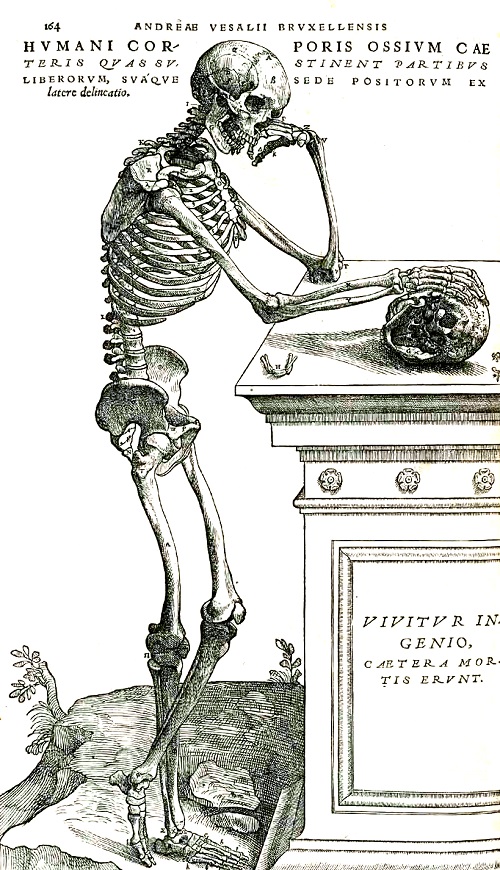
From Wikipedia’s library of De Humani illustrations.
Because in 1543, Vesalius was in that city* to work with printer Johannes Oporinus, even then publishing the physician’s magnum opus De Humani Corporis Fabrica. Vesalius personally transported to Oporinus the famously gorgeous and detailed woodcuts of Titian’s pupil Joannes Stephanus Calcarensis that made De Humani a smash hit in Vesalius’s own time and one of the most treasured artifacts of Renaissance scholarship.
On this date in 1573, the Hanseatic city of Hamburg beheaded the Seeräuber Hans von Erschausen with his crew, leaving naught but a vast row of pike-mounted heads and some excellent woodcuts.
January 21 is the feast date and traditional martyrdom date (in the year 304) of Agnes of Rome, a 13-year-old put to death in the Diocletian persecutions who has the distinction of being among the seven women mentioned by name in the Catholic Canon of the Mass.
Agnes means “chaste” in Greek,* and this was precisely the problem.
As prosperous as she was pulchritudinous, she was pious even moreso and spurned the many suitors for her hand and bed. Eventually one or the other of them peevishly reported her as a Christian.
Upon arrest, the abstinent youth was allegedly subjected to an official program of sexual assault, including displaying her naked in public and forcing her into a brothel. It’s said that divine intervention prevented her violation in these ordeals. (The flowing locks in the Ribera portrait of her at right are part of that myth, supposed to have sprouted long enough to save her from her public shaming.)
Considering that her defining characteristic is her virginity, Agnes has quite the lurid legend — and that does not exclude her very martyrdom. Per the erotically-charged poetic account of the 4th-5th century Christian poet Prudentius,** Agnes rejoiced sensually in the executioner sent to to render her to her heavenly bridal-bed:
I rejoice that there comes a man like this,
A savage, cruel, and wild warrior,
Rather than a languid, soft,
Womanish youth fragrant with perfume,
Come to destroy my life with the death of my honor.
This lover, this one at last, I confess, pleases me.
I shall rush to his eager steps
And not demur from his hot ardor.
I shall welcome the entire length of
His blade into my bosom, drawing the sword-blow
To the depths of my breast.
Agnes, whose purported relics are interred in the Roman church Sant’Agnese in Agone, is the patron saint of an entire pantheon of feminine sexual incipience: chastity, virgins, young women, and betrothed couples.‡
Little surprise, then, that the legend arose in Christendom that a maid could invoke the vision of her future husband by performing certain suggestive rituals — like lying supine and naked on her bed — on the eve of St. Agnes (that is, the night of January 20).
It’s upon this occasion that Keats pins his narrative poem The Eve of St. Agnes§ (full text here or here), in which a young woman performing these rites is in her dreamlike state deflowered by the desired suitor her family forbids — and then the two slip away by night “o’er the southern moors.”
Beyond a mortal man impassion’d far
At these voluptuous accents, he arose,
Ethereal, flush’d, and like a throbbing star
Seen mid the sapphire heaven’s deep repose;
Into her dream he melted, as the rose
Blendeth its odour with the violet,–
Solution sweet: meantime the frost-wind blows
Like Love’s alarum pattering the sharp sleet
Against the window-panes; St. Agnes’ moon hath set.
* It’s also similar to the Latin word for lamb, agnus; consequently, the lamb is Agnes’s usual iconographic symbol.
** Prudentius, best-known for his seminal allegorical verse Psychomachia, composed a number of hymnal poems. Some are still in use today — such as “Of the Father’s Love Begotten”.
† Translation has a few tweaks of my own but is primarily that of Colbert I. Nepaulsingh in “The Afrenta de Corpes and the Martyrological Tradition,” Hispanic Review, Spring, 1983.
‡ She’s also the patron saint of rape victims.
§ Tennyson later wrote a short poem of his own touching the same theme, “St. Agnes’ Eve”.
It might have been May 19, 399 BCE* — and if not, we’re in the neighborhood — that the original gadfly** philosopher Socrates obeyed a death sentence from his native Athens and quaffed a cup of deadly hemlock. It’s one of the most famous executions in history, and arguably one of the most consequential.
Socrates left no original writings that survive for us. Posterity sees him via the works of his students Xenophon and especially Plato, but he was a well-known figure to contemporaries in the polis.
For decades, the man with the method and the familiar daemon had been philosophizing around town. Socrates comes in for mockery in an Aristophanes play lampooning newfangled intellectual trends in the 420s BCE
“Like Ozzy Osbourne, [Socrates] was repeatedly accused of corruption of the young.”
The corrupting-the-young and impiety charges which putatively caused the man’s trial and death sentence have been much-debated in the centuries since. It seems clear that the real crime in the eyes of the hundreds of fellow-citizens who judged Socrates had to do with the students who weren’t reverential successor-eggheads, but toxic contemporary politicians. Socrates tutored the treacherous demagogue Alcibiades, who convinced Athenians to mount a catastrophic invasion of Sicily that cost Athens the Peloponnesian War; he rolled with Critias, one of the notorious tyrants of Athens during the 404-403 Spartan puppet dictatorship that resulted from losing that war.
All the while, Socrates had openly preached a dim view of the Athenian democratic system. Again, we don’t have the master’s direct words here, but something like the dialogue presented by the Socrates character in Plato’s allegory of the cave — in which non-philosophers are a lot of purblind morlocks — is difficult to square with anything but an elitist take of civilization. There’s a reason this could be a bit of a sore subject in a city that had just seen the glories of its late imperial apex possessed by Spartan hoplites, especially when espoused by a guy who rubbed chitons with the tyrants themselves.
Even so, Socrates was only narrowly convicted. Once convicted, the legal game had both the prosecution and the defendant propose a punishment, and the jury select one.
Were this system still practiced somewhere, game theorists would have a field day with it. But Socrates just opted out of the match by proposing that he be “punished” with a public pension for his services to the polis. There’s being a gadfly, and then there’s telling your jury to go take a long walk off a high rock: he was death-sentenced by a larger margin than had voted to convict. Plato makes this a much more martyr-like scene than Xenophon; the latter emphasizes that the septuagenarian chin-waggler didn’t much mind being excused from the frailties of advancing age.
Plato used Socrates repeatedly in various dialogues, and it goes without saying that these are cornerstones of the literary canon. The dialogues of most relevance† for his execution specifically are:
the Apology, Plato’s account of the defense Socrates mounted at trial: it’s in this text that Socrates is reported to utter the words, “the unexamined life is not worth living.”
Crito, a conversation between a wealthy guy of that name and the condemned Socrates in which the philosopher expounds his theory of citizenship and social contract in refusing Crito’s blandishments to escape before execution.
the Phaedo, in which Socrates argues for the immortality of the soul, and then gets down to the business of swallowing his fatal draught.
Soon the jailer, who was the servant of the Eleven, entered and stood by him, saying:—To you, Socrates, whom I know to be the noblest and gentlest and best of all who ever came to this place, I will not impute the angry feelings of other men, who rage and swear at me, when, in obedience to the authorities, I bid them drink the poison—indeed, I am sure that you will not be angry with me; for others, as you are aware, and not I, are to blame. And so fare you well, and try to bear lightly what must needs be—you know my errand. Then bursting into tears he turned away and went out.
Socrates looked at him and said: I return your good wishes, and will do as you bid. Then turning to us, he said, How charming the man is: since I have been in prison he has always been coming to see me, and at times he would talk to me, and was as good to me as could be, and now see how generously he sorrows on my account. We must do as he says, Crito; and therefore let the cup be brought, if the poison is prepared: if not, let the attendant prepare some.
Yet, said Crito, the sun is still upon the hill-tops, and I know that many a one has taken the draught late, and after the announcement has been made to him, he has eaten and drunk, and enjoyed the society of his beloved; do not hurry—there is time enough.
Socrates said: Yes, Crito, and they of whom you speak are right in so acting, for they think that they will be gainers by the delay; but I am right in not following their example, for I do not think that I should gain anything by drinking the poison a little later; I should only be ridiculous in my own eyes for sparing and saving a life which is already forfeit. Please then to do as I say, and not to refuse me.
Crito made a sign to the servant, who was standing by; and he went out, and having been absent for some time, returned with the jailer carrying the cup of poison. Socrates said: You, my good friend, who are experienced in these matters, shall give me directions how I am to proceed. The man answered: You have only to walk about until your legs are heavy, and then to lie down, and the poison will act. At the same time he handed the cup to Socrates, who in the easiest and gentlest manner, without the least fear or change of colour or feature, looking at the man with all his eyes, Echecrates, as his manner was, took the cup and said: What do you say about making a libation out of this cup to any god? May I, or not? The man answered: We only prepare, Socrates, just so much as we deem enough. I understand, he said: but I may and must ask the gods to prosper my journey from this to the other world—even so—and so be it according to my prayer. Then raising the cup to his lips, quite readily and cheerfully he drank off the poison. And hitherto most of us had been able to control our sorrow; but now when we saw him drinking, and saw too that he had finished the draught, we could no longer forbear, and in spite of myself my own tears were flowing fast; so that I covered my face and wept, not for him, but at the thought of my own calamity in having to part from such a friend. Nor was I the first; for Crito, when he found himself unable to restrain his tears, had got up, and I followed; and at that moment, Apollodorus, who had been weeping all the time, broke out in a loud and passionate cry which made cowards of us all. Socrates alone retained his calmness: What is this strange outcry? he said. I sent away the women mainly in order that they might not misbehave in this way, for I have been told that a man should die in peace. Be quiet then, and have patience. When we heard his words we were ashamed, and refrained our tears; and he walked about until, as he said, his legs began to fail, and then he lay on his back, according to the directions, and the man who gave him the poison now and then looked at his feet and legs; and after a while he pressed his foot hard, and asked him if he could feel; and he said, No; and then his leg, and so upwards and 118upwards, and showed us that he was cold and stiff. And he felt them himself, and said: When the poison reaches the heart, that will be the end. He was beginning to grow cold about the groin, when he uncovered his face, for he had covered himself up, and said—they were his last words—he said: Crito, I owe a cock to Asclepius; will you remember to pay the debt? The debt shall be paid, said Crito; is there anything else? There was no answer to this question; but in a minute or two a movement was heard, and the attendants uncovered him; his eyes were set, and Crito closed his eyes and mouth.
Such was the end, Echecrates, of our friend; concerning whom I may truly say, that of all the men of his time whom I have known, he was the wisest and justest and best.
A few books about the death of Socrates
* The Phaedo places Socrates’ trial on the day after Athens consecrated a ritual boat for its annual pilgrimage. (This was supposed to be the very boat that the hero Theseus had sailed back after defeating the minotaur in time immemorial, and the Athenians maintained it for centuries in a seaworthy state to make ceremonial voyages to the island of Delos, a sanctuary for Theseus’s patron Apollo. This is also the very conveyance in question in the “Ship of Theseus” paradox, a philosophical conundrum proceeding from the question of whether the thing was still “Theseus’s ship” if every single component of it had been replaced in the intervening years.) Anyway, Theseus aside, that mention of the consecration gives us Mounichion 7 on the confusing lunisolar Attic calendar for the trial of Socrates.
During the ship’s sacred voyage, Athens was to remain ritually “cleansed.” This condition included not conducting any executions. A date for the death of Socrates is established by Xenophon and Seneca reporting that the boat returned after 30 days — which was about twice as long as ordinarily required, but the archaic craft was very vulnerable to bad weather. 30 days is an eminently doubtable nice round number, but where ancient dates are concerned, we takes what we can gets.
“Counting inclusively, as was then the custom, Socrates died on Thargelion 6, which is the very day recorded for his birth,” notes Reason and Religion in Socratic Philosophy. It’s possible that Socrates’s birthday became associated with Thargelion 6 because Thargelion 6 was associated with Socrates via his execution … but Thargelion 6 became known as man’s execution date. It also happened to be the Athenian festival “Thargelia” (and the day before Plato’s Thargelia 7 birthday).
There are other dates out there. In particular, a number of easily accessible pages claim that the hemlock was downed on May 7, 399. I’m not positive, but it appears to me that this might have originally been arrived at by counting 30 days exclusively from Mounichion 7 to reach Thargelion 7, then noticing that Thargelion typically began sometime in May, and smushing together “May” and “7” from alien calendars … after which it’s been repeated on the basis of previous source’s authority. If there’s better support for this date than I infer, I welcome correction.
For my part, I’ve dated this entry based on the astounding Hellenic Month Established Per Athens calendar, specifically its dates for Thargelion of the 1st year of the 95th Olympiad. Thargelion 6 corresponded to May 18/19, says HMEPA — Greek days began at sundown — and since Socrates died at the end of daylight, just before sunset, that’s a Gregorian May 19th. Again, though, all this is built upon a chain of questionable inferences based on a few questionable passing remarks from just a couple of ancient sources. In the end, one just can’t know for sure.
** Plato reports in the Apology Socrates characterizing himself as such this way — “a sort of gadfly, given to the state by God; and the state is a great and noble steed who is tardy in his motions owing to his very size, and requires to be stirred into life” by his stings — bequeathing to us the evocative metaphor.
† Find these essential execution-related dialogues here, here, or here, or just the highlights here.


 Iconography often depicts St. Lucy brandishing her own eyeballs, like a Guillermo del Toro monster: this, too, is an allusion to the torments of the Romans, and the story is either the cause or the consequence of her patronage of the blind.

 For several months in 1749-1750 they prowled the environs of a lawless London, and notably Hyde Park, with the exaggerated courtesy demanded by romance of their profession. They found noteworthy prey: once, they stole a blunderbuss from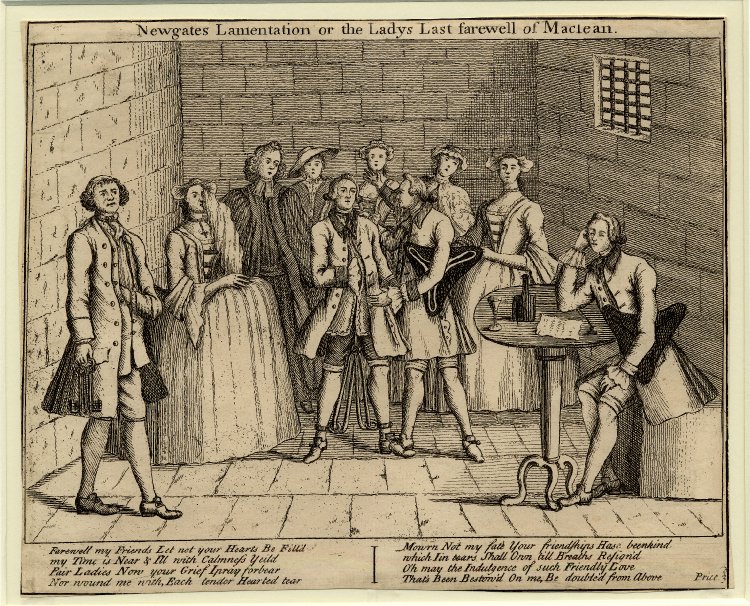


 “[H]is evil genius prompted him, for gold, to debase his talents in engraving,” the Newgate Calendar




 Agnes means “chaste” in Greek,* and this was precisely the problem.


