Blösche (English Wikipedia entry | German) was an SS Rottenführer and a Nazi Party member whose particular contribution to deporting Jews from the Warsaw Ghetto to Treblinka was fitting in some opportunistic rape, typically followed with summary murder. The ghetto’s wards called him “Frankenstein”.
Blösche was eventually captured by the Red Army, which you’d think might augur ill for his survival prospects. However, with the aid of a horrible accident he suffered in a postwar labor camp that helpfully disfigured his face, Blösche managed to fade quietly into East German society, wed, and raise a family.
He would need that facial anonymity, because the un-disfigured version is there full-frontal gazing over his submachine gun in one of the war’s most iconic and chilling images — snapped for the benefit of the Stroop report documenting the ghetto’s liquidation.
An SS trooper, eventually identified as Joseph Blösche, looms over a frightened Jewish boy in the Warsaw Ghetto. (The child might be one of Artur Dab Siemiatek, Levi Zelinwarger, Israel Rondel, or Tsvi Nussbaum)
This photo was published in the U.S. in Life magazine on November 28, 1960. The terrible image haunted Holocaust survivor Peter Fischl into writing his poem “The Little Polish Boy”.
Blösche’s luck ran out when his name came up in a West German war crimes trial in 1961; East Germany’s follow-up eventually zeroed in on the man, and he was convicted in April 1969 for directly killing up to 2,000 people, and participating in deportations that killed 300,000 more. He was executed in Leipzig with a single shot to the neck.
Joseph Blösche is the subject of the German documentary Der SS-Mann (there’s also a book of the same title).
On this day in 1941, seventeen-year-old Shaya “Shaike” Iwensky came within seconds of being shot by the Einsatzgruppen outside the city of Daugavpils, Latvian SSR. Sheer dumb luck — and a slight miscalculation by the Germans — saved his life.
Shaike was born and raised in Jonava, Lithuania and fled to Daugavpils with his brother when the Germans invaded the Soviet Union in June 1941. On June 29, he was arrested along with the other Jewish male adults in town. His brother, who was fifteen years old, was arrested alongside him, but released the same day because of his age.
For the next week and a half, Shaike was held in a crowded prison cell, fed almost nothing, and forced to work during the day.
On July 8, he noted “a change for the worse in our guards, an extraordinary meanness … In my worst fears, I could not have conjured up the kind of hell in which I now found myself.”
That day he and his comrades were stuck in a truly Sisyphean ordeal: forced to roll rocks up a hill, three men to a rock. They kept losing their grip and the rocks would slide back.
That night some other prisoners told him they had been forced to dig huge ditches, which were covered in chlorine.
The next day, the eighteenth day of Operation Barbarossa, Shaike found out what the ditches were for:
A series of shots … a short interruption and again shots … and again … It wasn’t long before we got the confirmation of what we’d been suspecting all along. One of the men in a neighboring cell stuck his head in the doorway, and said, “They are killing Jews. From the washroom window someone saw people lined up in the yard. They are from the first floor.”
Though this testimony specifically concerns a different massacre, in November of 1941, it gives a sense of the environment.
A couple of hours later, Shaike and the others from his part of the prison were ordered to leave and take all their belongings. They were marched down to the basement and made to empty their pockets into the “knee-deep rows of wallets, documents, pictures, watches, trinkets worthless to anyone else.” Then they were marched into the yard and formed into groups of twenty. Hoping to at least die with people he knew, Shaike stuck together with his old friends from Jonava.
The blue sky was almost clear, with only here and there a wisp of cloud. I looked up, and the thought hit me hard: I will never see the sky again.
It is said that, when a person faces death, his whole life flashes before him. But my thoughts were disjointed, disorderly; they tumbled through my mind rather like the flimsy clouds above, forming, changing shape, disappearing and reappearing … Catching myself picking at a hangnail, I thought, How silly. In a few minutes it will make no difference at all …
It occurred to me that reality was often quite unlike what we expect it to be. People standing in line to be killed didn’t look very different from those waiting to buy bread. Their faces, their eyes betray nothing of what is going on in their minds. People stand in line under the hot sun, they move ahead, then their times comes to die, and it is over.
Shaike and his friends waited in line for over two hours in the heat. He had not thrown out his handkerchief and was glad to have it to wipe the sweat from his face. Finally he and his group of twenty arrived at the gate … but when the soldiers came out, they didn’t escort them to the ditches. Instead they ordered everyone to turn around and march back to the prison.
That evening, the prisoners were ordered out again and taken to the killing ground, and then they realized what had happened: the Nazis had spared them because they had run out of ditches. The Jews had to cover the mass graves with earth, stamping down on the bodies and packing them together, and also to dig new trenches, presumably for themselves, until evening when they were sent back to the prison again.
That night, Shaike and some of his friends hid in an empty cell under blankets. The Nazis didn’t find them the next morning when they ordered the survivors out to get shot. They hid in the cell for two days before they were caught. Fortunately the Latvian guards who found them didn’t realize who they were, and merely beat them and tossed them in with some prisoners who’d arrived that same day.
Eventually, Shaike was released from the prison and taken to the Daugavpils Ghetto. He would eventually escape from there and spent some time living in the woods with a Soviet partisan detachment, going back and forth between there and the ghetto. Finally he was captured and taken first to the Stutthof Concentration Camp, then to Dachau. There he was liberated by Americans on April 29, 1945. At twenty years old, he was the sole survivor of his family.
Shaike moved to the United States in 1948 and changed his name to Sidney Iwens. He wrote a book about his experiences, titled How Dark the Heavens: 1400 Days in the Grip of Nazi Terror. Sidney Iwens died in Florida in 2010, at the age of eighty-four.
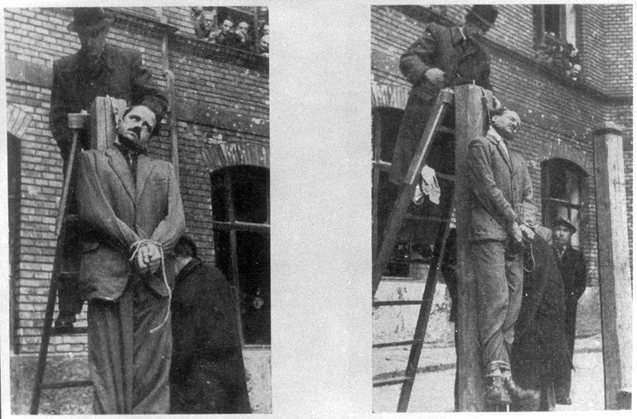
On this date in 1946, fascist Hungarian politicians Laszlo Baky and Laszlo Endre were executed by hanging in Budapest for their role in the decimation of Hungarian Jewry.
These two charmers were major figures in Hungary’s horrible final months of World War II.
This occupation lifted the virulent anti-semites Baky and Endre into national power, because along with keeping Hungary in the Axis coalition, the Nazis also forcibly overcame its junior partner’s former reticence about Jewish genocide.
Adolf Eichmann arrived into Nazified Hungary and used our day’s two principals (along with another executed collaborator, Andor Jaross, they’re known as the “deportation trio”) as his instruments. Within months, hundreds of thousands of Hungarian Jews were being shipped to the gas chambers. This period is one of the waypoints of pernicious Nazi race theory, when the collapsing German regime spent military resources urgently needed at the front to organize the mass slaughter of Jews.*
And they had to work fast, because by that next winter the Red Army was seizing Budapest. These enthusiastic fascist operators did not fare well by the postwar government.
* To do justice to the breadth of the human capacity, this is also the time and place where we find Raoul Wallenberg minting lifesaving Swedish passports by the thousands.
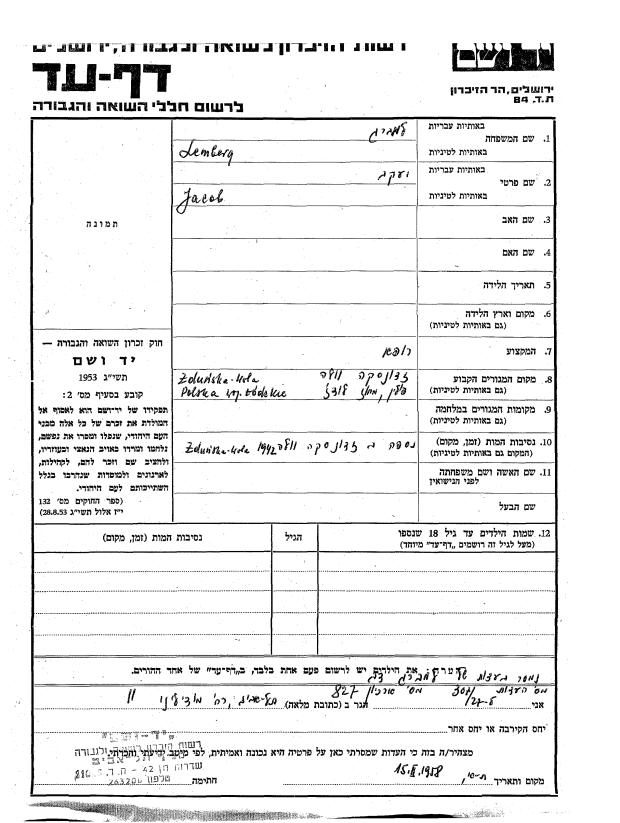
On this date in 1942, on the first day of Purim, Jakub Lemberg was executed together with his family in the Nazi ghetto in Zdunska Wola, Poland.
Lemburg, a 43-year-old internist and pediatrician, was head of the Judenrat in Zdunska Wola and thus it was his task to do the Nazis’ dirty work, such as putting together lists of his fellow-Jews for deportation.
He revealed himself to be a man of exceptional character and courage, and the circumstances of his death, as recorded in Louis Falstein’s The Martyrdom of Jewish Physicians in Poland, should not be forgotten:
The Gestapo chief ordered Dr. Lemberg to deliver ten Jews to be hanged for the ten hanged sons of Haman. Dr. Lemberg replied that he could deliver only four Jews: himself, his wife and their two children. Hans Biebow, “the Butcher of Lodz,” seized Dr. Lemberg and turned him over to the executioners, who killed him in the cemetery.
The Zdunska Wola ghetto was liquidated five months later. And in 1947, Biebow got his.
Here’s an image of Lemberg testimony (in Hebrew) from the Yad Vashem database.
On this day in 1942, the Nazis shot five Jewish men from Sokal, which was then part of Poland and now belongs to the Ukraine.
During the first years of the war, the Germans had designated Sokal as a Judenstadt (literally “Jew-town”), a central destination point for all Jews expelled from nearby towns and villages. Or, as diarist Moshe Maltz put it, “A solitary island in a sea of blood.”
It was Maltz, an Orthodox Jew and native of Sokal, who recorded the executions described in this entry. He kept regular notes throughout the war about the plight of Sokal’s Jews — not a diary exactly, but a chronicle, meant for the benefit of history.
On February 24, five Jews from Sokal were taken to a place somewhere on the outskirts of town and shot. One of them was Yeshaye, son of Yankel the coachman. In 1940, during the period of Soviet occupation, Yeshaye had been a coachman working for the NKVD. Now the Gestapo called him and ordered him to turn over to them the reins of his horses. They said to him, “We’ll give you three days to deliver those reins to us. If we don’t get them by that time, we’ll have you shot.” Yeshaye thought that the Gestapo must be joking. How could he go on working as a coachman without his reins? Unfortunately for Yeshaye, the Gestapo men were in dead earnest.
Also among the five shot was Dr. Knopf, a lawyer who had converted to Christianity. The Germans had ordered him to dismiss his Gentile maid so that she could be sent to work in Germany. Knopf petitioned the Gestapo to let him have his maid back. That’s why the Germans shot him. Despite his baptism, he was simply not an Aryan. The third victim was blind Yankel, who was found guilty of buying and slaughtering a calf. Under German occupation regulations, cattle can be slaughtered only by officially approved butchers.
In October 1942, the Jews of Sokal were confined to a ghetto. The following month Maltz wrote, with the same dispassionate tone, of the murder of his fourteen-month-old daughter at the hands of the Nazis.
Later in November he escaped from the ghetto with his wife and surviving son. They had made an arrangement with a Polish woman who lived nearby, and moved into her hayloft, above the pigsty.
Eventually fourteen people from three families in all would come to live in the hayloft. All of them survived except Maltz’s sister, who died of fever while in hiding. The others staggered out into daylight, barely able to walk, when the Russians liberated the area in July 1944.
Maltz and his entire family eventually emigrated to the USA.
When the Nazis attacked the house at 29 Kupiecka Street, rounding up all of its residents into the street, a bold young man, Izchok Malmed, whipped out a jar of acid from his pocket, hurling it in the face of a Nazi soldier, who was blinded at once. Seeking revenge, the sightless Nazi fired his revolver several times, hitting another Nazi soldier and instantly killing him. In the melee, Malmed vanished.
Commandant Friedl, after learning what had happened, ordered that one hundred men, women and children living in the area where the incident occurred be rounded up and force-marched to a nearby garden, where they were lined up against the wall of an adjacent bet hamidrash and shot with machine guns.
Afterward Nazi soldiers captured another group of Jews, forcing them to dig a large pit for the bodies of the one hundred martyrs. A thin layer of earth covered them. Some were still alive, their hands groping upward through the earth.
The Nazi soldier accidentally shot by his colleague whom Malmed had blinded was carried to the Judenrat building, and his body was placed on [Judenrat Chairman Efraim] Barasz’s desk. Friedl then proclaimed to Barasz, “See what your Jewish criminals have done. Now we shall take revenge. You shall see what we can do.” Friedl issued an ultimatum for the perpetrator of the crime to surrender within twenty-four hours. Failing that, the entire ghetto would be destroyed with everyone in it.
Barasz knew the Nazis meant what they said. He sent word to Malmed to give himself up and thereby save thousands of Jewish lives. As soon as Malmed heard, he surrendered himself to the Nazis.
Tamarof’s diary described in detail Malmed’s courage. Asked why he killed the Nazi soldier, he replied: “I hate you. I regret I only killed one. Before my eyes my parents were murdered. Ten thousand Jews in Slonim were liquidated before me. I have no regrets.” Tamarof tried to slip poison to Malmed but failed. Even the police could not get near the prisoner.
The next morning, Izchok Malmed, a hero of the ghetto, was hanged in the square where he had performed his act of courage. Despite the horrible torture to which he had been subjected, Malmed cursed the Nazi murderers. After several minutes of hanging on the gallows, the rope broke and the body fell to the earth. Instantaneously, the Nazis riddled Malmed’s corpse with bullets and re-hanged the body for another forty-eight hours.
Kupiecka Street was renamed Malmed Street after the war. Near the site of Malmed’s execution is a plaque reading, in Polish and in Hebrew, “Icchok Malmed, the hero and fighter of the Bialystok Ghetto, was killed here by the Nazi murderers on 8 February 1943. In his honor.”
* The Zchor account spells his name “Izchok” but on the memorial plaque it says “Icchok”. It’s a form of the name Isaac.
On this day in 1942, three anonymous Jewish residents of the Bialystok Ghetto in Nazi-occupied Poland were hung in the public square across the street from the Judenrat (Jewish Council) building. The three worked at the ghetto’s oil factory, and had been caught smuggling sunflower seeds.
The residents of the ghetto paid little attention to the execution, accepting it with resignation. It was hardly remarked on.
But this event was yet another small indication of dire events looming in the near future. Compared to those in other Nazi ghettos, such as those at Warsaw and Lodz, the Bialystok Jews had it pretty good. The ghetto, noted Sara Bender in her 2008 book The Jews of Bialystok During World War II and the Holocaust, was “organized, industrious, and even prosperous. Unlike other ghettos, it never experienced starvation or abject poverty.”
And it was seen as relatively safe. This day’s sort of vicious, arbitrary executions for minor rule infractions, which were so common elsewhere, were not at all frequent in Bialystok. Neither were the mass deportations that had by late 1942 decimated almost all the other ghettos.
Well, Bialystok’s turn was coming.
Unbeknownst to the Bialystokers, just as the sunflower seed smugglers were meeting their end, the powers that be in Berlin were debating the future of the ghetto. The Nazis in immediate charge of the ghetto wanted to keep it, and had logical reasons for doing so: namely, that it was a center of great industry, producing all kinds of goods for the German Army at almost no cost.
Killing off tens of thousands of hardworking slaves during wartime makes about as much sense as hanging three people over sunflower seeds, but this is what Berlin decided to do.
In early- to mid-February 1943, there was a surprise Aktion in the ghetto: 2,000 were killed and a further 10,000 deported to the Treblinka Extermination Camp. About 30,000 remained.
Once it was over, most of the surviving Bialystokers breathed a sigh of relief and hoped against hope that the worst was over — while a small underground group quietly organized an uprising for when the time came.
The rebellion, however, never really had time to get off the ground. When the final deportation occurred in August 1943, almost everyone went quietly in shock to their deaths. A cell of less than 100 fighters put up a few days’ struggle, enough to earn a footnote in history, before the last of the ghetto blew away with the ashes.
On August 6, 1942, in the Warsaw Ghetto, Polish/Jewish hero Janusz Korczak marched with his orphans to the death trains and into legend.
The man, his activities in the ghetto, and above all his famed final walk to the Umschlagplatz, are mentioned in many books and memoirs about the ghetto.
Korczak’s real name was Henryk Goldschmidt. He took the name Janusz Korczak (pronounced “ya-nish kor-chok”) for his writing and it wound up taking over his entire life, a la Mark Twain.
Born in an observant Jewish household in Warsaw (which was then Russian Territory) in either 1878 or 1879,* he became man of the house after his father suffered a nervous breakdown in 1889 and eventually had to be hospitalized.
By thirteen, bored by school, he was writing poetry and learning foreign languages by himself. He went to medical school and served as a military doctor with the Russian Army in the Sino-Japanese War of 1905-1906. Eventually he was promoted to the rank of major.
Korczak’s true calling wasn’t in medicine, however, but in writing and in working with children. He found himself drawn to neglected and abused youngsters, and believed in treating every child with honesty and respect.
While he was in China with the military, his first book, Child of the Drawing Room, became famous in Poland. He didn’t realize he was a celebrity until he returned home.
He tried to distance himself from his writing and his fame and be an ordinary pediatrician, but people wanted to see him, to the extent that they would pretend their children were sick in order to entice him to their homes.
Korczak wrote later that one woman claimed her sons had the flu and, when he made a house call, insisted on serving him tea.
“Have you been writing anything lately?” she asked.
“Prescriptions,” he replied, and left, realizing he’d been had.
In 1910, he gave up his medical practice to start an orphanage for Jewish children age seven to fourteen. His institution was very different from most of that time and place, for Korczak had very democratic ideas: the children wrote their own newspaper and had their own parliament and court system.
If one child had a falling-out with another, the urchin could “sue” and bring a case to be decided before the orphanage court, which met once a week. (Even teachers and other staff members could be sued.) The orphanage court also held trials for children accused of violating one of the home’s rules.
Children were rewarded for good behavior, and spanked only as a last resort. Every child had a private, lockable drawer to hold their most precious belongings. Korczak carefully monitored the children’s health and also acted as a sort of informal therapist, encouraging them — most of them orphans from backgrounds of desperate poverty and abuse — to talk about their feelings. The children called him Pan (“Mister”) Doctor.
When World War I broke out, Korczak left the orphanage to serve in the Army again. He left it in good hands, however, in the care of teachers and staff he had trained himself.
“All the world is submerged in blood and fire, in tears and mourning,” he wrote sadly of his war experiences.
It was while in the trenches on the Eastern Front that he began writing a book on child development, titled For The Love of a Child. In 1918, the war finally ended, Poland became a free and independent nation, and Korczak returned to his orphans in Warsaw.
He stayed busy, setting up a second orphanage in 1919, and afterwards writing King Matt the First. The novel, a children’s story about a young boy who becomes king and puts the country’s children in charge, became a bestseller throughout the country in the wake of the calamity lately unleashed by the grown-ups. The sequel, King Matt on the Desert Island, was also a commercial success.
Korczak continued to work for his children, however; he consulted at Warsaw’s juvenile court, and in 1928 founded third orphanage, called Our Home, which had attached dormitories for teachers-in-training and was intended for Catholic children.
In 1925, Korczak wrote another book called When I Am Little Again, told from the point of view of a middle-aged teacher and meant to be read by both children and adults.
He started a children’s newspaper, the Little Review, in 1926. Saying he wanted to “defend children” in his new paper, he invited children from all over Poland to write and tell him the stories of their lives. The newspaper lasted until 1939.
He also hosted a hugely popular radio show, using the name “Old Doctor.” The program was terminated in 1937, however, after only a couple of years; Korczak’s employers with the radio station were reluctant to keep a Jew on the air. When his identity became known, the right-wing press castigated him, saying that as Jew he could never be a real Pole and shouldn’t be allowed to educate Polish children.
Like any public figure, Korczak had his critics. Anti-Semites called Our Home “a new nest of Masonry and potential Communism erected in the heart of the capital.” Communists said his institutions weren’t Communist enough; Zionists criticized him for not directing the children towards a life in Palestine; religious Jews said there wasn’t enough religion in the orphanages while assimilationist Jews said there was too much.
Yet Korczak’s methods worked.
In a follow-up study he conducted of all the former residents 21 years after the first of his institutions was opened, he found that only a few had turned to crime or prostitution as adults. The same could not be said for children who graduated from other children’s homes in Poland.
During the 1930s, many of Korczak’s friends encouraged him to move to Palestine to escape the growing problems in Poland. He actually visited a kibbutz there, but he couldn’t make up his mind whether or to go; he had trouble leaning Hebrew and wasn’t sure a man of his age could start a whole new life.
“I don’t have forty years to spend in the desert,” he wrote to a friend.
Germany’s invasion of Poland in 1939 settled the question for him; leaving the country was no longer an option. Korczak volunteered for the Army again, but was turned down due to his age.
As the Nazis tightened their strangehold around Poland and Poland’s Jews, Korczak did the best he could to shied his orphans from the chaos, suffering and bigotry around them.
He turned his pen to appeals for funds for the children. As a protest against the occupation, he walked around the city openly in his old Polish Army uniform as well as the required Star of David armband.
The uniform proved surprisingly useful: he told a friend that when he went door to door asking for money for the children, “Some people are generous, but not everyone. If they’re difficult, I just undo my coat and reveal my Polish uniform. They get so nervous about having someone in uniform in their place that they give me something just to make me leave.”
The Warsaw Ghetto opened in 1940, and the orphanage was outside its boundaries, so they had to move. (Later, the Germans reduced the size of the ghetto, and Korczak’s orphanage had to relocate again.)
The Warsaw Ghetto was a kind of hell for Jews; allotted rations of only 800 calories a day — if they could get that — people died in droves of starvation and related diseases, including typhus and tuberculosis, as well as deliberate murder by the Nazis and their collaborators.
As recorded in Betty Lifton’s biography, a gentile friend, Igor Newerly, offered to help Korczak escape this fate:
“Everyone’s worried about your going into the ghetto with the children,” Newerly told him. “Just say the word and we’ll get you false identity papers to live on our side.”
“And the children?”
“We’ll try to hide as many as we can in monasteries and private homes.”
Korczak put down his cigarette, took off his glasses in their cheap round metal frames, and began wiping them with his handkerchief as he always did when he was stalling for time.
Finally, he asked: “Do you realize how difficult it would be to hide one hundred and seventy Jewish children — that’s that’s how many we have now.”
“We’d try,” Newerlv repeated.
“But can you guarantee me that every child will be safe?”
Newerly shook his head sadly: “I’m afraid that’s impossible. We can’t guarantee anything” — he
paused — “even for ourselves.”
Korczak thanked his friend, but turned him down. He would take his chances in the ghetto. His decision was sensible for the time — the “Final Solution” had not been conceived of, and no one knew what the eventual fate of the ghetto residents would be.
Lifton records:
On the day they were scheduled to depart, November 29, the children lined up in the courtyard as rehearsed, while Korczak made a final inspection of the wagons filled with the coal and potatoes that he had so arduously procured on his daily rounds. The children waved goodbye sadly to the Polish janitor, Piotr Zalewski, who was staying behind to care for the house. His face was swollen almost beyond recognition from the beating he had received the day before when he and the laundress had applied to the Nazi police for permission to go into the ghetto with the orphans. The Germans had thrown the laundress out, but detained Zalewski for questioning. Didn’t he know that Aryans were no longer allowed to work for Jews? When the janitor replied that after twenty years of service he considered the orphanage his home, the Germans thrashed him with whips and rifle butts.
[…]
The orphans tried to sing as they marched out of the courtyard and into the street, clutching their few possessions. The green flag of King Matt, with a Jewish star on one side, flew over the little parade as it made its way through the teeming streets the short distance to 33 Chlodna Street. When they reached the place where the wall cut along Chlodna, slicing its “Aryan” half off from the ghetto, they found German and Polish police at the gate demanding identification, as if they were crossing a foreign border.
Within the ghetto, Korczak continued his activities for children’s welfare.
He tirelessly solicited aid for the orphanage to keep the children clothed and fed. He and others held benefit concerts and poetry readings, and put posters all around the ghetto saying “OUR CHILDREN MUST LIVE” and “A CHILD IS THE HOLIEST OF BEINGS.”
He took the job as director of a hopelessly underfunded shelter that housed a thousand children; in spite of his efforts, the mortality rate there was sixty percent.
Everywhere children were dying of starvation and disease on the streets or in filthy, overcrowded hovels; Korczak lobbied for the creation of a sort of hospice where they could at least breathe their last in clean, quiet surroundings.
For himself he functioned mostly on pure willpower. It was hard for him to eat when he knew the children were hungry. Five shots of pure alcohol a day, mixed with water, provided precious calories.
Yet his health was failing. His friends noticed how emaciated he had become: “ill, wasted and stooped.” He had a persistent cough and a doctor who examined him diagnosed him with pulmonary edema. Nightmares interrupted his sleep. “How hard it is to live,” he wrote, “how easy to die!”
Yet he carried on.
In the summer of 1942, it became increasingly apparent that the ghetto would be liquidated. Igor Newerly approached Korczak again and offered to help save whoever he could.
Korczak declined his offer again, but gave him his diary for safekeeping — a sign that Korczak, too, knew the end was coming. He had decided to throw his lot in with the children.
In July, the Nazis announced that there were “too many Jews” and they were sending away the children, the old, the sick and anyone else who could not work. Orphans, of course, would be at the top of the list. Resettlement meant death, and many of the ghetto residents knew it, although a substantial number clung to the hope that they would be placed in work camps and find someway of surviving a little longer.
Adam Czerniaków, the Warsaw Ghetto Chairman and Korczak’s personal friend, took his own life rather than supervise the deportations.
For the next few weeks, people were marched or dragged to the death trains, packed inside and driven off to the Treblinka Extermination Camp for gassing.
Many people tried to hide, for the most part unsuccessfully, to escape being deported. Some of the ghetto residents were so hungry that they volunteered to go, because the Nazis promised bread and marmalade to anyone who reported of their own accord.
Korczak’s orphanage’s turn came on August 6. He and the staff had made up their minds earlier: all of them would go together. And they would go quietly, in an orderly fashion, so as not to frighten the children.
Their walk to the death trains, witnessed by thousands, has passed into Holocaust legend.
Lipton records:
The Germans had taken a roll call: one hundred and ninety-two children and ten adults. Korczak was at the head of this little army, the tattered remnants of the generations of moral soldiers he had raised in his children’s republic. He held five-year-old Romcia in one arm, and perhaps Szymonek Jakubowicz…
Stefa followed a little way back with the nine- to twelve year-olds. There were Giena, with sad, dark eyes like her mother’s; Eva Mandelblatt, whose brother had been in the orphanage before her. Halinka Pinchonson, who chose to go with Korczak rather than stay behind with her mother. There were Jakub, who wrote the poem about Moses; Leon with his polished box; Mietek with his dead brother’s prayer book; and Abus, who had stayed too long on the toilet.
There were Zygmus, Sami, Hanka, and Aronek, who had signed the petition to play in the church garden; Hella, who was always restless; big Hanna, who had asthma; and little Hanna with her pale, tubercular smile; Mendelek, who had the bad dream; and the agitated boy who had not wanted to leave his dying mother. There were Abrasha, who had played Amal, with his violin; Jerzyk, the fakir. Chaimek, the doctor; Adek, the lord mayor. , and the rest of the cast of The Post Office, all following their own Pan Doctor on their way to meet the Messiah King. One of the older boys carried the green flag of King Matt, the blue Star of David set against a field of white on one side. The older children took turns carrying the flag during the course of their two-mile walk…
The young protagonist of Jerry Spinelli’s novel Milkweed described it this way:
The orphans were going by. They were marching. Their heads were high and they were singing the song I had learned. I sang along with them. Not one was dressed in rags. Everyone wore shoes. Doctor Korczak lead the way…
“The very stones of the street,” wrote Yehoshue Perle, another chronicler, “wept at the sight of the procession.”
As the group waited for the trains to leave, Korczak’s many friends were seeking out anyone with influence, desperately trying to get them out of Umschlagplatz and back to the orphanage to die another day.
It was said that a German officer, who had been a fan Korczak’s King Matt books as a child, offered him the chance to leave — without the children. Korczak refused.
His presence kept the children calm; if he left them they might panic. He knew what was coming, and he knew he could not force the children to face death alone. The fact that he was in such poor health and probably would not have survived the war in any case does not make his sacrifice any less.
Eventually the orphans and the staff boarded the train and were hauled away. There were no survivors. His name is listed on a memorial stone at the site where Treblinka once stood — the only such stone with a name on it.
Korczak’s legacy is not just in books; his name and image have been used in a lot of memorabilia over the years, and have appeared on stamps in Poland, Israel and Germany. In 1991, Polish filmmaker Andrzej Wajda made a film about Korczak and his last march. There are four statues of him in Warsaw, and a school for street children in Thailand is named after him.
From Andrzej Wajda’s Korczak.
* His year of birth is uncertain; Korczak himself may not have known it.
Sometime in July 1943, a lucky accident saved the lives of thirteen-year-old Halina Birenbaum and a group of other girls and women, all of them inmates at the Majdanek Concentration Camp outside of Lublin, Poland.
Halina’s mother was sent to the gas chambers immediately upon their arrival at Majdanek. The daughter was spared to work and endure the torture that was daily life in the camp. “We were tormented day after day by roll calls, starvation, slave labor, beatings and vermin,” she recalled later in her memoir, Hope Is the Last to Die. “Lice devoured us at night.”
After two months of this, Halina was selected and sent along with her sister-in-law, Hela, and other female inmates to an empty hut in the men’s camp. The women had no idea what the Nazis wanted them for; there was nothing to do but wait.
When it was dark outside, the Storm Troopers locked the hut and switched off the light. I nestled up to Hela, and we both fell asleep on the floor, dreaming of a better camp, easier work, tolerable living conditions…
In the middle of the night, the SS noisily threw open the hut door, arousing us with their shouts and beatings; they began herding us out, making sure that no one hid or escaped. A fearful confusion ensued.
Sleepy, frightened to death, we crowded to the door, pushing and trampling one another in the darkness and panic. The Storm Troopers ran around like mad dogs. They made us form fours, lit electric lamps and counted us, swearing.
“They are taking us to the crematorium!” The terrible news fell on us like a thunderbolt and spread like lightning through the ranks.
My heart beat rapidly. I could not believe it. Once again I could not believe that death was possible, as months earlier, on the WarsawUmshlag, when the Nazis set up a machine-gun in front of us … And I did not yield to the general panic and despair.
The SS gave an order and we moved off … in the direction of the crematorium. Some women were weeping, others tearing their hair, praying, or bidding farewell to mothers or sisters.
They herded us into a hut, the interior of which resembled a bathhouse. Despite the darkness, we observed stacks of empty gas containers on the ground in front of the hut. There was a strange sweetish odor in the air. There was no doubt now that they were taking us to execution. The women went out of their minds … They groaned, wailed, had convulsions.
They herded us into the bathhouse, and barred the door behind us. Now we had to carry out an order given previously: undress and hang out clothes up on hooks on the wall. Obediently we undressed in silence. We knew there was no way out. We hung out clothes up, then sat down on benches along the walls, waiting in extreme agitation … When and how would death come?
Time passed. Hour followed hour. But nothing happened. No one came. It was silent both inside and outside the bathhouse. Perhaps they had forgotten us? A faint hope slowly began emerging … Toward morning they came back; after the nightmare of waiting for death in the gas chamber, we went outside. They counted us again (as though anyone could have escaped from that locked building!), and took us back to the men’s camp, to the same hut as the day before. There we learned from the prisoners that the supplies of gas has unexpectedly run out during the night … We had been spared on account of this accident.
Later that day, Halina and her fellow inmates were put on a truck and taken to Auschwitz.
Several times more she escaped death by the skin of her teeth. She would survive the war, move to Israel, and become a writer, poet and translator.
On this date in 1942, at close to 11:00 p.m., Shimon Cohen was shot to death in the village of Kalesnik, Lithuania.
A barber by trade, he had somehow managed to evade the roundup and mass shooting of all the Jews in the area eight months before. But he could only postpone capture and death for so long.
The details of Shimon’s death were recorded in the diary of 22-year-old Abelis Veinsteinas, later known as Aba Gefen, a fellow Jew who was also hiding in the area. Gefen and his brother were staying in the home of the Matulevich family in exchange for payment.
On May 18, Gefen wrote:
[Two days ago] Shimon Cohen was caught at friends of his. A fight broke out between the wife of the farmer who was hiding him and the farmer’s sister. One of the women informed on Shimon to the mayor of the village, who told the police. Shimon and the farmer were arrested. They say Shimon asked a priest to come and convert him, because he knows that he will die and he wants to die a a Catholic. I am very sorry to hear that — that he’ll die as a traitor to his people.
Shimon, it seems, was quite the ladies’ man, juggling multiple romantic partners at the same time. As often happens in these cases, it came back to bite him in the ass:
It seems that Shimon was betrayed by Marta, his mistress. When the Germans began to remove Jews from the town, Marta suggested that he hide with her family in the country. He agreed and lived with her at her brother’s house. But Marta’s sister-in-law also fell in love with him. Jealousy and hatred got the better of the two women. Shimon thought he would be able to save his life by declaring his love for both of them. But Marta was furious that he was making love to her sister-in-law and turned him in.
It would be kind of a funny story if it didn’t involve Nazis and death.
As Gefen recorded in subsequent diary entries, one of Shimon’s lady friends tried to save him by pulling some boards loose from the wall of the prison outhouse so he could escape. Shimon did indeed run away, but the authorities quickly caught him and he wasted no time in selling out the woman who had facilitated his escape attempt. (She was arrested, but her ultimate fate is unrecorded.)
In the days prior to his death, Shimon took religious instruction from a priest and was baptized.
At great risk, Gefen would occasionally leave his attic hideout and go to the village to retrieve some more of his family’s valuables to give to the Matuleviches.
He wrote in his diary that he was out on one of those surreptitious excursions, tiptoeing in the dark in his stocking feet, when he heard Shimon Cohen being executed:
When Mrs. Matulevitch and I went to Kalesnik at night and crossed the railroad tracks not far from the road that leads there, we heard shots … Today, when Mrs. Matulevich came back from the village, it turned out that those shots were bullets that killed Shimon Cohen, a Jew who converted just before his death. May Shimon rest in peace — but it was still no way to die.
[…]
Piletsky the partisan shot him. He had shot Jews before. In fact, they say he’s shot seventeen Jews. Now he’s killed Shimon, and he got 15 German marks for his trouble.
Gefen and his brother survived the war, staying with various villagers and occasionally in the fields. He moved to Israel in 1948. He published his diary under the title Hope in Darkness.


 Shaike was born and raised in Jonava, Lithuania and fled to Daugavpils with his brother when the Germans invaded the Soviet Union in June 1941. On June 29, he was arrested along with the other Jewish male adults in town. His brother, who was fifteen years old, was arrested alongside him, but released the same day because of his age.




 The man, his activities in the ghetto, and above all his famed final walk to the Umschlagplatz, are mentioned in many books and memoirs about the ghetto.
 Halina’s mother was sent to the gas chambers immediately upon their arrival at Majdanek. The daughter was spared to work and endure the torture that was daily life in the camp. “We were tormented day after day by roll calls, starvation, slave labor, beatings and vermin,” she recalled later in her memoir,