1948: Dieter Wisliceny, Eichmann aide

On this date in 1948, SS man Dieter Wisliceny was hanged in Bratislava for his role in the destruction of European Jewry.

The Hauptsturmfuhrer joined the Nazi party in 1933 and became one of Adolf Eichmann‘s key lieutenants* implementing the Final Solution in the occupied east.

The porcine Wisliceny himself seems to have been more of an opportunist than anything else — a washout theology student who got in with the Nazis on the upswing and happily enriched himself shaking down Jews who were trying to avoid deportation from his fiefs in Slovakia, Hungary or Greece, generally without providing much substantive life-saving in return.

Arrested after the war, Wisliceny gave damning testimony to the Nuremberg court about his onetime boss.

[Eichmann] said he would leap laughing into the grave because the feeling that he had 5 million people on his conscience would be for him a source of extraordinary satisfaction.*

Wisliceny had actually been Eichmann’s superior in the 1930s, and helped to promote the man. As Eichmann surpassed him in rank, so the policy of wholesale extermination Eichmann came to symbolize surpassed Wisliceny’s Zionist emigration position.**

Notably, Wisliceny would claim that Eichmann showed him a written extermination order never recovered after the war.

I was sent to Berlin in July or August 1942 in connection with the status of Jews from Slovakia, which mission is referred to more fully hereinafter. I was talking to Eichmann in his office in Berlin when he said that on written order of Himmler all Jews were to be exterminated. I requested to be shown the order. He took a file from the safe and showed me a top secret document with a red border, indicating immediate action. It was addressed jointly to the Chief of the Security Police and SD and to the Inspector of Concentration Camps. The letter read substantially as follows :

“The Fuehrer has decided that the final solution of the Jewish question is to start immediately. I designate the Chief of the Security Police and SD and the Inspector of Concentration Camps as responsible for the execution of this order. The particulars of the program are to be agreed upon by the Chief of the Security Police and SD and the Inspector of Concentration Camps. I am to be informed currently as to the execution of this order”.

The order was signed by Himmler and was dated some time in April 1942. Eichmann told me that the words “final solution” meant the biological extermination of the Jewish race, but that for the time being able-bodied Jews were to be spared and employed in industry to meet current requirements. I was so much impressed with this document which gave Eichmann authority to kill millions of people that I said at the time : “May God forbid that our enemies should ever do anything similar to the German people”. He replied : “Don’t be sentimental-this is a Fuehrer order”

This version of the story presents its narrator in a notably un-culpable light, as befits a man giving evidence with his own life on the line. Eichmann, the nimble bureaucratic operator, scoffed at the story.

Do you believe that he sat down in order to write to me: ‘My dear Eichmann, the Fuhrer has ordered the physical annihilation of all Jews’? The truth is that Himmler never wrote down a single line in this matter … I never received an order of any kind.†

Wisliceny’s evidence against his former associate may have been motivated by the prisoners’ dilemma, but his testimony injured Eichmann all the same when the latter finally came to trial years after the war. It was cutting.

I consider Eichmann’s character and personality important factors in carrying out measures against the Jews. He was personally a cowardly man who went to great pains to protect himself from responsibility. He never made a move without approval from higher authority and was extremely careful to keep files and records establishing the responsibility of Himmler, Heydrich and later Kaltenbrunner.

Reliable or not, this stuff didn’t do Wisliceny (enough) good, either. He was handed over to Czechoslovakian authorities after the war, and hanged for war crimes.

(Some sources give February 1948 as the execution date; I believe this may have been when Wisliceny was convicted.)

* In the version Eichmann gave at his trial in Israel, his line was “five million enemies of the Reich.”

** “A memorandum (Vermerk) of April 7, 1937, signed by Wisliceny presents an argument for the emigration of all German Jews, which could be achieved only by supporting the Zionist enterprise.” (Yehuda Bauer, Jews for Sale? Nazi-Jewish Negotiations, 1933-1945)

Jews for Sale? Nazi-Jewish Negotiations, 1933-1945

On this day..

1942: Anton Schmid

(Thanks to Meaghan Good of the Charley Project for the guest post. -ed.)

On this day in 1942, Sergeant Anton Schmid was executed for high treason. His crime: saving the lives of Jews in Nazi-occupied Vilna, Poland (now part of Lithuania and called Vilnius).

Schmid was born in Vienna and owned a radio shop there before he was drafted into the German Army following the Anschluss in 1938.

After Germany’s invasion of Russia in mid-1941, Schmid was put in charge of a unit in Vilna, tasked with collecting and reassigning soldiers who had been separated from their units. He witnessed the sufferings of the Jewish population in the Vilna Ghetto and was so horrified, he decided to take action.

Schmid used his position in the military to help Jews by employing them as workers for his unit, forging papers to get them out of prison and out of the ghetto, and using Army trucks to escort them away from the city.

At great personal risk, he would go into the ghetto to hand out food and warn the inhabitants when the Germans were planning roundups. In dire situations he would even hide people in his own apartment to protect them from the Nazis. He maintained close contact with Jewish resistance organizations and assisted their activities in a variety of ways.

According to one account by a Jewish woman who was herself killed later in 1942,

[Schmid] would mock the Jews and say how easily they could be fooled, and at the same time tried to find out what the Germans were planning. As soon as he learned something new, he would tell his Jews and order them to tell their friends so that they could hide until the situation stabilized … He negotiated on their behalf like a dedicated father, without fear of being punished if he was found out. He put them in his working place and provided them with food and drink. He gave them soup and bread. In short, in those chaotic days of massacres he managed to save dozens of Jews …

Although the Jewish Underground warned Schmid that his activities had become too widely known and he was in great danger, he refused to put a stop to his effort to save the Vilna Jews. In response to their concerns he reportedly said that if given a choice between “living as a murderer and dying as a rescuer,” he would choose to die.

He saved an estimated 250 to 300 people before his arrest in January or February 1942.

At his court-marshal, his attorney tried to say Schmid had taken the Jews out of the Vilna Ghetto because he thought they could better serve the Reich elsewhere. Schmid refused to allow this, however, openly proclaiming that he had been trying to save Jewish lives. He was convicted on February 25 and sentenced to die.

In a letter to his wife and daughter, just days before his death, he tried to explain himself:

Here there were a great many Jews who were being rounded up by the Lithuanian militia and shot to death in a meadow outside the city, groups of 2-3,000 at a time. On the way there, they were smashing children against trees and such like. You can imagine how I felt … You know how I am with my soft heart. I couldn’t think otherwise and helped them… This is a heavy blow for us, but please forgive me. I was just behaving like a human being and didn’t want to hurt anyone.

In 1967, twenty-five years after his death, Schmid was honored as a Righteous Gentile by Yad Vashem. His widow attended the ceremony on his behalf and accepted a medal reading “Whoever saves one life, saves the entire world.”

A street in Vienna and a military base in Germany are named after him.

On this day..

1942: Not Hersh Smolar, saved by Genesis

(Thanks to Meaghan Good of the Charley Project for the guest post. -ed.)

On this day in 1942, the Nazis issued an ultimatum to the Judenrat of the Minsk Ghetto in Belarus: turn over Hersh Smolar for torture and execution by noon, or they would all face execution themselves.

Smolar, a dedicated Communist who was a writer and editor in civilian life, had been a problem for the Germans for quite some time. He was a leader in the resistance of the Minsk Ghetto, and that resistance was a force to be reckoned with. Smolar and others like him formed an underground organization that printed leaflets about Soviet successes in the war, occasionally hid non-Jewish Communists and escaped Russian prisoners of war within the ghetto (the infectious disease ward of the hospital was a great hiding place: the Germans never went there), and above all tried to save the lives of as many Jews as possible.

The Minsk Ghetto underground formed links with underground resistance organizations on the outside and they worked together. Unlike the rest of Eastern Europe, the general population of Belarus was as a whole sympathetic and helpful to the Jews. The result was that Jews were able to escape the ghetto and join partisan groups in the forest by the thousands, surviving and taking out Nazis at the same time.

The Minsk Ghetto leaked like a sieve. By the time it was liquidated, 10,000 of its residents had joined partisan groups in the forest.

Smolar, of course, had tried to keep his activities a secret from the Nazis, but he couldn’t avoid their attention forever. Unfortunately the Minsk Ghetto Underground wasn’t very good at keeping itself a secret and twice it was decimated by mass arrests.

By the spring of 1942, Smolar was a hunted man, and in hiding. On April 1 he was in the hospital’s infectious disease ward, disguised as a typhus patient, meaning his face could be covered. (Typhus patients suffer extreme sensitivity to light.) The Judenrat paid him a visit and told him about the Nazis’ ultimatum.

Some of the Judenrat members were prepared to turn Smolar in, so only one person would have to die. Of course, the ideal solution would be where no one would die. They turned to the Tanakh for guidance, specifically the story of Joseph. When Joseph’s brothers sold him into slavery in Egypt and told their father he had died, they dipped his coat in the blood of a kid and presented this as proof of his death.

Displaying the sincerest and brassiest form of flattery, one of the Judenrat members took a blank passport, filled it out with Smolar’s photograph and details, smeared it with blood from a recent Nazi victim, and took it to the Gestapo officers. He explained that they had apparently gotten Smolar in a random shooting, as the passport had just been found on a mutilated body at the cemetery.

And the Germans actually fell for this. April Fools!

Barbara Epstein’s excellent book The Minsk Ghetto 1941-1943: Jewish Resistance and Soviet Internationalism records the rest of the story: Smolar remained in hiding in the hospital for another four months. Eventually he left the infectious disease ward and moved to a specially constructed hiding place in the attic chimney, which was only large enough to stand in.

Presumably he was very happy in August 1942, when the time came for him to leave the ghetto and join a partisan group in the forest. He survived the war … as did about 4,500 other Jewish partisans from the Minsk Ghetto.

Smolar wrote a memoir about his experiences and the Minsk Ghetto Underground in general, titled The Minsk Ghetto: Soviet-Jewish Partisans Against the Nazis. He died in Israel in 1993, age 88.

On this day..

1945: Szymon Srebrnik survives execution at Chelmno

(Thanks to Meaghan Good of the Charley Project for the guest post. -ed.)

On the night of January 17-18 in 1945, Szymon Srebrnik was shot in the head, along with 46 other Jewish prisoners, at the Chelmno Extermination Camp near the village of Chelmno in central Poland.

Szymon (whose name has also been spelled Simon, Shimon, Shi’mon, etc.), was fifteen short years of age … but he had sixty-one more years to live.

Relatively little is known about Chelmno, simply because there were so few survivors. At least 150,000 people, and possibly as many as 300,000, died there. The victims included Gypsies and probably Russian prisoners of war in addition to Jews, notably most of the inhabitants of the Lodz Ghetto.

There were three survivors. Count’em, three. Szymon was one of them. And there were one or two others who successfully escaped Chelmno but did not survive the war.

The operation went like this: the victims would be taken to the camp and told they were being sent to work camps where they would be treated well, but first they had to clean up. They undressed, and they were supposed to give their valuables to one of the Nazi officers for safekeeping.

To maintain the pretense, they were even given receipts or claim tickets. Once the naked Jews left the undressing room, however, all pretense was over. Kicked, shoved, whipped and beaten with rifles and clubs, they were forced down a ramp into a waiting van. After no more could get inside it (the capacity was about 60-80 people per van, with a few of the larger vehicles having space for 100), the van was sealed and driven away. The carbon dioxide emissions from the engine were pumped into the back of the van, and by the time the driver had reached the burial site in a nearby forest, all of the Jews would be dead. If any of them happened to still be alive, they were shot. The bodies were disposed of by either burial or burning.

Not everyone was killed at once, however.

A small number of strong, healthy men were kept alive for awhile in order to help dispose of the bodies and sort through all the belongings of the dead Jews. They were kept in iron shackles 24 hours a day to prevent escape. They slept in the granary.

These people were usually killed within days or weeks and replaced by others from new transports. Our Szymon, however, lasted for about ten months.

There were several reasons for this. The Nazis at Chelmno, for their own amusement, sometimes forced the prisoners to have athletic contests like racing and jumping, and Szymon was good at that and often won.

He also had a beautiful voice, and they enjoyed listening to him sing. The Hauskommando chief, who was in charge of the work site inside the camp itself, liked Szymon and helped keep him alive.

But all things must come to an end.

Szymon and his fellow sufferers were the last prisoner-workers left at Chelmno, and they were shot as part of a clean-up operation by the Nazis. The Russians would arrive within days; the camp itself had been destroyed, and they had to leave no witnesses behind.

Unexpectedly, the Jews put up a fight and actually killed two of the Nazis inside the granary, hanging one and shooting the other with his own gun. Mordechai Zurawski was able to fight his way free and escape. He was the second survivor (a third, Michal Podchelbnik, had escaped the camp in 1942) and testified about his war experiences alongside Szymon. The rest were all killed.

At his testimony in Lodz in June 1945, Szymon recalled:

When the Soviet Army was advancing quickly, one night we were ordered to leave the granary in groups of five … Lenz ordered us to lie down on the ground. He shot everybody in the back of the head. I lost consciousness and regained it when there was no one around. All the SS-men were shooting inside the granary. I crawled to the car lighting the spot and broke both headlights. Under the cover of darkness I managed to run away. The wound was not deadly. The bullet went through the neck and mouth and pierced my nose and then went out.

Szymon made his way to a Polish farm nearby, and the farmer agreed to hide him in his barn until the Russians came two days later. A Soviet Army doctor treated his wound, and he made a complete recovery.

In September 1945, Szymon went to Israel, one of the first Holocaust survivors to arrive there. He met his future wife en route.

Szymon went on to testify at Adolf Eichmann‘s trial in 1961, and in 1978, he went back to visit Chelmno for Claude Lanzmann’s film documentary Shoah.

Those events aside, Szymon lived a long and surprisingly normal life in Israel, marrying, having a couple of kids and living in relative obscurity. He died of cancer in 2006, at the age of 76.

On this day..

1944: Not Sim Kessel, Jewish boxer

(Thanks to Meaghan Good of the Charley Project for the guest post. -ed.)

“In December 1944,” begins Sim Kessel’s Holocaust memoir, “I was hanged at Auschwitz.”

He was twenty-five years old and had been caught attempting to escape.

Sim Kessel (called “Sam” in some accounts), a French Jew who boxed professionally, had been at Auschwitz for two years — a staggering period of time where the normal lifespan of a prisoner was at most three months — and had already escaped the gas chambers on two occasions.

The first time, he was in the infirmary recuperating from a severe beating and torture at the hands of the SS (one of his fingers had been cut off), and a Nazi doctor judged him incapable of recovery and took his number down. Then, a miracle: somehow, his chart was misplaced.

Four days later Kessel was selected again and this time actually marched to the gas chamber with other hopeless cases. As they were lined up, naked and shivering, waiting their turn to die, an SS man happened to pass on a motorcycle and stopped to have a look at them. Kessel recognized something in him:

Unmistakable. The stigmata of the ring. He also had muscular shoulders and a springy way of walking. I hesitated for a second and then thought, oh, what the hell!

Naked and shivering I walked up to him. I don’t know if it was a dim hope behind my overture, or some irrational kinship felt by boxers the world over, across all boundaries. I simply blurted out in German:

“Boxer?”

“Boxer? Ja!”

He didn’t wait for an explanation, he understood. […] “Get on!” he bellowed.

Kessel’s savior, whose name he never knew, took him back to camp and to the infirmary, where he made a full recovery from his injuries and rejoined the working prisoners. The two men never saw each other again. Kessel had no illusions about the character of the man who had saved his life:

This act of mercy which he had performed in the name of boxing meant something totally different to each of us. Obviously to me it was everything; for him, nothing at all. I was like a worm that one doesn’t step on at the last minute.

In December 1944, Kessel and four Polish prisoners tried to escape. He reflected later on that “the strategy could have succeeded despite its apparent idiocy.”

The idiotic strategy will be familiar to high school delinquents the world over: they casually walked out of camp together, in broad daylight, acting as if they had a legitimate destination in mind, and no one tried to stop them.

Unfortunately, they were caught the next day and sent back to Auschwitz. A public execution was the only punishment for escapees, and so the five were lined up on the scaffold in front of a crowd of some 25,000 prisoners. They each had to take their turn to die and Kessel was the last.

And then the rope broke.

Not that I knew it; I didn’t realize a thing, having lost consciousness from shock. I didn’t even know they had hanged me. […]

I came to. Or partly came to. It was as if I were in a dream, still unable to realize what was going on around me, aware mainly of the excruciating pain in my neck and back.

In some countries, if a person survives an execution they’re granted a reprieve and allowed to keep their lives. Not so in Auschwitz: you were simply hauled away and shot, this time without ceremony.

Kessel was left to the tender mercies of Jacob, described as “the camp’s official killer.” He knew his executioner’s reputation in camp and also out of it, for Jacob was also a professional boxer and had helped train the famous German champion Max Schmeling. Having nothing to lose, and remembering what had happened before, Kessel argued with him:

So I appealed to him, half in German, half in French. I argued that one boxer could not kill another boxer. That he, a former champion, a sparring partner of Schmeling’s, could not degrade himself by simply slaughtering me in cold blood.

Jacob listened and then walked away without a word. When he returned he carried a new camp uniform. Kessel was to put it on and simply rejoin the mass of prisoners outside.

Officially, Kessel was dead, and someone else’s body would be put in the crematorium ovens in place of his own. Certainly there were many bodies to choose from.

It probably wouldn’t have worked were it not for the fact that the Third Reich was in its death throes. The Wehrmacht was on the run, besieged by the Russians on one side and the Americans on the other, and within days Auschwitz would be evacuated.

Kessel survived two death marches and other dangers before he was liberated on May 7, 1945, five months after the rope broke.

On this day..

1941: Babi Yar massacre begins

(Thanks to Meaghan Good of the Charley Project for the guest post. -ed.)

Between September 29 and September 30 in 1941, the Nazis, specifically Einsatzgruppe C, shot some 34,000 Jewish people at Babi Yar, a ravine outside of the Ukrainian city of Kiev.

The United States Holocaust Memorial Museum gives a suspiciously specific death count of 33,771. This is considered the single largest mass murder of World War II, and for Kiev it was just the beginning.

In the days prior to the massacre the Nazis put up posters around the city reading:

Kikes of the city of Kiev and vicinity! On Monday, September 29, you are to appear by 08:00 a.m. with your possessions, money, documents, valuables, and warm clothing at Dorogozhitskaya Street, next to the Jewish cemetery. Failure to appear is punishable by death.

The Jews believed they were being resettled. They had no knowledge of Nazi atrocities, as the Soviet press had supressed such accounts. By the thousands they arrived at the cemetery with their belongings, expecting to be loaded onto trains.

Instead they were forced to strip naked and leave their clothes, shoes and possessions at designated places, all while being beaten by the Nazis and their Ukrainian accomplices.

A Ukrainian truck driver and innocent bystander described the scene:

The naked Jews were led into a ravine which measured approximately 150 m long, 30 m wide and 15 m deep. Two or three narrow entrances led to the ravine, through which the Jews were driven. When they arrived at the edge of the ravine they were taken by Schupo officers, and laid down on top of Jews who had already been shot. All this happened very quickly. The corpses were neatly stacked. As soon as a Jew lay there, a Schupo marksman came with an mp and shot him in the neck. The arriving Jews were so shocked when they saw this horrible scene that they were absolutely submissive. It even happened that some lay themselves down and awaited the shot.

There were only two marksmen who carried out the shootings. One marksman was at one end of the ravine, the second one at the other end. I saw the marksmen standing on the already piled-up corpses while shooting one person after another. As soon as a Jew was killed by a shot, the marksman climbed over the corpses of the killed to the next supine Jew, and shot them. This went on again and again, without any distinction being made between men, women, and children. The children were led to the ravine with their mothers, and killed with them.

Babi Yar survivor Dina Pronicheva

Much of what is known about the massacre comes from Dina Pronicheva, a survivor who later testified at the war crimes trials in 1946 and whose story is told in the most graphic terms in Anatoly Kuznetzov‘s memoir/documentary history Babi Yar: a Document in the Form of a Novel.

Contrary to popular belief, Pronicheva was not the only survivor — there were at least three or four others — but she is the most famous one and the only one to testify at the war crimes trials.

Pronicheva, an actress at the Kiev Puppet Theater, tore up her identity card when she realized what was happening. Her last name and her appearance were not typically Jewish, and she told one of the Nazis that she was a Ukrainian who had been seeing someone off and gotten caught up in the crowd.

She was told to stand aside with a group of other people in the same situation. The Nazis decided to shoot them anyway, however, as they could not allow witnesses to come back to the city and tell what they knew.

When it was her turn, Pronicheva jumped into the ravine without waiting to be shot, and played dead among the mass of bodies. As Kuznetzov put it:

It seemed to her she fell for ages — it probably was a very deep drop. When she struck the bottom she felt neither the blow nor any pain, but she was immediately spattered with warm blood, and blood was streaming down her face, just as if she had fallen into a bath of blood. She lay still, her arms stretched out, her eyes closed.

All around and beneath her she could hear strange submerged sounds, groaning, choking and sobbing: many of the people were not dead yet. The whole mass of bodies kept moving slightly as they settled down and were pressed tighter by the movements of the living.

The Germans went around the ravine firing their revolvers into anyone who appeared to be still alive. One SS man got suspicious of Pronicheva’s appearance. He kicked her hard in the chest and then stomped on her hand until the bones cracked, but she managed to remain limp and silent and he went away without shooting her. Eventually she was able to crawl out of the ravine and make good her escape.

Babi Yar continued to absorb bodies throughout the Nazi occupation of Kiev: Jews, Gypsies, Ukrainians, political activists and basically anyone who pissed the Nazis off. The total number of victims will never be known because before they were driven from the area by the Russians, the Nazis dug up the ravine and burned the corpses.


Mass execution of Soviet civilians at Babi Yar. (Source)

A guesstimate would be between 70,000 and 120,000, but some accounts run as high as 300,000. Some traces were left, as Kuznetzov remembers:

The river bed was of good, coarse sand, but now for some reason or other the sand was mixed with little white stones. I bent down and picked one of them up to look at it more closely. It was a small piece of bone … in one place we saw that the sand had turned to gray. Suddenly we realized we were walking on human ashes …

Nearby there had been a fall of sand, following the rains, which had exposed an angular projection of granite and a seam of coal about a foot thick. There were goats grazing on the hillside with three little boys, each about eight years old, looking after them. They were hacking away diligently at the coal with little picks and breaking it up on a granite block.

The coal was brown and crumbly, as though it was a mixture of ashes from a railway engine and carpenter’s glue.

“What are you doing?” I asked.

“See here!” And one of them pulled from his pocket a handful of something that glittered where it was not covered in dirt, and spread it out in his hand.

It was a collection of half-melted gold rings, earrings and teeth. They were digging for gold.

Babi Yar was filled in after the war and the site is now part of a residential neighborhood in Kiev. There were many international protests in 2009 after the city’s mayor announced plans for a hotel on the site, but he changed his mind.

On this day..

1944: Mala Zimetbaum and Edek Galinski

(Thanks to Meaghan Good of the Charley Project for the guest post. -ed.)

On or about this day in 1944, Malka “Mala” Zimetbaum and Edward “Edek” Galinski were executed in the Auschwitz Concentration Camp after a failed escape attempt. Mala was 22 or 24; Edek was 20 or 21.

Mala Zimetbaum.

Mala, a Belgian Jew of Polish descent, had been living in Auschwitz for two years and had a privileged position because of her linguistic skill; she could speak about five languages and worked as an interpreter and courier. The staff trusted her and she had permission to go everywhere in camp. She often used her position to help the inmates.

Mala fell in love with Edek Galinski, a Polish gentile prisoner. He was also a longtime inmate, having been in Auschwitz since 1940. He also had the freedom to go anywhere in the camp in his capacity as a mechanic.

Sometime in the late spring or early summer of 1944, they escaped together. What they planned to do afterward is unclear; there are some stories that Mala carried documents from the camp and planned to tell the world what was happening there. How they were caught is also a bit of a mystery. According to some accounts, only one was arrested and the other went voluntarily so they could die together.

Their subsequent executions have been the subject of legend, and lives large in many memoirs by survivors of the camp. Among those who wrote about it were Primo Levi, Sara Nomberg-Przytyk and Fania Fenelon. A witness, Raya Kagan, also testified about it at Adolf Eichmann‘s 1961 war crimes trial.

All the accounts contradict each other; practically everything about the execution is disputed. Contrary to what the Wikipedia entry says as of this writing, we don’t even know whether it really took place on September 15; other dates have been suggested, including August 22. (Curiously, September 15 is also the date given for Mala’s arrival at Auschwitz in 1942.) Edek was apparently hung in the men’s camp, possibly alongside several other prisoners; Mala was executed in the women’s camp that same day. Edek supposedly tried to jump into the noose before the SS guard could finish reading his sentence, in defiance of protocol. His last words may have been “Long live Poland.” Everyone agrees that Mala slit her wrist with a hidden razor blade as she was standing before the crowd of woman prisoners waiting to be hanged. When the SS guards tried to intervene, she slapped one of them. They bound up her arm to keep her from bleeding to death. She may have been trampled to death at the execution site, but most accounts state the guards ordered some prisoners to cart her to the crematorium and throw her in alive. Several reports state that she either died on the way there, or was shot or poisoned by an SS guard who took pity on her.

According to some accounts, Mala’s last words were directed at the guard she hit: “I shall die a heroine, but you shall die like a dog!” Others say she addressed the crowd of prisoners and told them liberation was in sight, or urged them to revolt. We will never know what her final words truly were, but their meaning is clear enough.

On this day..

1942: Lodz ghetto “Children’s Action” begins

(Thanks to Meaghan Good of the Charley Project for the guest post. -ed.)

Between September 5 and September 13 was the great deportation of vulnerable individuals from the Lodz Ghetto, one of the largest Nazi ghettos in Europe.

The 150,000-odd Jews within had starved, slaved and suffered for nearly two years, but what came next was almost too much to bear. The Nazis demanded that Mordechai Chaim Rumkowski,* the ghetto’s controversial chairman, turn over 20,000 non-working people for deportation, including the elderly and all children under the age of ten.

Those two groups constituted only 13,000 people altogether, so the gap had to be filled with the sick. The police and other Jewish authorities in the ghetto would have a chance to round up the deportees themselves. If they didn’t accomplish this, the Germans would do it themselves.

Rumkowski’s policy had always been one of accomodating to the Nazis’ demands and appeasing them with the goal of saving as many Jews as possible. He didn’t deviate from his plan even in this instance, and tried to explain himself to the ghetto population in an electrifying speech on September 4:

A grievous blow has struck the ghetto. They are asking us to give up the best we possess — the children and the elderly. I was unworthy of having a child of my own, so I gave the best years of my life to children. I’ve lived and breathed with children, I never imagined I would be forced to deliver this sacrifice to the altar with my own hands. In my old age, I must stretch out my hands and beg: Brothers and sisters! Hand them over to me! Fathers and mothers: Give me your children! […] I must perform this difficult and bloody operation — I must cut off limbs in order to save the body itself. I must take children because, if not, others may be taken as well — God forbid.

I have no thought of consoling you today. Nor do I wish to calm you. I must lay bare your full anguish and pain. I come to you like a bandit, to take from you what you treasure most in your hearts! I have tried, using every possible means, to get the order revoked. I tried — when that proved to be impossible — to soften the order. Just yesterday, I ordered a list of children aged 9 — I wanted at least to save this one aged-group: the nine to 10-year-olds. But I was not granted this concession. On only one point did I succeed: in saving the 10-year-olds and up. Let this be a consolation to our profound grief.

There are, in the ghetto, many patients who can expect to live only a few days more, maybe a few weeks. I don’t know if the idea is diabolical or not, but I must say it: “Give me the sick. In their place we can save the healthy.” I know how dear the sick are to any family, and particularly to Jews. However, when cruel demands are made, one has to weigh and measure: who shall, can and may be saved? And common sense dictates that the saved must be those who can be saved and those who have a chance of being rescued, not those who cannot be saved in any case. […]

Although it was never explicitly stated, the beaten-down, demoralized Lodz Jews harbored few illusions about the fate of deportees; most of them knew by now that deportation meant death.

Naturally there were cries of protest. People in the crowd suggested alternatives. They should all go together. Parents’ only children should not be taken; children should only be taken from families who had several. Rumkowski would have none if it:

These are empty phrases! I don’t have the strength to argue with you! If the authorities were to arrive, none of you would be shouting! I understand what it means to tear off a part of the body. Yesterday, I begged on my knees, but it did not work. From small villages with Jewish populations of 7000 to 8000, barely 1000 arrived here. So which is better? What do you want? That 80,000 to 90,000 Jews remain, or God forbid, that the whole population be annihilated? I have done and will continue doing everything possible to keep arms from appearing in the streets and blood from being shed. The order could not be undone; it could only be reduced.

One needs the heart of a bandit to ask from you what I am asking. But put yourself in my place, think logically, and you’ll reach the conclusion that I cannot proceed any other way. The part that can be saved is much larger than the part that must be given away!

In short, Rumkowski believed that only by cooperating with the German orders could he prevent even more lives from being lost.

He did have a point: The chairman of the Warsaw Ghetto, when faced with a similar deportation order, had committed suicide, and, as the Jewish authorities dragged their feet, the Nazis stepped in and, with much terror and bloodshed, forcibly deported close to 300,000 people over the course of six weeks. Resistance in Warsaw had made no appreciable difference in the death toll.

During the days that followed Rumkowski’s announcement, a general curfew was implemented and everyone was ordered to remain in their homes while the German SS and authorities, assisted by the Ghetto police and fire department (whose own families were exempted from the deportation) went from house to house to select their victims. The orphanages and old age homes were emptied, and Rumkowski himself supervised this to make sure no one was left behind.

People worked desperately to try to save themselves and the families. They knew the Germans would not be picky, would not be closely checking birth records or doctors’ certificates; it was enough for someone to simply look old or sick or very young.

Older men and women darkened their gray hair with coffee. Sick people dragged themselves out of bed and used makeup to brighten their faces. Children tried to hide, with their parents’ help, as Gordon J. Horwitz described in his book
Ghettostadt: Lodz and the Making of a Nazi City:

Some children hid in furniture and bedding, others in basement, in heaps of garbage and laundry, or in woodpiles. Parents did whatever they could, concealing children “in barrels in the attics, in ditches in the field, covered with leaves and branches.” One child sought refuge in a tree but was shot dead when discovered. Another, thanks to his father’s efforts to fashion an unusual hideout, rode out the danger concealed in a chimney on the roof. Though isolated and abandoned by the time they had been assembled in the collection area, child captives fought and scratched at the walls in a last-ditch effort to resist removal.

One teenage girl, after many attempts, managed to escape the assembly point and hid inside a mattress until it was safe to come out. Six-year-old Sylvia Perlmutter, whose experiences were fictionalized in her niece’s verse novel Yellow Star, hid in the cemetery.

Most of these efforts were in vain, however.

The search was thorough and the hunters ruthless. On September 13, the Nazis announced that the deportation was over. The survivors could resume their daily lives. It was not as bad as it could have been; 20,000 were not taken, after all. 15,859 people had been packed into trains, taken to the Chelmno Extermination Camp and killed. A further 600 had been shot within the ghetto itself.

For a long time after this, there were no more deportations. The ghetto inhabitants, although many of them continued to perish from starvation, overwork and disease, dared to hope that perhaps the Nazis would let them survive as long as they worked. But in the end, they didn’t escape: in August 1944, with the approaching Russian Army just 60 miles away, the entire ghetto population was deported to Chelmno and Auschwitz. An overwhelming number, including Chairman Rumkowski, perished.

* It was an open secret that Rumkowski was a pedophile who sexually abused the children in his charge both before and during the war. See Lucille Eichengreen’s Rumkowski and the Orphans of Lodz, and Edward Reichter’s Country of Ash.

On this day..

1946: Amon Göth, Schindler’s List villain

On this date in 1946, Plaszow concentration camp commandante Amon Göth was hanged near the camp site by Poland’s postwar Communist government.

Göth is most widely recognizable as Ralph Fiennes’ fiendish character in Schindler’s List, one of the American Film Institute’s top movie villains of all time. (And, naturally, a first-class bastard in real life, too.)

A short-drop strangulation is not the way you’d want to go. It turns out, though, that Steven Spielberg (ever the sentimentalist) seriously tidied up the proceedings.

As you watch the video of the real Amon Goeth’s exit below — and it’s a snuff film, so proceed advisedly — consider the following:

  • Amon Goeth does bear a passing fair resemblance to Ralph Fiennes.

  • To judge by their getup — dig the masks! — the executioners might have been Batman and Robin.
  • To judge by the discharge of their duties, the executioners might have been Larry, Moe and Curly. Goeth survived two drops (notice the executioner on the right gesticulating in frustration as the second try fails) before they finally got it right:

On this day..

1946: Eleven from the Stutthof concentration camp

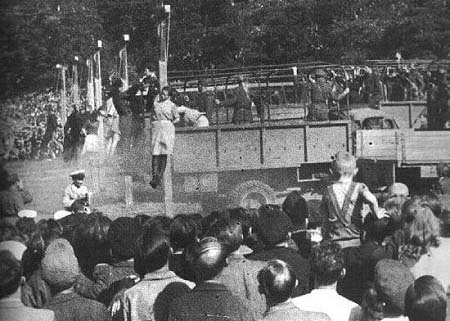
On this date in 1946, officials of Soviet-occupied Poland publicly hanged eleven convicted war criminals of the Stutthof concentration camp.

Set up immediately upon Germany’s September 1, 1939 invasion of Poland and not liberated until after official German capitulation in 1945, Stutthoff handled over 100,000 prisoners during its long service.

This day’s condemned — camp commandant Johann Pauls, five male kapos, and five female guards — were the product of the first of four Stutthof trials held in 1946-1947. At a hill in Gdansk known as Biskupia Gorka (Bishop Hill), upon a specially-erected row of four T-shaped double gallows centered around a pi-shaped triple gallows, and before a crowd of thousands, the doomed eleven were noosed on the back of military trucks which then drove away to leave them strangling to death with a “short drop” hanging.

The following gut-twisting images are among a number to be found here.

Above: on one end of the gallows row, the truck has just pulled away from Jenny Wanda Barkmann — a modish Hamburg lass in her mid-20’s known to Stutthof prisoners as “the Beautiful Specter” for her cruelty. Down the row, one can see that some of the prisoners are already swinging, while others have not yet been dropped.

Upon hearing her sentence, Jenny Barkmann retorted, “Life is indeed a pleasure, and pleasures are usually short.” (More about Barkmann, including trial photos, here.) In this closer view of her, just as in the first photo, she is still alive and struggling. Next to her, Ewa Paradies, another guard, is prepared for the same fate.

The central triple gallows. Commandant Johann Pauls hangs in the middle with Gerda Steinhoff — one of the senior female guards — in the foreground. The line of five male kapos recedes behind them into the enormous crowd of onlookers.

There’s more about Stutthof’s history at the Holocaust Research Project, and at the current memorial facility’s home page.

On this day..