2003: Nobody in Illinois

Six years ago today, a scandal-plagued governor of Illinois cleared out the state’s death row.

Republican George Ryan, in a speech two days before the end of his term, announced a mass commutation for anyone under sentence of death in Illinois — 157 people plus 10 others with pending legal challenges to vacated sentences, and four condemned men pardoned outright.

[flv:https://www.executedtoday.com/video/George_Ryan_clemency_announcement.flv 300 225]

Once a pro-death penalty legislator, Ryan grew increasingly discomfited with the state’s administration of the error-prone ultimate sanction.

That “demon of error” was dramatically unveiled for Ryan by Anthony Porter, a mentally retarded death row inmate who fortuitously avoided execution by two days on a legal technicality, and was subsequently exonerated by Northwestern University journalism students.

Seen as part of a pattern of wrongful convictions — like that of Rolando Cruz, who was cleared in the early 90’s despite the dogged efforts of then-Attorney General (and present-day quasi-Senator) Roland Burris to execute him in the face of exculpatory DNA evidence.

The governor imposed a moratorium on conducting executions for most of his term, culminating with this day’s controversial (though it did score him a Nobel Peace Prize nomination) announcement. Maybe there’s just something in the water at the Springfield governor’s mansion that attracts its residents to impolitic death penalty interventions.

Successor Rod Blagojevich called Ryan’s blanket clemency “a big mistake”, and his formal continuation of the Ryan moratorium on actual executions has been a dead letter since inheriting a vacant death row meant that no capital case reached the end of its appeals on his watch.

For the favor of sparing Blagojevich the burden of handling a death warrant — although one doesn’t get the sense that Blago is the type for a troubled conscience — George Ryan has been unkindly repaid.

Now residing in federal prison on corruption charges, the ex-governor’s own clemency petition has been complicated by sensational allegations of Blagojevich’s graft.

That petition is addressed to an outgoing executive oppositely inclined on the death row commutation question. Ryan authorized one actual execution early in his term, and spared this day’s host; George W. Bush, his virtual mirror image, has issued one commutation and carried out 155 executions during his time as chief executive of Texas and of the United States.

George Ryan is reportedly skeptical of his prospects for receiving a pardon.

On this day..

1934: Marinus van der Lubbe, for the Reichstag fire

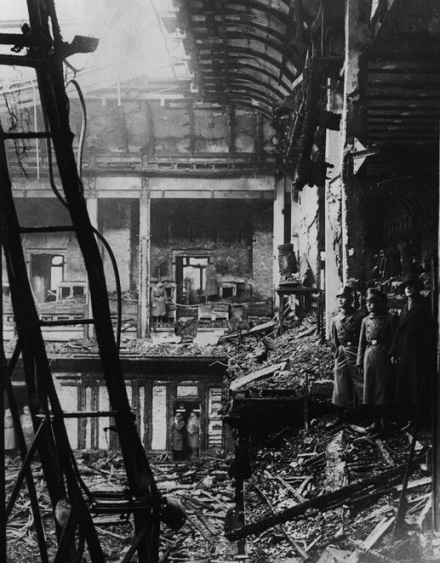
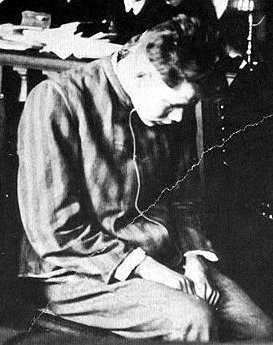
On this date in 1934, Dutch bricklayer Marinus van der Lubbe was beheaded by guillotine in Leipzig for setting the Reichstag Fire.

A watershed event* in the formation of the Nazi dictatorship, the Reichstag fire days before a parliamentary election enabled Hitler to stampede voters, suspend civil liberties, suppress left-wing parties on grounds of a suspected Communist plot, and seize “emergency” powers he would never relinquish.

Heil Hitler.

This clip from an American miniseries on Hitler with the characters chattering in unaccented English portrays the fascists’ opportunistic use of the attack on a national symbol … something not exactly unknown to later generations.

Van der Lubbe, who was arrested on the scene, suffered the predictable fate. Four other Communists charged as accomplices were acquitted, in a trial with the gratifying spectacle of Hermann Goering personally testifying, and being undressed on cross-examination by one of the reds. One is reminded here that Hitler did not yet have everything in the state apparatus at his beck and call … although he did have a great deal already, inasmuch as the arson law under which van der Lubbe died was passed after the Reichstag fire and made retroactive.

If the big-picture outcome of the Reichstag fire is pretty clear-cut, its real origin and the corresponding rightness of the judicial verdicts have remained murky ever since. The fact that the scene of the crime became Nazi ground zero for the next decade sort of obscures the evidence.

Van der Lubbe confessed, so his participation is generally taken as a given.

Whether he was really able to start the blaze acting alone, as he insisted, and the Nazis “only” exploited this fortuitous calamity; whether he was part of a larger leftist plot, as his prosecutors claimed; or whether, as Shirer and many others since have viewed him, he was a patsy in a false flag operation set up by the Nazis with an eye towards creating a politically advantageous national emergency — these possibilities remain very much up for debate.

For what it’s worth, postwar West German courts reversed and un-reversed the sentence before officially rehabilitating van der Lubbe last year on the non-specifically indisputable grounds that the legal machinery brought to bear on the Reichstag fire “enabled breaches of basic conceptions of justice.”

* From Defying Hitler: A Memoir by a writer who would soon emigrate:

I do not see that one can blame the majority of Germans who, in 1933, believed that the Reichstag fire was the work of the Communists. What one can blame them for, and what shows their terrible collective weakness of character … is that this settled the matter. With sheepish submissiveness, the German people accepted that, as a result of the fire, each one of them lost what little personal freedom and dignity was guaranteed by the constitution, as though it followed as a necessary consequence. If the Communists had burned down the Reichstag, it was perfectly in order that the government took “decisive measures”!

Next morning I discussed these matters with a few other Referendars. All of them were very interested in the question of who had committed the crime, and more than one of them hinted that they had doubts about the official version; but none of them saw anything out of the ordinary in the fact that, from now on, one’s telephone would be tapped, one’s letters opened, and one’s desk might be broken into. “I consider it a personal insult,” I said, “that I should be prevented from reading whichever newspaper I wish, because allegedly a Communist set light to the Reichstag. Don’t you?” One of them cheerfully and harmlessly said, “No. Why should I? Did you read Forwards and The Red Flag up to now?”

On this day..

1980: Islamic extremists for the Grand Mosque seizure

At dawn this date in 1980, the kingdom of Saudi Arabia publicly beheaded over 60 Islamic extremists who had seized Mecca’s holy Al-Masjid al-Haram the preceding November — one of the formative and strangely forgotten events in the birth of radical Islam.

Saudi Arabia’s uneven but unmistakable modernization generated friction extending to the royal family itself.

On November 20, 1979, with 100,000-plus pilgrims bustling in Islam’s holiest shrine on the hajj, a few hundred multinational messianic militants took it over with a cache of smuggled firearms.

For two embarrassing weeks, the Saudi government struggled to respond, bumbling a couple of military operations and delicately negotiating the ecclesiastical permission it would require to commit violence within the Grand Mosque. (Strict Moslim prohibitions against same had left the kingdom’s unarmed guards essentially defenseless against the initial takeover.)

In exchange for that fatwa, the House of Saud struck a Faustian bargain: agreeing to roll back secularization and impose strict Islamic law.

The balance of military materiel, of course, would prove to be no contest at all; Riyadh had troops, heavy armament, and now, permission to use them (and to damage the mosque … which they did). Most of the Mahdists were slain in the decisive assault; the survivors* (except for a few who were underage) were publicly beheaded in various cities around Saudi Arabia on this date, including the operation’s leader, Juhayman al-Otaibi.

But their deed — second-tier news at the time in a United States distracted by the Iranian Revolution — would have dramatic long-term repurcussions. Though intimations of deeper bin Laden family involvement** seem sketchy, it certainly appears to have inspired the 22-year-old Osama bin Laden; he soon made his way to fight the Soviets in Afghanistan, a war that began in earnest just days after the end of the siege and to whose prosecution Saudi Arabia and the west would gratefully direct Islamist energies.

Meanwhile, the Saudi government’s pact with the clergy that gained it permission to assail the Grand Mosque saw it subsequently bankroll Wahhabi religious instruction in Saudi Arabia and beyond … arguably the hand that rocked the cradle of present-day Islamic radical movements like al-Qaeda.

Much of what is latterly recalled about this affair by Anglophones comes courtesy of journalist Yaroslav Trofimov’s recent book The Siege of Mecca: The 1979 Uprising at Islam’s Holiest Shrine. (Review | Another | Book home page).

In this clip, the author discusses the legacy of the siege with Fareed Zakaria.

* The Saudi government put out the figure of 63 executions. Some sources now report 67.

On this day..

1864: Two Dodds, as two spies, in two states, and twice botched

On January 8, 1864, young David Owen Dodd was hanged in Little Rock for spying on federal troops … and cavalryman Ephraim Dodd (no known relation) suffered the same fate for the same crime in Knoxville.

Just one of those strange coincidences.

Ephraim Dodd

Ephraim Shelby Dodd is the subject of an outstanding HistoryNet profile whose contents this blog can not so much improve upon as summarize.

A member of Terry’s Texas Rangers (“men who ride like Arabs and fight like devils”) Dodd was captured in December 1863 and convicted by his diary — a particularly harsh reading of his diary in which a reference to having passed himself off as a Yankee was interpreted as evidence of espionage. (The diary is available online and as part of a book on Terry’s Rangers.)

Knoxville worthies rallied to save him and Ephraim Dodd insisted upon his innocence, but not so vociferously that he displayed any terror of his fate.

Do not grieve for me, my dear parents, for I am leaving a world full of crime and sin for one of perfect bliss.

The hanging itself wasn’t bliss, exactly, despite a well-planned soundtrack.

From the “Death March” the music gradually slid into “Mary’s Dream,” and then we were carried back by the magic of the plaintive notes to juvenile days; to visions of “Sandy far at Sea,” and to the sad cadence of that fading refrain,

“When, soft and low, a voice she heard
Saying, Mary, weep no more for me.”

The solemn march, the wailing notes of the fife, and perhaps above all the calm, unmoved, manly bearing of the prisoner — so we thought — produced a mournful impression upon the spectators.

Points earned on artistic merit, however, were deducted for technique.

At a signal the bolt was now withdrawn, the culprit fell, but the cotton rope broke by the sudden tension, and the man lay stretched and stunned upon the frozen ground below. A mummer of horror, mingled with expressions of pity, ran through the assembled crowd. Recovering for an instant from the shock — for his neck was not broken — he said — perhaps incoherently: “Release me quick, if you please.” For some ten minutes the unfortunate man lay thus upon his back, without moving a muscle. Meantime the officers and men, whose painful duty it was to see to the execution of the law, adjusted this time two parts of the same rope instead of one, and the half-conscious man was borne up the fatal steps a second time, being partly supported upon the drop until the double noose had been adjusted. Not a word or sign of suffering all this time escaped his lips. In another moment the drop fell, and prisoner’s form now hung by the neck — the knot behind the head. Death finally ensued by strangulation. In ten minutes, Dr. Cogswell, the officiating surgeon, pronounced life extinct, and the body was taken down and buried.

David Owen Dodd

A few hours later and 500 miles down the way, the entirely unrelated hanging of David Owen Dodd proceeded in Little Rock, Ark.

David Dodd’s final resting place at Mount Holly cemetery. Image courtesy of Richard Theilig.

Only 17 at his hanging and not physically robust enough to get his brains blown out at Gettysburg, Dodd was sent by his father on a business trip across Union lines — everything legit, and carrying a pass — but got busted with morse code notations of Union troop strength in the city.

Unlike Ephraim, who was basically a normal soldier thrust into incriminating-looking circumstances by the chance of war, young David Dodd was rightly accused.

He didn’t bother protesting his innocence, but he also kept mum about his contacts. (Suggestively, a teenage girl and her father were whisked out of town and kept under guard in Vermont for the rest of the war.) That proud silence has won him quite a reputation in Arkansas as the Boy Hero of the Confederacy.

But similarities between the condemned men extended beyond their names. David’s parting filial reassurance could pass for a paraphrase of Ephraim’s.

[D]o not weep for me for I will be better off in heaven. I will soon be out of this world of sorrow and trouble.

And the hanging itself, conducted in a tense atmosphere, was likewise a botched job. In this case, the slight young man didn’t fall hard enough to break his neck, but did fall far enough to get his tiptoes on the ground, initiating an agonizingly protracted strangulation which the soldiers on detail expedited by (accounts differ) pulling on David Dodd’s legs and/or pulling up on the rope.

On this day..

1898: Theodore Durrant, the Demon of the Belfry

The annals of crime will attest that malefaction, like any other history, repeats itself — as tragedy and then as farce and then simply with numbingly grisly monotony.

Which brings us to San Francisco, for another forgotten crime of the century — a theater of the time actually produced a play called Criminal of the Century — that sent the Nancy Graces of the Gilded Age aswoon.

Theodore Durrant‘s basic profile — normal-seeming medical student and Sunday school superintendent with a secret pervy side — might not seem so remarkable with a century’s worth of serial killer profiles in the books, but ponder what programming hours Court TV would fill with mutilated, violated female parishioners found stuffed in the cupboard and belfry at any of the nation’s Emanuel Baptist Churches.

That Durrant was the last person seen with either of them anchored what the Associated Press would call (only a week after the bodies were discovered) a “chain of circumstantial evidence that has been welded link by link … so strong that it seems hardly possible that it can be rent asunder.”

Why,

information poured in … proving that the prisoner was a degenerate of the most depraved class. For obvious reasons, names cannot be given of young ladies to whom he made the most disgusting propositions, and the wonder of it is that he was not killed, or at least exposed before. But in most instances the nature of his insults were such that the young ladies offended feared to inform their relatives, lest they would take the law in their own hands. One young lady told her mother that some time previous to these murders, Durrant had inveigled her into this same library and excusing himself for a moment, returned stark naked and she ran screaming from the church.

The particulars were nationwide news copy from the outset in 1895 to hanging in 1898, and the city had a difficulty scraping together a jury qualified to give the man a fair trial (deliberation time: five minutes).

Durrant, for his part, protested his innocence to the gallows. Few believed him, but he did pick up a married groupie the press nicknamed “Sweet Pea Girl” for the flowers she kept bringing him.*

The more things change …

Even the legal route to hanging was (by 19th century standards) characteristically-for-California tortuous. The “fight for delay,” reported the Los Angeles Times (Jan. 8, 1898), was “vigorously maintained for almost twenty months, not even ceasing with the execution of the death sentence.”

Durrant came within two days of execution twice in 1897; the full narrative of legal maneuvers will be amply suggested by the Times‘ account of those made in the last week alone.

On December 31, an appeal for a writ of supersedeas was made to the State Supreme Court, but was refused. The Federal courts were then vainly appealed to for a writ of habeas corpus. On January 3 a petition was presented to Gov. Budd, praying for executive interference in the case. The petition stated that Durrant was a vital witness in the slander suit brought by his mother against [trial juror Horace] Smyth.**

On January 5 Durrant’s attorneys made another application to the United States court for a writ of habeas corpus. This was denied; also permission to appeal to the United States Supreme Court. On January 6, Attorney Boardman arrived in Washington, and endeavored to persuade Justice Brewer of the Supreme Court to grant permission to an appeal. Justice Brewer declined, and Boardman announced that he would appear before the entire court on Friday and demand to be heard.

In San Francisco on January 6, Attorneys Dickinson and Deuprey asked the United States Circuit Court for leave to file a bill of exceptions. … On the same afternoon, Gov. Budd formally announced that he would not interfere.

Durrant’s beloved sister would change her name to Maud Allan and emerge as a popular dancer in Europe in the early years of the 20th century. Renowned for her sensual portrayal of Salome, Maud strikes an immediate reminder of another character from these grim pages … and like Mata Hari, Durrant’s sister was accused (non-fatally, in Maud’s case) of consorting with German operatives during World War I.

* A paroled murderess also had Durrant’s back.

** According to the story, Smyth publicly called Durrant a “moral monster” and suggested that the condemned had had relations with his mother and sister.

On this day..

1634: Anna Tait, “trublit in conscience”

(Thanks to historian and witchcraft expert Louise Yeoman for this guest post on an obscure and once-forgotten “witch” whose human tragedy all but leaps off the page. This post was originally an article prepared for the National Library’s now-defunct journal Quatro. Her work has appeared in many more high-falutin’ places than this here blog, and she is a co-creator of the Survey of Scottish Witchcraft.)

On the trail of Anna

If you look in Christina Larner’s Sourcebook of Scottish Witchcraft, you won’t find Anna Tait. That’s because she was one of many accused witches whose names were unknown to the compilers of the sourcebook. The details of Anna and almost a hundred others were recorded in a National Library of Scotland Advocates manuscript, which was overlooked many years ago when the huge edition of Scotland’s Privy Council records was in preparation. In the closing years of the last century, the editors of the Privy Council volumes carefully combed the holdings of the National Archives of Scotland for their material. What they didn’t realise was that a single volume of the Register of Commissions for the years 1630-42 had escaped them. In it were hundreds of records of Privy Council commissions to try criminal trials.

In it was Anna Tait.

I first came across Anna and Adv. Ms. 31.3.10 when my friend and fellow researcher Dr Michael Wasser of McGill University, Montreal showed it to me in the Library’s North Reading Room. Michael was (and still is) a historian of crimes of violence in 16th-17th century Scotland, and he was instantly aware of the significance of the manuscript. Almost the first thing he pointed out to me in it was a remarkable story of family tragedy. Out of hundreds of records, this one tale of domestic misery, horror and a woman’s life stood out. It stood out to the clerk who wrote the volume too. A commission is normally a bare record of who is accused of what crime and who is to try them. But the commission to try Anna contained harrowing detail. Almost straight away I agreed to transcribe her commission and to edit it for Scottish History Society. Why was it so remarkable?

Anna Tait ‘alias ‘Hononni’, was in the Scots of the original ‘thrie several times deprehendit putting violent hands to herself at her awne hous,’ in Haddington in 1634. In other words, she was caught trying to kill herself.

In 17th century terms suicide was one of the most heinous acts one could commit. It was like witchcraft, considered to be a particularly odious crime against God’s law and it was punishable by forfeiture of the entire goods of the victim and by a dishonourable burial in unconsecrated ground. What drove Anna to such terrible lengths?

The rest of the commission made the reasons clear. When Anna was apprehended for attempted suicide, she told a terrible tale of adultery, poisoning, domestic murder, unwanted pregnancy, botched home-abortion and death. Here is this part of the commission slightly adapted and with the spelling modernised.

She was for that cause, upon the 18th of December, taken and committed to ward within the tolbooth of the said burgh where being demanded and examined why she put hands to herself, she answered that the intolerable trouble of her mind, which she conceived for the murder of her first husband called John Coltart, nolt driver [cattle drover], and for the murder of her daughter, moved her thereto.

Confessing plainly that about 28 years ago, she being married to the said John, ane aged man, before the marriage she had sundry times committed fornication with William Johnston, her present husband, and that within the time of the marriage she had likewise committed adultery with him. To be quit of her first husband, she consulted with the Devil for his destruction, and that the Devil having directed her to make a drink of foxtrie leaves [foxglove leaves], she did the same, and gave it to her husband to drink who within three hours departed this life.

Concerning her daughter, she confessed that the daughter being with child, and she [Anna] having a purpose to murder the infant in the mother’s belly, at last she consulted with the Devil. He gave her direction to buy wine and to mix it with salt and give it to her daughter to drink, which she having drunken, she shortly thereafter departed this life.

So far, so sadly comprehensible, except for the inclusion of a character whose presence might seem unnecessary to modern readers — The Devil. The Commission finally proceeds ‘upon the 8th of December instant; she had carnal copulation with the Devil in her own bed, and that upon the 11th of December the Devil came to her bedside, gripped her by the hair of her head and did nip her cheek’. Suddenly a classic case of domestic murder and family tragedy is turned to that strangest of all 17th century phenomena to the modern mind: a witchcraft accusation. This was not just a case of three in a marriage, but three plus the Prince of Darkness. However, this wasn’t a strange notion to 17th century people. Where two, three or even just one person were engaged in works of wickedness, it went almost without saying that Satan was somehow present too. Anna was tried not as an adulteress or a murderer but as a witch – the commission was the licence to the magistrates of Haddington to try her, but where was her trial?

Records of such witchcraft trials held in local, rather than central, courts rarely survive. Whilst I was working on the commissions, I happened by chance to be helping someone with a totally different enquiry. Dr John McGavin was researching records of early modern Scottish drama. We discussed his research on poet and minister James Melville and Melville’s account of a dramatic performance in St Andrews. Hearing that John was soon going to be searching through the Haddington Burgh records in the National Register of Archives, I asked him if he would keep an eye out for Anna and any other witches he might happen to spot. To my delight, I soon had an e-mail from John telling me that her trial records were in the Haddington burgh court book.

Researching witchcraft cases can be an intense mixture of horror and delight for a historian. On the one hand to find unexpected light on a unique case is a matter for rejoicing. On the other hand, the details I found in the court book were even grimmer than those of her commission.

Anna had tried several times to hang herself using her own head-dress (her curch). When she was taken into custody, her suicidal behaviours became even more extreme. She attempted suicide again, both by trying to cut her own throat and then ‘when your hands were bound and your feet maid fast in the stocks, no other meanes being left to accomplish your devilishe designes, ye knocked your heid to the wall and stocks, wherby thinking to dispatch your self.’ The court book went into more detail, it claimed that Anna had sex with the Devil in the form of a black man and in the form of the wind and had made a covenant with him. Shape-shifting was a not uncommon piece of Scottish popular belief about Auld Nick, but on top of it were overlaid the sinister assumptions of European theories about demonic pact. One didn’t just meet the Devil according to the demonologists, one had sex with him, took his mark and swore one’s soul away to him. Anna was explicitly accused of all three actions.

The trial also gave more personal information about Anna to add to that from the commission. Taking both sources together we can say a little about her. She had married her first husband John Colthard, the cattle drover, 28 years ago at a place called ‘Furd Kirk’ in England in 1606. Cattle drovers went far afield in the course of their work and Anna had obviously travelled too. Interestingly enough she was accused of having made an appointment to meet the Devil at ‘Ellerslie’. The only places of this name are to be found over in the West of Scotland and not near her home in Lothian. Given 17th century spelling this may also have been the little Lanarkshire village of Elderslie, famed as the birthplace of William Wallace. Whichever it was, Anna’s world clearly stretched well beyond the confines of Haddington.

Age of marriage could be quite late in 17th century Scotland, so Anna was probably about or just under 50 years of age. Her second husband William Johnston was a miller who had lived at Winram, nearby Anna and her first husband. The proximity had assisted their illicit affair. Millers and cattle drovers could be prosperous members of an early modern community, so it is likely that Anna too had some standing in her community to keep up. She was probably very far from the stereotypical portrait of an accused witch as a poor begging woman going door to door looking for alms.

At sometime in her life Anna had acquired the alias ‘Hononni’, a Scottish variant of the English ‘Hey nonny no!’ a popular nonsense refrain in songs. It was an ironically jolly nickname for someone whose life was characterised by murder, tragedy and despair. We find the name of her beloved daughter too –- Elizabeth Johnston who died from the botched abortion. The records of this are chilling

The said Elizabeth, being as ye confessed with child (to whom, few but yourself knows and neither will ye reveal the truth of it), and apparently being loath to let it be known to whom the child belonged, she and ye sought all means to kill, to murther the child in her belly, that it might not come to light who was the father thereof, or how it was gotten, whether in adultery or incest, or what other unlawful way.

To that effect ye consulted with diverse of your confederates fra whom, ye got sundry feall [evil] counsel and by their advice, administered feall drinks to your daughter. But these not doing your turn and all other means failing you, ye went to your old maister the devil … who gave you advise to buy ane mutchkin of white wine, and mix a pint thereof with salt and minister the same unto your daughter, and it would do your turn. The which cruel and devilish counsel ye willingly obeyed and fetched the wine, mixt with the same with salt and gave it to your daughter to drink. By which she presently swelled and shortly thereafter both she and the child died.

In token wherof, you have confessed that the devil gave you as much money in true and real turners [small copper coins] as would buy the said mutchkin of wine and salt. And this deed only of all the devilish and abominable actions has most troubled you, and been the greatest cause of your desire to murder yourself.

In trying to cover up her daughter’s unwanted pregnancy, Anna ended up killing her child. Blaming herself for Elizabeth’s death, Anna no longer wanted to live. She tried repeatedly to kill herself. When it was put to her that the Devil had advised her do all this and that she had become a witch, it seems she barely bothered to defend herself. After all, even though she might have wanted to avoid the shameful death of being strangled and burned at the stake, at least it would have the virtue of ending her life. When the court asked whether she wanted anyone to speak in her defence, she answered ‘none but God in heaven’.

To modern eyes, Anna’s situation seems clear-cut. She had done some terrible things and for very understandable human reasons she wanted to die. Even in 21st century Scotland we would insist that, at the very least, Anna should go to jail for murdering her first husband and that she should be prevented from killing herself. Yet in 21st century Scotland, Anna would have been able to obtain a divorce from her first husband and her daughter would have been able to obtain an abortion (whatever you think of that). So the whole catalogue of tragedy might not have happened at all, or then again, perhaps it might. Was Anna a victim of a society which stacked the cards against women through its interpretation of the Bible or was she the sort of callous person who might have murdered a spouse despite all the advantages of a modern legal system? After all, the murders of spouses still occur. These are questions the historian can only raise and cannot answer.

Even in today’s society, however, a female criminal who had committed crimes of violence comparable to Anna’s would be unusual. To a 17th century society she was such a paragon of horror that the Devil had to be invoked to explain her conduct. In a society which stressed a woman’s subordination to her husband and saw her only rightful adult roles being those of a wife or a mother, Anna was a monster. To her community, she was not only an attempted self-murderer but also an adulteress and the unnatural murderer of her husband, daughter and unborn grandchild. By confessing to witchcraft, she had just about collected the set of the most appalling crimes a 17th century woman could commit. To be regarded with such horror in contemporary society, a woman would probably need to be accused of a string of serious offences against children or young people.

However Anna’s case also raises the question of her mental state and how issues of mental disturbance and suicidal urges were dealt with in her society. Such a suicidal defendant in a modern case might be found unfit to plead, but how did Anna’s contemporaries see her mental distress? Anna was ‘trublit in conscience’ and this points to the beliefs which probably helped to seal her fate. Despair as to whether one was part of the Calvinist ‘Elect’ or whether one was going to hell was a perfectly respectable state in Early Modern Scotland –- even to the extent of repeated suicidal impulses. This can be seen from the diaries, books, letters and sermons of radical Presbyterians and Covenanters. It was a very common phase of the Calvinist conversion experience of the 17th century. Demonic or even suicidal temptations were an almost a normal complication of the road to heaven. To despair over committing terrible sins worthy of hell-fire was not seen as being mentally unstable but as being eminently sane. Any reasonable Bible-believing person might think that way.

So Anna’s despair may have made her seem more culpable, rather than less culpable, to her interrogators whose beliefs would be that in her agony she had done utterly the wrong thing and turned in absolutely the wrong direction. She had, in their minds, turned to the Devil and not to God. Instead of despair proving to be a half-way stage for Anna on the road to conversion and eternal glory, Anna, it seemed by her confession, had failed to choose eternal life and had instead perversely chosen the ultimate dead-end: Hell. This was an offence made all the more horrible, as heaven in its Calvinist form, was no doubt being held out to her every Sabbath in their local church. Perhaps the reason it was necessary to punish the despairing so emphatically was pour encourager les autres; to make sure that when people experienced despair, they would in the Church’s eyes make the right choice: that they would resist the temptation and intensify their piety until the threat was overcome.

Faced with the reality of burning large numbers of accused witches amongst whom they found the suicidal and the mentally disturbed, later generations of Scottish Privy Councillors increasingly doubted the wisdom of this approach. In 1662 in the midst of a nation-wide witch-panic the council issued commissions under strict orders that to proceed with executing a convicted witch, it must be found that ‘At the tyme of their confessions they were of right judgement, nowayes distracted or under any earnest desyre to die’. Almost 30 years after Anna’s death, Scotland’s elite were becoming sensitive to the issue of attempted suicide by witch-confession and the mental state of the accused. It came much too late to affect Anna and because of her murder confession wouldn’t have saved her anyway, but it shows a little how things moved on even in that relatively short time frame. For Anna there could only be one ending — execution. Because she had confessed she was not burnt alive [burning alive tended to be reserved for those who died ‘impenitent’ ie. they refused to confess]. Her sentence was as follows:

It was given for doom [sentence] by the mouth of William Sinclair dempster [pronouncer of sentence] that the said Anna Tait should be taken, her hands bound behind her back and conveyed by William Allot, lockman [executioner] of Haddington to the ordinary place of execution, and there wirried [strangled] to the death at ane post and thereafter her body to be burnt in ashes, desuper act.

Note on sources

The commission for Anna’s trial is edited from Adv.Ms.31.3.10, f.102v. Her trial records may be found in National Archives of Scotland, Haddington Burgh Court Register B30/10/13, fos.24r-26v. A calendar of the witchcraft commissions in Adv. Ms 31.3.10 (including transcriptions of Anna Tait’s commission and her trial records) has been prepared by the author for Julian Goodare (ed.), Miscellany XIII, Scottish History Society, forthcoming.

On this day..

1527: Felix Manz, the first Anabaptist martyr

On this date in 1527, Anabaptist Felix Manz was trussed hand and foot and shoved into the Limmat in Zurich — the first martyr of the Radical Reformation.

As the Protestant Reformation made theologians of everyone without a concomitant social embrace of religious pluralism, it wasn’t long before men who would have been fire-eating heretics in Catholic eyes a decade before were turning their swords on one another for deviation from their own new orthodoxies.

As the Martyrs Mirror put it,

this was also the century in which Luther in Germany, Zwingli in Switzerland, and afterwards Calvin in France, began to reform the Roman church; and to deny, oppose and contend with the authority of God’s holy Word against the supposed power of the Roman Pope, and many papal superstitions, however, in order to avoid too great dissatisfaction, as it seems, they remained in the matter of infant baptism, in agreement with the Roman church

They also have retained with the papists, the swearing of oaths, the office of secular authority, war against enemies, and sometimes also against each other, etc.

In Zurich, former Zwingli follower Felix Manz (sometimes spelled Felix Mantz) co-founded a splinter group of Anabaptists and picked a fight with city hall over adult vs. infant baptism.

Zwingli has been dinged by many a true believer then and now for his compromises, but the man had a city to run and better reason to worry about the movements of nearby Catholic armies than an endless disputation over baptism. When the city had had enough, it declared drowning for adult baptism (“rebaptism,” to its opponents). Water for water, see?

Manz got first in line. (He wouldn’t be the last.)

Zwingli’s eventual successor recorded the scene.

As he came down from the Wellenberg to the fish market and was led through the shambles to the boat, he praised God that he was about to die for His truth. For Anabaptism was right, and founded on the Word of God, and Christ had foretold that His followers would suffer for the truth’s sake. And the like discourse he urged much, contradicting the preacher who attended him. On the way his mother and brother came to him, and exhorted him to be stedfast; and he persevered in his folly, even to the end. When he was bound upon the hurdle, and was about to be thrown into the stream by the executioner, he sang with a loud voice: “In manus Tuas, Domine, commendo spiritum meum.” (“Into Thy hands, O Lord, I commend my spirit.”) And herewith was he drawn into the water by the executioner, and drowned.


Felix Manz drowned in the Limmat.

If this dispute seems rather shallow cause for spilling human blood, it’s part of a fathomless theological debate only now becoming water — ahem — under the bridge.

On this day..

1946: The treacherous Theodore Schurch

One day after William Joyce became the last Briton put to death for treason, 27-year-old Theodore Schurch hanged for treachery at London’s Pentonville Prison.

Like Joyce, Schurch had enrolled in the British Union of Fascists as a teenager in the 1930’s, and it was reputedly at the party’s direction that he joined the army as a driver.

During World War II, Schurch crossed and recrossed enemy lines, delivering operational intelligence to the Italians and Germans by helping to interrogate prisoners of war, or posing as a P.O.W. himself to gain the confidences of other captured Allied soldiers.

Scurch’s army buddies seemed to think he was alright, and there was probably more than a shred of truth to the defense’s contention, paraphrased by the London Times (September 18, 1945), that the lad

was a poor, uneducated fool who was caught young [by fascist ideology] when he knew no better and jockeyed into a position from which he could not recover.

But obviously, one makes this argument when one is in no position to contest factually the capital charges against oneself, and indeed has admitted much of it. Schurch was convicted on all nine counts of treachery, plus one of desertion. Not a big fish, maybe — but just the right size to become the last man hanged in Britain for a crime other than murder.

He’s actually listed as a war casualty, which in a way he was, on the Commonwealth War Graves Commission’s Brookwood Memorial outside of London.

On this day..

1946: William Joyce, Lord Haw-Haw

On this date in 1946, fascist William Joyce, famous by the nickname “Lord Haw-Haw” for his English-language Nazi propaganda broadcasts, was hanged at Wandsworth Prison for treason.

As a pugilistic young anti-Semite with the unusual credential of being a Unionist Irish Catholic, Joyce had been a moving spirit in the interwar British fascist party. (Since audio broadcasts would define Joyce’s life, it seems appropriate to refer the reader for a fuller biography to this recent Oxford biography podcast.)

But because time loves a good laugh, it had the guy haranguing his countrymen for insufficient patriotism marked out for the last treason execution in British history, and unrepentant about it by the time he got there.

The Brooklyn-born Joyce (he never lost his American citizenship) who naturalized as a German in 1940 had a rather tenuous claim on the patriotic high horse to begin with, and after the war, that meant the treason charge proceeded on legally doubtful grounds: speaking the King’s English didn’t mean he owed allegiance to the king. Prosecutors ultimately hung him with a British passport he’d obtained fraudulently, and the legal principle has never since sat well with jurists.

It was just the tool at hand. The British government really hated the guy.*

However limited the resources at his disposal — sparse intelligence, paltry staff, and of course, after 1942, a disastrously collapsing war effort — he had fashioned them into broadcast spin to twist the British lion’s tail in countless British homes throughout the war.

Here’s one episode, with Joyce savaging Winston Churchill, selected from archive.org’s library of Joyce broadcasts (1-7, 8-16, 17-23).

[audio:William_Joyce_Churchill.mp3]

Joyce’s star shone brightest and his invective cut deepest early in the war. Once everything at the front stopped coming up Teutons, he descended into irrelevance and self-parody, albeit without professing the slightest doubt in his fascist convictions.

This last broadcast, prepared just a few days before Germany capitulated, has our day’s principal ramblingly drunkenly from the besieged Nazi capital.

[audio:William_Joyce_final_broadcast.mp3]

Content-wise, not much had changed eight months later, but at least he managed to make his gallows statement coherently.

In death as in life, I defy the Jews who caused this last war, and I defy the power of darkness which they represent. I warn the British people against the crushing imperialism of the Soviet Union. May Britain be great once again and the hour of the greatest danger in the West may the standard be raised from the dust, crowned with the words — you have conquered nevertheless. I am proud to die for my ideals and I am sorry for the sons of Britain who have died without knowing why.

There’s a thorough, and lavishly illustrated, history of Joyce here.

* Authorities passed on prosecuting his wife Margaret, who’d also appeared on some Lord Haw-Haw broadcasts. Under the circumstances, Joyce’s daughter (by his first marriage) Heather Iandolo turned out pretty balanced.

On this day..

1994: Mansour Kikhia?

Fifteen years ago, a Libyan-born dissident of American nationality was abducted from a human rights conference in Cairo.

The fate or current whereabouts of Mansour Kikhia remain unknown to this day — although one widely-suspected scenario (and the conclusion of a CIA report on the incident) is that he was spirited to Libya and secretly executed early in 1994.

While other speculation has had Kikhia being held alive, the insulin-dependent diabetic would have been in a bad way absent the sort of painstaking medical attention he would not likely have been receiving from his captors.

The former Libyan foreign minister and United Nations ambassador, who had broken with dictator Muammar al-Gaddafi in 1980, was in Egypt to participate in an Arab Organization of Human Rights conference. The date he vanished from his hotel, last seen in the company of unknown Egyptian men driving vehicles with Mukhabarat markings, was December 10, 1993 — the 45th anniversary of the seminal modern human rights document, the Universal Declaration of Human Rights.

Several distinguished Middle Eastern scholars wrote an open letter shortly after Kikhia’s disappearance imploring

Arabs, Americans with an interest in the Arab world and human rights organizations not to rest until he regains his freedom. Nothing could be worse than to let the governments concerned think he will be forgotten.

If not “forgotten” in the strictest sense — see some links of the bulletins issued over the years to keep alive his memory — the governments concerned sure seem to have paid no price for having disappeared Mansour Kikhia.

On this day..