1908: John Boyd, by John Radclive

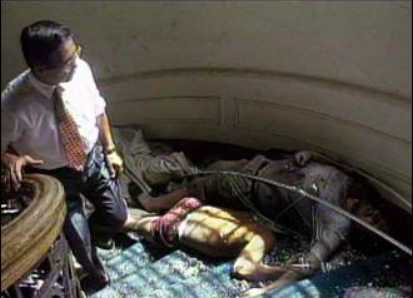
On this date in 1908, John Boyd managed six fitful hours of sleep, had a breakfast of toast, poached eggs and tea, and then went to the Don Jail gallows for murdering his paramour’s rival suitor.

Canada had long before ceased public executions. Prior to Boyd’s execution, Don Jail hangings had occurred in a jail yard — technically behind prison walls, but easily peeped upon by curiosity-seekers willing to obtain higher ground. Boyd’s execution introduced a new privacy measure: it was the first of 26 hangings to occur in an interior chamber completely away from public eyes, the same place where Canada eventually held its last hangings in 1962.

But apart from this minor milestone, we notice on this date the hurried and disturbed departure of prolific hangman John Radclive. “Another poor soul gone,” he was overheard to say as he left.

Radclive is the subject of an empathetic Toronto Star profile that’s well worth the read.

He was Canada’s first professional hangman, with 69 recorded executions and perhaps just as many which the uneven documentation of the day failed to note. Predecessor of the better-known Arthur Ellis, Radclive learned his trade direct from William Marwood, and was put on the federal payroll as a full-time executioner in 1892.

He had a swagger in his ill-starred step back then: he once started a brawl boasting in a pub that he had “come to hang a Frenchman, and hoped it would not be the last.” By the time he got to Boyd and beyond, he was ready for the last. Alcoholism had wasted his nerves (and his liver: he died of cirrhosis in 1911). In 1910 Radclive told a psychiatrist,

“Now at night when I lie down, I start up with a roar as victim after victim comes up before me. I can see them on the trap, waiting a second before they meet their Maker. They haunt me and taunt me until I am nearly crazy with an unearthly fear.”

On this day..

1612: John Selman, Christmas cutpurse

400th death-day congratulations go to John Selman, a brass-balled nimblefingers who was hanged on this date in 1612 for stealing … at Whitehall … on Christmas … in the presence of the king. And, Selman himself added in his scaffold confessional, “in the time of divine Service, and the celebration of the Sacred Communion.” That’s like hitting for Stuart England’s malefaction cycle.

This common thief had tried to blend among the ermine-clad set at church with a black-velvet cloak getup, but drawn enough suspicion to be nabbed with a 40-shilling purse he’d brazenly boosted from a nobleman‘s retainer.

Francis Bacon, one of Selman’s judges, affected a suitably hyperbolic indignation at the effrontery of it all: “The first and greatest sinne that ever was committed was done in Heaven. The second was done in Paadise, being Heaven upon Earth, and truly I cannot chuse but place this in the third ranke.” Tens of thousands of human beings in the judge’s immediate ambit — England, Europe — had been slaughtering one another to the glory of God for the past century when Bacon said that. He’d surely give Nancy Grace a run for her money.

Then as now crime moved copy, and if the realm’s lord magistrates were ready to measure this guy up against Beelzebub, one can readily imagine the woodblock tweets he sent a-flying among the hoi polloi. Selman’s audacious escapade relieved his last days’ dread with the gift of celebrity. Writers scrambled to churn out Selman-tinged copy, like these inevitable ballads.

With hands and eyes to heaven,
all did in reverence stand:
While I in mischife used mine eye,
and my accursed hand,
Now was my mischiefe ripe.
my villanyes full growne,
And now the God in secret knew it.
did make it open knowne.

Hopefully God got a cut of the action from these writers. Talk about a Christmas gift for a scribe.

No less a personage than Ben Jonson hastily wrote Selman into his Twelfth Night masque Love Restored as “the Christmas Cutpurse”: this debuted the same night the real Selman made his last peace with God and man awaiting the next day’s hanging on the road to Charing Cross. (After all this Christmas reverence, they piously held off on the hanging until the full twelve days of Christmas had elapsed.)

Selman’s 15 minutes apparently took years to run, because Jonson went back to the same inspiration for 1614’s Bartholomew Fair — perhaps basing the character of Ezekiel Edgworth on Selman.

At playes and at sermons and at the Sessions,
‘Tis daily their practice such booty to make;
Yea under the gallows, at executions,
They stick not the stare-abouts’ purses to take;
Nay, one without grace, at a better place,
At Court, and in Christmas, before the Kings face.
Alack then for pitty! must I bear the curse,
That only belongs to the cunning Cut-purse?
Youth, youth you hadst better been starv’d by thy nurse,
Than live to be hang’d for cutting as purse.

“A Caveat for Cutpurses” from Bartholomew Fair

Jonson sure got that right: under Selman’s own gallows-tree this day, “one of his quality (a picke-pocket I meane) even at his execution, grew master of a true mans purse, who being presently taken, was imprisoned, and is like the next sessions to wander the long voiage after his grand Captaine Mounsier Iohn Selman.”

On this day..

1989: Kehar Singh and Satwant Singh, assassins of Indira Gandhi

On this date in 1989, the last hangings at Delhi’s Tihar Jail dispatched two Sikhs for the assassination of Indira Gandhi.

Indira Gandhi (no relation to Mahatma Gandhi) was the daughter and political heir of Jawaharlal Nehru and one of the postwar world’s more remarkable political biographies.

Never averse to breaking a few eggs, Gandhi led her country (sometimes autocratically) for four terms from 1966 to 1984, sandwiched around a stint under a legal cloud for political corruption.

She backed East Pakistan’s breakaway from India’s neighbor and rival, but also negotiated a Kashmir settlement with her Pakistani opposite number; oversaw the Green Revolution; pushed ahead with a nuclear weapons program; maneuvered between American and Soviet foreign policy.

The omelet that cost her life was the June 1984 Operation Blue Star, when she had the Indian military storm a Sikh shrine that armed militants had turned into a virtual fortress, even using tanks and artillery in the shrine’s residential area.

Although the operation “worked,” hundreds — maybe a thousand or more — lost their lives and the shrine itself suffered heavy damage.

Sikhs were incensed — including, apparently, Beant Singh and Satwant Singh, two Sikh bodyguards of the Prime Minister who probably ought to have been reassigned. Maybe that’s just hindsight speaking, after they took the opportunity afforded by an escort assignment on Halloween 1984 to suddenly gun down their charge.

Beant Singh was shot down on the spot by other guards, but Satwant Singh was arrested.

He and Beant Singh’s uncle and alleged inciter Kehar Singh would later stand trial for their lives — but not before the assassination triggered an apparently government-blessed four-day anti-Sikh pogrom. The disturbing orchestration and four-figure body count of this infamous affair remain sensitive subjects on the subcontinent to this day, especially insofar as nobody has ever been punished for it.

The accused assassins were not so lucky — although they were more than content to accept martyrdom for avenging Operation Blue Star.

I have no hatred for any Hindu, Muslim, Christian, neither hatred for any religion. After my Shaheedi, let no Sikh throw any rock at any Hindu. I am not in favor of any retaliation or bloodshed over my Shaheedi. If we do create bloodshed, then there is no difference between us and Rajiv Gandhi. I am proud of the task that I did! I do ardas in front of Waheguru! If I am blessed with a human life, then give me a death of the brave when I am hanged. Forget one life, if I could I would give up a thousand lives to kill dushts like Indira Gandhi, and laugh as I become Shaheed by hanging.

Satwant Singh in court

The killers were then and are still held in high regard by many Sikhs. (Satwant’s fiancee even married his picture.)

Indira Gandhi’s son Rajiv Gandhi followed her as head of state — and followed her fate when he was assassinated by Tamil terrorists in 1991. The Nehru-Gandhi family remains a powerful force in Indian politics.

On this day..

1638: Four Frenchmen in effigy

We have touched in the past on the odd practice of executing effigies of criminals, a custom for which France had a particular penchant.

On this date in 1638, mannequins of Andre Armand, Gabriel Bonnaud, Sebastien Mareschal, and Simon Armand were “hanged” for murder.

As described in this French text, proceedings were delayed when, the previous November, the wife and mother-in-law of one of the absconded offenders appealed the sentence in their own inimitable way: by vandalizing the mannequins.

Thanks to Sonechka for deciphering the archaic French.

On this day..

2011: Ryu Kyong, Kim Jong-un rival

Sometime in early January — nobody seems to know quite when — North Korean intelligence official Ryu Kyong disappeared, apparently executed.

The number two man, and perhaps de facto number one man, in the State Security Department and a longtime Kim Jon-il ally, Ryu was reportedly “summoned by Kim Jong-il in early January and on his way to Kim’s residence, was arrested by members of the General Guard Bureau. He was interrogated and secretly executed.”

Speculative reason: the Leader viewed Ryu as having grown too powerful, and therefore as a potential rival to a clean succession for Kim Jong-un.

“With Ryu, many others were purged at the State Security Department,” a Seoul analyst said. “We can say that as he gained control of the department, Kim Jong-un needed to give jobs to people loyal to him.”

On this day..

2011: Two leaflet-readers

South Korean activists have in recent years taken to balloon-lifting propaganda leaflets over the DMZ into North Korea — including on the occasion of the recent leadership succession.

North Korea is not amused by this tactic and has pressured — and even militarily threatened — South Korea to clamp down on it. But that’s nothing next to the clampdown within North Korea.

On this date in 2011, according to an activist whose father is a North Korea abductee, two were publicly shot for the crime of handling these leaflets.

An army officer who pocketed dollar bills enclosed with the leaflets was shot along with a 45-year-old woman who concealed one of the flyers, said Choi Sung-Yong.

He said the executions were carried out on January 3 at Sariwon, 45 kilometres (27 miles) south of Pyongyang, in front of 500 spectators following a special ideological session on the leaflets.

Choi, citing a source in Sariwon, told AFP that six members of the victims’ families had been sent to a camp for political prisoners.

“North Korea apparently carried out the executions to teach a lesson to its people,” Choi said.

He said the regime appeared to have tightened ideological control as it grooms the youngest son of leader Kim Jong-Il as eventual successor to his father.

Those dollar bills that cost the army officer his life are, very sadly, enclosed with some leaflets to induce North Koreans to pick them up despite the risk to life and limb.

On this day..

Daily Double: The Path to Power in Pyongyang

With the death a few weeks ago of North Korea dictator Kim Jong-il, his son Kim Jong-un “inherits great comrade Kim Jong-il’s ideology, leadership, character, virtues, grit and courage” and, of course, power.

While North Korea is notoriously opaque when it comes to reading the political tea leaves, it’s at least arguable that Kim Jong-un’s path to power has been set up over the preceding months by a flurry of executions.

For our next two posts, we note two whose politics were wrong enough to die this time last year.

On this day..

10 executions that defined the 1990s

Hindsight is this blog‘s whole milieu, so even though our reactions are now conditioned by an intervening decade, we’re pleased to follow up our popular “10 executions that defined the 2000s” post with this retrospective on the 1990s. Hey, what could go wrong with a prequel?

We take you back to the days before Y2K. Communism had fallen, violent nationalism was back in style, a self-styled “hyperpower” went all-in on neoliberalism, and a little thing we call the Internet began minting increasingly preposterous millionaires. As always, the world’s hangmen, headsmen, triggermen and, increasingly, plunger-pushers just kept plugging away at yesteryear’s harvest of evildoers (or good-doers).

Whatever else it may have left the world, it certainly left a decade’s worth of noteworthy executions.

10. Zarmina

This secretly-filmed video of a woman being shot through the head in a Kabul stadium in 1999 generated worldwide disgust with the Taliban.

9. Chen Chin-hsing

Author of a crime spree that captivated and terrified a nation, Chen (with two accomplices who didn’t live to face the courts) “shook public confidence in law and government with the kidnap-murder of a TV celebrity’s daughter and a string of subsequent gun battles, killings, rapes and a hostage drama.” (Don’t forget about the underground plastic surgery!) His deadly seven months on the very public lam toppled the Taiwanese government and created one of the world’s highest-profile pro-death penalty activists.

8. The Tupac Amaru rebels

This dwindling band of softhearted leftist guerrillas took the Japanese embassy in Lima hostage for 126 days. Then-Peruvian strongman (today, Peruvian prisoner) Alberto Fujimori had the embassy taken by storm — and the rebels all shot on the spot.

7. Farzad Bazoft

Reporter for the London Observer hanged as a spy in Saddam Hussein‘s Iraq for sniffing around its weapons programs. A few months later, Iraq invaded Kuwait and western protests — somewhat pro forma in the moment, since Iraq was still an ally — suddenly became very explosive.

6. Ricky Ray Rector

Trying to shed his party’s soft-on-crime image, then-Arkansas Gov. Bill Clinton burnished his hip conservative-Democrat credentials by leaving the presidential campaign trail to oversee Rector’s execution personally — even though the cop-killer, lobotomized by a suicide attempt, famously saved the pie from his last meal to finish “later”.

As president, Clinton made good on the promise implicit in this execution.

5. Andrei Chikatilo

This infamous Ukrainian madman’s decade-long spree of sexual savagery was notoriously abetted by clumsy police work paralyzed of admitting a serial killer in the waning days of the Soviet workers’ republic.

4. Rosalie Gicanda

Revered Tutsi Queen Dowager whose summary execution with her ladies-in-waiting at the onset of the Rwanda genocide signaled that nobody was safe.

3. Ken Saro-Wiwa

“The ecological war that the Company has waged in the Delta will be called to question sooner than later and the crimes of that war be duly punished. The crime of the Company’s dirty wars against the Ogoni people will also be punished.” This Ogoni artist and activist remains a potent emblem long after he was hanged by the Nigerian dictatorship for the security of Shell’s oil fields.

2. Mohammed Najibullah

The man at the very hinge of the post-Cold War world, this last of the Soviet-backed Afghan rulers was hauled out of a U.N. compound and lynched on a traffic pylon by the conquering Taliban.

1. Srebrenica

The most dread name from the post-Yugoslavia dirty wars is that of the town where Ratko Mladic’s Serbian army slaughtered 8,000 Bosnian Muslims in July 1995.


Honorable Mentions

A few other executions to remember the 1990s by…

On this day..

1916: Sergeant John Robins, before evacuating Gallipoli

On this date in 1916, Sergeant John Robins of the 5th Battalion, Wiltshire Regiment — demoted for the occasion to Private — was shot “at a point on the beach 400 yards North of the mouth of the Gully Ravine” for disobeying orders.

This redundantly named topography was a feature of an ill-starred (for the British) peninsula Robins’s army was quite ready to see the back of: Gallipoli.*

Winston Churchill’s brainchild for a knockout punch in the First World War had long since come to grief — the enduring grief of the British, Australian, and New Zealand troops who died by the thousands under Ottoman guns whilst attempting to seize the Dardanelles, open the Black Sea, knock the Turks out of the war, and expose the Central Powers’ soft underbelly.

It didn’t do any of those things, but it did help Mel Gibson’s career.

The first days of 1916 were the very last days of the Gallipoli campaign, by which time the object was just to get out.

Actually, the invaders’ positions had been steadily, stealthily evacuated over the preceding weeks — successfully slipping away without alerting the Ottomans to the opportunity for a turkey shoot. The evacuation, at least, was a triumph.

Sergeant Robins was a part of this hot mess; he’d once had to flee from his bed when the Turks surprised his camp and overran it. But it didn’t seem to be jangled nerves that did him in so much as the everyday infirmity of the flesh.

By December 1915, a quarter of his unit was laid up on the sick rolls, but when Robins begged off a patrol assignment for unwellness, the powers that be didn’t reckon him among the legions of ill — but court-martialed him for refusing an order. A rather stunned Robins attempted to explain:

On the night in question I was not well enough to go out. I was eight and a half years in India where I suffered a good deal from fever and ague, and I still get fits of this. I had been suffering from this for several days off and on, and the wet weather had greatly affected me. I have been out here for nearly five months and this is the first trouble I have ever been in. I have always done my duty. This would not have happened if I had been quite well. At the time I did not realise the seriousness of what I did.

He realised the seriousness when he was shot at 8 a.m. on January 2, 1916. A week later, his unit — all his countrymen’s units — were out of Gallipoli.

On this day..

1943: Rosanna and Daniel Phillips

Executions on New Year’s Day have not been unheard-of in U.S. history, but it’s been Auld Lang Syne since the last such event — a North Carolina double-gassing on this date in 1943.

The previous year, January 1, 1942, had seen the Tar Heel state host the Rose Bowl at Duke University’s stadium: that was just 25 days after Pearl Harbor, and the California coast was considered a potential target. With war in the Pacific trending America’s way, however, the tournament of Roses — although still not the associated parade — was back in Pasadena on New Year’s 1943. So instead, North Carolina did this.*

Daniel and Rosanna Phillips, black sharecroppers, died consecutively in the Raleigh Central Prison gas chamber for the ax murder of their farm owner a mere five months before.

This laboring couple, lovers living out of wedlock (they married after the murder), seem to have had a violent relationship with one another; their 13-hour trial would feature the defendants’ mutual recriminations of black magic, and allegations by each that the other one was the real killer. (Theft appears to have been the motive.)

(The lengthiest accessible summary of this case that I’ve been able to find is in this pdf of a lengthy journal article, “Black Female Executions in Historical Context” (scroll all the way to p. 77).)

The U.P. wire report (as run in the New York Times, Jan. 2, 1943) says that the pair forgave each other by the end. Still, Daniel was gassed first “at the request of the State Parole Commission, on the possibility that he might make a last-minute statement exonerating his wife,” which would have spared Rosanna. One wonders if she was still in a forgiving mood when she found out that he hadn’t breathed the word that might save her.

At least some newsmen also reported a malfunction in the chair’s cyanide-dropping rack for Rosanna’s execution, which required guards to re-open the chamber after its strapped and hooded subject had been sealed in, and putz about the mechanism while she waited.

* Actual reason to do this on New Year’s Day: the mere happenstance of automatically scheduling execution dates a set number of days after the defendants’ last appeal failed.

On this day..