2013: Xia Junfeng, chengguan slayer

China has announced the execution this day of “homicide criminal” Xia Junfeng, a kebab vendor from Shenyang.

This case has been in the public eye for several years, and the predominant sentiment has been sympathetic towards the condemned man.

Xia and his wife Zhang Jing were part of China’s vast population of working urban poor, Xia having found his way into job insecurity by virtue of a layoff from the state electricity company. In the entrepreneurial spirit of the age, Xia started up an unlicensed business selling sausages and the like.

These denizens of the gray economy are, as a class, afflicted by the attentions of the City Urban Administrative and Law Enforcement Bureau, better known as the chengguan. Their benign job description entails administering municipal regulations, but this much-loathed force’s relationship to everyday citizens is perhaps best illustrated by the word chengguan‘s status as a shorthand neologism for bullying and abuse. Too many people know this goon squad firsthand, and too many stories of their worst excesses have circulated. Just this past July, the chengguan made headlines by killing a watermelon vendor.

“Chengguan abuses are an open scandal in China,” said Human Rights Watch’s China director. “The chengguan’s ability to flout China’s laws and inflict harm on members of the public is a recipe for greater public resentment and more violent confrontations.”

In the violent confrontation at issue in today’s execution, the chengguan chengguanned Xia Junfeng in May 2009. Xia fought back with his meat-carving knife, and slew two of his tormenters.

Death penalty cases redolent of the social stratification and institutional corruption that ordinary Chinese people experience have proven to be lightning rods in recent years.

Xia Junfeng’s turned, legally, on his claim that he killed protecting himself from the chengguan‘s beating.*

“Extralegal violence, thus employed to compensate for inadequate regulation and an absence of authority and legal deterrence, is no longer individual behavior. Such violence exists everywhere with the permission of the authorities. It is needed because of an overriding concern for “city image” and “urban management.” Finally, when extralegal violence is not monitored by the people and the media, and not punished by the law, it is only natural for Chengguan members to feel justified. Using violence with impunity enables the Chengguans to see violence psychologically as their “privilege,” a sign of status and pride. Since the legal and political status of Chengguan is unclear, it is only natural for its members to seek personal gain, vent their anger, and prey on the citizens they were intended to protect.”

-from the closing argument of Xia’s defense attorney

This allegation didn’t fly in court, where brother chengguan denied that they’d been abusing the shishkebaber, but it’s won in a rout when it comes to the court of public opinion. “His life and death are more than just a legal matter, but a bellwether of the era, with the tsunami-like public opinion firmly on the side of Xia Junfeng,” wrote author Yi Chen today.

Particularly galling for many is the disparity in treatment between Xia Junfeng and the likes of Gu Kailai, the latter a powerful business and political figure who was able to avoid execution despite being convicted of a scandalous contract murder. And Chengguan themselves never seem to be at risk of harsh punishment for any misbehavior; had Xia Junfeng been the one to leave that confrontation in a body bag, there certainly wouldn’t have been a death penalty case.


Anonymous cartoon circulated on Weibo criticizing Xia Junfeng’s condemnation. (Via) The drawing of the boy in the background was done by Xia’s son, whose art school fees were earned by his father’s roadside business.

Chinese speakers might want to peruse the Weibo feed of Xia’s widow.

* Several years ago, self-defense helped a Beijing migrat worker avoid execution for killing a chengguan who attempted to confiscate his bicycle cart.

On this day..

1537: Jurgen Wullenwever, Burgermeister of Lubeck

On this date in 1537, Jürgen Wullenwever was decapitated and quartered at Wolfenbüttel.

Photo by Agnete (Own work) [GFDL (http://www.gnu.org/copyleft/fdl.html) or CC-BY-SA-3.0 (http://creativecommons.org/licenses/by-sa/3.0)], via Wikimedia Commons

Wullenwever (English Wikipedia entry | German) was a merchant from Hamburg who came to the fore of a popular Lutheran movement in the Hanseatic port of Lübeck that claimed the power of its old aristocratic council for the city’s burghers.

In this capacity, Wullenwever maneuvered — vainly as it turned out — to arrest the century-long wane of the city’s influence. Lubeck in its day had been “the Queen of the Hanseatic League”. Come 16th century, it was struggling to maintain its trading preeminence against the inroads of Dutch merchants and the fragmentation of the once-mighty Hanse.

This project was doomed in its conception — there was nothing Lubeck could really have done to hold back the historical developments happening around it — and bungled in its execution. The merchant magnates of Wullenwever’s democratic coalition grew suspicious of (too-)popular religiosity.

And Wullenwever’s political high-wire act involved arrangements of convenience with the Anabaptist commune of Münster — spurring rumors of his own radical baptist conversion* — and fomenting Catholic peasant uprisings to meddle in the succession of the Danish-Swedish crown. Whatever else one could say of him, one can’t fault him for a want of daring, a quality that stood him in good stead with romantic era writers.

But Wullenwever’s allies lost their fights, and the political coalition that supported his municipal leadership soon broke up under the pressure of events.

The aristocratic party re-took power in 1535 and didn’t immediately persecute Wullenwever. But the hostile Archbishop of Bremen eventually seized the man on his territory and turned him over to a Catholic Saxon duke for punishment.

* I’m certainly not a specialist, but I’m skeptical of the claim in some sources that Wullenwever was an Anabaptist Manchurian candidate type. Wullenwever confessed to a great Anabaptist scheme … but that was under torture of enemies determined to do him to death, and it was retracted before his execution. The claim implies that all of northern Germany might have gone over to a radically democratic Anabaptism had not the ancien regime overthrown the Burgermeister, and for that reason it’s gained Wullenwever the surprising latter-day embrace of nationalists and revolutionaries.

On this day..

1884: Two Pennsylvania murderers

On this date in 1884, Joseph Sarver was hanged as a parricide at Indiana, Pennsylvania.

Sarver became enraged by his father’s affair with their housekeeper Mary Kelley, and shot the father dead in his doorway. (He also shot Mary Kelley; she survived.)

As if the parricide rap wasn’t enough to get the blood up, he “greatly intensified the popular feeling against him” by behaving after his arrest like an all-around jerk. Sarver reportedly fought with jailers over the timeliness of his breakfast, made merry in prison, and blithely boasted that “they could never hang him because he was a Democrat, and so was Governor Pattison.” (St. Louis Globe-Democrat, Nov. 14, 1883; Galveston Daily News, same date. It made the national crime blotter.)

He eventually made a full confession, and was said to have died firmly.


Executed on the same date in Cambria County, Penn., Michael Murray “dictated a letter, to be made public after his death, in which he charged that certain persons, possessing the powers of witchcraft, had exercised a spell over him, and while under its influence, he committed the deed.” The deed created by this sorcery was shooting a man on the Pittsburgh turnpike who called Murray a name.

On this day..

1909: Les Chauffeurs de la Drome

At daybreak this date in 1909, three French rural bandits dubbed “Les Chauffeurs de la Drôme” were publicly guillotined in Valence to the hurrahs of a great crowd.

Most of the (plentiful) information online about these charmers is in French; in their day about 1905 to 1908 they enjoyed quite a lot of notoriety in southern France for their bloody crime spree, comprising at least 11 murders amid numerous home invasion burglaries. They were a throwback gang whose niche the 20th century would eradicate as surely as they themselves. In the time before ubiquitous mass communication and high-speed transport, a sufficiently bold band of robbers could have their way with a rural residence miles from any possible aid: this was one of the great terrors of Europe, and early crime broadsheets from centuries previous dwell often on the terrors of an isolated farmer or miller made prey in his own home by a band of cutthroats.*

The root of the word chauffeur is the French verb “to heat” — think stoking an engine, for the word’s familiar meaning of professional driver — and the specialty of the Chauffeurs de la Drome was torturing their hostages by scorching their feet with hot irons until the sufferers yielded up the hidey-holes of whatever treasure they had on premises. Their trial was a fin-de-siecle circus, and their executions likewise to a discomfiting degree. Though nothing specifically scandalous occurred as the chauffeurs were snuffed out on a public street, there are a number of pictures of this event, some of them made into postcards and circulated.

This was a trend not very much appreciated by the French government, but of course such images make arresting historical artifacts.

We’re here featuring select images of Octave David. When David walked the few steps through a sea of early-rising spectators to the portable guillotine erected on the streetcar tracks directly in front of the prison gates, his companion Pierre Berruyer had already been beheaded. (The chauffeurs were nos. 126 through 128 in the prolific Anatole Deibler’s career.)

He would have glimpsed Berruyer’s headless trunk already rolled into the large box that would soon receive his body as well. (The box had accommodations for four.) And while the execution team washed down the blade between uses, the grotesque bloody puddles and remains of fresh gore were a constant source of complaint. All three executions were completed in a six-minute span; it’s safe to assume that the smell and the feel of Pierre Berruyer’s violent death surrounded David as he walked to the used chopper. As the events here transpired, the third robber Urbain Liottard still awaited his own turn just inside the prison walls — in a few moments, Liottard would see two steaming neckless corpses stacked up in the rude bin gaping to receive him.


Looking alarmingly Christlike, the half-naked form of the condemned murderer emerges from the prison’s maw amid a throng of indistinct, black-clad voyeurs.


David reaches the guillotine; the assistant executioners are about to tip him onto the board that will carry him into place. The identification on these photos is from Bois de Justice, an invaluable site on the history of the guillotine; I’m unsure from my own observation whether to equate the figure in these pictures with the one in the first, above.


One of the beheadings (I’m not certain that it’s David’s) has been completed; the body and head are being transferred to their receptacles. Again, Bois de Justice has details on this scene.


Following one of the beheadings, the visibly stained blade is raised for cleaning before the third criminal is brought out.

* For some examples, see Joel Harrington’s The Faithful Executioner, a book we’ve previously profiled.

On this day..

1939: Six assassins of Armand Calinescu

On this date in 1939, Romanian Prime Minister Armand Calinescu was gunned down on a Bucharest street in an ambush by the Iron Guard. (Romanian link)

Before the day was out, six of members of the hit squad were lined up and machine-gunned on the very same spot.

Armand Calinescu

Calinescu was a conservative politician trying to fight off the rising fascist movement in his country — that aforesaid Iron Guard — and preferred to keep Romania in politic neutrality and friendly with England and France rather than hitching its fate to Nazi Germany.

This entailed an increasingly acrimonious struggle throughout the 1930s against the fascists. Calinescu once called the Guard “an association of assassins,” and the prospect of taking a bullet from them can’t have been far from his mind. Calinescu’s fingerprints were all over press closures, pre-emptive arrests, and still worse offenses to outrage the far right. After years in the cabinet working hand-in-glove with the hated-by-fascists King Carol II, Calinescu finally became Prime Minister in March of 1939. Carol hoped he could be the bulwark against a Legionary takeover.

If by his enemies ye may know a man, know that Calinescu was taken seriously enough for a multilateral meeting between representatives of the Iron Guard, fascist Italy, and Nazi Germany in order to make the arrangements for his murder. But Calinescu would probably have just as soon have preferred his life to this tribute of his foes.

Upon news of the assassination, Calinescu’s place was immediately filled by Gen. Gheorghe Argesanu, whose one week as head of government was distinguished by a ruthless crackdown on his country’s homegrown terrorists.* The very next day’s British papers, in the same stories reporting the assassination, carried news “of an exemplary punishment” delivered within hours: “Last night, under the glare of powerful arc lamps, the murderers were publicly executed by machine-gun on the spot where the crime had been committed.” (London Times, September 22, 1939)

Nor was that the last exemplar.

The Times reported on September 25th that the ensuing days had seen “more than 300 former Iron Guards were shot” all around the country, including many “in the open street as a public example, on the pattern of the machine-gun executions in public at the scene of the crime.”

The “example” did not have the intended effect: in the span of another year, a fascist-aligned government had control of Bucharest and King Carol had hightailed it to Mexico, never to return.

* The Iron Guard would pay back Argesanu a year later by killing him during the Jilava massacre of its political prisoners.

On this day..

1631: Anna Katharina Spee

On this date in 1631, Bruchhausen vintner Anna Katharina Spee was burned at the stake for witchcraft.

She’s notable for being the remarried widow (German link) of Robert Spee, who was kin to* Friedrich Spee.

Spee is an honorable figure in the sad history of 17th century witch-hunting. This very year of 1631, he published — anonymously at first — his Caution Criminalis (Precautions for Prosecutors). This seminal volume took a heretical-for-the-time stance against the widespread contemporary practice of judicial torture. Spee argued, heatedly, that it was great at extracting confessions but not so reliable when it came to extracting accurate confessions.

Torture chair-illustrated title page of Hetty Kemmerich’s study of German witchcraft prosecutions, with Anna Spee’s plaintive titular cry. Sagt, Was Ich Gestehen Soll! has not been translated from German, but is available from Amazon.de.

“Why do we search high and low for wizards?” Spee jeered his contemporaries. “I will show them to you no matter where. Torture the Capuchins and Jesuits; they will confess … Torture the prelates and canons of the Church; they will confess … If you want still more, then torture you yourselves, and then torture me.”

There’s no known connection between Spee’s work and the fate of poor Anna Katharina, but she could certainly serve as a case in point.

In vain did she deny intercourse with the devil in September 1631 until she could withstand her interrogators no longer and gave them what they demanded of her. A German book about the witch hunts takes its title from Anna Spee’s plea to her tormenters: Sagt, was ich gestehen soll! Tell me what I should say next!

* Robert Spee was either a brother or a cousin of Friedrich Spee. According to the Spee family’s German Wikipedia page, she’s also a distant ancestor of singer Wolfgang Niedecken.

On this day..

1729: Jephthah Big, ineffective extortionist

On this date in 1729, Jephthah Big was hanged at Tyburn — “so ill at the place of execution, that he could not attend the devotions proper for men in his calamitous situation,” according to the Newgate calendar.

This member of the all-name team got his from an Israelite warrior-judge noted for the human sacrifice of his daughter. The sin of Jephthah Big was much the smaller.

When Big’s brother got hired as a London gentleman’s coachman, Jephthah decided to make a quick hundred guineas of his own off the guy by sending him “such a letter as would make the gentleman tremble.”

The difficulty in this scenario is always in actually taking possession of the boodle without exposing oneself to capture.

Jephthah’s big plan was to ask for the money to be delivered to the Black Boy ale-house in Goodman’s Fields, but while his confederate Peter Salter was holding down a bench there day after day waiting for the windfall, Salter chanced to read a newspaper advert taken out by the target himself offering a reward for busting the shakedown. When a porter turned up asking for their extortionist alias, Salter sagely opted not to answer to it and instead left the tavern … but the porter had his own suspicions, and when he saw Salter by chance again a few days later, he had him arrested.

Salter got out of the scrape by turning crown’s evidence against Jephthah Big, who was hanged as the instigator of the whole mess.

On this day..

1953: Louisa May Merrifield, elder abuser

(Thanks to Meaghan Good of the Charley Project for the guest post. -ed.)

On this date in 1953, housekeeper Louisa May Merrifield, the so-called Blackpool Poisoner, was hanged at Machester’s Strangeways Prison for killing her employer.

She was the third-last woman hanged in Britain and the very last woman to be executed at that particular prison, which now houses only men; the job was performed by Albert Pierrepoint.

Born in 1906, Louisa had already served prison time for ration book fraud by the time of the murder, and she lost custody of her four children due to her excessive drinking and neglect.
She couldn’t seem to hold on to a man (she was married three times) or a job (she had 20 in three years).

She took her final position on March 12, 1953, after she and her husband of one month, 71-year-old Alfred Edward Merrifield, became housekeepers and live-in companions to Sarah Ann Ricketts, a spinster who was nearly eighty years old. Sarah Ricketts owned a bungalow at 339 Devonshire Road, North Shore, Blackpool.

The Merrifields indulged in elder abuse and neglect, and Sarah Ann complained she didn’t get enough to eat and that her housekeepers swilled rum on her dime. Meanwhile, Louisa was going around boasting that she’d inherited a £3,000 house.

When someone asked her who had died, she answered, “She’s not dead yet, but she soon will be.”

Louisa’s prophecy was eerily accurate: Sarah Ann Ricketts expired on the night of April 14, 1953, only a month after she’d hired the Merrifields and three days after Louisa’s prediction … but not before drafting a new will which left her bungalow to the Merrifields.

Louisa didn’t call a doctor until the next morning. She said that, as the old woman was clearly beyond help, she didn’t want to drag anyone out of bed in the middle of the night.

The suspicious GP refused to sign a death certificate and insisted on an autopsy, which revealed the cause of death as phosphorus poisoning, administered in the form of a rat poison called Rodine.

Although a police search of the bungalow didn’t turn up any Rodine, a check at the local pharmacy showed Louisa had recently purchased the stuff and signed the poison register.

The Merrifields found themselves charged with murder. Louisa was arrested first, two weeks after Sarah Ricketts died, and Alfred a few days later.

At their trial in July 1953, Louisa was convicted and sentenced to hang. The judge called her crime “as wicked and cruel a murder as I ever heard tell of.”

The jury couldn’t reach a verdict on Alfred, however, and the district attorney decided not to prosecute again. He was released and in due time inherited a half-share in Mrs. Ricketts’s bungalow. He died in 1962 at the age of 80.

Louisa Merrifield’s ghost is said to haunt the cell she once inhabited at Strangeways Prison.

On this day..

1814: Vicente Salias, Venezuelan national anthem author

On this date in 1814, the Venezuelan doctor and writer Vicente Salias was shot in San Felipe castle at Puerto Cabello by the Spanish who meant to run the place.

Salias (English Wikipedia entry | Spanish) was a founding member of the Sociedad Patriotica de Caracas and editor of the nationalist publication El Patriota de Venezuela.

He worked for the First Republic of Venezuela, a short-lived (1810-1812) attempt to break away from a Spanish empire preoccupied by the Napoleonic Wars. In 1810, Salias is said to have* composed the lyrics for Gloria al Bravo Pueblo (Glory to the Brave People),

Captured attempting to escape the approaching royalist forces of Jose Tomas Boves, Salias was shot with the spectacularly defiant last cry of “God Almighty, if the Heavens admit Spaniards, then I renounce the Heavens!”

* There are some revisionist hypotheses postulating other authors.

On this day..

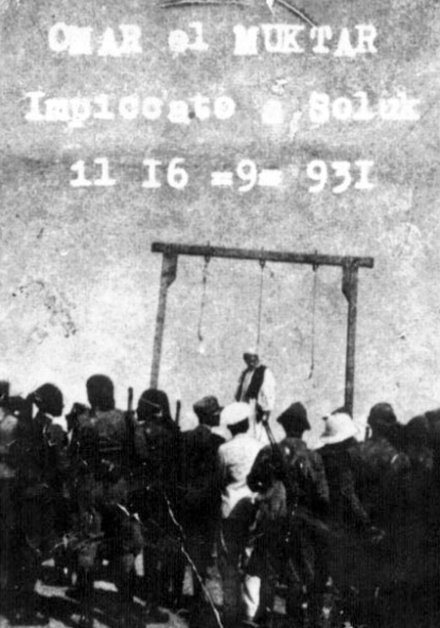
1931: Omar Mukhtar, Libyan revolutionary

On this date in 1931, Libyan independence martyr Omar [al-]Mukhtar was publicly hanged by the Italians at their concentration camp in Suluq.

Mukhtar (English Wikipedia entry | Italian) was born an Ottoman subject back in 1858 and had lived long enough to see his native Libya seized in the 1911-12 Italo-Turkish War.

Mukhtar, a religious teacher and follower of the Senussi movement, became the leader of the Libyan resistance that dogged the Italian occupation. Mukhtar proved an energetic and successful desert guerrilla fighter, and he had to be given the Italians’ mechanized military.

The Italians executed an estimated 4,000 Libyans in the 1920s, and drove hundreds of thousands into concentration camps, and gradually, only gradually, gained the upper hand on their adversaries.

Captured in battle after he abandoned a 1929 truce, Mukhtar was denied prisoner-of-war status and subjected to a snap military tribunal in one of the small coastal enclaves actually controlled by Italy — “a regular trial and consequent sentence, which will surely be death,” as the Italian general directed. It surely was.

He’s played by Anthony Quinn in the 1981 film Lion of the Desert — a better movie than you might think given that it was bankrolled by Muammar Gaddafi.

A national hero for contemporary Libyans across any social divide you’d care to name, Omar Mukhtar was valorized by the rebels who recently overthrew the aforementioned Gaddafi (here’s Mukhtar on a billboard in rebel-held Benghazi). “The whole world knows what Omar al-Mukhtar did,” Mukhtar’s 90-year-old son told media during the civil war. “That’s where they get their energy from. Ask the youth, they’ll tell you they are all the grandsons of Omar al-Mukhtar.”

His steely profile can be seen on Libya’s 10 10 dinar note.

On this day..