1691: Mark Baggot, Jacobite spy

On May 20, 1691, Captain Mark Baggot was hanged as a spy in Dublin.

Baggot had maintained loyalty to King James II when that sovereign was deposed in the 1688 Glorious Revolution that elevated William of Orange to the English throne.

Though deeply unpopular in England, the Catholic James — still to this day England’s last Catholic monarch — had sympathetic subjects to flee to in Ireland. Apart from the religious sympatico, the Irish were still smarting from ravages dating back to Cromwell and before, authored in the main by factions who were direct ancestors of the Whigs, King James’s staunchest domestic foes.

In 1689, James landed in Ireland backed by the French and kicked off the Williamite-Jacobite War between the rival kings. This war was so nasty it even survived the flight of King James himself in 1690:* William refused to guarantee amnesty for a wide swath of the Jacobite leadership, who consequently saw no odds in laying down their weapons.

The latter months of 1690 and the early months of 1691 had the now-outnumbered Jacobites girding the defenses of the cities they held against the coming Williamite attacks that were sure to come. Intelligence was critical under such conditions, and here our man Mark Baggot enters the stage.

Baggot was dispatched from the Jacobite stronghold of Limerick to Williamite-held Dublin to scout the enemy, but there had the embarrassment of being captured trying to escape notice in women’s clothes.** (You may be certain that the Williamite press included this emasculating detail on every available occasion.)

A court-martial condemned Baggot to hang the very next day, March 25.†

But the secret agent bought himself two months’ respite by cooperating with his captors — making the whole mission a clear intelligence win for the Williamites, especially since they still got to hang their spy in the end.

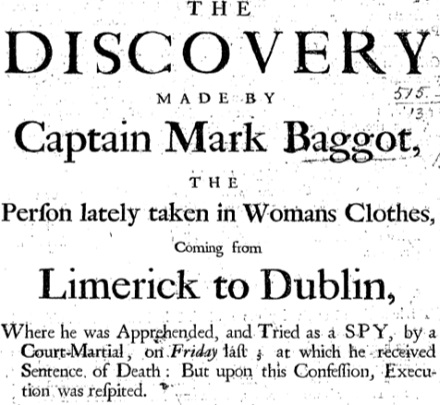
The resulting document has copy nearly as long as its unwieldy title …

The Discovery Made by Captain Mark Baggot, the Person Lately Taken in Womans Clothes, Coming from Limerick to Dublin, where He was Apprehended, and Tried as a Spy, by a Court-Martial ... at which He Received Sentence of Death: But Upon this Confession, Execution was Respited.

That the Irish army consists of forty thousand men of all sorts; that Tyrconnel was reducing them to thirty thousand; but SarsfieldSir Richard Nagle are pensioners of France.

That there is no good understanding between Tyrconnel and Sarsfield, having great jealousies of one another.

That King James has correspondence with, and intelligence from some persons in considerable places of trust here in England every ten days.

That the French fleet is hourly expected with thirty pieces of cannon, ammunition, provisions and arms; a French general, some marine men, but none of the army; they resolve to maintain their greatest force against the confederates in Flanders next campaign.

That the Irish army intends to move towards the frontiers, their greatest design being against Cork more than ny other place; what is left of the suburbs they intend to burn; they expect a great many deserters at their approach to the town. The commanders of the parties for this service are Colonel Dorrington and Colonel Clifford.

A spy, taken at Limerick, was hang’d here [Dublin], and confess’d that Major Corket was in particular favour, and held correspondence with the English, who was carried prisoner to Limerick, and suppos’d to have suffer’d death.

That the contributions paid to the new Irish are one peck of wheat or meal, 12 pound of butter every fortnight out of each plow lands.

That there is express order that no guns be removed from Limerick; that the English deserters are only paid and encouraged, but no pay given to the Irish.

That they are still fortifying Limerick.

That Ballyclough and Castletown, with some other places, were to be made garrisons by the Irish; that Sir Michael Creagh’s regiment of foot, under command of Colonel Lacy, are at Ballyclough, which places they are fortifying; that Strabane’s regiment of horse are at Charleveel and Buttifant, &c.

Baggot’s less than flattering report of the Jacobite forces’ condition proved bang-on: that July, the Williamites dealt a fatal blow to the Jacobite cause at the Battle of Aughrim — thanks to forcing a defile that the dug-in Jacobites ought to have held but for want of ammunition.‡ Shortly thereafter, Limerick capitulated to Williamite siege — its last Jacobite garrison escaping into exile, never to stir in Ireland again.

* He’s remembered in Ireland as “James the Shit” (Seamus a Chaca) because he ditched his supporters mid-war.

** Not the only Jacobite with a cross-dressing escapade to his name.

London Gazette, March 26-30, 1691, which calls the spy Baggot “a Person very well known.”

The Baggot(t)s (Bagods, Baggetts) were an English family that could trace lineage back to the age of William the Conqueror, with a very longstanding branch in Ireland. (Dublin still has streets that bear that name.) The 17th century Irish Baggots took it on the chin for their loyalty to the Stuarts, several dying in that service or being dispossessed. The family’s Baggotstown Castle in County Limerick was seized and razed by the Williamites months after the events in this post.

The date of Baggot’s execution is reported in the Gazette for May 25-28, 1691.

‡ “All the day, though he was sincking in his center and on his left, [the Williamites] yett durst not once, for his relief, attempt to traverse the cawsway, till despayr at the end compelled him to trye that experiment at all hazards … they confidently ventured to goe through, notwithstanding the fire from the castle on their right, which fire was insignificant; for it slew but a few in the passage. The reason of it was given, because the men had French pieces, the bore of which was small, and had English ball, which was too large. Here is a new miscarriage thro’ heedlessness. Why was not this foreseen and the dammage prevented?” (Source)

On this day..

1558: Three reformers at Norwich

From the 16th century tome of Protestant martyrology, Foxe’s Book of Martyrs — with evocative original Early Modern English from the 1570 edition.

The Martyrdome of William Seaman, Thomas Carman, and Thomas Hudson, put to death by the persecuting papistes at Norwich in the county of Norfolke.

Immediatly after William Nicole, succeded in that honorable and glorious vocation of Martyrdome three constant godly me[n] at Norwich in Norfolke, who were cruelly and tyrannically put to death for thee true testimony of Iesus Christ, the 19. of May an. 1558. Whose names be these.

William Seaman.
Thomas Carman.
Thomas Hudson.

The sayd William Seaman was an husbandman, of the age of xxvj. yeares, dwelling in Mendlesham in the county of Suffolke, who was sought for sundry tymes by the commaundement of Syr Iohn Tirrell Knight, and at last hee hym selfe in the night searched hys house and other places for hym: notwithstanding, hee somewhat mist of his purpose, God be thanked. Then he gaue charge to his seruantes, Robert Baulding, and Iames Clarke with others, to seeke for hym. Who hauing no officer, went in the euening to hys house, where he beyng at home, they tooke hym and caryed hym to their master Syr Iohn Tirrell. This Baulding beyng Seamans nigh neighbour, and whom the sayd Seaman greatly trusted as a speciall frend, notwithstandyng to do his Master a pleasure, now became enemy to his chief frend, and was one of the busiest in the takyng of him. Now as they were goyng to cary him to their Master Syr Iohn Tyrrel in the night, it is credibly reported that there fell a light betwene them out of the element and parted them. This Bauldyng beyng in company with the rest whe[n] the light fell, albeit he was then in hys best age, yet after that tyme neuer enioyed good day, but pined away euen vnto the death.

Well, for all that straunge sight (as I sayd) they caried hym to their master. Who when he came, asked hym why he would not go to masse, and receaue the sacrament, and so to worship it? Vnto which William Seaman aunswered, denying it to be a sacrament, but sayde it was an Idoll, and therefore would not receaue it. After which wordes spoken, Syr Iohn Tirrell shortly sent hym to Norwich to Hopton then Byshop, and there, after conference and examination had with him, the Byshop red hys bloudy sentence of condemnation against hym, and afterward deliuered hym to the secular power, who kept hym vnto the day of Martyrdome.

Thys sayd William Seaman left behind him when he dyed, a wife and three children very yonge: and with the sayd younge children, hys wife was persecuted out of the sayd towne also of Mendlesham, because that she would not go to heare Masse, and all her corne & goods seased and taken away by master Christopher Coles officers, he beyng Lord of the sayd towne.

Thomas Carman (who, as is said, pledged Richard Crashfield at hys burning, and thereupon was apprehended) beyng in prison in Norwich, was about one tyme with the rest examined & brought before the sayd Byshop, who aunswered no lesse in hys masters cause then the other, and therefore had the like reward that the other had, which was the Byshops bloudy blessing of condemnation, and deliuered also to the secular power, who kept him with the other vntill the day of slaughter, which hasted on and was not long after.

Thomas Hudson was of Ailesham in Norfolke, by his occupatio[n] a Glouer, a very honest poore ma[n], hauing a wyfe and three children, and laboured alwayes truely and diligently in his vocation, being of thirty yeares of age, and bearing so good a will to the Gospell, that he in the dayes of king Edward thee sixt, two yeares before Queene Maryes raigne, learned to read Englishe of Anthony and Thomas Norgate of the same Towne, wherein he greatly profited about the tyme of alteration of religion. For when Queene Mary came to raigne, and had chaunged the seruice in the church, putting in for wheate, draffe and darnyll, and for good preaching, blasphemous crying out agaynst truth and godlines, he then auoyding all their beggerly Ceremonies of superstition, absented him selfe from his house, and went into Suffolke a long tyme, and there remayned, traueling from one place to an other, as occasion was offered. At the last, he returned backe agayne to Norfolke, to his house at Ailesham, to comfort his wife & hys childre[n], being heauy & troubled with his absence.

Now when he came home, and perceaued his continuaunce there would be daungerous, he and his wife deuised to make hym a place among hys fagots to hyde himselfe in, where he remained all the day (in stede of hys chamber) reading and praying continually, for the space of halfe a yeare, and hys wife like an honest woman being carefull for hym, vsed her self faythfully and diligently towardes him.

In the meane tyme came the Vicar of the towne, named Berry (who was one of the Byshops Commissaryes, a very euill man) and inquired of thys sayd Thomas Hudsons wife for her husband. Vnto whom she aunswered, as not knowing were he was. Then the sayd Berry rated her, & threatned to burne her, for that she would not bewray her husband where he was.

After that, when Hudson vnderstoode it, he waxed euery day more zealous then other, and continually red and sang Psalmes, to the wonder of many, the people openly resorting to hym to heare his exhortations and vehement prayers.

At the last he walked abroad for certayne dayes openly in the Towne, crying out continually agaynst the Masse and all their trompery, and in the end, commyng home in his house, he sat him downe vppon hys knees, hauyng his booke by him, readyng and singyng Psalmes continually without ceassing. for. iij. dayes and iij. nightes together, refusing meate & other talke, to the great wonder of many.

The one Iohn Crouch his next neighbour, went to the Constables Robert Marsham and Robert Lawes in the night, to certifie them therof: for Berry comaunded openly to watch for hym: and þe Constables vnderstadyng the same, went cruelly to catch him in the breake of the day, the., xxij. of the moneth of Aprill. an. 1558.

Now when Hudson saw the come in, he sayd: Now mine houre is come. Welcome frendes welcome: you be they that shall lead me to lyfe in Christ, I thanke God therfore, and the Lord enhable me thereto for his mercies sake. For his desire was, and euer he prayed (if it were the Lordes wil) that he might suffer for the Gospell of Christ. Then they tooke hym, and lead hym to Berry the Commissary, which was Vicare of the Towne, and the sayd Berry asked hym first, where he kept his Church for iiij. yeares before. To the which the sayd Hudson aunswered thus: where soeuer he was, there was the Church.

Doest thou not beleue, saith Berry, in the Sacrame[n]t of the altar? What is it?

Hudson. It is wormes meate: my beliefe (saith he) is in Christ crucified.

Berry. Doest thou not beleue the Masse to put away sinnes?

Hudson. No, God forbid: it is a patched monstre, and a disguised Puppet, more longer a pecing then euer was Salomons temple.

At which wordes Berry stamped, fumed, and shewed him selfe as a mad man, and sayd: well thou villayne, thou: I will write to the byshop my good Lord, and trust vnto it, thou shalt be handled according to thy desertes. Oh syr, sayd Hudson: there is no Lorde but God, though there bee many Lordes and many Gods. With that, Berry thrust him backe with hys hand. And one Richard Cliffar standing by, sayd: I pray you syr, be good to the poore man. At which wordes Berry was more mad then before, and would haue had Cliffar bound in a recognisance of 40. poundes for his good abearing, both in worde and deede: which hys desire tooke no effecte. Then he asked the sayd Hudson whether he would recant or no. Vnto which wordes Hudson sayd: the Lord forbid: I had rather dye many deathes, then to doo so.

Then after long talke, the sayd Berry seing it booted not to perswade with him, tooke his pen and yncke, and wrote letters to the byshop therof, and sent thys Hudson to Norwich bound like a theefe to hym, which was viij. miles from thence, who with ioye and singing chere went thether, as mery as euer he was at any time before. In prison he was a moneth, where he did continually read and inuocate the name of God.


Original illustration via JohnFoxe.org, which notes that depictions of several triple burnings attest to the certainty that the printer had no block to illustrate three men in a fire.

These three christians and constant Martyrs, William Seaman, Thomas Carman, and Tho. Hudson, after they were (as ye haue heard) condemned, the xix. day of May. 1558. were caryed out of prison to þe place where they should suffer, which was without Bishops gate at Norwich, called Lollards pit.

And being all there, they made theyr humble prayers vnto the Lord. That being done, they rose and went to the stake, and standing all there with chaynes about them, immediately thys sayd Thomas Hudson commeth fourth from them vnder the chayne, to the great wonder of many: wherby diuers feared and greatly doubted of him. For some thought he would haue recanted: other iudged rather that hee went to aske a further day, and to desire conference: and some thought he came forth to aske some of hys parentes blessing: So some thought one thing and some an other: but hys two companions at the stake cryed out to hym to comforte hym what they could, exhorting hym in the bowels of Christ to be of good chere. &c. But thys sweete Hudson, felt more in his hart and conscience, then they could conceaue in hym. For (alas good soule) he was compassed (God knoweth) with great dolour and griefe of mind, not for his death, but for lacke of feeling of hys Christ, and therfore beyng very carefull he humbly fell downe vppon his knees, and prayed vehemently and earnestly vnto the Lord, who at the last, according to hys olde mercyes, sent hym comfort, and then rose he with great ioy, as a man new chaunged euen from death to life, and sayd:

Now I thanke God I am strong, and passe not what man can doo vnto me.

So going to the stake to his fellowes agayne, in the end they all suffered most ioyfully, constantly, and manfully the death together, and were consumed in fire, to the terror of the wicked, the comforte of Gods Children, & the magnifiing of the Lords name, who be praysed therfore for euer, Amen.

After thys, the fore named Commissary Berry, made great styrre about other which were suspected within the sayd towne of Aylesham, and caused two hundred to creepe to the Crosse at Penticost, besides other punishmentes which they susteyned.

On a time this Berry gaue a poore man of his parish of Marsham, a blow with the swingell of a flayle, for a word speaking, that presently theron he dyed, and the sayd Berry (as is sayd) held vp his hand at the barre therefore.

Then, after that in his parish of Aylesham also, an. 1557. there was one Alice Oxes came to his house, and going into the Hall, he meting her (being before moued) smote her with his fist, whereby she was fayne to be caryed home, and the next day was found dead in her chamber.

To write how many concubines & whores he had, none would beleue it, but such as knewe him in the countrey he dwelt in. He was rich and of great autoritie, a great swearer, altogether geuen to wemen, and persecuting of the Gospell, & compelling men to idolatry.

One Iohn Norgate a man learned, godly, and zealous, who would not go to theyr trash, but rather dye, being sore hunted by the sayd Berry, prayed hartely to God, and the Lord shortly after in a consumption deliuered hym. Notwithstanding, the rage of this wicked man waxed more fiercer and fiercer. He troubled sundry men, burnt all good bookes that he could get, and diuorsed many men and wemen for religion.

When he heard say that Queene Mary was dead, and the glory of theyr triumph quailed, the sonday after, being the xx. of Nouember, an. 1558. he made a great feast, and had one of his concubines there, with whom he was in his chamber after diner vntill Euensong. Then went he to church, where he had ministred baptisme, and in going from church homeward, after Euensong, betwene the churchyarde and hys house, being but a litle space (as it were a churchyard bredeth asunder) he fell downe sodeinly to the ground with a heauy grone, & neuer stirred after, neither shewed any one token of repentance. This hapned hys neyghbors being by, to the example of all other. The Lord graunt we may obserue his iudgementes.

And those that had his great riches, since his death haue so consumed with them, that they be poorer now then they were before they had his goodes, such iudgement hath the Lord executed to the eyes of all men.

On this day..

1548: Giulio Cybo, Andrea Doria disaster

On this date in 1548, Giulio Cybo was beheaded in Genoa for plotting against his father-in-law Andrea Doria.

Cybo (English Wikipedia entry | Italian) was a babe of barely 20 when he died, the whole of his short life lost to frustrating defeats in the skein of peninsular and familial politics.

His parents were the original Cybo and Malaspina whose union founded the Cybo-Malaspina house that until the 18th century ruled the small Duchy of Massa and Carrara where Liguria meets Tuscany.

Successful though their line might prove, theirs was a house divided and the parents’ rivalry for precedence in their territory transferred to their two sons. Thus Giulio, the father’s favorite, makes his first appearance on history’s stage invading Massa with a cohort of gendarmes to seize power from his own mother.

The success of his rude maneuver was short-lived and mom soon restored her authority — backed by the imperial forces haunting the land during the interminable Italian Wars. Although Giulio was married to the daughter of the Genoese admiral Andrea Doria,* whose word was law in that city, the in-laws frustratingly stiffed him out of the dowry payment that Giulio intended to use to restore his Freudian conquest.

These material grievances, and a young man’s wide streak of tragic impetuousity,** drove Giulio into the arms of Giovanni Luigi Fieschi. The latter was a Genoese nobleman whose dramatic plot to topple Doria failed with operatic† absurdity in 1547 when Fieschi mid-coup fell off a gangway and drowned in the harbor. Only in Genoa.

Cybo’s complicity in this scheme could not be proven because he arrived too late to do anything other than make a politic show of support for the already-victorious Doria. But now, encouraged by the French — the Habsburg empire’s enemy in the aforementioned Italian Wars and therefore the sponsor of its every rival faction — Cybo gathered some fellow malcontents in Venice and began working up a plot to oust Doria, restore the liberty of Genoa, and really put all the parents in their place. Once bitten, however, the wily old Doria was on the lookout for these troublemakers and had Cybo’s circle infiltrated early. The young man was arrested en route back to Genoa to implement his design.

The letters of the Fieschi [family] which were found on his person left no room to doubt his guilt. Some tell us that he was several times tortured and confessed that Farnese, Maffei, Ghisa and the Pope himself were accomplices in the plot, and that the Fieschi and Farnese were its instigators.

The emperor did not wish to execute Cybo; and we find evidence in documents of the period that even the bloodthirsty Gonzaga made every exertion to save him. On the other hand Graneville and Doria laboured with all their power to secure his punishment. In fact, so soon as Doria heard of this plot, committed rather in intention than act and excusable by the youth of the conspirator, “the prince (I use the words of Porzio) inflamed to wrath by the offence and full of vengeful animosity, disregarded the double tie which bound him to the young man, and made incessant appeals to Caesar for the blood of his relative.”

Many Italian and foreign princes asked grace for the prisoner, and the emperor was at first undecided; but severity triumphed over mercy — Doria desired vengeance and he obtained it. The victim met his fate with manly intrepidity. He was beheaded and his body exposed between two wax candles in the public square … on the 18th of May, 1548. He was scarcely twenty years of age.

Porzio says: —

His courage and military capacity inspired all who knew him with the conviction that, if he had not perished in boyhood, he would have become one of the first captains of his age. He made a single mistake: that of endeavouring to expel one foreigner with another — to drive out the Spaniards in order to establish the French in Italy.

* This man, one of the great naval captains of his age, was of course the namesake of the Genoese ocean liner Andrea Doria that sank in 1956.

** Cybo “liked not to rest contented in the battle of life,” was James Bent’s judgment, although it is difficult to tell that he ever had the option to do so.

** Well, stage-worthy at any rate: Fieschi’s fiasco is the basis of Schiller’s play Fiesco.

On this day..

1649: Three Banbury mutineers at Burford church

On this date in 1649, Oliver Cromwell had three leaders of his army’s working-class Levellers movement shot against the walls of Burford church.

The revolutionary army with which Cromwell had overthrown King Charles I came to a crisis in 1649 as the interests of senior officers and the class of landowners and merchants they hailed from clashed against those of the common soldiery.

This democratic and class-conscious Leveller movement has invited the sympathy of later radicals, and it would be hard to flatly call that attention anachronistic; Leveller William Walyn even anticipated Marx’s language in dismissing the Magna Carta as “that mess of pottage.”* This is an England whose capitalist shape is coming clearly into view.

Flint struck steel when the army’s Grandees laid a nasty Sophie’s choice on troops whose pay was deep in arrears: leave the army (forfeiting the back pay) or leave the country (to invade Ireland). Both options redounded to the advantage of the state and its moneyed interests, at the expense of the lower orders.

Army mutinies commenced immediately and the massive London procession that carried the executed Leveller Robert Lockyer to his grave proved the depth and danger of the public sentiment.

In early May of 1649, Colonel Scrope’s horse regiment — another of those offered the “opportunity” of serving in Ireland — followed suit, seizing the regimental colors, re-electing its own officers and marching out from Banbury across Salisbury plain to rendezvous with other discontented soldiers. In the words of one survivor,

the whole fabric of the Commonwealth fell into the grossest and vilest tyranny that ever Englishmen groaned under … which, with the considerations of the particular, most insufferable abuses and dissatisfactions put upon us, moved us to an unanimous refusal to go … till full satisfaction and security was given to us as Soldiers and Commoners, by a Council of our own free election.

Cromwell had a different satisfaction in mind.

Aided by an envoy sent to stall the rebels with a diversionary negotiation, Cromwell and Thomas Fairfax were able to surprise the 1,500 Levellers camped at Burford with a midnight attack the night of May 13-14. By morning, 340 soldiers were locked in Burford’s church as prisoners.

The tragic denouement of this Banbury mutiny was the execution of three soldiers, Cornet Thompson, Corporal Perkins, and Private Church. A plaque at the site still commemorates the event.

On month’s end, Cromwell was certifying to Parliament that mutinous Levellers had all been pacified … and come August, he was ravaging Ireland as planned.

The Saturday nearest May 17th is marked each year in Burford as Levellers Day. (The next one as of this writing is Saturday, 20 May 2017.)

* The Biblical allusion was current in the culture; Cromwell invoked the same phrase a few years later when he dismissed the Rump Parliament.

On this day..

1849: Quddus

On the Baha’i calendar, this date in 1849 marked the martyrdom of Quddus.

The 18th and last of the “Letters of the Living” comprising the original disciples of the the faith’s founding prophet the Bab, Quddus was a charismatic young mullah of whom it was said that “whoever was intimately associated with him was seized with an insatiable admiration for the charm of the youth.” Denis MacEoin even argues that Quddus’s preaching verged on asserting divinity, and he might have been an incipient rival to the Bab himself for leadership of the new religion.

Under either leader the movement was officially excommunicate to the ulama, and its heretical proselytizing consequently generated no shortage of martyr-making backlash. The backlash in question for this post began with an anti-Baha’i riot in the Mazandaran city of Barfurush (today, Babol) which drove a few hundred adherents to the nearby Shrine of Shaykh Tabarsi where they took refuge behind ad hoc defensive fortifications.

The Persians’ ensuing besiegement of this redoubt constitutes the Battle of Fort Tabarsi — and if the designation sounds a bit exalted for mob control it was dearly earned by the surprising (and to Persia, embarrassing) Baha’i resilience. Under Quddus’s leadership the makeshift fort held out for seven months. Half of those original 18 “Letters of the Living” disciples would die in the engagement — the largest upheaval during those formative years.

At last, having finally been reduced to near-starvation by the encirclement, the Baha’i defenders surrendered on the guarantee of safe passage — a guarantee that was immediately violated, with most of the former “garrison” massacred on the spot on May 10.

Quddus was preserved for special treatment in Barfurush several days later: not judicial execution, but simply handing over to an angry rabble who tore him apart.

The Bab, already imprisoned pending the passion he would suffer the following year, was said to be so devastated at learning of Quddus’s fate that he could scarcely write any longer: “the deep grief which he felt had stilled the voice of revelation and silenced His pen. How deeply He mourned His loss! What cries of anguish He must have uttered as the tale of the siege, the untold sufferings, the shameless betrayal, and the wholesale massacre of the companions of Shaykh Tabarsi reached His ears and was unfolded before His eyes!” (Source)

On this day..

1815: William Sawyer, guns and roses

William Sawyer hanged on this date in 1815* at London’s Newgate Gaol for a murder he committed while in Portugal.

Dispatched to Iberia during the 1814 mopping-up stages of the Peninsular War, Sawyer preferred to make time with a young Englishwoman named Harriet Gaskett who was supposed to be there as the mistress of Sawyer’s friend and fellow-officer. (Both of the men in question had wives back in Blighty.)

When this third wheel discovered their liaison,** Sawyer and Gaskett fell into that death-seeking tragic mooning that lovers do and after dinner one night in April they wandered off to the garden. Other guests soon heard three pistol shots crack the evening air. The reports proved to correlate with a dead Harriet, and a severely (but not mortally) wounded William.

After he was cleaned up — and after he once more failed to kill himself by slashing his own throat — his friends solicited a forthright confession.

Having laid violent hands upon myself, in consequence of the death of Harriet, I think it but justice to mankind and the world, being of sound mind, solemnly to attest that her death was occasioned by her having taken part of a phial of laudanum and my discharging a pistol at her head, provided for the occasion. I took the residue of the laudanum myself, and discharged two pistols at my head. They failing in their effect, I then retired to the house and endeavoured to put an end to my life, leaving myself the unfortunate object you now behold me.

William Sawyer

Besides doing the tragic lover thing, Sawyer was obviously intent on doing the officer-and-a-gentleman thing. His friends did very well believe the convenient-sounding version of events that he presented, such was his rectitude and lovesickness.

But under any construction of motive and circumstance, this narrative of “discharging a pistol at her head” amounted to confession to a hanging crime and Sawyer was convicted with ease.

Sympathetic to a fault, the Lord Chief Justice Ellenborough who personally tried the case reserved judgment as to the penalty pending a review by a panel of the king’s judges of several technical legal points. These were all defeated as entirely as was Sawyer’s wife’s attempt to see him in prison.

Despite his avoiding such an awkward interview Sawyer went to the gallows “very dejected,” in the words of the Newgate Calendar.

During the ceremony a profound silence prevailed throughout the populace. He died under evident symptoms of paroxysm, and a quantity of blood gushed from his mouth, from the cut in his throat. At nine o’clock the body was taken to Bartholomew’s Hospital in a cart, attended by the under-sheriff and officers. He was dressed in a suit of black, and [it] was not ironed.

* The Newgate Calendar, whose command of detail is often unreliable, mistakenly gives May 22 as the execution date — a week later than the true event.

** Intent on layering on the melodrama, Sawyer’s story was that the friend had actually given the two lovebirds leave to go live together. Great! Except Gaskell was convinced the permission was insincere and that he meant on killing himself once they did so and “although she had promised not to live with me, she had not promised not to die with me.” Anything for love.

On this day..

1873: John Devine, “The Chicken”

Purple prose for a broken neck from the San Francisco Bulletin of May 14, 1873. Transcribed below is only the first third of the article — the remainder being dedicated to accounts of various other previous San Francisco executions.

This day has been marked by an event of signal import in the history of this city, wherein the slow hand of justice, after a lapse of many years, has overtaken one of the class of reckless criminals who have reveled in rapine and bloodshed, bringing reproach on the fair fame of San Francisco, and red-handed murder has expiated its guilt by the righteous penalty of ignominious death upon the scaffold.

Whatever may be the abhorrence of capital punishment commonly experienced by a portion of the people, while contemplating the events of the past few years, the tardy and uncertain sway of justice, a sense of satisfaction and increased security will be inspired in the whole community by the announcement of John Devine, “The Chicken,” has met the fate which the law prescribes for the destroyer of human life, and there is one murderer less in San Francisco.

From the infamous character of this man, and the terror which his deeds of violence excited through a long course of comparatively unpunishable crime, ere consigning him to oblivion, the public will be interested in a brief sketch of the

Career of the Murderer.

The man who has now paid the penalty of his last dark crime, leaves a record which has no parallel among the many depraved wretches who have figured in the brief but terrible criminal history of San Francisco, and perhaps the half has not been told.

The police officials considered him the most dangerous and unscrupulous criminal that infested the city, and hint at mysterious deeds of blood, never unravelled by the minions of justice, with which he is believed to have been connected. In truth, he was a fellow by the hand of nature marked, quoted and signed to do a deed of shame — apt, liable to be employed in danger with neither pity, love nor fear.

Devine was a native of Waterford, Ireland, where he was born in the year 1840, and was accordingly 33 years old at the time of his death.

He was of medium size, sharp features, dark-blue eyes, a low forehead, and generally repulsive expression of countenance.

He arrived in San Francisco in the year 1863, as a seaman on the clipper ship Young America.

On the voyage hither he distinguished himself as a quarrelsome fellow, and was frequently confined in irons to restore the discipline of the ship.

After squandering the wages he received in a short spell of carousing on shore, he was driven to the sea again and made a voyage to China, returning in the spring of 1865. He then obtained employment as a runner for sailor boarding-houses, in which capacity he perpetrated innumerable deeds of ruffianism in the “shanghaing” of sailors and citizens on outward bound ships. Shortly after engaging in this vocation he received the title of

“The Chicken.”

Which was endearingly conferred by one of his fellows, as significant of his prowess in a prize-fight.

Devine had four notable encounters of this order, in the city and vicinity, and displayed remarkable endurance and determination, though not always successful.

His career from the time of setting himself on shore was one continuous round of crime, and he is well suspected of having a knowledge of the manner in which many a corpse found floating in the bay, with fractured skull and rifled pockets, yielded up i[t]s life. His record on the police register shows

Seventy-Nine Arrests!

Up to May 16, 1871, when his final arrest for the crime of murder was made.

The charges against him embraced all manner of crimes, principally robberies and assaults with deadly weapons, it being his custom to assault his victims with slung-shot and brass-knuckles. His recorded crimes, however, are not supposed to embrace any near approach to the ull measure of enormities that were charged upon his guilty soul.

He was capable of the most savage treachery, and on one occasion attempted the murder of a prize-fighter named Tommy Chandler, by springing upon him from behind a door with a heavy iron bar. Being foiled in this, he subsequently shot Chandler, but not inflicting fatal injury, he got off with a short term of imprisonment on conviction of assault to murder.

A Characteristic Exploit.

On the 8th of June, 1867, about 6 o’clock in the morning, Devine assailed an aged German lady, named Mary Martin, as she was walking along Merchant street, near Battery, tore the pocket from her dress, and robbed her of a purse containing a check for [obscure] and $25 in coin.

For this robbery he was arrested, and released on bail, for notwithstanding the character he bore, he was usually enabled to find friends to go upon his bond in a certain part of the city.

When the case came up for trial officers went in search of Mrs. Martin, who had resided at a house on Powell street, as the important witness for the prosecution of Devine. The lady had disappeared.

What became of her was never known; but it was possible that Devine might have told. Passing over a list of comparative minor offences, such as knocking down and robbing people, the next noticeable affair in which this remarkable criminal figured was the

Attempted Murder of Miss McDonald.

On the night of the 9th, October, 1867, Miss Martha McDonald was standing in front of her place of residence, at the Mission, when she was suddenly seized by two men who were masked.

She was gagged by a handkerchief being forced into her mouth, and prevented from giving any alarm. In this condition the men dragged her a distance of two blocks and a half, to the bridge which crosses Mission Creek at Sixteenth street.

One of the two then started, according to the directions of his companion to “get the carriage.”

Being left in the custody of one only, Miss McDonald made a desperate effort to release herself. The fellow attempted to chloroform her; but the drug being spilled from the bottle, he then endeavored to secure her with a strap.

At this juncture the other man returned, and she heard the exclamation, “kill her, kill her!” A moment after she was pushed off the bridge, and fell into the muddy waters of the creek, while the two men who had abducted her ran away.

Slowly and surely she was sinking into the muddy bottom, with no assistance at hand, until the water was about her neck. Fortunately an alarm of fire started some person past the locality, and her cries of distress being heard, she was discovered and rescued.

Devine was arrested as one of the participants in this crime, and Miss McDonald positively identified him by his voice. Devine extricated himself from the affair by proving an alibi, it appearing that he was serving a term in the County Jail at the time of the attempted murder.

It subsequently transpired, however, that he held the privileged position at the County Jail of “outside trusty,” and was permitted to travel to all parts of the city at will in the performance of errands for prisoners in more restricted limits. And more than this, he was abroad at the very time the abduction of Miss McDonald was made.

The Loss of a Hand.

In the month of May, 1868, Devine was indulging in one of his periodical carousing spells, and often bringing terror to several of the resorts on his beat at the city front, he entered a boarding house kept by William Maitland, on Battery street.

Here he flourished a huge knife with the recklessness of a savage, and caused a precipitate retreat of all who happened to be in the place.

The proprietor had been asleep in the second story of the house, and hearing the uproar, came came down for a reconnaissance. Devine immediately started for him when he made his appearance, but Maitland was not of so yielding a disposition as to be driven from his own castle, and closing with Devine, he succeeded in disarming him.

The latter then made an attempt to recover the knife, when Maitland with a powerful stroke cut him across the wrist. The blade, by wonderful chance, entered the wrist joint, and the completely severed hand fell to the floor.

Devine was appalled for once in his life, and hurriedly departed; but presently he returned and demanded his lost hand, which Maitland kicked out upon the sidewalk to him. Devine took the severed member and hastened to a drug store, where he implored a clerk to try and sew it on again. But the injury was irreparable.

Devine as a Merchant.

After a season of retirement in the County Hospital, Devine emerged as far repaired as medical science would permit, and being a cripple, his condition excited the pity of boarding-house masters and others at the city front with whom he had been associated.

A contribution was made among them, amounting to $800, to enable Devine to establish himself in business by keeping a cigar stand.

He took the money, but instead of following the advice of his benefactors he squandered the whole sum in a few weeks of dissipation, and again returned to the pursuit of crime with all his previous energy.

He was associated with a woman named Mary Dolan, as bad as himself, and who was punished by terms of imprisonment in the County Jail and Penitentiary.

From the time of losing his hand up to his final arrest, he perpetrated numerous larcenies, some of considerable amounts, and was always busily engaged in thieving when not confined in jail.

A complete history of this man and his offenses would be one of the most appalling in the annals of crime. Such was John Devine, and rarely has the slow grip of justice overtaken a criminal more richly deserving of the severest penalty known to the law.

Murder of August Kamp.

The crime which John Devine has now expiated with his life, was one of the most cruel and wanton ever recorded in a civilized community, and could only have been accomplished by one utterly depraved.

It was in perfect keeping with the whole life and character of Devine, who had become callous to every impulse that elevates a man above the merest savage.

August Kamp was an unsuspecting young German, without relatives in the country. On the 10th of May, 1871, he arrived in the city from Antioch, where he had been employed, bringing with him his savings, to the amount of about $120.

He started immediately in search of employment, and while making his inquiries along the city front, he was met by Devine, who offered to procure him a situation on a fishing vessel.

Elated with this promise, young Kamp was persuaded to loan $20 to Devine, on the understanding that it would be repaid him the following day. The money was not returned as agreed, and Kamp finally suspecting the true character of his debtor, importuned him earnestly for his pay. Devine put him off repeatedly, at one time pretending that he had nothing but greenbacks on hand, and again making some other excuse.

On the 15th of May, Kamp having again demanded his pay, Devine told him that if he wanted the money very bad, he must go with him to his mother’s ranch, beyond Bay View. Accordingly the two started for the imaginary ranch, walking as far as Long Bridge, when they boarded one of the Bay View cars. On reaching the terminus of the railroad, the two got off the car and walked along the road. After passing the Five-Mile House, Devine pointed off to one side, saying that his mother’s ranch was in that direction, and by striking off across the fields instead of following the road they might save a distance of one mile out of two. Young Kamp assented and the two started across a lonely stretch of land, through vales and over hills, until a point was reached which the murderer thought sufficiently secluded for carrying out his design.

Kamp stooped down to crawl between the rails of a fence, Devine walking behind him, when the latter suddenly drew a pistol and fired the fatal shot, the ball entering Kamp’s skull behind the right ear.

Devine then ran away, supposing he had effectually dispatched his victim, and was seen hastening back alone to the railroad terminus.

Kamp was shortly after discovered by a Spaniard, who was herding sheep in the locality, and being still able to walk, he was assisted to a saloon on the road, and from thence brought in to the city and given in charge of the authorities.

From the representations which the mortally wounded youth could make, and other circumstances, the police were immediately confident that Devine was his murderer, and measures were at once instituted for his arrest.

He was traced to various places in the city, where he had boasted of obtaining money by an easy method, admitted to several that he had shot a man and endeavored to dispose of a revolver.

He was finally captured on board a steamer at Meiggs’ wharf, which was just about crossing over to Marin county, and the revolver, with two chambers discharged, was still in his possession.

At the City Prison he was placed in the midst of fifteen or twenty persons, and Kamp, who was yet rational, readily singled him out as the murderer. He walked up and placed his hand on Devine, saying, “You are the man that shot me.” Kamp was taken to the County Hospital, and every effort made to save his life, but without avail.

Just before his death, which occurred on the 5th of May, an effort was made to take his ante-mortem deposition, but unfortunately the Coroner arrived too late, and the important evidence of the murdered man was not secured in the case.

The chain of circumstances presented in the several trials, however, made out a case against the accused as strong circumstantial evidence could be drawn, and a doubt of his guilt was hardily admissible.

The First Trial

Was brought in the Twelth District Court, before Judge McKinstry, on the 20th of February, 187, and occupied eight days, resulting in a verdict according to the indictment of “murder in the first degree.” The Court sentenced Devine to be executed on the 25th of April, 1872.

Judge Tyler, counsel for the condemned, appealed to the Supreme Court for a new trial on mere technical grounds, his principal point having reference to a minor discrepancy of evidence of one witness as taken before the Coroner at the trial. Although the several points did not affect the merits of the case in the least, the appeal was successful, and to the efforts of most indefatigable counsel the wretched man was indebted to an extension of his lease of life a full year.

The case was brought to a second trial in March last, in the same court. In the meantime an important witness had died, and the prisoner and his counsel were exceedingly hopeful of founding complications on this circumstance equal to another successful appeal to the Supreme Court.

After another tedious trial the inevitable verdict of “guilty” fell upon the ear of the doomed man for the second time, and he was again sentenced to be executed on Friday the 9th of May.

Hope was still buoyant in his breast, relying upon the determined goal of his counsel, until the 7th, when the announcement was made that the Supreme Court affirmed the judgment of the lower court, and his fate was sealed beyond the further probability of human interference.

By the earnest intercession of the spiritual adviser of the condemned prisoner, the Governor was persuaded to grant a brief reprieve of five days, in the hope that the guilty wretch, with the certainty of speedy death before him, might finally yield to the ministrations of his anxious spiritual adviser, Rev. Father Spreckles, and meet his end in a penitential spirit.

During his long term of imprisonment Devine manifested a bearing of bravado, never believing that merited retribution would finally overtake him, and on several occasions he laughed to scorn kindly persons who ought to impress him with a realization of his terrible position, and turn him to preparation for another life. By a

Remarkable Coincidence

His execution occurred two years to a day from the commission of the murderous act that consigned him to death at the hands of justice, and in his case it may be said, “God’s mills grind slow but sure.”

After receiving his brief reprieve from the Governor, Devine realized that no earthly interference could avail him further, and he relinquished all hope of life.

At his own solicitation all visitors were ecluded from his cell with the exception of his spiritual advisers, and he gave himself earnestly to preparations for the awful change that awaited him, in the few hours that still remained.

At times he wept bitterly when exhorted to a contemplation of his guilty life and true repentance, and the consolations of religious faith seemed to reconcile him to his fate, and enable him to await his end with fortitude.

On Monday he received the Sacrament of Communion from Rev. Father Spreckles, and Archbishop Alemany conferred upon him confirmation in the Roman Catholic Church.

On the succeeding days Devine assumed an air of cheerfulness. On Tuesday he asked permission of the Sheriff to be shaved, which was granted, the precaution first being taken to bind him securely to guard against any suicidal designs. His ostensible wife, Mary Dolan, was in jail at the time of the execution, having been committed a few weeks since for her common offence of habitual drunkenness.

Parting With His Son.

Devine also had a son, a child of six years of age, whom he had not seen for several years, and he expressed an earnest desire to see him before his death.

The Sheriff and his deputies were anxious to gratify this last request, and visited the various charitable institutions in the city yesterday, endeavoring to find the child.

Devine last heard of him at the Protestant Orphan Asylum, where he had caused him to be placed immediately after his arrest for murder, the mother, Mary Dolan, being unfit to care or provide for him in consequence of her continual drunkenness and frequent detentions in jail.

The lad had been removed from the Orphan Asylum, but the Sheriff happily discovered him in charge of the Ladies’ Relief Society, comfortably provided for.

When the child arrived at the cell of his wretched father last evening, Devine was much affected, and exhibited instincts of humanity he had never known before. He embraced his offspring tenderly, wept over him, and implored him to shun the evil ways that had brought his father to ignominious death, and when the lad was finally removed, he clung to him with convulsive throbs, as if parting with the only object that had ever awakened the emotion of affection in his breast.

Last Hours of the Doomed Man.

Devine retired at about 10 o’clock last night after devotion with his spiritual adviser. He slept soundly through the night until 5 o’clock this morning, when he was awakened by the Jailor.

In reply to the inquiries of the officer, he said that he had enjoyed refreshing slumber, as one could who had a clear conscience. He dressed himself with care, and gave much attention to combing his hair neatly and arranging his toilet, having been provided with a new suit of black and a pair of slippers.

At 8 o’clock he ate a hearty breakfast, and shortly after his spiritual adviser, Rev. Father Spreckles, Archbishop Alameney [sic] and two Sisters of Mercy arrived. The doomed man devoted the remaining few hours of his life to fervent supplications for mercy.

As the hour for the execution approached, the wickets in all the cells were closed, the “trustees” allowed the limits of the Jail were locked up, and the condemned murderer Russell was taken to a remote part of the jail and locked in the room formerly occupied by Mrs. Fair.

At 11 o’clock the reporters of the press were admitted and allowed to inspect the preparations for the execution.

The Scaffold

Was laid across the railings of the upper corridor at the north end, the trap in the centre permitting the body to drop to the lower corridor within about three feet of the floor, the rope allowing a fall of six feet.

The gallows beam was extended above under the skylights, the ends resting in the ventillating apertures on either side.

On the west side of the scaffold an iron rod run up, to which was attached a cord, secured to a ring in one of the cell doors, the slipping of which drew the bolt by a weight and allowed the trap to fall. The gallows was the same used in previous executions, the last murderer who had stood thereon being the Chinaman, Chung Wong, who was executed in 1865.

At twenty minutes to 12 the Sisters of Mercy took their leave of Devine, and shortly after, attended by the Sheriff and the priests, Devine was conducted from the No. 1 cell near the entrance of the lower corridor, which he had occupied since his fate became sealed, to No. 41 cell in the second corridor, which was located nearly opposite the steps leading upon the scaffold. He looked pale and haggard, but a smile rested upon his countenance as he passed the group of reporters at the foot of the stairway.

He ascended the stairway with a light elastic step, and seemed to look car[e]lessly at the gallows as he tripped along the gallery.

At half past 12 o’clock an immense crowd had gathered in the street in front of the jail, and on all sides of the building where a position might be obtained to observe even the grim walls within which the dread scene of violent death was being enacted.

The Sheriff then admitted all those who had received permission to be present, to the number of about two hundred. The spectators included several Sheriffs from adjoining counties, members of the Board of Supervisors, physicians, city officials, and upwards of thirty reporters of the press, among the latter being representatives of some of the Eastern papers, and artists for the New York illustrated journals.

The reporters were assigned a position directly in front of the scaffold, in the west gallery of the upper corridor, and the physicians took their places within the line on the floor of the lower corridor.

The prisoner remained in his cell engaged in his final devotions, while the tramping of many feet and the subdued murmur of voices without, reminded him of the relentless hand of Justice, eager to close his career.

The corridors, above and below, were greatly crowded, while the side openings, below the sky lights, in either, were completely occupied, their appearance suggestive of the private boxes of a public exhibition.

The Execution.

At a quarter to 1 o’clock, the Sheriff directed his deputies to their positions upon the scaffold, and immediately after he entered the cell of the doomed man for a parting interview of brief duration.

On emerging, Sheriff Adams mounted the scaffold and stated to the spectators that it was the wish of Devine that all should preserve silence and ask him no questions.

At two minutes before 1 o’clock the Sheriff opened the door of the cell and Devine emerged, carrying a crucifix in his hand and followed by Father Spreckles. He ascended the steps to the scaffold with closed eyes, manifesting symptoms of weakness, and though bearing up with great power of nerve, the expression of his countenance and the twitching muscles of his throat indicated the welling up of inexpressible agony of soul.

While standing upon the scaffold his eyes remained closed, while Father Spreckles, taking the crucifix, continued whispering the consolations of the Church in his ear.

The death-warrant was hurriedly read by Deputy Lamott, but Devine gave no heed thereto, attending closely to the ministrations of Father Spreckles and frequently kissing the crucifix with much fervor as it was placed to his lips.

At the conclusion of the reading of the warrant, ailor McKenzie bound the doomed man with straps. One was passed round his breast and pinioned the arms at the elbows, another at the waist pinioned the wrists, and two other straps were secured about the knees and the ankles. The rope was then placed about his neck, the large knot of the noose fixed under the left ear.

Last Scene of All.

The murderer now stood upon the verge of the unknown. He opened his eyes for the first time upon the scaffold ere quitting the warm precincts of the cheerful day, and cast one longing, lingering look behind.

The bright sunshine shimmered through the skylights into the gloomy corridor, and wrought the shadow of the gallows-beam before him.

Loud laughter and the murmur of the thoughtless crowd without disturbed the awful stillness that reigned within.

Nerving himself for the last moment, Devine exclaimed with a loud voice, “Oh, my sweet Jesus, unto thy hands I commend my spirit. Amen.” He kissed the crucifix again, and the black cap was drawn over his head.

The spectators awaited with bated breath.

A moment more and a dull grating sound lie the swinging of a gate, broke the solemn stillness, and the soul of the murderer had passed out.

As the trap swung, Devine dropped about six feet, a sharp snap indicating that his neck was broken. A few convulsive throes succeeded for a moment with drawing up of the knees, and death resulted speedily with little pain. The physicians made the usual observations, and pronounced life entirely extinct in less than 15 minutes. The execution was most successfully carried out in every detail.

The spectators commenced leaving the jail immediately after the fall of the drop, excepting the few whose presence was required to sign as witnesses of the due execution of the sentence. The large crowd without lingered until the afternoon was well advanced, in morbid curiosity, discussing the death and career of the departed murderer.

On this day..

1619: Johan van Oldenbarnevelt, laandsadvocaat

On this date in 1619, Dutch stadtholder Maurice of Orange beheaded his political and religious rival, jurist Johan van Oldenbarnevelt.

Both men had in their day been instrumental to winning the independence (de facto, if not yet de jure) that the Low Countries were already enjoying: laandsadvocaat van Oldenbarnevelt as the commanding political personality holding together the potentially fractious provinces in the 1580s and 1590s; stadtholder Maurice as the great general* of those provinces, whose sword-arm in the 1590s and 1600s more or less staked out the borders of the present-day Netherlands.

Thanks to their good offices, the once-desperate Dutch Revolt had triumphed in all but name, and in the 1610s paused to savor the fruits of victory during the Twelve Years’ Truce.**

Increasingly after 1600, the two developed a rivalry that was both personal, and political, and religious — for in their prominence they also became the chief exponents of the neighborhood schism, van Oldenbarnevelt championing the Remonstrants or Arminians (they remonstrated against some Calvinist doctrines) and Maurice upholding the orthodox Counter-Remonstrants or Gomarist side. The conflict was no joke; the States of Holland at van Oldenbarnevelt’s urging went so far as to hire its own mercenary army, knowing that it could not trust the national army commanded by the Counter-Remonstrant William. William secured the support of the States-General to forcibly disband this rival militia in July 1618† — and from that point until his death in 1625, William was the strongman in the Low Countries.

And van Oldenbarnevelt, well — he got the kangaroo court. See?


Detail view (click for the full image) of Satire on the trial of Johan van Oldenbarnevelt, by Cornelis Saftleven (1663). Saftleven liked painting animals.

Tried by a special (dubiously legal) court comprised of enemies, the grizzled pol was condemned to death as a traitor. On May 13, the day he went to the block at the Binnenhof in The Hague, his home province the States of Holland saluted him as “a man of great business, activity, memory and wisdom — yes, extra-ordinary in every respect.”

And it added a passage from Corinthians:

Die staet siet toe dat hij niet en valle

He who stands, let him take care that he does not fall


Detail view (click for the full image) of a 17th century engraving of Johan van Oldenbarnevelt’s beheading.

Van Oldenbarnevelt’s son Reinier, lord of Groeneveld was beheaded in 1623 for conspiring to assassinate Maurice in revenge for his father’s execution.

* Maurice of Orange was recognized in his time as perhaps Europe’s greatest and most innovative commander. His introduction of infantry volley fire and highly disciplined drill regimens revolutionized the battlefield — and made the Dutch very difficult for their Spanish masters to handle.

The Indian Ocean island-nation Mauritius, discovered by Dutch explorers in 1598, was named for him.

** Posterity has the luxury of hindsight knowledge that although war would resume for the Low Countries in 1621, the peace of Westphalia would secure an independent Netherlands. However, already during the Twelve Years’ Truce the place was acting as an independent country, and some other states formally recognized it as such.

† One of van Oldenbarnevelt’s supporters was international law pioneer Hugo Grotius. Grotius was clapped in prison with van Oldenbarnevelt’s fall in 1618; he famously escaped this dungeon in 1621 by hiding in a chest of books and lived out his scribbling days in France.

On this day..

1868: Robert Smith, the last publicly hanged in Scotland

Robert Smith hanged in Dumfries on this date in 1868 — the last man publicly executed in Scotland* before the advent of private hangings later that same month of May.

Though inclement Scottish weather kept the crowds at bay on the occasion, Robert Smith was a notorious villain for his season in the public eye, as the ensuing newspaper reports will attest.

His death mask is still kept at the Dumfries Museum and Camera Obscura.

The Sheffield & Rotherham Independent, Feb. 8, 1868:

FRIGHTFUL CRIMES IN DUMFRIES-SHIRE

On Sunday, the Scotch police apprehended in Carlisle, Robert Smith, whitewasher, aged 20, for an awful crime. On Saturday evening, near Cummertrees, Dumfries-shire, he took a girl, aged 14, into a wood, where he robbed her of 7s. 6d., hung her to a tree, and when dead cut her body down. Afterwards he entered a cottage at Longford, and stabbed a woman named Jane Paterson so fearfully about the neck that death is expected.

The following are additional particulars of this shocking crime: — A murder bearing a horrible resemblance to that lately committed at Alton has just startled the county of Dumfries. It appears that on Saturday afternoon, between 3 and 4 o’clock, a young man, named Smith, who earns a living by jobbing and labouring about the country, was observed by a woman, named Patterson, to take into a wood near to Cummertrees, a village between Annan and Dumfies, a girl, about fourteen years of age.

The woman, as it turned out, had been observed by the ruffian, for some time afterwards he entered her house at Longford-cottages and felled her to the ground. While down he attacked her with his knife and inflicted five stabs about her neck. Her cries alarmed three young men who were passing, and who rushed in to her assistance. The ruffian had meanwhile escaped.

On the poor woman recovering, she related what she had seen near the wood. Information was given at the nearest police-station, and on the party going to the wood they saw a horrible sight. The girl with whom the villain had been seen was found to have been robbed and murdered, after another atrocious crime had been committed. The murderer had hanged her up to a tree & then cut down her body.

Pursuit was at once commenced, and Smith was apprehended on Sunday. He had gone to a farm-house, where blood was observed on his clothes, and in his pocket was found a leather shoelace tied in a noose. There is little doubt that he is the murderer.

The atrocious affair has created the utmost horror. Another account states that the poor little girl is the daughter of a shoemaker at Cummertrees, named Scott, and that she was going to Annan to purchase groceries; that she stopped for shelter at a cottae on the road, and the supposed murderer, Robert Smith, a farm labourer, aged 20, known in the neighbourhood, arranged to accompany her. The man and girl left the cottage together at noon, and the latter was never seen alive again. It was 3 in the afternoon before Smith returned to the cottage and made the murderous attack upon the woman, with the design, as it is supposed, of preventing her from giving evidence against him.

Some additional facts have come to light.

It appears that the prisoner had, after murdering the little girl, gone on to Annan, and there purchased a pistol, with the necessary ammunition, such as powder, shot, and caps. The pistol has since been found in Longford Cottage, and the woman, who can tell a short story, states that after being struc she heard a pistol fired off, though she was stunned at the time.

Robert Smith, or Colvan, the perpetrator of the shocking outrage, is a native of Eaglesfield, near Kirtlebridge, in the county of Dumfiresshire. His mother died when he was about eight years of age. He was then taken charge of by an uncle, named Michael Smith, whose name he has since borne, though Colvan is his right name.

At the age of nine he was cast on the world to fight for himself. He commenced to work about some limekilns in the neighbourhood, and subsequently as a farm servant. During last harvest he found work on Longford Farm, where also the husband of the woman he so brutally mangled was employed.

Mrs. Creighton is progressing more favourably than was at first anticipated, and hopes are now entertained of her recovery.

Nottinghamshire Guardian, Apr. 24, 1868:

THE DUMFRIESSHIRE MURDER.

At the Dumfries Spring Court of Justiciary on Tuesday, Robert Smith, alias Colwin, was charged with the murder, on the 1st of February last, of Thomasina Scott.

The deceased, a girl of tne, was the daughter of a small shopkeeper at Cummertrees. On the morning in question she left home to go to Annan, a neighbouring town, and on her way thither she called at the house of an acquaintance, Mrs. Creighton.

The prisoner, who was a farm labourer, was in the house at the time, and when the deceased departed he too left the house. Some distance from that place the two were seen together.

Two hours later the prisoner returned alone, made a desperate attempt on the life of Mrs. Creighton, and then fled.

Subsequently the deceased was missed and a search in a plantation in the locality discovered her violated and murdered body. Death had been caused by strangulation.

The prisoner pleaded guilty to having committed a criminal assault. — His counsel contended that he was at the time in the state of mind called “moral mania.” — The Jury returned a verdict of guilty; and the prisoner was sentenced to be hanged on the 12th May.

Cheshire Observer and Chester, Birkenhead, Crewe and North Wales Times, May 16, 1868:

EXECUTION AT DUMFRIES.

On Tuesday morning, at eight minutes past eight o’clock, Robert Smith, or Colvin, was hanged at Dumfries Goal [sic], for the murder and rape of Thomasina Scott, a girl, on the first of February last.

Since his conviction the culprit seemed thoroughly resigned to his fate, and recognised the fact that the atrocity of his crime placed the commutation of his sentence beyond the reach of hope.

He expressed contrition for what he had done, and had written to th emother of his victim, asking her pardon.

His demeanour was, however, firm, and even stolid; and though he listened with attention to the ministrations of the chaplain (the Rev. Mr. Cowans), their effect upon him was not very visible. On Monday night he took supper at seven, and the chaplain remained with him till eight; when asked, he declined to receive any other minister.

The culprit rose about six on Tuesday morning. He stated that he had slept well — never better in his life; and, while taking breakfast, he conversed about his impending death with the utmost equanimity. The county authorities assembled in the prison about half-past seven, shortly after which the executioner, Thos. Asern, of York (Calcraft being retained to hang Barrett), was introduced to the condemned man.

He submitted to the process of pinioning, and in the procession to the scaffold he walked with firmness. On the platform he never once faltered, but stood with patience while the hangman rectified an error which he had made, and through which the noose had to be taken off and readjusted.

The drop fell at eight minutes past eight; the culprit struggled and swung a little, but in two minutes the body ceased to quiver.

The weather was raw and wet, and, in consequence, the assembled crowd was small. Some women shrieked when the unfortunate youth was led up the ladder, but otherwise all was orderly.

* By coincidence, Dumfries also hosted Scotland’s last public hanging of a woman.

On this day..

Corpses Strewn: New York’s slave conspiracy of 1741

Beginning on this May 11th, and scattered depressingly over the coming weeks, we revisit New York City’s great terrorist panic … of 1741.

This was scarcely the first security scare of New York — indeed, the city had been rocked by a major slave revolt back in 1712, a revolt that included arson.

By 1741, New York “boasted” the second-largest slave population of Britain’s North American colonies, behind only Charleston: enough souls to outnumber the city’s propertied elite should they manage to act in concert. As the cruel winter of 1741 abated, a series of fires in the city raised suspicion … and then fear … and soon, certainty … that just such a slave conspiracy was underway.

On March 18, Fort George caught fire, burning to the ground with the mansion of the autocratic royal governor before a semi-timely rainstorm aborted a potential Great Fire of London scenario.

Nobody could be sure what happened, but the cold-dried tinders of a wooden city were easy prey to accidental sparks. Though devastating, the calamity was not necessarily suspicious.

The event took on a different hue when another fire broke out near the ruins of the fort the very next week, March 25. Another occurred on April 1, and yet another on April 4.


1762 illustration of New Yorkers fighting a blaze by passing water buckets to a pumping wagon.

There were 10 fires in all, plus alarming near-misses like fizzled coals left under a heap of straw, and although each was contained without devastating the city it must have seemed that the flames licked Manhattan from the very mouth of hell, convening an ever more rattled bucket brigade again and again until — as the city’s Common Council recorded in convening on April 11 — “every one that reflected on the Circumstances attending them, the Frequency of them, and the Causes yet undiscovered, must necessarily conclude, that they were occasioned and set on Foot by some villainous Confederacy of latent Enemies amongst us.”


New-York Weekly Journal, April 20, 1741

A frightened populace confronting a shadowy menace in a world at war made an environment ripe for a witch hunt. That was not quite true in the literal sense:* a half-century’s distance from the Salem trials put 1741 New Yorkers in a different philosophical universe.

But for at least 30 of New York’s slaves, and for four white people known to keep intimacy with them, the effect was much the same. Harrowed between the masters’ self-confirming fears and their fellows’ desperate accusations under duress, the plot or the “plot” staked them to flaming pyres, high gallows, and public infamy.

We will pause for the particulars of various individuals’ situations as we meet them. As to the general outline, the provincial supreme court that condemned these 30-plus souls (and inflicted various sub-lethal punishments on others) had via testimony delivered to a grand jury beginning on April 22 evolved a working theory that the black slaves who frequented a tavern kept by a white couple named John and Peggy Hughson had formed a sinister society bent on outright revolution. The allegations of the Hughsons’ servant Mary Burton, drawn from her with fear and favor, were key to the entire affair; in her words, three slaves named Caesar, Prince, and Cuffee were the architects of the plan along with Mr. Hughson and they aimed to “burn the whole town … [and] when all this was done, Caesar should be governor, and Hughson, her master, should be king.” More than that: these dark serviles should when they ruled New York have the city’s white women for their own. There is something of the Witches’ Sabbath about these specifications after all.

Whether there ever was a slave conspiracy — and if so, whether it ever compassed more than a handful of people, or rose past the level of loose words or isolated and opportunistic deeds — has never really been known. Cities have now and very much had then a susceptibility to fire, and their inhabitants a susceptibility to finding spurious patterns in noisy data.

As soon as July of that same year 1741 it was charged publicly (albeit anonymously) that those tongues of Hell had been the “merciless Flames of an Imaginary Plot,” and New Yorkers admonished that “making Bonfires of the Negros … [is] perhaps thereby loading yourselves with greater Guilt than theirs.” On the other hand — and one is reminded here of the Rorschach quality these distant and ill-documented episodes carry — the idea of an actual wide-ranging slave plot has also been valorized as working class resistance to the cruel Atlantic economy. To think, the ghost of Spartacus abroad in Manhattan! If it were, then they died like Spartacuses, too.

A few books about the slave conspiracy

* Witches were actually passingly entertained as the possible malefactors here, as the day for this superstition was not yet entirely past.

On this day..