1741: Caesar and Prince, leaders of a plot to burn New York?

The first executions for New York’s 1741 fires took place on this date in 1741, several weeks before any others. They were two slaves of regal name: Caesar, the property of a baker named John Vaarck, and Prince, who was owned by the merchant John Auboyneau.

The first thing to know about these two men is that they were arrested in the first days of March … more than two weeks before fire consumed Fort George and initiated Gotham’s burning season. Though Prince was out on bail (as were the tavern owners John and Sarah Hughson, also arrested at the same time), Caesar and his white lover Peggy Kerry had been under lock and key throughout the supposed arson spree, awaiting trial for burglary.

Days prior to their arrest, they had contrived to unlock a window and steal coins plus £60 of linen merchandise from the shop of Rebecca Hogg. These men were indeed thieves, and they had a reputation in a town still intimately small (12,000 or so). Back in 1738, Caesar and Prince — along with Cuffee, who in 1741 would again be esteemed their third triumvir — had been carted shirtless through a Manhattan winter’s day, “attended by a Number of Spectators of all Degrees Ages and Sizes, and were continually complimented with Snow Balls and Dirt, and at every Corner had five Lashes with a Cowskin well laid on each of their naked black Backs.” (New York Gazette) The reason was that, in a celebratory mood, the three had broken into a pub and stolen its gin, thereafter toasting themselves the Geneva Club in celebration. They used the liquor as part of a mock initiation ceremony, travestying for their own fraternity the outlandish rites of New York’s white Freemasons. This in turn had led to them christening themselves as Black Masons.

As Jill Lepore notes in New York Burning: Liberty, Slavery, and Conspiracy in Eighteenth-Century Manhattan, the existence of this mock secret society would be conflated for the prosecutors of the 1741 burnings with a three-year plot to destroy New York.

This alliance of minor crooks was so obvious a target that the bailed-out Prince was re-arrested two days after Fort George burned, at the order of New York’s mayor. Round up the usual suspects!

They are also, collectively, the Patient Zero for that city’s epidemic of incendiary accusations. We can even date the first onset: April 22, 1741. That’s the day the Hughsons’ servant Mary Burton provided to Daniel Horsmanden‘s grand jury the crucial testimony that would cast their society as not merely deviant, but menacing. After making a great show of refusing to give evidence, Burton sang when threatened with the prospect of joining Caesar, Prince, Peggy Kerry, and the Hughsons in city hall’s cellar jail. Mary was no fool: far better the star witness in court than the undercard attraction at the gallows.

And when she started talking, she had a shocking story to tell them — one that would firmly fix upon the accused the city’s rampant rumors and speculations about a black plot.

Accordingly, she being sworn, came before the grand jury; but as they were proceeding to her examination, and before they asked her any questions, she told them she would acquaint them with what she knew relating to the goods stolen from Mr. Hogg’s, but would say nothing about the fires.

This expression thus, as it were providentially, slipping from the evidence, much alarmed the grand jury; for, as they naturally concluded, it did by construction amount to an affirmative, that she could give an account of the occasion of the several fires; and therefore, as it highly became those gentlemen in the discharge of their trust, they determined to use their utmost diligence to sift out the discovery, but still she remained inflexible, till at length, having recourse to religious topics, representing to her the heinousness of the crime which she would be guilty of, if she was privy to, and could discover so wicked a design, as the firing houses about our ears; whereby not only people’s estates would be destroyed, but many persons might lose their lives in the flames: this she would have to answer for at the day of judgment, as much as any person immediately concerned, because she might have prevented this destruction, and would not; so that a most damnable sin would lie at her door; and what need she fear from her divulging it; she was sure of the protection of the magistrates? or the grand jury expressed themselves in words to the same purpose; which arguments at last prevailed, and she gave the following evidence, which however, notwithstanding what had been said, came from her, as if still under some terrible apprehensions or restraints.

Deposition, No. 1. — Mary Burton, being sworn, deposeth,

1. “That Prince and Caesar brought the things of which they had robbed Mr. Hogg, to her master, John Hughson’s house, and that they were handed in through the window, Hughson, his wife, and Peggy receiving them, about two or three o’clock on a Sunday morning.

2. “That Caesar, Prince, and Mr. Philipse’s* negro man (Cuffee) used to meet frequently at her master’s house, and that she had heard them (the negroes) talk frequently of burning the fort; and that they would go down to the fly and burn the whole town; and that her master and mistress said, they would aid and assist them as much as they could.

3. “That in their common conversation they used to say, that when all this was done, Caesar should be governor, and Hughson, her master, should be king.

4. “That Cuffee used to say, that a great many people had too much, and others too little; that his old master had a great deal of money, but that, in a short time, he should have less, and that he (Cuffee) should have more.

5. “That at the same time when the things of which Mr. Hogg was robbed, were brought to her master’s house, they brought some indigo and bees wax, which was likewise received by her master and mistress.

6. “That at the meetings of the three aforesaid negroes, Caesar, Prince, and Cuffee, at her master’s house, they used to say, in their conversations, that when they set fire to the town, they would do it in the night, and as the white people came to extinguish it, they would kill and destroy them.

7. “That she has known at times, seven or eight guns in her master’s house, and some swords, and that she has seen twenty or thirty negroes at one time in her master’s house; and that at such large meetings, the three aforesaid negroes, Cuffee, Prince, and Caesar, were generally present, and most active, and that they used to say, that the other negroes durst not refuse to do what they commanded them, and they were sure that they had a number sufficient to stand by them.

8. “That Hughson (her master) and her mistress used to threaten, that if she, the deponent, ever made mention of the goods stolen from Mr. Hogg, they would poison her; and the negroes swore, if ever she published, or discovered the design of burning the town, they would burn her whenever they met her.

9. “That she never saw any white person in company when they talked of burning the town, but her master, her mistress, and Peggy.”

This evidence of a conspiracy, not only to burn the city, but also destroy and murder the people, was most astonishing to the grand jury, and that any white people should become so abandoned as to confederate with slaves in such an execrable and detestable purpose, could not but be very amazing to everyone that heard it; what could scarce be credited; but that the several fires had been occasioned by some combination of villains, was, at the time of them, naturally to be collected from the manner and circumstances attending them.

By the summer, Mary Burton’s credibility was shot. But for months before her fall from public confidence, the town fence’s 16-year-old servant sent many slaves and some whites too scrambling to protect themselves, unfolding a warren of defensive silences, opportunistic denials, and pay-it-forward name-naming that would flesh out the “twenty or thirty negroes” and more.

Caesar and Prince were just the low-hanging fruit. Languishing in jail and already charged with a theft that could be constructed as a capital crime, their now-certain doom became the leverage used against their white co-accused. Before they died, they would see Caesar’s lover Peggy Kerry, the mother of his son,** “admit” the plot — desperate gambit that would not in the end save her, either.

The court did not bother to keep them around for the arson trials that would come, but it was clear at Caesar and Prince’s sentencing (May 8, 1741) that it wasn’t the stolen linens that were on Judge Philipse’s mind.

I have great reason to believe, that the crimes you now stand convicted of, are not the least of those you have been concerned in; for by your general characters you have been very wicked fellows, hardened sinners, and ripe, as well as ready, for the most enormous and daring enterprises especially you, Caesar: and as the time you have yet to live is to be but very short, I earnestly advise and exhort both of you to employ it in the most diligent and best manner you can, by confessing your sins, repenting sincerely of them, and praying God of his infinite goodness to have mercy on your souls: and as God knows the secrets of your hearts, and cannot be cheated or imposed upon, so you must shortly give an account to him, and answer for all your actions; and depend upon it, if you do not truly repent before you die, there is a hell to punish the wicked eternally.

And as it is not in your powers to make full restitution for the many injuries you have done the public; so I advise both of you to do all that in you is, to prevent further mischief’s, by discovering such persons as have been concerned with you, in designing or endeavouring to burn this city, and to destroy its inhabitants. This I am fully persuaded is in your power to do if you will; if so, and you do not make such discovery, be assured God Almighty will punish you for it, though we do not:† therefore I advise you to consider this well, and I hope both of you will tell the truth.

The condemned slaves did not gratify their persecutors with any such discoveries.

MONDAY, MAY 11

Caesar and Prince were executed this day at the gallows, according to sentence. They died very stubbornly, without confessing any thing about the conspiracy; and denied they knew any thing of it to the last. The body of Caesar was accordingly hung in chains.

These two negroes bore the characters of very wicked idle fellows; had before been detected in some robberies, for which they had been publicly chastised at the whipping-post, and were persons of most obstinate and untractable tempers; so that there was no expectation of drawing any thing from them which would make for the discovery of the conspiracy, though there seemed good reason to conclude, as well from their characters as what had been charged upon them by information from others, that they were two principal ringleaders in it amongst the blacks. It was thought proper to execute them for the robbery, and not wait for the bringing them to a trial for the conspiracy, though the proof against them was strong and clear concerning their guilt as to that also; and it was imagined, that as stealing and plundering was a principal part of the he1lish scheme in agitation, amongst the inferior sort of these infernal confederates, this earnest of example and punishment might break the knot, and induce some of them to unfold this mystery of iniquity, in hopes thereby to recommend themselves to mercy, and it is probable, that with some it had this effect.

* Frederick Philipse, also one of the judges in this case. As already noted, the city was intimately small.

** An infant at the time events unfold here, the child presumably died as it disappears from the record about the time Peggy Kerry was arrested.

† Many other slaves burned for the purported conspiracy instead of “merely” hanging; this surely would have been the fate of Caesar and Prince had they been formally convicted of leading a plot to fire the city. But it’s still not quite the case that they weren’t punished for the fires: slaves being valuable property, it’s rather doubtful that they would have been executed for the linen thefts absent the subsequent security panic.

Part of the set Corpses Strewn: New York’s Slave Conspiracy of 1741.

On this day..

1756: Owen Syllavan

Colonial counterfeiter Owen Syllavan (Sullivan) was executed in New York on this date in 1756.

An Irish runaway, Syllavan followed an indenture to the North American colonies and wound up enlisted in the army during the French and Indian War. As a militia armorer, he picked up the smithing skills with which he would later turn out plates to to clone the colonies’ bills of exchange.

Anthony Vaver, author of Bound With An Iron Chain: The Untold Story of How the British Transported 50,000 Convicts to Colonial America, tells the charming crook’s story on Vaver’s blog Early American Crime; click onward to find out whether Syllavan’s gallows appeal for his 29 confederates to get out of the currency fraud game saved their necks.*

* Anthony Vaver has also guest-blogged for Executed Today.

On this day..

1800: Three Canadian pirates in Philadelphia

On this date in 1800, French Canadiens Joseph Baker (anglicized from Joseph Boulanger), Peter Peterson (LeCroix), and Joseph Berouse hanged in Philadelphia for a murderous mutiny.

That trio had seized control of their schooner Eliza, slaying three men in the process. They had a view to selling off the cargo but none of the three knew how to navigate the vessel — so they were obliged to bargain with the deposed captain William Wheland to sail them to Spanish territory. Eventually Wheland was able to get the drop on his mutineers, locking up LaCroix and Berouse in the hold while Baker was at the helm, then surprising the Canadian ringleader to get his ship back.


Norwith Courier, July 30, 1800

Whelan turned the naughty help over to a U.S. Navy ship, and in the consequent trial back at Philadelphia “his narrative alone was sufficient to carry conviction with it. The facts were too strong to admit a doubt of the commitment of the horrid crime with which the prisoners stood charged, and the jury, with very little hesitation, gave in their verdict guilty.” (Maryland Herald, May 1, 1800.)

The men died, penitent, at an execution island in the city harbor, “in the view of an immense concourse of spectators, who crouded the wharfs and the shipping.” A sorrowful confession purportedly taken down from Baker himself survives and can be read in full online.

On this day..

1945: Pvt. George Edward Smith, on VE Day

(Thanks to Robert Walsh for the guest post. Mr. Walsh’s home page has a trove of articles about historical executions, including another American serviceman hanged at Shepton Mallet. -ed.)

VE (Victory in Europe) marked the official end of hostilities in the European theatre of operations and quite possibly the largest and most joyous celebration in human history.

Unless, of course, you happened to be former US Army Air Forces Private George Edward Smith.

While most of the rest of the world basked in the joy of victory and the relief of the European war being over, Private Smith had a rather more pressing engagement to think about. The rest of the population might be about to enter a brave new world, but Smith was about to depart rather suddenly from the old one.

It was his execution day.

Smith, previously serving at RAF Attlebridge in Norfolk with the US Air Force’s 784th Bombardment Squadron, wouldn’t be celebrating the end of the European war. He’d be watching the clock tick relentlessly down to 1 a.m. when he’d be escorted from the Condemned Cell at Her Majesty’s Prison, Shepton Mallet, Somerset (loaned to the US military for the duration of the war). He’d be sat near the gallows pondering a past that was about to cost him his life while hoping for a reprieve that wouldn’t arrive and a future that was already lost.

While most of the world celebrated, George Edward Smith was going to die.

Smith’s guilt wasn’t in any doubt. Near RAF Attlebridge lay the sleepy Norfolk town of Honingham and the stately home named Honingham Hall (demolished in the 1960s).

Honingham Hall and the adjoining land were home to distinguished diplomat Sir Eric Teichmann, a long-serving figure vastly experienced in the Far East and serving as advisor to the British Embassy at Chungking. He’d noticed, as so many country gentlemen do, that he had a problem with poachers. December 3, 1944 would be the last time he had a problem with anything. It was in the small hours of the morning that he met George Edward Smith.

Smith and his accomplice Private Wijpacha had ‘borrowed’ a pair of M1 carbines from the base armoury and decided to do a spot of illicit hunting. Teichmann, familiar with the fact that poachers aren’t usually violent offenders and will usually run if challenged, heard gunshots from nearby woodland and went out to investigate. He went out unarmed, challenged Smith and Wijpacha — and Smith promptly shot him once through the head with his M1. Both men fled hurriedly back to their base, hoping that their absence wouldn’t be noticed.

Of course, a senior British diplomat lying murdered in the woodland was noticed.

Before long both men were arrested and questioned, during which Smith confessed, a confession he later retracted claiming that it was made under duress. That, not surprisingly, cut no ice whatsoever with either the American military or the British authorities. Smith and Wijpacha were court-martialled at RAF Attlebridge and Wijpacha (who hadn’t fired a shot) received a lengthy prison sentence. Smith, the triggerman, drew the death penalty.

Under the Visiting Forces Act, 1942 the Americans were free to try, imprison and condemn their own criminals independent of the British system of justice, not that it would have made any difference to Smith’s case. Murder was then a capital crime in Britain regardless of the criminal’s nationality. If Smith hadn’t been condemned by an American court-martial then a British trial would have seen the judge don the legendary ‘Black Cap’ and pass what British reporters once called ‘the dread sentence’ especially given the status of the victim.

Smith was promptly shipped to the prison at Shepton Mallet in the county of Somerset to await a mandatory review of his case and, if clemency was refused, execution.

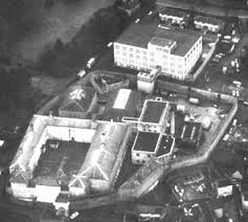
View of Shepton Mallet (left) and its execution shed (right)

Shepton Mallet had been a civilian prison for centuries before being turned over to the British military, who then lent it to the Americans as part of the Visiting Forces Act. Until its final closure a few years ago Shepton Mallet remained the oldest prison in the UK still operational, a dubious distinction now belonging to Dartmoor. There were, however, a few difficulties with the arrangement.

The Americans carried out 18 executions at Shepton Mallet during their tenure between mid-1942 and September, 1945. Two (Alex Miranda and Benjamin Pyegate) were by firing squad, upsetting local people, who knew very well what it meant to live next to a military prison and hear a single rifle volley at 8 a.m. The American military also preferred hanging common criminals to allowing them to be shot like soldiers.

The problems were simple. The locals didn’t like firing squads made no secret of it. Not surprisingly, there were complaints. The US military felt being shot was too good for most of its condemned and the British didn’t like the methods and equipment used by American hangmen, who had acquired a nasty and thoroughly-deserved reputation for using badly-designed scaffolds, the wrong type of rope and the antiquated standard drop instead of a drop length scientifically calculated by the prisoner’s weight.

The British also regarded American hanging equipment as outdated, while American military hangmen John Woods and Joseph Malta were entirely unfamiliar with the British kit. And British hangmen had evolved hanging to almost an art, needing mere seconds to complete the procedure.

Another problem was that the gallows at Shepton Mallet hadn’t been used since March, 1926. By 1942 it was considered unfit for service and needed replacing. A compromise had to be reached, and was.

The Americans could continue executions at Shepton Mallet, but the vast majority (16 out of 18) were performed by British hangmen using a British gallows in an extension built onto the end of one of the cellblocks. The Americans were permitted their usual practice of having the condemned stand strapped, noosed and hooded on the gallows while their death warrant and charge sheet were read out and then being asked for any last words. This caused executioner Albert Pierrepoint, master of the speedy hanging, to complain at what seemed to him a cruel, unnecessary delay in ending the prisoner’s misery.

Pierrepoint also complained about overcrowding in the gallows room during executions. At a British hanging there would be the prisoner, the hangman, his assistant, the prison Governor, the Chief Warder, the doctor, the Chaplain and two or four prison officers. At an American military hanging there were usually twenty or so people clustered around the trapdoors and lever. He felt a hanging should be both quick and perfect and that a crowded gallows room invited disaster.

Hangman Thomas Pierrepoint.

By VE Day the arrangement was well-established. Thomas Pierrepoint, uncle of Albert and brother of Henry (both of whom were also hangmen) performed 13 of the 16 hangings at Shepton Mallet while Albert performed the remaining three when he wasn’t busy elsewhere.

Their assistants were Steve Wade, Herbert Morris and Alexander Riley. Tom Pierrepoint had performed the last hanging at Shepton Mallet in 1926 (that of murderer John Lincoln) assisted by Lionel Mann. While the two firing squads were performed at 8 a.m., the hangings would be carried out at 1 a.m. which was discreet enough not to arouse neighbors’ ire.

Smith’s case was reviewed. Not surprisingly, his appeal was denied as were other requests including (most generously, under the circumstances) one from Lady Teichmann, widow of his victim. His date was set for 1 a.m. on what turned out to be the very day Europe’s guns fell silent. Tom Pierrepoint would do the job assisted by Herbert Morris. Smith was transferred to the Condemned Cell a few days prior to the execution date where he was granted free access to the military Chaplain.

When the time came, while the rest of the population celebrated the arrival of a new world and Smith contemplated his departure from the old one, it went as smoothly as could be expected. Smith was taken from his cell wearing standard military uniform, from which any badges or flashes marking him as a soldier were deliberately removed. Paperwork was completed signifying his dishonourable discharge from the US military as a common criminal and the US military were determined that he should die like one.

Given the delays caused by the reading of the charge sheet and death warrant and Smith being asked for his last words (he apparently had none) it took 22 minutes between Smith being taken from his cell and being certified dead by the prison doctor. Compare this with a standard British execution (minus the bureaucracy and speechifying) where 22 seconds would have been considered twice as long as was needed to do the job. Smith’s punishment, however, wasn’t done yet. Executed American servicemen were initially buried at Brookwood cemetery, but then moved to the notorious ‘Plot E’ of the Oisne-Aisne Military Cemetery in France. Plot E is deliberately hidden from the rest of that cemetery. Its residents have no names on their graves, only numbers. They have no headstones or crosses, only flat stone markers. No American flag hangs in their plot. It doesn’t appear on the plan of the cemetery even today and the markers are placed facing away from the graves of other Americans. Visits to Plot E are still discouraged and it wasn’t until a Freedom of Information request in 2009 that the names of those buried there were released.


A view of the “Dishonored Dead” in Plot E, Oise-Aisne American Cemetery. (cc) image by Stranger20824.

Whatever they may have done, and some committed truly dreadful crimes, it seems distasteful to virtually deny their existence and shame them even after death. It also denied their families and friends the chance to visit and grieve, despite the fact that they themselves had committed no crime.

That said, it’s no different to the routine imposed on condemned British criminals. In fact, the British death sentence expressly demanded that inmates be buried in unmarked graves within the prison walls inflicting the same suffering on their friends and relatives. The British hanged were officially designated ‘Property of the Crown,’ many of whom were not properly reburied until after abolition. At many British prisons they still remain in unmarked graves according to the following sentence:

Prisoner at the Bar, it is the sentence of this Court that you be taken from this place to a lawful prison and thence to a place of execution where you shall be hanged by the neck until you are dead, and that your body be afterwards cut down and buried within the precincts of the prison in which you were last confined before execution. And may the Lord have mercy upon your soul.

Remove the prisoner …

On this day..

2004: Nick Berg, by Abu Musab al-Zarqawi

Twenty-six-year-old American communications contractor Nick Berg was beheaded a hostage in Iraq on this date in 2004 — allegedly by the personal hand of Al-Qaeda in Iraq chief Abu Musab al-Zarqawi.

A veteran of the mujahideen who drove the Soviets out of Afghanistan in the 1980s, Zarqawi spent most of the 1990s in a Jordanian prison but was amnestied just in time to rejoin militant Islam before it became a post-9/11 boom industry.

Zarqawi’s Jordanian terrorist group Jama’at al-Tawhid wal-Jihad, founded in 1999, transitioned with the American invasion of Iraq into the Al-Qaeda franchise in that country, a feared prosecutor of the sectarian civil war there, and the lineal forbear of the present-day Islamic State (ISIS or ISIL).

It also became a lusty early adopter of the emerging beheading-video genre: an ancient penalty perfectly adapted for the digital age.

This ferocious group was a severe mismatch for Berg, a Pennsylvanian freelance radio tower repairman (and pertinently, a Jew) who set up his Prometheus Methods Tower Service in the northern city of Mosul* in the months following the 2003 U.S. invasion. This was also around the time that American occupation forces’ abuse of Iraqi prisoners at Abu Ghraib came to light — a powerful excuse for blood vengeance.

Berg vanished from Baghdad in April 2004, and was not seen in public again until the whole world saw him: the unwilling feature of a May 11 video titled Sheik Abu Musab al-Zarqawi slaughters an American infidel with his hands and promises Bush more.

“We tell you that the dignity of the Muslim men and women in Abu Ghraib and others is not redeemed except by blood and souls,” a voice says. “You will not receive anything from us but coffins after coffins … slaughtered in this way.”

Warning: Mature Content. This is both a political document of our time, and a horrifying snuff film. Notice that Berg appears in an orange jumpsuit, a seeming allusion to Muslim prisoners being held by the United States at Guantanamo Bay.

Twenty-five months later to the day, Zarqawi was assassinated by a U.S. Air Force bombing.

* As of this writing, Mosul is occupied by Zarqawi’s creation, the Islamic State.

On this day..

1791: William Jones, “in a country out of the reach of my enemies”

On this date in 1791, a man named William Jones hanged in Newark, N.J.

Jones cut an apologetic figure at his public execution, and a confession he signed off in the hours before was widely reprinted in New England newspapers. (This transcription is from the Boston Independent Chronicle of May 26, 1791.)

Knowing that without repentance there can be no salvation, and without a sincere confession of our public transgressions, there can be no true repentance, therefore I would give glory to God, exonerate and ease my own wretched mind; and as far as possible, afford that satisfaction to the public, by confessing my crimes, that others may take warning by my awful but just end, and be preserved from such horrid iniquities. This is the only reparation I can make to society, for the evil I have done, for which I am righteously, in the midst of my days, cut off from among men.

I confess I have been exceedingly wicked from my youth. I have been habitually addicted to Sabbath breaking, swearing, keeping evil company, gaming, drinking to excess; and when in liquor, passionate and quarrelsome, and have indulged myself to a high degree in other base and horrid abominations.

But the crime for which I am now to die, I would, with the greatest exactness relate. — I solemnly declare, I never intended to kill Mr. Shotwell, nor had I, at any time, as far as I know, murderous intentions in my heart against him, yet, I was the unfortunate man, that, to gratify my wicked passions, was the occasion of his death. I had long had a spite against Shotwell, because I looked upon it, that he & another man had injured me much, and were the cause of my being obliged to settle a civil prosecution, commenced against me, greatly to my wrong. Therefore I had often said, I would whip, beat or flog Shotwell, but as I never had a thought in my heart to murder him; as a dying man, I never said, I would kill him.

On the evening of Friday the 1st day of April, about or a little after sun down, I saw Samuel Shotwell pass my mother’s house driving cattle or a pair of oxen. In sometime, afterwards, I arose, went out into the road, and followed after him. I met Letts and stopped and talked with him for some minutes perhaps six or eight; then we parted and I followed after Shotwell. I crossed the fence in order to cut off a crook in the road and re-crossed the fence into the road still behind him. About three quarters of a mile from where I had seen Letts, I overtook Shotwell, and, without speaking a word to him, or he to me, I knocked him down with my fist, and there kicked him in the face and head, having on a pair of strong heavy shoes. I then passed the fence into the field opposite to where Shotwell lay. In a short time I saw him rise and go on the road, and I went along in the field. I had thoughts of going to a certain house, at no great distance before us, but before I came to the house, I altered my purpose, and so passed the fence into the road before Shotwell and going back along the way, I presently met him. I knocked him down again with my first, and again kicked him, and left him, and went on the road home. After sitting by the fire a little while, I went to bed, but was very uneasy lest I had beat Shotwell too much.

With regard to the club, of which much was said in the course of my trial, I never had it in my hand, nor did I ever see it, till the next day at the Coroner’s inquest. It was not the weapon I made use of nor had I any weapon whatsoever; but by knocking down Shotwell and kicking him in the manner related, I was the unhappy cause of his death.

I leave this testimony and confession, that my awful conduct may be a warning to others, that they by my dreadful fate, may be admonished to refrain from evil company, and from allowing themselves in drunkenness, wrath, malice or intemperate passions. My wickedness has brought me to this just and awful doom. May all others hear and fear!

WILLIAM JONES

A sad end for Messrs. Jones and Shotwell both; readers of the 21st century as well as the 18th ought to hear and fear.

But to the end of this awful but uncomplicated tragedy, we have this curious broadsheet published later in 1791.

What to make of this artifact?

One notices at first blush that as the document was printed in broadsheet form, it was presumably intended for the enrichment of its publisher … and we might suppose treacherous albeit not unpassable footing on the route from anyone actually party to such an occult missive in real life to a hustler harvesting gawkers’ pennies on the incredible secret. Indeed, it would be a profoundly ill turn for Jones or his correspondent, for no better reason than a gloat, to expose the physician of his deliverance to the sanctions that might attend unmasking. If this pamphlet’s remarkable claims were recapitulated in any other media at the time, I have not been able to locate it.

Even presuming that we have a sensational forgery, our bulletin does have something to say to us yet, and not only about the evergreen human fascination with surviving an execution.

This is a document from the Enlightenment, an interval where the vaunting progress of human ingenuity designed even to steal a march from the reaper himself by reviving the drowned or reanimating the dead.

Hangings were survived sometimes — not commonly, but often enough that the phenomenon was familiar and occasionally the enterprising condemned even schemed to accomplish it intentionally. Such a scenario necessarily inspired artists, whose fabulisms would only have reflected the fancies of their audiences. The scaffold was already being given over routinely as the portal to spiritual escape for the penitent knave crushed by his sin … why not the escapism of the flesh, too?

Maybe our broadsheet publishers took inspiration from the fantastic story a couple of years prior of a different man living through his hanging in Massachusetts. Though that earlier tale was perhaps more overtly crafted for moral instruction, the particulars of the harrowing procedure are much the same: the assistance of an obligingly altruistic doctor, the agonizing pain of resuscitation, and the convenient vanishing into unverifiable distant anonymity. Even Nathaniel Hawthorne would allude via a minor character in The Blithesdale Romance to the legend that an English banker executed in the 1820s had duped the hangman — and not unlike our William Johnson, Hawthorne judged that living phantom and his stolen years “a mere image, an optical delusion, created by the sunshine of prosperity, … [who] seemed to leave no vacancy.”

On this day..

1854: John Hendrickson, junk science victim

On this date in 1854, an Albany, N.Y. man named John Hendrickson hanged for the murder by aconite poisoning of his wife, Maria. “He has suffered the highest penalty of the law,” New York’s Weekly Herald pronounced the next day — “but whether justly or not, will likely never be known on earth.”

Whatever the prisoner’s denials,* a web of suspicious circumstances clasped the hemp around his throat. Hendrickson, whose family had some money and connections, fought the conviction tooth and nail; his then-unusual three appeals, plus clemency petition to the governor, stretched the time from conviction to execution out to nearly a year. “The evidence adduced … was so entirely circumstantial, and the testimony of the scientific men so liable to doubt and contradiction, that it was generally feared the murderer would escape,” a Boston Post correspondent reported.** But not to worry: “the atmosphere of guilt seemed to surround him in the whole county; not a man could be found that, at heart, believed him innocent.” We’re scarcely prepared at this distance to assert an affirmative case for the man’s innocence, but in some ways it reads like an antebellum Cameron Willingham case, all the way down to the dubious forensic evidence.

Like Willingham, Hendrickson was a less than stellar husband. He was noted for abusing his wife, philandering, and doing both together when he “communicated to her a loathsome veneral disease.”

The supposed murder motivation was his wife’s recent inheritance of the estate of her father, who died just a few months before the murder. Little could really be proven save by inference from the man’s bad character; in classic tunnel-vision fashion, the record suggests nearly every data point became fixed according to this theory. For example, Hendrickson’s trial prosecutors read into evidence — in the part of their presentation they called the “Moral Evidence” — that Hendrickson remarked at his wife’s autopsy that “they won’t find arsenic.” You and I might think he’s saying that the examination will dispel the gathering suspicions of poisoning, and saying it by reference to the chemical that was the metonym for poisoning in the nineteenth century. For the state, his uttering these words was

as if he knew (as he undoubtedly did) the precise poison which she had swallowed — as if he knew that that common poison, which is found in most cases of the kind, had not been given by the murderer in this case, and hence they won’t find arsenic. Ah! gentlemen, it was nature speaking out, as she often unconsciously or unguardedly will, disclosing the otherwise well concealed and apparently undiscoverable crime.

(This is why you don’t talk to police.)

The district attorney introduced evidence courtesy of chemists named Salisbury and Swinburne, to the effect that it was no mean arsenic that carried away Maria Hendrickson but the more exotic potion of aconite — derived from a toxic herb seeded (per Ovid) by Cerberus himself.

One can peruse the evidence presented in the case here, but the most remarkable part of this trial record is the appendix — wherein numerous medical men, including a former teacher of Dr. Salisbury, skewer the forensic processes used to decide that Maria Hendrickson died by poison and even offer to reproduce them in person under the eyes of Gov. Horatio Seymour to prove their unreliability. Their findings harshly undercut the only concrete evidence that any murder took place at all.

“I am pained and oppressed with the conviction that the medical witnesses for the prosecution have, in a main point of this case, abused the confidence with which criminal courts so often compliment the man of science,” one writes — words that could still today be applied to many disciplines of junk science that have disappeared bodies into oubliettes on the strength of lie detectors, bite mark analysis, matching hair samples, and suchlike hocus-pocus.

We turn from the contemplation of this subject with feelings of sorrow, not that any of ours have been crushed under the wheels of mutilated justice, set in motion by ignorance and false science, but we feel now, as we have always felt, that a great personal wrong has been committed under the authority of law, for which there can be no atonement, as the dead cannot be brought to life, nor the blasted feelings of the living restored.

It would be well, too, for judges and jurors, who are very often hasty and inconsiderate in letting their feelings and prejudices get the better of their judgment, to remember that life, human life, is neither a toy nor a rattle, but the gift of God; when once extinguished, no matter how, it is gone forever, and the dead never rise again.

-Dr. Charles A. Lee, reviewing the Hendrickson case

* Hendrickson’s final message to his parents via his spiritual advisor, on the eve of his hanging:

To-morrow I am to die, and standing as I do on the brink of eternity, I wish to say to you, in the presence of that God before whom I am so soon to appear, that I am entirely innocent of the crime of murdering my wife. I did not give her poison. I do not know that any one gave her poison. She did not come to her death by violence of any kind, so far as I know. I believe she died a natural death. She did not vomit on the night of her death. [This remark touches the disputed forensic evidence; vomiting would be a symptom of poisoning, and state chemists’ assertion that Maria had done so was among the conclusions challenged by outside scientists. -ed.] I never knew that there was such an article as aconite in the world, until after I was in jail. Nor did I know it by any other name. I do not know that I have anything further to add, except to say some farewell words to my parents. But you will remember what I have said to you, and inform them of it. I wish you to make it public.

** Transcribed here via the Portland (Me.) Advertiser of Apr. 18, 1854.

On this day..

1943: Rev. Leonard Kentish, kidnapped Australian civilian

On lonely scrubland at the Aru Islands port of Dobo on this date in 1943, the Japanese military beheaded kidnapped Australian Rev. Leonard Kentish.

Nobody knew his fate at the time — his wife spent years tring to discover it — but the so-called “Kentish Affair” was one of the true oddities of the Pacific War: a civilian of no particular import to the war effort who was snatched from Australian territorial waters.

On January 22, 1943, the civilian Kentish, chief of Northern Territory Methodist missions to the aboriginal peoples, had hitched a ride on the HMAS Patricia Cam, a wooden tuna trawler that had been requisitioned as a wartime naval transport. The Patricia Cam wasn’t running any blockades — she was strictly for local cargo runs, in this instance shuttling among Elcho Island and the Wessel Islands just off Arnhem Land.

She had no radar capacity, and no inkling at all of her fate that afternoon when the Aichi E13A floatplane dove out of the sky and skimmed above the Patricia Cam, within 100 feet of the mast — dropping a bomb amidships that ripped open the trawler’s belly and sent her to the bottom.

While survivors scrabbled in the Arafura Sea for “overboard drums, planks, boxes — anything that would float” the raider circled for another pass, splintering with a second bomb an emergency canoe that men were crowding into, then strafing the waves with machine gun fire. Finally, the victorious seaplane set down in the waves.

And then mysteriously, the pilot gestured Rev. Kentish into the vacant seat of his plane, and took off. Kentish was the only prisoner taken, and his countrymen never again laid eyes on him.

Sixteen other people survived the attack and were rescued a few days later. But poor Mrs. Violet Kentish remained entirely in the dark as to the fate of her husband. “I know that Len is not beyond God’s love and care wherever he may be,” she vainly pleaded to the Minister of the Navy. “But you will understand because we are only weak humans, the heartache and longing for one we loved so much.” (Quoted in Australia’s Forgotten Prisoners: Civilians Interned by the Japanese in World War Two)

After World War II, she desperately resorted to firing letters to newspaper editors, until an intelligence officer chanced to read one published in the Argus and made the necessary inquiries via U.S. Gen. Douglas MacArthur’s staff in Tokyo to unravel the mystery. In the clipped official findings:

1. The Rev KENTISH was taken on board a Jap float plane on Jan 22 43 after it had sunk the patrol vessel HMAS “PATRICIA CAM” off WESSEL IS.

2. Unfortunately no info can be obtained of the whereabouts of the Rev KENTISH until 13 Apr 43, when he arrived at DOBO.

3. The Rev KENTISH was held at DOBO as a prisoner till the 4 May 43. Throughout this period he was subjected to ill treatment by severe bashings, the most common being punches in the nose and eyes to such an extent that his nose was broken, and he had great difficulty in seeing. His diet, as such, was just sufficient to keep him alive.

4. On the morning of 4 May he was taken in to the scrub, (a distance of under 200 yds from the township of DOBO) where a grave had been prepared, and executed.

5. The execution was carried out by the order of 1st Lieut SAKIDJIMA.

6. The remains of the Rev KENTISH have been recovered, and handed over to Capt STOCKWELL, of the War Graves Unit. They will be transported to AMBON, and buried in the Internees cemetery there.

7. This case is now considered closed. All dates must be treated as approx.

The consequence of this inquiry was a 1948 war crimes case against Lt. Sagejima Maugan, who was hanged in Hong Kong on August 23, 1948 for conducting Rev. Kentish’s execution.

On this day..

1867: Modiste Villebrun, but not Sophie Boisclair

(Thanks to Meaghan Good of the Charley Project for the guest post. -ed.)

On this date in 1867, Modiste Villebrun was hanged in Sorel, Quebec, in what would be the last execution before Canada became its own country. His partner in crime, Sophie Boisclair, might very well have been executed alongside him had she not been pregnant.

Villebrun, a lumberjack from St. Zephirin, was having an affair with Boisclair and they wanted to get married. They had two slight problems to deal with, in the form of their respective spouses. In those times, divorce was unthinkable. Murder, apparently, was not.

Jeffrey E. Pfeifer details their crimes in his book Death By Rope: An Anthology of Canadian Executions:

The first victim was Villebrun’s wife, and their plan seemed to work well. No one suspected foul play when the previously healthy woman died, or at least no one could prove anything. Braced by their success, the lovers soon turned their attention to Boisclair’s husband, Francois-Xavier Jutras. Boisclair suggested to her husband that they should allow Villebrun to move in with them since the death of his wife had left him all alone. Jutras agreed to his wife’s request and almost immediately Boisclair began to lace his food with her “special” ingredient. It was not long before the strychnine took effect and Jutras was dead.

Unfortunately for the two lovers, a suspicious doctor demanded an autopsy, which revealed the dead man’s body was saturated with poison. Villebrun and Boisclair soon found themselves arrested.

They were tried separately and both were convicted in short order and sentenced to death. When asked, at sentencing, whether she had anything to say, Boisclair announced she was expecting a baby. She got a temporary reprieve until delivery, and got the opportunity to watch Villebrun’s execution from the window in her cell.

Ten thousand people attended his hanging.

Seven months later, Boisclair gave birth to his child, and her sentence was commuted to life imprisonment.

“Boisclair ended up serving 20 years in the penitentiary,” records Pfeifer, “before being released, a broken woman.”

On this day..

1612: The slave rebels of Mexico City

On this date in 1612, Spanish colonial authorities smashed an alleged plot among Mexico City’s black slaves with a grisly mass execution.*

In Mexico as elsewhere in the Americas, African labor had been imported en masse in the 16th and 17th centuries; David Davidson estimated** that Mexico City had a black population ranging from 20,000 to 50,000. And as elsewhere in the Americas, they frequently resisted: Mexico City slave risings dating back to the 1540s had badly shaken the city, and led the viceroy Luis de Velasco to worry in 1553 that “this land is so full of Negroes and mestizos who exceed the Spaniards in great quantity, and all desire to purchase their liberty with the lives of their masters.”

The most illustrious name of this era was Gaspar Yanga, who was kidnapped into bondage from the Gold Coast, and escaped bondage by leading a large band of fugitive slaves into the highlands of Veracruz and founded an outlaw colony that still bears his name today.

Yanga’s palenque — known in his time as San Lorenzo de los Negros de Cerralvo — had to fend off military action by the Spanish authorities from 1609 until a truce in 1618.

Still, a truce was possible: a refuge like San Lorenzo offered slaves the unwelcome-to-their-masters prospect of escape from the scourge economy, but the real threat to New Spain was that purchasing liberty with lives bit.

As we have seen in the American South, the situation on the ground begat paranoia that makes it nigh impossible for later interlocutors to disentangle fact from fantasy: was there really a phenomenal slave rebellion nipped in the bud? Or just informers and torturers refracting the terrors of those outnumbered Spaniards?

The slaves in this case were said by a Portuguese merchant who overheard them to be readying themselves to exploit Spanish inattention during Holy Week celebrations, and to bloody those days by falling upon their masters and taking possession of the colony. In the inevitable rounds of arrests and torture that ensue, the alleged plot as recorded by the annalist Chimalpahin (Spanish link) sounds suspiciously like a psychosexual projection, for it

involved castrating any surviving Spanish males, making sexual slaves of white women, and gradually “blackening” the latter’s descendants.**

Certainly the punishment blackened Mexico City; our correspondent uses this same word to describe the condition of the gibbeted corpses when they were finally let down from their gallows on the feast of the Holy Cross. Even then, the flesh of the would-be slave kings could not rest: most were beheaded posthumously and mounted on pikes while six others were quartered for display on all the roads entering the capital. This in itself was a small moderation for the public good. Chimalpahin reports that doctors advised the state that “if all the dead were to be quartered and hung up in the main streets to rot, their stench will blow a sickness across the city.”

* Thirty-five is the execution count supplied by Chimalpahin; some sources give 33.

** “Negro Slave Control and Resistance in Colonial Mexico, 1519-1650,” The Hispanic American Historial Review, Aug. 1966.

† Maria Elena Martinez, “The Black Blood of New Spain: Limpieza de Sangre, Racial Violence, and Gendered Power in Early Colonial Mexico,” The William and Mary Quarterly, Jul. 2004.

On this day..