1720: Matthew Tompkins, Daniel Lazenby, and Maurice Fitzgerald

THE Ordinary of NEWGATE

HIS ACCOUNT OF The Behaviours, Confessions, and Last Dying Words of the Malefactors that were Executed at Tyburn on Monday the 15th of August, 1720.

The Sunday preceeding the Execution of the Prisoners, I preached to them from the following Words.

Bloody and Deceitful Men shall not live out half their Days. (Psalm 55th, part of the 23d Verse.)

We first observed that the Psalmist every where speaks of Murder with conscious Sense of Shame; The Prophet Nathan’s Parable had pierced his Bosom, and cut deep into his Heart. Well knew he, that Uriah was the poor Man with an only Lamb, that was tender to him, and lay every Night in his Bosom: His Conscience started at his Guilt; and the prospect of Love that was pleasing late, is shocking now: The Beautiful Bathsheba, and the Blood-stain’d Uriah rise up at once to his View; and in the bitterness of Soul he cries out, Deliver Me from Bloodguiltiness O God, Thou God of my Salvation! (ver. 14.)

But deep and hearty was David’s Repentance; and for every Pleasure he paid a thousand Tears. Therefore, notwithstanding his Guilt, he hopes God will save him from his Enemies. That Confidence as he often expresses, so particularly in my Text, Thou, O God, shalt bring them down into the Pit of Destruction; Bloody and Deceitful Men shall not live out half their Days.

From the Words we observed the following Things.

First, We consider’d the Nature of Bloodguiltiness: According to, 1st, the Natural; 2d, the Jewish; 3d, the Christian Law.

Secondly, We consider’d Who were meant by Deceitful Men.

Thirdly, Very briefly advis’d all to a serious Reflection on the Doctrine; because, Bloody and Deceitful Men do not live out half their Days.

First, We consider’d Bloodguiltiness according to the Law of Nature.

This is a tacit Law, engraven on the Heart, that plainly exclaims against Murder. For ’tis not agreeable to Natural Reason to suppose that I and another Rational Creature, being both of Us the Right and Property of some Superiour Being that caused us to be, can have a Right to rob that superior Being of that his other Creature by Murder. That other Creature also has a Natural Right lodg’d in him, by the Creator, to enjoy the Light of the Sun; to sleep, and feed, and whatever else the Creator has thought fit to make him capable of enjoying. As therefore, I did not give him this Capacity of Enjoyment, ’tis plain, I can have no Right to take it from him; Unless indeed where I have a particular Commission from God to do it; which is the Case of the Brutes we devour.

This is according to the Light of Nature: And even the Heathens of Popayan and Paraguay, Tho’ they used to fat up their Captive Foes, to feast upon their Flesh, yet had so much Glimmering of the Dictates of Reason, as to detest, and severely Punish the Murder of their own People; Looking upon no Crimes as Capital but Incest and Murder; But to show their Abhorrence of Them, The Prince with a Dart pursued the Offender and with his own Hands destroyed him.

2d, We consider’d Bloodguiltiness according to the Mosaic Law.

This Law, agreeable to that of Nature, is very express against Murder. Whosoe sheddeth Man’s Blood, by Man shall his Blood be shed.

Under this Head, I took Notice of what I have sometimes thought remarkable, viz. That the very Giver of this Law, Moses, should slay a Man, without any Accusation laid against him. This a Hebrew, who had heard of it, thought a Crime; and accusingly said, Intendest thou to kill Me as thou didst the Egyptian Yesterday? It also made a great Noise in the Land, so that Pharoah was acquainted with it: But Moses fled from the Face of Pharoah, and dwelt in the Land of Midian. (Exod. 2. 15.) The Manner of his Slaying Him, was thus; And he spy’d an Egyptian smiting an Hebrew, one of his Brethren. And he looked this way and that way, and when he saw that there was no Man, he slew the Egyptian, and hid him in the Sand. (Exod. 2. 11, 12.)

The usual way of Answering this Difficulty, is, either by supposing it a wicked Action, tho’ not noted as such in Scripture; Or else, by saying, that Moses had a particular Commission from God to perform this Murder. But certainly that would be an Omission in the Sacred Writ (which far be it from any one to conceive) to leave out such a material Information; because the Murder is committed by a Person who is represented to Us as the Reverse of such a Doer. All Evil-Actions mention’d in Scripture, are mention’d for a Good End; and serve either to deter Us from the same Sins, by the Punishment annex’d to them; Or, to prevent our Despair, by the Sight of God’s Forgiveness: But it can serve to neither, of these Ends, to show Us a Virtuous Man Sinning, without noting him as disagreeing from himself.

This Answer therefore, seems to Me not to come up to the Difficulty. I would rather, with Submission, answer it thus. We must suppose it to be a Lawful Action; and who can assert the Contrary; unless he knew the Nature of the Skirmish between the Egyptian and the Hebrew? For it might be a justifiable Murder, if we suppose the Egyptian to be so beating the Hebrew, as resolving to have his Life; and to be so violent and furious therein, as that the Interposer Moses could not save the Life of the Servant of God, but by taking away That of the Barbarian; I think, with Submission, in that Case, it might be lawful for Moses to do it. The Egyptian was in the nature of an Assaulter, or Robber; and Grotius with the other Ethick Writers, determine, that I and my Friend may defend my own Life at the Expence of a Robber’s Blood. And this especially before the Christian Dispensation.

To this it may be objected, that Moses need not have looked this Way and that Way, to see if any was near, had he had this Cause for slaying the Egyptian. To this I answer, that tho’ this justified the Action in the sight of God, yet Moses knew it would not in the Eyes of Pharoah; who, we may suppose, had rather ten Hebrews should dye, than one Egyptian; As appears from his ordering all the Male Hebrew Children to be slain, only lest the Hebrews should grow too strong.

To confirm this Explication, we may observe, that the rescued Hebrew would not, in all probability, have discover’d his Brother and Deliverer, unless he had conceiv’d an Opinion (without thinking so far as Pharoah’s Partiality towards the Hebrews) that it was not a Criminal Action, on Account of the Murderous Intent of the Egyptian: And He must be the Discoverer, because we read, There was no one present. (ver. 12.)

3dly, The Christian-Law is much more express against Bloodguiltiness, than either the Natural or the Jewish; insomuch, that, Whosoe hateth his Brother is a Murderer. And agen, Whosoe sayeth to his Brother, Thou Fool, is in Danger of Hell-Fire. So far must Christians be from Murder, that Christ says, Resist not Evil; but whosoever smiteth thee on one Cheek, turn to him the Other also. (Mat. 5. 39.) Contrary to the Jewish Law, which said, An Eye for an Eye, and a Tooth for a Tooth.

Secondly, Under the Second general Head we consider’d, who are meant by Deceitful Men, – Bloody, and Deceitful Men.

  • 1st.) By Deceitful Men, may be meant False-Friends. This certainly is very sinful. ‘Tis also imprudent, We should well consider before we take a Friend to our Bosom; and better consider before we throw him thence agen.
  • 2dly.) By Deceitful Men, may be meant Thieves. As the Psalmist says, He sitteth lurking in the thievish Corners of the Streets. Psal. 10. 8.

    It is become usual for Us to see Robbings in the publick Streets; How different are you from the Example of our Saviour; He went about Doing Good, But you Doing Ill: He preach’d Peace thro’ the Streets, But you denounce Slaughter and Rapine. Little then would one think, ye had renounced the World at your Baptism, and profest your selves Followers, Pupils, Imitators of Christ.

    Some in your Conditions have seem’d to value themselves upon their bearing their Misfortunes as becomes Men: But can ye take a sort of Pride in dying Couragiously like a Man, and not be ashamed of having liv’d like Brutes? Was their not something Mean and Base (for that ye will most regard) in inhabiting the Night, and flying the Face of Day, which Man was form’d with an Aspect erect to gaze at? The Apostle says, We are not of the Night, but of the Day; and let us who are of the Day be Sober; putting on the Breast-plate of Faith and Love, and for an Helmet, the Hope of Salvation. 1 Thess. 5. 8.

  • 3dly.) By Deceitful Men may be meant Defamers and Backbiters. This is a Deceit, perhaps as pernicious as the Thief’s, tho’ not equally liable to Punishment: The Robber despoils Us of our Goods, the Defamer, of our Reputations; One injures Us Clandestinely, The other to our Face. But Christ said, Let him who is without Sin among you, first throw a Stone at Her.

Thirdly. The Third General Head was, to perswade All to the Consideration of the Doctrine, for the Reason in the Text, Bloody and Deceitful Men shall not live out half their Days.
Under this Head we consider’d the Misery of being cut off in the Pride and Prime of Youth, while the Face of Nature was delightful, and joyous the Light of the Sun: And that this Misery was but the Natural Consequence of Sin, especially of Bloodguiltiness, agreeable to the Text.

I lastly conjured them, to compensate for their former evil Lives, by the uncommon Earnestness of their Repentance; Never to leave Assaulting the Throne of Grace, till they had some dawning Assurances of Salvation; But so to expend their few remaining Hours, that they might launch forth from Sorrow to Joy; from Pain to Satisfaction; and from a World of Care into Realms of never fading Pleasures.

1. Matthew Tomkins, was Convicted of robbing John Wickers, on the High-way, of 4 Guineas and 16 s. 6 d.

The Account he gave me of himself was as follows.

He said he was 22 Years of Age; a single Man; born at Tunbridge, where he has now a Father and Mother residing in good Credit and Reputation. He said, they brought him up with the utmost Tenderness, and gave him a considerable share of Learning. He never was Apprentice to any Trade; but was in Quality of a Book-keeper for some time, at a great China Shop in London, where nothing was objected against his Behaviour.

He said, he was lately Master of about 400 l. That he then gave himself up too much to Pleasure: He was often advis’d by his Friends to purchase a Place for Life, but never was so happy as to follow their good Counsel; He added, that he liv’d in a very jovial Manner, upon the principal Money, pursuing his Pleasures, and denying himself nothing that might tend to the Gratifying his Inclinations.

Upon a Day (as he told me) he took a Ride to Ware in Hartfordshire, alone by himself; but he there got into some Company, they proposed a Game at Cards, which they said they did not well Understand, ’twas a new Game, but they were told ’twas very Diverting. Mr. Tompkins soon undertook to play with them. When he had lost all his Money, he call’d for his Horse, in order to return to London.

Upon the Road, he said, he met a Man, of a sober Aspect; whose Occupation he should little have suspected from his Appearance. With this Person he fell into Discourse, and was complaining of the Tricks and Deceits of Cards, and related how he had been served at Ware, where he had been bubbled out of all his Money. The Stranger told him, he need not be necessitated for Money, so long as he was upon an open Road; and in short, gave him a Pistol. The next Gentleman they met, they rob’d of four Guineas and some Silver, half of which he had; and parting with his Instructor at London, never saw him after.

This is the Account he gave me of his committing this wicked Action. He also told me, That he had let his Parents know his Misfortunes he was under, but had, at the same time requested of them, not to come to London on that Account, for it was not in their Power to be any way Serviceable to him in that Condition; but that the Sight of them, who had always used him with so great Tenderness and Affection, would greatly aggravate and encrease his Sorrow.

He shou’d me a Book, which a Clergyman sent him, which he said had been the occasion of his passing the sad and Melancholly Hours of Confinement, not only with Patience but with some Satisfaction and Delight.

The Saturday before his Execution, He told me he had then entirely laid aside all Thoughts of the World, and that the Sight of his Acquaintance was become Painful to him; for he had in some measure habituated Himself to think of Heaven, till it was become Grateful to him in the Consideration.

2. David Lazenby, was Convicted of breaking open the Chambers of Charles Wood, Esq; in the Night-time, and stealing thence, some Holland Shirts, Cravats, a Beaver Hat, Sheets, a Cloath Coat and Wast-coat, Worsted Stockings, &c. The Account he gave me of himself was as follows.

He said, He was 26 Years of Age; Born at Market-Weston in Suffolk, of honest and reputable Parents. He was put Prentice to a Weaver; to which Trade he served his 7 Years out. But this Employment not being sufficient to maintain him, he said, he went into the Country; Being there at a loss how to employ his time, and procure a comfortable Subsistance, he at last determin’d to set up a Publick House, which he accordingly did; but soon growing weary of that noisy and quarrelsome Life, he returned again to London, where he met with tolerable Encouragement in his own Trade.

He said, that at the Time he was Apprehended on Suspicion, he liv’d at Hoxton, where he Employ’d 5 Journeymen under him at the Weaving Business .

He told me, that during my Sickness, a Great Distiller in Fore-street had desired to speak with me concerning him; that I would put the Question to him, whether he was not concern’d in robbing his Dining-Room, of several peices of Plate, some marked with his Coat of Arms, and some Plain. When the Prisoner had told me this, I accordingly taxed him, as he was a Dying Man, and had I hoped a value for his Soul, whether he knew any thing of the aforesaid Robbery? But he solemnly protested that he was entirely ignorant of it.

Another Gentleman also in Hoxton-Square, apply’d to me, to desire I would put the Question to him, whither he was not concern’d in the Breaking open his House; he having suspected him on Account of some Tickets for an Entertainment, dropt near his House, with David Lazenby’s Name thereto. But the Prisoner said, the Tickets were accidentally dropt by that House, and were for him and some Friends to make merry innocently together. I hope he was sincere in his Declarations.

3. Maurice Fitzgerald, was condemned for the Murder of a Watchman in the Strand.

He was about 20 Years of Age; born in Ireland; his Education was Liberal and Genteel. As to his Behaviour during his Confinement, after the Sentence pass’d upon him, it was Sober and Grave; he constantly frequented the publick Service in the Chappel, where he appear’d not without Devotion and a sense of Religion, making the Responces very duely, and reading the Psalms alternately after me. Notwithstanding this, It has been thought that he did not dye in the Communion of the Church of England; But this I think he would not have dissembled, had it been so; for I put the Question to him, and he told me that he dyed a Member of the English Church. I frequently talk’d with him about the Nature of his former Course of Life, and his Stabbing a Man sometime ago with a Penknife; he seem’d to acknowledge that among all Courses of Life, the Sober and Serene Man bids the fairest for Happiness even here; and that no Satisfaction really consists in having the Spirits always in a Hurry and a Flutter, and in flying about from one House of Obscenity to another.

The Account of them at the Place of Execution.

Maurice Fitzgerald. At the Tree he spoke to the People present; signifying that he had reason to accuse some Persons as to his being Executed, whom he Named. He then declared, that he dyed in Charity towards all Men; and desired the Spectators Prayers for his departing Soul; adding, that he was pleas’d and easy at his leaving Care and Anxiety. He then gave me a Letter for his Brother; and ask’d me if I had retain’d the Paper he gave me at the Sacrament. He had been Scandaliz’d for Living with a Lady in a vicious Manner, to wit, Mrs. Witworth; That Paper relates to this, and is as follows.

SIR,

I Beg you will satisfy the World, that I was lawfully Married to Mrs. Witfield, according to the Rights and Ceremonies of the Church of England, as I shall answer before the Great and Good God one Day, and to her. Witness my Hand, this 14th of August, 1720. M. Fitzgerald.

David Lazenby. At the Tree, he deliver’d me a Paper, which he desired I would by all means Publish; and was as follows.

WHEN under Sentence of Death, one Mrs. Flowers came to me, concerning a Robbery, which one John Young swore her into: Now, I David Lazenby do solemnly declare upon the Holy Sacrament, which I take this 15th day of August, that the said Robbery (at the Quaker’s next Door to the Nagg’s Head in Islington) was committed by two other Persons, whose Names are John Brush, and Joseph Smith. Neither was Mrs. Flowers any way concern’d in purchasing the Goods.

THO. PURNEY, Ordinary and Chaplain.

LONDON: Printed and Sold by JOHN APPLEBEE, a little below Bridewel-Bridge, Black-Fryers.

On this day..

1944: Lucien Natanson

Erwin Lucien NAUM-NATANSON, born in Bucharest (Romania), on April 5th, 1921, merchant, son of Julien and Jeanne SCHWARTZ, husband of Jeanine Hélène PROVOST, living in La Paute, killed in La Paute, on August 14th, 1944, around 21 o’clock.

The excerpt above from a report of judges and doctors of Le Bourg-d’Oisans on the executions inflicted by a German column in August 1944 comes from a family page compiled by a cousin of Lucien Natanson. Twenty-three years old and Jewish, Natanson had spent the war years laying low with his family in southeastern France until … well … read on.

On this day..

Feast Day of Pope Pontian and Antipope Hippolytus

August 13 is the shared feast date* of third century saint and antipope — two adjectives rarely held in tandem — Hippolytus of Rome, and also the feast of the official pope to whom he reconciled in the end, Pontian.

His legend, including his feast date, has been muddled with another ancient martyr of the same name, and even with the mythological son of Theseus — from which also derives the etymologically apt fancy that St. Hippolytus met his end by the straining of horses.**


The central panel (click for the full image) of the St. Hippolyte Triptych, from the Sint-Salvator Cathedral in Bruges, Belgium. (via the blog of Canadian Archbishop Terrence Prendergast) Attributed to Dieric Bouts and Hugo van der Goes, this image was commissioned by a courtier of Charles the Bold, Hippolyte de Berthoz — who also underwrote other depictions of his namesake’s martyrdom.

But Hippolytus the theologian and cleric was no fable.

Zealous after the correct doctrine in an age of heretical pitfalls like modalism and alogianism, Hippolytus clashed with Pope Zephyrinus and his successor Callixtus over their leniency — not only for heterodoxy but also for sinful conduct like adultery.

This timeless horn-locking between purists and pragmatists led Hippolytus to take his flock out of the Roman communion in opposition to Callixtus, and apparently to maintain himself as antipope for the best part of a generation — the very first recorded antipope, in fact.

Ironically it was the schismatic’s perspicacious quill that would bear to posterity much of our understanding of Christianity in the early third century. Apostolic Tradition, whose attribution to Hippolytus is contested, is a rare source on the early liturgy; Refutation of All Heresies helpfully catalogues dozens of beliefs disfavored of its author among pagan and Christian sects. He wrote a chronicle of the world since its creation, a compendium of ecclesiastical law, and numerous Biblical commentaries.

While world-shaping controversies gripped the sacerdotal space, the temporal world spiraled toward Rome’s Third Century Crisis, a periodization commonly dated to the rise of the cruel barracks-emperor Maximinus in the very year of our rival pontiffs’ martyrdoms, 235.

Maximinus’s years in the purple were short and sanguinary, harbinger of many like decades to come. “Italy and the whole empire were infested with innumerable spies and informers,” Gibbon wrote.

On the slightest accusation, the first of the Roman nobles, who had governed provinces, commanded armies, and been adorned with the consular and triumphal ornaments, were chained on the public carriages, and hurried away to the emperor’s presence. Confiscation, exile, or simple death, were esteemed uncommon instances of his lenity. Some of the unfortunate sufferers he ordered to be sewed up in the hides of slaughtered animals, others to be exposed to wild beasts, others again to be beaten to death with clubs.

Both Pontian and Hippolytus were arrested at Maximinus’s order, which was scarcely an act of pagan reverence on the latter’s part since he was also noted for stripping the traditional temples of valuables that could be melted into currency.

Banished to Sardinia for rough handling that was tantamount to a death sentence, the two men reconciled before attaining the crown of martyrdom.

Numerous cities in France (and one in Quebec) are named for St. Hippolytus.

* It’s the feast date in the Roman church. The Orthodox world honors Hippolytus on January 30.

** He’s the patron saint of horses, too.

† A reading of On Christ and the Antichrist is available free from Librivox.

On this day..

1896: Mirza Reza Kermani, assassin of the Shah

On this date in 1896,* Persian revolutionary Mirza Reza Kermani was hanged publicly for assassinating the Qajar Shah of Persia.

Shah since his gouty father kicked off in 1848, Naser al-Din Shah Qajar enjoys the distinction of being the third-longest ruler in the long history of Persian polities.

Only 64 years old at his death, Naser al-Din was young enough to have made a good run at the longevity runner-up 16th century Shah Tahmasp I;** however, his increasingly dogged resistance to reform and proclivity for gifting economic concessions to foreign firms bearing lucrative kickbacks eventually induced a young revolutinary named Mirza Reza Kermani to shoot Nasser al-Din dead at a shrine. It’s alleged that he had foregone a previous opportunity to murder the king in a public space frequented by Jews celebrating Passover, for fear that the regicide would be attributed to them and induce pogroms.

Naser al-Din’s sybaritic son Mozaffar ad-Din Shah Qajar struggled equally to manage his restive subjects’ hunger for better statecraft, eventually (in 1906) leading to a constitutional era setting an a parliament at loggerheads with the Qajar princes.

* I’m attributing the date based on original reportage datelines in the Western press. There are some attributions to August 10 and to August 22 to be found.

** Number one is Shapur II, who was king for all of his 70 years in the fourth century.

On this day..

1944: Eliga Brinson and Willie Smith, American rapists abroad

Privates Eliga Brinson (of Tallahassee, Florida) and Willie Smith (of Birmingham, Alabama) were hanged on this date in 1944 at Shepton Mallet prison.

The two U.S. servicemen had ambushed and raped 16-year-old Dorothy Holmes in Gloucestershire that April. Tried and sentenced by the U.S. military, their hangings occurred over 100 years after Great Britain abolished the death penalty for rape.

On this day..

1966: James French, fried

On this date in 1966, James French went to the Oklahoma electric chair, clinching his spot in perpetuity on last-words listicles by cracking to the press pool, “Hey, fellas. How about this for a headline for tomorrow’s paper? French Fries!”*

French had enjoyed five years to work out this chill fare-thee-well since the calculated murder of his cellmate in 1961, back when he, French, was already serving time for murder.

It’s alleged that French committed this ruthless deed in pursuit of the mercy seat, as a form of suicide by executioner; whether this is or isn’t so he had certainly embraced the consequence by the time he presented himself to the judiciary.

“He deserved to die,” the expansive French once informed an interviewer. “And now because of what I did, I deserve to die, too. I don’t want to die. Who does? But the rules are clear: to take a life is to forfeit your own.”

It’s just that his letters imploring speedy implementation of justice could not override procedural errors in his first trial (they biased the jury by presenting French in manacles) nor his second trial (bad jury instruction by the judge) until the third time charmed in 1965.

The man could have lived a long life punning on his surname — perhaps he would have insisted on going by James Freedom as a post-9/11 America blundered into Iraq? — had he chosen to fight his death sentence, for even then the law’s French frying apparatus was grinding to a halt. Just two more executions — Aaron Mitchell and Luis Monge, both in 1967 — would take place in all the land before capital punishment went into a decade-long hiberation during which all previously existing death sentences were invalidated. French’s was the last death by electric chair until John Spenkelink in 1979 and the last ever electrocution in Oklahoma (which has used lethal injection in the modern, post-1972 era).

* His actual, and better, last words in the death chamber were by way of declining to make a final statement: “Everything’s already been said.”

On this day..

1941: Sheyna Gram and the Jews of Preili

(Thanks to Meaghan Good of the Charley Project for the guest post. -ed.)

On this date in 1941, less than two months after Germany invaded the Soviet Union, fifteen-year-old Sheyna Gram and her parents and younger brother were murdered, together with approximately 1,500 Jewish people from the town of Preili in the occupied Latvian SSR. Nearly the entire Jewish population of Preili was wiped out by the ever-diligent Einsatzgruppen.

During World War II the Nazi death squads moved from town to town in Poland and Eastern Europe. They had one job and they performed it very well, slaughtering Jews and other “undesirables” by their thousands, most notably at Babi Yar outside of Kiev in Ukraine, where 33,771 people were killed in two days.

Preili, one of the oldest Jewish settlements in Latvia, was a much smaller community than Kiev; when the German invasion began, it had a population of less than two thousand, around half of whom were Jewish.

Latvia as a whole had a prewar Jewish population of just under 100,000. Only a few thousand of them survived, mostly those who were evacuated deep into Soviet territory and beyond the reach of the Wehrmacht. Of all the Jews in Preili, only six survived the war.

Preili was no different than any of the other Soviet Jewish communities wiped out in the Holocaust, but we know details about what happened there because Sheyna Gram left a diary behind. She chronicled the day-to-day events of the German occupation from June 22, the day the Nazis invaded the USSR, until August 8, the day before she and her family were killed.

Shortly after the war, noted Soviet journalists Ilya Ehrenburg and Vasily Grossman traveled all around the USSR, interviewing people and collecting eyewitness testimonies, letters, diaries, and other documents to bear witness to the Soviet Jewish experience during the German occupation. The result, titled The Complete Black Book of Russian Jewry, was the first major documentary work on the Holocaust. However, it wasn’t actually published until 1993, and even then it was nowhere near “complete.” In 2008, Indiana University Press translated and published The Unknown Black Book: The Holocaust in the German-Occupied Soviet Territories, which consists of accounts and documents that didn’t make it into the first Black Book; the second book is nearly as long as the first.

Among the documents included in the second volume is Sheyna Gram’s diary, translated from Yiddish. It somehow survived the war even though its author had not, and even seventy-plus years later, Sheyna has not been forgotten. Several books about the Holocaust in Latvia have referenced her diary, comparing its writer to Anne Frank, and at least one play based on the diary was performed in Latvia in around 2012.

Per The Unknown Black Book, the Gram family consisted of Itzik, a 60-year-old tailor, his 52-year-old wife, and their four children: sons Gutman, 18, and Leyba, 12, and daughters Freya, 20, and Sheyna. Evidence in the diary suggests they were not a particularly observant Jewish family.

The Unknown Black Book reports that Gutman survived the war, serving in the Red Army, but Yad Vashem’s Central Database of Shoah Victims has a page of testimony for him stating he was killed in military service. Although Mrs. Gram is unnamed in The Unknown Black Book, a search of the Database of Shoah Victims turns up a Sara Gram née Zangvil who lived in Preili and was the right age. The same person, Shmuel Latvinskiy, submitted Sara and Gutman Gram’s testimonies, and Sheyna’s as well; he names himself as Sara Gram’s nephew, Gutman’s cousin, and Sheyna’s relative, making it all but certain that Sara Gram was Sheyna’s mother.

What little information is available about Sheyna indicates she was an ordinary enough teenager. She was a good student, “an intelligent girl of good spiritual development,” and had just finished the sixth grade at school when war broke out. She started her diary that very day with a few sentences, and wrote entries regularly until her death:

June 22. At twelve o’clock, the radio announced, “Germany has declared war on the USSR. At four o’clock this morning, German aircraft bombed several Russian cities.”

Toward evening, I went to Ribenishki [seven kilometers from Preili]. I sit by the radio all the time until midnight. They tell you how to protect yourself from an air raid.

The next day, Sheyna recorded that Daugavpils* had been bombed and “a state of siege has been declared.” Wanting to do her part to help with the war effort, she signed herself up for first aid lessons. “New people are coming into town all the time,” she wrote. “Each person has something new to report. The Germans are successfully advancing.” Over the following days there was an 8:00 p.m. curfew and various new rules: radios were confiscated, freedom of assembly was curtailed, and windows had to be covered.

By July 2, the Germans had arrived in Preili. The following day Sheyna wrote,

The first day went quietly. On the second day, the Germans smashed the shops and looted everything. They broke into the synagogue, hauled out the Torah scrolls, and trampled on them. In other streets, they go on various sorts of rampages. […] We are living in a state of great fear. Many Germans have stopped in our town. There are some proper gentlemen among them as well. They keep on reassuring us that they are not going to touch the workers. A decree is published that Jews and Russians do not have the right to fly their national flags. Walking on the street is permitted until 10:00 p.m., but no one dares poke their head out the door.

As per standard operating procedure, the Nazis ordered Jews to wear a six-pointed yellow star, “twelve centimeters wide and long. Men are to wear it on their backs, their chests, and their legs, just above the knee. Women will wear them on their chests and on their backs.” For the rest of the month, Jews were regularly rounded up for forced labor. Sheyna was assigned to a work party cutting peat; roll call was at five in the morning and work didn’t stop until 7:00 p.m.

Except when she was working, she didn’t leave home. She whiled away the empty hours sleeping, studying Russian, reading back issues of the Jewish magazine Yidishe bilder, and writing in her diary.

On July 27, she wrote:

This is a bloody Sunday for the Latvian Jewish people.

Morning. All the Jews in Dvinskaya Street are ordered to put on their best clothes, take some provisions with them, and go out into the street. Searches of the homes are carried out. At twelve o’clock, all the Jews are herded into the synagogue. One group of young Jews is sent to dig graves behind the cemetery. Then the Jews of two more streets are driven into the synagogue.

It is 3:30 in the afternoon. All the Jews are chased out beyond the cemetery and shot there. All 250 Jews: men, women, and children.

This is terrible. We did not expect things to end this way. The handful of survivors expects death at any moment.

Iossif Rotchko’s untranslated book about the Holocaust in Latvia describes in detail what happened that terrible day. According to his account, the killers were not German but Latvian, local collaborators, and he names names:

The unfortunate [Jews] were ordered to stop at a stone quarry. They were ordered to take off their clothes and remain in underclothes, then they were led to the edge of the pit by groups of 8-10 persons. The executioners killed them by firing at their backs, as if they were afraid to look in their eyes a final time. After all, they were neighbors. The killers were conducted to the killing ground by carts driven by the farmers I. Prikulis, J. Litaunieks, as well as others…

Whomever the perpetrators were, this was the first such massacre Sheyna was personally affected by, although she’d probably heard rumors of others. One of her friends had been among the victims, and she was understandably terrified. “We look at each other,” she wrote, “and are amazed that we are still alive.”

On July 30, she reported that the Germans had said “they are not going to touch the Jews again. They are satisfied with the 250.” She was skeptical, however, writing the next day:

Every day there are new persecutions, and there is no end in sight. We have lived this long, but we do not know whether or not we will manage to survive. They send Jewish girls to clean freed-up Jewish apartments for those who have been killing them. They do not take me. But when they clean out the apartment of my murdered friend Mery Plagova, which they are preparing for a police officer, I go. I gather up her photos and keep them with me. I cannot believe that my friends the Plagovas are dead.

The Jewish holiday of Tisha B’av on August 3 found the young diarist still contemplative.

I have never fasted on this day or ever fasted at all. Today, however, a week after the great catastrophe, after that bloody Sunday, when so many innocent victims fell, I have decided, keeping it a secret from the authorities, of course, to fast the entire day. At 1:30, they come to see me and register me for the peat work. Mama orders me to eat something, otherwise I will not be able to work. I obey her. Then they change the list and send my little brother instead of me.

Three days later the Gram family was ordered out of their apartment, but “there are no apartments to move to. It is as though we are living up in the air … Yet another commission comes and decides that we can stay where we are.”

August 8 was her last entry:

The peasants say that lots of airplanes flew over during the night. At seven o’clock we go to wash the floors of the police station. The boss is in a bad mood today. It rains the entire time. At twelve o’clock they arrest three Jewish representatives. They demand that they send thirty people out to work. Twenty-one turn up, leaving nine short. The commandant demands the nine; otherwise things will go badly. The nine have hidden themselves. We are all dreadfully worried.

Rain the entire day. They want to select nine other Jews, but he insists only on the ones from before. From the moment, the representatives are under arrest. No one knows when our sufferings will end. I feel as though the next awful thing is getting closer and closer to me.

Her intuition was right: the next day, the 1,500 Jews from Preili and the surrounding area were murdered in the Jewish cemetery, among them Sheyna, Itzik, Sara and Leyba Gram. The Unknown Black Book notes that Freya Gram survived for another week: she was “kept back after work that day by the commandant, who, when he had had his fill of her, had her killed on August 16.”

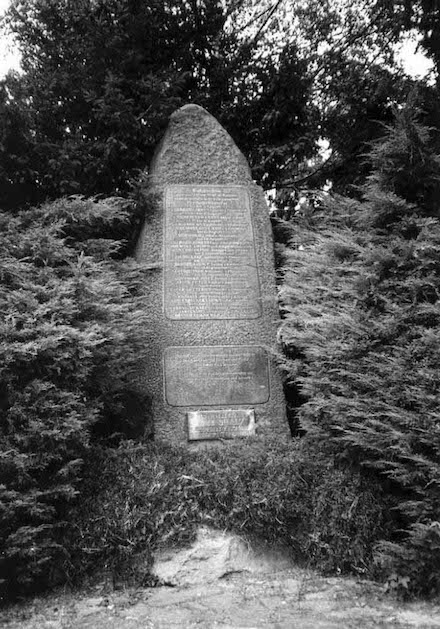
A memorial with Latvian, Hebrew and English text, marks the spot where the Preili Jews died. It was funded by David Silberman, a Holocaust survivor from Preili, and dedicated on August 8, 2004, sixty years almost to the day after the massacre. The central obelisk has a quote from Sheyna Gram’s diary, and buried beneath it is an urn with a list of the names of the victims, pieced together by the aforementioned Shmuel Latvinskiy, who wrote pages of testimony for the Gram family. Additional photos of the memorial can be seen at the bottom of this page.

* Sheyna calls this city by its Yiddish name, Dvinsk. An 832-page list of Jewish people from Daugavpils who died in the Holocaust can be found here.

On this day..

1942: Six German saboteurs

Seventy-five years ago today, six German saboteurs were electrocuted in a Washington, D.C. jail … a failed World War II operation that bequeathed its target nation a controversial legal landmark.

On June 13 of 1942 — just eight weeks before they faced the electric chair — Herbert Hans Haupt, Heinrich Heinck, Edward Kerling, Herman Neubauer, Richard Quirin and Werner Thiel, all of them German nationals who had returned to the Fatherland after previous emigration to the U.S., were dropped by U-Boats along with two other men, Ernest Peter Burger and George John Dasch, in two quartets on the eastern fringe of Long Island and the Florida coast.

“Operation Pastorius” to sabotage war industries on the U.S. mainland would never even have time to get its land legs; spied in Long Island by a Coast Guard watchman whom they clumsily attempted to bribe, the agents scattered themselves to New York and Chicago. Burger and Dasch — who for this reason were not in the end electrocuted* — had their reservations about the Third Reich to begin with and guessed after the Coast Guard encounter where this fiasco was heading. They rang up the gobsmacked FBI to shop themselves and their comrades, enabling the feds to pick up the other six men in short order.

The eventual fate of the Nazi saboteurs is no surprise, but the means to obtain it was controversial then and remains so to this day.

On a substantive level, the Germans had landed in uniform for the explicit purpose of asserting POW status were they to be apprehended immediately; this didn’t cut much ice since all had then discarded their uniforms and attempted to melt away in the U.S. Attorney General Francis Biddle successfully cited the American Revolution precedent of John Andre, whom patriots hanged as a spy after detaining him out of uniform behind their lines. That they hadn’t yet done anything yet was a bit beside the point.**

Much thornier was U.S. President Franklin Delano Roosevelt’s order to try the Germans using a seven-member military tribunal that he conjured for this purpose, and seemingly with the objective of assuring the harshest possible sentence. (Bear in mind that these events transpired only months after Pearl Harbor.) Such a commission is explicitly anticipated by the U.S. Articles of War† whose 81st and 82nd provisions the saboteurs were charged with violating:

ART. 81. RELIEVING, CORRESPONDENCE WITH, OR AIDING THE ENEMY. — Whosoever relieves or attempts to relieve the enemy with arms, ammunition, supplies, money, or other thing, or knowingly harbors or protects or holds correspondence with or gives intelligence to the enemy, either directly or indirectly, shall suffer death or such other punishment as a court-martial or military commission may direct.

ART. 82. SPIES. — Any person who in time of war shall be found lurking or acting as a spy in or about any of the fortifications, posts, quarters, or encampments of any of the armies of the United States, or elsewhere, shall be tried by a general court-martial or by a military commission, and shall, on conviction thereof, suffer death.

However, the military commission did not seem very well in keeping with the American preference for regular jurisdictions as expressed by Ex parte Milligan, the post-Civil War decision forbidding the use of military courts anywhere that civilian courts are functioning.‡ The signal Milligan precedent formed the basis of a furious objection by Army defense lawyer (and future Secretary of War) Kenneth Royall, who fought his clients’ hopeless corner so vigorously that the doomed men signed a letter praising his efforts. (“unbiased, better than we could expect and probably risking the indignation of public opinion.”)

Already recessed for the summer, the Supreme Court hastily reconvened to cut this Gordian knot: the only forum of judicial review the case would ever receive. Its decision, Ex parte Quirin — titled after one of the defendants — spurned Royall’s Milligan claim and upheld Roosevelt’s statutory authority to determine this case for a military tribunal by a unanimous vote.

The court’s common front concealed a variety of stances on the reach of executive authority. While the whole court agreed that “Congress has explicitly provided … that military tribunals shall have jurisdiction to try offenses against the law of war in appropriate cases,” a concurring memorandum by Justice Robert H. Jackson — later famous for his role prosecuting the Nuremberg trials — proposed to carry the argument well beyond this point. Jackson claimed in a concurrence that he would eventually withdraw that “the Court’s decision of the question whether it complied with the Articles of War is uncalled for … it is well within the war powers of the President to create a non-statutory military tribunal of the sort here in question.” This was by no means the consensus of his colleagues.

The later publication of a “Soliloquy” memorandum by one such colleague, Felix Frankfurter, throws a less than dispassionate light on deliberations. Writing to smooth over internal disputes between the blackrobes, Justice Frankfurter shows himself personally hostile to the Germans — “You’ve done enough mischief already without leaving the seeds of a bitter conflict involving the President, the courts and Congress after your bodies will be rotting in lime,” he chides them in his own voice. “That disposes of you scoundrels.” In the end, the court took his advice to sidestep the potentially deep jurisdictional question.

But that question has not been left rotting in footnotes (they never are). Quirin in general and Jackson’s expansive claims of executive power in particular have been relied upon by 21st century Presidents to justify muscular and controversial innovations like the Guantanamo Bay prison and the drone war.

A few books about Operation Pastorius and Ex parte Quirin

Pierce O’Donnell, author of In Time of War: Hitler’s Terrorist Attack on America, discussed his book on C-SPAN here.

Jurisprudence is not the only artifact of the Nazi saboteurs’ failed infiltration.

Bizarrely, a tributary slab “in memory of agents of the German Abwehr” was discovered in 2006 illicitly placed on National Park Service land in southeast Washington DC, the same vicinity where the saboteurs had been secretly buried after their electrocution. There it had seemingly reposed some twenty-odd years, unknown but to its devotees … who if the stone’s carvings are to be credited must consist of the heirs of the (defunct since 1983) National Socialist White People’s Party, also known as the American Nazi Party.

* They would be condemned to death along with the rest, but Roosevelt commuted their sentences: a fine boon but far short of the outright pardons they had been promised for their cooperation. In 1948, President Truman had Burger and Dasch deported to Germany, where many saw them as traitors.

** After unsuccessfully attempting to trade Andre for Benedict Arnold, whose defection Andre had facilitated, and whom the American revolutionaries would have much preferred to Andre for a hanging.

† Enacted by Congress in 1920, these Articles of War are no longer operative in the U.S.: they were replaced by the Uniform Code of Military Justice in 1951.

‡ Haupt and Burger were also U.S. citizens, further complicating the commission’s suspension of their constitutional habeas corpus rights.

On this day..

1849: Ernst Elsenhans, Rastatt revolutionary

Swabian revolutionary Ernst Elsenhans was shot at fortress Rastatt on this date in 1849 for his role in the revolutions of 1848-49.

Elsenhans — that’s a German link, which is the case for almost everything readily available about this gentleman — was a democratic journalist who was already serving a prison sentence for inciting treason in the Baden installation of Germany’s 1848 revolutions when he was liberated by the May 1849 republican recrudescence. He of course went right back to inciting treason, as secretary to the revolutionary government’s War Ministry for its short interim before Prussian boots stamped out the rebellion.

Elsenhans and other revolutionaries shot in the course of this suppression are honored at a memorial slab unveiled for the sesquicentennial of their martyrdoms.

German speakers can peruse editions of the Fortress Messenger published by Elsenhans in July 1849 here.

On this day..

1859: Ratu Mara Kapaiwai, Fiji warrior

On this date in 1859,* the Ratu (chief or prince) Seru Epenisa Cakobau hanged a major obstacle to his control the Fiji archipelago.

Fiji comprises over 300 distinct islands in the South Pacific of which the principal and namesake is Viti Levu. Our man Cakobau ascended as the Ratu of a two-mile islet, Bau, which hugs the east coast of Viti Levu and to a 19th century European visitor “may with propriety be called the capital of Feejee.”

Not all of “Feejee” was quite so eager as Mary Davis Wallis to champion the suzerainty of the Ratu of Bau, and so Cakobau spent much of the mid-19th century maneuvering to consolidate and extend his authority. He would in the end succeed well enough to establish the first unified Kingdom of Fiji in 1871, and it was his signature on the 1874 Deed of Cession that gave said kingdom to the British.**

But before he could be the father of the nation he had to put his foot on the neck of rivals like his cousin Ratu Mara Kapaiwai.

“The ubiquitous stormy petrel of mid nineteenth century Fiji” (source), Mara’s bold adventures blew a turbulent wind through the Fijian political scene in the 1840s and 1850s. A renowned seaman and aggressive warrior, he called no one place home but shuttled incessantly among Fijian and Tongan islands, and among shifting alliances thereof. If there was one constant in the life of Mara Kapaiwai it was rejecting the overlordship of Cakobau.

He suffered what would prove to be a decisive defeat in 1855 at the Battle of Kaba, although the convert Cakobau in a paroxysm of Christian charity forgave the defeated right there on the battlefield instead of insisting the traditional right to kill and cannibalize them.

His pique for his kinsman only stoked by the defeat, the stormy petrel returned soon enough to his schemes and by 1858 had raised another rebellion.

Cakobau put an end to this resistance by putting an end to Mara himself: luring Mara to Bau with promise of forgiveness, Cakobau instead had him seized and sent to the gallows the very next day.

“He said his punishment was quite just — that he had been a very bad man and had caused the death of very many people, but that he sincerely repented of his sins and looked for mercy believing that in God his sins were being pardoned,” according to a Wesleyan missionary who attended to Mara.

* There are a few cites to be found for June 8, rather than August 6, which I cannot credit to any better cause than an inverted reading of the date 6/8 or 8/6 because people are rubbish about dates. The scholarly consensus around 6 August, and the allusion in sources like this book chapter to western missionaries’ diaries and letters, carries the argument for me — even though I have not been able to lay my own eyes on those primary documents. (As best I can determine, many of these firsthand accounts are held, un-digitized, by the Methodist Church of Australasia Department of Overseas Missions.)

** Fiji attained independence within the Commonwealth in 1970. Queen Elizabeth II’s picturesque honorific as Tui Viti (paramount chief) of Fiji — the title that Cokabau ceded to Queen Victoria along with the archipelago — has slipped into official disuse in recent years but many Fijians still embrace Elizabeth as queen. Here’s a newsreel of her 1953 visit to Fiji:

Topical here: Ratu Mara’s grandson Lala Sakuna became one of the leading statesmen of Fijian independence in the 20th century, although he predeceased its realization … fulfilling Mara’s plea to his executioner “for the safety of his 10-day-old son Joni, promising Cakobau that one day the child’s descendants would ‘bear Fiji up’.” (Source)

On this day..