1889: Thomas Brown, Fargo-Moorhead outlaw

At 4 a.m. on this date in 1889, Clay County, Minnesota hosted its only execution.

This affair began, as such things do, when “a bunch of drunken hoboes got into a fight near Hillsboro, ND” in the autumn of 1888. One of them was killed, and a farmer who saw it happen identified Brown as the suspect. What little is known of Brown* indicates that he was a hardened outlaw; he broke out of prison in Wisconsin, and did time in the Dakota territories, too. While awaiting his fate he would solve a frontier sporting mystery by admitting that he murdered the tramp who had killed bareknuckles pugilist George Fulljames.

So police had their eyes peeled for Brown 40 miles down the way in the border settlement of Fargo-Moorhead. (Fargo is on the North Dakota side of the river, Moorhead on the Minnesota side.)

One night in October, an off-duty Fargo cop spotted Brown a few blocks into the Minnesota side of town, and alerted Moorhead policeman John Thompson. But Brown had noticed them, noticing him, and drew on the Moorhead officer. While Brown was demanding to know what the two had spoken about, another Moorhead policeman approached.

This Patrolman Peter Poull’s appearance set off the gunplay: Brown wheeled and felled Poull with a shot through the heart, but the distraction allowed Patrolman Thompson to draw and wound he fleeing desperado. Brown was captured, his revolver empty, collapsed on the train tracks with shots through his shoulder and leg. It was only because the quick-thinking Clay County sheriff whisked Brown out of jail under cover of darkness by forcing a night train to Minneapolis to make an unscheduled stop that a lynching was averted.

“Unless I get a change of venue I guess I shall have to swing,” Brown observed, with preternatural coolness.

He did not get a change of venue.

Brown’s execution was one of the first (to state it more exactly: it was the second) to occur under the state’s new “midnight assassination” law, which not only shamefacedly stashed hangings behind prison walls under cover of darkness, but also prohibited newspapers from publishing the particulars of the event.

Those lingeringly detailed descriptions — of the hardihood of the dead man and the conduct of the onlookers and the ceremony upon the gallows and whether the victim confessed and if he died fast or died hard — have been a staple of print media practically since its birth, and certainly an indispensable font for these grim annals. But the legislature had been persuaded that their circulation constituted a moral degradation to the consumers who eagerly read them. This directive was at best unevenly complied with: a number of newspapers did publish such accounts, and they were not punished for it. And of course the law did not reach across the Dakota border at all, so the Fargo Argus was able to insinuate an editor into the death chamber, who later described the killer’s last moments thus:

When the spectators reached the gallows, Brown was standing on the drop, on either side being a priest, all engaged in half audible prayer … Sheriff Jensen then tied Brown’s feet, and adjusted the noose about his neck, the knot being behind his right ear … In a weak and trembling** voice, almost inaudible he bade the jailor, Sheriff and priests goodbye, shaking hands with them and wishing them well. He then turned to the spectators, half smiled and nodded a farewell. The black cap was then pulled over his head and fastened under the chin, he with the priests praying meanwhile.

The drop fell at exactly 4:30 o’clock and the murderer of Officer Poull was launched into eternity. Brown’s neck was broken by the fall … In twelve and a half minutes his pulse ceased to beat, and in fifteen his heart had ceased action.

* Even to the end he refused to reveal his real identity or background, so as not to shame his family.

** Other published accounts speak of the hanged man’s unusual nerve. Between the moralizing interests of the interlocutors and the circulation of bogus information facilitated by the midnight assassination law, we here profess agnosticism as to Brown’s actual behavior.

On this day..

1851: Aaron Stookey, clemency denied

State of New York, Executive Department
Albany, Sept. 4, 1851.

To Thomas Carnley, Esq., Sheriff of the City and County of New York

Sir: — I have carefully considered the application for a commutation of the sentence of death pronounced upon Aaron B. Stookey, to be executed on the 19th inst., for the murder of Zeddy Moore.

I have weighed the evidence with an anxious desire to give him the benefit of every circumstance which tends to extenuate his guilt; but after a mature deliberation I am clearly of opinion that his conviction was merited, and that the ends of public justice require the execution of the sentence.

The facts disclosed on his trial were sufficient beyond all doubt, to constitute the crime of wilful murder. It is contended that most of the material witnesses for the prosecution were persons of infamous character and unworthy credit. Making all due allowance for this objection, the proof of his guilt is so complete and overwhelming as to preclude any doubt, and in fact no material fact alleged by any of the witnesses have been called in question by the convict or his friends.

It appears that Stookey met his unfortunate victim casually in one of the public streets of your city. He was armed with deadly weapons, which he usually carried about his person. Upon provocation which, if not wholly imaginary, was too trivial to justify even momentary resentment, and apparently with no other motive than the indulgence of wanton and brutal passion, after first instigating his comrade to commit violence upon Moore, he declared his own intention to kill him and instantly stabbed him to the heart.

To palliate the enormity of this offence, it has been alleged that Stookey was laboring under temporary alteration of intellect, and was morally incapable of an intentional and deliberate crime. [i.e., he was drunk on rum -ed.] Several affidavits have been placed before me intended to sustain this hypothesis. Deeming it my duty to obtain satisfactory evidence on so material a point before coming to a final decision, I have caused an investigation to be made of all the facts bearing upon the question of insanity, and the result proves that there are no sufficient grounds for such an assumption.

It is shown that Stookey, for some years past, had led a life of dissipation and debauchery, that his moral nature was depraved, and his mental faculties impaired, by a long course of vicious indulgence; and in this general degradation of character consists the only reason that has been adduced for doubting that he was conscious of evil, and still retained those powers of moral perception which are given to discern between virtue and crime. All the usual phenomena of insanity and lunacy are wanting. There was nothing in his conduct to indicate that destitution of reason which absolves men from moral and legal responsibility.

My sympathies have been deeply moved by the earnest appeals made in behalf of your prisoner by his worthy relatives and friends. The petitions presented to me bear the names of many influential and respected citizens, whose opinions deserve the highest deference and regard. It is a painful office to be compelled to resist these urgent and affecting solicitations. But all must remember it is the voice of the law which condemns the murderer to death. This penalty, the most dreadful which human power can inflict, is imposed not in a spirit of retaliation or of vengeance, but from conviction of its necessity, for the protection of society and the security of mankind. The severity of the law in this respect has its source in the sacred regard for human life which pervades all civilized communities.

It proclaims in advance, to all whose evil passions may prompt to deeds of blood and vengeance, the impressive warning, that whosoever shall take the life of his fellow being shall thereby forfeit his own. This stern mandate is conceived not in cruelty but in humanity; in compassion for the innocent rather than a willingness to destroy the guilty; it originates in the obligation which society owes to all its members to protect them from unlawful violence, and its true aim is to prevent both crimes and punishments by restraining those who can only be deterred from the worst of offences by the most terrible penalties.

I am aware that serious differences of opinion exist among enlightened legislators in respect to the justice and tendency of a penal code which forfeits the life of the offender in case of murder. It does not come within my province to discuss this principle in the discharge of my executive duties. The law as it stands must be my guide, so long as it remains in force. It is among the first and highest of my obligations to see that it is faithfully executed.

The penalty which the State has prescribed, as a punishment for the crime of wilful murder, must be enforced in all cases where the offence is established by clear and sufficient proofs. This responsibility, weighty and difficult at all times, derives unusual force from the alarming increase of crime in some portions of our State, and especially in your city. The destruction of life by criminal violence has become an event of almost daily occurrence. My reflections upon this subject have produced a firm conviction that this deplorable evil is to be checked, and the lives of our peaceful citizens effectually shielded from danger only by an efficient, faithful and unswerving execution of the law. The peace and safety of society are too sacred to be hazarded by the indulgence of those generous sympathies which the fate of the convict is so well calculated to excite. The demands of justice, and an enlightened regard for the public security, must prevail over the pleadings of compassion.

It remains for you to discharge the most trying duty of your office as I now do mine.

Very respectfully,

Washington Hunt

P.S. — I intended to have remarked that Stookey’s crime may be traced directly to the habit he had adopted of carrying a dangerous weapon concealed about his person. His fate should be a warning to all who indulge in this reprehensible practice. It cannot be too strongly impressed upon their minds that persons who choose to carry concealed arms, will be held to a rigid responsibility for the use they may make of them, and for all consequences that may ensue.

(Clemency denial and execution order as printed in the New York Spectator, September 11, 1851.)

On this day..

1685: Krystof Alois Lautner, Witch Hammer victim

On this date in 1685, Catholic priest Kryštof* Alois Lautner was degraded from the clergy and burnt at the stake as a sorcer — but his real crime was standing athwart a witch hunt.

The term “witch craze” doesn’t quite seem the just one for the Northern Moravian witch trials since they spanned 18 terribly systematic years until the gouty main inquisitor mercifully retired in 1696, having put about 100 people to the sword and stake.

Generally understood in the context of Catholic hostility to reform denominations on the soil of the present-day Czech Republic, this dreadful affair started when a Vernirovice woman was caught sneaking the Host out of Easter Mass in 1678, intending to use it as a charm for a folk spell to enhance the fertility of her cows.

By 1679, that woman was burned at the stake — along with two others whom she was induced to accuse by the threat of torture.

These executions were the fruit of a witchcraft commission that had been empaneled to pursue the original desecration of the communion bread, but now that the witch team was an institution it began finding more and more necromancers, in a self-justifying spiral of accusations.

Lautner, a well-liked deacon of Sumperk, spoke against the witch hunt when it came to that city and for his pains he was arrested there in 1680 … then leisurely broken by torture over a period of four years until he was at last undone by accusations wrenched from the torture of the wealthy Sattler family. (Whose valuables the commission did not neglect to appropriate.) It was standard witchcraft fare: black sabbaths, incestuous orgies, pacts with Satan.

“Milder tortures were used against him initially” the records say. “But those he admirably resisted, and remained obdurate. Then came harsher steps. Lautner began to confess, but when he was removed from the devices he recanted his admissions. So he was put to torture again and again, to defeat the devil’s secrecy. He was interrogated in June 1684 — twelve days in a row, except Sunday.” The case progressed so deliberately in part because the prosecution of a clergyman required the signoff of church heirarchy** … and in part because Lautner’s own friends intervened to try to free him. (One such ally, the priest Tomáš König, wrote a letter to the bishop on Lautner’s behalf and thereby became an object for investigation himself; it’s thought that he was about to be arrested by the witchsmellers when he fortuitously died in 1682.)

In the end the cleric could not hope to withstand the pressure. 20,000 people are reported to have swelled Sumperk for his execution by fire.

His case — which has latterly been commemorated by public monuments celebrating Lautner as a hero of conscience — was dramatized in the historical novel Witch Hammer by Vaclav Kaplicki. Otakar Vavry adapted the story for the silver screen; Kladivo na Carodejnice is available online in its entirety, but you’ll need to be up on your Czech.

* Hacek courtesy of Jan Hus!

** Pope Innocent XI ultimately signed off on proceedings, on the sententious grounds that clergy can’t be above the law when they traffic with devils.

On this day..

1723: Hermann Christian von Wolffradt, Chancellor of Mecklenburg-Schwerin

On this date in 1723, Hermann Christian von Wolffradt was beheaded by the German duchy of Mecklenburg which he had long served as a minister of state.

Pomerania, the territorial strip along the south of the Baltic Sea,* has often been divided in its history — as it is now (between Germany and Poland) and as it was then (between Sweden and the emerging Prussian empire — with Mecklenburg-Schwerin still an independent principality destined eventually to be subsumed into Prussia/Germany). Various products of the noble Wolffradt house lived and served the different realms that planted flags in Pomerania; our man’s father, also named Hermann von Wolffradt, was chancellor of Swedish Pomerania.**

Our Hermann Christian was a chip off the old block, but since he got a slice of the patrimony on the Prussian side, he climbed the ranks of the Duchy of Mecklenburg-Schwerin.

He was a fixture in the court of Duke Friedrich Wilhelm I (not to be confused with his contemporary Friedrich Wilhelm I of Prussia, Frederick the Great’s severe father). But Wolffradt’s relationship with Friedrich Wilhelm’s son and successor, Karl Leopold, proved to be a strained one even as Wolffradt reached the position of Chancellor in 1721. This was no great distinction, as Karl Leopold’s relations were rocky with just about everyone; he called in Russian troops to beef with the Swedes, and so alienated the Mecklenburg estates that by 1728 the Holy Roman Emperor had him deposed.

Karl Leopold might have first suspected his chancellor — whose wife was incidentally also Karl Leopold’s mistress — of conniving with the duchy’s knights against him in the 1710s. By 1721 the duke was on his guard against his minister once more, and contrived to convict him of disloyalty and have him beheaded at Dömitz.

* Its name derives from the Slavic “po more” — “by the sea”.

** And our executed Hermann’s younger brother Carl Gustav von Wolffradt was a general in the Swedish army, while Carl’s most notable son was Erich Magnus von Wolffradt, a Prussian general.

On this day..

1915: Peter Sands, home leave

Irish lance corporal Peter Sands was shot as a deserter one hundred years ago today at Fleurbaix, near Armentières.

Sands, a nine-year veteran age 26 or 27, left the Royal Irish Rifles with another soldier on a home leave pass in February 1915 and returned to his family in Belfast.

Sands had a pass for four days. Instead, he stayed for five months — openly living with his wife, and wearing his military uniform, until some unknown busybody turned him in as a deserter that July.

He would tell his court-martial that he had lost his travel documents to return to the horrible front, and had been blown off when he visited a Belfast barracks to see about a replacement. He did not aim to desert, he insisted; “Had I intended to desert I would have worn plain clothes, but up to that time I was arrested I always wore uniform.” It is not so hard to reach Corporal Sands, psychologically — a man perhaps indulging a lethal opiate of denial. Suppose his “desertion” began with a good-faith mishap and thereafter did not last for five months, but just for one day more … day upon day.

He had no pass, so what was he to do next? He stayed in Belfast with his wife and daughter wearing his service duds while he contemplated that question. (Who can say whether he contemplated it in bemusement or terror.) He stayed every day in March, and it became every day in April, and every day in May and June, too. Nobody came for him on any of those days.

Had his war ended, then? Had he somehow slipped the toils of the machine back to a domestic idyll?

Maybe he truly had … but for that anonymous snitch.

Even if it had to be reminded of its prodigal corporal’s absence, His Majesty’s royal meatgrinder expected a little more hustle from its meat than one barracks call in five months: while Sands was at home, his mates had gone out of the trenches in the Battle of Neuve Chapelle (11,000+ British casualties), and the disastrous* Battle of Aubers Ridge (another 11,000+).

His commanding officer “consider[ed] this a bad case of desertion and I recommend that the sentence be carried out.” And it was.

Sands was buried at a nearby churchyard, but his resting-place was lost during the war. He has a marker at Cabaret-Rouge Military Cemetery at Souchez.

* The report of the Times from Aubers Ridge — headlined “Need for shells: British attacks checked: Limited supply the cause: A Lesson From France” — precipitated the “Shell Crisis of 1915”.

On this day..

258: St. Cyprian, Bishop of Carthage

The Christian bishop of Carthage, Cyprian, was condemned by Roman authorities on this date and immediately beheaded.

Not one of your dubious ancient martyrs fogged with legend, Cyprian was a major public figure in his own time; dozens of epistles and treatises of his survive. An epidemic that ravaged the Roman Empire in the 250s and 260s is known from his description of it; hence it is remembered as the Plague of Cyprian.

The real-life Cyprian had different plagues to fight.

The essential challenge of Cyprian’s day — and the one that would see him to martyrdom — was the onset of anti-Christian persecution after the relative tolerance of the 240s. Cranky senator turned general Decius claimed the purple in 249 on a programme of traditional values that included a demand that all* obtain a magistrate’s certificate confirming that they had performed public sacrifice to the pagan gods. We don’t want anyone tempting divine vengeance here.

The Christian community had grown, little molested of late, to encompass many peaceable adherents who were not necessarily prepared to sell their lives over a stick of incense. Now, it fragmented under the Decian persecution — which was applied by different governors with varying levels of severity. Some Christians made the requisite sacrifices; others paid bribes to get the paperwork. Some fled to hiding: Cyprian himself did so, and some Christian ultras criticized him for failing to embrace martyrdom.

Decius died in 251, leaving the Christian minority with a controversy over how to handle the so-called lapsi who had made some concession to the idols of Rome: perspectives arrayed from the most lax (welcome everyone back with minimal hassle) to the most punitive (expel them all: this was the Novatian heresy). Cyprian had a middle-ground position in this dispute; his De Lapsis preserves his intervention, accepting readmission but under conditions of suitable penance administered by the clergy.

In such a case there remains only penitence which can make atonement. But they who take away repentance for a crime, close the way of atonement. Thus it happens that, while by the rashness of some a false safety is either promised or trusted, the hope of true safety is taken away.

But you, beloved brethren, whose fear is ready towards God, and whose mind, although it is placed in the midst of lapse, is mindful of its misery, do you in repentance and grief look into your sins; acknowledge the very grave sin of your conscience; open the eyes of your heart to the understanding of your sin, neither despairing of the Lord’s mercy nor yet at once claiming His pardon. God, in proportion as with the affection of a Father He is always indulgent and good, in the same proportion is to be dreaded with the majesty of a judge. Even as we have sinned greatly, so let us greatly lament. To a deep wound let there not be wanting a long and careful treatment; let not the repentance be less than the sin. Think you that the Lord can be quickly appeased, whom with faithless words you have denied, to whom you have rather preferred your worldly estate, whose temple you have violated with a sacrilegious contact? Think you that He will easily have mercy upon you whom you have declared not to be your God? You must pray more eagerly and entreat; you must spend the day in grief; wear out nights in watchings and weepings; occupy all your time in wailful lamentations; lying stretched on the ground, you must cling close to the ashes, be surrounded with sackcloth and filth; after losing the raiment of Christ, you must be willing now to have no clothing; after the devil’s meat, you must prefer fasting; be earnest in righteous works, whereby sins may be purged; frequently apply yourself to almsgiving, whereby souls are freed from death.

This is more or less the position the Church as a whole arrived at — a fairly liberal readmissions policy in the scheme of things. Unfortunately for Cyprian and his flock, the question would soon grow pressing once again: the emperor Valerian resumed the persecution in 257.

Cyprian was first sent into exile, then brought to Carthage for examination at a villa thronged with his supporters, who are said to have roared in support when Cyprian refused to sacrifice and demanded, “Let us be beheaded with him!”

The bishop attained his hieromartyr‘s laurels directly after the verdict, with Carthage’s Christians clamboring alongside him to the execution grounds. Afterwards, the faithful collected his remains and interred them lovingly, erecting a church over the bones that the Vandals would eventually ravage.

Even in his death under persecution, Cyprian’s biography reflects the growing weight of Christianity in Rome — not least in the fact that it was consequential enough to attract imperial backlash under the right circumstances. The reluctance of provincial magistrates to make hecatombs of their neighbors whatever the edicts demanded has been widely noted — like the proconsul Antoninus, who sent away confessing Christians who wished to solicit their own martyrdoms with the exasperated words, “if you are thus weary of your lives, is it so difficult for you to find ropes and precipices?”

“The life of Cyprian is sufficient to prove that our fancy has exaggerated the perilous situation of a Christian bishop,” Edward Gibbon wrote — a paradoxical observation to make of a martyr, but we notice that Cyprian’s noisy Christian supporters don’t seem to have been harried even in the midst of the prelate’s execution. Thereafter, “the funeral of Cyprian was publicly celebrated without receiving any interruption from the Roman magistrates; and those among the faithful, who had performed the last offices to his person and his memory, were secure from the danger of inquiry or of punishment. It is remarkable, that of so great a multitude of bishops in the province of Africa, Cyprian was the first who was esteemed worthy to obtain the crown of martyrdom.”

* Jews were exempted; Romans had respect for the antiquity of that monotheistic religion which was not extended to the novel concoctions of Christianity.

On this day..

1567: Four Anabaptists in Antwerp, after torture

On this date in 1567, four Anabaptists were burned at Antwerp as heretics.

Their sect furnishes many martyrs for these pages. That Christian Langedul, Cornelis Claess, Mattheus de Vick, and Hans Symons were sniffed out and clapped in prison for their faith is no surprise for the time and place they lived, and that they withstood torture and went joyfully to the stake is the script demanded for historical remembrance.

Letters in the hands of three of these men (all save Mattheus de Vick) were retained by their comrades and eventually published in the Martyrs Mirror chronicle of Protestant (especially Anabaptist) martyrs during the Reformation.

Hans Symons and Cornelis Claess wrote words of exhortation to faithfulness and steadfastness. Christian Langedul’s letter, however, catches our eye for its very direct exposition of the nature of the torture that he and the others were put to. In a letter to his wife, Langedul doesn’t sugar-coat his situation in the least — and she must have known full well what their arrest would entail. Centuries later, it’s a discomfiting first-person account of what a man suffers on and after the rack.

we were all examined today before the margrave, and of us six we four freely confessed our faith, for it had to be; either the soul or the body had to be sacrificed; the Lord had to be either forsaken or confessed. Thus, Hans Symons, Cornelis the shoemaker, and Mattheus, confessed as also, I unworthy one, and I hope to keep it to the praise of the Lord, but not through my own power or merit, but by the power and grace of God; for through weakness we are made strong, this I must confess. Eph. 1:19; II Cor. 12:9.

Hence be of good cheer in the Lord, and do the best with the children, of whom I dare not think, for they lie heavily on my heart.

When the margrave examined me today, concerning my faith he asked me about nothing but baptism, and I held out against him as long as I could, by saying that I knew but one baptism according to the Gospel and Christ’s own command and injunction; but his constant question was, “Say yes or no, whether you are satisfied with the baptism you received in your infancy, or whether you have received another?”

I replied that I knew nothing to say about infant baptism; but this did not suffice, I had to confess that I had received another, and thus I confessed it, the Lord be praised, and I have not regretted it yet, and I hope that I shall not regret it unto the end, for it is the truth.

…

Know, my beloved wife, that yesterday about three o’clock I had written you a letter, which I now send you. I could not send it then, for soon afterwards the margrave came here to torture us; hence I was not able to send the letter, for then all four of us were one after another severely tortured, so that we have now but little inclination to write; however, we cannot forbear, we must write to you.

Cornelis the shoemaker was the first; then came Hans Symons, with whom also the captain went down into the torture chamber. Then thought I, “We shall have a hard time of it; to satisfy him.” My turn came next — you may think how I felt. When I came to the rack, where were the lords, the order was, “Strip yourself, or tell where you live.” I looked distressed, as may be imagined. I then said, “Will you ask me nothing further then?” They were silent.

Then thought I, “I see well enough what it means, it would not exempt me from the torture,” hence I undressed, and fully resigned myself to the Lord: to die. Then they racked me dreadfully, twisting off two cords, I believe, on my thighs and shins; they stretched me out, and poured much water into my body and my nose, and also on my heart. Then they released me, and asked, “Will you not yet tell it?” They entreated me, and again they spoke harshly to me; but I did not open my mouth, so firmly had God closed it.

Then they said, “Go at him again, and this with a vengeance.” This they also did, and cried, “Go on, go on, stretch him another foot.” Then thought I, “You can only kill me.” And thus stretched out, with cords twisted around my head, chin, thighs, and shins, they left me lie, and said, “Tell, tell.” … Again I was asked, “Will you not tell it?” I did not open my mouth. Then they said, “Tell us where you live; your wife and children, at all events, are all gone away.” In short, I said not a word.”What a dreadful thing,” they said. Thus the Lord kept my lips, so that I did not open them; and they released me, when they had long tried to make me speak.

Thereupon two of them, the executioner and his assistant, bore me from the rack. Think how they dealt with us, and how we felt, and still feel. Then they half carried, half dragged me from the torture chamber up into the jailer’s room, where was a good fire of oak wood. There they, once or twice, gave me some Rhenish wine to drink, which revived me in a measure. And when I had warmed myself somewhat, they again half dragged me up over the porter’s room. There they had such commiseration for me; they gave me wine again; they gave me spices, and of everything you had sent me, all of which rendered me very good service. They had wine brought and helped me to bed. But the sheets were very coarse, and greatly hurt my shins and thighs; however, soon afterwards the sheets and pillow you sent me arrived, and there were also two or three pocket handkerchiefs. They then covered me with the sheets, which came very convenient to me, as did also the spices. Had the sheets not come, I know not how I should have passed the night; but so I slept tolerably well. But I am hardly able to stand yet, and the lower part of my legs is as though they were dead from racking; however, it is all well, as I trust by the grace of the Lord.

…

After me Mattheus was tortured; he named his house and the street in which we live, and said it was in a gate; however, I am of the opinion that there are no longer any gates in that street. Hence move away altogether, if you have not done so yet; for I think the lord will find his way there. Let therefore no one who stands in any danger go into the house. He also named R. T.’s house, and the street where F. V. St. lives. Do herein immediately the best you can. He is very sorry for it.

…

I wrote you yesterday that I hoped to write to you during the day, but I could not do it; Mattheus and I lay in bed until two o’clock, so greatly were we afraid, because the margrave came here to torture Cornelis again, and we feared that we should also be tortured a second time, of which we had a great dread, more than of death, for it is an excruciating pain. Cornelis was tortured and scourged to such a degree the second time, that three men had to carry him up, and they say that he could scarcely move a member, except his tongue. He sent word to us, that if they come again it is his opinion it will finish him. Thus the Margrave did not come yesterday, but we expect him today again; may the Lord help us, for it is a horrible pain.

On this day..

1879: Pocket, on the Hallettsville hanging tree

On this date in 1879, a half-blooded Native American named Pocket died in Hallettsville on an oak tree.

The son of a French Canadian father and a Blackfoot Sioux mother, Pocket had been befriended by a cattleman named Lou Allen. They met by chance in the early 1870s; Pocket was a half-caste child, maybe not even into adolescence, with broken English, doing odd jobs to scrape by.

Of Pocket we have only glimpses of the moments where he comes into the view of white men. His rancher-friend took him until “becoming tired of civilized life, and pining for the freedom of his native wilds,” Pocket vanished on a horse that Mr. Allen willingly gave him. (The quote comes from the Galveston Weekly News of September 18, 1879; it’s also the source for the other quotes in this post.)

That was in 1874. For the next several years Pocket’s activities are mostly unknown, save for the few times he popped back into Mr. Allen’s life — once to bum a suit of clothes; another time when they met by accident in Wichita, Pocket destitute after gambling everything away; and finally when Pocket reappeared in Lavaca County only to be refused aid by his benefactor in a possible gesture of tough love. Pocket found work on a nearby farm instead.

On Valentine’s Day 1878, Pocket was seen in the county seat of Hallettsville getting roaring drunk on whiskey. He left town for the countryside carrying another bottle and proceeded to stop at several farms to accost their residents.

At the Smith house, he barged in, stole a pistol, and forced his way into the family dinner. He stumbled into the home of a former slave named Frank Edwards, ripped up bed clothes, and started swinging an axe around until Edwards punched out the unwanted visitor.

Fuming, Pocket proceeded to yet another farm, the Petersons, where he contrived to get the family hunting rifle by representing the presence of a drove of turkeys nearby. A young Brit named Leonard Hyde worked for the Petersons, and he went along with Pocket “to see the fun.” As ominously as this reads, Hyde had no reason to suspect trouble; the Galveston Weekly News would note that Hyde and Pocket “were both under twenty-one years of age, friendly with one another up to the last moment, and both strangers in the land which has given to each of them a grave.” Two kids out on a turkey-shooting lark.

Hyde trotted along on foot after Pockett, and soon another of Hyde’s friends joined the supposed hunting foray. Suddenly, their intoxicated leader stopped and cursed Hyde for following him — then shot him dead through the forehead with his pistol. The killer’s mind was obviously disordered and impulsive, but it’s possible that Hyde died in place of Frank Edwards, or if not Edwards then whomever Pocket might have crossed paths with next that night.

Now with blood on his hands, Pocket did not pause to revenge any other slights but galloped off into the wilderness. He was eventually captured in Bosque County.


(Source, which also preserves a sad letter from Hyde’s father written in March 1878 upon learning of his son’s murder.)

Perhaps three thousand souls turned out to see a repentant Pocket die in Hallettsville on September 12, 1879 — “every road entering this town became alive with people of all ages, sexes and colors, without regard to previous condition, coming to witness the first legal execution in this county.” Pocket had spent his last weeks in religious devotion and struck those who saw him as a profoundly changed man.

The great hanging-tree can still be seen today, shading a picnic-table in City Park, next to the Hallettsville Golf Association clubhouse.

On this day..

1721: John Meff

John Meff hanged at Tyburn on this date in 1721 for returning from convict transportation.

If we are to credit the autobiographical account that Meff furnished the Ordinary of Newgate prior to his hanging, it was the last act in an adventuresome life. (Here’s the Ordinary’s account of the execution of Meff with three other men; here’s the Newgate Calendar entry based upon it, and which provides the quotes ensuing in this post.)

“I was born in London of French parents,” Meff begins — Huguenots who had fled Catholic harassment.

Huguenot refugees formed an important part of London’s Spitalfields weavers, and Meff apprenticed in this business until he could hang out his own shingle. But finding business too slow to support his family, he took to a bit of supplementary thieving.

Meff says that he had already once been condemned to death for housebreaking “but, as I was going to the place of execution, the hangman was arrested, and I was brought back to Newgate.”

Certainly the era’s executioners had frequent criminal escapades, but I have not found this remarkable Tyburn interruptus related in any press accounts in the 1710s. It’s possible that Meff is embellishing on the 1718 downfall and execution of hangman John Price — though Price was seized red-handed and not detained in the exercise of his office. This inconsistency has not prevented creation of a wonderful illustration, The Hangman Arrested When Attending John Meff to Tyburn, from this volume.

At any rate, Meff’s sentence was moderated to transportation to the New World, and he says that he “took up a solemn resolution to lead an honest and regular course of life … But this resolution continued but a short time after the fear of death vanished.”

Here Meff’s story really gets colorful — whether to the credit of the unsettled Atlantic economy or to the teller’s gift for embroidery we cannot say.

The ship which carried me and the other convicts was taken by the pirates. They would have persuaded me and some others to sign a paper, in order to become pirates; but we refusing, they put me and eight more ashore on a desert uninhabited land, where we must have perished with hunger, if by good fortune an Indian canoe had not arrived there. We waited till the Indians had gone up the island, and then, getting into the vessel, we sailed from one small island to another, till we reached the coast of America.

Not choosing to settle in any of the plantations there, but preferring the life of a sailor, I shipped myself on board a vessel that carried merchandise from Virginia and South Carolina to Barbadoes, Jamaica, and other of his majesty’s islands. And thus I lived a considerable time; but at last, being over-desirous to see how my wife and children fared inEngland, I was resolved to return at all adventures.

Once back, Meff says, he “quickly fell into my former wicked practices” — as if by gravity, no further explanation ventured. It’s hard not to suspect that he simply managed to escape his American indenture to continue a career in larceny, absent the whole marooned-by-pirates subplot. Men were known to tell tall tales to the Ordinary — who, after all, had their own story to sell the public through the deaths of their charges.

“The narrow escape he had experienced from the gallows ought to have taught him more wisdom than to have returned from transporation before the expiration of his time; but one would think there is a fatality attending the conduct of some men, who seem resolutely bent on their own destruction,” the Newgate Calendar’s entry concludes.

“One truth, however, is certain. It is easy, by a steady adherence to the rules of virtue, to shun that ignominious fate which is the consequence of a breach of the laws of God and our country.”

On this day..

1990: Charles Coleman, the first lethal injection in Oklahoma

Despite our occasional predilection for the odd “literally executed today” post, this macabre chronicle has never really aspired to focus on our subject matter’s breaking-news beat.

Nonetheless, the landscape of the death penalty has evolved noticeably in the years since we launched on Halloween 2007. Executions are down in China, but up in Saudi Arabia and Iran; India has ended a long death penalty hiatus; Pakistan began, sustained, and dramatically repudiated a death penalty moratorium.

And in the United States, the prevailing execution method, lethal injection, has fallen under a barrage of legal and political challenges.

Like the guillotine, the electric chair, the gas chamber, and weirder contraptions, the prick of the needle had once been sold as a Solomonic compromise between the executioner and his critics: you still get to kill a guy, but now he doesn’t feel a thing. This time we really mean it!

Lethal injection got some run in the Nazi T-4 euthanasia program but was first approved for regular judicial executions by Oklahoma in 1977, and first used by Texas in 1982. Where gas and electricity transferred industrial technology to the death chamber, with great metal chairs and huge switches like Dr. Frankenstein’s lab, injection analogized medicine: silent and light, and so sterile that the technicians would hygienically swab the skin before they pushed in the death-dealing needle.

Most of all it was sterile for the viewers, who had occasionally been subjected under the other processes to nauseating botches: men who were supposed to be dying instantly instead thrashing wildly away, catching fire, gushing blood, or requiring jolt after jolt to finish off. The electric chair surely owes its iconic cultural position in part to its reputation for spectacular failures.

When capital punishment got its 1970s reboot, it only seemed natural to think about cleaning up the how along with the why. Nearly everyone now had the experience of anaesthetic; it was natural to think that you could just put a man down like the family dog and not have any mess to clean up afterwards.

“Being a former farmer and horse raiser, I know what it’s like to try to eliminate an injured horse by shooting him,” future president Ronald Reagan had said in proposing the technology while he was still governor of California in 1973. “Now you call the veterinarian and the vet gives it a shot and the horse goes to sleep. That’s it.”

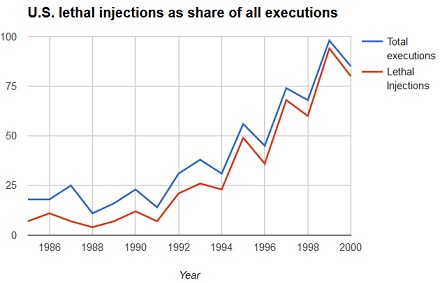
As executions surged in the 1990s, lethal injection was thoroughly displacing America’s previous humane technologies to become the overwhelmingly predominant method.


Data via the Death Penalty Information Center’s executions database.

And the state of Oklahoma, which had been first with a lethal injection law back in ’77, finally started rolling out gurneys — when it put murder Charles Troy Coleman to death with the needle on September 10, 1990. It was Oklahoma’s first execution in 24 years.*

It was Oklahoma’s medical examiner Jay Chapman who had formulated the three-drug cocktail that for a long time comprised the definitive lethal injection protocol: the short-acting barbiturate sodium thiopental, followed by the paralytic drug pancuronium bromide, capped with potassium chloride to stop the heart. Why three drugs, Human Rights Watch later asked him? “Why not?” Chapman was not a pharmacologist and had little expertise with the drugs in question.

Nevertheless, his process “could not be construed as cruel and unusual punishment since it is merely the extreme of procedures done daily around the world for surgical procedures,” Chapman insisted when he proposed it. “It’s simply an extreme form of anesthesia.”

Extreme anaesthesia. Was it really?

Even at Coleman’s death, observers saw it differently.

“I saw him choke and gasp and struggle for air,” said Joe Ward, an investigator in the public defender’s office. “It looked like he was choking to death. He looked over … and mouthed the words, ‘I love you.’ Then he looked straight back up and started choking.” Reporter Art Cox, by contrast, viewed it as “a very easy death … a very cold death, very antiseptic.”

Oklahoma has executed well over 100 people since Charles Coleman but if anything the uncertainty about that “easy” and “antiseptic” death has only grown — in the Sooner state and elsewhere.

And the question has become quite urgent during the lifetime of this blog as political pressure on manufacturers has dried up the supply of sodium thiopental, forcing the many states using lethal injection to scramble for a variety of new drug sequences that are basically being invented on the fly and sussed out with live experimentation on the next death row prisoner in the queue.

Oklahoma’s version was to switch from sodium thiopental to pentobarbital; in January 2014, a man being executed with pentobarbital exclaimed, “I feel my whole body burning.”. Months later, the manufacturer of that drug also cut off the supply, unwilling to be party to the executions it facilitated.

So Oklahoma switched to a third anaesthetic, midazolam, a drug whose execution debut took place in Florida in 2013. The state has also tried to shield its suppliers from anti-death penalty campaigners with a secrecy law.

Proceeding on a mad catch-as-can basis, Oklahoma proceeded to horribly botch its midazolam executions, throwing its new procedure right back to the courts. Just this past June, a divided U.S. Supreme Court narrowly approved the continued use of its midazolam cocktail, which a dissenting justice savaged as “the chemical equivalent of being burned alive.”

It’s a story still being written before our eyes — a long quarter-century after Charles Coleman premiered Oklahoma’s modern era of executions on this date in 1990.

* The last previous execution in Oklahoma was that of James French in 1966.

On this day..