2005: Six surprised Somalis

Six Somali migrant workers were publicly beheaded in Jeddah on this date in 2005 for robbing taxi drivers. The muggings, though violent, were not fatal to the drivers, so the punishment was quite harsh even by the harsh standards of KSA.

According to an Amnesty International researcher, the doomed men had not been “informed in advance that their five-year prison sentences, which they had served — and also been lashed — by May 2004, had apparently been changed later to death sentences by a secret procedure.” They were unaware until the morning of their execution that they had even been condemned to death.

Their names were Ali Sheikh Yusuf, Abdel-Fatar Ali Hassan, Abdullah Adam Abdullah, Hussein Haroon Mohamed, Abdul-Nur Mohamed Wali and Abdullah Hassan Abdu.

On this day..

1799: Francesco Antonio Lucifero, mayor of Crotone

On this date in 1799, the Jacobin mayor of the Calabrian city of Crotone was shot by counterrevolutionists with three comrades.

Francesco Antonio Lucifero hailed from a devilishly powerful family that had produced several prior mayors who weren’t left-wing radicals. Our Lucifero cleaved to the Parthenopean Republic, the Neapolitan revolutionary state that from the first days of 1799 displaced the Kingdom of Naples.

The Republic was short-lived, and so was Lucifero.

Southerly Crotone was one of the first targets of the Catholic and monarchist Sanfedismo militia led by Calabrian Cardinal Fabrizio Ruffo, which counterattacked the Republic with fury and alacrity. Ruffo overcame that city in March; Lucifero was condemned to death along with three other leading nobleman-revolutionaries Bartolo Villaroja and Giuseppe Suriano, and a Captain Giuseppe Ducarne — the leaders of the holdout republican resistance whom Ruffo besieged in Crotone’s fortress.

On this day..

1759: Mary Edmondson

A sad selection from the Newgate Calendar:

MARY EDMONDSON

Strongly protesting her Innocence, she was executed on Kennington Common, 2nd of April, 1759, for the Murder of her Aunt

This unhappy girl was the daughter of a farmer near Leeds, in Yorkshire, and was sent to reside with her aunt, Mrs Walker, of Rotherhithe, who was a widow lady. With this aunt she lived two years, comporting herself in the most decent manner, and regularly attending the duties of religion.

A lady, named Toucher, having spent the evening with Mrs Walker, Mary Edmondson lighted her across the street on her way home, and soon after her return a woman who cried oysters through the street observed that the door was open and heard the girl cry out “Help! Murder! They have killed my aunt!” Edmondson now ran to the house of Mrs Odell, wringing her hands and bewailing the misfortune, and, the neighbours being by this time alarmed, some gentlemen went from a public-house, where they had spent the evening, determined to inquire into the affair. They found Mrs Walker, with her throat cut, lying on her right side, and her head near a table, which was covered with linen. One of the gentlemen, named Holloway, said: “This is very strange; I know not what to make of it: let us examine the girl.”

Her account of the matter was that four men had entered at the back door, one of whom put his arms round her aunt’s neck, and another, who was a tall man, dressed in black, swore that he would kill her if she spoke a single word.

Mr Holloway, observing that the girl’s arm was cut, asked her how it had happened; to which she replied that one of the men, in attempting to get out, had jammed it with the door. But Holloway, judging from all appearances that no men had been in the house, said he did not believe her, but supposed she was the murderer of her aunt.

On this charge she fell into a fit and, being removed to a neighbour’s house, was bled by a surgeon, and continued there till the following day, when the coroner’s inquest sat on the body, and brought in a verdict of wilful murder; whereupon she was committed to prison, on the coroner’s warrant.

Mrs Walker’s executors, anxious to discover the truth, caused the house to be diligently searched, and found that a variety of things, which Mary Edmondson had said were stolen, were not missing; nor could they discover that anything was lost. Mrs Walker’s watch and some other articles which she said had been carried off by the murderers were found under the floor of the necessary-house.

Being committed to the New Jail, Southwark, she remained there till the next assizes for Surrey, when she was tried at Kingston, and convicted on evidence which, though acknowledged to be circumstantial, was such as, in the general opinion, admitted little doubt of her guilt.

She made a defence indeed; but there was not enough of probability in it to have any weight.

Being condemned on Saturday, to be executed on the Monday following, she was lodged in the prison at Kingston, whence she wrote to her parents, most solemnly avowing her innocence. She likewise begged that the minister of the parish would preach a sermon on the occasion of her death. She asserted her innocence on the Sunday, when she was visited by a clergyman and several other people; yet was her behaviour devout, and apparently sincere.

Being taken out of prison on the Monday morning, she got into a post-chaise with the keeper, and, arriving at the Peacock, in Kennington Lane, about nine o’clock, there drank a glass of wine; and then, being put into a cart, was conveyed to the place of execution, where she behaved devoutly, and made the following address to the surrounding multitude: —

It is now too late to trifle either with God or man. I solemnly declare that I am innocent of the crime laid to my charge. I am very easy in my mind, as I suffer with as much pleasure as if I was going to sleep. I freely forgive my prosecutors, and earnestly beg your prayers for my departing soul.

After execution her body was conveyed to St Thomas’s Hospital, Southwark, and there dissected, agreeably to the laws respecting murderers.

On this day..

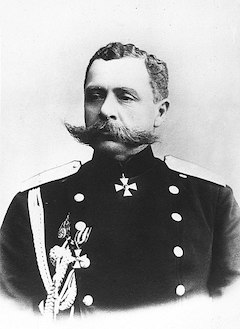
1918: Paul von Rennenkampf, tsarist general

On this date in 1918, General Paul von Rennenkampf dug his own grave by the side of the railway tracks near Taganrog, then was shot by the Bolsheviks for declining a promotion.

The Baltic German with the glorious Hungarian had spent a career in the tsarist officer corps; he took part in the multinational suppression of China’s Boxer Rebellion, and then the entirely domestic suppression of the abortive 1905 revolution.

Less well did the motherland fare against the Japanese in 1904 (where Rennenkampf’s shin and Russia’s infantry were both shattered) or against history in the Great War (which saw Rennenkampf sacked for command failures in the Battle of Lodz).

Although it seems that the latter result was the consequence of political infighting moreso than verifiable incompetence, the man was still cooling his heels in forced retirement when the revolutions of 1917 arrived. Both the February and the October revolutionaries detained him for a time and then released him, finding insufficient interest in those weighty days in a cashiered sexagenarian no matter how backwards his political priors.

But the Bolsheviks found him interesting when they took over Taganrog, where Rennenkampf was parked. This was his wife’s home town, near the southern industrial center Rostov-on-Don — a place that would be intensely contested in the unfolding civil war between communist Red and tsarist White armies. Such moments entail a choice of sides, so when the Bolsheviks offered this veteran senior commander a role in the Red Army, it was understood to be an offer he couldn’t refuse. He refused it, with bold words that were patriotic but not prophetic.

I’m old. I have not much left to live, for the salvation of my life, I will not become a traitor and will not go against my own. Give me a well-armed army, and I will go against the Germans, but you have no army; to lead this army would mean leading people to slaughter, I will not take this responsibility on myself.

On this day..

1984: Ryszard Sobok

Polish mass murderer Ryszard Sobok hanged in Wroclaw on this date in 1984.

The horror of the little village of Walim, Sobok suddenly slaughtered six intimates from February 11 to 12, 1981.

On the former date, Sobok strangled his seven-month-pregnant mistress Krystyna Nykiel along with Krystyna’s 16-year-old daughter and one-year-old son. They had a fractured relationship: Sobok drank away their little money, and he was angry that she wanted to abort her pregnancy. Still, the fury he vented on this woman seemed to well surpass the bounds of any ordinary crime of passion: Sobok hung up the bodies in his tenement’s main living room, then went calmly to sleep.

Upon waking, he called on his father and bludgeoned the man to death with a hammer, then applied the same fate to a young niece and nephew. And once again these last two he strung up, a special nightmare awaiting their mother’s discovery upon return from work that afternoon.

His chillingly calm confession gave no hint of madness and neither did the court psychiatrists. He was treated accordingly.

I killed Krystyna Nykiel because she wanted to kill my child and drive me away … her daughter Teresa because she saw me kill her mother and could tell someone … her son Marek so that he didn’t starve when orphaned … my father because he didn’t lend me money for food and because of him I didn’t have any milk or food at home … Irka and Anka because they tried to defend my father.

On this day..

1908: Chester Gillette, A Place in the Sun inspiration

Theodore Dreiser‘s classic novel An American Tragedy was inspired by an infamous 1906 murder whose author, Chester Gillette, was electrocuted at Auburn Prison on this date in 1908.

It was a crime tailor-made for the burgeoning mass media, popular and pretty 20-year-old Grace Brown gone to work at the Cortland, N.Y. Gillette Skirt Factory where the owner’s nephew seduced and impregnated her.

That, of course, is our man Chester Gillette, who further distressed his lover by tomcatting around town, especially charging the love triangle with class rivalry with his rumored interest in a socialite while he stalled for time with Ms. Brown. Dreiser’s novel — which is freely available from the public domain — spins on this axis, although the real-life heiress in question put out an arch press release averring that “I have never been engaged to Chester E. Gillette … Our acquaintance was of … a limited duration.”

That was also true of Gillette’s acquaintance with Grace Brown. At length he induced the future mother of his child to elope to the Adirondacks upon the apparent prospect of finally regularizing their situation. Instead, after making a couple of stops in upstate New York, they paused on July 11 at Big Moose Lake for a nice canoe outing. While out on the water, Gillette bashed his lover’s head with his tennis racket and forced her into the water to drown.

Letters the two had exchanged would establish that Gillette knew Brown could not swim … and the fact that he’d brought his whole suitcase with him for this supposed day trip would establish his premeditated intent. Gillette schlepped his stuff along with his guilty conscience through the woods to another lake and checked into a hotel under his real name(!). He was as careless with his coverup, alibi, and escape as he had been with his heart; Brown’s body was recovered the very next day and the trail led directly back to Gillette, who was not difficult to find and couldn’t stick to a story — alternately claiming that the drowning was an accident, a suicide, or something that happened when he wasn’t there at all.

The snake was public enemy number one by the time he came to his trial, making the case a national sensation. Dreiser improved it to literature in 1925, and it was such a hit that he was immediately called upon to adapt it for the stage. A version hit the silver screen as soon as 1931, but its best-known rendering is the 1951 classic A Place in the Sun, which earned Academy Award nominations for both Shelley Winters and Montgomery Clift, who portrayed the young lovers.

It’s had an enduring appeal for the century since; rumors of Grace Brown’s ghost haunting Big Moose Lake brought the case to the Unsolved Mysteries television program in the 1990s, and an award-winning 2003 novel A Northern Light centers around a fictional friend of Grace Brown’s. There’s even an A Place in the Sun opera.

On this day..

1987: Lawrence Anini, The Law

Nigerian bandit Lawrence Anini was executed on this date in 1987.

Strongman of a well-armed gang whose robberies and hijackings terrorized Benin Cty, Anini in 1986 fell out with his erstwhile police protectors, resulting in a bloody war of assassinations that claimed nine policemen’s lives and god knows how many gangsters. It also made Anini Nigeria’s public enemy number one.

He was wheelchair-bound throughout his high-profile trial, owing to having a leg amputated after it was badly shot up in the course of his December 1986 arrest. This fact earned the man once chillingly nicknamed “The Law” no sympathy at all, although he did also implicate a number of corrupt cops, drawing several convictions.

He was shot along with a number of his confederates on March 29, 1987.

On this day..

1572: Annecke Lange, Gesche Herbst, and Annecke Rotschroeder

On this date in 1572, Annecke Lange, Gesche Herbst, and Annecke Rotschroeder were all condemned and burned at Neustadt am Rübenberge, as witches and poisoners.

Although commoners, they were the luckless casualties of misbegotten marital politics in the Holy Roman Empire, and in the words of Tara Nummedal in Anna Zieglerin and the Lion’s Blood: Alchemy and End Times in Reformation Germany, “the entire incident laid bare simultaneously the fear of poison and sorcery and the reluctance to advance witch accusations against women of elite status in the princely courts of central Europe.”

The particular princely court of interest for us is that of Eric(h) II, Duke of Brunswick-Lüneburg, a Lutheran convert who married a House of Wettin princess called Sidonie of Saxony. It was one of those love-matches by which the bluebloods slip the bonds of arranged dynastic alliances and often, of historical irrelevancy. ‘Tis a likely antechamber to the volumes of Executed Today.

Sidonie was a decade Eric’s senior, leading one wise grandee to predict, “All sorts of things will happen inside this marriage after the kissing month ends.”

Just so. Eric reverted to Catholicism and the childless couple became bitterly estranged — not only over religion, but money, and the want of a child. (Eventually Eric would die without an heir, and pass his realm to a cousin.) So intense would the couple’s antipathy become that they began to suspect one another of seeking an abrupt annulment by the hand of the poisoner.

That hypothesis became self-confirming when Eric fell ill in 1564, and Eric (this is Nummedal again) “initiated an investigation, accusing four women in Neustadt am Rübenberge, close to Hannover, of both trying to poison him and using sorcery to disrupt his marriage, keep him away ‘from his land and people,’ and make Sidonie barren.”

Three of these four women broke under torture and admitted not only poisoning but witchcraft; they were burned in 1568. But the fourth woman, Gesche Role, had the fortitude to withstand her interrogators and was released.

It’s by way of Gesche Role that we arrive at our day’s principals — for in some fresh turn of the diplomatic jockeying between the estranged power couple, Eric renewed his accusation and re-arrested the poor woman upon fresh claims of fiendery. This time she succumbed and confessed — adding, as is the style, a series of charges against five other acquaintances: our three victims, Annecke Lange, Gesche Herbst, and Annecke Rotschroeder; plus, Annecke’s husband Hans Lange, who died under torture; and, a woman named Margarethe Ölse or Ölsin, whose fate was stayed by dint of her pregnancy. Hans Lange had actually been a barber and surgeon who had been in ducal employment, affording some material connection to the “victim’s” plate, but of course all confessions were secured in the usual violent manner.

On the 28th of March, our three victims were condemned at Neustadt and immediately sent to the stake. Several others in the widening witch inquiry shared a like fate later that same year; the overall number of Neustadt “witches” executed from the various procedures initiated by Eric is not known, but might run up towards 60.

The reader will mark that all these souls were merely humble folk destroyed as flies to wanton boys. Witch fires were usually quenched once their flames licked titled estates, and so it was in this case, as the 1572 Hexenprozesse “also implicated a cluster of noblewomen (Anna von Rheden, Katharina Dux, and Margaretha Knigge), and it was not long before Duke Erich’s estranged wife, Sidonie, herself was accused of directing the poison plot against her husband, purportedly because of his relationship with his mistress, Katharina von Weldam. This escalation of the trial as it reached into the nobility proved to be too much, apparently, even for Duke Erich II, who halted the trial before the noblewomen were sentenced,” and after a pause the Holy Roman Emperor reconvened a hearing at which all concerned were exonerated.

On this day..

1915: Pandit Kanshi Ram, Ghadar plotter

On this date in 1915, Indian revolutionary Pandit Kanshi Ram was hanged by the British.

Present on the U.S. west coast for the founding of the heavily Sikh revolutionary Ghadar Party, Ram repatriated to participate in that clique’s eponymous Ghadar Mutiny.

This attempt to incite rebellion in the Raj was heavily surveilled, and crushed at the outset. The result was a series of trials bringing 20+ executions in 1915 known as the Lahore Conspiracy trials. (It’s not to be confused with the Delhi-Lahore Conspiracy.) “The British as a nation, all white men as a race and the English Government in particular, are all maligned in a spirit born of a depraved nature,” fumed the first court, the one that condemned Pandit Kanshi Ram. “Facts are not only distorted but most maliciously perverted to appeal to the lowest passions of Indian subjects. In the most open, defiant and unmasked manner mutiny is preached. “

On this day..

1689: Gabriel Milan, Danish West Indies governor

Gabriel Milan, the governor of the Danish West Indies, was beheaded on Copenhagen’s Nytorv Square on this date in 1689.

Born to an emigre family of former Marranos that had resumed open Judaism, Milan (English Wikipedia entry | Danish) was a cavalryman turned merchantman married to the daughter of one of Europe’s most prominent Jewish scholars.

Well-connected in the court of Prince George of Denmark, Milan in 1684 was tapped to govern the struggling nascent sugar colony of the Danish West Indies — the islands of Saint Thomas, Saint John, and Saint Croix that have comprised the U.S. Virgin Islands since Denmark sold the money pits off in 1917.

There he proved to be a pettifogging despot who was noxious to the island’s planters and conspicuous about exploiting his office to fatten his own coffers. His incompetent predecessor, who was only supposed to be sent back to the mother country, Milan instead clapped in a dungeon. Even his brutal treatment of slaves — using impalement for an execution! — shocked peers accustomed to a different spectrum of cruelty.

“I wish for my part that your Excellency could have been here a single day and heard what thundering there has been in the commission, with howling, shouting, and screaming, one against the other,” the official reporter noted. “God be thanked it is over.”

On this day..