1781: Tupac Amaru II, Incan insurgent

On this date in 1781, the last name in Incan rebellion met a horrible end in the ancient Incan capital of Cusco.

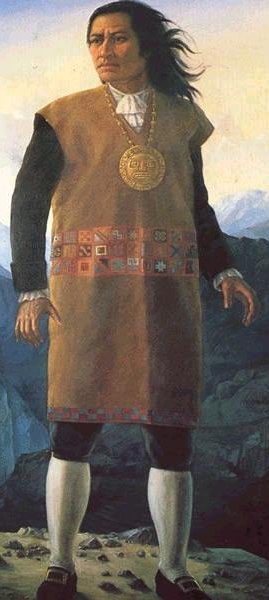
José Gabriel Condorcanqui — rechristened Tupac Amaru II, as he was a distant descendant of the last Incan king — was a member of the privileged indigenous population depended upon by the Spanish to administer the forced and extorted labor that made its New World empire worth having.

Condorcanqui evidently had an epiphany.

In November 1780, he launched a well-planned rebellion by engineering the public execution of a hated corregidor Antonio de Arriaga at the hands of his own servant.

“From this day, no longer shall the Spanish feast on your poverty!”

This attention-grabbing entry onto the political chessboard was followed with an exemplary victory over Spanish forces. His revolt rapidly metastasized into an ethno-religious crusade, with all the accumulated bitterness of the Indians’ two-plus centuries maltreatment ferociously visited upon the Spanish.

It was a heady moment — but only a moment; within a few months, the Spanish had rallied and Tupac Amaru was betrayed into their hands.

The rebel had seized Incan symbology for his own purposes — speaking at ancient shrines, for instance — and the Spanish sentence against him included not only the inevitably horrific execution (of both Tupac Amaru and his wife and family) but a comprehensive and explicit programme of cultural annihilation to consign the Incan identity to the past. This lengthy sentence is well worth the read. (Sourced here, a pdf file; the bolded sections are my highlights.)

I must and do condemn José G. Túpac Amaru to be taken out to the main public square of [Cuzco], dragged out to the place of execution, where he shall witness the execution of the sentences imposed on his wife, Micaela Bastidas [Spanish link]; his two sons, Hipólito and Fernando Túpac Amaru; his uncle, Francisco Túpac Amaru; and his brother-in-law, Antonio Bastidas, as well as some of the principal captains and aides in his iniquitous and perverse intent or project, all of whom must die on the same day.

And once these sentences have been carried out, the executioner will cut out his tongue, and he will then be tied or bound by strong cords on each one of his arms and feet in such a way that each rope can be easily tied or fastened to others hanging from t he saddle straps of four horses, so that, in this position, each one of these horses, facing opposite corners of the square, will pull toward his own direction; and let the horses be urged or jolted into motion at the same time so that his body be divided into as many parts and then, once it is done, the parts should be carried to the hill or high ground known as “Picchu,” which is where he came to intimidate, lay siege to, and demand the surrender of this city; and let there be lit a fire which shall be prepared in advance and then let ashes be thrown into the air and a stone tablet placed there detailing his main crimes and manner of his death as the only record and statement of his loathsome action.

His head will be sent to the town of Tinta where, after being three days on the gallows, it shall be placed on a stake at the most public entrance to the town, one of his arms will go to the town of Tungasuca, where he was chief, where it will be treated in like manner, and the other in the capital of the province of Carabaya; one of the legs shall likewise be sent for the same kind of demonstration to the town of Libitaca in the province of Chumbilcas, while the remaining one shall go to Santa Rosa in the province of Lampa along with the affidavit and order to the respective chief magistrates, or territorial judges that this sentence be proclaimed publicly with the greatest solemnity as soon as it arrives in their hands, and on the same day every year thereafter; and they will give notice in writing of this to their superiors in government who are familiar with the said territories.

Since this traitor managed to arm himself and form an army and forces against the royal arms by making use of or seducing and leading with his falsehood the chiefs who are the second in command in the villages, since these villages, being of Indians, are not governed by such chiefs but rather by mayors who are elected annually by the vote or nomination of the chiefs: let these same electoral communities and the chief magistrates that care to give preference to candidates who know Spanish, and who are of the best behavior, reputation, and customs so that they will treat their subjects well and lovingly, honoring only those who have demonstrated honestly their inclination and faithfulness, eagerness, respect, obedience, submission, and gratitude to the greater glory of our great Monarch through the sacrificed of their lives, properties, or ranches in deference of their country or religion, receiving with brave disdain the threats and offers of the aforesaid reel leader and his military chiefs, yet taking care that these elected leaders are the only ones with the right to the title of chief or governor of their ayllus [communities] or towns, and that they cannot transmit their position to their children or other family members.

To this same end, it is prohibited that the Indians wear heathen clothes, especially those who belong to the nobility, since it only serves to symbolize those worn by their Inca ancestors, reminding them of memories which serve no other end than to increase their hatred toward the dominant nation; not to mention that their appear is ridiculous and very little in accordance with the purity of our relics, since they place in different parts images of the sun, which was their primary deity; and this prohibition is to be extended to all the provinces of this southern America, in order to completely eliminate such clothing, especially those items which represent the bestialities of their heathen kings through emblems such and the unco, which is a kind of vest; yacollas, which are very rich blankets or shawls of black velvet or taffeta; the macapaycha, which is a circle in the shape of a crown from which they hand a certain emblem of ancient nobility signified by a tuft or tassel of red-colored alpaca wool, as well as many other things of this kind and symbolism. All of this shall be proclaimed in writing in each province, that they dispose of or surrender to the magistrates whatever clothing of this kind exists in the province, as well as all the paintings or likenesses of their Incas which are extremely abundant in the houses of the Indians who consider themselves to be nobles and who use them to prove their claim or boast of their lineage.

These latter shall be erased without fail since they do not merit the dignity of being painted in such places, and with the same end in mind there shall also be erased, so that no sign remains, any portraits that might be found on walls or other solid objects; in churches, monasteries, hospitals, holy places or private homes, such duties fall under the jurisdiction of the reverend archbishops or bishops of both viceroyalties in those areas pertaining to the churches; and in their place it would be best to replace such adornments with images of the King and our other Catholic sovereigns should that be necessary. Also, the ministers and chief magistrates should ensure that in no town of their respective provinces be performed plays or other public functions of the kind that the Indians are accustomed to put on to commemorate their former Incas; and having carried out the order, these ministers shall give a certified account to the secretaries of the respective governments. In like manner shall be prohibited and confiscated the trumpets or bugles that the Indians use for their ceremonies and which they call pututos, being seashells with a strange and mournful sound that celebrate the mourning and pitiful memorial they make for their antiquity; and there shall also be prohibited the custom of using or wearing black clothing as a sign of mourning, a custom that drags on in some provinces in memory of their deceased monarchs and also of the day or time of the conquest which they consider disastrous and we consider fortunate since it brought them into the company of the Catholic Church and the very loving and gentle domination of our Kings.

With the same goal it is absolutely forbidden that the Indians sign themselves as “Incas,” since it is a title that anyone can assume but which makes a lasting impression on those of their class; and it is ordered, as is required of all those who have genealogical trees or documents that prove in some way their descent, that they produce them or send them certified and without cost by mail to the respective secretaries of both viceroyalties so that the formalities may be observed by those persons responsible to their excellencies the viceroys, consulting His Majesty where necessary according to each case; and the chief magistrates are charged to oversee the fulfillment of such requirements, to seek out and discover anyone who does not observe them correctly, in order to have it done to collect the documents with the aim of sending them to the proper authorities after giving their owners a receipt.

And so that these Indians renounce the hatred that they have conceived against the Spaniards, and that they adhere to the dress which the laws indicate, adopting our Spanish customs and speaking Castilian [Spanish], we shall introduce more vigorously than we have done up to now the use of schools, imposing the most rigorous and fair penalties on those who do not attend once enough time has passed for them to have learned the language; the duties and responsibilities involved in this plan going to the very reverend ecclesiastical prelates so that, in the opposition between parishes and doctrinas, they take care that those candidates bring affidavits from the provincial judges as to the numbers of people who speak the Said Castilian in those provinces … it being left up to the sovereign discretion of His Majesty to reward and honor those towns whose inhabitants have rendered, under the present circumstances, their due loyalty and faithfulness.

Finally, the manufacture of cannons of all kinds shall be prohibited under the penalty that any noble found manufacturing such items will be sentenced to ten years of prison in one of the presidios in Africa and any commoner will receive two hundred lashes as well as the same penalty for the same time period; reserving for a future time a similar resolution with regards to the manufacture of powder. And since there cannons of almost every caliber in the many ore-crushing mills and timber yards in these provinces, they will be gathered up by the magistrates once of the pacification of this uprising has been completely terminated in order to give account of them to the respective captaincy general so that he may determine whatever use he deems proper for them. Thus have I visualized, ordered, and signed: this is my final judgment.

José Antonio de Areche.

Tupac Lives.

The Spanish campaign to eradicate his name and identity didn’t exactly have legs.

The savagery of the crackdown helped generate Incan support for the rebellions that would shake off Spanish authority in the generations to come. He entered the official iconography of the post-colonial state, and can be found on Peruvian currency.

The very name Tupac Amaru became pregnant with the spirit of resistance — both in Peru, where it was adopted by a 1990’s revolutionary movement, and abroad, where a New York City Black Panther activist (pdf) gave the name to a son: Tupac Amaru Shakur.

On this day..

1972: The rapists of Maggie dela Riva

On this date in 1972, Jaime Jose, Basilio Pineda and Edgardo Aquino were electrocuted* in Muntinlupa for the gang-rape of actress Maggie de la Riva (or dela Riva) five years before.

The rising young actress had scarcely wavered after the assault before courageously making the always-fraught rape charge against a quartet** of attackers themselves from elite families. (The particulars are recounted in the Supreme Court ruling.)


J’accuse! Maggie de la Riva identifies two of the culprits just five days after her gang rape. Talk about facing your accuser; according to the accompanying article, “the frail-looking mestiza was a picture of righteous indignation as she extended her arms, showed her bruises, and asked Pineda, pointedly: ‘Do you remember these?'”

The case was a media sensation from day one. The Philippine film blog Video 48 republished a three-part series on the rapists’ capture (parts 1 and 2) and execution (part 3), complete with the desperate efforts of the offenders’ families to save them.

The victim herself continued her acting career.

Decades later, she’s still a public personality, and seems to have made peace with and moved on from her famous ordeal with impressive equanimity.

When that misfortune happened to me, I realized that although my body was raped my true self was never defiled and that there’s another person in me that’s beautiful, strong and true. The old Maggie has faded away. I look at my experience as something that happened to someone else who is no longer the person I am today. (Source)

* The Philippines adopted use of the electric chair in the early 20th century from the U.S., its colonial ruler at the time. It’s the only country besides the United States to have used the chair.

** One of the four condemned to death for the rape, Rogelio Canial, died in prison of a drug overdose several months before the executions.

On this day..

1975: Michael X

On this date in 1975, black revolutionary Michael X was hanged for murdering an insubordinate follower.

Born Michael de Freitas to a mixed-race parentage, the future Michael X immigrated to London from his native Trinidad in 1957.

There, he quickly established a criminal niche — drugs, racketeering, prostitution. “They’ve made me the archbishop of violence in this country,” he joked. It was a background noticeably parallel to that of Malcolm X, whose naming convention he took after a 1965 meeting.

By then, our day’s subject had been swept into the contradictory whirl of the 1960’s, emerging as Britain’s “authentic voice of black bitterness”, whose networks ran the gamut from the criminal underbelly to the rich and powerful.

(He’s a fringe character in the 2008 film The Bank Job, which imaginatively posits that he ducked prosecution for a heist by threatening to expose incriminating photos of swinging royal Princess Margaret.)

Michael’s chameleon-like identity — he was raised to pass as white, and known as “Red Mike” by black nationalist compadres — meshes well with the Rorschach-blot times he lived in. Certainly there was the eloquent spokesman of black militancy. There was also, ever more predominant, the violent avatar of social breakdown.

Michael X skipped bail in England to bolt for Trinidad and an agricultural commune with an increasingly creepy bent. Eventually, two bodies turned up: Joseph Skerritt, personally murdered by a machete-wielding Michael X for refusing to attack a police station and/or general disillusionment; and (sensationally) the socialite daughter of a Tory M.P. evidently buried alive.

Michael X — now Michael Abdul Malik — still had the cachet to draw celebrity support for his clemency campaign; Angela Davis, William Kunstler and John Lennon (who had put up Michael de Freitas’s bail in some previous legal scrapes) backed the “Save Malik” committee, but to no avail.

On this day..

1297: Marion (Murron) Braidfute, bride of The Wallace

May of 1297 marks the first appearance in the historical record of Braveheart hero William Wallace … so we mark today the undated (and presumably fictional) execution/murder of his wife that, by the most cinematic account possible, set Wallace on his own path to the scaffold.

The face that lifted a thousand claymores: Catherine McCormack as Braveheart‘s version of Marion, Murron MacClannough. Murron’s “execution” inspires William Wallace.

Marion (or Marian) Braidfute, she’s called by the Scottish poet Blind Harry in the epic dating near two centuries after famed rebel’s rising. Not wanting audiences to confuse her with Robin Hood sweetie Maid Marian, the Braveheart script renamed her Murron MacClannough.

In Mel Gibson’s gory silver screen epic, Wallace is, at this point, a determinedly apolitical commoner — a stance contrasting markedly with a backstory of nationalistic identity-forming experiences, like having his father and brother killed by the English. He’s radicalized only after his attempt to protect Murron from rape results in her demonstrative summary execution.

And of course, Wallace then wreaks a bloody revenge (complete with summary execution of his own) that soon has the country in flames.

Hollywood’s avenging-his-woman angle exploits a folkloric embroidery of a female character perhaps created by Blind Harry, writing in the 15th century. In “The Wallace”, the titular hero is already well along his conflict with the English crown when he weds Marion — whose story arc differs greatly from that of the peasant eye candy Mel Gibson taps. In the poem, Marion is exposed to the vengeance of the Sheriff of Lanark, William Heselrig, when Wallace goes off to fight and refuses to take her along.

Now fierce with Rage the cruel Foe draws near,
Oh does not Heaven make Innocence its Care!
Where fled thy guardian Angel in that Hour
And left his Charge to the fell Tyrant’s Power,
Shall his fierce Steel be redned with thy Gore
And streaming Blood distain thy Beauties o’er?

But now awaken’d with the dreadfull Sound
The trembling Matron threw her Eyes around,
In vain alace were all the Tears she shed
When fierce he waves the Fauchion o’er her Head
All Tyes of Honour by the Rogue abjur’d
Relentless deep he plung’d the ruthless Sword;
Swift o’er her Limbs does creeping Coldness rise
And Death’s pale Hand seal’d up her fainting Eyes.

Wallace slays Heselrig the next day, according to the poem — the actual historical event of May, 1297,* that marks Wallace’s emergence from the dim fogs of history. (In the film Braveheart, the chronology is unstated, but Wallace is revenged before Murron’s burial.)

John of Fordun, writing in the 14th century, tells the tale.

The same year William Wallace lifted up his head from his den — as it were — and slew the English sheriff of Lanark, a doughty and powerful man, in the town of Lanark. From that time, therefore, there flocked to him all who were in bitterness of spirit, and weighed down beneath the burden of bondage under the unbearable domination of English despotism; and he became their leader. He was wondrously brave and bold, of goodly mien, and boundless liberality … So Wallace overthrew the English on all sides; and gaining strength daily, he, in a short time, by force, and by dint of his prowess, brought all the magnates of Scotland under his sway, whether they would or not.

* “In the month of May the perfidious race of Scots began to rebel.” (Walter of Hemingborough)

On this day..

1880: Edwin Hoyt, in Bridgeport

From the New York Times.

THE DEATH OF A PARRICIDE.

HANGING OF EDWIN HOYT AT BRIDGEPORT — PERSISTING TO THE LAST THAT HE WAS INSANE.

BRIDGEPORT, Conn., May 13. — The first administration of capital punishment in Fairfield County since 1809 occurred in this city to-day. Edwin Hoyt was hanged for the murder of his father, in the Town of Sherman, June 23, 1878. Hoyt was then 37 years of age, and had shown during his life a very ugly disposition. His wife, the mother of his five children, had experienced his temper in a manner which placed her life in danger, he having discharged a shot-gun at her and severely wounded her. On the Sunday of the murder he had nothing to exasperate him except the refusal of his brother-in-law to accompany him on a fishing trip. Having been refused, he went home, and, taking a butcher-knife from his house, told his wife that he was going to kill his father. He then returned to the house of his brother-in-law, where his father was at the dinner-table with the family. He appearad [sic] despondent, and said it would be better for him to die, but that there were two or three people he wanted to kill first. He then went to the porch and sat down with his father. A few minutes afterward he sprang up and stabbed his father several times, making a fatal wound in the neck. Hoyt was tried twice, the first time in October, 1878, and the second time in April, 1879. The State claimed that the motive for the killing was animosity toward his father, who had always exercised great severity toward him, and who, he believed, had decided to wholly disinherit him. The defense in both cases was that of insanity.

Hoyt had never believed that he was to be hanged until Wednesday evening, when the final attempt to save his life by means of a writ of error proved ineffectual. After this he was not despondent, but talked pleasantly with the Rev. Dr. E.W. Maxey, who baptized him according to the rites of the Protestant Episcopal Church about 7 o’clock in the evening. After the clergyman went away he ate a hearty supper, smoked a cigar, and wrote a letter to his brother George. The letter was finished by the time Judge Blydeuburgh, of New-Haven, and Mr. Taylor, of Danbury, Hoyt’s counsel, arrived. They were with him about an hour, during which time he delivered his will to them, saying that he wished to have it kept private. They suggested to him that he might desire to make a final statement. He had nothing to say, he answered, in addition to what he had said, for he was not responsible for the killing, having known nothing of it. After his lawyers had left him, the Rev. Dr. Maxey came to remain with him until the time of the hanging.

The hanging occurred in a yard on the west side of the jail, and was witnessed by about 500 people. The yard was nearly filled, and from the woman’s ward of the jail many spectators looked down on the gallows. The prisoners in the male ward were permitted to witness the hanging from their windows. At just 11:30 o’clock the procession to the gallows started. First came Sheriff Sanford; next came Deputies Bartram and Dann, and behind them walked Hoyt, the Rev. Dr. Maxey having his hand on his right arm. Deputies Wakeley and Hughes were in the rear of the prisoner, and behind them walked Drs. George R. Porter, Robert Lauder, and E.D. Noony, of Bridgeport, and Dr. Marshall, of Greenwich. Hoyt, on the scaffold, raised his face to the sky, but showed no emotion beyond that which was expressed in his pale face. He was dressed in the old clothing which he has worn in jail, having refused to change to a black suit sent to him by a friend. The streaks of gray in his otherwise black hair and mustache gave him the appearance of being at least 10 years older than he was. When he was placed on the trap Sheriff Sanford asked him if he had anything to say. He answered in a faint voice, “No, Sir.” Dr. Maxey then read prayers, after which the noose was arranged and the black cap adjusted. Sheriff Sanford shook hands with Hoyt, saying, “Good-bye, poor fellow,” and stepped to the spring near which one of his deputies was standing. The trap fell. There was no noise except that made as the body fell a distance of five and a half feet. Dr. Porter, who had been in charge of the bodies of Mrs. Surratt and the other conspirators executed at Washington, had his hand on the wrist of the condemned man as the rope straightened. The fall of the trap occurred at 11:35 1/2, and at 12:14 the body was taken down. Death was instantaneous, resulting from a dislocation of the neck. There was some muscular tremor, but it lasted only a second. After the body had been taken to the jail, the physicians applied electric batteries and produced muscular contortions of the face and limbs an hour and a quarter after death occurred. The body was given up to Hoyt’s sisters, and taken to Sherman for burial.

On this day..

1993: Leonel Herrera, perilously close to simple murder?

On this date in 1993, Leonel Herrera was executed by lethal injection in Huntsville, Texas, for shooting two policemen. Herrera’s last statement averred,

Herrera’s sister Norma self-published this book about the case — keeping a promise to her executed brother.

I am innocent, innocent, innocent. Make no mistake about this; I owe society nothing. Continue the struggle for human rights, helping those who are innocent, especially Mr. Graham. I am an innocent man, and something very wrong is taking place tonight. May God bless you all. I am ready.

Well, Herrera wasn’t the first to go to his death maintaining his innocence. The circumstances (and circumstantial evidence) of the crime rate on the forgettable side.

But Leonel Torres Herrera was a bit different from his cousins in hopeless protestation: while he died this evening, his name lived on … in a landmark Supreme Court decision

Herrera v. Collins

Years after Herrera was convicted and death-sentenced, multiple affidavits were produced to the effect that his late brother, Raul, was the real killer.

This evidence was naturally pursued with gusto by the condemned man.

Unfortunately, a claim like Herrera’s of “actual innocence” faces a very high bar when raised in appellate courts, once a prisoner has already been convicted and their presumption of innocence become a presumption of guilt.

That this arbitrary rule of the game has a defensible rationale — could any criminal justice system operate if prisoners could continually relitigate their cases while memories fade and evidence ages into obsolescence? — does not make it the less Kafkaesque for individual prisoners, some of whom are in fact innocent.

Herrera presented this problem in unusually stark terms. Lacking any procedural violation upon which to hang his hat as an appeals issue, his claim pitted substance against form in the Supreme Court. (Oral arguments at Oyez.org)

You already know how it ended.

Chief Justice William Rehnquist’s opinion patiently explained a jurisprudential truism loftily uncolored by any experience in life liable to introduce a sense of kinship with a Hispanic man charged with a Texas cop-killing who uncovers too late the evidence that could save him.

“[A]ctual innocence” is not itself a constitutional claim.*

Instead, the Court recommended — tongue no doubt planted firmly in cheek — that Herrera apply for executive clemency, a dead letter procedure in Texas used exclusively in a good cop/bad cop routine opposite the black robes.

“Judicial restraint forbids relieving you,” says the court. “Go ask the governor.”

“The courts have thoroughly reviewed the case,” intones the governor. “May God have mercy on your soul.”

Herrera himself may or may not have been innocent. At the end of the day, he went down because the game was rigged against him: his exculpatory evidence was not available at trial, when it might have introduced “reasonable doubt” — as Rehnquist’s opinion put it, “in state criminal proceedings the trial is the paramount event for determining the guilt or innocence of the defendant.” Once that evidence became available deep in the appeals process, it was procedurally barred, and far from such a slam-dunk exoneration that any institutional actor would stick his, her or its neck out to lift Leonel Torres Herrera from the gurney.

Justice Harry Blackmun’s dissent retorted,

Just as an execution without adequate safeguards is unacceptable, so too is an execution when the condemned prisoner can prove that he is innocent. The execution of a person who can show that he is innocent comes perilously close to simple murder.

Whether “simple murder” happened in Huntsville this night in 1993, perhaps no one can really say with certainty.

But as DNA evidence and other forensic advances in the intervening years have increasingly eroded confidence in the reliability of the justice system that metes out death, Herrera v. Collins stands as a key precedent in a case now before the Supreme Court — in which states (joined by the Obama administration) are asking the justices to agree that convicted prisoners have no right to cheap, simple, and frequently dispositive DNA testing that may not have been available when they were tried.

Given the composition of the court (including three holdovers from the Herrera majority), that decision figures to have Leonel Herrera rolling over in his grave.

* Rehnquist conceded a theoretical possibility that extraordinarily persuasive evidence could generate relief on due process grounds. Antonin Scalia and Clarence Thomas went much further, claiming that prisoners had no right to anything but their trial and their (procedural) appeals.

On this day..

1891: The Namoa pirates

On this date in 1891, Chinese authorities beheaded 15 at Kowloon, including the leaders of the then-notorious Namoa pirates.

They were nicknamed for the steamer they had infamously commandeered six months before. The tale is related by an English maritime official’s orientalist (and now public-domain) memoir, The Mystic Flowery Land:

The most daring and disastrously successful piracy of late years … was the “Namoa” piracy in 1890. The startling news of this outrage created a general feeling of unsafety and consternation among the foreign communities in China, mingled with grief and just resentment for the cold-blooded murder of Captain Pocock and Mr. Petersen, both most popular and respected men, the latter being a member of the Customs Service.

On Sunday, the 3rd of December, 1890, the Douglas, Lapraik, and Co‘s coasting steamer, “Namoa,” commanded by my late most esteemed friend Capt. Pocock,* left Hongkong at noon, bound on her usual trip up the coast to Swatow, Amoy, and Foochow with several European and a large number of Chinese passengers, most of the latter being Fuhkien people returning to their native homes after many years absence in the United States and California, each with his little hoard of hard-earned dollars, gained by a small lifetime of frugal toil and self-denial in a distant land. These poor men were nearing their well-remembered haunts of earlier days, to once more spend among the relations and friends of their youth the fast-approaching New Year.

…

Several Chinese passengers [during the voyage] came up out of the main between-decks and walked about for some minutes in a seemingly aimless manner; then others emerged from the hatch, until there were between forty and fifty on deck — some forward near the hatchway leading down to the junior officers’ mess, others near the bridge ladder and entrance to engine-room and stokehole, and the rest at the main hatchway, saloon entrances and after skylight.

Suddenly, at a given signal, off came their loose outer garments, and these harmless-looking passengers were armed men; each with a cutlass and two revolvers in hand, and at their appointed stations.

…

The ship was now entirely in the hands of the pirates, whose leader placed one of the gang at the helm, with directions to steer a certain course.

The attack had been planned and carried out with consummate tact and forethought, for the pirates were old hands — desperate scoundrels … two or three ventured below … among their terror-stricken countrymen, and ransacked their luggage, robbing them of their treasured packets of dollars, saved during long and lonesome years of comparative exile and drudgery. Every cent was taken from these poor fellows, who wept in vain, and heart-rending scenes ensued. But the wretches took all.

…

Then [the European passengers] were all driven into the captain’s little berth, which was barely large enough to hold them all, where they were nearly suffocated.

At this point, the pirates steam off to rendezvous with their confederates, transfer their persons and their booty to the getaway ships, and — after debating whether to burn the Namoa — instead abandon the ship unsunk and the hostages unkilled.

These put the ship to rights and got it back to Hong Kong.

Public indignation was great, and considerable pressure was brought to bear on the Chinese Government to bring the pirates to justice. Skilled foreign and Chinese detectives were sent out on their track, doggedly determined to run these criminals to earth and make them pay the full penalty of their dastardly deeds.

… most, if not all, of these notorious crime-hardened criminals were eventually brought to justice, suffering decapitation outside Kowloon city, the majority of them being executed on Monday, April 17th, 1891, and the remaining nineteen on Thursday, 11th May, of the same year.**

The pirates were such big news that posed photos were taken of their public executions. (Both images are detail views; click for the full picture.)

For some time great precautions were taken by the captains and officers of coasting steamers to search the luggage of all native passengers, and thus guard against a similar catastrophe.

* Captain Thomas Guy Pocock was killed by the pirates, and has a private memorial in Hong Kong Cemetery (aka Happy Valley Cemetery). He left a one-year-old son who died in World War I.

** According to a tome on legal administration in Hong Kong, the pirates were beheaded in batches mixed in with other criminals.

A wholesale execution took place at Kowloon City on the 17th April, 1891, when nineteen pirates were decapitated, thirteen of them for participating in the Namoa and other piracies, and six others for various offences in Chinese territory … on the 11th May fifteen more prisoners were beheaded at Kowloon by the Chinese authorities, amongst the number being six Namoa pirates, including the three leaders of the gang, one of the men being the captain of the junks on board which the pirates put their plunder … One of the leaders decapitated, named Lai A Tsat, was a man whose boldness and cunning in carrying out piracies had long made him a terror both at sea and on shore.

On this day..

1994: John Wayne Gacy, scary clown

This date in 1994 was the last on earth for Pogo the Clown — better known as John Wayne Gacy.


Hello, children.

The local small businessman and closeted pederast filled his crawlspace with the remains teenage boys he’d either kidnap off the street, or hire in his capacity as an independent contractor.

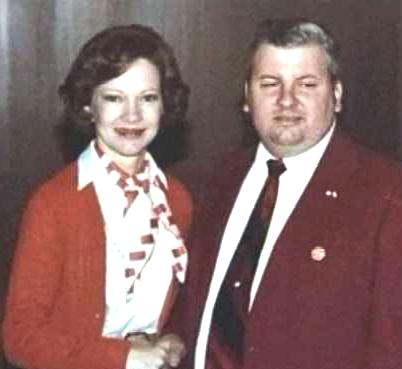
When he wasn’t raping and murdering, he kept up appearances as a Democratic machine operative (once photographed with First Lady Rosalynn Carter) and amateur block party harlequin.

Gacy was a notable “serial killer artist” in the years he spent awaiting lethal injection.* In that capacity, the clown motif continued to inspire him.


* The lethal injection was botched with a clogged IV tube. It took 18 minutes.

On this day..

1948: U Saw and the assassins of Aung San

On this date in 1948, Burma hanged six for a shocking assassination that haunts the country to this day.

The previous summer — specifically, at 10:37 a.m. on July 19th — independence hero/proto-head of state Aung San and six members of his cabinet had been massacred by gunmen

The trail quickly led back to rival pol U Saw, himself a former Prime Minister of under British colonial rule.

U Saw had once defended in court the hero of a peasant revolt that the British had quelled with some difficulty. His own maneuverings were heretofore of a more slippery character, having negotiated with the British government early in World War II for independent dominion status — and then turned around and negotiated with the Japanese for consideration in their occupation government.

(The British caught him at his act, and locked him up for the rest of the war. Aung San — “hands … dyed in British and loyal Burmese blood,” Winston Churchill charged* — had also collaborated with the Japanese, who were viewed as liberators by many who had struggled against British domination.)

U Saw was executed with three collaborators in this plot this day at Insein prison, while two others were hanged at Rangoon prison.

But were the British the unindicted co-conspirators?

The damage done by the assassination, in any event, could not be undone with the noose. Aung San appeared to be the only person with sufficient stature to govern Burma effectively. After his death, the newly independent country suffered impotent governments, ethnic conflict, and eventually coups that have today brought to power one of the more repugnant military dictatorships in the world.

The current Burmese junta has for a generation held under house arrest the most recent person to democratically win (but not assume) the office of Prime Minister: Aung San’s daughter, Nobel laureate Aung San Suu Kyi.

* Churchill said this after Aung San’s assassination. See London Times, Nov. 6, 1947, p. 4.

On this day..

1795: Antoine Quentin Fouquier-Tinville, Robespierre’s prosecutor

On this date in 1795, the attorney who had engineered the Terror was guillotined for engineering the Terror.

Antoine Quentin Fouquier de Tinville (English Wikipedia page | French), or just plain Fouquier-Tinville, had emerged during the Revolution from penurious obscurity to wrangle a jury foreman’s position courtesy of his connection to Camille Desmoulins. When Desmoulins ally Georges Danton spearheaded creation of a Revolutionary Tribunal (French link), Fouquier-Tinville drew the choice gig of Public Prosecutor.

From that perch, he would supply the arbitrary exercises of the Committee of Public Safety their (increasingly scanty) scaffolding of formal legality in Paris’s greatest show trials.

Charlotte Corday.

The Girondists.

Marie Antoinette.

Fouquier-Tinville’s own onetime benefactors, Danton and Desmoulins. (He struggled to contain Danton’s rhetorical fireworks, as depicted in the 1983 film Danton — we see him plying his trade from about 3:29 of this clip.)

Heck … when the Terror ended, our good state’s attorney even signed off on the execution of Robespierre, with what must have been a lump in his throat. He was himself denounced within days, and narrowly preserved from the summary justice of his fellow-prisoners upon incarceration.

Naturally, like every criminal barrister since, Fouquier-Tinville’s defense was, hey, don’t blame me: the law made me do it. “I had only acted in the spirit of the laws passed by a Convention invested with all powers. Through the absence of its members [on trial], I find myself the head of a conspiracy I have never been aware of.”

Pity the lawyers.

This varietal of the only-following-orders defense did not impress in Fouquier-Tinville’s case; the Public Prosecutor had made the role too much his own.

I have been told by a gentleman who was at school with Fouquier, and has had frequent occasions of observing him at different periods since, that he always appeared to him to be a man of mild manners, and by no means likely to become the instrument of these atrocities; but a strong addiction to gaming having involved him in embarrassments, he was induced to accept the office of Public Accuser to the Tribunal, and was progressively led on from administering to the iniquity of his employers, to find a gratification in it himself.

And, indeed, he was condemned by his own hand. His lawyerly letter to the Convention during Danton’s trial — “the accused are behaving like madmen and demand the summoning of their witnesses … our judicial powers do not furnish us with any means of refusing” — duly elicited those heretofore absent powers, which the prosecutor immediately deployed to gag the defense.

Antoine Quentin Fouquier de Tinville, the sinister mediocrity who gave villainy the cover of law, was guillotined this morning in 1795 to the delight of the Paris mob: the last head to roll in a batch of 16.

On this day..