1951: Jean Lee, the last woman to hang in Australia

(Thanks to Richard Clark of Capital Punishment U.K. for the guest post, a reprint of an article originally published on that site with some explanatory links added by Executed Today. CapitalPunishmentUK.org features a trove of research and feature articles on the death penalty in England and elsewhere. -ed.)

Jean Lee, an attractive 31-year-old redhead, made history as the last woman to hang in Australia when she went to the gallows in Pentridge prison in the Coburg suburb of Melbourne in Victoria state on the morning of Monday, February 19th, 1951. She and her two male companions were hanged for the murder of 73-year-old dwelling house landlord and bookmaker, William “Pop” Kent.

Jean Lee was apparently quite intelligent and a bit rebellious at school and had a succession of dead end jobs from which she soon left or was fired.

She married at 18 and lived with her husband for about nine years before leaving him and entrusting her daughter to her mother. She had a relationship with a petty criminal who got her into prostitution with American servicemen. He acted as her pimp whilst she worked to support them both.

She left him for another professional criminal, Robert David Clayton, with whom she fell deeply in love. As is so often the case, she became caught in a downward spiral. She was in love with a criminal who abused her and used her in his criminal activities.

These centered principally on what was known as the “badger game.” Lee, at the time, a voluptuous and attractive woman would pick up men and get them to a hotel room, their own home, or a car where she would appear to be about to have sex with them. Once they were semi-naked and vulnerable, Clayton would appear in the role of outraged husband and demand money from them. Usually the victims handed over their ready cash but kept quiet for fear of their wives finding out or of being ridiculed — so it was a fairly safe bet. If they were not forthcoming Clayton would beat them up. It was a scheme that had worked well, although at least two previous cases had been reported to the police.
On the evening of November 7th, 1949, Lee, Clayton and a third accomplice, Norman Andrews, whom Clayton had met in prison, saw William Kent in a Melbourne hotel lounge. Jean Lee had several drinks with Kent and soon succeeded in persuading the old man to take her back to his apartment where she tried to pick his pockets.

However, Mr. Kent, although inebriated and quite elderly, was of sterner stuff. He put up a fight with Lee which was ended when Clayton and Andrews entered his room. Mr. Kent was systematically kicked, beaten and tortured over the next hour in an attempt to get him to reveal where he kept his money. His hands had been tied behind his back and his thumbs tied together with bootlaces. He had been repeatedly stabbed with a small knife and was finally manually strangled.

The trio were soon arrested at their hotel and bloodstained clothing was found in Lee’s and Andrew’s rooms. At police headquarters, they were questioned in separate rooms where each initially denied their involvement and then started to blame the others.

They came to trial on March 20th, 1950 at Melbourne’s Criminal Court and the proceedings lasted six days. As each had tried to shift the blame on to the others in their statements to the police, the trial judge Mr. Justice Gavan Duffy explained the law of “common purpose” to the jury, i.e. that when three people take part in a violent robbery and murder they are all equally guilty, irrespective of which one had actually strangled Mr. Kent. The jury took less than three hours to find them all guilty and they were sentenced to death. Lee became hysterical whilst Clayton shouted abuse at the jury.

Their appeal was heard by the Court of Criminal Appeal and was upheld by a two to one majority decision on the 23rd of June 1950. The Appeal Court ruled that their statements to the police had been obtained improperly as the statement of one was used to extract confessions from the other two. They were thus granted a retrial. However, this was not to be as the High Court overturned the Appeal Court and reinstated the convictions and sentences.

There was considerable protest, led by left-wing and feminist groups, when Lee was sentenced to death. However, it seemed to primarily be against the execution of a woman by hanging, rather than the execution of women per se.

Lee would became the first woman to be hanged in Victoria since Emma Williams in November 1895. She had aged noticeably during her time in prison and suffered violent mood swings — now abusing her wardresses, next begging them for an alcoholic drink. She told one of her wardresses: “I just didn’t do it. I haven’t enough strength in my hands to choke anyone. Bobby was stupid but the old man was trying to yell for help. None of us meant to kill him.”

It was decided that Lee should be the first to hang at 8 am, the two men being executed two hours later.

She was heavily sedated as she shuffled under escort to a double cell near the gallows. Her weight was recorded as 7 stone 6 lbs, her height as 5′ 7″ and the drop was set at 8 feet exactly.

Sheriff William Daly was required to read the death warrant to her. She collapsed on seeing the hangman and his assistant — both wearing “massive steel rimmed goggles [with a] soft felt hat … to ensure that they were not recognised in the future”. A doctor examined her and found she was unconscious. However, the execution had to proceed so Daly continued to read out the details of her conviction and sentence although she would not have heard a word of it — if she had, she would have spotted a mistake (the date on which she had been sentenced).

Because of her state of collapse, the executioner pinioned her arms in front of rather than behind her back as was normal. His assistant then pinioned her legs with a strap whilst he put the white hood on her head, and they carried her from the cell the few yards to the gallows where she had to be placed on a chair on the trap. Her head drooped to her chest and the executioner had to pull it back in order to adjust the noose correctly.

The flap of the hood, which was to cover her face, had been left open. At a signal from the sheriff, the executioner dropped the flap to obscure her face, stood back from the trap and pulled the lever. The trap fell and both she and the chair plummeted through. The chair had been secured to the gallows by a cord and although it fell with her, the two parted company at the end of the drop leaving her suspended normally. Her weight was recorded as 7 stone 6 lbs, her height as 5’ 7” and the drop was set at 8 feet exactly. The knot was positioned under her left ear and death was said to be “instantaneous”. At 8.05 am the prison doctor found no heartbeat. The death certificate was signed at 8.20.

Two hours later Clayton and Andrews, both mildly sedated, shared her fate.

Capital punishment ended in Australia with Victoria’s next execution, that of Ronald Ryan on the same gallows at Pentridge prison on the 3rd of February 1967.

A recent book, Jean Lee: The last woman hanged in Australia by Paul Wilson, Don Trebl and Robyn Lincoln casts doubt on the justice of her conviction and execution based upon the police interrogation methods and her part in the murders.

On this day..

1804: Ann Hurle, forger

(Thanks to Richard Clark of Capital Punishment U.K. for the guest post, a reprint of an article originally published on that site with some explanatory links added by Executed Today. CapitalPunishmentUK.org features a trove of research and feature articles on the death penalty in England and elsewhere. -ed.)

Ann Hurle was one of twelve people to be hanged for forgery in 1804. The law took a very severe view of this offence at the time and few forgers were reprieved.

Ann was an educated young woman of twenty-two, living in London, who had devised quite an elaborate plan to defraud the Bank of England of £500, which was a very large sum in those days and would now be the equivalent of over a quarter of a million pounds. The crime was perpetrated on Saturday the 10th of December 1803 when she met Stock Broker, George Francillon, at the Bank Coffee House and persuaded him to obtain a power of attorney for her to enable her to sell some Bank of England 3% stock belonging to one Benjamin Allin, an elderly gentleman from Greenwich. Mr. Francillon had known Ann for some six months and therefore was not overly suspicious. She told him that she had lived in Mr. Allin’s house as a child, where her aunt was the housekeeper, and that he had given her this stock in return for the aunt’s service to the household and the kindnesses she had shown him. Mr. Francillon obtained the power of attorney for Ann on the Saturday, and she told him that she was then going to take it Greenwich to get it signed by Mr. Allin.

Ann returned on Monday morning with the document purportedly signed and witnessed by Thomas Noulden and Peter Verney, who both ran small businesses in Greenwich. Ann met Mr. Francillon at the Bank of England where he took the document to the Reduced Office for verification. Ann meanwhile went off to sell the stocks. Mr. Thomas Bateman, the Clerk in charge of powers of attorney, asked to see George Francillon with Ann and informed them that Benjamin Allin’s signature on the power differed from that on the specimen held by the bank. Ann told Mr. Bateman that she knew Mr. Allin and that as he was nearly ninety years old, in poor health and nowadays wrote very little, it was not surprising that his signature differed. She also offered to take out another power of attorney and obtain a new signature on it. Mr. Bateman did not feel that this was necessary but wrote a letter to one of the witnesses to the document.

During the conversation in Mr. Bateman’s office, Ann mentioned that she had recently married and asked by Mr. Bateman why she had not taken out the power in her married name, she told him that she feared her marriage to one James Innes was not a good one. She suggested that he had stolen her money and then boarded a ship at Bristol and that he was already married to another.

Ann left the bank and returned on the following Tuesday. In the meantime, Mr. Francillon had become suspicious when he checked the document. He put their main meeting off to the following day while he did some further research, including going to see Benjamin Allin. As arranged, Mr. Francillon met Ann on the Wednesday morning at the Bank of England. He had previously had a meeting with Mr. Newcomb the principal clerk in the Reduced Office and explained his suspicions. He and Mr. Newcomb had a meeting with the Governors. Ann came to the Bank with a young man and must have realised from the delays in seeing her that all was not well and left. She was arrested the following day in Bermondsey and taken to the Mansion House for questioning. The young man turned out to be James Innes, who was also questioned. She was charged with the forgery and he with being an accessory to the crime, although it seems that his case was dropped as there is no record of a trial for him. The case was obviously unusual and of some public interest as it was reported in The Times of Wednesday, the 21st of December 1803. Ann was committed for trial at the next Sessions of the Old Bailey in London.

These Sessions opened on the 11th of January 1804, before the Lord Chief Baron of the Exchequer, Sir Archibald Knight. Ann was charged with four offences. The first was “feloniously, falsely, making, forging, and counterfeiting, on the 12th of December, a certain instrument, or letter of attorney, with the name Benjamin Allin thereunto subscribed, purporting to have been signed, sealed, and delivered, by one Benjamin Allin, of Greenwich, in the county of Kent, gentleman, a proprietor of certain annuities and stock transferable at the Bank of England, called Three per Cent. Reduced Annuities, to sell, assign, transfer, and convey, the sum of five hundred pounds of the said transferable annuities, the property of the said Benjamin Allin, to her, the said Ann Hurle , with intent to defraud the Governor and Company of the Bank of England.” The second count was, “For uttering and publishing as true a like forged deed, knowing it to be forged, with the like intention.” There were two further counts on the indictment against her, being the same offences against Benjamin Allin. Mr. Garrow led for the prosecution and Mr. Knapp for the defence.

George Francillon and Benjamin Allin were the principal prosecution witnesses. Mr. Francillon related the above story to the court and Mr. Allin examined the power of attorney document and declared that the signature was not his and that he had never signed such a document. Thomas Bateman, Peter Verney and Thomas Noulden also testified against her. Ann’s aunt, Jane, told the court that Ann had not visited Mr. Allin’s house recently and neither had Messrs. Verney and Noulden, the two purported witnesses to his signature on the document.

The witnesses’ testimonies were cross examined at this time but Ann offered no actual defence, leaving this to her counsel. She was thus convicted and remanded to Tuesday, the 17th of January 1804 for sentence. Four men and three women were bought before the court to received their death sentences that Tuesday, with the Recorder of London making particular reference to the gravity of Ann’s crime and the fact that she preyed upon “an infirm and imbecile old man”. He opined that only death was sufficient punishment for such a crime. He then proceeded to pass sentence on each prisoner. When Ann’s turn came, she was asked in the normal way if their was any reason why sentence of death should not be pronounced against her and replied that she thought she was “with child” (pregnant). She did not make this claim with any apparent confidence so no further enquiry into its validity was made. Sarah Fisher, another of the condemned women, also claimed to be pregnant but did so much more forcibly, thus requiring the court to empanel a Jury of Matrons, who examined her and declared that she wasn’t. It is feasible that both women could have been in the early stages of pregnancy, although neither was “quick with child”. Only if the prisoner was obviously pregnant was her execution respited until after she had given birth. In most cases she was reprieved altogether and her punishment commuted to transportation. “Pleading the belly” as it was called was a frequently used tactic at this time by women desperate to avoid the noose.

The Recorder of London reviewed the cases of those condemned to death and made a recommendation in each one. He then presented his recommendations in person to the Privy Council, which was chaired by King George III. In Ann’s case, there could be no recommendation for a reprieve. She was therefore scheduled for execution, along with Methuselah Spalding who had been convicted of sodomy at the previous Sessions held on the 30th of November 1803. It is interesting to note that Spalding was the only one of five condemned men at that Sessions not to be reprieved and that Ann was the only one out of the six men and three women at the January 1804 Sessions not to get a reprieve. Non-murderers normally had a period of two to three weeks before execution at this time and Ann’s execution was set for Wednesday, the 8th of February.

For reasons that are unclear, the normal “New Drop” style gallows at Newgate was not to be used for these two hangings. A simple gallows was erected at the top of the Old Bailey, near to St. Sepulchre’s Church.

On the morning of execution, Ann and Spalding were brought from their cells and pinioned in the Press Room. They were then taken out into the yard and loaded into a horse drawn cart covered in a black cloth which emerged from the prison at about 8.10 a.m. for the short ride to the gallows. The cart was backed under the beam and the two prisoners were allowed to pray with Ordinary and make their last statements. Ann was dressed in a mourning gown and wore a white cap. She made no address to the multitude who had come to see her die but prayed fervently with the Ordinary for five minutes or so. William Brunskill, the hangman for London & Middlesex, placed the rope around her neck and when she had finished praying, pulled the white cap down over her face. The cart was now drawn away leaving them both suspended. It was recorded that Ann let out a scream as the cart moved and that she struggled hard for two to three minutes before becoming still, her hands were observed to move repeatedly towards her throat and her un-pinioned legs kicked and padded the air. No doubt the eyes of the crowd were riveted on her poor writhing form. After hanging for the customary hour, they were taken down and returned inside Newgate from where they could be claimed by relatives for burial.

An angry letter appeared in The Times newspaper the following week castigating the authorities for the execution on the grounds of cruelty compared with the New Drop and the difficulty in seeing the prisoners and thus taking a moral lesson from their demise. It was alleged in the letter that the reason for the change of gallows was that the Newgate staff were too lazy to assemble the New Drop gallows. Whether this was true or whether the drop mechanism had become defective we will never know, but it was returned to service for the next execution, that of Providence Hansard for the same crime on the 5th of July 1805.

It seems surprising looking back two centuries that Ann, acting alone, would have devised such an ambitious plan to obtain this large sum of money. However, no evidence was offered at her trial to show that anyone else was involved, other than perhaps James Innes on the periphery of the crime. It must have taken quite some time to think through and make the necessary contacts, such as George Francillon, who would be able to obtain the power of attorney for her. It is hard to believe she was not aware of the risk of failure and the deadly consequences that would follow it. In the period 1800 – 1829, an amazing 218 people were to die for forgery in England and Wales. Another two women were to follow Ann to the gallows outside Newgate over the next two years, Providence Hansard mentioned earlier and Mary Parnell on the 13th of November 1805. Forgery ceased to be a capital crime in 1832 and the last execution for it took place on the 31st of December 1829, when Thomas Maynard was hanged at Newgate. Over two centuries attitudes have altered; had a modern day Ann committed the crime in the 21st century, she would have got somewhere between four and five years in prison and have been released on licence half way through this sentence.

On this day..

1771: Mary Jones, hanged for shoplifting

(Thanks to Richard Clark of Capital Punishment U.K. for the guest post, a reprint of an article originally published on that site with some explanatory links added by Executed Today. CapitalPunishmentUK.org features a trove of research and feature articles on the death penalty in England and elsewhere. -ed.)

Mary was thought to be about eighteen or nineteen years old but was already married with two children when her husband, William, was press ganged into the Navy to go to the Falkland Islands, leaving her virtually destitute. She lived with her friend Ann Styles in Angel Alley in the Strand and was at times reduced to begging to feed herself and the infants. It is said that she had her baby with her in the cart as she was taken to Tyburn to be hanged.

There had been a spate of shoplifting incidents in Ludgate Street area of London during 1771 and the shop keepers were on high alert and keeping watch for suspects. On Wednesday the 7th of August Mary, with one of her children in tow and Ann Styles went on a shop lifting expedition in the Ludgate Street. They may have other accomplices with them although no one else was arrested. Mary and Ann were observed going in and out of a large number shops. Thomas Ham, a shopkeeper himself and a witness at the trial, was suspicious of their activities and kept a close eye on them. He estimated that he had seen them go into as many as fifteen shops in the street, between three o’clock and six o’clock that afternoon. Finally the pair went to the drapery shop owned by a Mr. William Foot and expressed interest in buying a child’s frock. Nothing that they were shown appeared to be what they wanted and Mary made to leave the shop but Mr. Foot’s assistant, Christopher Preston, noticed that she had something concealed under her cloak. He went after her and brought her back into the shop where he discovered she had concealed four pieces of worked muslin which she had taken from the counter. Christopher Preston told the other assistant, Andrew Hawkins, to fetch a constable while he kept the women in the shop. The constable arrested them both and they were taken to the Compter (a local lock up jail).

Both women were charged under the Shoplifting Act with the theft of the muslin which was valued at £5. 10s. (£5.50) The actual offence at this time being called “privately stealing in a shop”. The value of the goods stolen, being more than five shillings (25p), made it a capital crime. The pair were tried at the Sessions of the Old Bailey held on Wednesday the 11th of September 1771, Thomas Ham, Christopher Preston and Andrew Hawkins each giving evidence for the prosecution.

Mary and Ann were permitted to speak in their own defence. Mary told the court of her struggle to support two children without her husband and that she had always been an honest woman.

Ann told the court that she had merely gone with Mary to by the child’s clothes and that she had nothing to do with the theft.

The trial lasted no more than two hours and Mary was convicted as she was actually in possession of the stolen items but Ann was acquitted. Mary received the mandatory death sentence and was transferred to Newgate to await her trip to Tyburn. When the Recorder of London prepared his report for the King and Privy Council there was no recommendation to mercy for Mary, despite her age and circumstances. As was normal for non murder cases she was to spend some time in the Condemned Hold until the next “hanging day”. She would have been regularly attended by John Wood, the then Ordinary (Newgate’s prison chaplain) and would have been expected to attend Sunday religious services. She and the other condemned criminals had a special area in the centre of the chapel, surrounded by a high partition so that they could not be seen by or communicate with the other prisoners. On the table in front of them was a coffin!

On the morning of Wednesday the 16th of October she was brought to the Press Yard of Newgate where the halter noose was put round her neck and her arms tied to her body with a cord above the elbows. She was made to get into the cart and sit on her own coffin.

With her for her last journey were four men, James Allen who had been convicted of stealing in a dwelling house, William Penn, Richard Thompson and John Hughes who had all been convicted of highway robbery.

The procession consisting of a court officer responsible for prisoners, Reverend John Wood, the Ordinary, the hangman and his assistants and a troop of javelin men started out for Tyburn, about two and a half miles away. The procession made its slow and bumpy passage along Holborn, St. Giles, and the Tyburn Road (now called Oxford Street), to Tyburn itself near what is now Marble Arch. A stop was often made at St. Sepulchre’s Church where the bell would be tolled, and the minister would chant, “You that are condemned to die, repent with lamentable tears; ask mercy of the Lord for the salvation of your souls.” As the procession passed on, the minister would tell the audience, “All good people, pray heartily unto God for these poor sinners who are now going to their death, for whom the great bell tolls.” Here friends might present the criminals with small nosegays (bunches of flowers).

Stops were made at two public houses along the way, probably the Bowl Inn at St Giles and the Mason’s Arms in Seymour Place, where the condemned would be allowed an alcoholic drink. Once they left the second pub it was a short journey to the gallows.

On arrival at Tyburn around noon, some two to three hours after they had left Newgate, the prisoners were greeted by a large crowd.

Mary’s cart was backed under one of the three beams of the gallows and Edward Dennis, the hangman, uncoiled the free end of the rope from her body and threw it up to one of his assistants balanced precariously on the beam above. They tied the rope to the beam leaving very little slack. The Ordinary prayed with her and when he had finished the hangman would have pulled a night cap over her face if she had been able to afford one. As you can imagine the preparations took quite some time where a batch of five prisoners was being hanged.

When everything was ready, the City Marshall gave the signal and the horses were whipped away, pulling the prisoners off the carts and leaving them suspended. They would only have a few inches of drop, at most and thus many of them would writhe in convulsive agony for some moments, their legs paddling the air — “dancing the Tyburn jig” as it was known, until unconsciousness overtook them. The hangman, his assistants and sometimes the prisoners’ relatives might pull on the prisoners’ legs to hasten their end. It is not recorded whether or not Mary struggled or was one of the fortunate few who quickly became still. The five bodies were left to hang for an hour before being cut down and claimed by relatives or friends and taken for burial.

One can well understand why the law in this period in history is now referred to as the Bloody Code. Of the two hundred and ninety four people executed at Tyburn in the decade from 1765 to 1774 only twenty five were to die for murder and three for rape. The rest mostly suffered for various types of property related crime, such as highway robbery, burglary, housebreaking and forgery.

It seems amazing today that a young mother should be hanged for what would now considered to be a minor crime, yet in 1771 nobody would have thought anything of it — it was a regular and perfectly normal event. If it was Mary’s first offence, as she claimed, she would probably get a community service order now, especially as he had dependant children. However Georgian justice was being applied increasingly severely at this time. Sixty-two men and six women received the death sentence during this year, of whom thirty four of the men and one of the women, Frances Allen, were to share Mary’s fate. Frances Allen was hanged on Wednesday the 7th of August for housebreaking.

A few years later her case was raised in Parliament by Sir William Meredith, the Whig Member for Liverpool, when he was opposing a motion to make yet another offence capital. He told the House that he did not believe “a fouler murder was ever committed against law, than the murder of this woman by law”. His eloquence was to no avail however and the Bill was carried.

It is a circumstance not to be forgotten, that she was very young, (under nineteen) and most remarkably handsome. She went to a linen draper’s shop, took some coarse linen off the counter, and slipped it under her cloak. The shopman saw her, and she laid it down again. For this she was hanged. Her defence was, ‘that she lived in credit, and wanted for nothing, till a press-gang came, and stole her husband from her—but since then she had no bed to lie on, nothing to give her two children to eat, and they were almost naked: and perhaps she might have done something wrong, for she hardly knew what she did.’ The parish officers testified the truth of this story. But it seems there had been a good deal of shop-lifting about Ludgate; an example was necessary — and the woman was hanged for the comfort and satisfaction of some shopkeepers in Ludgate-street. When brought to receive sentence, she behaved in such a frantic manner as proved her to be in a distracted and desponding state; and the child was sucking at her breast when she set out for Tyburn gallows! Let us reflect a little on this woman’s fate. The poet says, “An honest man’s the noblest work of God.” He might have said, with equal truth, that a beauteous woman is the noblest work of God. But for what cause was God’s creation robbed of its noblest work? It was for no injury, but for a mere attempt to clothe two naked children by unlawful means. Compare this with what the State did, and what the law did. The State bereaved the woman of her husband, and the children of a father, who was all their support: the law deprived the woman of her life, and children of their remaining parent, exposing them to every danger, insult, and merciless treatment, that destitute and helpless orphans suffer, Take all the circumstances together, I do not believe that a fouler murder was ever committed against law, than the murder of this woman by law.

On this day..

1879: Kate Webster, of the Barnes Mystery

(Thanks to Richard Clark of Capital Punishment U.K. for the guest post, a reprint of an article originally published on that site. (I’ve added some links and done a bit of minor reformatting.) The images accompanying this post are also provided by Mr. Clark. -ed.)

Kate Webster was a rather incompetent career criminal who had served several prison terms for various thefts and offences of dishonesty, both in her native Ireland and in England. These included a period of 12 months in 1877 in London’s Wandsworth prison, where she would ultimately die.

She was born Catherine Lawler in 1849 in Killane, Co. Wexford in what is now the Irish Republic and started her criminal career at an early age. She claimed to have a married a sea captain called Webster by whom, according to her, she had had four children. Whether this is true is doubtful, however.

She moved to Liverpool (stealing money for the ferry fare) and continued stealing once she arrived there. This was to earn her a four-year prison sentence at the age of 18. On release, she went to London and took work as a cleaner — often “cleaning out” her employer’s possessions before moving on.

In 1873, she settled at Rose Gardens in London’s Hammersmith area. Her next door neighbours were Henry and Ann Porter whom she got on well with and were to feature later in her story. She moved to Notting Hill to a new job as a cook/housekeeper to Captain Woolbest and whilst in his employ, met a man named Strong with whom she went to live and became pregnant by. She duly gave birth to a son on the 19th of April 1874 and was promptly abandoned by Mr. Strong. Without any means of support (there was no Social Security then), Kate resorted to her usual dishonest practices and served several prison sentences as a result.

On release from Wandsworth in 1877, she again sought domestic work — firstly with the Mitchell family in Teddington, of whom she was to say that they didn’t have anything worth stealing. She was constantly on the move at this time and used several aliases including Webster and Lawler.

Sarah Crease, another domestic servant, became friends with Kate somewhere around this period, and it was Sarah who found herself looking after Kate’s son during his mother’s spells in prison.

The murder.

On the 13th of January 1879, Kate entered the service of Mrs Julia Martha Thomas at No. 2 Vine Cottages, Park Road, Richmond. To begin with, the two women got on well and Kate recorded that she felt she could be happy working for Mrs. Thomas, who was comfortably off, although a rather eccentric woman in her mid 50’s.

Soon, however, the poor quality of Kate’s work and her frequent visits to local pubs began to irritate Mrs. Thomas and after various reprimands, she gave Kate notice with Kate’s dismissal to take effect on Friday, the 28th of February. This period of notice was a fatal mistake on the part of Mrs. Thomas and she became increasingly frightened of her employee during its period, so much so that she asked friends from her church and relatives to stay in the house with her.

Friday the 28th arrived and as Kate had not managed to find a new job or any accommodation, she pleaded with Mrs. Thomas to be allowed to remain in her house over the weekend. Sadly, Mrs. Thomas agreed to this — a decision that was to cost both women their lives.

On the Sunday morning (the 2nd of March 1879), Mrs. Thomas went off to church as usual. Kate was allowed Sunday afternoons off work but had to be back in time for Mrs. Thomas to go to the evening service. This Sunday afternoon Kate went to visit her son, who was as usual in the care of Sarah Crease, and then went to a pub on the way back to Vine Cottages. Thus she got back late which inconvenienced Mrs. Thomas, who again reprimanded her before rushing off so as not be late for the service. Fellow members of the congregation noticed that she seemed agitated, whether this was because she suspected Kate’s dishonesty and feared her home was being robbed, is quite possible.

Whatever the reason, Mrs. Thomas left church before the end of the service and went home, sadly without asking anyone to accompany her. Precisely what happened next is unclear. In her confession prior to her execution, Kate described the events as follows:

We had an argument which ripened into a quarrel, and in the height of my anger and rage I threw her from the top of the stairs to the ground floor. She had a heavy fall. I felt that she was seriously injured and I became agitated at what had happened, lost all control of myself and to prevent her screaming or getting me into trouble, I caught her by the throat and in the struggle choked her.

At her trial, the prosecution painted a rather different picture. Mrs. Thomas’ next door neighbour, Mrs. Ives, heard the noise of the fall followed by silence and at the time thought no more of it. Little was she to suspect what was to happen next.

Kate, of course, had the problem of what to do with the body but instead of just leaving it and escaping, she decided to dismember it and then dispose of the parts in the river.

She set about this grim task with a will, firstly cutting off the dead woman’s head with a razor and meat saw and then hacking off her limbs. She par-boiled the limbs and torso in a copper on the stove and burned Mrs. Thomas’ organs and intestines.

Even Kate was revolted by all this and the enormous amount of blood everywhere. But she stuck to the job and systematically burnt or boiled all of the body parts and then packed the remains into a wooden box, except for the head and one foot for which she could not find room. It has been said that Kate even tried to sell the fatty remains from boiling the body as dripping.

Mrs. Ives was later to report a strange smell from next door (which was caused by the burning).

Kate disposed of the spare foot on a manure heap but was left with the problem of the head, which she decided to place into a black bag.

She continued to clean up the cottage on the Monday and Tuesday and then “borrowing” one of Mrs. Thomas’ silk dresses went to visit the Porter family on the Tuesday afternoon, taking the black bag containing the head with her.

She told the Porters that she had benefited under the will of an aunt who had left her a house in Richmond which she wanted to dispose of, together with its contents, as she had decided to return to Ireland. She asked Henry Porter if he knew a property broker (estate agent) who might be able to assist her.

Later in the evening Kate excused herself and went off, ostensibly to visit another friend, returning later without the black bag which was never found. Both Henry Porter and his son Robert had carried the bag for Kate at various stages of their walk to the railway station and two pubs along the way and both noticed how heavy it was.

This still left Kate with the rest of the human remains in the box to dispose of and she sought the services of young Robert Porter to help her in this, taking the lad back home with her for the purpose. She and Robert carried the box between them to Richmond Bridge, where Kate said she was meeting someone who was taking the box and told Robert to go on without her. Robert was to hear a splash of something heavy hitting the water below a few moments before Kate caught up with him again.

The box was discovered the next morning by a coal man who must have had a horrible shock when he opened it. He reported his discovery to Inspector Harber at Barnes police station and the police had the various body parts examined by a local doctor who declared that they were from a human female and noticed that the skin showed signs of having been boiled. Without the head, however, it was not possible to identify the body.

Kate meanwhile was calling herself Mrs. Thomas and wearing the dead woman’s clothes and jewellery. She kept up pressure on Henry Porter to help her dispose of the property and he introduced her to a Mr. John Church, who was a publican and general dealer, who she persuaded to buy the contents of the house. Kate and Church seemed to rapidly become friends and went drinking together several times. The real Mrs. Thomas had not been reported missing at this stage and the papers referred to the human remains in the box as “the Barnes Mystery,” a fact known to Kate as she could read, as could the Porter family. Robert told his father about the box he had helped Kate carry which was like the one described in the papers.

Kate agreed a price for the furniture and some of Mrs. Thomas’ clothes with John Church and he arranged for their removal. Unsurprisingly, this was to arouse the suspicion of Mrs. Ives next door who questioned Kate as to what was going on. Mrs. Church was later to find a purse and diary belonging to Mrs. Thomas in one of the dresses. There was also a letter from a Mr. Menhennick to whom Henry Porter and John Church paid a visit.

Menhennick knew the real Mrs. Thomas and it became clear from the discussion that it could well be her body in the box. The three men, together with Menhennick’s solicitor, went to the Richmond police station and reported their suspicions. The next day a search was made of No. 2 Vine Cottages and an axe, razor and some charred bones were recovered, together with the missing handle from the box found in the river. Thus on the 23rd of March, a full description of Kate Webster was circulated by the police in connection with the murder of Mrs. Thomas and the theft of her effects.

Kate had decided to flee to Ireland taking her son with her — which was to be the first place the police looked for her. She was arrested on the 28th of March and kept in custody awaiting collection by two detectives from Scotland Yard. She was brought back to England and taken to Richmond police station where she made a statement on March 30th and was formally charged with the murder.

The statement accused John Church of being responsible for Mrs. Thomas’ death and he was subsequently arrested and charged with the murder too. Fortunately, he had a strong alibi and had also assisted the police in discovering the crimes. At the committal hearing, the charges against him were dropped while Kate was remanded in custody. She was transferred to Newgate prison to save the journey by horse drawn prison van across London each day for her trial.

Trial.

Kate Webster’s trial opened on the 2nd of July 1879 before Mr. Justice Denman at the Central Criminal Court (the Old Bailey) next door to Newgate. In view of the seriousness of the crime, the Crown was led by the Solicitor General, Sir Hardinge Giffard, and Kate was defended by Mr. Warner Sleigh.

A hat maker named Mary Durden gave evidence for the prosecution telling the court that on the 25th of February, Kate had told her she was going to Birmingham to take control of the property, jewellery, etc. that had been left her by a recently deceased aunt. This, the prosecution claimed, was clear evidence of premeditation, as the conversation had occurred 6 days before the murder.

One of the problems of the prosecution case, however, was proving that the human remains the police had found were actually those of Mrs. Thomas. It was a weakness that her defence sought to capitalise on, especially as without the head there was no means of positively identifying them at that time. Medical evidence was given to show that all the body parts had belonged to the same person and that they were from a woman in her fifties.

The defence tried to suggest that Mrs. Thomas could have died of natural causes, in view of her agitated state, when she was last seen alive leaving church on the Sunday afternoon. Both Henry Porter and John Church gave evidence against Kate describing the events of which they had been involved, and her defence again tried to point the finger of suspicion at them. In his summing up, the judge, however, pointed to the actions and previously known good characters of both of them. Two of Kate’s friends, Sarah Crease and Lucy Loder, gave evidence of her good nature.

Late on the afternoon of Tuesday, the 8th of July, the jury retired to consider their verdict, returning just over an hour later to pronounce her guilty. Before she was sentenced, Kate yet again made a complete denial of the charge but cleared Church and Porter of any involvement in the crime. As was normal, she was asked if she had anything to say before she was sentenced and claimed to be pregnant. She was examined by a panel of matrons drawn from some of the women present in the court and this claim was dismissed as just another of her lies. She went back to Newgate and was transferred the next day to Wandsworth to await execution. It has been suggested that Wandsworth did not have a condemned cell at this time although it would seem unlikely. In any event, Kate was guarded round the clock by teams of female prison officers.

Kate was to make two further “confessions” in Wandsworth, the first implicating Strong, who was the father of her child. These allegations were also found to be baseless.

Kate was informed by her solicitor that no reprieve was to be granted to her, despite a small amount of public agitation for commutation. So on the eve of her hanging, Kate made another confession to the solicitor in the presence of the Catholic priest attending her, Father McEnrey, which seemed somewhat nearer the truth. She stated that she was resigned to her fate and that she would almost rather be executed than return to a life of misery and deception.

Execution.

The actual execution of the sentence of death had changed a great deal over the 11 years between the ending of public hangings and Kate’s death, even though the words of the sentence had not.

No longer was it a public spectacle with the prisoner being given a short drop and allowed to die in agony. William Marwood had made great improvements to the process and had introduced the “long drop” method, designed to break the person’s neck and cause instant unconsciousness.

The execution was, as usual, to take place three clear Sundays after sentence and was set for the morning of Tuesday, the 29th of July at Wandsworth prison. Wandsworth was originally the Surrey House of Correction and had been built in 1851. It took over the responsibility for housing Surrey’s condemned prisoners on the closure of Horsemonger Lane Gaol in 1878.

Kate was to be only the second person and the sole woman to be hanged there.

At 8.45 a.m., the prison bell started to toll and a few minutes before 9.00 a.m. the Under Sheriff, the prison governor, Captain Colville, the prison doctor, two male warders and Marwood formed up outside her cell.

Inside, Kate was being ministered to by Father McEnrey and attended by two female wardresses. She would have typically been offered a stiff tot of brandy before the execution commenced. The governor entered her cell and told her that it was time and she was led out between the two male warders, accompanied by Father McEnrey, across the yard to the purpose built execution shed which was nicknamed the “Cold Meat Shed.” (See photo)

Having the gallows in a separate building spared the other prisoners from the sound of the trap falling, and made it easier too for the staff to deal with the execution and removal of the body afterwards. As Kate entered the shed, she would have been able to see the large white painted gallows with the rope dangling in front of her with its simple noose laying on the trapdoors. The idea of coiling up the rope to bring the noose to chest level came later, as did the brass eyelet in the noose. Marwood stopped her on the chalk mark on the double trapdoors and placed a leather body belt round her waist to which he secured her wrists, while one of the warders strapped her ankles with a leather strap. She was not pinioned in her cell, as became the normal practice later.

She was supported on the trap by the two warders standing on planks, (one is just visible in the bottom left hand corner of the photo) set across it. This had been the normal practice for some years in case the prisoner fainted or struggled at the last moment. Marwood placed the white hood over her head and adjusted the noose, leaving the free rope running down her back. Her last words were, “Lord, have mercy upon me.”

He quickly stepped to the side and pulled the lever, Kate plummeting down some 8 feet into the brick-lined pit below. Marwood used significantly longer drops than later were found to be necessary. Kate’s body was left to hang for the usual hour before being taken down and prepared for burial. The whole process would have taken around two minutes in those days and was considered vastly more humane than Calcraft’s executions.

The black flag was hoisted on the flag pole above the main gate, where a small crowd of people had gathered for her execution. They would have seen and heard nothing and yet these rather pointless gatherings continued outside prisons during executions until abolition.

As the criminal was female no newspaper reporters were been allowed to attend the execution but the Illustrated Police News did one of their famous drawings of the scene as they imagined it, with Marwood putting the hood over a pinioned Kate’s head.*

The Sheriff’s Cravings show that William Marwood received £11 for hanging Kate, presumably £10 plus £1 expenses.

Later in the day, her body was buried in an unmarked grave in one of the exercise yards at Wandsworth.** She is listed in the handwritten prison records as Catherine Webster, interred 29/07/1879. Although she was the second person to be executed at Wandsworth, she was buried in grave no. 3 as the graves were numbered 1, 3, 5, etc. on one side of the path, while on the other side they were numbered 2, 4, 6, etc. and it was decided to use those on one side first.

In all, 134 men and Kate were to be hanged at Wandsworth up till the 8th of September, 1961, when Henryk Niemasz became the last to suffer for the murder of Mr. and Mrs. Buxton.

Comment.

If the events of that Sunday evening were exactly as Kate described them, it is strange that Mrs. Ives did not hear the quarrel or any other noises from next door. Again why were there bloodstains at the top of the stairs if Mrs. Thomas’ injuries had occurred at the bottom?

It is generally held that Kate lay in wait for Mrs. Thomas and hit her on the head with an axe causing her to fall down the stairs, where she then strangled her to prevent any further noise. This would, of course, make the crime one of premeditated murder and is much more in line with the forensic evidence.

Whether Kate decided to kill Mrs. Thomas in revenge for her earlier telling off or whether it was because she saw a great opportunity to steal from Vine Cottage, or both, is unclear. It is not unknown for previously non-violent criminals to turn to violent murder. John Martin Scripps became, to date, the last British man to be hanged for murder when he was executed in Singapore in April 1996. He too had convictions for dishonesty.

But what turned Kate to such appalling violence? Did she just snap or had she spent two hours or so thinking about it? We will never know the answer to these questions because there was no psychiatric assessment carried out on murderers back then.

Postscript.

It was reported in October 2010 that Julia Martha Thomas’s skull has finally been discovered in the grounds of Sir David Attenborough‘s property in Park Road, Richmond by workmen excavating for an extension. He had purchased a former pub called “The Hole in the Wall” which was adjacent to his property and has had demolished the rear of the pub. It is highly likely that Kate Webster frequented “The Hole in the Wall”.

The coroners report stated that the skull had fractures consistent with falling down stairs and also had depleted collagen which suggested it had been boiled.

* Interesting sidelight on the popular circulation of crime news here, using a comparison of this case and that of another noteworthy 1879 hanging, Charles Peace. -ed.

** After the 90th Wandsworth execution, the authorities started to re-use some graves of previously hanged male prisoners. Nobody else was ever buried in Kate’s grave, however.

On this day..

1989: Sandra Smith and Yassiem Harris

(Thanks to Richard Clark of Capital Punishment U.K. for the guest post, a reprint of an article originally published on that site. The images accompanying this post are also provided by Mr. Clark. -ed.)

Sandra Smith was the last woman to be hanged in South Africa (with her boyfriend Yassiem Harris).

Background.

Sandra Smith was a 22-year-old coloured woman (official South African designation during the apartheid era) who was married to a trawlerman called Philip and had two small children. Philip spent long periods at sea and sent money back for Sandra and the children. She began having an affair with Yassiem Harris, who was 3 years her junior, in the autumn of 1983 and soon they were deeply in love. Harris had been involved in crime since the age of 13 and had convictions for theft and fraud and was also a drug user. Philip found out about the affair from his neighbours and in March of 1986, he finally threw Sandra out. She and Harris now began living together in a rented apartment but soon the money that Philip used to give her ran out and their finances became tight.

The crime.

To make ends meet, they tried renting video recorders from shops and then selling them but this didn’t net them any real money. Harris, who was unemployed, also spent time hanging about outside a girl’s school and got to know some of the girls, including Jermaine Abrahams. He soon found out where she lived and from his conversations with Jermaine, he concluded that her family were quite wealthy.

They hatched a plan to break into the Abrahams’ family home and steal her mother’s jewelry and anything else of value. Harris had also found out that her parents left for work at 7.00 a.m. in the morning and she left for school about 7.40 a.m.

The victim, Jermaine Abrahams.

Smith and Harris arrived at the house about 7.30 a.m. on September the 1st, 1986, and Harris was let in by Jermaine on the pretext of him wanting to use the telephone. They tied Jermaine up but were disturbed by someone knocking at the door. She started to shout for help and struggle so they then tried to strangle her with a dish cloth. Harris now fetched a knife from the kitchen and repeatedly stabbed Jermaine in the neck. Amazingly, she didn’t die from her injuries and managed to get to her feet and stagger a few paces before collapsing. Harris carried Jermaine to her parents bedroom and made her show him where the jewelry and valuables were kept. He wrapped the poor girl in a duvet and then cut her throat, leaving her to bleed to death. He and Smith collected up what they wanted and then left the house.

Two weeks later, while Smith was being questioned by the police regarding the video scam, she surprised the interviewing officer by confessing to the killing of Jermaine. “I wouldn’t have been able to live with it,” she said. In her statement she told the police, “He pulled the scarf tight across her mouth and then cut her throat.”

On the 15th of September 1986, Sandra Smith was formally charged with the murder and 5 days later Harris was arrested and also charged with it.

Trial.

At their committal hearing at the Mitchell’s Plain Magistrates’ Court on the 23rd of September, they pleaded guilty to murder, alternatively to culpable homicide, and to stealing R2,000 worth of jewelry.

They were tried together at the Cape Town Supreme Court on December the 1st, 1986, before Mr. Justice Munnik, the Judge-President of the Cape Court, and two assessors. South Africa did not use the jury system, although its court proceedings were based upon British law, but instead a system of a judge and assessors. Both were represented by counsel and both attempted to shift the blame on to the other. Smith maintained that Harris had done the actual killing and Harris claimed to have been dominated by Smith, although they both admitted being present during the murder.

Sandra Smith was embarrassed by the revelations of her sex life with Harris in court and seemed at times more concerned with these than the fact that she was on trial for her life.

Having heard all the evidence, Mr. Justice Munnik gave a full reasoned judgement in which he described Harris as “an appalling witness.” He said it was clear that it was Harris who had stabbed the girl and slit her throat to prevent her identifying them. He also rejected Harris’ defence claim that he been dominated by Smith which had been refuted by the psychiatrist giving evidence for the prosecution. He accepted that Smith was demanding but not dominant, and there was no evidence to indicate that she forced Harris to kill Jermaine, nor that she had done anything to prevent the murder. He thus concluded that they were both equally responsible for the crime under the doctrine of “common purpose.” Thus on the 11th of December 1986, they were both formally convicted of the murder of Jermaine Abrahams and with robbery with aggravating circumstances and remanded for sentence.

Eleven days later they were brought back to the court and received the mandatory sentence for murder — that they be hanged by the neck until they were dead. Additionally, Harris received a 10-year prison sentence for robbery and Smith was given seven years for it. Sandra Smith became hysterical when she was sentenced to death and had to be taken struggling and screaming to the cells.

They were transferred to the country’s only death row, at Pretoria Central Prison, a modern facility on the outskirts of the capital where all South African executions were carried out. Their appeals were turned down and the review of the trial transcripts to determine whether to recommend that the state president grant clemency carried out by the Ministry of Justice failed to find any mitigating circumstances. As clemency was not forthcoming, their execution date was set for the 2nd of June 1989. Apparently, only around one in 50 people convicted of homicide were actually hanged at this time, the majority serving a prison sentence.

Execution.

At 6.50 a.m. on that morning, Smith was taken to meet Harris for the first time in over two and a half years. Together with two other men who had been convicted of murder, they were led the 52 steps to the pre-execution room next to the gallows. The death warrants were read to them and they were given the opportunity to say their last words. Their hands were handcuffed behind them and white hoods placed over their heads, these having a flap at the front which was left up until the last moment.

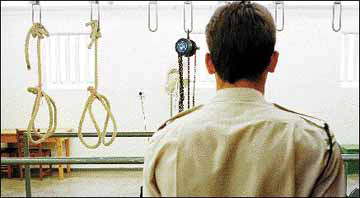
They were now led forward by warders into the large and brightly lit execution room. It was some 40 feet long with white painted walls. They would have seen the gallows beam running the length of the room and the 7 large metal eyes from which the four nooses dangled. (Seven prisoners could and often were hanged at once on this gallows.) The picture shows very much what Smith and Harris would have seen as they were led to the gallows. The chain hoist on the middle metal eye is used for raising the trapdoors after an execution.

They were positioned side by side, on painted footprints over the divide of the trap and held by warders while the hangman placed the nooses around their necks. He then turned down the hood flaps and when all was ready, pulled the lever plummeting them through the huge trapdoors.

They were left to hang for 15 minutes before being stripped and examined by a doctor in the room below. Once death had been certified, the bodies were washed off with a hose and the water allowed to drain into a large gully in the floor. A warder put a rope around each of their bodies and with a pulley lifted them to allow the rope to be taken off. They were then lowered onto a stretcher and placed directly into their coffins before taken to a public cemetery for burial.

Although executions in South Africa were held in private, the procedure was described in detail by the then hangman, Chris Barnard, in an interview before he died. He officiated at over 1,500 hangings there.

South Africa hanged 1,123 people at Pretoria Central prison between 1980 and 1989, Solomon Ngobeni being the last on November 14th, 1989. Surprisingly perhaps, almost all of these were for “ordinary” murders rather than politically motivated crimes and most attracted very little publicity.

According to the South African Department of Correctional Services, two other coloured women were hanged for murder in the years 1969 to 1989, Gertie Fourie, on the 20th of May 1969 and Roos de Vos, on the 12th of December 1986. A total of 14 women were executed between 1959 & 1989, out of a total of 2,949 hangings.

President De Klerk ordered a moratorium on executions in 1990 and capital punishment was abolished altogether by the incoming black government of Nelson Mandela on the 7th of June 1995.

Comment.

We cannot know why Smith and Harris went to the Abrahams’ home while they knew Jermaine would still be there or whether they had actually formed any intention to kill her. Neither of them had any record of violence prior to the murder. My guess is that they panicked when she started to call for help from the person who knocked on the door and they tried to silence her. However, it seems hard to believe that Harris really thought she wouldn’t identify him to the police as soon as they had left and he may well have decided to kill her for this reason. It is claimed that Smith wanted Jermaine dead as she was jealous of her having some sort of relationship with Harris. In any event, Jermaine suffered a horrible and agonising death at their hands.

We cannot know, either, which one of them did the actual killing or whether they both took equal part in it. But there was clear “common purpose” established under law, and there were no obvious mitigating circumstances to allow the state to reduce the sentence on either of them. South Africa had the highest rate of judicial execution in the world during the 80’s so they would surely have known the penalty for murder but like so many people, gave no thought to it until it was too late.

Sadly, it is so typical of the kind of brutal and senseless murder that happens all too frequently and one that led to cruel deaths for three young people.

On this day..