1954: Henry Frank Decaillet

(Thanks to Meaghan Good of the Charley Project for the guest post. -ed.)

On this date in 1954, 52-year-old Henry Frank Decaillet met his death in the gas chamber at San Quentin in California.

Teenage girls seem to have been his type; when he married at 23 years old, his bride was just 14. They had five children, four of whom survived to adulthood. By the time of Decaillet’s crime, though, he and his wife had been estranged for years and had separated.

Decaillet, a farmhand, had joined his local Pentecostal Church and there he met Phoebe Ann Bair described as “a pretty brunette large for her age.” Her family was also part of the church. She was thirteen. He fell in love with her, he said, and they entered into a sexual relationship for about a year.

The affair had become the subject of local gossip by mid-1953 and the local police had a chat with Decaillet about the risks associated with having sex with minors. Phoebe herself had cooled towards him. He heard she had been “messing around with some boys” her own age and he became frantic.

On the evening of June 11, Decaillet accosted Phoebe at a Pentecostal Church meeting. She refused to speak to him and he drove to her house and took a .22 caliber rifle out of his car. He’d been carrying it around in his vehicle for some time, debating over what to do. Now he had made up his mind. He went into the Bair home, where three of Phoebe’s siblings and two other children were present. When they saw the gun, they went running out the door for the police.

Decaillet hid in a closet in the house. Phoebe and her parents arrived home at 9:45 p.m. Mr. and Mrs. Bair realized they’d left one of their other children behind at the church and left to pick her up, telling Phoebe to stay home and get ready for bed. After her parents left, as Phoebe was standing in the kitchen, Decaillet shot her through a crack in the door. She ran and tried to reach the front door, but he chased after her, grabbed her and shot her three more times in the head.

When the police arrived at the Bair residence, Decaillet was sitting on the sofa with rifle in hand and Phoebe’s head cradled in his lap. He admitted to his crime, saying he’d been planning it for weeks.

He said Phoebe had been leading an immoral life and he had killed her “to stop her from becoming a prostitute.”

Decaillet had little to say for himself after that. Although he was a heavy drinker who’d been treated at the state hospital for alcoholism — in fact he became a Pentecostal as part of his effort to turn over a new leaf — he was sober at the time of the murder. He said he knew what he’d done was illegal and wrong and agreed that he should die for it. He pleaded guilty to murder, without requesting leniency.

Less than a year passed between murder and execution.

On this day..

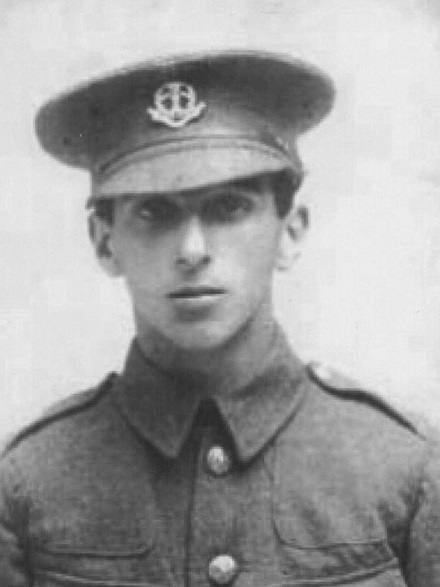
1916: Abraham Bevistein, child soldier

One century ago today, a Polish Jew from east London named Aby Bevistein was shot for cowardice in Calais — four weeks shy of his 18th birthday.

Abraham Bevistein was among an estimated quarter-million Brits who bore arms as minors in World War I. Fired by patriotism, these boys dodged the military’s 18-year-old minimum by … telling their recruiters they were 18. No documentation necessary.

Bevistein, whose family had moved to London from Warsaw when he was a small child, was British through and through enough to surge into the army with the first wave of pie-eyed volunteers in September 1914. He had 16 years and four months, and if he was like many of his new comrades in arms he probably reckoned on being back home by 17 — a bonny hero of a speedy war.

Instead, he spent most of 1915 navigating the labyrinth of trenches in France, and all their attendant horrors. He was wounded in December of that year but soon passed fit for duty again. On February 12-13, 1916, shellshocked and deafened by German grenades, he again sought medical help but was directed back to the lines by a harried medical officer. Instead, Bevistein wandered away to the rear, and took temporary refuge at a French farm.*

“We were in the trenches and I was ill so I went out,” he wrote to his mother by way of all-too-nonchalant explanation. “They’ve taken me to prison and I’m in a bit of trouble now.”

Anti-war suffragette Sylvia Pankhurst took up Bevistein’s cause when she learned about his execution, prominently publishing a sympathetic feature story in her newspaper, Women’s Dreadnought. Like 305 other British and Commonwealth soldiers shot at dawn during the Great War, Bevistein was posthumously pardoned and added to war memorials in the 21st century.

* The farm owner’s later testimony to Bevistein’s court-martial that the young tommy had expressed an intent to return to England sealed his fate as a deserter.

On this day..

1988: Dmitri Polyakov, Cold War spy

Although it would not be publicly known until two years later, the retired Soviet Gen. Dmitri Polyakov was on March 15, 1988 executed for treason.

A World War II artillerist, Polyakov (English Wikipedia entry | Russian) was a military intelligence officer working as an embassy attache when he made contact with American agents in New York in 1961. For the next quarter-century — across assignments to Burma, India, the U.S., and back in Moscow — he would ship to the CIA and FBI some of its choicest morsels of the Cold War.

“Polyakov was the jewel in the crown,” former CIA chief James Woolsey lamented of his loss. Polyakov-supplied documents underscoring the extent of Russia’s split with China have been credited with spurring Richard Nixon’s overtures to Beijing.

The spy code-named Bourbon, Roam, and Top Hat had idiosyncratic motivations; he was not an ideological true believer like a Sorge nor a man afflicted by demons like a Vetrov. He accepted only a little bit of money from his handlers, mostly to support an innocuous wordworking hobby.

This Russian article indulges a variety of hypotheses — contempt for Khrushchev, the death of a son, an appetite for risk-taking — but nothing his U.S. contacts could learn of him rebutted the presentation he made of himself as a Russian patriot chagrined at the prospect that the corrupt Communist state could win the Cold War.

His revelations did much to check that possibility.

Polyakov retired as a general in 1980, having operated under the Kremlin’s nose for a phenomenally long period of time. (His U.S. contacts made sure to feed him some career-advancing secrets, too.) But he was betrayed in the 1980s by the USSR’s own moles, Robert Hanssen and Aldrich Ames and arrested in 1986.

His fate, imposed by the Military Collegium of the Soviet Supreme Court, thereafter was a mystery to his former handlers. Two months after his secret execution, U.S. President Ronald Reagan sought Polyakov’s pardon or his exchange for a captured Soviet mole at his May-June 1988 arms control summit with Mikhail Gorbachev. The solicitation was politely deferred.

On this day..

1951: Ants Kaljurand, Estonian Forest Brother

On this date in 1951, the Estonian anti-Soviet partisan Ants Kaljurand was executed by the NKVD with comrades Arved Pildin and Juhan Metsäären.

Renowned for his ferocity and derring-do, “Ants the Terrible” was among 12,000 to 15,000 or so Estonian “Forest Brothers” who organized armed resistance to the Soviet Union.

The small Baltic state had won a two-decade interwar independence rudely terminated by Soviet occupation in 1940 under the carving-up done by the Molotov-Ribbentrop Pact. Moscow did not have long to enjoy its mastery of the place before Germany’s invasion swapped one occupation for the other.

German mastery appeared the more congenial than Russian,* and vice versa: Tallinn-born Nazi race theorist Alfred Rosenberg celebrated “the true culture bearer for Europe … the Nordic race. Great heroes, artists and founders of states have grown from this blood. It built the massive fortresses and sacred cathedrals. Nordic blood composed and created those works of music which we revere as our greatest revelations. … Germany is Nordic, and the Nordic element has had an effect, type forming, also upon the western, Dinaric and east Baltic races.”**

Germany had some traction recruiting SS volunteers locally, and Estonia’s small Jewish population was exterminated so efficiently with the aid of right-wing militias that the country was officially Judenfrei by the time of the Wannsee Conference. (Kaljurand himself was an Omakaitse paramilitary.)

Once Germany was pushed back out by the Red Army in 1944 there were thousands of far-right Estonian fighting-men prepared to bear arms against the new-old boss: one part a desperate hope of resuming the pre-war independence, two parts fatalistic principle. “We understood that it is better to die in the forest with a weapon in your hands than in a Soviet camp,” an ex-Forest Brother pensioner told the New York Times in 2003.

For a few years** after World War II, the harassment of Forest Brothers pricked Soviet authority, but as elsewhere in the Baltics the contest was impossibly unequal for guerrillas far from any hope of aid in a post-Yalta world. Ants the Terrible was captured in 1949 by which time the movement, ruthlessly hunted, was waning away. It was finally stamped out in the early 1950s, but in the post-Soviet Estonia — independent once again — these resisters have been belatedly celebrated as patriots.

* “In Estonia it was hard for us to live, much less operate,” a Soviet partisan in Estonia reported. “At partisan training, they told us that the people were waiting for us to drive out the Germans … But we were never told that we’d be assaulted by the Estonians themselves.” (From War in the Woods: Estonia’s Struggle for Survival 1944-1956, a source extremely laudatory of the Forest Brothers.)

** From Rosenberg’s magnum opus, The Myth of the Twentieth Century. It’s not all sunshine for the eastern Baltic race in Rosenberg’s cosmology; “mixed as it is with a Mongol element,” these types are “pliant clay either in the hands of Nordic leadership or under Jewish and Mongol tyrants. [The eastern Baltic] sings and dances, but as easily murders and ravages.”

† One of the last Forest Brothers in the field, August Sabbe, was only caught in 1978 at the age of 69. He died in the arrest, either murdered by his KGB pursuers or resolutely quick-witted enough to drown himself to escape interrogation.

On this day..

1903: Edgar Edwards, sash weight killer

On this date in 1903, Edgar Edwards was hanged in Wandsworth Prison for a minor-league* triple murder.

Of course, the killing was anything but trivial to its victims, a Camberwell grocer and his wife along with their infant daughter. The couple put their business up for sale: Edwards answered the ad but had a different transaction in mind. Contriving to separate man and wife in the course of the interview, he bashed Beatrice Darby to death and strangled the infant child. Evidently he had some proficiency wielding a five-pound sash weight. The reader may perceive that this weapon, albeit improvised, is a crueler device than its accessorizing name might suggest.

Having done with the wife, he lured unwitting husband John to his makeshift abattoir and murdered him in the same horrid fashion.

That occurred way back in November, but it wasn’t until Edwards tried the same ploy using the same type of bludgeon** against a London businessman a month later that the earlier homicide unraveled. As the investigation led back to Leyton (thanks in part to Edwards’s foolish possession off John Darby’s business cards) the neighbors all started remembering that he’d been awfully keen about burying something in the garden a few weeks back. Rear Window this ain’t.

The motive for all this was just to take possession of the stock and sell it quietly for ready cash. Edwards had little recourse when captured but to try to draw out a family history of insanity, a ploy could not have impressed jurors much in view off the crime’s calculated ferocity.

* A century and God knows how many murders onward, this crime may be an imperceptible drop in the sea; in its day, however, it earned Edwards wax statuary at Madame Tussaud’s.

** The humble sash weight has its niche in the crime annals; it was also the weapon used by Double Indemnity inspirations Ruth Snyder and Judd Gray.

On this day..

1962: Kelly Moss, restless of spirit

On this date in 1962, J. Kelly Moss went to the Kentucky electric chair in Kentucky for murder.

A lifelong criminal whose offenses ran more to the impulsive than the diabolical, Moss was arrested 10 or more times from 1950 to 1953, according to an Evansville (Ind.) Courier and Press profile. “Kelly Moss, when he was sober, was a real gentle person,” the former police chief of Henderson, Ky. told reporters decades later. “My recollection is that he was a real good man. But when he got drunk, he was a holy terror. When (Moss) was coming at you, he looked like a raging bull. When you got a call to Kelly’s house, you sent every car you had.”

His stepfather Charles Abbitt unfortunately didn’t have all those cars.

When Moss, fresh out of his latest prison stint on a robbery charge, showed up at Abbitt’s Henderson home blind drunk and in need of fare for the cab that had just delivered him. The cab driver gave up and left while Moss wailed on the door; what happened in the next 90 minutes or so must be guessed at, but Moss’s mother returned from church to find her husband’s mangled remains. “His face was pulverized by blows, and many of his ribs had been broken,” according to the Henderson Gleaner.

Moss apparently hadn’t realized just how much damage he’d done in his raging-bull mode; when arrested later, he was shocked to discover himself a murderer. “We had a little fight but I certainly didn’t intend to kill him. This is the worst thing I have ever had happen to me. This means a long term for me.”

Actually, the term was not so long — although Moss did his level best to extend it.

Leveling himself up into a skilled jailhouse lawyer, he papered Kentucky courts with relentless self-prepared writs that protracted the short lease on life his murder conviction offered. (He helped other prisoners file their appeals, too.) Outliving his victim by four-plus years was making good time by his era’s standards.

“The restless spirit of Kelly Moss was stilled just after midnight this morning,” the Gleaner reported on March 2, 1962. He wasn’t reconciled to the electric chair, and the device almost choked on him: Moss was the last person executed in Kentucky prior to the death penalty’s long 1960s-1970s lull in America. Kentucky’s next, and last, electrocution would not take place until 1997.

On this day..

1968: Two Jordanians, a sergeant and a civilian

Soldier and Civilian Hanged By Jordan as Spies for Israel

AMMAN, Jordan, Feb. 29 — Two Jordanians, an army sergeant and a civilian, were publicly hanged at dawn today after having been convicted by a military tribunal on charges of spying for Israel.

The authorities said they had been caught in April, 1966, when the civilian, Mahmoud el-Haihi, 30 years old, was crossing into Jordan from Israel near his home in Tulkarm. He was said to have been carrying a message and money from Israeli military intelligence officer to Sgt. Fawzi Abdullah, 32, also from the Tulkarm area.

The death sentence was pronounced in January, 1967, and approved last month by King Hussein.

-New York Times, March 1, 1968

On this day..

1975: The Gold Bar Murderers

On the last day of February in 1975, seven men from among a gang who authored one of Singapore’s signature murders were hanged at Changi Prison.


(cc) image from Bullion Vault.

Four days after Christmas in 1971, the phone rang for Andrew Chou, an Air Vietnam staffer who had been exploiting his security credentials to smuggle gold bars out of Singapore for several crime syndicates.

It was a fresh delivery for the Kee Guan Import-Export Co. for that evening — to be dropped at Chou’s house as usual.

Chou’s cut of these runs was lucrative, of course: hundreds of thousands in cash, out of which the able crook paid off his own muscle as well as the air crew.

But this night, he intended to take a lump sum.

As the couriers counted out the treasure at Chou’s kitchen table, Chou and associates attacked them. Later, Chou would phone his contacts to advise that the goldmen had never arrived that night: in fact, Ngo Cheng Poh, Leong Chin Woo and Ang Boon Chai had been consigned to the industrial muck of a convenient mining pool.

This incident, soon to be known as the Gold Bar Murders, went wrong very quickly but perhaps the judicial punishment visited on its perpetrators only spared them from a similar underworld revenge. An anonymous tipster had seen the bodies being dumped and police pulled them out of the ooze the next day. The smuggling-murder circle was busted immediately; a few gold bars were recovered from the office of Chou’s brother Davis, and the balance from an associate named Catherine Ang, who had received them for safekeeping from the hands of the killers.

There were 10 in this conspiracy. One, Augustine Ang,* saved his own life by giving evidence against his comrades. Two others, Ringo Lee and Stephen Lee, were minors at the time of the murder and escaped the noose on that basis.

The remaining seven — Andrew Chou, David Chou, Peter Lim, Alex Yau, Richard James, Stephen Francis, and Konesekaran Nagalingam — all hanged without their appeals availing any of them the least whiff of judicial or executive mercy.

* There was no blood relationship between the murderer Augustine Ang, the victim Ang Boon Chai, and the fence Catherine Ang.

On this day..

1943: Mildred Fish-Harnack, an American in the German Resistance

On this date in 1943, the Milwaukee-born translator and historian Mildred Fish-Harnack was beheaded at Plotzensee Prison — the only American woman executed by Hitler’s order.

A graduate student at the University of Wisconsin Milwaukee,* she met German jurist Arvid Harnack when the latter was a visiting scholar at the university’s sister campus in Madison.

In 1929, the couple moved to Germany where they worked as academics: Mildred, a teacher of language and literature; Arvid, of economics and foreign policy.

Both watched the rise of Third Reich with growing horror, and soon began converting their circles of academics, artists, and expats into a hive of opposition doing what they could to aid the many classes of excommunicate humans Berlin was busily proscribing. As the Nazi enterprise intensified, that opposition demanded ever more dangerous — more treasonable — extremities.

Good friends with American diplomats, the Harnacks for a time used Arvid’s placement in the Reich economic ministry to pass information to the United States. In 1940, they made contact with Soviet intelligence and from that time until the Gestapo snatched them in September 1942 the so-called** Red Orchestra sent furtive coded radio transmissions to Moscow reporting war preparations, economic data, and whatever else their circle could lay hands on among their various posts.

We have treated the fate of the Red Orchestra elsewhere in these pages; Mildred Harnack did not go to the meathook-nooses with her husband Arvid and others on December 22 because she was sentenced initially only to a term of years. These judgments came down at just the same time as the USSR was drowning the Wehrmacht in blood at Stalingrad, so there might have been a bit of personal pique when the Fuhrer personally quashed Mildred’s lenient sentence and demanded a, ah, reconsideration.

“And I have loved Germany so much,” she murmured as she was thrown under the fallbeil.

There’s a Mildred-Harnack-Schule in Berlin (also a Mildred-Harnack-Straße); her birthday, September 16, is observed every year in Wisconsin schools — although Mildred’s red associations meant that widespread recognition in her native country had to await the end of the Cold War.


Trailer for a Wisconsin Public Television documentary that can be viewed in full here.

* Then known as the Milwaukee State Normal School.

** Though this is the name history remembers them by, Red Orchestra (Rote Kapelle) was conferred by the German intelligence working to stop them. Confusingly, the name was applied to multiple different, and unrelated, spy networks.

On this day..

1926: Josef Jakubowski, Weimar Germany wrongful execution

On this date in 1926, Weimar Germany beheaded Josef Jakubowski for a murder he did not commit. Though a notorious miscarriage of justice in Germany, it is not widely known elsewhere and most of the links about Jakubowski are in Germany.

A Pole reared in the tsar’s Lithuania, Jakubowski emigrated by way of that great ravager of imperial borders, the First World War: taken as a POW, he preferred sticking around as a Mecklenburg farmhand over returning to a now-Bolshevik Russia engulfed in civil war.

Jakubowski never married, but if he had done it would have been to Ina Nogens, a local woman with whom he fathered a daughter out of wedlock. But his lover died (in non-suspicious circumstances) leaving Jakubowski to support not only the infant girl but also Ina’s three-year-old son by another man, Ewald — who were nonetheless being raised not by Jakubowski but by the Nogens relatives.

On November 9, 1924, Ewald disappeared: he was found outside the village the next day, strangled to death.

The Nogens family immediately made known their suspicions of the almost in-law from a foreign land, and in no time at all Jakubowski was caught in that still-familiar gaze of official tunnel vision and its mirrors of endlessly receding self-vindication. The most substantial evidence against Jakubowski was the shaky — and in fact, manipulated — eyewitness report of a mentally impaired teenager made to sort of put the Pole on the path to the Nogens house on the morning of the little boy’s disappearance. That’s it. It’s the sort of case would have to level up several times to achieve the stature of laughability, but when everyone already knows you did it, actual evidence is really just a luxury. Jakubowski was an outsider who maybe wanted to stop paying child support. Work backward from there!

Two years after the luckless migrant lost his head to the fallbeil, it came out that some of the Nogens clan were the ones really behind the murder, a two birds, one stone scheme to take off their hands both bastard whelp and Auslander. Three were judicially convicted of the very same murder, and one, Ina’s brother August, was actually sentenced to death — although the sentence was remitted. Despite issuing these other convictions, no German state organ has ever officially reversed Jakubowski’s condemnation.

The case was portrayed in a two-part West German TV series in 1964, Der Fall Jakubowski.

On this day..