1541: Margaret Pole, Countess of Salisbury

Thanks for the guest post to Nancy Bilyeau, the author of The Crown and The Chalice, thrillers set in Tudor England. The main character is Joanna Stafford, a Dominican novice.

On this date in 1541, 68-year-old Margaret Pole, countess of Salisbury, was beheaded within the confines of the Tower of London, as befitted her rank. She was cousin to Henry VIII’s mother, and well trusted by the king for years. Yet this intelligent and dignified aristocrat died without trial in a horribly botched execution that is considered a low point of Henry’s reign.

Margaret knew better than most how difficult it was to survive royal storms if your family was close to the throne. Yet despite all her efforts to stay out of danger, it was her family that doomed her to the axe in the end.

George Plantagenet, Duke of Clarence and brother to Edward IV, was her father and Isabel Neville, oldest daughter of the “Kingmaker,” Earl of Warwick, her mother. This glittering pair didn’t last long. Mother died of disease (some whispered poison); the duke, disloyal to his brother the king, was drowned in a barrel of Malmsey in the Tower of London.

First Murderer. Take him over the costard with the hilts of thy
sword, and then we will chop him in the malmsey-butt
in the next room.

Second Murderer. O excellent devise! make a sop of him.

-Shakespeare’s Richard III, Act 3, Scene 4. Margaret Pole is an ensemble character with no lines in this play.

Once the Tudors were in charge, royal children were either imprisoned, such as Margaret’s brother, who spent the rest of his life in the Tower of London,* or assimilated. At the age of 14, Margaret was married to Sir Richard Pole, a trusted relation of Henry VII‘s. The marriage was not unhappy, and they had four sons and one daughter.

When Catherine of Aragon arrived in England to marry Prince Arthur, Margaret became one of her ladies and a deep friendship sprang up. Years later, when Margaret was a relatively young widow, tall and red-haired, and Catherine was married to Arthur’s brother, Henry VIII, Margaret was singled out for several great honors. In 1512, the king gave Margaret many of the lands of her Warwick grandfather and a family title. She became the countess of Salisbury in her own right.

Margaret was selected by king and queen to be the governor for the 9-year-old Princess Mary, their only child. In a separate, vast household, she would be the one to guide Mary toward her destiny as heir to the throne. Some of Margaret’s own children made excellent marriages, such as her daughter Ursula to the oldest son of the duke of Buckingham. Her son, Reginald, began to shine as a cleric and intellectual; Henry VIII paid for his studies at the University of Padua.

The Pole family fortunes crashed — as so many others did — after Anne Boleyn became the second wife of Henry VIII. Not surprisingly, Margaret had sided with Catherine and Mary during the divorce struggle. When in 1533, the king’s men came to Mary’s household to claim her jewels as part of Henry’s move to bastardize his daughter, Margaret refused to hand them over. She was then discharged from her office by the king, who called her a “fool.”

Margaret did and said nothing else that was publicly critical of the king. She never saw Catherine of Aragon again and rarely saw Mary, to whom she had been a second mother. She spent her time in country retirement. She adhered to traditional Catholic doctrine, and priests lived in her homes. This was not illegal, but as religious reform gained steam, it brought her under scrutiny.

However, from the safety of France and Italy, her son, Reginald, chose to make public remarks sharply critical of Henry VIII. He published a treatise in 1536 attacking the king’s claim to superiority over the English church and calling on the princes of Europe to depose him. The king was enraged.

Margaret and her oldest son, Henry Pole, Lord Montagu, wrote Reginald letters pleading with him to cease his attacks. “Do your duty or you will be my undoing,” she warned — correctly.

In 1538 another of Margaret’s sons, Geoffrey, was questioned and then confined in the Tower of London. He eventually gave statements that his brother, Montagu, and their relations and friends sympathized with Reginald Pole and had privately criticized Henry VIII. Under law, this was treason, punishable by death. All the noblemen accused of being part of the “Exeter Conspiracy” were executed. But there was no proof that Margaret Pole ever wrote or said anything that fell under the definition of treason.

It didn’t matter. She was questioned, held under house arrest, and then imprisoned in the Tower of London for two years. She suffered in the winters, and Henry VIII’s fifth wife, the teenage Catherine Howard, bravely sent her some warm clothes.

A minor rebellion broke out in England, led by a Neville, her mother’s family, but unconnected to Margaret. Nonetheless, it seems to have prompted Henry VIII to eliminate the woman whom he had once trusted and admired, who was his closest female relative after his daughters.

Early in the morning of May 27, the Constable of the Tower woke up Margaret to tell her she would die within the next few hours. The ailing countess replied she had never been charged with any crime.

Because of her royal descent, she was executed on the Tower grounds, on the same spot as Anne Boleyn five years earlier, before more than 100 spectators. There was not enough time to erect a scaffold; also, the executioner was not in residence, only his novice.

Margaret commended her soul to God and asked the spectators to pray for the king and queen, Prince Edward and of course the Princess Mary. Reports conflict on what happened next. Some say she refused to kneel before the block on the ground, or to stand still. The novice swung at her with his ax, hacking at her shoulders, before managing to kill her. It may have taken 10 chops.

Margaret Pole was buried in the Chapel of St Peter Ad Vincula, within the Tower, not far from Anne Boleyn, Thomas Cromwell, Sir Thomas More and Cardinal John Fisher. Within the year Catherine Howard would join them. In the 19th century Macauley said of St Peter Ad Vincula, “In truth there is no sadder spot on earth than that little cemetery.”

* The rest of Edward Plantagenet’s life ended at the block in 1499, after he tried to escape with Perkin Warbeck.

On this day..

1934: Georges-Alexandre Sarrejani, vitriolic

On this date in 1934, Georges-Alexandre Sarrejani (alias Sarret) became the last person guillotined at Aix-en-Provence

This charmer — most of the links today are in French — ticked one off the bucket list by seducing a pair of sisters, Catherine and Philomene Schmidt.

These he used as partners in a simple insurance scam way back in 1920: get them to marry a couple of men at death’s door, produce bogus medical exams declaring them to be in robust health, and pocket the proceeds when they kick the bucket. Sarrejani got the lion’s share because he threatened to denounce the Bavarian sisters as World War I spies. Insurers had their suspicions but couldn’t prove anything.

In 1925, a defrocked priest and said priest’s mistress threatened to turn in the scam artists.

Sarrejani, again with the full complicity of his women, horrifyingly disposed of the threat.

After shooting both dead, he ducked off to Marseilles to pick up a bathtub and 100 liters of vitriol (aka sulfuric acid). With this, Sarrejani and his mistresses marinated their victims until they had dissolved into a foul brackish puddle, which was nonchalantly poured out into the garden.

It’s this stomach-turning crime that Sarrejani is most famous for, and got the “trio infernale” immortalized on the silver screen in a gruesome 1974 film.

However, this murder was unknown for six years and might have gone permanently undetected had not the infernales attempted an even more primitive insurance scam in 1931. How many victims, one wonders, have been successfully acid-bathed by murderers restrained enough to get away with it.

At any rate, in 1931 Catherine Schmidt insured herself and faked her own death, substituting a tuberculotic corpse. She had the carelessness to show herself in Marseilles where someone recognized her as a “dead” woman … and in the ensuing interrogation, she turned the denunciation game right around on Serrejani. I’ll show you a Bavarian spy, mister.

The result was France’s most headline-grabbing trial since the bluebeard Henri Landru, pictures of which can be gawked at this French forum thread. Sarrejani had some legal training, enabling him to drag out the melodrama even further to the great delight of the nation’s editors.

When all was said and done, Sarrejani was set to lose his head; the Schmidts got just 10 years in prison. Call it the dividend on that insurance-fraud money he’d muscled out of them.

The whole ghastly affair had one last horror when Sarrejani met the blade this morning just outside the prison walls: the blade stuck halfway down, leaving embarrassed executioners to do 10 minutes of live troubleshooting while their patient below (justifiably) fulminated against their incompetence.

On this day..

1886: David Roberts, dutiful son

On this date in 1886, David Roberts was hanged at Cardiff for a murder-robbery the October previous.

Both Roberts and his father, Edward Roberts, were arraigned for the murder. The Robertses, father and son, had both been playing cards with the late David Thomas on the night of the crime, and left together with him (as well as another man).

The next day, David Thomas was found in a field bludgeoned and stabbed to death, with David Roberts’ pipe nearby. A search of the Roberts home revealed £66 stashed away in a bloody handkerchief, the approximate amount Thomas as known to have made at market on the day before he died.

David Roberts made a voluntary written confession specifically claiming sole responsibility for the murder. He even pleaded guilty in court, shouting out, “I swear my dad had nothing to do with this murder!”

Apparently he was persuasive: prosecutors decided to present no evidence against Edward Thomas and allowed him to be acquitted.

So Roberts stood alone on the trap this day, having at least the comfort of having done right by his family duty. Unfortunately the hangman did not quite do right by Roberts fils as he appeared to survive the drop. Witnesses were hastily conducted away while Roberts dangled, still twitching and strangling. The error was ascribed to the condemned man’s “muscular neck,” but this alleged physiognomy only mattered because at this late date British hangmen still designed the parameters of the drop impressionistically.

All that was changing to follow the professional example of the scientific William Marwood, however. Later in 1886, a commission was formed under former Liberal Home Secretary Baron Aberdare to examine the issue. This commission ultimately produced the first official table of drops specifying the fall that should be allotted to prisoners based on their weight, with a view to reliably breaking the neck.

On this day..

1909: C.Y. Timmons

(Thanks to Meaghan Good of the Charley Project for the guest post. -ed.)

Minutes after midnight on this date in 1909, an Oregon plasterer named C.Y. Timmons was hanged at the state prison in Salem, Oregon for the murder of Estella, his wife of two years.

On October 21 the previous year, he had put an ax in the back of her head, slit her throat from ear to ear with a straight razor and then attempted to take his own life with the same razor. The two were discovered by the neighbors at 7:30 the next morning when a partially unclothed C.Y. came knocking on their door, “covered in blood from head to foot.”

C.Y.’s wound, as R. Michael Wilson explains in his accounting of the case in Legal Executions After Statehood in North Dakota, South Dakota, Wyoming, Montana, Idaho, Washington and Oregon, was serious but not fatal, and it responded to medical treatment: “The gash had missed the veins and arteries but had severed the trachea, but it had sealed and prevented him from drowning in his own blood.”

Timmons quickly regained his ability to speak and told authorities Estella had cut his throat while he was sleeping. He grabbed the razor from her hand, slit her throat in self-defense, and then finished her off with an ax. Then he lay down and waited until dawn before he went and asked for help.

The truth came out, however, and at his trial in mid-January 1909, C.Y. admitted that he’d gone round the bend with jealousy over his younger wife’s* affair with one Robert Hornbuckle. C.Y. and Estella had been quarreling for a long time about her relationship with Hornbuckle. Only the day before the murder, the couple had met with an attorney to procure a divorce — a drastic measure in that day and age.

During the meeting, Estella told the lawyer that her husband had a violent temper, especially when he had been drinking, and that he had threatened her life on numerous occasions.

C.Y. apparently believed his victim’s alleged infidelity would outrage the jury into acquitting him. Not so; they deliberated a whopping 35 minutes before finding him guilty. C.Y. broke down in tears when the verdict was read. And, for what it’s worth, all evidence indicates that Estella’s “affair” with Hornbuckle existed only in her husband’s imagination.

C.Y.’s hanging was as gruesome as his crime, as Wilson records:

[A]t 12:31 p.m., the trap was sprung and Timmons dropped six feet, one inch. The force of the drop caused the neck wound to open and for some time the hanging figure breathed through the gaping wound beneath the rope, and the body was drenched with blood. The attending physicians differed on whether Timmons’ neck was broken in the fall, but later examination proved that the vertebrae had been dislocated. This complication, breathing through the open wound, prevented pronouncement of death until 12:54 p.m., and the body was allowed to hang another seven minutes to ensure he was dead.

The murderer was buried separately from his victim, at the Lee Mission Cemetery in an unmarked grave.

* Her age was given in different accounts as either 19 or 21; C.Y. Was 37. Another pathetic detail to her tragic life: Estella was an orphan, raised in an orphanage after her parents both died of tuberculosis.

On this day..

1979: Pin Peungyard, Gasem Singhara, and (twice) Ginggaew Lorsoungnern

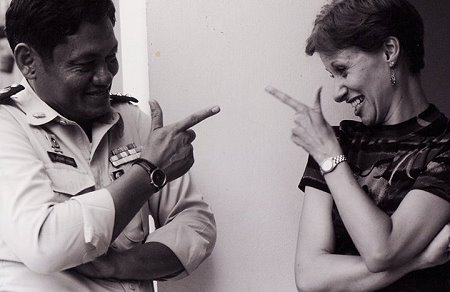
For this date’s entry we turn to The Last Executioner — the memoirs of Chavoret Jaruboon, who was the last prison executioner in Thailand.


Bang. The late (he died in 2012) Chavoret Jaruboon, on the left.

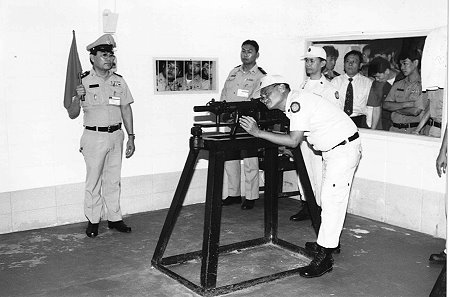
Thailand uses lethal injection today, but our narrator here was the last to conduct executions by that country’s previous execution method, a unique shooting arrangement that prevailed through 2002.*

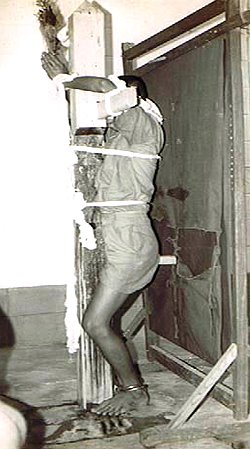
The prisoner to be executed was tied to a wooden cross, hands pinned in a prayerful position (wai), and facing a wall; behind him (or occasionally, as in today’s post, her), a screen; behind the screen, Chavoret Jaruboon with a mounted automatic rifle that would discharge a burst of up to 15 bullets into the vicinity of the heart, generally terminating life immediately.

The clientele this date were three members of a kidnap gang. Ginggaew Lorsoungnern, a former domestic for a Pathumwan, Bangkok family, had picked up from school the six-year-old child who was her former charge and delivered her to a bunch of toughs. When the ransom delivery went awry — the parents were supposed to toss the money out of a moving train at the spot of a flag, but missed the flag owing to darkness — the enraged kidnappers stabbed the little boy to death. Ginggaew allegedly flung herself over the child in a vain effort to protect him.

Inasmuch as her inside position was the lynchpin for the whole operation, however, these hystrionics would not save her from reprisal. (It wasn’t quite judicial reprisal since the execution was carried out by executive decree: not uncommon in dictatorial 1970s Thailand.) It probably didn’t help that coroners discovered soil in the victim’s lungs … meaning that when they’d dumped his body into its grave, he wasn’t yet dead.

The case was a media sensation. The late executioner’s 21st century book (copyright date: 2006) says that he was even then still “constantly asked about Ginggaew.” For what it’s worth, he thought the sentence was too harsh for her part in the crime. But executioners don’t get to make these decisions.

Ginggaew was the first woman shot in Thailand since 1942, and the first that Chavoret Jaruboon ever saw executed. In his time, he shot three women; Ginggaew is not among their number because in 1979, he was only a member of the execution team, not the man with his finger on the trigger. He was an “escort”, part of the team that brought the doomed from their cell to the execution chamber and then removed the corpse.

Escort duty was “one of the most emotional roles in the whole process of execution,” he writes. “Even the executioner does not have to see the body after he has done his job.”

And on January 13, 1979, the day Ginggaew died followed by two of her collaborators, the escorts had especially unpleasant duty.

While the men died stoic, Ginggaew was frantic, and fainted repeatedly over the hours before execution. “I didn’t do it, I didn’t kill the boy,” she pleaded. “Please don’t kill me, I didn’t kill him.”

Worse was to come.

At 5pm Ginggaew was selected to be brought to the execution room first. The escorts helped her to her feet but she immediately crumpled to the ground. She sobbed that she felt too weak to stand … As she approached the room she had to be revived from another faint.

I found this very difficult to deal with. Between us [escorts on the execution team] we finally got the stricken woman to the cross. She cried while they bound her at the waist, shoulders, and elbows. Her arms were brought up over the beam in a position of prayer. Still, she struggled and tried vainly to break free. The escorts pulled across the screen and fixed it so that the white square indicated where her heart was. Then they stepped out of range. I walked to the gun to load it and aim it at the target on the screen. I was aware that Ginggaew was still struggling. Normally once the prisoner was fixed to the cross they gave up fighting, but this was not the case with her. I secured the gun over her stifled sobs, locking it into position. When I was satisfied, I nodded at Prathom to take over. He took his position and at 5.40pm exactly he released ten bullets into Ginggaew’s body.

Doctor Porngul went up to her and checked for the pulse and retina response. As expected, he confirmed her dead. The escorts quickly untied her body, which was bleeding profusely from the chest, and laid her face down on the floor. She jerked and twitched a little. This wasn’t out of the ordinary but was distressing to witness. Her chest burst open and the blood looked like it would never stop flowing. They carried her into the morgue, the tiny room that we used just off the execution hall. I followed them just to make sure everything was alright. They placed her gently on the bed and we went out to prepare for the next one. What happened then will never leave me.

As the second prisoner, Gasem, was brought into the execution room, there was a sound from the morgue. I could see everything from where I was standing as the door was wide open — Ginggaew was trying to get up. The shocked escorts and I ran back to her. There was blood everywhere. One of the escorts rolled her over and pressed down on her back to accelerate the bleeding and help her die. Another escort, a real hard man, tried to strangle her to finish her off but I swept his arms away in disgust. We stood there watching her gasp for breath for I don’t know how long, but it could only have been a minute or two. I was filled with pity for her. I couldn’t help thinking that she was dying the way that little boy had died — except suffocating from blood instead of earth.

Meanwhile, Gasem had been shot. He died instantly from ten bullets. He had not resisted his death in any way, and spoke to nobody on the way to the cross. After the doctor confirmed that Gasem was definitely dead he checked on Ginggaew. Amazingly she was still breathing. It was a horrible, horrible situation. He told the escorts to put her back on the cross. The men complied, somewhat relieved to be able to just follow orders. It was a grim, nauseating job and they were covered in her blood when they turned to pull the screen across. This time the full quota of 15 bullets were used, and finally, she was dead.

You might wonder why we didn’t just shoot her where she lay, but it would have been against the regulations. Also, I don’t know that any of us could have stood so close to the young girl and pulled the trigger. As it was, the escorts moved as quickly as possible, each of us was concerned that her suffering should not be prolonged.

Pin had had to wait outside for ten minutes until Ginggaew was carried to the morgue for the second time. He was then brought in and tied to the cross. At 6.05pm Prathom pulled the trigger, sending 13 bullets into his back. The doctor went to check on him and discovered that he too was still alive, only just, but still breathing all the same. I loaded the gun again and Prathom shot a further ten bullets, this time killing him instantly. We were all in need of more than one stiff drink that evening.

There are a couple of reasons why Ginggaew had such a terrible death. Firstly her heart wasn’t on the left side as with most people. She most probably had Kartagener’s Syndrome, which is when a person is born with their heart on the right-hand side instead of the left. And even if it was she wasn’t secured firmly enough to the cross so she was able to move around, therefore the bullets would miss their target. It showed the importance of binding the prisoner as tightly as possible, for their own sake. I had my doubts when she was first pronounced dead. I thought I could detect some strain in her neck, and maybe that’s why I followed the escorts to the morgue. The head should normally flop backwards with the cross being the only support for the limp body.


Ginggaew, Gasem, Pin, and all others who were executed by shooting entered the execution building through this red door … now disused and overgrown since Thailand scrapped shooting. Pic from this Norwegian Amnesty International page.

After Thailand switched to lethal injection, Chavoret Jaruboon retired to a monastery. His books show no disquiet about his career. He explicitly supported the death penalty.

“What I do is empty this story (the executions) from my mind. If I don’t do that I don’t know what (the executions) will do to me.”

-Chavoret Jaruboon

* We’ve previously written about a 2001 execution by gunfire in Thailand.

On this day..

1868: Priscilla Biggadike, exonerated Stickney murderess

On this date in 1868, Priscilla Biggadike withstood one last gallows-foot plea from her minister to admit to poisoning her husband.

‘I implore you not to pass away without confessing all your sins; not only generally, but especially this particular case, for which you are about to suffer. I had hoped that you would have made that confession, and thus have enabled me, as a minister of Christ, to have pronounced the forgiveness of your sins … It has grieved me much to find that [you] still persist in the declaration, that you are not accountable for your husband’s death; that you still say that you did not administer the poison yourself; that you did not see any other person administer it, and that you are entirely free from the crime. Do you say so, now?

The Prisoner, still in a firm voice, said, yes.

The Chaplain. — There is only one [hope] left, that you have endeavoured to confess your sins to God, though you will not to your fellow creatures. All I can now say is that I leave you in the hands of God; and may he have mercy on your soul. What a satisfaction it would be to your children, to your friends, to your relations, to know that you had passed from death into life, in the full persuasion that your sins were forgiven you … I am sorry I cannot exercise that authority [to pronounce sins forgiven] at the present moment.

Then, at the stroke of 9 a.m., she was hanged by ten-thumbed executioner Thomas Askern. True to form, Askern made a mess of it, and Biggadike painfully strangled to death with the rope’s knot infelicitously positioned under her chin* … although, since this execution was behind the walls of Lincoln Castle (in fact, it was the first female hanging after an 1868 Act of Parliament had made all hangings private), at least it didn’t incense a vast concourse of onlookers.

Posterity, though, has taken plenty of umbrage at Priscilla Biggadike’s fate.

She and her late husband Richard kept two lodgers in a two-room house in the village of Stickney.

Richard already suspected an affair between Priscilla and one of those lodgers, Thomas Procter (or Proctor), when he returned home from work on September 30, 1868, enjoyed tea and cakethat his wife had made for him, and then fell violently, fatally ill. The post-mortem examination showed Richard Biggadike had been poisoned with arsenic.

Priscilla Biggadike and Thomas Procter were both arrested on suspicion of murder but charges against Procter were soon dropped.

Priscilla was known to have quarreled with her husband over that whole infidelity thing, and she had alluded at least once to having arsenic around for killing mice. She was accordingly found guilty of poisoning him, though “only,” in the words of the jurors when the judge pressed the question, “upon the ground of circumstantial evidence.”

Indictment, trial, conviction, and execution for the “Stickney Murderess” wrapped up in two months’ time. But the discharged co-accused, Thomas Procter, years later made a deathbed confession that it was really he who poisoned Richard Biggadike.

(During the investigation, Priscilla had even attempted to blame Thomas Procter, reporting that on one occasion prior to the murder he’d even made what looked like an attempt to poison Richard by mixing white powder into his tea, after which Richard became sick. Police didn’t regard the accused as a particularly credible source for obvious reasons, but it’s hard to believe anyone would have failed to follow up on that sort of lead.)

On account of that whole wrongful-hanging mix-up, Priscilla Biggadike received a posthumous pardon. She’s even had a short musical made about her conviction, which was recently performed in Lincoln Castle. If you visit, you can still see the cell where she passed her final days.

* The bad botch of this job led Lincolnshire officials to audition for their next execution a local cobbler and amateur noose enthusiast destined to revolutionize the British hanging with his scientific approach: William Marwood.

On this day..

1989: Carlos DeLuna, “I didn’t do it. But I know who did.”

On this date in 1989, with the last words “I want to say I hold no grudges,” Carlos DeLuna died by lethal injection in Texas

At the time, not many people took seriously DeLuna’s claim that a different Hispanic man named Carlos — one Carlos Hernandez — was the man who actually slashed Wanda Lopez to death in a Corpus Christi gas station on February 4, 1983.

“I didn’t do it. But I know who did.” That’s what he’d told a police officer soon after his arrest.

A generation later, it’s increasingly clear that Carlos DeLuna really didn’t do it … and that he knew who did it, knew he was going to the gurney for the crime of a man whom the state claimed was just a “phantom” invented by the defendant. Just a few months before DeLuna went to his death, that “phantom”, still on the streets, had knifed a four-inch gash in another woman’s abdomen. Carlos Hernandez had even bragged to others that his “stupid tocayo” — namesake — “took the blame for” a murder he’d committed. (Hernandez died in 1999.)

Carlos DeLuna might be the most convincingCameron Todd Willingham notwithstanding — instance of wrongful execution in America’s modern death penalty era.

DeLuna was arrested suspiciously hiding under a truck near the scene of a grisly knife slaying at a gas station. A Hispanic man had been reported as the suspect, and the eyewitness was able to identify DeLuna as that man, just moments after his arrest. Case closed.

Except everyone was wrong.

He was hiding because he’d been violating his parole by drinking at a strip club across the street. He chanced to look just like another Hispanic man from the area, a fellow who just happened to be a violent thug. And he didn’t have a spot of blood on him even though the murder scene looked like the set of a slasher film.

“It was an obscure case, the kind that could involve anybody,” Columbia Law Prof. James Liebman said. “Maybe those are the cases where miscarriages of justice happen, the routine everyday cases where nobody thinks enough about the victim, let alone the defendant.”

The facts of the case have been extensively documented elsewhere, including a 2006 Chicago Tribune series* and an entire 2012 issue of the Columbia University Human Rights Law Review, culmination of a years-long project organized by Liebman.

The latter investigation, complete with original source documents, video, and photographs, is preserved for public use at the magnificent Los Tocayos Carlos site. Its intensively-sourced book-length treatment comes highly recommended, but you might need to clear your schedule.

Executed Today is pleased to welcome one of the coauthors of Los Tocayos Carlos, Andrew Markquart — a 2012 graduate of Columbia Law who collaborated with Prof. Liebman on the DeLuna investigation and now practices in New York.

ET: How did you come to focus on this case, and what went into the investigation?

AM: I got involved after my first year at law school. I started out as a research assistant for Prof. Liebman, and he had been working on this project for years in one form or another when I got involved. I had already had quite a bit of interest in death penalty issues, so I jumped on it.

The initial investigation that Prof. Liebman did was back in 2004. He had done a previous study called “A Broken System” in which they found a shockingly high rate of reversals in capital cases. And basically the question that came out of that for him was, what does that mean?

Does that mean that the courts are doing their jobs and there are a lot of reversals because they’re being very diligent?

Or, is that high number indicative of some big systemic problems?

He started out looking at cases in Texas, for obvious reasons, and particularly focused on cases involving single eyewitnesses. This one came out fairly early on, but there wasn’t much about it initially to suggest this was a strong case. But Prof. Liebman was having someone going down to Corpus Christi anyway and had him check it out, and within one day this investigator was able to track down a lead and figure out exactly who this Carlos Hernandez person was who DeLuna claimed was the actual killer. From there the floodgates opened.

This case reads like something out of Dumas … your doppelganger, who looks just like you and also shares your name, commits a crime and you take the rap. Speaking as a layperson, it’s astonishing that Carlos DeLuna explicitly made the very argument you’re making, that this guy Carlos Hernandez was the real killer. But it wasn’t so much that DeLuna’s allegation was considered and rejected as that it was never taken seriously at all, even by his own defense. Why was that?

It’s a good question and it’s one of the major points we tried to make.

At first DeLuna was a little hesitant, with good reason: Hernandez was well-known in Corpus Christi; he was a terror in the town and had been known to use violence against people who threatened to expose him. Eventually the threat of execution overcame that.

His defense team did very little to research what could or would have been his saving argument, and on the flip side the prosecution said Carlos Hernandez didn’t even exist, which is just a mind-blowing claim. This guy had a rap sheet a mile long. He had been a major suspect in 1979 in another murder case involving one of the prosecutors in the DeLuna case.

The defense lawyer in that case did what DeLuna’s lawyer should have done: he called Carlos Hernandez to the stand and basically prosecuted Carlos Hernandez as his defense. He got his client off, and we’re pretty confident from our research that Hernandez was actually guilty of that murder, too.

Hernandez was definitely no “phantom”: he was known to law enforcement, known in the neighborhood. Can you explain why the prosecuting attorneys would make such a claim?

It’s hard to explain. I suspect they probably thought they had the right guy, they probably thought he was making up a bogus story … and they cut a few corners. But that’s speculation.

Your report writes, “Central to DeLuna’s obscurity was the failure of lawyers on the defense as well as the prosecution side to have the curiosity and gumption to look just an inch or two below the surface.” It seems like there just wasn’t much of any work done by any actor to pursue evidence that could defend DeLuna.

Carlos DeLuna’s defense lawyer had trouble getting any kind of funding to do investigation. And this was his first criminal case of any kind, let alone capital case.

The police only investigated for a couple of hours before turning it over to the store manager to clean up to open the next morning. It was a simple case of tunnel vision: they had arrested Carlos DeLuna, they got a quick eyewitness ID, and they thought they were done.

There’s all kinds of evidence at the scene. In the police photos, which are available at our website, there’s a footprint in blood that has to be the culprit’s shoeprint, and they never even saw it. It was that sloppy. You can also see the detective, Olivia Escobedo, literally standing on evidence — a nice metaphor for the investigation.

DeLuna’s lead prosecutor has recently reiterated his confidence in the verdict in the face of your investigation, and said that DeLuna lied about his activities that night. Did he?

Yes, he did. For reasons I can’t make sense of, he either was just severely misremembering, or just made up, some story about hanging out with these girls earlier in the evening that was completely untrue. But the thing about it is that the story as he gave it didn’t even help his case. It didn’t give him an alibi. But it hurt his case, because then they could bring in these girls to testify and destroy his credibility.

It’s hard to figure out what was in his head to say that. DeLuna wasn’t the most intelligent person; his IQ tested just barely above the threshold for cognitive impairment.

The original trial was in 1983, and Carlos was executed in 1989. How representative are the circumstances of this case still, relative to new death penalty trials today or to death row prisoners whose appeals are being handled now?

“[DeLuna]’s lying. He won’t admit it. I hope this is the day he gets it. He’ll lie like he’s been lying and now he’ll have to pay for what he did to my daughter.”
-Wanda Lopez’s mother Mary Vargas, quoted in Dec. 7, 1989 Dallas Morning News

“After carefully reviewing the information recently uncovered and printed by Steve Mills and Maurice Possley in the Chicago Tribune, I am convinced that Carlos DeLuna did not kill my sister and that Carlos Hernandez was the real murderer.”
-Wanda Lopez’s brother Richard Vargas, June 2006

You see these kind of cases and issues come up even today. That’s one point we try to make: yes, this case was from 29 years ago, but a lot of things remain the same.

There was no physical evidence, despite all the blood at the scene: it was just based on eyewitnesses.** And you kind of have a casebook bad eyewitness identification. They didn’t use a lineup; it was nighttime; it was a cross-racial identification, which we know are highly error-prone; he [DeLuna] was in the squad car, at the scene, handcuffed, under a highly stressful environment. You have these kinds of show-up identifications happen all the time, all over the country. They’re rife with error.

I know actually someone in the Texas legislature has introduced a bill to reform the eyewitness identification process.

And there’s a lot of good public defenders out there who really work hard and do good work, but also a lot of underexperienced and overburdened public defenders who are just being crushed. There’s always systemic pressure for cops and prosecutors to cut corners. I certainly don’t think the lessons of Carlos DeLuna’s case have been learned.

In your view, what are the most important of those lessons?

The fallibility of our criminal justice system. Carlos DeLuna wasn’t convicted and executed in some third world country — he was given a trial and a lawyer and appeals and all the other protections and yet he still slipped through the cracks.

And the other lesson is the widespread nature of the factors involved, like the unreliable eyewitness ID. People go to prison on that basis every day. It seems highly likely there are more Carlos DeLunas.

The way that we found this story and developed it was enormously labor-intensive. The number of man-hours that went into this, between authors, investigators, research assistants, and the whole staff of the Columbia Human Rights Law Review … you just can’t do this for every case where there’s some kind of colorable suggestion of the possibility of wrongful execution.

I’d be very surprised if there aren’t more like him.

* The Tribune series on DeLuna began on June 25, 2006 … the day before Supreme Court crank Antonin Scalia taunted in Kansas v. Marsh that there was “not one” case of a “clear” wrongful execution. “The innocent’s name would be shouted from the rooftops by the abolition lobby,” Scalia wrote.

** Eyewitness (mis)identification is also at the heart of the Ruben Cantu case, another suspected wrongful execution in Texas.

On this day..

1943: The Zalkind family

(Thanks to Meaghan Good of the Charley Project for the guest post. -ed.)

Sometime in the autumn of 1943, a refined actor had a family of Vilna/Vilnius Jews summarily hanged on a public gallows.

Vilna* was one of the major Jewish ghettos in Nazi-occupied Eastern Europe.

Noted for its rich cultural life, the Vilna Ghetto, which at its peak contained approximately 40,000 people, lasted from September 6, 1941 to September 24, 1943. By the end of its existence, however, through starvation, overwork, disease, and bullets, the ghetto’s population had been reduced by three-quarters.

In late September 1943, the ghetto was liquidated. Most of the inhabitants were taken to the nearby forest in Ponar and shot, or sent to extermination camps in Poland or work camps in Estonia, where almost all of them died.

The convivial Bruno Kittel

The liquidation was supervised by German Oberscharführer Bruno Kittel. (He is not to be confused with Otto “Bruno” Kittel, the Luftwaffe flying ace.)

Kittel was an actor. He graduated from the theater school in Berlin and from the plundering school in Frankfurt. On Sundays he played songs on his saxophone at the Vilna radio station. Kittel was not only the youngest of his colleagues; he was the most zealous … [His] reputation extended from Riga to Lodz to Warsaw.

At first glance, you would never guess that Kittel was an executioner. Constantly smiling with his dazzling white teeth, he was perfumed, elegant, polite, and refined.

After the ghetto was no more, a few skilled craftsmen and artisans whose work was essential to the war effort remained within the city at one of three labor camps.

Karl Plagge, a German major in charge of the HKP 562 camp, was sympathetic to the plight of his workers and worked to save their lives, albeit without much success. For this, he would later be honored as a Righteous Gentile by Yad Vashem.

During the liquidation, in an attempt to avoid capture, many of the Vilna Jews concealed themselves in hiding places and bunkers, called “malines” or “malinas”. Sadly, the Nazis caught almost all of them, but a few were able to wait out the carnage and then escape.

The Zalkind family were among the fortunate people who were able to remain in hiding throughout the liquidation.

But they did not survive for very long afterwards.

Their final days are described in The Complete Black Book of Russian Jewry, a collection of accounts of atrocities in the Soviet Union from which the observation about Kittel above is also drawn.

Journalists and historians began gathering eyewitness statements before the war was even over, and Ilya Ehrenburg and Vasily Grossman assembled and edited the accounts and finished the Black Book in 1946. It was the first major documentary work on the Holocaust. However, Stalin refused to allow its publication and had the type-plates and galley proofs destroyed in 1948.

A few copies survived, and the book was finally published in Russian in 1993. The English translation came out in 2002.

The full names of the Mr. and Mrs. Zalkind and their son are not recorded. Yad Vashem’s Central Database of Shoah Victims’ Names lists a Masha Zalkind, age 34, a store manager who was married to Moshe, and Hone Khona Zalkind, 2, whose parents were Masha and Moshe. Both lived in Vilna during the war and were killed in 1943; they might well be the mother and son from this story.

There are several Moshe Zalkinds listed. One, a tailor who was born in 1907, lived in Vilna and was married to Masha. He’s the closest match, but it says he was in Estonia during the war and was killed in 1944.

In any case, the Zalkinds were on the Aryan side of Vilna, probably posing as Christians with forged identity papers, when they were spotted in the street by Bruno Kittel. The Black Book records::

Suspecting they were Jews, Kittel stopped them and had them sent to the concentration camp [at 37 Suboch Street], where he determined that their name was Zalkind and that up until now they had been hiding in a malina. He ordered a gallows to be erected in the middle of the yard and summoned sixty SS men from the Gestapo. When everything was ready and the yard was full of SS surrounding the doomed Zalkinds — husband, wife and child — Kittel said:

“For having violated my order and hiding in the city, you will now be hanged in front of everyone.”

Kittel went over to the gallows to be sure that the rope was strong; then he began the execution process. The child was the first to be hanged. Then the mother. When the noose was tightened around the father’s neck, the rope broke.

Kittel ordered a new noose to be made. But as soon as Zalkind was hanging from it, the rope broke again.

Kittel was simply amused by it all.

“If the rope should break a hundred times, I’ll hang you a hundred times,” he said. And he ordered the hangman to prepare another rope.

Following the rule of collective responsibility, after Mr. Zalkind finally died, Kittel randomly selected fifty inmates of the camp, loaded them into a van and hauled them off to their deaths at Ponar.

Only a few hundred of the Vilna Ghetto’s Jews, mostly those assisted by Major Plagge, survived the Nazi era. Some of the Germans who helped wipe out this city’s once-vibrant Jewish community were apprehended after the war and prosecuted.

Bruno Kittel, however, disappeared without a trace and was never found at all.

* At the time, Vilna was part of Poland. Vilna was its Yiddish name; the Polish name was Wilnow. The city is now the capital of Lithuania and called Vilnius.

On this day..

1858: James Rodgers, lamented

On this date in 1858, youthful delinquent James Rodgers was hanged in New York City.

The 19-year-old Irish immigrant Rodgers, according to the New York Herald‘s Nov. 13 post-hanging review, was one of a gaggle of ne’er-do-wells “well known to the police of the Sixteenth precinct as loungers about the corners.”

Corner-loungers evidently share behavioral DNA with the common high school meathead, for Rodgers (drunk on rum) precipitated his trouble by carrying “his arms a-kimbo, so that one elbow hit [John] Swanston violently as he went by him.” Swanston, a respectable burgher returning from market with his wife, didn’t take kindly to this territory-marking, and exchanged words with Rodgers until the punk terminated the conversation by planting a knife between Swanston’s ribs. The unfortunate gentleman, perhaps second-guessing his decision to make such a big deal over the elbow, expired painfully in the street as witnesses rushed to the scene.

If the Herald is to be believed, a concerted clemency push (including author Caroline Kirkland, who called personally on Gov. John King) went begging owing to a general public outcry against corner-lounging Irish hoodlums and their a-kimbo elbows.

Even though Rodgers was hanged in private in the Tombs, New Yorkers strained the roofs of nearby buildings (at ten to fifty cents per head) just to get a glimpse of him being walked to the gallows with the rope picturesquely around his neck and whatever else they could peep over the walls.

Reportedly contrite (he slept on the stone floor of his cell and ate bread and water by way of self-mortification), prayerful, handsome, and at the gallows unflinching, the youthful Rodgers died game … and also harrowingly.

The Tombs was already by this point employing a gallows that jerked the condemned upward rather than dropping him through a trap: the idea was that this method would humanely kill the wretch on the first strike of the knot.

That was not the case for James Rodgers.

By the time the executioners axed through the rope restraining the counterbalance and the fall of a 250-pound lead weight yanked Rodgers into the air, the noose’s knot had slipped to the nape of the culprit’s neck where it would fail to deliver a lethal fracture. The killer twisted and fought horribly for some eight minutes as he strangled to death, even freeing his right hand from its restraint and with it tearing at his heart. “Sickening to behold,” reported the New York Times.

So, that was James Rodgers. Like many murderers of the time, and especially those who could be constructed as sympathetic people led astray by drink, the man got himself a hanging ballad, “The Lamentation of James Rodgers.”

This ditty appears to have been appropriated, meter and lyrics alike, a generation later for the ballad “Charles Guiteau” — whose subject is the nutter assassin of President James Garfield. Guiteau hanged in 1882.

It’s pretty striking, really, even if not unusual for the genre; the lyrics show a line-for-line lift.

Lamentation of James Rodgers

Come all you tender Christians,
I hope you will draw near,
And likewise pay attention
To those few lines I have here:
For the murder of Mr. Swanston
I am condemned to die,
On the twelfth day of November
Upon the gallows high.

My name is James Rodgers
The same I ne’er denied,
Which leaves my aged parents
In sorrow for to cry,
It’s little ever they thought
All in my youth and bloom,
I came into New York
For to meet my fatal doom.

Charles Guiteau

Come all you tender Christians
Wherever you may be
And likewise pay attention
To these few lines from me.
For the murder of James A. Garfield
I am condemned to die
On the thirtieth day of June
Upon the scaffold high.

My name is Charles Guiteau
My name I’ll never deny,
To leave my aged parents
To sorrow and to die.
But little did I think
While in my youthful bloom
I’d be carried to the scaffold
To meet my fatal doom.

Here’s the Garfield version … as the guilt-ridden young tough James Rodgers is not much remembered on YouTube.

On this day..

1864: Retaliatory executions by John Mosby

Though executioners don’t quite bat 1.000 — who does, at any human endeavor? — the field on the whole succeeds more often than not.

On this date in 1864, the Confederate guerrilla John S. Mosby had seven Union prisoners executed, but he only managed to kill three of them — an efficiency very well below the Mendoza Line for the executioner’s trade.

It was a rare competence gap for the brilliant cavalryman.

The irregulars Mosby commanded in the Shenandoah Valley had frustrated for six months the consolidation of rampant northern armies, thereby preserving the Confederate capital of Richmond and extending the Civil War.

The situation had quick become intolerable for the Union, and Gen. Ulysses Grant emphasized (pdf) to Gen. Phil Sheridan the cruel anti-insurgent tactics he would countenance for “the necessity of clearing out the country so that it would not support Mosby’s gang. So long as the war lasts they must be prevented from raising another crop.”

By way of example-setting, the Union army had summarily executed six of Mosby’s rangers at Front Royal in September — followed by a seventh who was captured in early October in Rappahanock County.

Incensed, the Confederate “gray ghost” began stockpiling blue bodies from the offending command of George Armstrong Custer — yes, the Little Bighorn guy; he was perceived by Mosby to be responsible for the atrocity, although the actual paper trail on the execution order seems to be a little sketchy.

Mosby, who fancied himself the genteel sort who would closely abide the laws of war when fighting for the right to maintain human chattel, sent a lawlerly appeal up the chain of command seeking permission “to hang an equal number of Custer’s men.” General Robert E. Lee and Confederate Secretary of War James Sedden granted it.

Twenty-seven captives were therefore assembled and subjected to a lethal lottery. Jay Simson’s Custer and the Front Royal Executions of 1864 recounts this horrible affair in an excrutiatingly page-turning narration.

The preparations began innocently enough on a quiet Sunday morning (November 6, 1864) when 27 Union prisoners of war were ushered with no explanation about what was happening out of a brick storehouse located in Rectortown, Virginia …

[They] were then marched to the banks of Goose Creek, about half a mile away. some, but definitely not all, of this specially selected pool of 27 prisoners belonged to Custer’s commands both past and present … [but] of the seven men eventually selected to die on Mosby’s orders only two were actually members of the Michigan Cavalry Brigade.

All 27 of the prisoners were lined up along Goose Creek and then made to draw slips of paper from a hat. Twenty of those slips of paper which were part of the macabre lottery were simply that, blank pieces of paper. The other seven — one for each of Mosby’s men executed at Front Royal and in Rappahanock County — were marked with a number …

Of the men who were forced to draw those slips of paper, some of them simply stared into space. Others, once they understood what was happening, prayed. There were a few of them who simply broke down.

Among the prisoners was a young drummer boy … who broke down completely, sobbing … He drew a blank slip and immediately proclaimed: “Damn it, ain’t I lucky!” When a second drummer boy was found to be unlucky enough to have drawn one of the marked slips of paper, upon the request of the men who had been spared, Mosby personally ordered the boy to be released from the seven condemned prisoners and the 18 remaining prisoners (excluding the first drummer boy) drew from the slips of paper for a second time.

Then one of the seven adults also got himself swapped out of the scrap by flashing a Masonic sign at a Confederate lodge member. The things that stand between life and death.

Out of the nine to come under death’s pall and the seven who were actually marched overnight to the place of execution (as close to Custer’s camp as Mosby dared) only three were there successfully ushered past death’s threshold.

At 4 a.m. on Monday, November 7, 1864 (the day before the election which would give Abraham Lincoln his second term in the White House and would therefore become the signature on the death warrant of the Confederacy), the Rangers and their prisoners reached the execution site in Beemer’s Woods, a mile west of Berryville, and the executions were carried forward. However, everything did not go exactly according to plan.

In the pre-dawn darkness and confusion (either through carelessness or lack of caring for their orders, since none of the prisoners had actually been involved in depredations against Confederate civilians) the Rangers allowed two of the seven prisoners (one of whom, G.H. Soule, 5th Michigan Cavalry Regiment, punched out a guard) to escape outright. Two other prisoners were apparently shot in the head, but surviving, having only been grazed, also escaped since they pretended, and were apparently believed, to be dead. The remaining three prisoners were hanged. The identities and whether or not these three prisoners were members of either Custer or Powell’s commands are unknown. Lt. Thompson, in accordance with his orders attached a placard to one of the hanged men (just as similar placards had been attached to the bodies of all three of Mosby’s hanged men). Mosby’s placard read: “These men have been hung in retaliation for an equal number of Colonel Mosby’s men hung by order of General Custer at Front Royal. Measure for Measure.”

Believing his purpose accomplished, or at any rate close enough for rebel government work, Mosby then wrote to Union General Sheridan justifying the action and assuring him that future “prisoners falling into my hands will be treated with the kindness due to their condition, unless some new act of barbarity shall compel me, reluctantly, to adopt a line of policy repugnant to humanity.”

The letter, and the 3-out-of-7 reprisal, actually worked — with no further measures exacted for measure or tits given for tat. For the waning months of the war the rival forces confined themselves to killing one another on the battlefield, and not in the stockade.

Well, mostly: one of the conspirators in the plot to assassinate Abraham Lincoln in April 1865 — which did assassinate Lincoln, but was really a wider attempt to decapitate the entire northern government — was a former Mosby’s ranger named Lewis Powell aka Payne. Lincoln killer John Wilkes Booth also seemed to flee in Mosby’s direction (Mosby’s units were still in the field, not covered by the April 9 Appomattox surrender.) There exists an unproven but delicious speculative hypothesis that the hand of John Mosby was among those behind an exponentially more ambitious “line of policy repugnant to humanity.”

Be that as it may, Mosby actually became a Republican after the war — for which he received some Southern death threats — and lived fifty eventful years. Among other things, the aged Mosby regaled the young George Patton (whose father Mosby knew) with Civil War stories.

On this day..