1996: Huugjilt, wrongful execution

On this date in 1996, a Chinese Mongol with the singular name of Huugjilt was executed by gunshot for rape and murder at Hohhot. With benefit of hindsight, it’s come to be viewed as “one of the most notorious cases of judicial injustice in China.”

Huugjilt discovered the body of a woman named Yang in a public toilet at a factory, on April 9, 1996 — just 62 days before the execution. She’d been raped and strangled, and that official tunnel vision common to wrongful conviction scenarios immediately zeroed in on Huugjilt himself. With conviction quotas to fulfill, authorities abused Huugjilt into a confession and an overhasty conclusion.

“It has not been rare for higher authorities to exert pressure on local public security departments and judiciary to crack serious murder cases,” China Daily editorialized. “Nor has it been rare for the police to extort confessions through torture. And suspects have been sentenced without solid evidence except for extorted confessions.”

This conviction unraveled in 2005 when a serial sex predator named Zhao Zhihong admitted the murder. (He was charged with many similar crimes besides.) The belated investigations ensuing from the resulting uproar cleared Huugjilt, even to the extent of holding a formal posthumous retrial that overturned the original verdict.

On this day..

1980: Ten Hafizullah supporters

This terse report of loose ends tied — so they hoped — hails from the Encyclopedic Dictionary of Conflict and Conflict Resolution, 1945-1996:

On 9 June 1980, the Soviet-supported government of Afghanistan’s Babrak Karmal executed ten supporters and aides of the late president, Hafizullah Amin. Among the number were Amin’s brother and nephew. Also executed at the same time was rebel leader Abdul Majid Kalakhani.

Everyone else in Afghanistan lived happily ever after.

On this day..

1951: The Einsatzgruppen Trial war criminals

A batch of Nazi war criminals highlighted by four condemned at the Einsatzgruppen trial hanged at Germany’s Landsberg Prison on this date in 1951.

Formed initially to decapitate Polish intelligentsia when Germany invaded that country in 1939, these notorious paramilitaries were deployed by Reinhard Heydrich behind the advancing German line of battle to pacify occupied territory. “Pacify” in the event meant slaying Communists, partisans, and of course, the Reich’s innumerable racial inferiors. Einsatzgruppen authored many mass executions like the massacre of Jews at Babi Yar outside Kiev, each local atrocity a self-conscious contribution to the wholesale genocide. All told these units might have killed upwards of 2 million human beings; they were also used to gather Eastern European Jews into urban ghettos, which subsequently became the staging points for deportations to the camps.

Postwar, the big Nuremberg war crimes tribunal against the major names in the German hierarchy unfolded from late 1945 in a multinational courtroom: American, British, French, and Russian judges and prosecutors working jointly.

But the emerging superpower rivalry soon narrowed the window for similar cooperation in successor trials, leading the rival powers to try cases on their own.* Accordingly, United States military tribunals unfolded 12 additional mass trials, known as the subsequent Nuremberg trials — each exploring particular nodes of the Nazi project — such as the Doctors’ trial and the IG Farben trial.

The Einsatzgruppen trial was one of these — 24 Einsatzgruppen officers prosecuted at the Palace of Justice from September 29, 1947 to April 10, 1948.

Twenty-two of the 24 were convicted of war crimes and crimes against humanity, and 14 sentenced to death. However, ten of the fourteen prospective hangings were commuted, and all surviving prisoners had been released by 1958. The four who actually went to the gallows at Landsburg Prison on June 7, 1951 were:

    Out of the total number of the persons designated for the execution, 15 men were led in each case to the brink of the mass grave where they had to kneel down, their faces turned toward the grave. At that time, clothes and valuables were not yet collected. Later on this was changed …

    When the men were ready for the execution one of my leaders who was in charge of this execution squad gave the order to shoot. Since they were kneeling on the brink of the mass grave, the victims fell, as a rule, at once into the mass grave.

    I have always used rather large execution squads, since I declined to use men who were specialists for shots in the neck (Genickschusspezialisten). Each squad shot for about one hour and was then replaced. The persons which still had to be shot were assembled near the place of execution, and were guarded by members of those squads, which at that moment did not take part in the executions.

    -Paul Blobel on his mass-execution process

  • Otto Ohlendorf, an economist tapped as commander of Einsatzgruppe D (educated and ideologically reliable administrator were intentionally sought for leadership positions in these gangs). Together with Ukrainian and Romanian auxiliaries, this unit killed 90,000 people in southern Ukraine and Crimea which the good functionary strove to render “military in character and humane under the circumstances.”
  • Werner Braune, a former Gestapo man who became chief of one of Einsatzgruppe D’s units, called Einsatzkommando 11b.
  • Erich Naumann, a former brownshirt turned commander of Einsatzgruppe B who frankly acknowledged to the tribunal that “I was ordered to Heydrich and I received clear orders from him for Russia. Now, first of all, I received the Fuehrer-Order concerning the killing of Jews, Gypsies and Soviet officials” and “considered the decree to be right because it was part of our aim of the war and, therefore, it was necessary.”
  • Paul Blobel, a World War I veteran become architect who was into his late forties when he helped organize the Babi Yar massacre. Afterwards, he had charge of Sonderaktion 1005, a 1942-1944 project to destroy evidence of such massacres by, e.g., digging up mass graves to pulverize and dynamite the remains into unrecognizability. “The mission was constituted after it first became apparent that Germany would not be able to hold all the territory occupied in the East and it was considered necessary to remove all traces of the criminal executions that had been committed,” according to Adolf Eichmann aide Dieter Wisliceny. Blobel “gave a lecture before Eichmann’s staff of specialists on the Jewish question from the occupied territories. He spoke of the special incinerators he had personally constructed for use in the work of Kommando 1005. It was their particular assignment to open the graves and remove and cremate the bodies of persons who had been previously executed. Kommando 1005 operated in Russia, Poland and through the Baltic area.”

In a concession to efficiency or spectacle, they were joined by the three other condemned men from other installments of the Nuremberg trials, the , against the directorate that ran Germany’s concentration camps.

  • Oswald Pohl, the head of he directorate that ran Germany’s concentration camps. He was the only person executed from his own particular installment of the war crimes trials, called thePohl trial
  • Georg Schallermair, an SS sergeant convicted for murders he’d personally committed at Dachau.
  • Hans Schmidt, the former adjutant of the Buchenwald concentration camp who carried his implausible insistence of ignorance as to the camp’s deaths all the way to the end. Schmidt’s name in the news might have inspired an American wrestling promoter to assign it in 1951, along with a boffo Nazi persona, to one of pro wrestling’s great heels.

* Here’s some information about Soviet war crimes trials.

On this day..

1764: John Ives, spectator turned spectacle

“I was here at the last execution, as free as any one of you, and little thought of this my unhappy fate. God grant you all more grace than I have had.”

-Last words of burglar John Ives, hanged with six other felons at Tyburn on June 6, 1764.

On this day..

1825: Odysseus Androutsos

On this date* in 1825, Greek revolutionary Odysseus (or Odysseas) Androutsos was summarily executed as a traitor by his comrades.

Fruit of Ithaca like the immortal hero of the same name, Androutsos joined the uprising that became the Greek War of Independence and repelled the numerically overwhelming forces of the cruel Ottoman governor Ali Pasha that had lately crushed Athanasios Diakos.

This upstart victory at the Battle of Gravia Inn might have been decisive in saving the independence bid from being destroyed in its cradle. In its day it established Androutsos as one of the major commanders of the revolution, good enough for unprincipled English rogue and Lord Byron crony Edward John Trelawny to fall in with long enough to marry Androutsos’s sister.**

According to the Scottish historian George Finlay — another British interloper in this war — many of the warlords who prosecuted Greek’s revolution are best viewed in the perspective of klephts or hajduks: an archetype combining anti-Ottoman insurgent and opportunistic brigand, making for themselves on treacherous terrain. “Odysseus never attached any importance to political independence and national liberty,” Finlay opines. “His conduct from the commencement of the Revolution testified that he had no confidence in its ultimate success. He viewed it as a temporary revolt, which might be rendered conducive to his own interests.”

Installed in eastern Greece, it was only natural that such a figure would consider cutting deals with the Ottomans. Androutsos’s brief and little-harmful defection was prosecuted as treason by his comrades — his execution on Athens’s Acropolis conducted by his former second-in-commannd, Yannis Gouras — but countrymen down the years have been quite a bit more understanding. The Greek government reconsidered its malediction and in 1865 reburied Androutsos with honors; his grave is never since to be found without the garlands of admiring posterity.

* June 5 is the Julian date, an exception from our normal Gregorian preference in the 19th century because, well, it’s a national hero of an Orthodox polity. Nevertheless, the Gregorian June 17 can be found mentioned here and there, including even on Androutsos’s cemetery stele.

** Trelawny dumped her when his Greek holiday had run its course, and he returned to England a bachelor.

On this day..

1571: Sigismondo Arquer, Sardinian scholar

Sardinian scholar Sigismondo Arquer was burned at the stake in Toledo, Spain, on this date in 1571.

Born in the capital of Spanish-governed Sardinia, this gentleman had a hereditary imperial knighthood but also an interest in humanism and religious heterodoxy well-calculated to annoy in Counter-Reformation Spain.


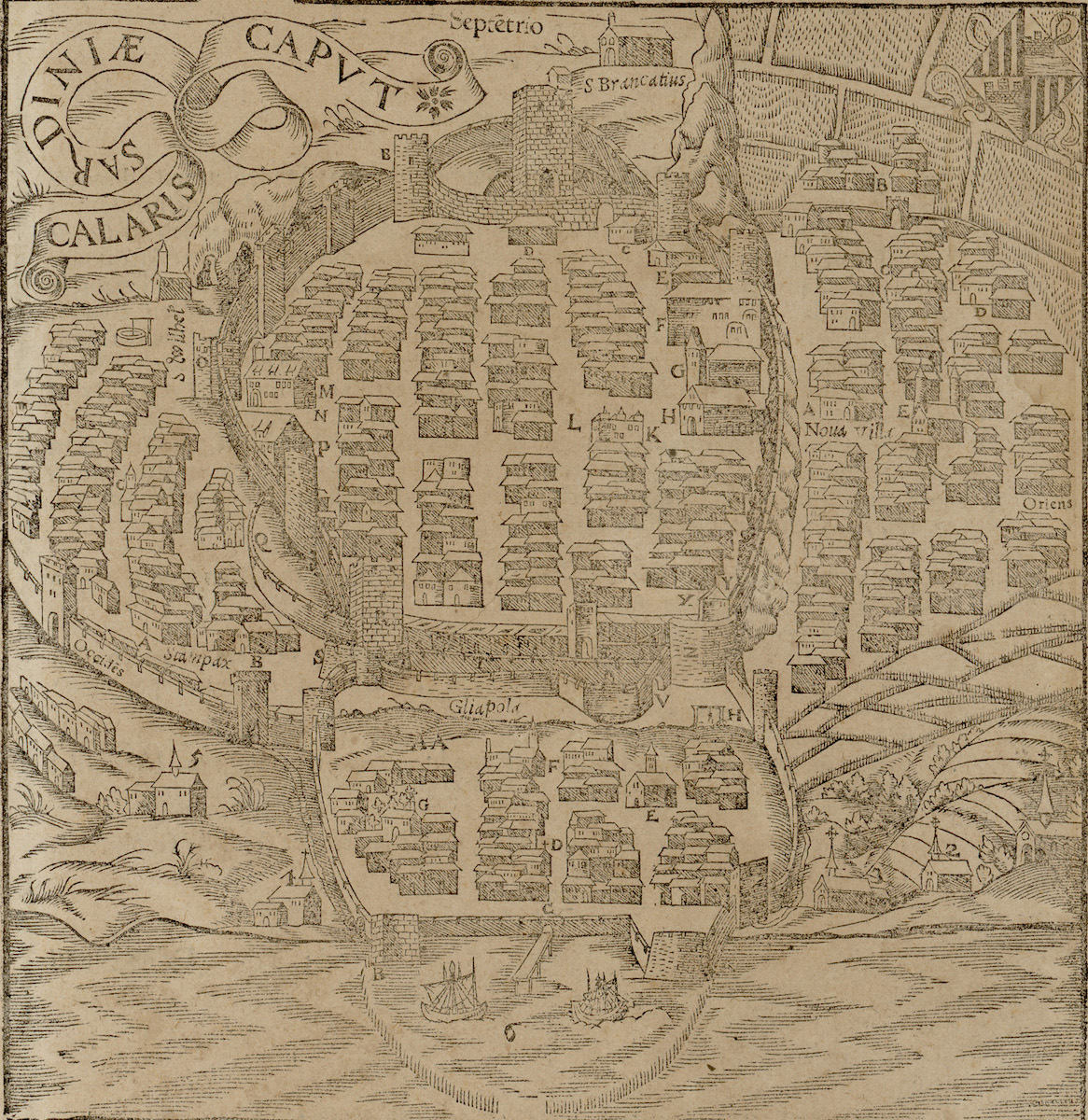
Arquer’s map of his native city of Cagliari, for the Cosmographia universalis, for which compendium he also composed an entry on “dark Sardinia” that “in its blend of ancient sources, personal observations and original narrative structure … played a critical role, even when not explicitly acknowledged, in the development of the image of Sardinia in European culture.” (Source) Today, one of the streets in this very historical core the man once sketched is called Via Sigismondo Arquer.

Exploiting Arquer’s associations with Swiss Protestants as well as his talent for making powerful enemies — skewering clergy in the Cosmographia, nettlesome lawsuits against Spanish oligarchs — the Inquisition bagged him for heresy in 1563. He was 33.

In between bouts of interrogation, Arquer used his long confinement to knock out a Passion in Catalan, heavy with personal resonance. The Christ parallels ran all the way to the Plaza de Zocodover, where a soldier — motivated by anger at the heretic or pity for the sufferer, only God can say — speared him through the side during his death throes.

On this day..

1453: Loukas Notaras, Byzantine

On this date in 1453, Loukas Notaras, the last megas doux of the freshly destroyed Byzantine Empire, was executed at the command of Mehmed the Conqueror.

A wealthy Greek merchant who’d been circulating on the highest plane of Byzantine statecraft, Notaras is famous for his purported quip, “I would rather see a Turkish turban in the midst of the City [Orthodox Constantinople] than the Latin mitre.” The quote is probably apocryphal, but it sticks because he got the wish when Mehmed conquered Constantinople.

His end made a canvas congenial to moralizing brushwork. The victorious sultan spared him initially only to reverse course a few days later. By hostile Christian repute this was when Notaras was commanded to deliver his youngest son for perverse usage in the harem; a hostile-to-Greeks version has the wily old courtier immediately falling into his habitual scheming.

This post drawing on the work of the French scholar Thierry Ganchou suggests a less sensational compounding of reactions that ensued upon the sultan’s demand for Notaras’s youngest son, Jacob — not as a sex slave but as a court hostage, which was a normal practice in this period to keep potentially rivalrous elites onside. Notaras reacted badly, viewing the demand as an arbitrary humiliation and fearing the boy’s potential conversion to Islam and matters spiraled from there.

In his history written a century later, the ex-bishop Makarios Melissenos also suggests that, like Hulagu Khan upon destroying the Caliphate, Mehmed found himself contemptuous of prey yet so wealthy when his own country had gone to the wall.

“Inhuman half-breed dog, skilled in flattery and deceit! You possessed all this wealth and denied it to your lord the emperor and to the City, your homeland? … Why were you unwilling to assist the emperor and your homeland with your immense wealth?” (Source)

On this day..

1292: Rhys ap Maredudd

Welsh lord Rhys ap Maredudd was executed as a traitor at York on this date in 1292, for leading a failed rebellion in his homeland.

Rhys ruled the Cantref Mawr, a fragment of the larger region of Deheubarth his house had once ruled as a united principality.

Our guy was working a project to augment this reduced patrimony by allying himself to King Edward I of England against Dafydd ap Gruffydd. But the English king made only a miserly bestowal, and insult to injury even booted him out of Dryslwyn Castle. Chafing at the domination of Edward’s men, the frustrated Rhys rebelled against English domination in 1287.

The inconstant lord was crushed in a siege at Newcastle Emlyn. Although able to escape and stay on the run for a few years, he was eventually captured in 1291 and executed as a traitor.

On this day..

1868: Thomas Griffin, gold commissioner

On this date in 1868, disgraced Australian gold commissioner Thomas Griffin was hanged for murdering two police escorts in the course of a robbery.

He was an Irish-born constable who parlayed decorated service in the Crimean War into emigration to Australia.

There he lodged himself in the policing ranks and by dint of energy and charm worked his way up by late 1863 to the administrative post of gold commissioner in the emerging gold rush boom town of Clermont, Queensland.

“During his four years’ residence at Clermont, Griffin became widely known in the district,” according to The Early History of Rockhampton by a working journalist who knew Griffin, J.T.S. Bird.

In addition to being physically a fine manly-looking fellow, he had a very suave and attractive manner, and readily gained the favour and friendship of those whom he desired to stand well with.* To those under him he was as a rule distant and overbearing, and was by no means well liked … Ostentation and vanity, with a fondness for display, were leading traits of his character, and were noticeable to all who knew him.

One index of his no means well-likedness was the community petition that deposed him from his post in September 1867. It seems that Griffin had formed a reputation as “despotic, arbitrary and partial,” made himself a fixture of gambling dens, and had been investigated for embezzling mining revenues that he was supposed to hold in trust.

Demoted to a lower position in the same bureau in nearby Rockhampton, Griffin immediately vindicated his critics by arranging to accompany the next “gold escort” transporting valuables between Clermont and Rockhampton, along with troopers Patrick Cahill and John Power. En route, Griffin gunned the two men down by surprise on the Mackenzie River, making off with about £4000 in notes (not gold). He then unconvincingly presented himself back in Rockhampton as having separated naturally from the party, surprised as anyone that the other two hadn’t returned. Although he participated in the initial search, he was arrested within days.

Bird has a lengthy narrative of the investigation and trial; one notable aspect was early forensic experimentation with shooting sheeps’ skulls in an attempt to model the damage done by the gunshots received by the unfortunate guards — further to demonstrating that they were murdered execution-style at close range rather than shot from a distance as a wilderness brigand might do.

Suffice to say that no matter the spattering of ruminant brains, Griffin’s foul reputation made his pretense of innocence completely untenable, even though he continued it all the way to the gallows.

After a prayer at the foot of the scaffold, Griffin stood up and Mr. Smith said:

I shall meet you at the judgment seat of God; you have but a few minutes to live, and in the sight of God who is to judge between us all, I ask you will you not acknowledge your guilt?

Griffin drew himself up and said in a resolute voice, “No!”

He went up the first of the scaffold steps two or three at a time, finishing the remainder with a firm step. Stepping on the drop, he came promptly to “attention.” Griffin told the executioner [John Hutton] he had nothing to give him, but if he saw Mr. Brown he would give him something. The hangman then asked if Griffin had anything to confess.

Griffin replied in a firm voice: “No, I have nothing to confess!”

The white cap was placed in position, and Griffin, as though impatient at any delay, said: “Go on, I am ready!” The bolt was drawn, and death followed instantly.

Griffin had frequently told Dr. Salmond and others that he would die with calm firmness, and he was as good as his word.

His was the first of nine executions recorded at Rockhampton Gaol. A week after the hanging, Griffin’s grave was robbed and his head stolen.

* One early indicator of the man’s character was his seduction of a wealthy widow on the very ship he took to Australia. After quickly dissipating her fortune, he parted ways with her by publishing a fake death notice in the newspaper.

On this day..

2004: Three for honor-killing a 6-year-old

(Thanks to Richard Clark of Capital Punishment U.K. for the guest post, a reprinted section from a longer article about capital punishment in Kuwait that was originally published on that site. (Executed Today has taken the liberty of adding some explanatory links.) CapitalPunishmentUK.org features a trove of research and feature articles on the death penalty in England and elsewhere, including a wider history of the juvenile death penalty in England. -ed.)

On the 31st of May 2004, three executions were carried out simultaneously at 8.15 a.m. in the courtyard of the Nayef Palace. The criminals, two Saudi nationals, Marzook Saad Suleiman Al-Saeed, aged 25, Saeed Saad Suleiman Al-Saeed, aged 28 and 24 year old Kuwaiti Hamad Mubarak Turki Al-Dihani, had been convicted of the abduction, rape and murder of a six year old girl.

It was a particularly appalling crime that had received a great deal of media coverage. Their victim, Amna Al-Khaledi, was kidnapped from her home on the 1st of May 2002 and driven to a remote desert area, where she was gang raped and stabbed five times in the chest before her throat was slit. The three men were arrested some three weeks after Amna’s body was discovered. They had murdered Amna in a so called honour killing to avenge a sexual relationship between her elder brother, Adel Al-Khaledi, and Al-Saeed’s sister. Amna’s brother was given a five-year prison term for having the illicit sexual relationship.

(Honour killings are committed to avenge a perceived affront to a family’s honour, such as an out of wedlock relationship or a female relative marrying without her parents’ consent.)

A third Saudi, Latifa Mandil Suleiman Al-Saeed, a 21-year-old female cousin of the two brothers, was sentenced to life in prison for taking part in the abduction.

Some 1,000 people, including Amna’s relatives, were at Nayef Palace to see the aftermath of the executions according to Interior Ministry spokesman Lt. Col. Adel Al-Hashshash. Incongruous photographs appeared in the press the next day showing the hanging bodies with Kuwaiti women in full Islamic dress taking photos of them with their state of the art mobile phones. The bodies were taken down some 20 minutes after the execution and covered with white sheets. The head of the Penal Execution Department, Najeeb Al-Mulla, announced that it took Hamad Al-Dehani approximately 6 minutes to die, while the two Saudi brothers were timed was 8½ minutes and 5½ minutes respectively. Saeed Al-Saeed and Marzouq Al-Saeed had asked for their remains to be buried in Saudi Arabia and the three convicted asked for the authorities to donate a charity project in their names.

On this day..