On this day in 1887, a teenager named Joseph Morley was hanged for the brutal murder of his 24-year-old landlady, Martha Bodger. He had been only seventeen at the time of the crime.
Morley, a journeyman blacksmith, lived with a married couple, Martha Bodger and James Mears Bodger, along the Romford Road in Essex. James worked as a gardener at nearby ominous Hainault Lodge.
The Overlook Hotel-esque lodge is no longer extant and its former site has been turned into a nature preserve.
Joseph had been living with them since early in 1887 and had caused no trouble in the household.
James last saw his wife alive on October 11, 1887. He rose at 4:00 a.m. and, at 5:40 a.m., took a cup of tea to his wife. He set off for work at 5:45, reminding Joseph to make sure and shut the front door on his way out.
Just a few minutes later, the neighbors heard screams coming from from the direction of Martha’s bedroom.
The noise was cut off abruptly, and did not resume. One of the witnesses, next-door neighbor Thomas Briant, tried the Bodgers’ front door, but it was locked and no one answered. Briant’s niece, who was present, said she heard the sound of a man’s heavy footsteps coming from the kitchen. Briant also worked at Hainault Lodge and, uncomfortable with the situation, he decided to go there and tell James what had happened, just to be on the safe side.
While Briant was hurrying to the lodge, his niece stayed inside and heard someone leaving through the Bodgers’ front door. She looked out and saw Joseph Morley walking away from the house at an unhurried pace, evidently en route to his job at a blacksmith’s shop 200 yards away.
When Thomas Briant told James Bodger about the noises, the worried husband and father rushed home to see what had happened. The sight that greeted him in the bedroom was something from a horror movie. As Linda Rhodes and Kathryn Abnett describe in their book, Foul Deeds and Suspicious Deaths in Barking, Dagenham and Chadwell Heath:
Martha was lying on her back across the center of the bed. Her nightdress was pulled up towards her waist, leaving her lower body exposed. Her legs hung over the side of the bed facing the door, the feet not quite touching the ground. There was blood everywhere — across her throat, on the floor, and across the walls. The blanket, counterpane and sheet lay on the floor, and were also saturated with blood.
Next to Martha’s body lay the couple’s six-month-old baby, Amy Elizabeth. Little Amy was covered in blood but unharmed, and giggled when she saw her father. The murder weapon, James Bodger’s razor, was under the bed. The killer had wielded it with such force that the blade had snapped off the handle.
Martha was beyond help; she was already dead by the time her husband found her. The doctor counted four long, deep cuts across her throat as well as a gash on her face and defensive wounds on her left hand. She had also suffered a blow to the side of the head. There was no evidence of sexual assault, in spite of the position of her clothes. Her purse was by the bed with no money missing.
James had no doubt who must have killed his wife, and went storming off to Joseph Morley’s place of work. Morley flatly denied having had anything to do with the matter, but his boss noticed some small spots of blood on his coat.
Closer scrutiny revealed additional stains on his coat and pants, as well as on his shirt, which had been turned inside out. Morley claimed the blood was from a cut he’d gotten when he fell off his bicycle the night before, and produced deep cuts on both hands that he said were from yesterday’s accident. But the same doctor who had examined Martha’s body had a look at Joseph’s hands and said the cuts were very recent, an hour or two old at the most.
He was placed under arrest for murder. Morley, with a “dreamy unconcerned manner,” followed the police constable to the station.
At his trial in early November, Morley’s attorney argued the case against him was only circumstantial. Forensics of the 1880s could not have identified the source of the bloodstains on his clothes, or even proven they were human. Nevertheless, he was convicted, and shortly afterwards he confessed his guilt.
Deploying the timeless “blame the media” gambit, Morley claimed he had had lately been obsessed with reading about murders and other crimes in the news, particularly a case in Suffolk where a vicar had been murdered with a razor in his own bed. He said he had yielded to an irresistible impulse to kill Martha and he deeply regretted his actions. He denied any sexual motive for the crime.
He was hanged by executioner James Berry, who told reporters that Morley was the youngest person he’d had to hang so far in his career. After a good night’s sleep, Morley enjoyed a breakfast of fish, bread and butter before mounting the scaffold. He died quickly and easily, and a reporter who viewed his corpse afterwards said it looked as if he had passed away peacefully in bed.
James Bodger remarried two and a half years after his first wife’s murder, and his second marriage produced a son. Unfortunately, Bodger’s life would be a short one: he died of influenza in 1894, aged only 33.
Amy Elizabeth was brought up by her aunt and uncle. She stayed in the local area, married in 1912 and lived a long life, dying at age 90.
On this date in 1781, midwife Margaret Tinkler hanged at Durham.
Tinkler had care of Jane Parkinson who wished to rid her belly of a pregnancy. The reader might well guess that procuring an abortion in 18th century England was a frightful procedure; in Parkinson’s case it took her life thanks to (as the court found) Tinkler’s “thrusting and inserting 2 pieces of wood into & against the private parts & womb of the said Jane giving the said Jane diverse mortal wounds punctures and bruises of which she languished from 1st to 23rd July & then died.” (Source) All that “languishing” gave the dying Parkinson time to accuse Tinkler; the midwife’s insistence that she had merely counseled her patient how to contrive an abortion rather than performing that abortion fell on deaf ears. (Tinkler maintained that story to her last confession.)
As a murderer, Tinkler was posthumously anatomized. The surgeons discovered “two long black double wire pins, as used at that time in women’s hair … in her belly, which it was supposed she had swallowed to destroy her life.”
(Thanks to Robert Elder of Last Words of the Executed — the blog, and the book — for the guest post. This post originally appeared on the Last Words blog. Fans of this here site are highly likely to enjoy following Elder’s own pithy, almanac-style collection of last words on the scaffold. -ed.)
I’m sorry to have caused all this trouble. You seem to be taking harder than I do.
— John Fleming, convicted of murder, hanging, California
Executed November 17, 1933
Prior resident of Folsom and San Quentin prisons for robbery and assault charges, John Fleming murdered Amos Leece at a gas-station and road house when a prostitute named Peggy O’Day (aka Leonora Smith) made derogatory remarks to Leece after he refused to buy her a drink. Leece left the station to crank his car but not before he called O’Day “a cheap, chippy whore.” Fleming then confronted Leece, demanding that he apologize and then shot him three times when he refused.
On this date in 1747, a Tyburn hanging dispatched (along with three other, unconnected criminals) Thomas Fuller, member of one of 18th century England’s most notorious gangs.
Named for their home village, the Hawkhurst Gang dominated the trade in contraband in England’s south from Doset to Kent in the 1730s and 1740s, with the arms and ill-temper to trade blow for blow with crown agents who rightly learned to fear the syndicate. In the process that gang contributed several members to Blighty’s gibbets for various deeds of spectacular violence — gentlemen whom this site will revisit in future posts.
Our Mr. Fuller, however, was by the evidence laid at his trial a mere grunt, and his prosecution targeted the gang’s more routine forms of outlawry.
Despite the smuggler’s romantic knight-errant literary profile — Rhett Butler, Han Solo — it was for 18th century England a vast economic sector organized on a nearly industrial scale. Excise duties imposed on in-demand imports, notably tea but also spirits, tobacco, sugar, and other indulgences, made these articles so profitable to move illegally that it’s a fair bet that they were predominantly consumed as contraband. We have seen in these pages, from a post laid 30 years to the future, that tea smuggling was so commonplace that respectable country parsons made no pretense about securing their refreshments on the black market.
It was enterprises like the Hawkhurst Gang that delivered the leaf to its market.
Exploiting the long coastline, from which skiffs could scuttle to rendezvous with channel shipping, the gang built a storage infrastructure, supply chains, distribution networks. We have a taste of how this worked from the words of the attorney general at Fuller’s trial:
About the Beginning of August last the Prisoner at the Bar, with a great Number of other Persons, all of them on Horseback, arm’d with Fire-Arms, the Prisoner particularly, among the rest, with a Carbine or a Blunderbuss, together with the rest, was on Horseback; and they were then accompanied with several drove Horses, and upon the Horses they rode, as upon those they drove, they carried great Quantities of Tea in Oil-skin Bags, and Half-Anchors, peculiar to those Sort of People; a Peculiarity it is which no Goods besides is carried, in order to elude Justice.
Multiple witnesses in this case described how widespread the practice is; they were needed because the crown case had an evidentiary weakness: everyone knew that posses toting oilskin bags were tea smugglers, but the witnesses had not literally seen the defendant reveal the contents of his oilskin bags. Here is a customs agent named Walker explaining the situation:
Sollicitor-General. What is the Practice of Smugglers in carrying off their Goods?
Walker. Such time as I have been an Officer, which has been ten Years, I never took no Tea in my Life upon Horses, but what was in Oil-skin Bags. Wherever I had a Suspicion, and found Oil-skin Bags, I always found Tea.
Q. How many may you have found?
Walker. Thousands of Bags; when they are in a Hurry, and taken from the Sea, they are in Oil-skin Bags; but when they carry them up into the Country, they carry them in Sacks; there is never a Gang that comes from the Sea-side, but rides with something upon their Horses.
Later, a different officer made an equally important observation about the well-known Hawkhurst Gang: “we never attack’d them, because we were over-power’d.” The Hawkhurst Gang was hardly alone in this. As readily as Britons embraced their untaxed smuggled tea and brandy, the underworld firms that delivered them were growing frighteningly in size and propensity to violence during the 1740s.
Accordingly, they were met by a concerted crackdown by authorities. (And, perhaps more helpfully, a reduction in the tea tax.) In 1745, Parliament had stacked upon the century’s vast allotment of property crimes fresh capital offenses for armed smuggling — no matter whether those arms were actually used. For the case at hand, there was no need to link Fuller to a homicide or the like: only to show that he participated in the normal activities of the Hawkhurst Gang.
As was often the case, it was left to the likes of the Ordinary of Newgate to express in words the ideological message of smugglers’ execution. He did so with great vehemence (but less persuasive effect) when Fuller went to hang:
The common People of England in general, fancy there is nothing in the Crime of Smuggling, but cheating the King of a small Part of his Revenue; and that there is no Harm done to the Community in general, or to the Properties of particular Persons: They think they have a Right to shun, as much as possible, paying any Duty for their Goods, and what they get by their Dexterity in that Manner is honest Gain, to be enjoyed as the Fruits of their Industry and Labour; but a little Consideration will teach them to think otherways, and convince them, that Smuggling is in itself a Crime of worse Consequence to Society, and more hurtful to particular Persons, than many other Crimes which Custom has taught them to look upon with great Abhorrence.
The Prejudice done the Society, and the Damage received by Individuals, next to the express Declaration of the divine Will, are the best Marks by which we can judge of the Degree of Immorality in any Action whatever; and if we judge of their Crime of Smuggling by this Criterion, we shall find it a Sin of deep Dye, and to deserve the Resentment of every Man, who pretends to any Share of moral Honesty.
In the first Place, the fair Trader is injured in his Property by their kind of illicit Trade: He pays honestly the Duties and Taxes charged upon his Commodity at his Entry, which in some Cases amounts to near as much as the prime Cost of his Goods at the first Market; this he must charge upon the Consumer, with a living Profit for his Riske, Trouble and Out-lay of his Money; but the Smuggler, who buys his Goods at the same Market, and perhaps at a lower Price, as he chuses the worst Sort upon running them, is able to undersell the fair Dealer at least one Third, and for that Reason is, by the greedy Retailer, preferred, though the Commodity he deals in is worse in Quality. Is not this robbing the honest Merchant of his real Profit, and forcing him either to sell below what his Goods cost, or leave off a Branch of Trade, to which perhaps, he has served an Apprenticeship, and built extraordinary Hopes upon, of being a Support to him or his Family? I appeal to every thinking Man, if there is any material Difference betwixt ruining a Man by robbing him on the Highway, and this Method of beggaring him and his Family by Smuggling? If there is any Difference in Point of Immorality, it must lie on the Side of Smuggling, as the Evil attending it is more universal, and reaches farther. Few Men carry their All in their Pocket; and not one Man in a Thousand is ruined, by what is taken from him by the Highwayman: But there is not a Ship of Goods run upon our Coast but injures Hundreds; perhaps not immediately, but in Process of Time it certainly has that Effect. Not only the Parts adjacent, and the Dealers near the Smuggling Port suffer by this Means, but the most distant Corners of the Kingdom are affected by it in a few Weeks, in Proportion as it lowers the Price of the Commodity, and diminishes the publick Revenue. But it is this lowering the Price which is the great Temptation; the Cheapness of the Smugglers Goods tempts the Retailer to prefer him to the fair Trader, from a mistaken Notion that it is his peculiar Interest to buy as cheap as he can, and consequently he encourages, conceals, and connives at all the Villainies of this Set of People. But if such a Retailer should give himself Time to think, I believe he might easily persuade himself, that he is robbing Peter to pay Paul; that what he gets upon one Article, he loses on another.
It is evident, Taxes must be paid to support the Expences of the Government; and that every Subject, as he enjoys the Benefit of Government, is obliged to contribute his Proportion to that Expence. It is likewise evident, that if the Duties laid upon one Commodity does not answer the Sum charged upon it, that the Deficiency must be charged upon some other. Thus: Suppose the Duties charged upon Teas, Brandy, &c. falls short 100,000 l. of the Sum allotted to be raised upon these Commodities, is it not evident that this 100,000 l. must be charged upon Soap, Candles, Leather, Sand, or some other Branch? Suppose then a Dealer, by dealing with the Smuggler, saves about half the Duty payable to the King, or, which is the same thing, buys it so much cheaper from him than he would from the fair Trader, and that his Gains upon this Article amounts to ten or twenty Pounds a Year, I mean his illicit Gains, or the Difference between the trading Price and smuggling Price; now, as it is evident, that every twenty Pounds gained this Way lessens the Revenue forty Pounds, he or somebody else must re-place this Sum in the Treasury, by a Tax upon another Commodity; from whence it is as clear as the Sum; that instead of gaining twenty Pounds by his smuggling Dealer, he really loses twenty Pounds upon the Ballance. I own, he may not chuse to deal so largely in these other Articles, as to bring it to this Ballance, but some of his Neighbours may. And as much Money as they pay towards making up this Deficiency, occasioned by the Smuggler; just so much does the Person, who deals with such People, rob out of the Pocket of his Neighbour.
If I was to charge several People, who make no scruple for the Lucre of Profit, to buy Goods which they know to be run, with as foul a Crime as Robbery, or even that of cheating their Neighbour, they would be apt to treat me with some Severity, and think I much injured their Reputation: Yet, upon serious considering the Circumstance attending this Practice, they must at last own, they deserve no better Character than that of a Highwayman and Cheat.
Thus it is plain that Smuggling is a Crime of the most dangerous Nature, both against the Community and private Persons, and as such subject to the Divine Displeasure, as much as any other Felony. It is not only a Sin destructive to Society, and contrary to human Laws enacted for the Peace, Protection, and Subsistence of the State, but is a Sin against the literal Precepts, as well as the Meaning and Intent of Christianity: We are commanded Obedience to Government for Conscience sake; we are commanded to pay Tribute to whom Tribute is due. Our Saviour gave that Answer to the Jews, though that People had as much Reason as any People on Earth, to look upon the Romans as Tyrants, and having no Right to that Tribute, but what they founded upon the superior Force of their Arms; but how much stronger is the Christian Obligation, to pay towards the Support of a Government established? Not by Force or Fraud, butby the Consent of a free People, and conducted by all the Arts of prudent Policy conducing to their Happiness, both in their Religious and Civil Capacities.
If we consider ourselves as several Members united in one Society for our mutual Peace and Protection, we must conclude it the highest Piece of Injustice in us to refuse or evade by Force or Fraud to pay our Contingent of the Expence incurred for such valuable Purposes, as the securing our Religion and Liberties.
If the Government was to make any Infringement upon the Properties of Individuals, or aim at lessening the Freedom of the Constitution, how would the Smuggler and his Friends rail and exaggerate the mighty Grievance? Yet at the same Time grudge to pay their Quota, and take all Means in their Power by Deceit or Violence to cheat the Government of what enables them to preserve Order and Peace in the Community.
…
These Considerations alone are sufficient to awaken the Conscience of the Guilty in this Way, and to hinder us from affording them an unseasonable Compassion; but there yet remains some other Circumstances to blacken the Blackness of their Crime. These are the Manner in which they go about to execute their Smuggling Purposes.
They go in Companies together, armed with all Manner of offensive Weapons, and escorted by the most profligate Wretches they can pick up: They employ none in their Service but Fellows who have given Instances that their Consciences are Proof against all Checks of Morality, Religion or Law, and whose Courage is equal to the most daring Attempts upon the Peace of the Society. By these Men Perjury amongst others, is looked upon as a venial Transgression, beneath the Conscience of a Gentleman Smuggler to be troubled with. Murder, Rapes, and Robberies are with them but as frequent, as they conduce to their Interest. Their Character, their Cruelty, and Numbers has given them another Source of Encouragement, and a new set of Allies. For Numbers of the Country People who perhaps abhor their Practice, from the Dread they have justly conceived of their Power, find themselves obliged, tho’ against their Wills, to connive at or conceal, and even to assist them, and when they are not willing, they are compelled to lend their Aid. For when a Smuggling Vessel touches on the Coast, those concerned or their Associates meet at a Place of Rendezvous, and press all the Horses they meet with for their Service, which they sometimes return, and sometimes not, just as their Business requires, and the Owners dare not complain for fear of having their Throats cut, or their Houses set on Fire: Not only single Houses, but whole Villages and trading Boroughs are kept in this slavish Dependence upon them, out of real Apprehension of Danger, without any Regard to Profit in dealing with them.
China today carried out the controversial execution of Jia Jinglong, a peasant who found a nail gun was his only avenue of redress.
Jia’s village home in the northern Hebei province was demolished three years ago at the order of a local Communist chief who subsequently balked the family of compensation. (They got a small apartment in a high-rise.)
Rapacious developers backed by the power of the state expropriating dwelling-places in an environment of weak legal protections make for one of the most deeply felt abuses in boomtime China, and it goes without saying that it’s a racket where the wealthy and powerful dip their beaks and the other 99% shift as they can and nurse futile grudges. According to the Associated Press, Jia’s village near the city of Shijiazhuang “is overwhelmed by a cacophony of drilling, pounding and jack-hammering coming from construction sites. More than a dozen cranes could be seen in the distance, adjacent to high-rise apartment towers still being built.” As if to add a literary flourish to the injury, Jia also lost the girl in the end as his fiancee, now deprived the prospective roof over her head, promptly called off the wedding.
“What he has experienced is what many are going through or will be going through,” Jia’s sister Jia Jingyuan told reporters. “Because my brother is part of this society’s underclass, he represents the lives of many ordinary people.”
That’s because Jia Jinglong didn’t allow his grudge to remain futile: he used a nail gun to murder the local party chief who wrecked his house and life. It is hardly the only time that a desperate common person has lashed back at the cruelties of state capitalism with the pleasurable self-destruction of personal violence.
While premeditated homicide with a power tool is surely your basic capital case in any jurisdiction keen on the death penalty, the story behind it brought most of China to Jia’s defense; even some state media editorialized for abating the sentence. That wasn’t only in a spirit of vicariously joining the man’s revenge: the severity of the law towards an ordinary citizen charged with slaying an official raised an obvious equal-treatment grievance when contrasted with the likes of the wife of disgraced party boss Bo Xilai, who had a British businessman assassinated but still dodged execution.
(In fairness to the People’s Republic, China has executed powerfulofficials and plutocrats in various other recent high-profile cases.)
Thanks to Twitter friends including @jewssf and @luimnea for tipping me this story.
On this date in 1886, 45-year-old William S. Wilson was hanged for murder in Jonesboro, Illinois. He had killed his wife, Margaret.
Wilson was good at producing offspring — he was the father of at least seven children and possibly as many as nine — but not so good at providing for them. At Christmas in 1885, he left his family and went to Kentucky, leaving his destitute wife and kids only $5 in cash (the equivalent of about $130 in modern terms) and very little fuel. When supplies ran out in early January, several neighbors took pity on Margaret Wilson and her brood and banded together to cut enough firewood to get them through the winter.
When William returned home on January 7, however, he was furious when he learned Margaret had shamed him by accepting charity.
Wilson berated his wife for allowing the neighbors to act. He chased the heavily pregnant woman out of their cabin and shot her down in the mud and slush. The sight of her near-term unborn baby vainly kicking against the interior wall of her abdomen appalled witnesses, who could do nothing to save it. Details such as these illustrate the brutality that often characterizes these all-too-common wife-killing cases.
William had shot Margaret twice: once in the chest inside the house, and once again outdoors as she was running away. As she lay dying on the frozen ground he walked away. He didn’t get far before he was arrested.
A contemporary newspaper article speculated that William might be crazy, noting that he had been “affected for a long time with some incurable disease” and “is not regarded by some as sane.” But it wasn’t enough. William paid the ultimate price for his crime eleven months after the murder.
KNOXVILLE, Tenn., Nov. 10 — Samuel and Milton Hodge, both colored brothers, were hanged here to-day in the presence of about 8,000 persons. The doomed men spoke for about ten minutes, each saying they were prepared to die and were “going home to glory.” They warned those present to beware of their fate. As the black cap was pulled over Milton’s face, he sang in a strong voice “Going Home on da Even’ Train,” and Samuel was singing “Going Home to Die no More,” when he was choked by the rope.
The crime for which the Hodge’s [sic] were hanged was the killing of their brother-in-law, James McFarland, over a year ago.
(Thanks to Robert Elder of Last Words of the Executed — the blog, and the book — for the guest post. Fans of this here site are highly likely to enjoy following Elder’s own pithy, almanac-style collection of last words on the scaffold. -ed.)
“The time will come when my innocence will be proven, and then Bob Dodge will haunt you for his murder.”
— Robert S. Dodge, convicted of murder, hanging, California.
Executed November 8, 1866
Borrowing a double-barrel shotgun, ostensibly to hunt quail, Dodge could not account for his whereabouts when a man who was quarreling with his brother was shot. Dodge went through two trials and during the second was found guilty of first-degree murder. In prison, he attempted suicide by taking opium.
To Elder’s hanging-day sketch (and since blog column-inches are free) we add the report of the San Francisco Evening Bulletin, Nov. 10, 1866 — itself channeling the Nevada Transcript. (Meaning Nevada City, Calif., not the state of Nevada.)
[Dodge] was twice tried and convicted of the murder of Mark P. Hammock, and after both trials the case was taken to the Supreme Court, whence the case was once sent back.
The verdict after the second conviction was sustained and the District Court ordered to fix a day for the execution.
The testimony against Dodge was entirely circumstantial.
Sheriff Gentry read the death-warrant, after which Dodge stepped to the rail in front and addressed those in the yard in a speech of ten minutes. He said he had once more the privilege of addressing them in this dark and gloomy world. He alluded to his home, his mother and friends, speaking of them in affectionate terms, and picturing the grief they would feel on hearing that their youngest son had died upon the gallows.
He spoke of the anxiety manifested to witness his death, and warned those present that the time would come when they would repent having seen it, and that when they discovered, as they surely would, that he was innocent, remorse would forever follow them.
He declared that he suffered on account of false testimony offered against him. He alluded to the future, saying that in “eternity Bob Dodge would be seen coming in glory.”
At the conclusion of the speech he turned to Sheriff Gentry and requested him to finish the work quickly. When asked if he had anything further to say by the Sheriff, he replied only “I am innocent.”
He then bid those on the platform good-bye, shaking hands with them, and then stepped upon the trap. His limbs were lashed with cords and the black cap placed over his head.
He then said, in a loud voice, “Boys, I want you all to hear, I am innocent.”
A prayer was read by Mr. Anderson, and at 18 minutes past 1 o’clock the trap fell, and the soul of Dodge was sent to a higher court for judgment.
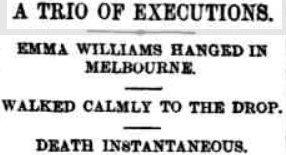
Melbourne, November 4.
Emma Williams, who was convicted of the murder of her child at Port Melbourne on August 13 last, was executed in Melbourne Gaol this morning in the presence of about a dozen persons.
Public excitement was aroused over the murder when it was first discovered owing to the callous and unfeeling way in which the deed was done and the careless attitude of the mother afterwards. The victim, who was only two years of age, was taken by its mother to the pier in the Sandridge Lagoon, where she tied a stone to its body and pushed it into the water.
After her conviction the Anti-Capital Punishment League made strenuous efforts to obtain a reprieve, chiefly because the condemned woman alleged that she was pregnant.
Medical examinations did not support that statement, and it was discovered on Friday last that the condition which lent color to the woman’s statements was produced artificially.
At first Williams treated her terrible sentence with apparent unconcern, being buoyed up with the hope of reprieve; but when that expectation had passed she became most devout and earnest in her attentions to the ministrations of the gaol chaplain (the Rev. H. F. Scott), by whom she was attended to the scaffold. She expressed great sorrow for the crime she had committed and for the loose life she had led.
She remained in that frame of mind to the end.
When the sheriff demanded the body of the prisoner from the governor of the gaol at the door of the little cell alongside the gallows this morning she walked calmly on to the drop, but her face was blanched and wore a terrified expression.
In answer to the usual questions from the sheriff as to whether she wished to say anything Williams answered “No,” in a low but firm voice.
The white cap was immediately drawn over her face and the rope adjusted, and then, as Roberts, the hangman, turned to pull the lever, she exclaimed, “Oh, Lamb of God, I come.”
The next moment the drop fell, and at that moment Williams uttered a nervous, plaintive exclamation that was not quite a scream. Then all was over. The whole of the proceedings did not occupy more than a quarter of an hour, and death was instantaneous.
The dead woman had a very eventful career, having been married when she was 14 years old. At 15 she bore a daughter, who is still living. Her husband left her, and afterwards died in the Melbourne Hospital, while the widow continued a career of dissipation. Her daughter was adopted by a friend of her husband, and the child which she drowned was born after his death.
She was born in Launceston, Tasmania, where her mother still lives.
Brisbane, November 4.
A double execution took place at the Boggo Road Gaol this morning.
Jackey, an aboriginal, was hanged for the murder of a Javanese, Jimmy Williams, at Mount Morgan, and Frank Tinana [or Tinyana -ed.], a Dative of Manila, was executed for the murder of Constable Conroy, on Thursday Island. The men behaved well in prison. Jackey was able to recite prayers taught him by the Bey. Mr. Simmonds, and Father Dorrigan attended Tinana, who admitted having committed murder. He said he bad a jealous quarrel with another colored man, in which Constable Conroy attempted to arrest him. He then stabbed Conroy to death.
During the past few days both condemned men ate and slept well, and this morning they partook of breakfast. When they came upon the scaffold Tinana was agitated and seemed afraid. Neither man spoke.
The preliminaries were quickly arranged and the bolt was drawn. Death, in each case was apparently instantaneous. When Jackey, whose height was nearly 6 ft, fell blood burst from his nose and stained his white cap.
No colored men were present to witness the execution, which was carried out in the presence of the usual officials. Jackey left a letter to a woman who is looking after his child, telling her to take great care of the infant, to bring it up as a white man’s, and not to let it drink rum or go to the blacks’ camp. Tinana left a letter coached in terms of great affection to his wife.
On this date in 1803, Flemish outlaw Ludovicus Baekelandt was guillotined at Bruges with about 20 of his gang.
Deserting the army of the conquering French, Baekelandt set up as a bandit preying the deep spruce forests of the Vrijbos, eventually attaining leadership of a gang more than 30 strong.
Baekelandt is one of those whom popular memory and national sentiment (resentful here of the French occupation) has elevated into huggable social banditry. But the evidence remaining us testifies to little but a garden-variety brigand whose offenses were in no way confined to property crimes.
The gang was rounded up in 1802 and the Bruges court heard testimony from more than 100 witnesses, eventually dooming 21 men and three women to death for a litany of murders and robberies.
Almost all the information about Baekelandt available online is in Dutch; if that tongue is in your toolkit, gentle reader, this public-domain book is sure to level you up on Ludovicus Baekelandt and friends.




 Deserting the army of the