1691: William Macqueen, the Irish Teague

On this date in 1691, 11 hanged publicly at Tyburn.

From the Ordinary’s Account they make a fairly typical, if voluminous, assortment: an infanticide, a drunken murderer, and thieves and highwaymen of various descriptions.

Two of these rude knights of the road were “William Selwood alias Jenkins, condemned with William Mackquean a Papist,” the latter also called “Bayley, alias the Irish Teague.” Condemned for robbery on the road, Macqueen confessed to having previously murdered a soldier in a similar encounter; they were “Old Offenders” who had previously “been Reprieved, but would not take warning.”

For the veteran robber Macqueen we have a fine instance of the facts-be-damned mythmaking characteristic of the early Newgate Calendar: his entry credits him with stealing the mace of the Lord Chancellor, an outrageous caper that different criminals really did pull off many years before. Not accidentally, our rewrite version from the Whig ascendancy also edits the identity of the Lord Chancellor involved, who perforce must seem ridiculous to have lost the emblem of his station in this manner — replacing the true victim, the moderate and forgettable Earl of Nottingham, with that hated late-Stuart bete noir (and notorious hanging judge), Lord Jeffreys.

The implicit parable of the Glorious Revolution is reinforced by what must surely be a fanciful vignette in which Macqueen mugs the Lady Auverquerque, the wife of one of the Dutch commanders who invaded England with William of Orange in 1688. Both parties involved are foreigners on English soil, and their awkwardness in that most naked transaction of gunpoint robbery has comedic effect. Presented with a confusingly veiled demand for a “loan,” the mistress seeks clarification: “I believe you had as good tell me at once you are come to rob me; for this is an odd way of borrowing.” Macqueen/Teague apologizes and manages crudely but effectively to the convey the point: “I am a stranger in this country, and so if I don’t know the difference between robbing and borrowing, you must excuse me; for all I mean is, to have your money.”

On this day..

1944: Four Italian fascist saboteurs

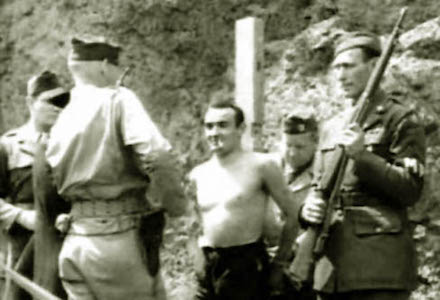
On this date in 1944,* four young Italian fascist agents of Mussolini‘s rump state were shot as spies and saboteurs by the Allies at a quarry near Capua’s Sant’Angelo in Formis abbey.

Most of the information readily available about Franco Aschieri, Italo Palesse, Mario Tapoli-Timperi, and Vincenzo Tedesco is in Italian: specifically, in nationalist Italian pages celebrating the sacrificial patriotism of the young men who had parachuted into Allied-controlled southern Italy to operate as partisans. A number of their peers were shot in similar circumstances beginning in late 1943 and in greater numbers through the spring of 1944.

The quartet died game and then some, conferring upon posterity charismatic photos of handsome valor in the face of execution. The most startlingly iconic (at least one design based on it is available for sale) the shirtless and barrel-chested Palesse tied to the stake with an insouciant cigarette a-dangle from his lips. Inevitably their last cries ran to Viva il Duce! and Dio stramaledica gli inglesi! (God curse the Anglos!)


The condemned party in their cell on the morning of the execution, where their confessor remembered “I found them laughing.”


Having shucked off his shirt so the bullets won’t spoil it, Italo (sometimes given as Idalo) Palesse receives the comfort of a priest. (Source)


Franco Aschieri


Vincenzo Tedesco, from the firing squad’s perspective.

Mature Content: Video of this same scene records the men being shot.

On this day..

2014: Two crucifixions in Raqqa

In the Syrian city of Raqqa on this date in 2014, the Islamic State (ISIS/ISIL) reportedly crucified two men in a posthumous public gibbeting, after executing them by shooting. (There were seven executions in Raqqa that day.)

Raqqa was the Islamic State’s breakthrough conquest, and the city it claims as its caliphate’s capital — the “Bride of the Revolution.”

Horrific pictures of these crucifixions circulated worldwide thanks to the dissident group Raqqa is Being Slaughtered Silently. Needless to say, what follows is Mature Content.

On this day..

1909: A triple execution in Chalco

The composed image in this date’s post would almost lead one to believe it posed, but Mexican campesinos Arcadio Jiménez, Hilario Silva, and Marcelino Martínez really were all shot together at Chalco on this date in 1909, for killing a policeman during the tense twilight of dictator Porfirio Diaz, on the verge of the Mexican Revolution. It’s believed to have been taken by Augustin Casasola.


From this lengthy dissertation pdf. (See the 384th page of the pdf, or page 354 as numbered within the document.)

According to Photographing the Mexican Revolution: Commitments, Testimonies, Icons, the event was luridly covered by the magazine El Imparcial, which described the execution in these words:

The bodies fell simultaneously, slowly backward, and a hoarse whisper flowed from either the enormous holes made by the bullets or their tightly pressed lips. The clothing smoked from the gunpowder, and their contractions denoted an extraordinarily cruel suffering. A death rattle, like that of a sheep with its throat cut, escaped from the three bodies. Their families sobbed, and their cries filled the countryside. Those of us who were present will never forget it.

On this day..

1896: Carl Feigenbaum, the Ripper abroad?

On this date in 1896, New York City electrocuted Carl Feigenbaum.

He’d been convicted of slaying the widow from whom he rented a room at eight cents per day … but many at the time suspected his homicidal exploits might also have traced to Whitechapel, under the dread sobriquet Jack.

We can only really be sure of the one murder: on September 1, 1894, he attacked 56-year-old Julianna Hoffman in her room on East Sixth Street, for the possible reason of robbing her. One ferocious slash with his long bread knife nearly decapitated the landlady; the disturbance roused Hoffman’s 16-year-old son who burst in on the assailant — reportedly just as Feigenbaum had his blade poised to begin horribly gouging the corpse. Both killer and witness grappled briefly and then fled from each other; Feigenbaum was arrested before the day was out.

Today you’d call the part of town East Village but back in the 1890s it was Klein Deutschland, with one of the world’s largest concentrations of Germans abroad.

Probing his client for material to use for an insanity defense,* Feigenbaum’s attorney elicited his client’s self-diagnosis that “I have for years suffered from a singular disease, which induces an all-absorbing passion; this passion manifests itself in a desire to kill and mutilate the woman who falls in my way. At such times I am unable to control myself.” That seems interesting.

It emerged that Feigenbaum had left Germany as a merchant mariner, and that profession had possibly seen his boats tied up in the Thames during the pivotal months when the Whitechapel murders took place.

In the Big Apple, the idea of modern crime’s great bogeyman throwing his demonic shadow across their very own dungeons appealed irresistibly, to nobody moreso than Fiegenbaum’s own attorney William Lawton, who reveled in his hypothesis of proximity to evil and made a silly bid for celebrity on that basis. Lawton claimed to have hit upon the Ripper idea as he pondered the meaning of Feigenbaum’s professed impulse to mutilate women.


From the St. Albans (Vt.) Daily Messenger, April 28, 1896.

The very day after his client’s electrocution, Lawton explicated the suspected connection to the press, “stak[ing] my professional reputation that if the police will trace this man’s movements carefully for the last few years their investigations will lead them to Whitechapel.” (Lawton is also the sole source of Feigenbaum’s alleged self-incrimination, quoted above: to everybody else Feigenbaum insisted on his innocence far past any possible stretch of plausibility, and even carried that insistence to the electric chair.)

Regrettably, Feigenbaum’s pre-Hoffman movements are obscure to the point where Lawton’s theory is essentially immune to corroboration (or refutation). Even when Lawton dropped his intended bombshell did his hypothesis come in for some public ribbing; the New York Tribune scoffed on April 29 of that year that Feigenbaum now being indisposed to object, all the city’s most troublesome unresolved homicides ought to be attributed to this empty cipher.

Despite the surface similarities of his aborted disemboweling to the infamous London crime spree, Feigenbaum’s case for Ripper immortality doesn’t enjoy much of a constituency today. (Trevor Marriott’s 2005 Jack the Ripper: The 21st Century Investigation is a notable exception to the skepticism.)

* Feigenbaum, who had been literally caught red-handed, ultimately did not pursue the insanity defense that was probably his only hope of avoiding the chair because he did not have enough money to hire the expert alienists who would be required to present such a case to the jury. But for a guy supposedly resource-constrained, Lawton does seem to have gone to some trouble to research the possible Ripper connection.

On this day..

1947: Hisao Tani, for the rape of Nanking

Lieutenant General Hisao Tani was shot on this date in 1947 for his part in the Rape of Nanking.

Tani commanded a division that took part in the conquest and occupation of that Chinese city in 1937, and it was outside its gates — following a Chinese war crimes trial — that he took his leave of this world.

On this day..

1852: Nathaniel Bowman, William Ide inspiration

This date’s anecdote, from a public domain local history, concerns the April 24, 1852 hanging of Nathaniel Bowman. Bowman has the minor distinction of being the first person executed in California’s Colusa County.

Bowman would not escape his execution but his attempt to do so summoned the offices of William B. Ide, a pioneer who had led a revolt in Mexico’s Alta California and thereafter headed the very short-lived California Republic — an affair sometimes remembered as the “Bear Flag Revolt” for the sigil still used today by the state.


The present-day California flag.

The service Ide would render his countrymen in this post was among the last of his life: he died of smallpox later in 1852.

The first legal execution in Colusa County occurred in the spring of 1852. Nathaniel Bowman was convicted of murder in the first degree for killing Levi Seigler by beating him over the head with a bottle.*

There was no jail then, and during the trial Bowman was placed under guard at Monroeville. After his conviction he nearly made good his escape. In some manner he eluded the vigilance of his guard and, still shackled, hobbled to the home of Jesse Sheppard, where he begged piteously to have his irons filed off. Sheppard, however, took him back and turned him over to the authorities at Monroeville, where he was executed soon afterwards.

This episode clearly showed the necessity of having some safe place of detention for prisoners.

With his characteristic resourcefulness in emergencies, William B. Ide met this situation also. He obtained some bar iron and bolts from San Francisco and fashioned a cage. This he placed in the shade of a great oak in front of the hotel in Monroeville, which did duty at that time as the county courthouse also. This simple expedient solved the problem until the seat of government was transferred to Colusa in 1854, whereupon Ide’s cage was removed also, to continue duty as a cell in the county jail in Colusa.

* The Sacramento News (April 27, 1852) advises that Bowman “addressed the assembled crowd, from the scaffold, and stated that it was not his intention to kill Seigler, but to beat him badly.”

On this day..

1947: Garlon Mickles, the last hanged in Hawaii


Seattle Times, April 22, 1947.

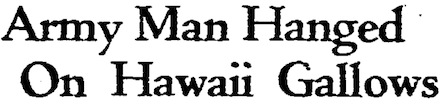
On this date in 1947, U.S. Army Private Garlon Mickles was hanged at a place called “execution gulch” in Honolulu’s Schofield Barracks.

Mickles had enlisted three years before, the 16-year-old son of a St. Louis laundress. (“Tell my mother I died like a man,” were his reported words to the chaplain.)

According to Associated Press reports, army engineers frustrated peeping eyes by “put[ting] up a smoke screen to shield the gallows from the view of the curious.”

He was convicted of raping and robbing a female War Department employee on Guam, where he was stationed with the Twentieth Air Force — from which staging-point the unit conducted bombing raids on mainland Japan. (The Enola Gay, which dropped the atomic bomb on Hiroshima, was part of the 20th.)

Mickles appears to be the last person ever executed on the Hawaiian islands, and also an unusual overlook by the Espy File of U.S. executions, from which he’s totally absent.

On this day..

1857: The mutineer Jemadar Issuree Pandy

From the Annals of the Indian Rebellion, 1857-58:

THE MUTINEER JEMADAR ISSUREE PANDY.

This Jemadar of the 34th Regiment N.I. was brought to trial on the following charges: —

1st. For having at Barrackpore on the 29th March 1857, he being then in command of the quarter-guard of his regiment, not used his utmost or any endeavours to suppress a mutiny begun by Mungul Pandy, the said sepoy having on the afternoon of the day above mentioned, gone out into the parade ground in front of and near to the quarter-guard of the regiment armed with a sword and musket; and then and there used words to excite the men of the reigment to come forth and join him in resistance to lawful authority; and having then and there on the parade ground, and near to the quarter-guard of the regiment, discharged his loaded musket at Serjeant Major James Thornton Hewson, and Lieutenant Bempole Henry Baugh, of the 34th Regiment N.I., and then and there with a sword struck, and severely wounded, the said Lieutenant Baugh and Serjeant Major Hewson, and the said Jemadar not having taken any measures to arrest and confine the said sepoy throughout the aforesaid occurrences, nor to assist the said Lieutenant Baugh and Serjenat Major Hewson, and he [sic] the said Jemadar having, moreover, then and there discouraged and interfered to prevent any sepoys of his guard from going to their assistance.

2nd. For disobedience to the lawful command of his superior officers in not having advanced with his guard to rescue the Serjeant and capture the aforesaid sepoy, Mungul Pandy, when shortly after the occurrences, set forth in the first charge, he was ordered to do so by Brevet Colonel S.G. Wheler, commanding the 34th Regiment N.I.

The Court found the prisoner, Jemadar Issurree Pandy, guilty of both charges preferred against him, and sentenced him to suffer death. On the 21st April 1857 Major General Hearsey reported as follows: —

Jemadar Issuree Pandy was duly hanged by the neck this afternoon at 6 o’clock in presence of all the troops at the station; the crimes, finding, and sentence of the General Court Martial before which he was arraigned, approved and confirmed by His Excellency the Commander-in-Chief, having been first carefully explained to all the native corps.

It may be perhaps satisfactory to the Government to know that when on the scaffold the Jemadar made a voluntary confession of his guilt, and admitted the justice of the sentence which had been passed on him, at the same time imploring all his fellow soldiers who were present to take warning by his untimely fate.

They didn’t.

On this day..

2017: Ledell Lee

Moments before his death warrant expired at midnight U.S. Central Time, after a last meal consisting only of communion, Ledell Lee was executed by the U.S. state of Arkansas.

Lee spent 24 years awaiting execution for the bludgeon murder of Debra Reese on February 9, 1993, but he was done to death in a rush that left unanswered some of the most fundamental questions in the case.

Trial is the forum designated for contesting this question, of course. At Lee’s, he was represented by an unwilling defense team that repeatedly sought its own removal from the case, citing an “intolerable conflict” with their client, a conflict that paled in comparison to that of the judge, who was having an affair with a prosecuting attorney. (Multiple separate rape cases were pending against Lee at the same time, and those same conflicting attorneys were removed from those cases.)

A quarter-century on death row suggests claims litigated to the point of exhaustion, but this is not how the death penalty game is played in America. The art of execution lies in expediting a conviction and then fighting hammer and tong to maintain that verdict as a fait accompli against any attempt on appeal to litigate issues that the jury never heard. Mostly, the clocks runs for years on useless waiting or epicycles of procedural do-overs that never reach the most salient topics. The Innocence Project reports that outright exonerees (not limited to condemned prisoners) serve an average of 14 years before winning release on their various evidentiary trump cards. (Arkansas’s most famous death row exoneree,* Damien Echols, waited 17 years.)

By the time one reaches the end of the glacial death penalty process, the very refusal of the law to probe the questions it never bothered asking will have become the fault of a prisoner’s own dilatory appeals, leading — in this instance — to victim’s kin at Lee’s clemency hearing “asking you and begging you to please let us have some closure.”

In the name of closure, end-state cases must also insist on renouncing one of the potential benefits of all that time-wasting, the perspective of passing years. DNA tests that were not available when Lee stood trial for his life — and the discredited “forensic evidence” of matching hair samples was invoked against him — could have been used to examine blood spots on Lee’s shoes.** Because the prisoner maintained his innocence in the case from the time he was arrested until the very end, one of his late appeals vainly implored Arkansas to test that DNA sample. There are many cases, death penalty and otherwise, meeting this description, and most U.S. jurisdictions compulsively resist any calls to revisit testable tissue in the light of emerging DNA science as so many affronts to the majesty of law.

So what has everyone been up to while not testing DNA all those years? The Fair Punishment Project report on Lee’s post-conviction road makes depressing reading.

Lee’s first state post-conviction attorney had substance abuse problems that left him “impaired to the point of unavailability on one or more days of the Rule 37 hearing.” The Arkansas Supreme Court noted several examples of his lawyer’s “troubling behavior,” including “being unable to locate the witness room;” “repeatedly being unable to understand questions posed by the trial court or objections raised by the prosecution;” “not being familiar with his own witnesses;” and “rambling incoherently, repeatedly interjecting ‘blah, blah, blah,’ into his statements.” Unsurprisingly, Ledell lost his state-post conviction petition. Eventually, the Arkansas Supreme Court recognized that Lee received grossly inadequate representation and withdrew its opinion, giving him new counsel.

Unfortunately, his new counsel were not much better. First, they missed the filing deadline for the appeal. Then, the Arkansas Supreme Court twice, sua sponte, ordered the attorneys to submit a new brief because their filings failed to comply with Court rules — the second time, the Court referred the attorneys to the Committee on Professional Conduct. The attorneys also appear to have refused to accept their client’s phone calls and ignored his letters.

At one point, Ledell received a glimmer of hope when the Arkansas court appointed the Arkansas Federal Defender to his case. They tried to litigate a claim that Ledell is intellectually disabled. In response, the state argued that Ledell — with all of his competent representation — had procedurally defaulted this claim by not raising it before.† But before the parties could complete litigation on the claim, the Federal Defender was removed due to a conflict.

In 2016, Ledell’s local habeas attorney moved to withdraw from the case because she was retiring. She made clear that in ten years, she had done little work on the case. “I have no file on [Ledell],” she stated, despite having argued at least one of Ledell’s appeals before the Eighth Circuit. “I have no working relationship with [Ledell]. I have not seen [him] for several years. I have no relationship with [his] present counsel and have not had any working relationship with them for some time.”

In June of 2016, one of Lee’s federal habeas lawyers, Gary Brotherton, voluntarily surrendered his legal license “to prevent possible harm to clients” because he was suffering from bipolar disorder with psychotic features and anxiety. One month later, the Missouri Supreme Court suspended him from the practice of law. So, just seven months ago, in the eleventh hour of his case, Ledell received yet another lawyer on his case.

All in all, a shambolic proceedings crowned by the indignity of Arkansas’s cramming Lee into a raft of eight proposed executions — many of them now stumbling on late appeals — slated together for the last days of April for the tawdry expedient of using up the state’s lethal injection drugs before their imminent expiry. It’s a very not normal situation, and yet, it is also all too normal.

Ledell Lee was the first person executed by Arkansas since 2005.

* As we’ve previously noted, Arkansas forced Echols to make an Alford plea as the price of his release, allowing it to claim on a technicality that it had not wrongfully imprisoned an innocent man for two decades.

** The crime scene was a bloodbath, so the supposition is that the murderer would certainly have imbrued his clothes with Reese’s blood.

† Reese’s alleged intellectual disability ought to have been raised by his unwilling defenders at the trial’s mitigation stage; it appears they barely investigated it.

On this day..