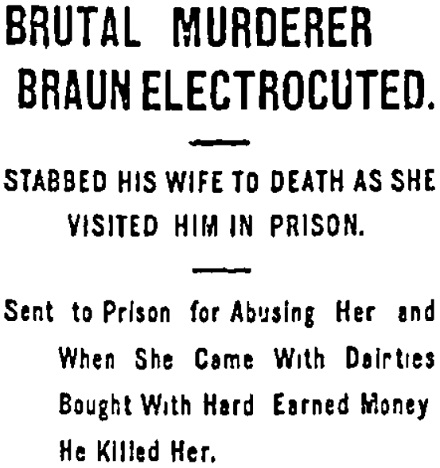
1899: Adrian Braun, who murdered his wife in Sing Sing


Wilkes-Barre Times, May 29, 1899.

On this date in 1899, Adrian Braun was electrcuted at Sing Sing.

Braun was a hulking German cigar-maker with a reputation for habitually thrashing his wife. Authorities got involved when he bashed a neighbor who intervened in a beating so hard that it fractured the man’s skull.

In August 1897, Braun caught a two-year sentence for assault. With her batterer put away, Kate Braun now had to shift for herself; struggling to make ends meet as a washer-woman, she had to give up two of her five children to the St. Joseph’s Roman Catholic Orphan Asylum. Still, she scraped together enough money to buy her incarcerated husband some sweets on a prison visit.

Mr. Braun was at work peeling potatoes in the prison kitchen when he was summoned for the arrival of his spouse in March 1898. After using up their visiting time on a conversation that appeared entirely mutually affectionate, the two were about to part when Adrian Braun suddenly whipped out the potato-knife he had recently been employing and daggered the poor woman’s throat — with lethal effect.

Braun never explained his shocking crime and pursued only a half-hearted insanity defense at his ensuing trial.

“No man was ever executed at the prison who had less sympathy than was felt for Braun,” the Wilkes-Barre Times reported on the day of the man’s execution.

On this day..

1879: Alexander Soloviev, bad shot

On this date* in 1879, would-be regicide Alexander Soloviev was hanged

Soloviev (English Wikipedia entry | Russian), a Narodnik revolutionary, was one of the less competent assassins to have a go at Tsar Alexander II.

Surprising the undefended sovereign on the latter’s morning constitutional near Winter Palace, Soloviev couldn’t connect with his revolver from four meters’ distance. As Alexander fled, Soloviev gave chase, firing four more times in the process to no effect before the gathering crowd wrestled him to the cobblestones.

Soloviev admitted the crime — the admission was hardly necessary — and hanged before a crowd of 70,000 souls. Despite the ensuing police crackdown on subversives (resulting in still more executions), many of those 70,000 surely numbered among the gawkers two years later for the hanging of the Narodnaya Volya terrorists who at last successfully assassinated Alexander.

* May 28 was the local (Julian calendar) date for the execution; by the Gregorian calendar prevailing outside Russia, it was June 9.

Part of the Themed Set: Terrorism.

On this day..

1925: The Sveta Nedelya bombers

Three perpetrators of Europe’s most spectacular terrorist attack were hanged on this date in 1925 in Bulgaria’s capital Sofia — after each stood on the gallows for forty minutes while the names of their victims were read to them.

Those 40 minutes of victims had unknowingly begun their path to Calvary two years before, when the Bulgarian military overthrew the post-World War I civilian government.

Though the Communist party stayed out of this putsch — it was a peasants‘ party that was toppled from power — the reds responded a few months later with their own countercoup: the September Uprising.


Septemvri 1923, by Ivan Milev. Perhaps topical to the horrible events yet to come in this post, also check out his 1926 Our Mothers Are Always Dressed In Black.

The eventual Cold War Communist government of Bulgaria would officially regard September 1923 as “the first anti-fascist uprising” — an ex post facto interpretation that would be aided by the Bulgarian dicator‘s eventual affinity for the World War II axis, and by the “White Terror” unleashed by the military after it routed the Communist revolt.

Harried and hunted, and their underground leadership succumbing to assassinations, the Communists conceived a punchback as devastating as it was contrary to the standard Leninist line on terrorism.

On April 14, 1925, a Communist agent assassinated Gen. Konstantin Georgiev.


Memorial marker for Konstantin Georgiev. Photograph by Miko (Own work) [CC BY-SA 3.0].

Shocking as this murder was, it was only the overture — and Gen. Georgiev was only the bait.

Two days later — Holy Thursday — a huge crowd turned out for the general’s funeral in Sveta Nedelya Church, perhaps Bulgaria’s most important cathedral. Unbeknownst to them, they shared the sacred vault with 25 kilograms of explosives packed into a column under the church’s dome.

When detonated during the service, it brought the dome down on the congregation.

“A tremendous explosion occurred and all became dark,” a former War Minister told the London Times correspondent. “Fortunately, I was standing almost below a pair of arches and I escaped without injury, not even losing my balance. A minute later the fumes began to disperse and, with six or seven others, I found myself standing while every one else was lying on the ground. Fragments of masonry were falling from the walls and the roof.”

One hundred fifty people died and another 500 were injured when Sveta Nedelya’s roof fell in — though amazingly, none of the many top state officials attending were killed. (And Tsar Boris III was not even in attendance.)


Sveta Nedelya after the explosion.

Like Samson, the bombers brought the walls down on their own heads, too.

Already none too lenient with the subversive element, the dictatorship directly implemented martial law and began rounding up suspected fellow-travelers, “disappearing” hundreds in the process. (One notable victim was poet Geo Milev, who never returned from a May 15 police interview; his remains were discovered 30 years later in a mass grave.)

The lucky ones managed to escape to Yugoslavia and thence to the Soviet Union. But three men* implicated in the plot remained to face the more decorous vengeance of the judiciary: Lieutenant-Colonel Georgi Koev, Marko Fridman, and Petar Zadgorski. The last of these was a sexton at Sveta Nedelya whose role as the inside man was essential to infiltrating the deadly package into the sanctuary.

* There were actually eight death sentences at this proceeding, but five of them were delivered in absentia … an absentia caused, for three of the five, because they had already been murdered during the post-bombing crackdown.

Part of the Themed Set: Terrorism.

On this day..

1868: Michael Barrett, the last public hanging in England

England held its last-ever public execution on this date in 1868, and made it big game indeed: Fenian Michael Barrett, whose Clerkenwell Prison bombing long remained one of the most infamous atrocities of the Irish nationalist cause.

The bill certifying the end of that distinctive institution, the public hanging, would be finalized three days hence, so the occasion’s milestone was anticipated in advance. Elites increasingly disdained the boorish carnivals that unfolded under the gallows, like Dickens who complained that “no sorrow, no salutary terror, no abhorrence, no seriousness; nothing but ribaldry, debauchery, levity, drunkenness, and flaunting vice in fifty other shapes” redeemed the 1840 hanging of Courvoisier.


“The Great Moral Lesson at Horsemonger Lane Gaol”, Punch magazine’s view of the notoriously rowdy mob at Frederick and Marie Manning execution.

“The crowd was most unusually orderly,” ran the Times‘ report of Barrett’s death — a sort of dual eulogy — “but it was not a crowd in which one would like to trust.”

It is said that one sees on the road to the Derby such animals as are never seen elsewhere; so on an execution morning one see faces that are never seen save round the gallows or near a great fire. Some laughed, some fought, some preached, some gave tracts, and some sang hymns; but what may be called the general good-humoured disorder of the crowd remained the same, and there was laughter at the preacher or silence when an open robbery was going on. None could look on the scene, with all its exceptional quietness, without a thankful feeling that this was to be the last public execution in England. Towards 7 o’clock the mass of people was immense. A very wide open space was kept round the gallows by the police, but beyond this the concourse was dense, stretching up beyond St. Sepulchre’s Church, and far back almost, into Smithfield — a great surging mass of people which, in spite of the barriers, kept swaying to and from like waving corn. Now and then there was a great laughter as a girl fainted, and was passed out hand over hand above the heads of the mob, and then there came a scuffle and a fight, and then a hymn, and then a sermon, and then a comic song, and so on from hour to hour, the crowd thickening as the day brightened, and the sun shone out with such a glare as to extinguish the very feeble light which showed itself faintly through the glass roof above where the culprit lay. It was a wild, rough crowd, not so numerous nor nearly so violent as that which thronged to see Muller or the pirates die. In one way they showed their feeling by loudly hooting a magnificently-attired woman, who, accompanied by two gentlemen, swept down the avenue kept open by the police, and occupied a window afterwards right in front of the gallows. This temporary exhibition of feeling was, however, soon allayed by coppers being thrown from the window for the roughs to scramble for. It is not right, perhaps, that a murderer’s death should be surrounded by all the pious and tender accessories which accompany the departure of a good man to a better world, but most assuredly the sight of public executions to those who have to witness them is as disgusting as it must be demoralizing even to all the hordes of thieves and prostitutes it draws together. Yesterday the assembly was of its kind an orderly one, yet it was such as we feel grateful to think will under the new law never be drawn together again in England.

Michael Barrett’s ticket to this last assembly was punched by a different execution six months previous — the hanging of the Manchester Martyrs. This trio of Irish patriots were part of a mob who liberated some comrades from a police van, shooting a policeman in the process — though it was far from certain that any of these three actually fired shots.

Of importance for our purposes today was the crackdown on other Fenians occasioned by the Manchester affair. In November of 1867, a Fenian agent named Richard O’Sullivan Burke was arrested with his companion Joseph Casey in London purchasing weapons for the movement. They were clapped in Clerkenwell Prison pending trial.

The bombing that brought Michael Barrett to the gallows was a bid to liberate these men … and it did not pause for subtlety. The conspirators simply wheeled a barrel of gunpowder up to the wall of the facility when they expected the inmates to be at exercise in the adjacent yard. The explosion blasted a 60-foot gap in the wall; the inward-collapsing rubble might easily have been the death rather than the salvation of the prospective beneficiaries, except that they weren’t actually in the yard at all — nobody was there, and nobody escaped Clerkenwell.

But numerous working-class families lived in little tenements opposite the prison and were there, and in fact Clerkenwell had a reputation for political radicalism and Fenian sympathy. This monstrous new “infernal machine” tore through Clerkenwell homes, leaving 12 people dead and numerous buildings near to collapse, while windows and chimneys shivered to pieces all up and down the block.


Improvised struts shore up damaged buildings opposite the wall of Clerkenwell Prison reduced to rubble by the December 13, 1867 Fenian bombing.

Karl Marx, a strong supporter of the Irish cause, despaired this counterproductive turn towards terrorism: “The London masses, who have shown great sympathy towards Ireland, will be made wild and driven into the arms of a reactionary government. One cannot expect the London proletarians to allow themselves to be blown up in honour of Fenian emissaries.”

English reformer Charles Bradlaugh agreed. “The worst enemy of the Irish people could not have devised a scheme better calculated to destroy all sympathy,” he wrote.


Punch magazine depicts the Clerkenwell bomber(s) as the “Fenian Guy Fawkes“.

Considering the magnitude of the crime, someone would have to pay for it. That Barrett was that someone did not sit well for many.

Five men and a woman stood trial at the Old Bailey in April for the Clerkenwell outrage, but Barrett was the only one of them convicted, a terribly inadequate investigation/prosecution outcome given the infamy of the crime.

That conviction stood on the basis of disputed eyewitness identifications: Barrett produced witnesses who said he was in Glasgow when the bomb went off, while the crown found others who would swear he was actually in London. (The length of Barrett’s whiskers on specific dates in late November and early December forms a running subplot of the dueling testimonies.)

The reliability and even the good faith of all such winesses might well be impugned. A highly questionable stool pigeon named Patrick Mullany who ducked prosecution by turning crown’s evidence, charged that Barrett personally set off the ordnance.

Despite his certain doom, Barrett eloquently vindicated himself at his sentencing

To give me credit for such an undertaking is utterly absurd; being, as I am, a total stranger to acts of daring, and without any experience which would in any way fit me for engaging in such an enterprise. Is it not ridiculous to suppose that in the City of London, where … there are ten thousand armed Fenians, they would have sent to Glasgow for a party to do this work, and then select a person of no higher standing and no greater abilities than the humble individual who now stands convicted before you? To suppose such a thing is a stretch of imagination that the disordered minds of the frightened officials of this country could alone be capable of entertaining.

If it is murder to love Ireland more dearly than life, then indeed I am a murderer. If I could in any way remove the miseries or redress the grievances of that land by the sacrifice of my own life I would willingly, nay, gladly, do so. if it should please the God of Justice to turn to some account, for the benefit of my suffering country, the sacrifice of my poor, worthless life, I could, by the grace of God, ascend the scaffold with firmness, strengthened by the consoling reflection that the stain of murder did not rest upon me, and mingling my prayers for the salvation of my immortal soul with those for the regeneration of my native land.

Benjamin Disraeli’s government could not in the end realistically entertain the agitation from liberal and radical circles for sparing Barrett, because that would mean that nobody would hang for Clerkenwell. But as the next day’s edition of Reynold’s News noted, “Millions will continue to doubt that a guilty man has been hanged at all; and the future historian of the Fenian panic may declare that Michael Barrett was sacrificed to the exigencies of the police, and the vindication of the good Tory principle, that there is nothing like blood.”

Three months after Barrett made that expiation, England officially began its era of fully private hangings behind prison walls.

* James Joyce hung out with a (much-older) Joseph Casey in Paris in the early 20th century. Yes, that’s in Ulysses too: “He prowled with Colonel Richard Burk, tanist of his sept, under the walls of Clerkenwell and crouching saw a flame of vengeance hurl them upward in the fog. Shattered glass and toppling masonry. In gay Paree he hides, Egan of Paris, unsought by any save by me.”

Part of the Themed Set: Terrorism.

On this day..

1987: Pawel Tuchlin, the Scorpion

Pawel Tuchlin, whose eight-year serial murder spree earned him the nickname “the Scorpion”, was hanged on this date in 1987 — the second-last execution in Poland’s history.

The classic quiet-neighbor-we-never-saw-it-coming type, farmer Tuchlin authored 20 sex attacks on young women in the vicinity of Gdansk from 1975 to 1983. Eleven of the victims survived their ordeals, but a bloodied hammer recovered from Tuchlin’s farm testified to the horror of the nine deaths to his name.

After confessing the crimes, Tuchlin attempted to retract the admission — and upon sentencing in 1985 he anticipated O.J. Simpson by a decade with his vow, “If I am released, I will search for the murderer to the end of my life.”

On this day..

2014: Mahafarid Amir Khosravi, billionaire

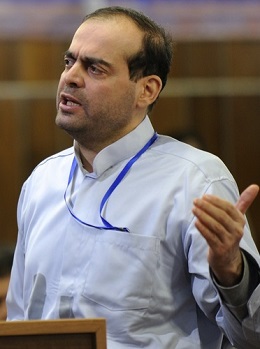
Businessman Mahafarid Amir Khosravi, once the wealthiest man in Iran, was hanged one year ago today for embezzling $2.6 billion.

Khosravi rocketed up the world’s rich lists — Forbes estimated that he would slot in around no. 219 in 2012 — during the late 2000s, when he launched the Aria Investment Development Company. This firm sprouted up from a strapling of 50 million rial (just a couple thousand US dollars) to 20 billion rial in just three years — thanks, as investigations ultimately revealed, to a series of bank loans obtained by means of forged documents that bank managers were tricked or bribed into accepting, then using those loans to purchase state-owned companies like Khuouzestan Steel at sweetheart rates.

According to the Associated Press, “Khosravi’s business empire included more than 35 companies from mineral water production to a football club and meat imports from Brazil.” His fall was a gigantic scandal, generally reckoned the largest financial scam in the history of the Islamic Republic.

The condemnation of a top business magnate on the nuclear “corrupt on earth” charge could hardly fail to raise uncomfortable questions about top government officials. In this case allegations of untoward connections were alleged by to go all the way to then-president Mahmoud Ahmadinejad, as a political football to discredit the more liberal elements in Ahmadinejad’s Cabinet.

On this day..

1865: Stanislaw Brzoska, Polish patriot priest

Freedom-fighting Polish priest Stanislaw Brzoska was hanged in the marketplace of Sokolow Podlaski on this date in 1865.

A young firebrand who had already served time in a Russian fortress because of his nationalist harangues, Brzoska (English Wikipedia entry | Polish) put his faith into deeds with the 1863 January Uprising against Russia’s domination of what was once the Polish-Lithuanian Empire.

He fought in several battles, and a 40-man mounted unit he had personally raised was in the field until the end of 1864 — well after Russia had quelled most other resistance.

Finally cornered in April 1865 and captured in a gunfight, he was executed before a crowd of thousands. Later generations, with an independent Poland to call their own, have garlanded Brzoska’s memory with various markers and statues.

Polish speakers might enjoy this presentation of the hero-priest’s life:

On this day..

1929: Nikolaus Karlovich von Meck, wrecker

On or about this date in 1929, Russian railway magnate Nikolaus (Nikolai) Karlovich von Meck was shot as a saboteur.

Von Meck (Russian link) had the iron horse in his blood: his father Karl was among Russia’s first railroad-builders after the Crimean War clock-cleaning motivated the tsar to make with the modernizing.

While von Meck pere was busy laying crossties in the 1860s, the St. Petersburg Conservatory was germinating the young composer Tchaikovsky. In time, the two men would be linked by the union of their kin: our man Nikolaus Karlovich von Meck married Tchaikovsky’s niece, Anna.

It wasn’t just a glancing association with the musical colossus for the von Mecks. Karl’s widow — Nikolaus’s mother — Nadezhda was Tchaikovsky’s main financial patron for 13 years. They weren’t lovers: Tchaikovsky was gay, and the reclusive Nadezhda von Meck demanded as a condition of her patronage that they never meet. But they kept up a voluminous correspondence, and Tchaikovsksy dedicated several works to her — like this Sympohony No. 4 in F minor.

So Nikolaus von Meck was the genius’s patron’s son as well as the genius’s niece’s husband.

He was also a brilliant engineer and entrepreneur in his own right; over the 26 years preceding the Russian Revolution, he chaired the Moscow-Kazan Railway firm that his father had begun back in the 1860s. Under the son’s leadership its rail-mileage multiplied more than tenfold. He was also one of Russia’s first motorists.

Von Meck remained in Russia after the Bolshevik Revolution, continuing to work on developing the now-Soviet state’s rail infrastructure — his means reduced, he remained no less the conscientious and patriotic artificer. That held even after the man was arrested as a counter-revolutionary a few different times in the revolution’s early years; each time he was soon released.

But by the late 1920s, Stalin was in full control and the industrialist would become the first subject of a new Soviet law against “wreckers”.

Ostensibly designed to target the saboteurs that were supposedly retarding economic growth, it would prove its utility in the frightful years ahead as a first-rate instrument of the Terror. The prospect that any economic setback, inefficiency or controversy could be lethally attributed to a cabal of global capitalists intent on strangling communism in the crib made “wrecking” as flexible and as devastating a charge as witchcraft had once been. How do you even begin to rebut that? Wrecking would in time be attributed to innumerable purge victims, great and small, and an implied whip against every worker who might be slacking on his production quota.

This potent juridical apparatus went for its first spin in the North Caucuses city of Shakhty in 1928-29. The Shakhty Trial of 53 engineers and technicians as “wreckers” also has the distinction of being Stalin’s first show trial. Von Meck and four other men* were condemned to die, a comparatively modest harvest of blood next to what was to come; 44 others went to prison.

“What accomplished villains these old engineers were! What diabolical ways to sabotage they found!” Solzhenitsyn mused of those luckless souls in The Gulag Archipelago.

Nikolai Karlovich von Meck of the People’s Commissariat of Railroads, pretended to be terribly devoted to the development of the new economy, and would hold forth for hours on end about the economic problems involved in the construction of socialism, and he loved to give advice. One such pernicious piece of advice was to increase the size of freight trains and not worry about heavier than average loads. The GPU [forerunner of the NKVD, which in turn became the KGB -ed.] exposed von Meck, and he was shot: his objective had been to wear out rails and roadbeds, freight cars and locomotives, so as to leave the Republic without railroads in case of foreign military intervention! When, not long afterward, the new People’s Commissar of Railroads, Comrade Kaganovich, ordered that average loads should be increased, and even doubled and tripled them (and for this discovery received the Order of Lenin along with others of our leaders) — the malicious engineers who protested became known as limiters. They raised the outcry that this was too much, and would result in the breakdown of the rolling stock, and they were rightly shot for their lack of faith in the possibilities of socialist transport.

Nikolaus and Anna’s daughter Galina Nikolayevna von Meck — who did time in Siberian exile herself in the 1930s — wrote a memoir of her famous family in 1973, As I Remember Them.

* Notably Peter Palchinsky, whose life is dealt with in some detail in Loren Graham’s The Ghost of the Executed Engineer: Technology and the Fall of the Soviet Union.

On this day..

1912: Rev. Clarence Richeson, minister, madman, and murderer

Minutes after midnight this date in 1912, a desexed preacher’s troubled concupiscence was at last abated by the Massachusetts mercy seat.

Some demon ruled Clarence Virgil Thompson Richeson‘s wayward footsteps through this life, and ere its last immolation saw Richeson alternate a serial pattern of abstinent betrothals with bouts of increasingly severe mental instability.

“Clarence had become deranged,” wrote one of the several theological seminaries he attended to his father, explaining why he couldn’t be kept.

Derangement for Clarence Richeson ranged from the merely embarrassing (wet dreams, three or four times a week) to the positively poltergeistian (bouts of raving, delirious lunacy). These foibles proved no obstacle to the charismatic Richeson’s repeated engagement — six or more young women by my count succumbed to his court — although he would later confess that these relationships, never consummated in matrimony, were almost never consummated in bed either. Richeson claimed to have remained a virgin until age 28, and then for most of the succeeding six years as well, even though a book of that period describes him as a “tall, handsome giant with the classic face of a Gibson hero.” On at least one occasion he besought a doctor to castrate him as he feared he could not keep his self-control around women.

Richeson’s strange proclivities kept interrupting the cursus honorum of Baptist pastorships that comprised his professional life: he had to resign from a church in Kansas City in 1904 after proposing to three different women, and a gig in El Paso was cut short when he fell into a spell of paranoid delusion.

1908 finds him a minister once again, now in Hyannis, Mass., and celebrating the birthday of 17-year-old Avis Linnell with an engagement ring. His “spells” or “fits” of madness were continuing as well, and numerous associates would later produce affidavits testifying to his violent outbursts. A doctor (who only quelled Rev. Richeson this night by morphine) recalled one incident:

I was called to see him at the residence of Mrs. Hallet, with whom he was boarding, and when I arrived I found there were with him two or three men whom I knew to be members of his church; he was acting violently and they were trying to control and quiet him both by words and by attempting to restrain him by physical force. He appeared at times to be partly conscious; then he would go into a state whereby he lost consciousness and was practically unconscious, apparently had no knowledge of what he was doing or saying. During this period of time he talked irrationally, raved incoherently, and physically manifested an abnormal degree of strength.

Parishioners decent enough to stand with their preacher would eventually find these private afflictions played out in lurid public detail. That was after Avis Linnell turned up dead at the Boston YWCA where she boarded while studing at the New England Conservatory of Music. It was 17 days before her scheduled Halloween, 1911 marriage to Clarence Richeson, and Miss Linnell was pregnant.

At first ruled a suicide, the case caught the eye of the Boston Post, whose swarm of reporters soon found a pharmacist who had sold Richeson cyanide days before the death of his betrothed. Richeson’s clemency petitions would eventually focus on his unbalanced mental state, but poison, of course, suggests the calculation of the pastor and not the outbursts of the madman within. (We’re getting ahead of ourselves, but doctors arguing for mercy also viewed Richeson as a prime research subject, whose maintenance behind bars could help to avert dangerous mental illnesses in others in the future.)

Matters went very quickly from this point.

Richeson resigned from his pastorship and, while lying in jail under indictment, slashed himself with a sharp piece of tin. Not his wrists, but his manhood — an attempted emasculation that was near enough successful that the physician responding to his shrieks was obliged to complete it in order to close up the wound. Richeson would later insist that he “shall think to my dying day that two men came in and did it” — apparitions of his mind’s creation.

The dying day was quick in coming. Two weeks after his self-mutilation, on January 5, 1912, Richeson withdrew his pretrial not guilty plea and simply copped to the murder. The death sentence was mandatory, but the plea also prevented any opportunity for a jury to rule on whether the killer’s instability lessened his criminal culpability. It was the opinion of some psychiatrists and not a few laymen that it was not simply a matter of Richeson’s state slipping between lucidity and delirium, but that his deterioration over the years had delivered him into a state of permanent derangement. Even Avis Linnell’s mother forgave her daughter’s killer “this dreadful thing” because “it is my belief he went to the electric chair an insane man and that he has been mentally irresponsible for some time past.”

On Sunday, May 19, a day and a half before he became the 14th client of the Massachusetts electric chair, Rev. Richeson conducted his last service — not in the prison chapel (against regulations) but from his own cell. “This is Sunday my last on earth,” he reflected. “If I had lived a righteous life I should today be delivering a sermon from the pulpit of my church in Cambridge instead of being caged here awaiting a felon’s death.”

It had not been so long ago in those environs that any execution would be a prayerful service, condemned together with the congregation. Matters by now were disposed of behind prison bars, but the electrocution of a clergyman was far too rich a theme not to fill New England’s actual pulpits that same day with topical exhortations; indeed, since the Richeson case made national headlines, these were preached all over. (The Olympia, Wash., Daily Recorder of May 20 notes a Presbyterian baccalaureate address that Sunday touching on Richeson as a cautionary example; the Grand Rapids, Mich. Evening Press of May 27 had a preacher at the Calvary Baptist Church declaiming against Richeson’s execution as an instance of anti-clerical prejudice.)

With the witnesses all gathered in the death chamber and just as the last straps were being adjusted the Rev. Herbert S. Johnson stepped forward and asked Richeson the following questions which he answered in a clear voice:

“Would you like to confess Christ as your Savior before these witnesses?”

“I do confess Christ as my Savior.”

“Have you the peace of God in your heart in this hour?”

“I have the peace of God in this hour.”

“Does Christ give you the strength you need in this hour?”

“Christ gives me the strength I need.”

“Do you repent of your sins?”

“I do.”

“Have you the peace of God in your heart?”

“God will take care of my soul and I pray for all.”

“Are you willing to die for Jesus’ sake?”

“I am willing to die.”

Just as he uttered the word “die,” Warden Bridges tapped the stone floor with his gold headed black cane which had been used so many times as a signal to the executioner who switched on the electric current and at 12:17 Drs. McLaughlin, McGrath and Butler pronounced Richeson legally dead. The penalty exacted by the laws of Massachusetts had been paid and all hope of studying this abnormal man for the purpose of aborting criminal tendencies in others of his kind was wiped out in a few seconds.

On this day..

1799: Simon Taylor, for indulging in drunkenness

From the public-domain An Account of the English Colony in New
South Wales From Its First Settlement, in January 1788, to August 1801
(pdf):


April 1799

On the first of this month the criminal court sat for the trial of a soldier belonging to the regiment, who had a few days before stabbed a seaman of the Reliance, who insulted him when centinel at one of the wharfs at Sydney. The man died of the wound; the soldier, being called upon to answer for his death, proved to the satisfaction of the court, that it had been occasioned by the intemperance of the seaman, and he was accordingly found to have committed a justifiable homicide.

This accident was the effect of intoxication, to which a few days after another victim was added, in the person of a female, who was either the wife or companion of Simon Taylor, a man who had been considered as one of the few industrious settlers which the colony could boast of. They had both been drinking together to a great excess; and in that state they quarrelled, when the unhappy man, in a fit of madness and desperation, put an untimely end to her existence. He was immediately taken into custody, and reserved for trial.

To this pernicious practice of drinking to excess, more of the crimes which disgraced the colony were to be ascribed than to any other cause; and more lives were lost through this than through any other circumstance; for the settlement had ever been free from epidemical or fatal diseases. How much then was the importation of spirits to be lamented! How much was it to be regretted, that it had become the interest of any set of people to vend them!

Several robberies which at this time had been committed were to be imputed to the same source.

May 1799

Several offenders having been secured for trial, it became necessary to assemble the court of criminal judicature; and on the 16th Simon Taylor was brought before it, accused of the murder of his wife [Ann Smith was her name -ed.]; of which offence being clearly convicted, he received sentence of death, and was executed on the 20th at Parramatta. This unhappy man was thoroughly sensible of the enormity of his guilt, and in his last moments admonished the spectators against indulging in drunkenness, which had brought him to that untimely and disgraceful end.

At the same court, one man, Robert Lowe, was adjudged corporal punishment, and one year’s hard labour, for embezzling some of the live stock of Government, which had been entrusted to his care. He was a free man, and had been one of the convicts who were with Captain Riou in the Guardian, when her voyage to New South Wales was unfortunately frustrated by her striking upon an island of ice; on account of which, and of their good conduct before and after the accident, directions had been given for their receiving conditional emancipation, and being allowed to provide for their own maintenance.

Few of these people, however, were in the end found to merit this reward and indulgence, as their future conduct had proved; and this last act of delinquency pointed out the necessity of a free person being sent out from England to superintend the public live stock, with such an allowance as would make him at once careful of his conduct, and faithful in the execution of his trust.

It should seem that the commission of crimes was never to cease in this settlement. Scarcely had the last court of judicature sent one man to the gallows, when a highway robbery was committed between the town of Sydney and Parramatta. Three men rushed from an adjoining wood, and, knocking down a young man who was travelling to the last mentioned town, rifled his pockets of a few dollars. On his recovering, finding that only one man remained, who was endeavouring to twist his handkerchief from his neck, he swore that no one person should plunder him, and had a struggle with this fellow, who, not being the strongest of the two, was secured and taken into Parramatta. A court was immediately assembled for his trial; but the evidence was not thought sufficient to convict him, and he was consequently acquitted. The want of any corroborating circumstance on the part of the prosecutor compelled the court to this acquittal.

On this day..