Catholic priest John Murphy was executed on this date in 1798 for his part in the Irish Rebellion of 1798.
The Black 47 jam “Vinegar Hill” celebrates Father Murphy, imagining him confronting and embracing the choice to rebel …
I return to my prayers
And reflect upon Your tortured lips
But not a word do I hear
Just a veil of silence around the crucifix
And I remember the Bishop’s words
“When faith is gone, all hope is lost”
Well, so be it
I will rise up with my people
And to hell with the eternal cost!
An exemplar of that rare type persuadable to follow his moral commitments all the way out of the safety of a status quo sinecure, Father Murphy initially eschewed the trend towards armed rebellion in 1798.
This outbreak was itself a response to a violent martial law-backed campaign of repression to crush Ireland’s growing United Irishmen movement for self-rule, republicanism, and Catholic emancipation — each of them scarlet fighting words to the Crown. The risings that finally broke out had only scanty success, weakened as they were by months of arrests.
By far the strongest rising occurred in Wexford, so much so that the Wexford Rebellion is nearly metonymous for the Irish Rebellion as a whole. And our man, John Murphy, was a priest in Wexford Town.
Giving due heed to Ecclesiastes, Murphy pivoted quickly from his previous counsel that prospective rebels surrender their arms once he saw an enemy patrol gratuitously torch some homes, a decision that would immortalize his name at the cost of greatly shortening his life.
During the brief existence of the Wexford Republic, the padre surprisingly became one of its prominent combat commanders, and also one of the signal martyrs after the rebels were shattered at the Battle of Vinegar Hill on June 21, 1798.*
Murphy escaped that tragic battlefield only to have his remnant definitively routed a few days later.
He had only a few days remaining him at that point, days of hiding out with his bodyguard, James Gallagher. At last they were captured at a farm on July 2, and subjected that same day to a snap military tribunal and execution delayed only by the hours required to torture him.
After hanging to death, Murphy was decapitated so that the British could mount his head on a pike as a warning.
This 1798 rebellion they were able to crush, but Murphy has survived into legend. He flashes for only an instant in the sweep of history, springing almost out of the very soil into the firmament as an allegory of revolutionary redemption, brandishing together (as Black 47 puts it above) both his missal and his gun.
At Vinegar Hill o’er the River Slaney
our heroes vainly stood back to back
And the yeos of Tullow took Father Murphy
and burned his body upon the rack
God grant you glory brave Father Murphy
and open heaven to all your men
The cause that called you may call tomorrow
in another fight for the Green again.
* There was a “Second Battle of Vinegar Hill” … comprising Irishmen but not in Ireland, for it was a convict rebellion in Australia in 1804. One of its leaders, Phillip Cunningham, was a survivor of the 1798 Irish Rebellion.
Archbishop Oliver Plunkett earned the last Catholic martyr’s crown in Britain on this date in 1681.*
Product of County Meath blood and Italian seminary, Plunkett had been back floating around Ireland as its chief prelate since 1670. In this decade, the English-imposed laws burdening Catholics had been relaxed; Plunkett was able to minister his flock, openly at first and after 1673 as a fugitive whom Irish authorities did not much wish to pursue.
Plunkett’s safety speedily expired with the emergence in England of the Popish Plot, a security panic catalyzed like its modern-day analogues by equal parts bad faith and malice.
The concoctions of an opportunistic fabulist caused the English populace to become convinced in 1678 that a vast and treasonable Catholic conspiracy menaced the land; in its day, it was a delusion held so widely and deeply as to cow into silence and compliance all skeptics, even King Charles himself. Charles’s Lord Lieutenant in Ireland, the Earl of Essex, cynically leaned into the hysteria by whipping fears of a Plunkett-hatched invasion of Ireland by the French, although he well knew that Plunkett was “of a … peaceable temper & … comforable to ye Government.”
Plunkett spent months in hiding, refusing to flee Ireland, until he was finally arrested in December 1679. After proceedings in Ireland collapsed, the prelate was moved to London for a more manageable show trial, the entire transcript of which can be perused here.
In it, the Lord Chief Justice Sir Francis Pemberton chastises Plunkett for soliciting time to collect his witnesses, and concludes with a denunciation of the enemy religion that would not look far out fo place in many a present-day comments section.
truly yours is Treason of the highest Nature, ’tis a Treason in truth against God and your King, and the Country where you lived. You have done as much as you could to dishonour God in this Case; for the Bottom of your Treason was, your setting up your false Religion, than which there is not any Thing more displeasing to God, or more pernicious to Mankind in the World. A Religion that is ten Times worse than all the Heathenish Superstitions; the most dishonourable and derogatory to God and his Glory, of all Religions or pretended Religions whatsoever, for it undertakes to dispense with God’s Laws, and to pardon the Breach of them. So that certainly a greater Crime there cannot be committed against God, than for a Man to endeavour the Propagation of that Religion; but you to effect this, have designed the Death of our lawful Prince and King: And then your design of Blood in the Kingdom where you lived, to set all together by the Ears, to destroy poor innocent People, to prostitute their Lives and Liberties, and all that is dear to them, to the Tyranny of Rome and France.
Now tormented that his opportunistic fear-mongering was actually going to lay the archbishop in his grave, Essex implored the Catholic-sympathetic King Charles to spare Plunkett. “Then, my lord, be his blood on your own conscience,” snapped Charles, politically constrained from a beneficence he would have dearly loved to grant. “You could have saved him but would not, I would save him and dare not.”
On the first of July, he was drawn to Tyburn (a stained glass depiction of it can be found in this post), where he was hanged and quartered. (The strange Anglo-Irish plotter Edward Fitzharris preceded Plunkett on the scaffold, as an undercard attraction.) “He won more credit and repute, as well for himself as for his country, by one hour of suffering, than he could have acquired perhaps by hundreds of years of life,” one observer wrote.
This might very well be so. Aside from being the last Catholic martyr in the Isles, Plunkett is among the most warmly remembered, as evidenced by his recent remit as the patron saint of peace and reconciliation in post-Troubles Ireland — not to mention the loving preservation of his relics at St. Peter’s cathedral in Drogheda.
St. Oliver Plunkett’s head preserved in a shrine at Drogheda, Ireland. Photo by DAVID ILIFF. License: CC-BY-SA 3.0
* July 1 by the Julian calendar still then employed in England; by the Gregorian calendar adopted in most Catholic countries at this point, the date was July 11 — and some Catholic primary sources use the latter date.
On this date in 1797, a president of the floating republic was put to death by an empire of the lash.
The occasion brings us to the era of Great Britain’s protracted war with Revolutionary France. That war’s essential factor from the British point of view was the navy — crewed in its turn by an immiserated working class, sometimes forcibly impressed, and drawing pay on a schedule that had been set in 1658.
In April 1797, after a wage grievance was dismissed out of hand by the Admiralty, the crew of the Channel Fleet mutinied at Spithead, near Portsmouth. For “mutiny” here, think less H.M.S. Bounty* and more labor strike: keeping discipline within their ranks, they used the leverage of refusing to put out to sea to successfully negotiate that pay rise, as well as the transfer of some distasteful officers who went otherwise unharmed. The Spithead mutiny contributes no execution to our pages.
This hostile caricature of the Spithead mutineers nevertheless depicts — however incredulously — the common sailors’ degree of organization.
However, in its waning days in May, a sympathy mutiny ensued at the fleet lying at an anchorage at the mouth of the Thames, called the Nore. These Spithead and Nore mutinies are generally taken together since they had the same grievances … but their resolutions were very different.
The Nore mutiny, less united and disciplined than that at Spithead, saw several ships at Nore mutiny and elect as their leader this post’s principle character, Richard Parker. Parker was an intelligent, veteran sailor with some history of sticking his neck out for better working conditions. He would always insist that he had no part of the mutiny’s planning and was appointed its leader by surprise; whether or not this was so, he exercised his newfound office, President of the Delegates of the Fleet, as best he could. It was a fraught situation; each ship had its own delegates (hence Parker’s title) who did not always agree, and there were radical and moderate factions, and a proclivity among ships inclining to the latter to slip away from the mutinied fleet even as their erstwhile comrades fired upon them.
But the most perilous function demanded of Parker was to present mutineers’ demands to the Admiralty, whose perspective was that the fleet’s complaints had already been disposed of via Spithead — especially when the Nore demands expanded to include peace with France. The mutiny collapsed, and Parker was marched to Maidstone Prison to the jeers of Londoners.
Even the Newgate Calendar, scold for the status quo, could not resist admiring Parker’s bearing, “throughout the whole of his trial … firm and manly; while he was before the Court, decent and respectful, and from the time he received his sentence, till his execution, resigned and penitent” even while abhorring his “wretched existence.”
After a solemn pause of nearly ten minutes the Lord Advocate rose and, with his head uncovered, read the awful sentence — viz. “The Court judges Richard Parker to suffer death, and to be hanged by the neck, on board any one of his Majesty’s ships, and at such time as the Lords of the Admiralty may think proper to appoint.”
The prisoner listened to the sentence without emotion, and addressed the Court as follows: — “I have heard your sentence; I shall submit to it without a struggle. I feel thus, because I am sensible of the rectitude of my intentions. Whatever offences may have been committed, I hope my life will be the only sacrifice. I trust it will be thought a sufficient atonement. Pardon, I beseech you, the other men; I know they will return with alacrity to their duty.”
The president then briefly addressed himself to the prisoner. He said that, notwithstanding the enormity of the crimes of which he had been found guilty, on the fullest and clearest evidence, yet the Court, in order to afford him the necessary time to expiate his offences, and to make his peace with God, would then not name any day for his execution, but leave that point to the determination of the lords of the admiralty. The prisoner then withdrew, and was soon put in irons.
The time of his execution was fixed for Friday, the 30th of June. 1797. At eight o’clock in the morning a gun was fired on board his Majesty’s ship L’Espion, lying off Sheerness garrison, Vice-Admiral Lutwidge‘s flagship, and the yellow flag, the signal of capital punishment, was hoisted, which was immediately repeated by the Sandwich hoisting the same colour on her foretop.
The prisoner was awakened a little after six o’clock, from a sound sleep, by the provost-marshal, who, with a file of marines, composed his guard; he arose with cheerfulness, and requested permission might be asked for a barber to attend him, which was granted. He soon dressed himself in a neat suit of mourning (waistcoat excepted), wearing his half-boots over a pair of black silk stockings. He then took his breakfast, talked of a will he had written, in which he had bequeathed to his wife a little estate he said he was heir to, and after that lamented the misfortune that had been brought on the country by the mutiny, but solemnly denied having the least connection or correspondence with any disaffected persons ashore; and declared that it was chiefly owing to him that the ships had not been carried into the enemy’s ports. [a threat to sail to France was part of Nore mutiny negotiations]
At half past eight he was told the chaplain of the ship was ready to attend him to prayers upon the quarter-deck, which he immediately ascended, uncovered: at his first entrance on the deck he looked a little paler than corn mon, but soon recovered his usual complexion; he bowed to t lie officers, and, a chair being allowed him, he sat down for a few moments: he then arose, and told the clergyman he wished to attend him: the chaplain informed him he had selected two psalms appropriate to his situation; to which the pris oner, assenting, said, “And with your permission, sir, I will add a third,” and named the 51st. He then recited each alternate verse in a manner peculiarly impressive.
At nine o’clock the preparatory gun was fired from L’Espion, which he heard without the smallest emotion. Prayers being soon after closed, he rose, and asked Captain Moss “if he might be indulged with a glass of white wine”: which being granted, he took it, and, lifting up his eyes, exclaimed, “I drink first to the salvation of my soul! and next to the forgiveness of my enemies!” Addressing him self to Captain Moss, he said, “he hoped he would shake hands with him”; which the captain did: he then desired “that he might be remembered to his companions on board the Neptune; with his last breath sent an entreaty to them to prepare for their destiny, and refrain from unbecoming levity.” His arms were now bound, and the procession moved from the quarterdeck to the forecastle, passing through a double file of marines on the starboard side, to a platform erected on the cat-head, with an elevated projection. Arriving there, he knelt with the chaplain, and joined in some devout ejaculations, to all of which he repeated loudly, “Amen.” Rising again, the Admiral’s warrant of execution, addressed to Captain Moss, was now read by the clerk, in which the sentence of the court martial, the order of the Board of Admiralty and his Majesty’s approbation of the whole proceedings were fully recited, which the prisoner heard with great attention, and bowed his head, as if in assent, at the close of it. He now asked the captain whether he might be allowed to speak, and immediately apprehending his intention might be misconceived he added: “I am not going, sir, to address the ship’s company. I wish only to declare that I acknowledge the justice of the sentence under which I suffer; and I hope my death may be deemed a sufficient atonement, and save the lives of others.”
He then requested a minute to collect himself, and knelt down alone, about that space of time; then rose up and said: “I am ready.” Holding his head up, he said to the boatswain’s mate: “Take off my handkerchief (of black silk); which was done, and the provost-marshal placed the halter over his head (which had been prepared with grease,) but, doing it awkwardly, the prisoner said rather pettishly to the boatswain’s mate, “Do you do it, for he seems to know nothing about it.” The halter was then spliced to the reeve-rope: all this being adjusted, the marshal attempted to put a cap on, which he refused; but, on being told that it was indispensable, he submitted, requesting it might not be pulled over his eyes till he desired it. He then turned round, for the first time, and gave a steady look at his shipmates on the forecastle, and, with an affectionate kind of smile, nodded his head, and said “Good-by to you!” He now said, “Captain Moss, is the gun primed?” — “It is.” — “Is the match alight?” — “All is ready.”– On this he advanced a little, and said, “Will any gentleman be so good as to lend me a white handkerchief for the signal?” After some little pause, a gentleman stepped forward and gave him one; to whom bowing, he returned thanks. He now ascended the platform, and repeated the same questions about the gun. He now ascended the platform. The cap was then drawn over his face, and he walked by firm degrees up to the extremity of the scaffold, and dropped a white handkerchief, which he had borrowed from one of the gentlemen present, and put his hands in his coat-pockets with great rapidity. At the moment he sprang off, the fatal bow-gun fired, and the reeve-rope, catching him, ran him up, though not with great velocity, to the yardarm. When suspended about midway his body appeared extremely convulsed for a few seconds, immediately after which no appearance of life remained.
It being ebb of tide, the starboard yard-arm pointed to the Isle of Grain, where scaffolding was erected for the spectators on shore; a considerable number of yachts, cutters, and other craft, surrounded the Sandwich. The last time the prisoner knelt with the chaplain at the cat-head, though he made his responses regularly, his attention was particularly directed the whole time to the armed boats of the fleet, which were plying round on duty. The whole conduct of this awful ceremony was extremely decorous and impressive; it was evident, from the countenances of the crew of the Sandwich, that the general feeling for the fate of their mutinous conductor was such as might be wished: not a word, and scarce a whisper, was heard among them.
The Newgate Calendar’s illustration of Parker’s execution.
Parker was not mistaken to warn his compatriots to brace for punishment, and his hope that his would be the only life paid in forfeit was sorely disappointed. Twenty-nine more men were hanged as Nore mutineers, in addition to a number of others imprisoned, flogged, or transported. (The Sydney, Australia suburb of Redfern is named for the transported Nore mutineer who once owned the land.)
* Speaking of the Bounty, its old notorious captain William Bligh in 1797 captained one of the mutinied ships at the Nore, on which occasion Bligh discovered “that his common nickname among men in the fleet was ‘that Bounty Bastard’.”
On this date in 1685, Roundhead militant Richard Rumbold — known affectionately to his comrades from the English Civil War as “Hannibal”, since he shared with the great Carthaginian general the distinction of an eye lost on campaign — was beheaded at Edinburgh‘s Mercat Cross.
J.M.W. Turner watercolor of the Rye House circa 1793.
Rumbold was the owner of the Rye House in Hertfordshire, the manor which in the 1680s would become famous as a regicidal adjective: the titular epicenter of the Rye House Plot. Hannibal Rumbold had intended to station a force of armed men on his grounds with the intent to kidnap/assassinate King Charles II and his Catholic brother and heir presumptive, James as they returned to London from horse races at Newmarket. When fire struck Newmarket, the royal party’s plans changed and the plot never came off … but it was discovered some weeks later and yielded an ample harvest of heads. Rumbold escaped to the continent for a time but was none repentant about it when taken, saying “he did not neither durst repent for it, but on the contrair that if all the hair of his head were men, he would venture them all for the cause.”
In this instance, it also yielded some edifying scaffold oratory, and this man’s parting sentiment that “this is a deluded generation, veiled with ignorance … for none comes into the world with a saddle on his back, neither any booted and spurred to ride him” was of interest to British Whigs and American revolutionaries a century later. It plays much better lo these many years later with ellipsis in place of the “popery” stuff which occurs between, but judge for thyself: here follow Rumbold’s erudite owns in context via an open source volume which has the address titled “Against Booted and Spurred Privilege”
Gentlemen and Brethren: —
It is for all men that come into the world once to die; and after death the judgment! And since death is a debt that all of us must pay, it is but a matter of small moment what way it be done. Seeing the Lord is pleased in this manner to take me to himself, I confess, something hard to flesh and blood, yet blessed be his name, who hath made me not only willing, but thankful for his honoring me to lay down the life he gave, for his name; in which, were every hair in this head and beard of mine a life, I should joyfully sacrifice them for it, as I do this. Providence having brought me hither, I think it most necessary to clear myself of some aspersions laid on my name; and, first, that I should have had so horrid an intention of destroying the King and his brother … It was also laid to my charge that I was antimonarchical. It was ever my thoughts that kingly government was the best of all where justly executed; I mean, such as it was by our ancient laws; — that is, a King, and a legal, free-chosen Parliament, — the King having, as I conceive, power enough to make him great; the people also as much property as to make them happy; they being, as it were, contracted to one another! And who will deny me that this was not the justly-constituted government of our nation? How absurd is it, then, for men of sense to maintain that though the one party of his contract breaketh all conditions, the other should be obliged to perform their part? No; this error is contrary to the law of God, the law of nations, and the law of reason. But as pride hath been the bait the devil hath caught most by ever since the creation, so it continues to this day with us. Pride caused our first parents to fall from the blessed state wherein they were created, — they aiming to be higher and wiser than God allowed, which brought an everlasting curse on them and their posterity. It was pride caused God to drown the old world. And it was Nimrod‘s pride in building Babel that caused that heavy curse of division of tongues to be spread among us, as it is at this day, one of the greatest afflictions the Church of God groaneth under, that there should be so many divisions during their pilgrimage here; but this is their comfort that the day draweth near where, as there is but one shepherd, there shall be but one sheepfold. It was, therefore, in the defense of this party, in their just rights and liberties, against popery and slavery —
[Being here interrupted by drum beating, he said that they need not trouble themselves, for he should say no more of his mind on that subject, since they were so disingenuous as to interrupt a dying man. He then continued: –]
I die this day in the defense of the ancient laws and liberties of these nations; and though God, for reasons best known to himself, hath not seen it fit to honor us, as to make us the instruments for the deliverance of his people, yet as I have lived, so I die in the faith that he will speedily arise for the deliverance of his Church and people. And I desire of all you to prepare for this with speed. I may say this is a deluded generation, veiled with ignorance, that though popery and slavery be riding in upon them, do not perceive it; though I am sure there was no man born marked of God above another; for none comes into the world with a saddle on his back, neither any booted and spurred to ride him; not but that I am well satisfied that God hath wisely ordered different stations for men in the world, as I have already said; kings having as much power as to make them great and the people as much property as to make them happy. And to conclude, I shall only add my wishes for the salvation of all men who were created for that end.
After hanging, they quartered his parts and pinned them up as a warning.
It was a black hood for the Blackout Ripper on this date in 1942.
Charming Royal Air Force serviceman Gordon Frederick Cummins gave rein that February to a theretofore unarticulated inclination to femicide, attacking six women in the course of a single week, four of whom were killed by strangulation. The pattern of perverse post-mortem mutilations led one examiner to characterize the wanted man as “a savage sexual maniac”. This predator’s opportunistic use of the city’s protective cloak of air raid darkness reminds a similar spree perpetrated on the Berlin S-Bahn: truly, all men are brothers.
For a few days, this special horror gripped the wartime capital, so recently under enemy blitz. As fingerprint expert Frederick Cherrill, whose evidence would help to tie up Gordon Cummins’ noose, wrote in his now-out-of-print autobiography,
Women police in ordinary clothes strolled about the streets in the hope of being accosted by the unknown killer. So great was the terror which swept like a wave over the square mile in which these crimes had been committed that the regular street-walkers who haunted the area were too scared to venture out. [several of the victims were prostitutes -ed.] Small wonder, for nobody knew when or where the killer would strike again. That he would strike again seemed certain, for the lust of killing appeared to have siezed him in a merciless grip
Unlike his permanently elusive Whitechapel namesake, the Blackout Ripper was not long at his liberty once he loosed the beast within: crime scene forensics were still coming of age in this period, but the ample evolution of the bureaucratic state did for Cummins. On lucky Friday, February 13, Greta Hayward had fought off her attacker with the help of a passerby’s interruption. Cummins, when he fled, abandoned his RAF gas mask case … which was helpfully stamped with a serial number identifying its owner. He was arrested on February 16, just eight days after the start of his spree. (Scotland Yard, however, would later claim that his fingerprints connected him to two previous London murders, from October 1941.) It took a jury 35 minutes to convict him.
An irritating situation became an intolerable one when loyalists and Mohawks descended on the village of Cherry Valley November 11, 1778, and massacred not only its defenders but about 30 non-combatants.
The slaughter of Jane Wells during the Cherry Valley Massacre. Engraving by Thomas Phillibrown from an original image by Alonzo Chappel (1828-1887).
“The Expedition you are appointed to command is to be directed against the hostile tribes of the Six Nations of Indians, with their associates and adherents,” Washington instructed his man.
The immediate objects are the total destruction and devastation of their settlements, and the capture of as many prisoners of every age and sex as possible. It will be essential to ruin their crops now in the ground and prevent their planting more.
I would recommend, that some post in the center of the Indian Country, should be occupied with all expedition, with a sufficient quantity of provisions whence parties should be detached to lay waste all the settlements around, with instructions to do it in the most effectual manner, that the country may not be merely overrun, but destroyed.
But you will not by any means listen to any overture of peace before the total ruinment of their settlements is effected. Our future security will be in their inability to injure us and in the terror with which the severity of the chastisement they receive will inspire them.
But the first chastisements were issued to no Indian, but to Tory skulks.
Sullivan took command of one column, and ordered Gen. James Clinton to march another force down the Mohawk River Valley to Canajoharie. The following narration from the very specific chronicle History of Schoharie County, and border wars of New York gives us two Tory spies along with at least one patriot deserter all executed in those precincts; however, another Clinton letter dates only the Hare hanging specifically to Monday, June 21 (precise dates for the other two executions appear to be lost to history).
While Gen. Clinton was waiting at Canajoharie for his troops and supplies to assemble, and also for the construction of bateaus, two tories were there hung, and a deserter shot. The following letter from Gen. Clinton to his wife, dated July 6th, 1779, briefly narrates the death of the two former:
I have nothing further to acquaint you of, except that we apprehended a certain Lieut. Henry Hare, and a Sergeant Newbury, both of Col. Butler’s regiment, who confessed that they left the Seneca country with sixty-three Indians, and two white men, who divided themselves into three parties — one party was to attack Schoharie, another party Cherry-Valley and the Mohawk river, and the other party to skulk about Fort Schuyler and the upper part of the Mohawk river, to take prisoners or scalps. I had them tried by a general court martial for spies, who sentenced them both to be hanged, which was done accordingly at Canajoharie, to the satisfaction of all the inhabitants of that place who were friends to their country, as they were known to be very active in almost all the murders that were committed on these frontiers. They were inhabitants of Tryon county, had each a wife and several children, who came to see them and beg their lives.
The name of Hare was one of respectability in the Mohawk valley, before the revolution. Members of the Hare family were engaged for years in sundry= speculations with Maj. Jelles Fonda, who, as already observed, carried on an extensive trade with the Indians and fur traders at the western military posts; his own residence being at Caughnawaga [the region north of the Mohawk] Henry Hare resided before the war in the present town of Florida, a few miles from Fort Hunter. At the time he left the valley with the royalist party to go to Canada, his family remained, as did that of William Newbury, who lived about 3 miles from Hare, toward the present village of Glen.
If Hare had rendered himself obnoxious to the whigs of Tryon county, Newbury had doubly so, by his inhuman cruelties at the massacre of Cherry Valley, some of which, on his trial, were proven against him. Hare and Newbury visited their friends, and were secreted for several days at their own dwellings. The former had left home before daylight to return to Canada, and was to call for his comrade on his route. Maj. Newkirk, who resided but a short distance from Hare, met a tory neighbor on the afternoon of the day on which Hare left home, who either wished to be considered one of the knowing ones, or lull the suspicions resting upon himself, who communicated to him the fact that Hare had been home — and supposing him then out of danger, he added, “perhaps he is about home yet.” He also informed him that Newbury had been seen.
Hare brought home for his wife several articles of clothing, such as British calicoes, dress-shawls, Indian mocasons, &c., and on the very day he set out to return to Canada, she was so imprudent as to put them on and go visiting — the sight of which corroborated the story told Newkirk. The Major notified Capt. Snooks, who collected a few armed whigs, and in the evening secreted himself with them near the residence of Hare, if possible, to give some further account of him.
Providence seems to have favored the design, for the latter, on going to Newbury’s, had sprained an ankle. Not being willing to undertake so long a journey with a lame foot, and little suspecting that a friend had revealed his visit, he concluded to return to his dwelling. While limping along through his own orchard, Francis Putman, one of Snook’s party, then but 15 of 16 years old, stepped from behind an apple tree, presented his musket to his breast, and ordered him to stand. At a given signal, the rest of the party came up, and he was secured. They learned from the prisoner that Newbury had not yet set out for Canada, and a party under Lieut. Newkirk went the same night and arrested him. They were enabled to find his house in the woods by following a tame deer which fled to it.
The prisoners were next day taken to Canajoharie, where they were tried by court martial, found guilty, and executed as previously shown. The execution took place near the present village of Canajoharie. The influence exerted by the friends of Hare to save him would have been successful, had he declared that he visited the valley solely to see his family. He may have thought they dared not hang him; certain it is, that when he was interrogated as to the object of his visit, he unhesitatingly said that he not only came here to see his family, but also came in the capacity of a spy. A deserter, named Titus was shot at Canajoharie about the time the spies were hung, as I have been informed by an eye witness to all three executions. — James Williamson.
Deserters were shot for the first, second, or third offence, as circumstances warranted. Newbury and Titus were buried near the place of execution, and the bones of one of them were thrown out at the time of constructing the Erie Canal [which cut through the Mohawk Valley -ed.], by workmen who were getting earth for its embankment. The body of Hare was given to his relatives for interment. Previous to burial the coffin was placed in a cellar-kitchen, before a window, in which position a snake crawled over it. This circumstance gave rise to much speculation among the superstitious, who said “It was the Devil after his spirit.”
This honourable man, a good knight and a gentle; of living somewhat dissolute; plain and open to his enemy, secret to his friend, easy to beguile, as he that of good heart and courage forestudieth no perils; a loving man, and passing well-beloved; very faithful, and trusty enough — trusting too much.
The Baron Hastings arose this date as the trusted councillor of the Lord Protector. Before dinner, he’d had his head chopped off over a log in the Tower of London.
Lord Hastings sported this fancy badge of a handsomely endowed manticore.
Richard III (Duke of Gloucester).
I pray you all, tell me what they deserve
That do conspire my death with devilish plots
Of damned witchcraft, and that have prevail’d
Upon my body with their hellish charms?
Lord Hastings.
The tender love I bear your grace, my lord,
Makes me most forward in this noble presence
To doom the offenders, whatsoever they be
I say, my lord, they have deserved death.
Richard III (Duke of Gloucester).
Then be your eyes the witness of this ill:
See how I am bewitch’d; behold mine arm
Is, like a blasted sapling, wither’d up:
And this is Edward’s wife, that monstrous witch,
Consorted with that harlot strumpet Shore,
That by their witchcraft thus have marked me.
Lord Hastings.
If they have done this thing, my gracious lord —
Richard III (Duke of Gloucester). If? thou protector of this damned strumpet —
Tellest thou me of ‘ifs’? Thou art a traitor:
Off with his head! Now, by Saint Paul I swear,
I will not dine until I see the same. Lovel and Ratcliff, look that it be done:
The rest, that love me, rise and follow me.
[Exeunt all but HASTINGS, RATCLIFF, and LOVEL]
Lord Hastings.
Woe, woe for England! not a whit for me;
For I, too fond, might have prevented this. Stanley did dream the boar did raze his helm;
But I disdain’d it, and did scorn to fly:
Three times to-day my foot-cloth horse did stumble,
And startled, when he look’d upon the Tower,
As loath to bear me to the slaughter-house.
O, now I want the priest that spake to me:
I now repent I told the pursuivant
As ’twere triumphing at mine enemies,
How they at Pomfret bloodily were butcher’d,
And I myself secure in grace and favour.
O Margaret, Margaret, now thy heavy curse
Is lighted on poor Hastings’ wretched head!
Sir Richard Ratcliff.
Dispatch, my lord; the duke would be at dinner:
Make a short shrift; he longs to see your head.
Lord Hastings.
O momentary grace of mortal men,
Which we more hunt for than the grace of God!
Who builds his hopes in air of your good looks,
Lives like a drunken sailor on a mast,
Ready, with every nod, to tumble down
Into the fatal bowels of the deep.
Lord Lovel.
Come, come, dispatch; ’tis bootless to exclaim.
Lord Hastings.
O bloody Richard! miserable England!
I prophesy the fearful’st time to thee
That ever wretched age hath look’d upon.
Come, lead me to the block; bear him my head.
They smile at me that shortly shall be dead.
Of greater moment for the pivotal year of 1483 was Hastings’s bitter enmity with the Woodville family — the kin of widowed queen when Edward died suddenly in 1483. In his life, the king had checked the rivalry between Woodvilles and York magnates. But “the king’s death at once broke up the unity of the court, the peace of the country, and the fortunes of the house of York.”
Before Edward’s body went cold, both factions raced into the power vacuum: the heir was a 12-year-old who wasn’t event present in the capital when his father died. Power in the realm hinged on the actions of men like Hastings in April and May of 1483.
And Hastings made the most of his moment — to his own later grief. While the Woodvilles flexed during the first days of the regency, Hastings drug his feet, threatened to start a civil war, and successfully negotiated for the respective sides to minimize their armed retinues when they arrived for the coronation of young Edward V. He also wrote urgently to the new de facto captain of Team York, the late king’s brother, Richard of Gloucester.
Hastening to answer the call, Gloucester hijacked a too-lax royal convoy en route to London, acquiring custody of the heir, and rolled into town that May as the master of both the boy king’s person and the political situation. Edward V and his brother were the urchins destined to disappear into the Tower of London; Gloucester would eventually crown himself King Richard III. The Woodvilles fled from power and danger, to the sanctuary of an obliging cathedral.
Big win for Bill Hastings, right? He
was extremely elated at these changes to which the affairs of the world are so subject, and was in the habit of saying that hitherto nothing whatever had been done except the transferring of the government of the kingdom from two of the queen’s blood to two more powerful persons of the king’s; and this, too, effected without any slaughter, or indeed causing as much blood to be shed as would be produced by the cut of a finger. In the course, however, of a very few days after the utterance of these words, this extreme of joy of his supplanted with sorrow. (Croyland Chronicle)
The sorrow arrived like a thunderbolt at a particularly infamous royal council meeting on June 13, 1483, when Gloucester seemingly out of nowhere denounced Hastings as a traitor, along with three others. The others we set aside; they were politically insulated from membership in the pages of Executed Today. But not so Hastings, who was detailed for immediate beheading on Gloucester’s say-so, and never mind the trial.
Politics on this plane was intrinsically cutthroat; nevertheless, this shock destruction of an essential ally puts Richard in a pretty unflattering light. Was he really, as Gloucester claimed, plotting against him? Perhaps Gloucester perceived Hastings too loyal to Edward V at a moment when he was resolved upon usurpation? Had it factored, as the proclamation alleged, that Hastings took up with the late king’s remarkable mistress Jane Shore,* “one of his secret counsel in this heinous treason, with whom he lay nightly, and namely the night past before his death”? Claims and counterclaims around this black June 13 grow thick on the ground, none of them rooted in any decisive evidence.
The estimable David Crowther deals with these perilous months in Episode 187 of the History of England Podcast. The guest episode 187a in that same series explores the aforementioned mistress of William Hastings, whose humiliating public penance inspired the Walk of Shame scene in Game of Thrones.
This tale of a dreadful Maltese wife-murder arrives via the Times of Malta’s roundup of sensational hanging crimes on that Mediterranean island. Now independent, Malta was still British-controlled at the time of the events in this excerpt.
A marker outside Corradino Prison records the people hanged on its gallows, including Guzeppi Micallef
The murder of 19-year-old Roza Micallef is undoubtedly the most sensational uxoricide of the 19th century. Roza was precious for her husband, Guzeppi, but he was fearful of losing her. This fear was the result of jealousy.
The couple, who had been married only for a few months, lived in a farmhouse at Maghtab. Roza’s parents objected to the marriage as Guzeppi’s brother was married to Roza’s sister and their marriage was not a happy one. However, Roza did not take heed her parents’ warnings and married Guzeppi.
Roza and her husband used to work in the fields with her parents. She was a lively woman and enjoyed talking to relatives and friends. Her husband objected to this behaviour and warned her to be less talkative. Two days prior to the murder, she was seen waving to her uncle, Alessandro. This affectionate gesture triggered off the quarrel Guzeppi had with his wife on the night of the murder.
After sunset on October 8, 1899, Roza’s brother, Teofilio, heard his brother-in-law crying for help as his wife had been hit by a shot accidentally fired by his shotgun. According to Guzeppi, the shotgun was resting against the wall when he accidentally hit it with his foot. The firearm slid to the ground and was discharged accidentally, hitting Roza in her breast.
When the police were called, Teofilio told them that some time before he heard the shot he called on his brother-in-law, Guzeppi, to give him some money. Teofilio said that when he was at his sister’s house he was sure that something wrong was afoot; however, he chose not to interfere.
Regarding the shot, Teofilio said that when he heard the firing of a shotgun he thought that Guzeppi had shot his neighbour’s dog which was barking at that time.
The post-mortem examination revealed that the shotgun had been discharged from a high position and not from the floor as Guzeppi had affirmed in his statement. Moreover, court experts appointed to investigate the case further confirmed that Roza did not die as a result of an accident.
Guzeppi was charged with his wife’s murder and his trial opened on May 28, 1900. The prosecution produced witnesses who testified that the accused was very jealous of his wife. However, Dr Etienne Micallef, the defence counsel, maintained that the accused was jealous because he feared he might lose his wife’s love and had no intention of killing her.
As the accused was found guilty with a unanimous vote, he was sentenced to death.
Representatives of the Chamber of Advocates, the president of the Chamber of Commerce and the Council of Government petitioned the [Lord] Grenfell [Governor of Malta] to commute the sentence but he refused the appeal.
Micallef was hanged on June 6, 1900. He was only 20 years old and the only man in Malta since 1800 to have been hanged for uxoricide.
We (and Dr. Fitzharris) enter these sensitive parts via a bit of junk preserved at the Royal College of Surgeons: the severed penis which long ago inhabited, along with the bacterium Neisseria gonorrhoeae, the trousers of a highway robber named George Robertson.
Neither bacterium nor reader will be surprised to discover that when Robertson and a couple of other hard men knocked down James Holland in Mansfield Street to dispossess him of his hat and his wig, the pestilential thief resided at “a bawdy-house” (per the evidence of his perfunctory trial).
We don’t know the ins and outs of what this specimen got up to when Robertson had his liberty — only that its condition was so obvious that it interested the doctors. With nary a care for patient privacy, the Ordinary of Newgate emitted to the public that Robertson felt “so ill with the foul Disease, as not to be able to walk, and wished himself dead, because he had no Money or Friend to put him in the Hospital.”*
Agony though it might have been to our dissolute footpad, such cocks excited the physicians.
Dr. Fitzharris directs our attention to A Treatise on the Venereal Disease, by Robertson’s contemporary, the surgeon John Hunter. Hunter might well have fondled this very todger in his own day; as we learn from this turgid treatise, he and his colleagues found in the engorged members of the hung a penetrating scientific tool. The eightfold execution in the spring of 1753 that Hunter references below might be a previous Tyburn hanging date, of February 12, 1753. (That hanging included Robertson’s accomplice John Briant or Bryant: no word on the condition of John Briant’s John Thomas.)
Till about the year 1753 it was generally supposed, that the matter from the urethra in a gonorrhoea arose from an ulcer or ulcers in that passage; but from observation it was then proved that this was not the cafe. It may not be improper to give here a short history of the discovery of matter being formed by inflammation without ulceration.
In the winter 1749, a child was brought into the room used for dissection, in Covent Garden, on opening of whose thorax a large quantity of pus was found loose in the cavity, with the surface of the lungs and the pleura furred over with a more solid substance similar to coagulable lymph. On removing this from those surfaces they were found intire. This appearance being new to Dr. Hunter, he sent to Mr. Samuel Sharp, desiring his attendance, and to him it also appeared new. Mr. Sharp afterwards in the year 1750, published his Critical Enquiry, in which he introduced this fact, “That matter may be formed without a breach of substance;” not mentioning whence he had derived this notion. It was ever after taught by Dr. Hunter in his lectures ; we however find writers adopting it without quoting either Mr. Sharp or Dr. Hunter. So much being known, I was anxious to examine whether the matter in a gonorrhoea was formed in the same way. In the spring of 1753 there was an execution of eight men, two of whom I knew had at that time very severe gonorrhoeas. Their bodies being procured for this particular purpose, we were very accurate in our examination, but found no ulceration, the two urethras appeared merely a little blood-shot, especially near the glans. This being another new fact ascertained, it could not escape Mr. Gataker, ever attentive to his emolument, who was then attending Dr. Hunter’s lectures, and also practising dissection under me. He published, soon after in 1754, a treatise on this disease, and explained fully, that the matter in a gonorrhoea did not arise from an ulcer, without mentioning how he acquired this knowledge; and it has ever since been adopted in publications on this subject. Since the period mentioned above, I have constantly paid particular attention to this circumstance, and have opened the urethra of many who at the time of their death had a gonorrhoea, yet have never found a fore in any ; but always observed that the urethra near the glans was more blood-shot than usual, and that the lacunae were often filled with matter.
* As usual, the Ordinary plied the condemned while they languished in Newgate. However, he broke with his usual practice and did not make the trip to Tyburn for this triple execution, “because as they all three died Roman Catholicks, I did not choose to attend, to give them the Opportunity of turning their Backs upon me, as a Protestant Minister, which I knew they must do if I did.”
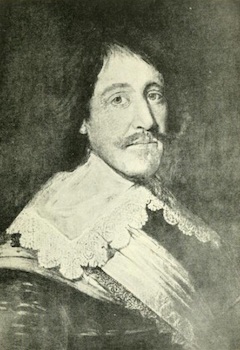
On this date in 1661, Presbyterian lord Archibald Campbell, the first Marquess of Argyll, lost his head at Edinburgh.
Once a privy councilor to King Charles I, “Red Argyll” had been in the 1640s a great champion of Scottish national liberty and a leader of the Presbyterians in the many-sided wars that tore apart the British Isles.
Scotland’s Presbyterians — who favored bottom-up church governance as opposed to the crown-controlled selection of bishops that’s known as episcopacy — made an initial alliance with English Parliamentarians to support one another in their mutual hostilities with King Charles I. And in Scotland’s civil war in the mid-1640s, Argyll’s Presbyterians defeated the Earl of Montrose‘s royalists.
But the failure of Oliver Cromwell‘s similarly victorious Parliament to deliver on its covenant fractured the Presbyterian party and drove Argyll to the political sideline.
Argyll’s own opposition to other Presbyterians’ attempted engagement with the imprisoned Charles I became untenable when, to the horror of his countrymen, Charles was beheaded by Parliament. As his entry in the Dictionary of National Biography notes, Charles’s execution “completely upset his calculations, which had all along been founded on a close union between the parliaments of Scotland and of England … the results of his safe and prudent policy were ruthlessly annihilated … [and] Argyll lost his presence of mind, and therefore his control of events in this stupendous conjuncture, and became as much a puppet in the hands of contending factions as was Charles II.” His growing ranks of foes derisively nicknamed him the “Glaed-Eyed Marquis”, attributing an obvious metaphorical import to his imperfect eyesight.
“Myself encountered so many difficulties that all remedies that were applied had the quite contrary operation,” he later wrote of those years when his influence waned. “[I was] a distracted man of a distracted subject in a distracted time wherein I lived.” It did not wane all at once: Argyll had the honor of crowning King Charles II at Scone on the first of January, 1651, and even tested the king with dynastic marriage inquiries for his daughter. (No dice.)
But as events ran away from him he fell into debt, disgrace, and irrelevancy.
When Charles II resumed the throne in 1660, Argyll presented himself at the court of his would-be father-in-law, and was surprised to find himself immediately thrown in the Tower. Like the Presbyterian cause itself, he was permanently and tragically alienated from both factions of the English Civil War: Cromwell always suspected Argyll a royalist for that whole crowning-the-king thing, and Charles always resented Argyll for his part in the destruction of his father.
The Glaed-Eyed Marquis found himself shipped off to Edinburgh to stand trial for treason. Although records of the trial are lost, it’s said that he was on the verge of total acquittal when Cromwell’s former commander in Scotland, George Monck, delivered a packet of incriminating letters. This story might be apocryphal but Argyll lost his head all the same, on Edinburgh’s distinctive Maiden.
Peruse here Argyll’s tart and downright comical last will and testament, satirizing many of the surviving figures of the day and bidding his heirs to lay his body “so shallow, that at the next trump of sedition, it may by the same raise-devil directory [i.e., Parliament] be conjured up again, and meet my exalted head, that bound-mark of Presbytery, its ne plus ultra, ‘Hitherto shall you go and no further.'”
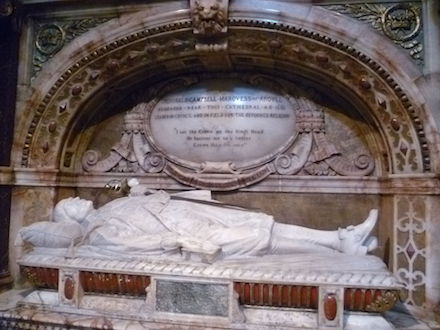
Memorial to Archibald Campbell in Edinburgh’s St Giles’ Cathedral with the epitaph “I set the Crown on the King’s Head. He hastens me to a better Crown than his own.” (cc) image from Kim Traynor.

 An exemplar of that rare type persuadable to follow his moral commitments all the way out of the safety of a status quo sinecure, Father Murphy initially eschewed the trend towards armed rebellion in 1798.
 Product of County Meath blood and


 Charming Royal Air Force serviceman


 Once a privy councilor to King Charles I,